
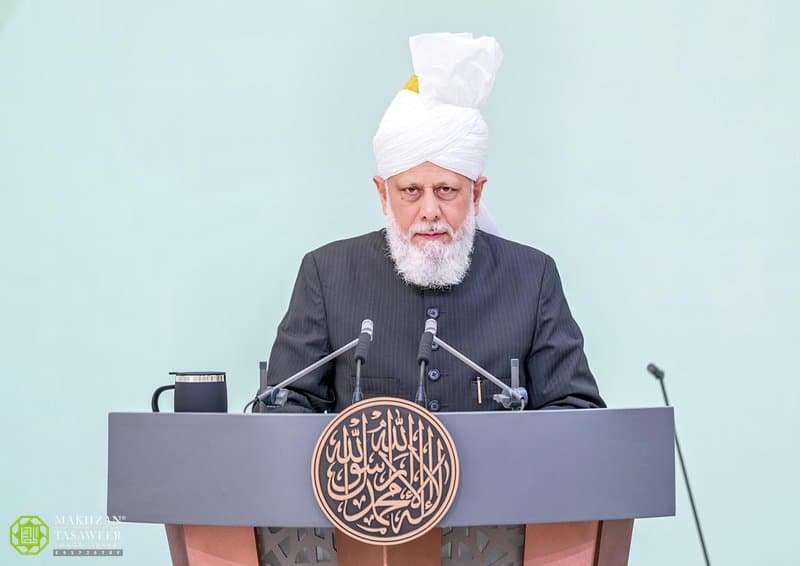
After reciting the tashahhud, ta‘awwuz and Surah al-Fatihah, Hazrat Khalifatul Masih V (aa) stated:
In the previous Friday sermon, the high standards of the truthfulness of the Holy Prophet (sa), his excellent model and his advice and guidance to the believers were mentioned. I will mention further details about these aspects today as well. In relation to the high standards of truthfulness to which the Holy Prophet (sa) wished to see us adopt, the following is recorded in a tradition: Hafs bin ‘Asim relates that the Holy Prophet (sa) said: “It is sufficient for a person to be considered a liar that he goes about repeating everything he hears to others.” (Sahih Muslim, Muqaddammah, Bab an-nahyi ‘ani al-hadithi bi kulli ma sami’a, Hadith 5)
We observe that this is a common habit found among people. Even within the Jamaat, this ill-habit is considerably prevalent in some individuals. Some people even write to me about others, saying that they have done this or that. However, when an investigation is conducted, the matter turns out to be false. And when the one who wrote is asked as to who told him, since the allegation is untrue, he simply replies that I only heard about it. And merely based on this hearsay, they cause a commotion everywhere. Such people ought to reflect that the Holy Prophet (sa) has deemed such individuals to be liars.
Then, in another tradition, it is recorded that Hazrat Aisha (ra) relates that the companions of the Holy Prophet (sa) were not averse to any trait more than falsehood. If a person were to tell a lie in the presence of the Holy Prophet (sa), that matter would remain in his heart. If he knew someone had lied, it would cause him immense pain, and he would keep it in his heart until he came to know that the person had repented, reformed himself and completely refrained from telling lies. (Musnad Ahmad bin Hanbal, Vol. 8, Hadith 25698, Maktab al-Kutub, p. 280)
In another tradition, it is recorded that Hazrat Asma relates that a woman came to the Holy Prophet (sa) and said that I have a co-wife (that is, my husband has another wife). Would I be guilty of sin if I gave the impression that I am completely satisfied with the provisions of my husband? In other words, if I show her that our husband gives me a lot; he gives me this and that. Whereas he has not actually given those things to me. I merely wish to provoke and tease her. The Holy Prophet (sa) replied: “The one who pretends to be satisfied with something that he has not been given is like one clothed in two garments of falsehood.” The reason for this is that she said those things to hurt her emotionally and to provoke her. Nevertheless, the Holy Prophet (sa) said that this is completely wrong. (Sahih Muslim, Kitab al-libas wa z-zinah, Bab an-nahyi ‘ani t-tazwir […], Hadith 3959, Vol. 11, Noor Foundation, p. 233)
In commentary on this, it is written that the word “garment” has been used here as a metaphor, and it means that the person is one who uses falsehood and deception. He has clothed himself in two garments of falsehood – one as an upper covering and the other as a lower garment. In other words, he is a liar through and through. (Umdah al-Qari, Vol. 20, pp. 289-290, Dar Al-Kotob Al-Ilmiyah, Beirut; Fath al-Bari, Vol. 9, pp. 228-229, dar al-Rayyan li at-Turath)
Thus, in a very subtle and profound manner, he instructed his followers to avoid falsehood. In one narration, it is reported from Hazrat Abdullah bin Amr (ra) that the Holy Prophet (sa) said:
“There are four traits – whoever possesses them is a complete hypocrite, and whoever has even one of these traits has within him a characteristic of hypocrisy until he abandons it:
“If something is entrusted to him, he betrays the trust; when he speaks, he tells a lie; when he makes a promise, he breaks it; and when he quarrels, he uses abusive language.” (Sahih al-Bukhari, Kitab al-iman, Bab ‘alamati l-munafiq, Vol. 1, Nizarat Ishaat, pp. 80-81)
All of these are such traits that, in one way or another, directly or indirectly lead to falsehood or are expressions of it.
Therefore, these moral weaknesses are signs of hypocrisy. Keeping this in mind, we should examine ourselves and reflect on the extent to which such weaknesses exist within us. These are traits that lead towards hypocrisy, and no person ever wishes to be counted among the hypocrites.
Then, regarding those who spread falsehoods, he gave a very stern warning. In one narration, Hazrat Samurah bin Jundub (ra) relates that the Holy Prophet (sa) would often ask his companions whether any of them had seen a dream. Hazrat Samurah (ra) further relates, “When he asked this, those whom Allah willed would relate them to him. (That is, those who saw dreams would relate them to him.)
“One morning, the Holy Prophet (sa) said that during the night, he (i.e., speaking about himself) had seen a vision. He said: ‘Two people came to me, woke me, and said, “Come along.” I went with them until we came to a man who was lying flat on his back. Another man was standing beside him, holding an iron hook (he was standing holding something like a large clamp or pliers). He would go to one side of the man’s mouth and tear it open all the way to the back of his head. (That is, he would tear open the entire side of his mouth from one side.) Then he would move to the other cheek (first he did the right side, then the left) and do exactly the same as he had done to the first side of the mouth. Before he could even finish, the first side (which he previously tore open) would return to its normal state, just as it had been before being torn. Then he would return to it and do the same again, tearing it open repeatedly in this manner.
“The Holy Prophet (sa) said: ‘I exclaimed, Holy is Allah! Who are these people?’ They replied, ‘Listen, we will tell you the reality. The person you came to whose mouth was torn to the back of his head, whose nostril and eye were ripped in that manner, is the one who leaves his home in the morning and fabricates a lie which then spreads far and wide.’” (Sahih al-Bukhari, Kitab al-Ta’bir, Bab Ta’bir al-Ru’ya Ba’d Salat al-Subh, Vol. 16, pp. 246-252, Hadith 7047, Nizarat Ishaat)
This refers to those who spread rumours and false statements about others. Some people speak merely for the sake of conversation or for amusement; at times, such statements are also intended to defame others in society. In any case, what they say causes harm.
Therefore, such people should always remember that this is something for which they will be held accountable. Allah the Almighty will take them to task and punish them. It is a matter of deep reflection, and one should seek forgiveness in abundance.
There is a narration from Abdullah bin Harith, who conveyed it from Hazrat Hakim bin Hizam (ra). He said that the Holy Prophet (sa) stated, “The seller and the buyer both have the option to cancel the transaction (that is, whatever deal has been made, they have the right to cancel it) until they separate from one another.” As long as they are still together, this option remains, but once they part from each other, then they cannot. He further said, “If both of them act truthfully and speak honestly, then blessings will be placed in both of their transactions. But if they conceal something and speak falsely, then the blessing in their transaction will be erased.” (Sahih al-Bukhari, Kitab al-buyu’, Bab idha bayyana l-bayyi’an wa lum yaktuma wa nasaha, Hadith 2079, Vol. 4, Nizarat Ishaat, pp. 38-39)
Many business disputes arise because of false actions and statements, and Allah Almighty does not place blessings in the dealings or affairs of such people. In this world, they suffer the losses they must bear, and with Allah Almighty, they are also considered sinful and earn punishment.
Hazrat Ibn Umar (ra) narrates that the Holy Prophet (sa) said: “When a person tells a lie, an angel moves a mile away from him because of the foul smell of what he has intentionally committed.” (Jami’ at-Tirmidhi, Kitab al-birri wa s-silah, Bab ma ja’a fi s-sidqi wa l-kidhb, Hadith 1972)
In a narration, it is reported from Hazrat Abu Hurairah (ra) that the Holy Prophet (sa) once passed by a heap of grain. He placed his hand into it, and his fingers felt moisture (he sensed that there was moisture inside), so he said, “O seller of grain, this grain you are selling (whether it is wheat, corn, or something else) – what is the matter, is it wet inside?” The man replied, “O Messenger (sa) of Allah, rain had fallen on it.” The Holy Prophet (sa) said, “Then why did you not place the wet grain on top?” Instead of hiding it underneath, if rain had fallen on it, you should have put it on top so that people could see it. He then said, “Whoever deceives is not from me.” (Sahih Muslim, Kitab al-iman, Bab qawli n-nabiyy [sa]: ‘mun ghashsha fa laysa minna’, Hadith 139, Noor Foundation, Vol. 1, p. 93)
Thus, those in business should examine themselves over such minute details and criticism. This is the standard that he wished to establish for Muslims, but unfortunately, today it is the Muslims themselves who are defamed in the world due to deceitful business practices and calumny.
Therefore, today, we who claim to believe in the Promised Messiah (as) and to have true faith in the Holy Prophet (sa) must uphold the highest standard of truthfulness in every word and action. Otherwise, the Holy Prophet (sa) has said that if this is not the case, then you are not from me, and I have no connection with you. He gave countless lessons and guidance, urging people to adopt truthfulness with great precision, and no person can be a true Muslim unless they fully abide by truth.
With regard to his character, I now present some aspects. The Holy Prophet (sa) was always known among people as the most truthful and trustworthy because of his constant truthfulness and his excellence in honesty and integrity. Thus, one author has written, “Muhammad (sa) was sent in an age of ignorance, when no warner had come to his people, prior to him. (No prophet had come to their nation.) The people worshipped idols, false deities and shrines. Even among them, the Holy Prophet (sa) was granted understanding and wisdom from his childhood; despite being surrounded by the followers of Satan and idolaters, the Holy Prophet (sa) never inclined toward any idol, nor did he ever participate in any festival with them. No lie was ever heard from him. People regarded him as ‘Sudooq’, meaning extremely truthful, and ‘Amin’, i.e., forbearing and extremely gracious.” (Imta’ al-Asma’, Vol. 4, Dar Al-Kotob Al-Ilmiyah, Beirut, p. 212)
It is even narrated that before the advent of his prophethood, during the age of ignorance, people would seek out judgment from the Holy Prophet (sa). (Subul al-Huda wa al-Rashad, Vol. 2, Dar Al-Kotob Al-Ilmiyah, Beirut, p. 147)
While describing his excellent example, Hazrat Musleh-e-Maud (ra) has stated in one place:
“The collective testimony regarding the noble moral character of the Holy Prophet (sa) is that which was accepted by his own people – that even before his claim to prophethood, his nation had conferred upon him the titles of Amin [the Trustworthy] and Sadiq [the Truthful]. There are many in the world against whom there is no proof of dishonesty. Likewise, there are many who are never subjected to trials; rather, they pass through only ordinary tests, and their integrity remains intact. Yet despite this, their people do not assign them any special title. This is because distinctive titles are only bestowed when a person surpasses all others in a particular quality.
“Every soldier who participates in battle places his life in danger; yet the British do not award every soldier the Victoria Cross, nor does Germany confer upon every soldier the Iron Cross. In France, there are millions engaged in intellectual pursuits, yet not every individual is awarded the Legion of Honour. Thus, the mere fact that a person is honest and truthful does not, in itself, cast any special light upon his greatness. However, for an entire nation to confer upon someone the titles of Amin and Sadiq is indeed extraordinary. Even if the people of Mecca had been accustomed to granting such titles to individuals across different generations, the one who received these titles would still be considered a great person. But Arabian history shows that the Arabs did not bestow such titles upon individuals in every generation. Rather, in the span of hundreds of years of Arab history, only one example is found – Muhammad, the Messenger (sa) of Allah – upon whom the people of Arabia conferred the titles of Amin and Sadiq.” (Dibacha Tafsir-ul-Quran, Anwar-ul-Ulum, Vol. 20, pp. 374-375)
Thus, the fact that throughout centuries of Arab history, the entire nation granted these titles to only one individual demonstrates that his trustworthiness and truthfulness were of the highest order, such that no other example comparable to him was known among them. The Arabs were distinguished in the world for their perceptiveness. Therefore, whatever they declared to be rare is indeed worthy of being regarded as rare in the world.
The Promised Messiah (as) states:
“The state of the world today has become rather precarious. From whichever way one looks at things, false testimony is fabricated. Filing a false case is a trivial matter. Fraudulent documents are manufactured. If they state something, they will do so while evading the truth. Now, someone should ask those who do not understand the need for this [Ahmadiyya] Movement whether this was the religion that the Holy Prophet, may peace and blessings of Allah be upon him, had brought. Allah the Exalted had said that lying is an abomination, so avoid it:
اجۡتَنِبُوا الرِّجۡسَ مِنَ الۡاَوۡثَانِ وَاجۡتَنِبُوۡا قَوۡلَ الزُّوۡرِ
“[Shun therefore the abomination of idols, and shun all words of untruth.] (The Holy Quran, 22:31)
“God had equated lying with idol worship; just as a foolish man abandons Allah the Exalted in order to bow his head before an idol […].” Allah says to avoid impurity, as it is a grave sin, because falsehood is like falling into impurity and evil deeds. Idol worship, too, is wrong and a very impure act. The Promised Messiah (as) states:
“God had equated lying with idol worship; just as a foolish man abandons Allah the Exalted in order to bow his head before an idol, in the same way, abandoning truth and honesty, a person makes an idol out of falsehood to achieve his purpose. This is why Allah the Exalted joined lying with idolatry.” Abstain from idolatry, for it is a grave sin, and falsehood is of the same nature.
The Promised Messiah (as) states, “An idolater seeking salvation from an idol. A liar also carves out an idol for himself and imagines that he will attain salvation through this idol […]. What could be a greater misfortune than believing that one’s life depends on falsehood?
“When they are asked why they do not abandon falsehood, they say they must resort to falsehood in order to attain their own benefit.” The Promised Messiah (as) said, “What could be a greater misfortune than believing that their life depends on falsehood? Nevertheless, I assure you that truth alone triumphs in the end. Virtue and victory belong to it.” (Malfuzat, Vol. 8, pp. 270-271)
While describing the life of the Holy Prophet (sa), Hazrat Musleh-e-Maud (ra) writes at one instance:
“When the Holy Prophet (sa) informed his wife about the revelation he had received, she did not say, ‘What stories have you begun fabricating?’ Rather, she said, ‘Do not be anxious. What you have seen is true. Allah will never forsake you, for you uphold ties of kinship, you bear the burdens of the needy, you restore lost virtues, you show hospitality to guests, and you support the truth.’
“Then she took him to her cousin Waraqah bin Naufal, who was a scholar of the Israelite scriptures. Upon hearing the account, he immediately said that this was the same kind of revelation that had descended upon Moses (as), and that the commandments contained within it were similar to those received by Moses (as). (Hazrat Musleh-e-Maud [ra] continues narrating testimonies. I have briefly mentioned this in a previous sermon. After presenting the testimony of Waraqah bin Naufal, Hazrat Musleh-e-Maud [ra] presents another testimony:)
“Then there was a young relative in the household, approaching maturity; someone who could become an effective means of propagation among the youth. When he heard his brother and sister-in-law – that is, the Holy Prophet (sa) and Khadija (ra) – speaking with great seriousness about this profound change, he stepped forward with composure and said, ‘I too believe that you are truthful, and that Allah has indeed spoken to you and appointed you for the reformation of the world.’
“Then there is the testimony of a freed slave, who, captivated by the noble character of the Holy Prophet (sa), had forsaken his parents and remained at his doorstep. When he heard these unfolding events and observed the signs of concern upon his master’s face, he stepped forward, held on to his master’s mantle, and said, ‘O my master, what you have seen is true; what you have said is true. Divine power cannot deceive a person like you. You are the embodiment of truthfulness. How could Divine power ever deceive you? The time has now come for the reformation of the world through your hands. Grant me the permission to remain with you and to serve you.’”
There is another testimony of his, one close and intimate friend, as though a second pearl nurtured within the same shell. When he hears that his companion has begun to speak in an unfamiliar manner and that people are saying perhaps his mind has been affected, he hastens to him, opens the door and asks: “Is what I hear true?”
When the Holy Prophet (sa) begins to explain the matter to him, he says: “By God, do not present arguments. Just tell me whether these things are true.” And when he affirms it, he replies: “My truthful friend, I believe in your prophethood. You were about to do me a disservice by offering proofs and thereby casting doubt upon my faith. I have witnessed so much of your truthfulness that I have no need of arguments.” Then, Hazrat Abu Bakr said: “My friend, how can one who has seen your face ever doubt your word?”
There is no doubt that opposition was bound to arise, for, as Waraqah bin Naufal said:
لَمْ یَاْتِ رَجُلٌ قَطُّ بِمِثْلِ مَا جِئْتَ بِہِ اِلَّا عُوْدِیَ
“No man has ever brought a message similar to yours without being persecuted.” But observe the design of God: before the storm of opposition could break, how He raised up Companions for him. Among the people of Mecca, that one learned man of the scriptures, Waraqah, bowed before him at the very first encounter. His life companion, Khadija, upon hearing the revelation, was overcome with love and support for him. The young kinsman Ali, who constantly observed his domestic character, offered his services. The freed servant Zaid, who had closely and deeply studied his dealings and his treatment of the poor, swore by his truthfulness. The childhood friend, the benefactor of Mecca, the embodiment of nobility, Abu Bakr, merely upon hearing that he had claimed to receive revelation, placed himself in complete devotion at his doorstep.
“How immense must have been the joy these unparalleled manifestations of love and sincerity produced in the Holy Prophet’s (sa) heart. When he heard the uproar of Mecca and their taunts, how he must have smiled and said: ‘This is the verdict of those who do not know me, who call me a sorcerer and by other names. Now listen also to the verdict of those who know me, how they stand by my side, even ready to give their lives for me.’
“Moses prayed for a helper to share his burden. Here, in interpreting the verse, a comparison is drawn between the companions of Prophet Moses (as) and those of the Holy Prophet Muhammad (sa). For this reason, the example of Moses was stated. Moses asked for one helper to assist him, but Muhammad, the Messenger (sa) of Allah, was granted five helpers without him asking, and such helpers who excelled in sharing his burden. Waraqah, though he soon passed away, left behind an indelible testimony to his truthfulness. For 12 subsequent years, what Khadija demonstrated with her devotion would humble even the bravest of men. Zaid, for twenty years, displayed unparalleled sacrifice and ultimately proved it by shedding his blood before drawn swords, thereby establishing the true standard of the helpers of the Holy Prophet Muhammad (sa). Abu Bakr and Ali remained even after his passing, and as caliphs they demonstrated their service in a new and profound manner.” (Tafsir-e-Kabir, 2023, Vol. 13, pp. 201-202)
Then, describing the example of the Holy Prophet (sa), Hazrat Musleh-e-Maud (ra) states:
“One of the most powerful proofs of the truthful and upright person is his own self, which proclaims aloud, addressing both opponents and supporters, the unacquainted and the familiar, strangers and confidants alike: ‘Look at me, and before you call me a liar, reflect on whether you truly can. If you declare me false, will you not deprive yourselves of all the means by which you discern truth? And by branding me an impostor, will you not close upon yourselves every door through which you might attain your objective?’
“Everything in the world proceeds in continuity and passes through stages. Neither can virtue reach its perfection without passing through intermediate stages, nor can evil reach its extreme without traversing its own degrees. How then is it possible that one running towards the west should suddenly find himself at the farthest edge of the east? (It cannot be that one travels in one direction yet arrives in another), or that one heading south should find himself standing on the northern horizon.
“The Holy Prophet (sa) said: ‘I have spent my entire life among you. I was a child and grew up in your midst. I was a youth and became middle-aged among you. My private and public affairs are all known to you. Nothing of my actions has been hidden from you, nor any word concealed. Is there anyone among you who can say that I have ever spoken a lie?’ This declaration was made by the Holy Prophet. ‘Is there anyone who can say that I have ever lied, or committed injustice, or deceived, or defrauded, or usurped anyone’s right, or sought personal greatness, or attempted to seize authority? In every field you have tested me, and in every condition you have examined me, yet you have always found my steps upon the path of moderation, always free from every blemish, until both friend and foe alike bestowed upon me the titles of the Trustworthy and the Truthful.’
“What, then, has happened that until yesterday evening I was known among you as trustworthy, truthful, upright – far removed from falsehood, devoted to truth, indeed one upon whom truth itself took pride – and in every matter you placed your trust in me and accepted every word I uttered; yet today, within the span of a single day, such a transformation has occurred that I have become the worst of the worst and the most impure of men? Is it merely because of one claim – that though I had never ascribed lies to men before, but now I have begun to forge lies against Allah?
“Is there any example in the law of nature of such an abrupt and radical change? If it were a matter of a day or two, you might say it was an affectation. If it were a matter of a year or two, you might claim that I had adopted such a course to deceive you. But I have spent my entire life among you. You witnessed my childhood; you observed my youth; and the period of advancing age, when old age begins to set in, has also passed before your very eyes. How could such sustained pretence and fabrication be possible?
“In childhood, when one is scarcely aware even of one’s own good or harm, how could I have contrived such deception? In youth – often called the age of passion – how could I have concealed my true state through deception? Reflect, then: when did this deception occur, and who perpetrated it?
“If, upon reflection, you find my life to be free from blemish and to be completely selfless – indeed, if you behold it as the embodiment of virtue and the very image of truth – then do not, while looking at the sun, proclaim that it is night. The day has fully dawned; do not declare it to be darkness. My condition is such that my words are as manifest as the light of day. Do not complain of darkness when light is present.
“Do you require any proof beyond my own self? My very being is the greatest proof. Is there any need for further evidence after considering my past conduct? My entire past lies before you, yet you still demand a sign. My own self bears witness for me, and my life stands as testimony on my behalf.
“If each one of you were to look within himself, his heart and mind would testify that truth is firmly established in me, and that I stand upon truth; that righteousness takes pride in me, and I take pride in righteousness. Such a one is not in need of any external proofs to establish his truthfulness. His example is like that of the rising sun – it is itself the proof of its existence.
“It was this very compelling evidence that entered the heart of Hazrat Abu Bakr (ra) and it is this powerful proof that will continue to take root in the hearts of all lovers of truth.
“When the Holy Prophet (sa) made his claim, Hazrat Abu Bakr (ra) was at the house of a friend. There, a freed bondwoman informed him that the wife of his friend was saying that her husband had become a Prophet like the Prophet Moses (as) whom they spoke of. At once, he rose and went to the house of the Holy Prophet (sa) and asked: ‘Have you indeed declared that you are the Messenger (sa) of Allah?’ The Holy Prophet (sa) replied, ‘Yes, I am the Messenger (sa) of Allah.’ Upon hearing this, Hazrat Abu Bakr (ra) immediately accepted his claim.
“Thus, the Holy Prophet (sa) would later say regarding his faith: ‘I invited people to Islam, and in every case there appeared some hesitation, reflection, or doubt; but when the message of Islam was presented to Abu Bakr, he showed not the slightest hesitation – rather, he accepted it at once.’
“What was it that compelled Hazrat Abu Bakr (ra) to believe without witnessing any outward sign? It was the very being of the Holy Prophet (sa) which was brimming with honesty and truthfulness and his very being itself bore witness to his truth.’
“Similarly, as I have already mentioned, Hazrat Khadija (ra), Hazrat Ali (ra) and Hazrat Zaid bin Harithah (ra) all testified to his truth, having witnessed his truthfulness.
“In short, the first inner proof of a Prophet’s truthfulness is his own self, which bears witness to his truth. Such testimony is so overwhelming that, in its presence, there remains no need for any other miracle or sign.” (Da’wat-ul-Amir, Anwar-ul-Ulum, Vol. 7, pp. 425-428)
The Promised Messiah (as) states:
“The Word of God states that the righteous are those who walk with humility and modesty and do not speak arrogantly. They speak as though they were a lowly person addressing their senior. In any case, we should act in a manner that brings about our prosperity. None can claim a monopoly over Allah Almighty, for He desires righteousness alone. One who adopts righteousness shall attain a lofty status. The Holy Prophet, peace and blessings of Allah be upon him, or Abraham, on whom be peace, did not receive honour by any inheritance. Although we believe that Abdullah, the revered father of the Holy Prophet, peace and blessings of Allah be upon him, was not an idolater, (people often as this question, this is the answer, that the Holy Prophet’s respected father was not an idolater), but it was not on this account that the Prophet of Islam was conferred his prophethood. Prophethood was endowed to him by divine grace due to the virtues present in his nature. This is what drew in God’s grace. It was sincerity and righteousness which led Abraham, on whom be peace, the Father of the Prophets, to sacrifice his son without hesitation. Even he himself was cast into a fire. Just reflect upon the sincerity and devotion of our Chief and Master, Muhammad, the Messenger of Allah, peace and blessings of Allah be upon him. The Holy Prophet (sa) stood firm against all forms of evil. He bore diverse trials and tribulations, but did not care in the least. It was this sincerity and devotion which moved Allah the Exalted to shower His grace. It is for this reason that He states:
اِنَّ اللّٰہَ وَمَلٰٓئِکَتَہٗ یُصَلُّوۡنَ عَلَی النَّبِیِّ ؕ یٰۤاَیُّہَا الَّذِیۡنَ اٰمَنُوۡا صَلُّوۡا عَلَیۡہِ وَسَلِّمُوۡا تَسۡلِیۡمًا
“Allah Almighty and all His angels send blessings upon the Messenger. O ye who believe! You also should invoke blessings and peace upon the Prophet (sa). [The Holy Quran, 33:57] This verse establishes that the deeds of the Noble Messenger (sa) were such that Allah Almighty did not use any specific word to praise them or outline his attributes. Although words could be found, God Himself chose not to use any in particular. For the pious deeds of the Holy Prophet (sa) were beyond the confines of praise. A verse of this nature does not exist in praise of any other Prophet. The soul of the Holy Prophet (sa) was imbued with such sincerity and purity, and his deeds were so praiseworthy in the sight of God that Allah the Almighty decreed for all times to come that all future generations would send blessings upon the Holy Prophet as an expression of gratitude. The resolve and devotion of the Holy Prophet (sa) is such that we would find no equal, either before him or after him, who could match him. One may reflect upon the time of the Messiah (as) to see the extent to which his resolve, or spiritual sincerity and devotion, impressed an effect upon his disciples. Anyone can appreciate how difficult it is to put right an ill habit. It is truly challenging to relinquish firmly rooted habits. However, our Holy Prophet, peace and blessings of Allah be upon him, reformed thousands of people who were worse than animals. There were some who, like animals, thought nothing of having relations with their mothers and sisters; they would devour the wealth of orphans and usurp the inheritance of those who were no more. Some worshipped the stars, while others were atheists, and others still worshipped the elements. What was the Arab Peninsula? It was home to diverse religious thought.
“One benefit of this is that the Holy Quran possesses within itself every necessary teaching. Its tenets are more than sufficient to uproot every false doctrine or ill teaching that could possibly exist in the world. This is the deep wisdom and power of Allah the Exalted.” (Malfuzat, Vol. 1, pp. 36-37)
In that, he sent the Holy Prophet (sa) and sent him at a time when ignorance was at its peak. And then he transformed those animals into men.
اللّٰھم صل علٰی محمد وعلٰی اٰل محمد وبارک وسلم انک حمید مجید۔
[O Allah, exalt Muhammad and His family, and bestow blessings and peace on him. Surely, You are the Praiseworthy, Exalted].
May Allah the Almighty enable us to follow the example of the Holy Prophet (sa) as well as the commandments mentioned in the Holy Quran and elevate the standards of truthfulness to ever new heights.
(Official Urdu transcript published in the Daily Al Fazl International, 15 May 2026, pp. 2-8. Translated by The Review of Religions.)