
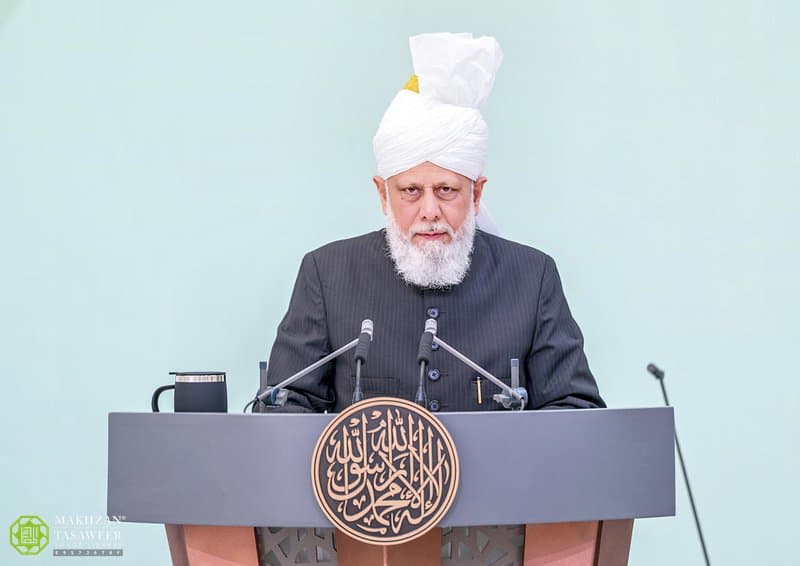
After reciting the tashahhud, ta‘awwuz and Surah al-Fatihah, Hazrat Khalifatul Masih V (aa) said:
In the past few sermons, I have been speaking about the highest level of trust [i.e., tawakkul] in Allah, as demonstrated in the life of the Holy Prophet (sa). Today, I will speak about how the Promised Messiah (as), the true servant of the Holy Prophet (sa) in this age, explained this example for us, what teachings he gave regarding it and how he himself acted upon them.
The Promised Messiah (as) states:
“True trust in Allah is to gather, to the best of one’s ability, the means that Allah the Almighty has appointed for attaining a certain objective, and then devote oneself to prayer, beseeching God: ‘O God, You alone bring about a favourable outcome for this.’ There are hundreds of calamities and thousands of difficulties which can destroy and overturn these means. Protect us from their effects and enable us to attain true success and reach our ultimate objective.” (Malfuzat, 2022, Vol. 4, p. 288)
A person makes use of the available means, but there are many difficulties and circumstances in which the means upon which one relies may be destroyed. Therefore, one should seek Allah’s help, praying that Allah the Almighty protect us from their harmful effects. This is the state through which a believer can attain the blessings of Allah the Almighty.
The Promised Messiah (as) states:
“To become pleased with Allah the Exalted, cannot be attained by everyone; it is, in fact, the highest level of trust in Allah, cutting oneself off from the world – contentment and resignation to the will of God, where a person no longer has any misgivings and complaints about his Supreme Lord. And Allah the Exalted being pleased with His servant depends on the perfect sincerity and loyalty of the servant and the highest degree of his purity and piety and perfect obedience. From this, one learns that the Companions (ra) had completed all the stages of ma‘arifat [divine cognisance] and suluk [journey to God].”
The Companions (ra) attained such a rank in having a connection with Allah and placing their trust in Him that it has been made an example for us. The followers of Jesus (as) say that he used to cure the sick. However, the Promised Messiah (as) says that did this increase his disciples in their trust in God? One’s standard of trust in God can only increase by His grace and if one focuses their entire attention towards Him. The Promised Messiah (as) states:
“If you search for an example of this (trusting God) among the disciples [of Jesus Christ], you will never find it. Therefore, it is not prudent to be pleased merely with the healing of the sick. (This in itself does not accomplish anything. It is recorded even regarding saints that they are able to exhibit miracles. The Promised Messiah [as] says that it is not prudent or wise to be pleased merely with this.) One who craves spiritual excellence cannot be happy with these things. That is why I desire that you purify your heart and develop such a relationship with God Almighty that that Beneficent Supreme Lord becomes pleased with you, and you become pleased with Him. Then He will endow your body and your words with such blessings that even those who cure ailments will be astounded and humbled upon witnessing them.” (Malfuzat [English], Vol. 7, p. 516)
In other words, if one develops such a connection with Allah the Almighty, then those who heal the sick would be humbled. Thus, if a believer places his trust in Allah the Almighty and develops a relationship with Him, he can himself become capable of manifesting miracles.
On another occasion, drawing attention to trust in God and complete devotion to Him, the Promised Messiah (as) said:
“Also remember that there is no ointment for the wound of affliction as soothing and comforting as trust in Allah Almighty. The person who puts his trust in Allah Almighty finds solace and satisfaction within himself even in the severest of difficulties and adversities. He does not feel bitterness and torment in his heart. At the very most, the final result of this trouble may be death if that is the immutable decree (the decree that cannot be changed).”
Difficulties also befall a believer, but if his faith in Allah is firm, he does not allow them to overwhelm him.
He states, “Nonetheless, what would happen from this? The world is not a place where one can live forever anyway. Ultimately, a day and time comes upon everyone when this world must be abandoned. Then, if death is the consequence of it, what harm would it cause? For the believer, this death is even more comforting, becoming the means to unite with the Beloved. (If a person is a true Muslim, with true conviction in Allah Almighty, he is fine with this, understanding that he will meet Allah the Almighty.) This is so because he has complete faith in Allah Almighty and trusts in His omnipotence and knows that the next world for him is that of eternal comfort.
“Therefore, a simple calamity, whether it is an illness or any other type of calamity, cannot be the cause of suffering or torment. Rather, that calamity is adjudged a painful chastisement in which there is no faith and trust in Allah Almighty.”
If difficulties befall a believer, they are not a punishment for him. Punishment occurs when he has no faith in Allah and does not place his trust in Him.
“Such a person does suffer severe torment (who has no faith). If someone fancies that he would not face death, then this notion is false because Allah Almighty has declared this world to be impermanent. For such a person, there will be a very painful hell in the next world for which he should be prepared.” (Malfuzat [English], Vol. 7, pp. 384-385)
Thus, this also provides a general answer to those who ask how we can know whether a difficulty or hardship is a punishment or a trial from Allah.
The Promised Messiah (as) would advise his followers, according to the circumstances, to place their trust in Allah. It is narrated that Hazrat Master Nazir Husain Sahib relates that the Promised Messiah (as) said:
“Think not that Allah Almighty is weak. Indeed, He is the possessor of immense power. When you put your trust in Him for support in any matter, He shall come to your aid, just as He Himself states:
وَمَنْ یَّتَوَکَّلْ عَلَی اللّٰہِ فَھُوَ حَسْبُہٗ
“(The Holy Quran, 65:4)
“‘And he who puts his trust in Allah – He is sufficient for him.’” (Rawayat Ashab-e-Ahmad, Vol. 3, p. 184)
Describing the qualities of the fortunate, the Promised Messiah (as) states:
“Another [great bounty] is the station of tawakkul [trust in God] upon which they are established with utmost firmness. That pure spring can never be attained by anyone besides them, rather, it is made pleasant and agreeable solely for them. The light of cognition lends them such support that very often without there being any resources and finding themselves far away from normal means, they lead such jovial and cheerful lives and pass their days in such prosperity as if they possessed thousands of treasures.”
Even when the conveniences to which they have become accustomed are unavailable, those who place their trust in Allah live with great happiness, as though they possessed thousands of treasures.
“Their countenances display the freshness of wealth and the steadfastness of the rich. They have perfect trust in their Benevolent God in times of hardship, with a cheerful heart and complete certainty.” (Barahin-e-Ahmadiyya – Part IV [English], p. 340)
They have a relationship with Allah the Almighty, and therefore even amid hardship and difficulty they continue to place their trust in Allah and do not turn away from Him. They do not become consumed by thoughts such as, “Who knows what is happening? Is this a trial, an examination or a punishment?” If their trust in Allah is complete and they are fulfilling the rights owed to Allah, then Allah surely bestows His grace upon them.
The Promised Messiah (as) states:
“Those who are reliant upon God and incline towards Him never perish. What can a person who is constantly preoccupied with his personal efforts attain except for humiliation? Since the world has been created, this has been the practice of Allah that the people who abandon the world, attain it, and those who run after it, are deprived of it. Even if the people who do not enjoy a bond with God Almighty, attain something for a few days through their machinations and deceit, it is useless (people typically resort to deceit and falsehood to attain the word), for in the end, they are forced to see utter failure. The best people in Islam were always those who did not care about the world in comparison to religion.”
He states:
“The Saints Qutb-ud-Din (rh) and Mu‘in-ud-Din (rh) lived in India. These people worshipped God in secret, but God brought their high rank out into the open.”
Then the Promised Messiah (as) relates an incident:
“I saw the son of a pir in Batala completely covered in dust who was chasing after some deputy [commissioner] in relation to the cases of his land.” The officer was a government official, and this man would go after him regarding his cases or in order to acquire property.
The Promised Messiah (sa) says, “I wondered that if he had possessed true virtue (he called himself a Pirzada, claiming to be the progeny of saints), and was one who trusted in God, then why would he have to bear such distressful events?” (Malfuzat [English], Vol. 9, p. 326)
The Promised Messiah (as) says:
“The reason why so many sins have arisen in the world is that the degree of certainty a person has in the pleasures of this world, worldly honour, and worldly wealth and possessions is not found in his belief in the hereafter. (This is why a person commits sins.) Just as a person can place his trust in a chest filled with precious jewels and pure gold which is in his possession, he cannot place the same trust in God.
“And just as people fear worldly governments and worldly authorities, and resort to flattery (or sycophancy) towards them in order to make their living, they do not fear Allah the Almighty in the same manner. What is the reason for this? The reason is that the apparent means and worldly resources (the material means that are visible before a person) appear so certain to him that religious beliefs seem insignificant in comparison.” (Nuzul-ul-Masih, Ruhani Khazain, Vol. 18, p. 468)
Worldly means are visible before him, while faith in God and religious beliefs are given no importance. Thus, when there is no reliance upon Allah the Almighty, and there is no concept of giving precedence to faith over worldly matters – something that we repeat in every pledge we make, and which we will also repeat at the Khuddam-ul-Ahmadiyya Ijtema – then this weakness of belief and faith will deprive such a person of the blessings of the hereafter as well.
They have considered this world to be everything and continued striving to attain it. Some attained it, while others passed away in their efforts to attain it, unsuccessful. Or they attained it, only for it to subsequently be lost, after which they spent their lives undergoing great worldly suffering. They belonged neither to faith nor to the world.
In this regard, a poet has said:
“Neither did they attain God, nor the union with the beloved.”
Explaining deeply concerned he was with bringing people towards Allah the Almighty and making them mindful of the hereafter, and how much pain he felt for this, and how he would pray for this the Promised Messiah (as) said, addressing Allah the Almighty:
“Behold, my soul flies towards You with complete trust, just as a bird returns to its nest. Thus, I desire a sign of Your power, but not for myself and not for my honour. Rather, I desire it so that people may recognise Thee, so that people may recognise You and adopt Your pure ways, and so that they may not turn away from guidance by rejecting the one whom You have sent. I bear witness that You have sent me and that Thou hast manifested great signs in my support.” (Tiryaq-ul-Qulub, Ruhani Khazain, Vol. 15, p. 511)
Allah the Almighty Himself gave the Promised Messiah (as) the name Mutawakkil [one who places his complete trust in God]. Thus, he says:
“A sign of the descent of the Messiah is recorded as being that he will have placed his hands upon the wings of two angels. This points to the fact that his right and left hands – which are the means of acquiring intellectual knowledge and inner illumination – will rely upon heavenly agents entrusted with various tasks (meaning those who have been entrusted with this task, as in angels).”
In other words, the knowledge of reason, the inner spiritual lights, and matters of spiritual insight and religious understanding will come through this means – with the help of angels. This is the meaning of placing his hands upon the two angels: he will rely upon their support.
“He will not acquire this knowledge through schools, books or spiritual mentors, but from God Almighty Himself. He will be granted ‘ilm ladunni (that is, he will receive knowledge that is taught by none other than God), and God Himself will also take responsibility for and provide for his necessities of life.
“For the past ten years, this revelation had already been published in Barahin-e-Ahmadiyya (the Promised Messiah [as] gives the example of Barahin-e-Ahmadiyya) concerning this humble servant:
اِنَّکَ بِاَعْیُنِنَا سَمَّیْتُکَ الْمُتَوَکِّلَ وَعَلَّمْنٰہُ مِنْ لَّدُنَّا عِلْمًا
“That is: ‘You are before Our eyes. We have named you Mutawakkil, and We have taught you knowledge from Ourselves.’
“[…] It is established from numerous ahadith and from the Holy Quran that when a person develops complete detachment from all else and places complete trust in God, the angels are appointed to serve him, and each angel serves him according to the responsibility entrusted to him.” (Izala-e-Auham, Ruhani Khazain, Vol. 3, p. 476)
One day in a gathering of the Promised Messiah (as), the discussion turned to trust in God. The Promised Messiah (as) said: “I find that the state of my heart is a strange one. When it is extremely humid, and the heat becomes immensely intense, people begin to hope with a sense of certainty that rain will soon follow. Similarly, when I find my casket to be empty (in other words, when he had no money), I feel a firm sense of certainty in the grace of God that now it will be replenished, and this is exactly what happens.”
Then, the Promised Messiah (as) swore by God Almighty and said: “When my pouch (or his pocket or bag) is empty, the sort of joy and pleasure that I experience in trusting God Almighty at such a time is beyond my ability to explain. (The Promised Messiah [as] said that when he had nothing, his trust in God would only increase.) My state at such a time is extremely comforting and satisfying, in comparison to when my pouch (or his pocket) is full.” (Malfuzat [English], Vol. 2, p. 43)
Commenting on these words of the Promised Messiah (as), Hazrat Mirza Bashir Ahmad Sahib (ra) writes:
“The money pouch of the saintly people generally remains empty; (that is, those whose life is devoted to God do not accumulate wealth. Their treasures are generally empty, and their pockets remain devoid of worldly riches, as they distribute whatever they possess among others.) But observe the remarkable degree of the Promised Messiah’s (as) trust in Allah. It was like the confidence of an astute farmer who, on the basis of repeated experience with a particular well, is certain that when its present supply of water begins to run low, its underground springs will open of their own accord and the well will once again become filled with water. (At times, after a well has been dug, its water is drawn out repeatedly until it becomes dry; yet, gradually, water begins to accumulate in it once again.)
“In the same manner, the heart of the Promised Messiah (as) was imbued with the firm conviction that, as soon as my pocket becomes empty, the unseen Hand of Heaven will once again fill it, and there will be no hindrance in the work that God has entrusted to me.
“This is that very station of divine succour concerning which Allah Almighty announced to the Promised Messiah (as) at the very outset:
اَلَیْسَ اللّٰہُ بِکَافٍ عَبْدَہٗ
“‘Is Allah not sufficient for His servant?’
“The truth is that, from the very beginning to the end, this divine revelation remained over the Promised Messiah (as) like a cloud of mercy.” (Sirat-e-Tayyibah, p. 146)
An incident relating to trust in Allah is found in the life of the Promised Messiah (as). In connection with the delay in the publication of Barahin-e-Ahmadiyya, the Promised Messiah (as) wrote a letter to Haji Muhammad Wali Sahib, a distinguished official of the State of Kapurthala. He wrote:
“The previous letter of yours was filled with such fervour and bitterness. (He wrote a letter following the delay in publication of Barahin-e-Ahmadiyya, as he had donated some money towards its publication. When he did not receive it, he wrote a letter. And so, with reference to this letter of his, the Promised Messiah [as] wrote:) Your previous letter was filled with such fervour and bitterness and contained such harsh and unpleasant expressions, that it was immediately apparent that your ill opinion had reached an extreme level of foulness.”
He had written the letter in considerable anger, and from his letter it was evident that his anger had reached an intense level. The Promised Messiah (as) therefore remarked that, had there been no commercial relationship concerning the purchase and sale of the book, he could never have imagined that such words would have proceeded from his pen. Since he had given money, he could not tolerate its delay and therefore expressed such words.
He further stated:
“It is therefore evident that such an unfortunate attachment [to worldly wealth] has disturbed the temperament of a person of such standing. It remains to be seen to what extent this inner agitation and distress may ultimately lead. As for this humble one, the whole of this undertaking rests upon no one’s support or reliance except that of the Divine and Glorified Being.”
In other words, this work is being carried out with reliance upon Allah Almighty, and, God willing, it shall be completed. However, certain obstacles arise along the way. I have neither the power nor the authority to remove them by my own strength. Thus, he should not display such impatience.
The Promised Messiah (as) further wrote:
“In view of this, it would perhaps be advisable to cancel the transaction and return the amount that was sent. (If he thinks that the Promised Messiah [as] took his money from him), then perhaps this may bring peace and tranquillity to your mind. (Perhaps, upon receiving his money back, his anger will subside). There seems to be no other reason for such agitation except that the separation from a few rupees – which one must eventually spend anyways – has caused your temperament to fall into anxiety, regret, distress and perplexity.
“It is with this consideration that this letter is being sent: if, as I have understood, these harsh and unbecoming expressions have arisen for this very reason, then inform me, so that I may return the amount you sent and thereby provide the remedy whereby you may be able to tame your speech (i.e., the harsh manner in which he was speaking) and to restrain one’s tongue is among the characteristics of the believers.”
In other words, it behoves a believer not to speak in such a manner and to restrain their tongue, and if, by returning his money, it will bring about this reform and cause him to adopt the restraint of speech that is the blessed way of believers, then the Promised Messiah (as) was prepared to return the money to him.
The Promised Messiah (as) then wrote:
“Moreover, if you were to see the treatise Surma-e-Chashm-e-Arya, you would know that I had already announced that if anyone is displeased on account of the delay in the publication of Barahin-e-Ahmadiyya and wishes to have his payment returned, he should inform me, and the amount paid by any such purchaser will be refunded.”
The Promised Messiah (as) had already announced that, as he was engaged in writing Surma-e-Chashm-e-Arya, the publication of Barahin-e-Ahmadiyya might be delayed. Thus, if anyone was in haste and wished to have his money returned, he may do so.
The Promised Messiah (as) then wrote:
“It should also be clear to you that those who harbour ill opinions and utter foul or unbecoming words cannot cause us any harm. Rather, by entertaining ill opinion, they become the embodiment of the words:
خَسِرَ الدُّنۡیَا وَالۡاٰخِرَۃَ
“‘He has lost this world and the Hereafter.’
“This entire undertaking is from the Lord of Majesty, and it is He alone who shall bring it to completion in the best and most excellent manner. (In other words, he had no need of their money. This was the work of Allah Almighty, and he had complete certainty that He shall bring it to completion.)
“Even if all of mankind were to develop in their hearts the same thoughts that you entertain today, they could not cause us the slightest harm. Our Gracious Nurturer is with us – the One Who commissioned us in an age of darkness – and He alone is sufficient for us.”
Hazrat Sheikh Yaqub Ali Sahib Irfani (ra), commenting on this letter, states:
“This letter also provides an insight into the Promised Messiah’s (as) complete trust in Allah. It is for this very reason that divine revelation bestowed upon him the name Mutawakkil [one who places his complete trust in Allah]. In short, this letter is a mirror reflecting the pure and exemplary life of the Promised Messiah (as).” (Maktubat-e-Ahmad, Vol. 1, Letter no. 5, Addressed to Haji Muhammad Waliullah Sahib, pp. 399-400)
Regarding prayer and trust in Allah, the Promised Messiah (as) stated that all difficulties are resolved through prayer. The Promised Messiah (as) stated:
“All difficulties are resolved through prayer. What do we possess in our hands? If we have any means of wishing well for anyone, what is it? It is nothing more than the instrument of prayer which God has bestowed upon us. Whether it is for a friend or an enemy, we cannot turn black into white or white into black. We have not the slightest power of our own; whatever we possess is only what God Almighty grants us through His grace.”
He further stated:
“When a person is faced with difficulties, he naturally experiences anxiety and distress; nevertheless, he should never relinquish his trust in Allah. The occurrence of such conditions of anxiety is necessary for the development and progress of human character and spiritual stages. However, one should never allow despair to draw near.”
A person may naturally become restless and anxious, desiring that a matter should be resolved quickly. Yet this must not lead him to despair or cause him to abandon his trust in Allah.
“This must never be the case, for despair is a characteristic of the disbelievers. Various thoughts and doubts may assail a person and cause him anxiety, but faith dispels these doubts and misgivings. Human nature gives rise to anxiety, whereas faith removes it.” (Malfuzat, 2022, Vol. 4, pp. 271-272)
In other words, human nature may produce restlessness, but when faith is complete, it drives that restlessness away, and they have firm faith in their success. Thus, although the requirements of human nature may cause a person to experience anxiety, a person possessing perfect faith ultimately dispels this anxiety.
While drawing attention towards prayers and advising the development of reliance upon Allah the Almighty, the Promised Messiah (as) states:
“The second aspect of prayer is to reform the self and attain the ability to do virtuous deeds to meet a good end. In this, the degree to which one trusts Allah the Exalted, has faith in Him, and moves forward untiringly, is the degree to which one will attain excellent results and fruits. All difficulties will be removed, and the supplicant will reach the lofty station of righteousness” (Malfuzat [English], Vol. 7, p. 74)
While describing this aspect of the Promised Messiah’s (as) reliance upon Allah, Hazrat Sheikh Yaqub Ali Irfani Sahib – who has written a biography of the Promised Messiah (as) – states:
“Despite the fact that he would exert the utmost effort and endeavour in making preparations for a case, he would never place his reliance upon these means. Rather, the Promised Messiah (as) would resort to prayers, and the Being of God Almighty would always remain in his mind. He alone was the One to be worshipped and the One that was sought, and upon Him alone did he place all reliance and trust.” (Hayat-e-Ahmad, Vol. 1, Part 3, p. 317)
An incident has been recorded in history that after the Promised Messiah (as) had been commissioned by God, an elderly Hindu, who was a friend of the Promised Messiah’s (as) father, came to Qadian. He relates an incident concerning the Promised Messiah’s (as) circumstances and his reliance upon God. The Hindu said that he was around prior to the birth of the Promised Messiah (as). He related this incident by stating that he was around prior to the birth of the Promised Messiah (as). He had held him in his arms and played with him. He said that ever since he had reached the age of maturity, he had been extremely righteous.
Whilst praising the Promised Messiah (as), the Hindu man said: “He did not engage in any worldly occupations. He did not become absorbed in playing and amusement like other children. There was never any mischief, disorder, falsehood or abuse in his character. Myself and those of my own age used to consider him indolent, simple-minded and foolish, and would think: ‘How will this man ever support a household? He was raised in my very hands. (The Hindu man was mentioning this about the Promised Messiah [as]) How will he spend his life? Apart from remaining in a separate room, he had no other occupation. He neither struck anyone nor was he ever struck himself.”
This, too, is a habit of young men: there are quarrels and disputes; when they go outside, [at times] they hit others or are themselves struck; in this way they learn. Since he had not learnt any of this, what, then, would he do? (He was considering all this from a worldly perspective.)
He further said: “He neither spoke ill of anyone nor allowed anyone to speak ill of him. It was a remarkably pure life. However, in our eyes it was not a good life. If it is viewed from a religious perspective, it was indeed a very pure life, but in the eyes of us worldly people (the Hindu man says), it was not a good life. He did not go anywhere, nor would he speak much unless it was for something particular.
“If we ever said anything to him, such as: ‘What is happening in the world? You should also live in this way. At least come outside for the sake of playing and amusement,’ he would say nothing, but would instead smile and remain silent. We would say to him: ‘Come to your senses. Eat, earn something and do some work.’ Upon hearing this, he would remain silent.
“The Promised Messiah’s (as) father would say to me, ‘Numberdar [Revenue collector]! Go and call Ghulam Ahmad. Let us advise him.’ I would go and call him. Upon hearing his father’s command, he would come immediately, sit quietly and keep his eyes lowered.
“His father would say, ‘Ghulam Ahmad, my son, I am greatly concerned and apprehensive about you. How will you earn your livelihood? How long will you spend your life in this manner? Earn a livelihood; how long will you remain like a bride? One must be concerned about food and sustenance. Look, the world earns, eats, drinks, and engages in work. There will come a time when you will marry; you will have a wife and children. They will require food, drink and clothing. They will be your responsibility; looking after them will be your duty. In this state, I am afraid to arrange your marriage. Face the reality and forsake this negligence and simplicity. How long will I survive? I know eminent British officials and rulers, and they have great regard for me. I can write you a letter; get yourself ready, or, if you would like, I will go with you and give a recommendation for you.’
“Mirza Ghulam Ahmad would not give any response. His father, Mirza Ghulam Murtaza Sahib, would repeatedly say the same thing to him. Eventually, when he did reply, he would say:
“‘Father, tell me this: I am employed by the Chief of all officials, the Master of all dominion, the Best of all judges – that is, I am a servant of the One Who is the Master of all kingdoms – and I am obedient to my Lord, the Lord of all the worlds. Why, then, should I worry about anyone else’s employment? Nevertheless, I will not disobey your command either. If you tell me to take up a job, I will do so.’
“Upon hearing this response, Mirza Ghulam Murtaza Sahib would fall silent and say, ‘All right, my son. Go and attend to your place of seclusion.’”
When he had left, the Hindu who narrated this incident said that when Hazrat Mirza Ghulam Ahmad would go from there – he was in his youth at the time – his father would tell them, “My son will remain a cleric. I should at least find a mosque for him where he might earn ten or twenty maunds of grain. But what can I do? He is not even suited to the work of a cleric. How will he make a living after we are gone? He is certainly pious and righteous, but this is no age for such people. This is an age for clever men.”
Then, becoming tearful, he would say, “Where do we possess the purity that Ghulam Ahmad possesses? This man is not of the earth; he is of heaven. He is not an ordinary man – he is an angel.”
Having said this, the elderly Hindu himself became tearful. The old man who was relating the incident began to weep and said:
“If only Mirza Ghulam Murtaza were alive today (the Hindu was an old friend of his), he could witness his son’s rise and advancement – if the father of the Promised Messiah (as) could see the exalted position his son has attained. The intelligent men and mullahs of the world are now dependent upon his door and God has granted him such a station and manifested His Power through him in such a way that all the learning and intellect of others appear insignificant before him.” (Tadhkiratul Mahdi, pp. 300-302)
Thus, this Hindu was acknowledging that if Mirza Ghulam Murtaza were alive today, he would realise that the very person who had placed his trust in Allah and sacrificed everything for His sake was now the one from whom the entire world was learning.
The Promised Messiah (as) states:
“Once, I happened to be in need of 50 rupees. As is sometimes the case with those who live a life of poverty and reliance upon God, we had nothing with us at that time. So, when we went out for a walk in the morning, the thought of this need inspired me to pray in that wilderness. We went to a secluded place and prayed beside the stream, which is situated three miles from Qadian in the direction of Batala.
“As soon as I had finished praying, I received a revelation, the translation of which was: ‘Observe how I accept your prayers.’ We then returned happily towards Qadian and headed towards the marketplace to inquire at the post office. (This was prior to the time of making his claim.) We wished to find out whether any money had arrived in our name that day. Accordingly, we received a letter stating that someone had sent 50 rupees from Ludhiana, and most probably that money reached us that very day or the following day.” (Nuzul-ul-Masih, Ruhani Khazain, Vol. 18, p. 612)
Upon hearing a prominent man’s view that the Muslim belief that difficulties can be resolved through prayer makes them very weak – that is, that the belief that prayer is a means of resolving difficulties prevents them from taking practical action, and that there are people who turn only to prayer and do not make use of the means available to them, thereby becoming weak – the Promised Messiah (as) stated:
“He who denies prayer denies God. Prayer alone is a means of attaining the recognition of God, and the time has now come when His authority must be acknowledged, willingly or unwillingly. In reality, atheism prevails everywhere. The condition of gatherings nowadays is such that those who make a mockery of prayer, reliance upon God and saying insha-Allah [God willing]” regard such things as foolishness. (These circumstances have become even more prevalent nowadays.) Otherwise, if they had even the slightest love for God, why would they be offended by His name? Whoever loves someone inevitably mentions the name of their beloved in one way or another. If, in their view, God is nothing, then the door of death is open – let them try closing it.
It is astonishing that, to the extent that we place our hopes in His existence, the other group is equally despairing of Him (that is, those who oppose belief in God and are atheists). In reality, the grace of God is necessary. If He does not unlock the locks of the heart, who else can unlock them? If He wills, He can grant even a dog the understanding to comprehend His words, while He may deprive a human being of it.’” (Malfuzat, Vol. 6, pp. 169-170)
Hazrat Mian Allah Yar Sahib, a contractor, relates, “The Promised Messiah (as) called me and said, ‘Do you have any wood?’ I replied, ‘Yes, Your Holiness. There is some jujube, acacia and peepal (sacred fig) wood.’ The Promised Messiah (as) said, ‘Some charpoys are being made for the guest house. Their legs have to be made, and there is a need for them.’ I said, ‘We can make them from peepal wood.’ A man said, ‘Your Holiness, peepal wood becomes weak and its legs do not last long.’ The Promised Messiah (as) said, ‘The One for Whom they are being made is not poor; He is All-Sufficient.’ (Meaning, we are making them for the sake of Allah, so it is fine. They will last for some time. According to the circumstances at present, this is sufficient.)
“He further said, ‘When the first garment becomes worn out, He grants a new one. There is no need to worry.’ The Promised Messiah (as) instructed me to make 20 charpoys and bring them. Everything has to become defective one day, but he expressed, with great reliance upon Allah, that ‘Allah is the Being Who gives, and if something becomes damaged, He will make arrangements for it again.’” In any case, he was told to fulfil this need.
He states, “I was about to leave after receiving the instruction to make the legs of 20 charpoys, when a blacksmith also came there and mentioned the afflictions he faced from the non-Ahmadis. He said, ‘They torment me when they find me alone in the village. Pray that Allah Almighty may save me from their harshness. They have taken my anvil (the heavy iron block on which they heat and hammer iron). They stole it, and now I cannot work.’
“The Promised Messiah (as) said to him, ‘Place your reliance upon God. Allah the Almighty will be your Helper and Supporter. Surely remember that whoever belongs to God, God belongs to him. (If you are suffering difficulties because of being an Ahmadi, then, insha-Allah, these difficulties will be removed. Your needs will be fulfilled.) If you do not abandon God, He will provide your provision for you. We shall also pray for you.’” (Taken from Rawayat Ashab-e-Ahmad, Vol. 4, p. 465)
In this gathering where he expressed his own reliance upon Allah, he also instructed another person to place his reliance upon Allah and to pray.
Hazrat Mirza Bashir Ahmad (ra) relates a piece of advice which the Promised Messiah (as) gave to a sincere follower. In one narration, Hafiz Nur Muhammad, resident of Faizullah Chak, wrote to him stating that he heard from Hafiz Hamid Ali that the Promised Messiah (as) said, “If one ever has to appear before a ruler in a court case or for some other matter, then before going, one should recite Surah al-Fatihah seven times and write ‘O Mighty One [Aziz]’ seven times on one’s forehead with one’s finger. In this way, Allah the Almighty grants success.”
Commenting on this, Hazrat Mirza Bashir Ahmad (ra) writes that “Perhaps he said this in order to create a state of independence from anyone other than Allah, as well as a state of reliance upon Allah.” (Sirat-ul-Mahdi, Vol. 1, Part 2, Narration 468, pp. 441-442)
Meaning, if one prays in this manner, one’s attention will be directed towards Allah the Almighty, the fear of anyone other than Allah will disappear, and insha-Allah, Allah will also bestow His grace upon you.
Regarding the decisions of court cases, the Promised Messiah (as) states: “My own principle is that even if the worst human brings forth a court case, the authority of Allah is at work, and whatever God Almighty wills, He causes that verdict to be issued. To place one’s reliance upon a human is shirk [associating partners with Allah]. Rather, even if one were to take a case before a wolf, God would even grant the wolf understanding.” (Malfuzat, 2022, Vol. 4, p. 177)
Countless court cases were brought against him, but he possessed such a certainty in, and reliance upon God Almighty that he never experienced an occasion – nor did he believe any occasion would occur – in which the opponent would succeed.
Regarding an incident of this nature, Hazrat Maulvi Abdul Karim Sialkoti (ra) relates:
I remember vividly that on the day that the district superintendent came to Qadian to search the home of the Promised Messiah (as), there was no prior news or knowledge of the impending search, nor could there have been. On that morning, our respected Mir Sahib (as in Mir Nasir Nawab Sahib) heard from somewhere that today a warrant would be coming along with handcuffs as well (to arrest the Promised Messiah [as]). Mir Sahib was shocked and became extremely anxious. He hurried in to inform the Promised Messiah (as), and as he was overcome by emotion, he expressed the matter at hand with grave difficulty (He delivered the news with great difficulty because he was overcome with emotions due to the fact that they were coming with handcuffs and an arrest warrant). His Holiness (as) was writing Nur-ul-Quran at the time, and he was engaged in a very subtle and delicate subject. The Promised Messiah (as) raised his head, smiled, and said: “Mir Sahib! People wear bangles of silver and gold on occasions of worldly joy. I shall deem that I have put on bangles of iron in the way of Allah Almighty.” (The Promised Messiah [as] had profound trust in Allah). Then, after a pause, the Promised Messiah (as) said: “But this will never happen, because the government of God Almighty has its own ways of wisdom. God does not allow His divinely commissioned vicegerents to be humiliated.” (Malfuzat [English], Vol. 2, p. 26)
Hazrat Mirza Bashir Ahmad (ra) writes that Maulvi Sarwar Shah Sahib narrated to him: “During the days of the court case with Karam Din in Gurdaspur, and the magistrate had fixed a date [for the hearing], the Promised Messiah (as) was in Qadian. Two days before the date of the hearing, he sent me to Gurdaspur so that I might extract and prepare certain references there, because references were to be presented at the next hearing.”
He relates, “When we arrived at the house in Gurdaspur, we called out to the late Dr Muhammad Ismail Sahib (ra) from the door.” (They went to his house and opened the door.) He further states that upon hearing them call out, the doctor began weeping uncontrollably and became extremely distressed. After some time, he came downstairs while wiping away his tears, and said, “Muhammad Husain Munshi came to me. (He was a clerk in the court, and he was also an opponent of the Movement.) However, he came and told me: ‘A gathering of the Aryas was held today, and an Arya friend took me along with him. After the gathering concluded, they announced that everyone else should leave because they were holding a private meeting. I remained there with this friend. He told me to sit in one corner and that we would leave together.’
“He further said that, ‘During their private meeting, one person stood up. (According to Muhammad Husain) this man mentioned the Promised Messiah (as) by name and said to the magistrate, “This man is our staunch enemy and the murderer of our leader Lekh Ram. Now he is your prey in your hands, and the eyes of the entire nation are upon you from every direction. If you allow this prey to escape from your hands, you will become an enemy of the nation.” He then made various other statements intended to incite him.
“‘Upon this, the magistrate replied, “It has already been my desire that, if possible, I should send not only Mirza, but all of his associates and witnesses in this case, to hell. But what can be done? The case is being conducted with such intellect that I cannot find any opportunity to lay hands upon them. However, I now swear that whatever happens, I shall take judicial action at this very first hearing.”’
“Muhammad Husain said to me, ‘You do not understand what judicial action means. It means that every magistrate has the authority – at the beginning of or during a case – to arrest the accused whenever he wishes, without accepting bail, and place him in custody.’ After conveying this information, he said, ‘Doctor Sahib, I have conveyed this news to you. You should make some arrangements. In my opinion, there can be two possible courses of action. (He worked in the courthouse, so he gave advice based on his legal opinion.) One option is to try to have the case transferred from here to the Chief Court. The other is that, by whatever means possible, Mirza Sahib should not appear before the court again for a hearing and should submit a medical certificate.’”
He relates: “We also became extremely frightened. We decided that someone should immediately be sent to Qadian to inform the Promised Messiah (as). It was already night, and we could not arrange any means of transport. So, two or three men set out for Qadian on foot.
“The Promised Messiah (as) reached Qadian at the time of the morning prayer. I briefly conveyed the matter to him, but the Promised Messiah (as) said calmly, ‘Very well, we shall go to Batala. Khwajah Sahib and Maulvi Muhammad Ali Sahib will meet us there on their return from Lahore, and we shall mention the matter to them as well. We shall find out there what result came from the attempt to have the case transferred.’ (They had gone there for this purpose.)
“Accordingly, the Promised Messiah (as) came to Batala that very day. Maulvi Muhammad Ali Sahib and Khwaja Sahib also met us there while travelling back. They informed him that the attempt to have the case transferred had not been successful.
Upon hearing this, the Promised Messiah (as) did not turn back. Rather, he proceeded to Gurdaspur, and on the way he did not inform Khwajah Sahib and Maulvi Sahib of the incident. He made no mention of the fact that this news had been received from the magistrate.
“When he reached the house in Gurdaspur, he went, as was his custom, and lay down on a charpoy in a separate room. However, at that time, we were extremely apprehensive, wondering what would happen now.
“After a short while, the Promised Messiah (as) called me. I went to him and found him lying straight on his back, with the palms of both hands joined together beneath his head. When I entered, he turned onto one side, rested his head on the palm of his hand with his elbow supporting him, and lay there. He said to me, ‘I called you so that you might tell me the whole incident – what did the magistrate say?’
“I related the entire incident to him, explaining what had been said. The Promised Messiah (as) listened silently. When I reached the word ‘prey,’ and related that the magistrate had said, ‘You have the prey in your hands,’ the Promised Messiah (as) immediately sat upright. His eyes began to sparkle, and his face became red. He said, ‘Am I his prey? I am not prey – I am a lion, and a lion of God! Can he dare lay his hands upon the lion of God? Let him try!’
“As he uttered these words, his voice became so loud that everyone outside the room was startled and turned towards it in astonishment, although no one entered the room. The Promised Messiah (as) repeated the words ‘the lion of God’ several times. At that time, his eyes, which were normally lowered and half-closed, were wide open and truly shone like the eyes of a lion. His face had become so red that it was difficult to look at.
Then he said, ‘What can I do? I have already presented myself before God, saying that for the sake of Your faith, I am ready to have iron placed upon my hands and feet’ (that is, he was ready to be handcuffed), but He says, “No, I shall save you from disgrace and acquit you with honour.”’
Then the Promised Messiah (as) began speaking about the love of God and continued speaking passionately for approximately half an hour. When he spoke of the words of Allah the Almighty, he had complete certainty and expectation. He said, ‘No matter what he may say against me, he can never lay his hands upon me.’” (Taken from Sirat-ul-Mahdi, Vol. 1, Narration 107, pp. 84-88)
Hazrat Musleh-e-Maud (ra), while mentioning this incident, writes that the power of faith is very great. There is an incident concerning the Promised Messiah (as). He narrated this very incident concerning the jail. Hazrat Musleh-e-Maud (ra) says that he was not present in the gathering in which this incident took place. He was in Gurdaspur, but he was not present in that gathering. A friend told him about it.
He mentioned Khwaja Kamaluddin. Khwaja Kamaluddin Sahib and other Ahmadis were worried because the case was before a certain magistrate. The Aryas had put considerable pressure on him, saying, “Mirza Sahib is opposed to our religion. Punish him, and this will be your national service.”
When the Promised Messiah (as) heard this, the magistrate had apparently said, “Very well, I shall certainly punish him. Now he is in my hands.”
When the Promised Messiah (as) heard this, he leaned on his elbow and said, “Khwaja Sahib, can anyone lay a hand upon the lion of God?”
Consequently, Allah the Almighty punished that magistrate. Hazrat Musleh-e-Maud (ra) writes that the first thing that happened was that the magistrate was transferred from Gurdaspur. Then he was demoted. Not only was his promotion halted, but he was given a lower post. He had been an Assistant Commissioner – an Extra Assistant Commissioner – but was made a Munsif, that is, a simple magistrate. Then another magistrate came and gave the decision, and that decision was in favour of the Promised Messiah (as). (Taken from Some Important and Necessary Matters, Anwar-ul–Ulum, Vol. 16, p. 293)
Regarding this same case, Chaudhry Ghulam Sarwar Bajwa Sahib relates, “When the criminal case concerning Karam Din was brought against the Promised Messiah (as), one day, after consultation among many scholars and lawyers, they told the Promised Messiah (as) that efforts should be made to have the case transferred. The Promised Messiah (as) replied that one should not place all reliance upon worldly means, but should place one’s trust in God.” (Rawayat Ashab-e-Ahmad, Vol. 1, p. 85)
On the day of the decision in the Karam Din case, the Promised Messiah’s (as) remarkable trust in Allah was manifested in the following manner.
Babu Ghulam Muhammad Sahib Sani relates, “During the time of Chandu Lal, before Atma Ram, the Promised Messiah (as) said, ‘This man is very malicious, and it is impossible to know what is within him. When he comes before me, he stands with his hands folded and behaves with great humility, saying, “Hazrat, my position is such that I cannot fall at your feet (he displays outward humility).” Yet he makes us sit there all day and then says, “Please come tomorrow.” He does this every day. These are merely ways of causing trouble. Apparently, they will fold their hands and say certain things, while in practice they are doing something entirely different.’
“In any case, when the time came for the verdict to be announced in Atma Ram’s court, a large number of police were called in and water was sprayed, while the entire court was surrounded and cordoned off by the police.
“At that time, Khwaja Kamaluddin Sahib interpreted the situation to mean that the magistrate was going to impose a sentence. Addressing this humble servant, he said, ‘Convey my message to the Promised Messiah (as): This man appears determined to do evil. If Hazrat gives permission, three lawyers should be called. Muhammad Shah, a lawyer from Lahore, Fazal Din Sahib, and myself. One should be sent to the Divisional Court, another to the Governor, who is currently on tour, while I shall remain here.’
“When I went and conveyed this to the Promised Messiah (as), he laughed heartily. In response to the entire proposal that He should not go because the magistrate would arrest Him, the Promised Messiah (as) said:
“‘He is a Kashmiri, is he not? He has lost heart.’
“He then said, ‘Go and tell them that until today, we have followed your legal advice. Whatever legal counsel you have given, I have followed it. Now leave the matter to God. My trust is in God, not in you.’
“I went and conveyed exactly this message, and Khwaja Sahib took great offence and stood there with his head bowed.” (Rawayat Ashab-e-Ahmad, Vol. 4, p. 235)
Such is the remarkable state of placing one’s complete trust in Allah, which we see manifested everywhere in the life of the Promised Messiah (as), following the example of his master, the Holy Prophet (sa).
May Allah enable us also to attain the highest standards of trust in Him.
(Official Urdu transcript published in the Daily Al Fazl International, 16 October 2026, pp. 1-8. Translated by The Review of Religions.)