
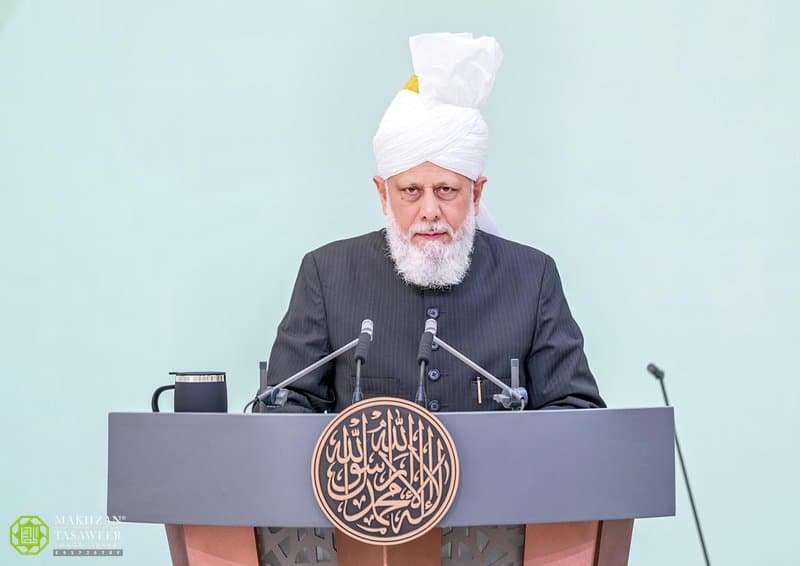
After reciting the tashahhud, ta‘awwuz and Surah al-Fatihah, Hazrat Khalifatul Masih V (aa) stated:
Incidents in the life of the Holy Prophet (sa), particularly related to Tawhid [the Oneness of God] were previously being discussed. Details of breaking the idols at the time of the Conquest of Mecca have already been mentioned in previous sermons. He did all of this as a proclamation of the unity of Allah the Almighty; to demonstrate that this is the state of the idols that they worship. As such, we saw that the main idols around Mecca, such as Manat, ‘Uzza and Suwa’, etc., had been destroyed.
With regards to the idol of the people of Ta’if, Lat – which they referred to as Rabba, i.e., their goddess – it is recorded that the people of Ta’if requested that it not be destroyed for three years. This request was presented before the Holy Prophet (sa). The Holy Prophet’s (sa) honour for the Unity of God did not allow for such an agreement. The people of Ta‘if again requested that it not be destroyed for at least one year. However, the Holy Prophet (sa) rejected their request once again. They then requested that it not be destroyed for at least one month so that people could enter Islam and so that ignorant men and women would not leave Islam as a result of destroying it. However, the Holy Prophet (sa) did not grant this concession either and sent Hazrat Abu Sufyan and Hazrat Mughira bin Shu’ba and had the idol destroyed. His honour for Tawhid did not permit such idols to remain standing under any circumstances, especially since an Islamic state had been established. (Al-Sirah al-Halabiyyah, Vol. 3, pp. 304-305, Dar Al-Kotob Al-Ilmiyah, Beirut)
Abu al Hayyaj Asadi relates that Hazrat Ali bin Abi Talib said to me: “Shall I not send you on the same mission on which the Holy Prophet (sa) sent me; [He instructed] to not leave any idol standing and to destroy it, and also not to leave any high grave without levelling it?” (Sahih Muslim [Translated], Vol. 4, Noor Foundation, Rabwah, p. 133, Kitab al-jana’iz, Bab al-amri bi taswiyati l-qabr, Hadith 1597)
Why was this? Because such things negate Tawhid and within an Islamic state, such practices cannot be tolerated at all. However, it is unfortunate that nowadays, a large number of Muslims have fallen into venerating and prostrating before graves. Instead of beseeching God Almighty, they seek from those buried in these graves and they go to extremes in this regard.
There is no doubt that for the establishment of Tawhid, the Holy Prophet (sa) confronted a powerful nation like the idolaters of Mecca and ultimately, he purified the Ka‘bah of 360 idols. However, alongside this, he also waged a magnificent and blessed jihad [struggle] to establish Tawhid within the hearts of those who accepted Islam and through his spiritual power, he established a community that loved Tawhid. He morally trained his Companions in such a profound and excellent manner that not even the slightest trace of shirk [association of partners with Allah] arose in their minds. For this, he even prevented his Companions from exaggerating in praising him.
Hazrat Ibn Abbas relates that he heard Hazrat ‘Umar (ra) saying upon the pulpit: “I heard the Holy Prophet (sa) say: ‘Do not exaggerate in praising me as the Christians exaggerated in praising the son of Mary. I am only His servant – (a servant of Allah) – so say, ‘the servant of Allah and His Messenger.’” (Sahih al-Bukhari, Kitab ahadithi l-anbiya’, Bab qailillahi ta‘ala ‘wa dh-kur fi l-kitabi maryam’, Hadith 3445)
It is narrated from Hazrat ‘Abdullah bin ‘Umar (ra) that the Messenger (sa) of Allah once met Hazrat ‘Umar bin al-Khattab (ra) while he was travelling with a caravan and was swearing by his father. The Holy Prophet (sa) said:
“Listen! Allah forbids you from swearing by your forefathers. Whoever wishes to swear should swear by Allah, or remain silent.” (Sahih al-Bukhari, Kitab al-imani wa n-nudhur, Bab la tahlifu bi aba’ikum, Hadith 6646)
The Holy Prophet (sa) could not tolerate even the slightest association with the oneness of Allah the Almighty.
Regarding the rank of one who recites the declaration of unity, a narration mentions the following:
‘Ubaidullah bin ‘Adiyy bin Khiyar relates that Hazrat Miqdad bin ‘Amr al-Kindi (ra), an ally of Banu Zuhrah – and among those who had participated in the Battle of Badr with the Messenger (sa) of Allah – said that he once asked the Holy Prophet (sa):
“Tell me, if I encounter a man from among the disbelievers and we begin fighting, and he strikes one of my hands with his sword and cuts it off, then he hides behind a tree and says: ‘I have become a Muslim for the sake of Allah.’ O Messenger (sa) of Allah, should I still kill him after he has said this (i.e., the Kalimah)?”
The Messenger (sa) of Allah replied:
“Do not kill him.”
Hazrat Miqdad (ra) said:
“O Messenger (sa) of Allah, he has cut off one of my hands, and after cutting it off, he then said: “There is none worthy of worship except Allah.”
The Messenger (sa) of Allah again said:
“Do not kill him. For if you kill him, then he will attain the position that you held before killing him, and you will assume the position that he held before uttering the words which he has now spoken.” (Sahih al-Bukhari, Kitab al-maghazi, Bab 12, Hadith 4019)
Thus, even if some of the earlier Companions committed such an act, the Holy Prophet (sa) strongly expressed his displeasure over it. But if we look at the condition of the so-called scholars today, it is quite different. In Pakistan, the extent of the persecution inflicted upon Ahmadis – despite their reciting the Kalimah – knows no bounds. The Holy Prophet (sa) has already given the verdict regarding such oppressors in this very narration. In any case, those people who follow these extremist clerics should reflect carefully.
In this regard, it is mentioned in another narration that Hazrat Usamah bin Zaid (ra) said:
“The Messenger (sa) of Allah sent us on an expedition. In the morning, we reached Huraqat of Juhainah. (Huraqat was the name of a village in the area belonging to the tribe of Juhainah.) There, I overtook a man and captured him. He said [لَا اِلٰہَ اِلَّا اللّٰہ – There is none worthy of worship except Allah] but I still struck him with my spear.
“Afterwards, I felt uneasy in my heart because he had said لَا اِلٰہَ اِلَّا اللّٰہ and yet I had killed him. So I mentioned this to the Holy Prophet (sa). The Messenger (sa) of Allah said:
“‘Did he say لَا اِلٰہَ اِلَّا اللّٰہ and you still killed him?’
“I replied, ‘O Allah’s Messenger (sa), he only said it out of fear of the weapon.’
“The Holy Prophet (sa) said, ‘Why did you not cut open his heart to see whether he said it sincerely or not?’
“The Holy Prophet (sa) kept repeating this to me until I wished that I had only accepted Islam on that very day.” (Sahih Muslim [Translated], Vol. 1, Noor Foundation, Rabwah, pp. 88-89, Kitab al-iman, Bab tahrimi qatli l-kafiri ba‘da ’an qala ‘la ilaha illallah’, Hadith 132)
In another narration, Hazrat Jabir (ra) relates that a man came to the Holy Prophet (sa) and asked:
“O Messenger (sa) of Allah, which two things make paradise and hell inevitable?”
The Holy Prophet (sa) replied, “Whoever dies without associating anything as a partner with Allah will enter paradise; and whoever dies while associating partners with Allah will enter the fire.” (Sahih Muslim [Translated], Vol. 1, pp. 84-85, Kitab al-iman, Bab ad-dalili ‘ala ’an mun mata la yushriku billahi shay’an dakhala l-jannah, Hadith 127)
Mahmud bin Labid relates that the Messenger (sa) of Allah said, “The thing I fear most for you is subtle shirk.” The Companions asked, “O Messenger of Allah, what is a subtle shirk?”
The Holy Prophet (sa) replied, “It is ostentation (i.e., showing off).” On the Day of Judgement, when people are recompensed for their deeds, Allah the Almighty will say to such people:
“Go to those for whom you used to show off your deeds in the world and see whether you find any reward with them.”
If they now seek forgiveness, they should seek it from those very people, and then see whether they receive anything from them. (Musnad al-Imam Ahmad bin Hanbal, Vol. 7, Alam al-Kutub, 1998, p. 799, Hadith 24030)
Thus, displaying one’s deeds or flattering others to gain worldly benefit from them is akin to putting someone alongside Allah the Almighty – and this is shirk, which Allah the Almighty greatly dislikes.
Hazrat Abdullah (ra) narrates that when this verse was revealed:
اَلَّذِیۡنَ اٰمَنُوۡا وَلَمۡ یَلۡبِسُوۡۤا اِیۡمَانَہُمۡ بِظُلۡمٍ
“Those who believe and mix not up their belief with injustice […]” the Companions of the Holy Prophet (sa) said, “Which one of us has not committed injustice?” We may have committed injustices many times and often may not have even realised when we did so. Then Allah the Almighty revealed:
اِنَّ الشِّرْکَ لَظُلْمٌ عَظِیْمٌ
“Indeed, associating partners with God is a grievous wrong.” (Sahih al-Bukhari, Kitab al-iman, Bab zulmin duna zulm, Hadith 32)
Thus, this answer came from Allah the Almighty, that associating partners with Him is a great injustice. Therefore, to be dependent on anything other than Allah the Almighty is to associate partners with Him. By going into subtle detail, we must examine ourselves lest there be any aspect of associating partners with Allah within us, because this is a very great injustice.
In the commentary of Sahih al-Bukhari by Hazrat Waliullah Shah Sahib, which we have published, it is written:
[اِنَّ الشِّرْکَ لَظُلْمٌ عَظِیْمٌ – “Surely, associating partners (with God) is a grievous wrong.”]
The meaning of “Zulm” (grievous wrong) is:
وَضْعُ الشَّیْیِ ٔ فِیْ غَیْرِ مَوْضِعِہٖ
“To place something where it does not belong.” Every type of evil trait and unlawful thing is included within the meaning of “Grievous wrong”. Under the heading “a lesser form of disbelief,” shirk, i.e., associating partners with Allah, has been declared the greatest form of disbelief and even lesser bad morals has also been termed as a form of disbelief. This is the subtle meaning of this.
Then, under the heading “a lesser form of injustice,” associating partners with Allah has been declared the greatest injustice, and it has been explained why it is such a grave sin: because within it, the special attributes of divinity belonging to Allah the Almighty are attributed to others. For example; others are set up as equals to Allah in worship, which is another meaning of love and obedience and is the reality, the right of Allah the Almighty alone. A human, who was His servant and was created to fulfil His will, becomes instead a servant of his own self, or of another human like himself, or even of lowly creations and thus lowers himself far below the station upon which he was created to stand.
With respect to the rights owed to mankind, giving undue possession to another is an injustice, but in the rights of Allah, giving undue possession to another is an even greater injustice. (Injustice in the rights owed to humans is indeed injustice, but failing to properly fulfil the rights of Allah is also an injustice.)
This is the concept of “injustice” that corresponds completely with associating partners with Allah. In reality, associating partners with God destroys the ultimate purpose of a human being. By reasoning from the verses and ahadith, Imam Bukhari (rh) has explained that complete faith is that which is entirely pure from the adulteration of associating partners with Allah.
اُولٰٓئِکَ لَہُمُ الۡاَمۡنُ وَہُمۡ مُّہۡتَدُوۡنَ
Perfect faith and guidance belong only to those whose faith is free from any addition of associating partners with God and injustice. Faith is not complete until, on one hand, it is accompanied by righteous deeds, and on the other hand, it is free from every form of injustice, because associating partners with God, sin, and every type of disbelief continues to weaken it.” (Sahih al-Bukhari, Vol. 1, Nazarat Isha‘at, p. 79)
Thus, this is the standard of establishing the Oneness of Allah and being pure from associating partners with Him, which the Holy Prophet (sa) has taught us.
Abu Hurairah (ra) narrates that the Holy Prophet (sa) said, “Allah the Almighty says: ‘The son of Adam denied Me and he had no right to do so. And the son of Adam uttered profanities against Me and he had no right to do so. As for his denial of Me, it was due to his saying that ‘I will not resurrect him again (as in, if he denies the life to come, then this is denying Allah), as I created him in the beginning. And as for his uttering profanities against Me, it is his saying that “He has taken a son”, even though I am the independent and besought of all. I beget not nor was I begotten, and there is none like unto me.’ He begets not, nor was He begotten and there is none who share His attributes.” (Sahih al-Bukhari, Kitab tafsiri l-qur’an, Bab qawluhu ‘Allahu s-samad’, Hadith 4975)
While explaining Surah al-Ikhlas at one place, the Promised Messiah (as) states, “Allah the Almighty says:
اَللّٰہُ الصَّمَدُ
“Allah is the Being upon whom all are dependent, but He is not dependent upon anyone.
“Observe with what elegance and excellence in this brief statement, which is not even one line long, the Being of the Maker has been described as free from every kind of association. The explanation of this is that, according to the reckoning of reason, association can be of four types. Sometimes, association is in respect of number, and at other times in rank, sometimes in respect of descent, and sometimes in respect of action and effect. So, in this surah, it has been declared that God is free from association with all four of these types. It has been made clear that He is One in number and is not two or three. He is Samad; that is, He is Unique and Incomparable in His station of being the Necessary Existence and Needed by all, while everything besides Him has only a contingent and mortal existence and is ever dependent upon Him. And He is ْلَمْ يَلِد, which means that He has no son so that he, by virtue of being His son, should be His partner; He is ْلَمْ يُوْلَد, which means that He has no father so that, by virtue of being His father, he should be His partner; and He is لَمْ يَكُنْ لَّهٗ كُفُوًا, which means that no one can be His equal in His works to claim partnership with Him on account of the working relationship. Thus, it has been made clear that God Almighty is free from associates of all four types, and is One, without associate.” (Barahin-e-Ahmadiyya – Part IV, English Translation, pp. 323-324)
Hazrat Aisha (ra) narrates that the Holy Prophet (sa) appointed a man as the leader of a military expedition. During the Prayer, he would recite for his companions and would conclude his recitation with [قُلْ ھُوَ اللّٰہُ اَحَدٌ – Say, ‘He is Allah, the One;] that is, he would recite Surah al-Ikhlas at the end. When they returned, they mentioned this to the Holy Prophet (sa). The Holy Prophet (sa) said, “Ask him why he does this.” Thus, they asked him, to which he replied, “Because it contains the attributes of the Gracious God, and I love to recite it.” The Holy Prophet (sa) then said, “Inform him that Allah loves him.” As it is a proclamation of the Unity of Allah the Almighty, he should know that Allah also loves him. (Sahih al-Bukhari, Kitab at-tawhid, Bab ma ja’a fi du‘ai n-nabiyyi (sa) ummatahu ila tawhidillahi tabaraka w ta‘ala, Hadith 7375)
Many examples filled with the recognition of the love of Allah the Almighty and love for His Unity are also found among the Companions. In one narration, Hazrat Anas bin Malik (ra) relates that a man from among the Ansar used to lead them in prayer at Masjid Quba. Whenever he recited a chapter for them in the prayer, he would begin with Surah al-Ikhlas until he completed it, and then he would recite another Surah along with it, and he would do this in every rak‘ah [unit of prayer]. The first incident was of a group sent on an expedition; this, however, was the consistent practice of an Imam of a locality.
His companions spoke to him and said, “You recite this chapter, then you consider that it is not sufficient for you until you recite another chapter as well. Either recite only this – that is, Surah al-Ikhlas – or leave it and recite another chapter.” He replied, “I will not abandon it. If you like that I lead you in prayer in this manner, then I shall do so, and if you dislike it, then I shall leave you; I have no need of leading the prayer.” They considered him to be the most excellent among them, and they disliked that anyone other than him should lead them.
When the Holy Prophet (sa) came to them, they mentioned this matter to him – that this person recites Surah al-Ikhlas in every rak‘ah and before every Surah. The Holy Prophet (sa) said, “O so-and-so, what prevents you from acting upon what your companions say, and what causes you to recite this chapter in every rak‘ah?” He submitted, “O Messenger (sa) of Allah, I love it.” The Messenger (sa) of Allah said, “Indeed, your love for it has admitted you into Paradise” – that is, the love of Surah al-Ikhlas has admitted him into Paradise. (Jami‘ at-Tirmidhi, Kitab fada’ili l-qur’an, Bab ma ja’a fi surati l-ikhlas, Hadith 2901)
The spiritual power and training of the Holy Prophet (sa) had made the Companions themselves a beacon for guiding others towards the Unity of God. In a narration of Sahih al-Bukhari, it is also stated that the Holy Prophet (sa) declared this chapter to be one-third of the Quran, that is, a third part of the Quran. (Sahih al-Bukhari, Kitab fada’ili l-quran, Bab fadli qul huallahu ahad, Hadith 5013)
In its commentary, Hazrat Musleh-e-Maud (ra) has written:
“The meaning of this chapter being one-third of the Quran is not that it constitutes one-third of the physical volume of the Holy Quran; rather, it signifies that its subject matter holds special importance.
“From studying the Holy Quran and the ahadith, it becomes evident that in the latter days two great trials were to arise: one, the trial of Dajjal [The Antichrist] and the other, the trial of Gog and Magog. These two trials were to confront Islam one after the other. One trial holds the belief in three gods instead of the One God – namely, God the Father, god the Son, and god the Holy Spirit – and the other trial is that of materialism, which altogether denies the existence of God. The Holy Quran has refuted the beliefs of both these trials and has expounded on the correct doctrines.
“The Holy Quran is filled with the praise of God the Father, and it affirms that He alone is the Sustainer and the One God – that is, it proclaims the praise of the One God, Allah the Almighty and affirms His Unity. At the same time, it strongly rejects the notions of god the son and god the Holy Spirit. Allah the Almighty denies that there are any other gods besides Him. Thus, the Holy Quran has established the Godhood of God the Father and has refuted the concepts of god the Son and god the Holy Spirit.
“Therefore, it is evident that since affirming the Godhood of God the Father constitutes one-third of the subject matter of the Holy Quran, Surah al-Ikhlas also amounts to one-third of the Quran. In reality, the purpose of the Holy Quran is to establish the Unity of God and to eradicate false beliefs. Hence, when this chapter has, in the most comprehensive and concise words, conveyed that subject which refutes false doctrines, proves them to be false, and sets forth the reality of Divine Unity, then this Surah is not merely one-third of the Quran, but is, in fact, equal to the whole Quran.
“Thus, the Holy Prophet (sa) declaring this Surah to be one-third of the Quran is not an exaggeration; rather, in view of the importance of its subject matter, he stated this on account of its profound significance.” (Tafsir-e-Kabir, Vol. 15, pp. 372-373)
The Promised Messiah (as) states:
“Know for sure, therefore, that certainty of Tawhid can be achieved only through a Prophet, as our Holy Prophet, may peace and blessings of Allah be upon him, convinced the atheists and pagans of Arabia of the existence of God Almighty by showing them thousands of heavenly Signs. Even to this day, true and perfect followers of the Holy Prophet, may peace and blessings of Allah be upon him, present those Signs to the atheists. What is really true is that, until a person observes the living powers of the Living God, Satan does not depart from his heart, nor does true Tawhid enter into it, nor can he be convinced with certainty of the existence of God. This pure and perfect Tawhid is attained only through the Holy Prophet (sa).” (The Philosophy of Divine Revelation, pp. 140-141)
In this age, even those who outwardly profess belief in the Oneness of God have turned their eyes away from its true essence. Aside from the external evil ploys of Gog and Magog, internally, the Muslims themselves have forgotten the true understanding of Tawhid [Unity of God].
Thus, in such circumstances, it was necessary that the devoted servant of the Holy Prophet (sa) should appear in the form of the Promised Messiah and Mahdi. In accordance with the promise of Allah the Almighty, he did indeed appear and opposed every attack against Tawhid [Unity of God].
Therefore, we can only truly fulfil the pledge of our Bai‘at when we become true believers in Tawhid [Unity of God]. When the Promised Messiah (as) established the Jamaat on 23 March – and we are currently passing through the month of March and we hold various Jalsas to commemorate “the Promised Messiah (as) Day” – it is to remind us that the devoted servant of the Holy Prophet (sa) was sent by Allah for the establishment of Tawhid [Unity of God]. Hence, by entering into this Jamaat, we have pledged to remain steadfast upon Tawhid [Unity of God]. Its true fulfilment lies in striving to establish it within ourselves, within our families, and within our society.
May Allah the Almighty grant all the Muslims the ability to accept the one sent by God Almighty, so that they may establish Tawhid [Unity of God] and repel the evil ploy of Gog and Magog and of the Dajjal, which are nowadays attacking with great intensity.
With reference to the Night Journey [Isra’], a narration is reported by Hazrat Abdullah ibn Mas‘ud (ra), that the Holy Prophet (sa) said:
“I met Abraham (as), on the night of the Isra’. He said: ‘O Muhammad (sa), convey my greetings to your community and inform them that Paradise has pure soil and sweet water and is a vast plain, and its plants are: SubhanAllah [Holy is Allah], Alhamdulillah [All praise belongs to Allah], La ilaha illAllah [There is none worthy of worship except Allah], and Allahu Akbar [Allah is the Greatest].’” (Jami‘ at-Tirmidhi, Kitab ad-da‘wat, Bab 59, Hadith 3462)
Thus, a believer should engage in these remembrances with deep understanding and with a complete realisation of Tawhid [Unity of God] – for therein lies success. We believe in Allah as the One and Only.
In another narration, a qudsi hadith is reported by Hazrat Anas ibn Malik (ra). He relates that he heard the Holy Prophet (sa) say:
“Allah the Blessed and Exalted says:
“‘O son of Adam! Verily, as long as you called upon Me and hoped in Me, I forgave you, despite whatever may have occurred from you, and I did not mind. (That is, despite their weaknesses and shortcomings, Allah the Almighty granted His forgiveness because they were supplicating to Him.)
“O son of Adam! Were your sins to reach the heights of the sky, then you sought forgiveness from Me, I would forgive you, and I would not mind. (Irrespective of the number of sins committed, God Almighty can forgive them all for He is the Master and can do so whatever He wills.) So, O son of Adam! If you came to me with sins nearly as great as the earth, and then you met Me not associating anything with Me, I would come to you with forgiveness equal to them.
“If a person has sins equal to the size of the earth, but as long as he has not committed shirk and remained fearful of Allah the Almighty and proclaimed His unity and strived to act upon it, then I shall grant His forgiveness.’” (Jami‘ at-Tirmidhi, Kitab ad-da‘wat, Hadith 3540)
Thus, all sins are forgiven by Allah the Almighty when a person turns to Him in humility. However, the condition is that one must not commit shirk [associating partners with God] and must fulfil the due rights of His Divine Unity. Mere verbal belief is not sufficient; just as I mentioned earlier, in fact, one must prove through every action that God Almighty is One.
Regarding the exalted station of Tawhid [Divine Unity], a narration from Abu Sa‘id al-Khudri (ra) relates that the Holy Prophet (sa) said:
“Prophet Moses (as) supplicated: ‘O my Lord, teach me something by which I may remember You and supplicate to You.’
“Allah the Almighty said: ‘O Moses, say: La ilaha illallah [there is none worthy of worship except Allah].’
“Moses (as) submitted: ‘My Lord, all Your servants say this.’ (That is, they all proclaim that there is none worthy of worship except Allah.)
“Allah the Almighty replied: ‘O Moses, say: La ilaha illallah.’
“Moses (as) said: ‘There is none worthy of worship but You, my Lord, but I seek something particular for myself.’
“Allah the Almighty said: ‘O Moses, if the seven heavens and all their inhabitants, and the seven earths, were placed in one scale, and La ilaha illallah in the other, then La ilaha illallah would outweigh them all.” (Al-Mustadrak ala al-Sahihayn, Vol. 1, Dar Al-Kotob Al-Ilmiyah, p. 710, Kitab ad-du`‘a, Hadith 1936)
That is, all the creations of the heavens and the earth, with all their goodness, when placed on one side, would still be outweighed by the declaration of La ilaha illAllah [i.e., Divine Unity].
While responding to an objection and explaining the reality of the Islamic creed that “there is none worthy of worship except Allah”, the Promised Messiah (as) states:
“Your statement that the Holy Prophet (sa) has taught that reciting the words: لا الہ الا اللہ [‘There is none worthy of worship except Allah.’] dispels all sins, is absolutely true. This indeed is the truth that whosoever considers only God to be One without a partner and believes that Muhammad, the Chosen One, peace and blessings of Allah be upon him, has been sent by the same Omnipotent and Unique God, then – without any doubt – if such a person meets his end upholding this belief, he will surely attain salvation. There is absolutely no salvation under the heavens through the suicide of someone else. Certainly not! And who could be more insane than one who even entertains such a thought? However, to hold the belief that God is One and has no partner and that He is so Compassionate that – showing great mercy – He sent His Messenger, whose name is Muhammad, the Chosen One, peace and blessings of Allah be upon him, to deliver the world from its error is such a doctrine that believing in it dispels the darkness of the soul, egotism is eliminated, and Tawhid [Oneness of God] takes its place. And, ultimately, the passion of Tawhid so engulfs the heart that the life in Paradise begins in this very world. Just as you see that darkness cannot survive when light arrives, in the same way, when the luminosity of:
لا الہ الا اللہ
“falls upon a person’s heart, all the passions of the darkness of the ego become, as if, extinct. The reality of sin is none other than that there should be a cacophony of egoistic passions admixed with rebellion, and a person is labelled a sinner when he is in the state of subservience to them. (When a person acts contrary to this, he is labelled a sinner.)
“And the meanings of لا الہ الا اللہ that we understand from the usage of Arabic lexicons is:
لَامَطْلُوْبَ لِیْ وَلَا مَحْبُوْبَ لِیْ وَلَا مَعْبُوْدَ لِیْ وَلَا مُطَاعَ لِیْ اِلَّا اللّٰہُ
“Meaning that, with the exception of God, there is none whom I desire, or whom I love, or whom I worship, or whom I obey. Now, it is clear that these meanings are completely at odds with the essence of sin and the real source of sin. Therefore, the person who allows these meanings to occupy his soul with heartfelt sincerity (and these are words are worth deeply pondering over), the meaning counter to it [i.e., submitting to false idols] will, of a necessity, leave his heart, (nothing else will remain in the heart of such a person, because he will act in accordance with God’s commands and acknowledge His Oneness) because two opposites cannot coexist at one place.
“Thus, when egoistic passions get purged, then this is precisely the state that is called true piety and real righteousness. And the need to believe in the one sent by God – which is the purport of the second part of this declaration of faith – is that faith in God’s word should also be attained. This is because it is necessary for anyone who declares that he wishes to become obedient to God, that he should also believe in His commandments. And it is not possible to believe in His commandments without believing in the person through whom the commandments came into the world. (It is also necessary to believe in the bearer of the Divine teachings.) This is the true purport of this declaration of faith.” (The Light of the Holy Quran – Number II, pp. 118-119)
Hazrat Abu Musa al-Ashari (ra) narrates that one day the Holy Prophet (sa) addressed us and said, “Beware of shirk, for it is subtler than the footprint of an ant.” That is, it is more subtle than the trace left by an ant’s foot. Someone asked, “O Messenger of Allah, how can we guard ourselves against it when it is subtler than the footprint of an ant?” The Holy Prophet (sa) replied, “Recite this prayer:
اَللَّھُمَّ اِنَّا نَعُوْذُبِکَ مِنْ اَنْ نُشْرِکَ بِکَ شَیْئًا نَعْلَمُہُ وَنَسْتَغْفِرُکَ لِمَا لَا نَعْلَمُ
“O Allah, we seek refuge in You from knowingly associating anything with You, and we seek Your forgiveness for what we do unknowingly.” Always continue to seek help. (Musnad al-Imam Ahmad bin Hanbal, Vol. 6, Alam al-Kutub, Beirut, 1998, pp. 614-615; Musnad Abu Musa al-Ashari, Hadith 19835)
Hazrat Abdur Rahman bin Abza relates that the Holy Prophet (sa) would recite this supplication upon waking in the morning:
اَصْبَحْنَا عَلٰی فِطْرَةِ الْاِسْلَامِ وَعَلٰی کَلِمَةِ الْاِخْلَاصِ وَعَلٰی دِیْنِ نَبِیِّنَا مُحَمَّدٍ صلی اللّٰہ علیہ وسلم وعَلٰی مِلَّةِ اَبِیْنَا اِبْرَاھِیْمَ حَنِیْفًا مُسْلِمًا وَمَا کَانَ مِنَ الْمُشْرِکِیْنَ
“We have entered the morning upon the natural state of Islam, upon the word of sincere devotion to Tawhid, upon the religion of our Prophet Muhammad (sa), and upon the way of our father Abraham, who was upright, a Muslim, and not among the polytheists.” Upon waking, one should always remember Allah. (Musnad al-Imam Ahmad bin Hanbal, Vol. 5, Alam al-Kutub, Beirut, 1998, pp. 294-295, Musnad Abd al-Rahman bin Abzi, Hadith 15434)
Hazrat Abdullah bin Masud (ra) relates that when evening fell, the Messenger (sa) of Allah would recite:
اَمْسَیْنَا وَاَمْسَی الْمُلْکُ لِلّٰہِ وَالْحَمْدُ لِلّٰہِ لَا اِلٰہَ اِلَّا اللّٰہُ وَحْدَہُ لَا شَرِیْکَ لَہ
“We and the entire creation have entered the evening for Allah’s sake. All praise is for Allah. There is no god but Allah, He is One and has no partner.” (Sahih Muslim, Kitab adh-dhikri wa d-du‘a, Bab at-ta‘awwuzi min sharri ma ’amala wa min sharri ma lum ya‘mal, Hadith 2723)
Abdullah bin Buraidah al-Aslami narrates from his father that the Holy Prophet (sa) heard a man supplicating and saying, “O Allah, I ask You by virtue of my testimony that You are Allah, there is none worthy of worship but You. You are the One, Self Sufficient, He who neither begets nor is begotten, and none is equal to Him.” Upon hearing this, the Holy Prophet (sa) said, “By Him in Whose hand is my soul, he has asked Allah by His Greatest Name. When one supplicates through it, He answers, and when one asks through it, He grants.” (Jami‘ at-Tirmidhi, Kitab al-Da‘wat, Bab Ma Ja’a fi Jami al-Da‘wat an Rasulillah [sa], Hadith 3475)
Hazrat Asma bint Umais (ra) narrates that the Messenger (sa) of Allah said to her, “Shall I not teach you words that you should recite in times of hardship and affliction?” They are:
اَللّٰہُ اَللّٰہُ رَبِّی لَا اُشْرِکُ بِہِ شَیْئًا
“Allah, Allah is my Lord. I do not associate anything with Him.” (Sunan Abi Dawud, Kitab al-Witr, Bab Fi l-istighfar, Hadith 1525)
When people ask what they should recite in times of difficulty, this is one of the supplications.
In another narration, Hazrat Ibn Abbas (ra) relates that in times of distress the Holy Prophet (sa) would supplicate:
لَا إِلٰهَ إِلَّا اللّٰهُ الْعَظِيْمُ الْحَلِيْمُ، لَا إِلٰهَ إِلَّا اللّٰهُ رَبُّ السَّمَوَاتِ وَالْأَرْضِ، وَرَبُّ الْعَرْشِ الْعَظِيْمِ
“There is no god but Allah, the Most Great, the Most Forbearing. There is no god but Allah, Lord of the heavens and the earth, and Lord of the Mighty Throne.” (Sahih al-Bukhari, Kitab al-Da‘wat, Bab al-Du‘a Inda al-Karb, Hadith 6345)
Just observe the subtlety with which the Holy Prophet (sa) would instruct the establishment of the Oneness of God. In one narration, Abu Rimsah (ra) relates that his father said to the Messenger (sa) of Allah, “Show me the mark upon your back,” meaning the Seal of Prophethood, “for I am a physician.” The Holy Prophet (sa) replied, “The true physician is Allah. You are merely a companion who gives comfort and reassurance. The physician is He who created him and He alone grants healing.” (Sunan Abi Dawud, Kitab at-tarajjul, Bab fi l-khidab, Hadith 4207; Aun al-Ma‘bud, Vol. 11, Dar Al-Kotob Al-Ilmiyah, Beirut, 1990, p. 175, Kitab at-tarajjul, Bab 17, Hadith 4201)
Hazrat Ubadah bin Samit (ra) relates that the Messenger (sa) of Allah said, “Whoever testifies that there is no god but Allah, He is One and has no partner, and that Muhammad (sa) is His servant and Messenger, and that Jesus is the servant of Allah and the son of His maidservant, and His word which He cast to Mary and a spirit from Him, and that Paradise is true and Hell is true, Allah will admit him into Paradise through whichever of its eight gates He wills.”
Umair bin Hani relates the same narration with the same chain and affirms it, and he stated that the Holy Prophet (sa) said, “Whatever his deeds may have been, God will admit him into paradise.” However, he did not corroborate the statement about the eight gates of paradise. In this second narration, the reference to the eight gates is not mentioned. (Sahih Muslim, Kitab al-iman, Bab ad-dalil ‘ala mun mata ‘ala t-tawhidi dakhala l-jannah, Hadith 28)
It is narrated by Hazrat Ibn Umar (ra) that the Holy Prophet (sa) said: “Islam is founded upon five things: that Allah alone be worshipped and that all others be rejected as objects of worship; the establishment of Prayer (Salat); the payment of Zakat; the pilgrimage to the House of Allah; and the fasting in Ramadan.” (Sahih Muslim, Kitab al-iman, Bab bayani arkani l-islam, Hadith 16)
It is narrated by Hazrat Yasirah (ra), who was among the female migrants, that the Holy Prophet (sa) said: “It is incumbent upon you, O women, to engage in tasbih [sanctification of God], tahlil [sending salutations], and taqdis [glorification of God], and do not fall into heedlessness lest you forget the Unity of God. Count upon your fingers, for indeed the fingers will be questioned on the Day of Judgment and will be made to speak.” That is, one should also count while engaging in the remembrance of Allah, proclaiming His purity, declaring His Oneness, and glorifying Him. (Al-Mustadrak ala al-Sahihayn, Kitab ad-du‘a, Vol. 1, Dar Al-Kotob Al-Ilmiyah, p. 732, Hadith 2007)
Thus, the Holy Prophet (sa) never missed any opportunity, whether in a gathering, an assembly, or among any group, to instil within the hearts of his people the truth of Divine Unity and the greatness of Allah.
In this regard, Hazrat Musleh-e-Maud (ra) has stated in one instance in a sermon:
“The Holy Prophet (sa) was so fervent in this matter that even his opponents acknowledge that, whether standing, sitting, or moving about, he would constantly proclaim the name of God.
“A French historian writes that whatever accusations may be levelled against Muhammad (sa), (the historian says) there is one thing that stands out to him (about the Holy Prophet [sa]) which he has not observed in any other person since the beginning of the world. He states that from the moment the Holy Prophet (sa) declared his prophethood until the time of his death, there remained only one word upon his tongue, and that was ‘Allah.’ It was as though he was consumed with a single passion, even a kind of obsession: to establish belief in God and to make Him apparent to the world.
“Thus, those who describe this condition of the Holy Prophet (sa) as a form of ‘obsession’ still concede that his foremost and greatest mission was to establish belief in God and His Unity. If it be called ‘obsession’, then indeed it is such an ‘obsession’ that later generations recognised its bearer as perfect; or at the very least acknowledged that a person who spends day and night proclaiming God, striving constantly to establish His Unity and attributes, cannot be an evil person.
“In any case, observing this state of the Holy Prophet (sa) makes it clear that the purpose of his advent – indeed the advent of all prophets – is to eradicate shirk, to establish belief in God, and to spread the teaching of His Unity throughout the world.” (Khutbat-e-Mahmud, Vol. 9, pp. 260-261)
At another instance, Hazrat Musleh-e-Maud (ra) writes:
“One must bear in mind that no matter how exalted the rank of the Holy Prophet (sa) may be, and no matter how deep our love for him, (he mentioned this in a sermon), the station of Allah the Almighty is infinitely higher than his. Allah is Eternal and Everlasting, while Muhammad (sa) is one of the greatest manifestations of His grace.
“To ascribe to the Holy Prophet (sa) a station that diminishes the rank of Allah would, in fact, be an act of enmity towards him, for he himself never approved of being given a status higher than that of God.”
As has been mentioned earlier through ahadith, he did not approve of being elevated above Allah, and every aspect of his life testifies to this. Whatever great achievements he accomplished were such mighty works that no human being could accomplish them independently; they could only be achieved through the power of Allah. Even the strongest of men could not perform such feats. Yet, when he was in the throes of death – a time of immense suffering – Hazrat Aisha (ra) relates: “I used to think that a person who suffers greatly at the time of death is not a good person. (She thought that one who is in agony at the time of death is not a good person.) However, when I witnessed the condition of the Holy Prophet (sa), I was compelled to change my opinion. Even in that extreme state of suffering, he was so mindful of the rank of Allah the Almighty that, knowing the intense love his followers bore for him and fearing that they might exaggerate his status, he repeatedly uttered:
“‘May Allah curse the Jews and the Christians, for they made the graves of their prophets into places of worship.’”
He continued to repeat these words again and again. Thus, the final lesson he imparted to his people was this: “do not assign to me a status that leads to shirk. If you do so, do not think that I will be pleased; rather, my soul will curse those who commit such an act.”
Therefore, even if it concerns the Holy Prophet (sa), attributing to him a station that dishonours the rank of Allah is not a source of his pleasure, but rather invites his curse. And a curse uttered at the time of death carries immense gravity.
Even those who do not follow a true religion – such as many among the Hindus – fear the curse uttered at the time of death. People fear even the supplications or curses of their parents at the time of their passing. Then how significant must it be when the Holy Prophet (sa), the Chief of All Prophets, utters such words at the moment of death! How grave a warning this is, and how necessary it is for us to guard ourselves against it.
Although such practices are not carried out at the blessed resting place of the Holy Prophet (sa), as I have mentioned before, they are indeed practised at the shrines of saints and so-called holy men. Such practices fall under the very curse that the Holy Prophet (sa) pronounced. (Khutbat-e-Mahmud, Vol. 20, pp. 600-601)
Therefore, we who claim to follow the True Servant of the Holy Prophet (sa) must be especially mindful. We must strive to understand the true reality of Divine Unity, comprehend the deep anguish and concern the Holy Prophet (sa) had for establishing it, and make every effort to become true monotheists. May Allah grant us the ability to do so.
The conditions of war in the world are also becoming increasingly severe. The United States and Israel are intent on establishing their dominance across the world, particularly in the Muslim world. As was stated by the Prime Minister of Israel at the outset of the conflict in Palestine, the map of the region and even that of the Arab world would be altered. These are indeed attempts to reshape the geopolitical landscape, and the Muslim world must awaken to the direction in which these forces are moving. Unity among Muslim nations is absolutely essential.
It has been reported that Pakistan is attempting to broker peace between Iran and certain other countries with the United States. Since the Arab countries themselves are also suffering losses, Pakistan is making efforts from that perspective. However, certain factions in Iran have developed suspicions regarding these efforts. Some experts and commentators in Iran have even gone so far as to allege that Pakistan is assisting in the training of American forces or aiding groups that might act against Iran along its border. Such claims are entirely baseless. Pakistan has categorically denied them. The enemy seeks to exploit these circumstances to create discord, so that Muslim countries may never unite or support one another.
Therefore, there is a great need for prayers. May Allah grant us the ability to pray earnestly in this regard as well, and may He enable the Muslim nations to be united in a bond of true unity.
(Official Urdu transcript published in the Daily Al Fazl International, 17 April 2026, pp. 1-8. Translated by The Review of Religions.)