
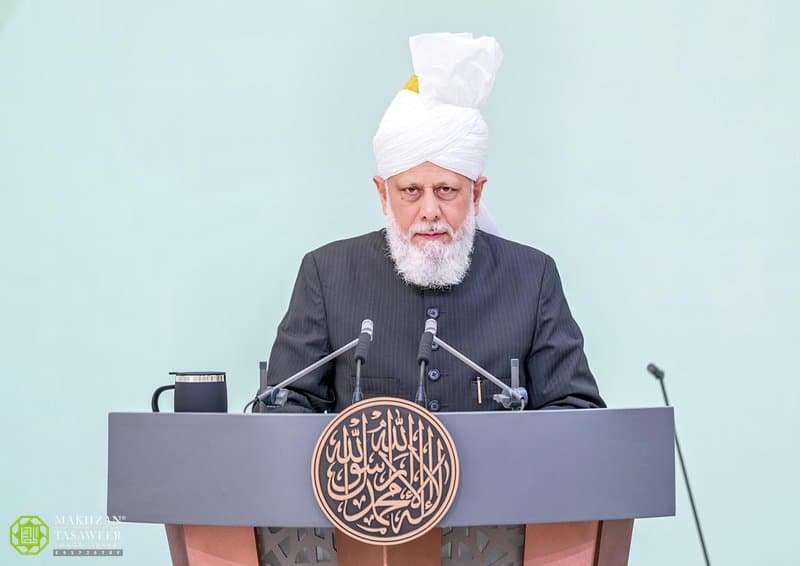
After reciting the tashahhud, ta‘awwuz and Surah al-Fatihah, Hazrat Khalifatul Masih V (aa) stated:
In the previous sermons we had been learning about the heartfelt desire of the Holy Prophet (sa) for the establishment of Tawhid [Oneness of God] in the world, his effort, courage, how he stood like an unshakeable rock in opposition to any form of shirk [associating partners with God] and how he proclaimed the truth against the concepts of shirk of every nation and their teachings. In relation to this, the Promised Messiah (as) states:
“Just think how, to his last breath, the Holy Prophet (sa) steadfastly and unwaveringly held on to his claim of Prophethood in the face of countless perils and so many enemies, detractors and threateners. The persecution and hardship he endured for years seemed to preclude all possibility of success and were increasing day by day. His patient response to them clearly rules out any plans for material gain. On the contrary, the very moment he made his claim to Prophethood, he lost even the little support he already had.” That is, he lost even those who were close to him. “With a single announcement, he made innumerable enemies and brought upon himself countless tribulations. He was forced into exile, pursued by bloodthirsty enemies, his home and property were destroyed, and repeated attempts were made to poison him. Those who were once his well-wishers turned against him, and friends became foes. The severe hardship he endured for so long and with such fortitude could not have been tolerated by a deceiving imposter.”
The Promised Messiah (as) states:
“Such was his truthfulness and candour that he did not hesitate to proclaim Tawhid [Oneness of God] even at the cost of antagonising all the people and tribes – indeed, the whole world of idolaters. His own kith and kin were the first to oppose him when he forbade them from worshipping idols. The Jewish community became his bitterest enemy and continuously plotted to assassinate him when he tried to wean them away from diverse forms of creature-worship, blind following of the saints, various forms of malpractices, and from blaspheming against the Messiah [Jesus (as)]. (The Holy Prophet (sa) prohibited the Jewish community from speaking ill of Jesus [as].) The Christians were similarly antagonised when he declared that, contrary to their beliefs, Jesus (as) was neither God nor the son of God, nor did he atone for their sins through Crucifixion. Fire-worshippers and star-worshippers were also enraged when he forbade them from worshipping their deities and exhorted them instead to turn to the One God for their salvation.”
The Promised Messiah (as) states:
“Now, honestly, are these the means by which one could hope to achieve success in this world?” The people at that time alleged that the Holy Prophet (sa) tried to achieve worldly success. “If he had worldly ambitions, was it prudent to attack the beliefs of all religions and provoke them in such a way that they were all heartbroken and turned against him? They were so disturbed as to become thirsty for his blood, while he did not have any significant following to defend him against their onslaught.” Even today, orientalists and opponents of Islam raise the same allegations against the Holy Prophet (sa). However, while doing so, they do not think about why someone would put themselves through such circumstances to gain something.
The Promised Messiah (as) states:
“Would it not have been more in keeping with the ways of the world to criticise some and praise others, (if one had to follow the common practices of the world to such an extent, then just as some were declared false, others could also have been declared truthful in order to please them), so that where he had enemies, he might also have some friends? For instance, if he had conceded to the Arabs that Lat and ‘Uzza were true gods, they would have obeyed him and followed him without question, for they were a people who placed great importance on family and tribal affiliations and national honour. (They were related and fellow tribesmen, and were ever-ready to make any sacrifice for this sake.) They were in agreement with everything [the Holy Prophet (sa) taught]. The only thing he needed was to permit idol-worship to win their heartfelt obedience.
“(If he had merely said that it was fine for them to worship idols, they would have been content and obeyed him completely. This is the request they presented to him. Thus, one should ponder:) What worldly expediency could have led the Holy Prophet (sa) to alienate one and all for the sake of holding firmly to Tawhid – a creed that was deeply unpopular at the time and the profession of which spelt many a trouble and even the risk of death? And what earthly motive could he have for continuing to insist on the doctrine that had taken away everything from him and the very expression of which could cause new converts to Islam to suffer confinement and torture? (He not only had to endure suffering by proclaiming the oneness of God, but his followers also had to face this.)
“How could anyone hope to attain material success by telling people what was against their temperament, customs and beliefs, thereby making them his mortal enemies, and not keeping ties with anyone? Is this the way cheats and liars scheme? (i.e., those who are driven by greed, who desire something, or who try to show cleverness or cunningness) Do schemers turn their friends into enemies? Do those who plan on gaining material reward through their clever devices challenge the whole world at once and live in constant fear for their lives? Far from it, they are keen to humour everyone and eager to award the certificate of truth to every religion. It is not in their character to show fortitude for the sake of God and take pains to uphold their belief in His Oneness and Greatness. Indeed, why should they do so when their aim is to lay their nets where the prey is most easily caught (if they wish to capture someone or bring them under control through deception, then they lay traps like a hunter) and to employ tactics that require the least toil and bring the greatest material gain? Hypocrisy is their profession, and flattery is their habit. Sweet talk and cultivating the favour of both sides is their favourite principle. They say ‘Allah, Allah’ with the Muslims as readily as they chant ‘Ram, Ram’ with the Hindus. They readily agree with everyone. (They mould themselves according to the situation.)
“They have nothing to do with God and no concern to show fidelity for Him. They would never court trials and tribulations to introduce pain and anguish into their happy life. Their mentor teaches them only one thing: to tell everyone that they agree with their beliefs, opinions, and understandings. They are not concerned with right or wrong, truth or falsehood, and good or evil. Whoever greases their palms is good and virtuous and a gentleman; whoever praises them to feed their ego is given the glad tidings of salvation, heaven and everlasting life. (They become everything for them.)
“On the other hand, it is very clear when we study the life of Hazrat Khatamul-Anbiya’ [the Seal of the Prophets], may peace and blessings of Allah be upon him, that he possessed the highest level of uprightness and integrity. He was ever willing to sacrifice his life for God. He was entirely free from fear or hope from the people and placed his trust only in his Lord. So complete was his submission and devotion to the will of God that he preached His oneness without fear of the calamities that would befall him and the pain and suffering that he would have to endure at the hands of idolaters. In carrying out his Lord’s command, he embraced every tribulation, hardship and affliction. Undaunted by threats, he fulfilled all the requirements of spiritual exercise, preaching and exhortation. I tell you truly that throughout the history of all other prophets, there is not one who showed such trust in God, preached His oneness, forbade idolatry in the face of so much danger, and remained ever-steadfast and firm while facing so many enemies. (Look at the history of the prophets, and you will not find a single one as steadfast as he was.) Anyone who ponders over these events with any degree of honesty will find them bearing witness to the inner truth of the Holy Prophet (sa).
“Upon deeper reflection, a reasonable person will also realise that the age in which the Holy Prophet (sa) appeared stood in dire need of a great heavenly reformer and spiritual guide and that the teachings he brought were certainly true and met all the needs of the time and encompassed all the requirements of the age. (The age was so corrupted that there was a need for a guide, a reformer, a leader – and it was then that he came in that very age. And the teachings met all the needs of the time and encompassed all the requirements of the age.) So effective and forceful was his teaching that thousands were drawn towards the truth, and the words لا الہ الا اللّٰہ [There is none worthy of worship but Allah] were engraved upon their hearts. The ultimate purpose of prophethood – which is to impart teachings that lead to salvation – was accomplished to perfection [by the Holy Prophet (sa)]. This is far more than what any other prophet had ever achieved.
“Anyone pondering over this will spontaneously testify that the Holy Prophet (sa) is the true guide sent by God. There is no cure for those who persist in denial out of prejudice and stubbornness – such people deny even the existence of God – but it is impossible to show, in the life of any other prophet, even one of those signs of truth as are found to the brim in the Holy Prophet (sa). If someone thinks otherwise, let him come forward.”
The Promised Messiah (as) further states:
“The Hindus sing the praises of the Vedas, considering them to be the sum total of all guidance, while denying the truthfulness of all other scriptures and Prophets. Also, the Christians consider the Gospels to be the last Word, forgetting that the merit of a scripture can only be measured by the extent to which it establishes God’s Oneness. A Book that excels in establishing the Oneness of God can alone be judged higher in status. (The real purpose of a divine scripture is that it establishes Tawhid). This is why a denier of Tawhid, even if he is a paragon of virtue, cannot attain salvation. (If a person contains all virtues within them, yet they deny the Oneness of God, then in the eyes of Allah, they cannot attain salvation.) Hence, these people should first ask themselves: which of these Books has done the most to promote the concept of God’s Oneness, upon which salvation depends? Can the Vedas boast of one country in which they have introduced the Oneness of God? […] There is no land in which the Gospels became the means for spreading Tawhid. On the contrary, its followers consider monotheists unworthy of salvation. Their priests give monotheists tidings of a dark inferno (they claim that those who follow Tawhid, and believe in One God and reject the Trinity, will be thrown into the fire), where there will be much wailing and gnashing of teeth. According to them, only those will be saved from it who believe that God suffers death, suffering, hunger, thirst, pain and that he entered a mortal body and became flesh; otherwise, there is no hope of salvation. (i.e., referring to Jesus [as]) In other words, they believe that the paradise of their imagination will be divided among the two great nations of Europe – the British and the Russians.”
Now other big nations are including themselves in this; the USA also makes this claim. In fact, some supporters of the President of the USA claim that Trump is the second coming of Jesus – God forbid.
The Promised Messiah (as) states:
“It will be divided in half, while all monotheists will be cast into hell for the crime of considering God to be free from every fault and imperfection. What I am trying to demonstrate by writing all this is that Tawhid, in its purest form, is not to be found among any people on the face of the earth except the followers of the Holy Prophet, may peace and blessings of Allah be upon him. And there is no book upon the earth, other than the Holy Quran, that has firmly committed millions to this holy doctrine and that leads mankind so reverentially towards the One True God. People of every religion have created artificial gods for themselves, whereas the God of the Muslims is the One, Eternal and Immutable God, whose attributes are the same today as they were before. All this goes to show the truth of the Prophethood of the Founder of Islam (sa) beyond any shadow of doubt (as bright as the sun), for it is only in his blessed person that the essence and purpose of Prophethood is demonstrably fulfilled. Just as a creator is recognised through his creation, so do the wise and knowledgeable recognise this Divine Reformer by the reformation he has brought about. (If an inventor has made something, whether a small part or something else, they will be judged according to the quality of that creation. In the same way, a divine reformer can be recognised according to the teachings of Tawhid.) There are countless other signs to prove that the Holy Prophet (sa) enjoyed divine support. For instance, is it anything less than a miracle that a poor, helpless, unlettered orphan came with such an enlightened teaching – at a time when powerful nations prided themselves on their economic, military and intellectual strength – that he rendered them speechless with his flawless logic and arguments and even pointed out the blunders of their so-called scholars and philosophers? And did he not, despite his vulnerable state, bring down mighty rulers and replace them with common people? If this was not a sign of divine help, then what else was it? Is it possible for anyone to overcome the whole world in reason, knowledge, power and strength without divine support?” (Barahin-e-Ahmadiyya, Part II, Ruhani Khazain, Vol. 1, pp. 109-119 [English Translation: pp. 127-138])
The Promised Messiah (as) states:
“History clearly testifies, as do several verses of the Holy Quran […] that the Holy Prophet, may peace and blessings of Allah be upon him, appeared in an age when idolatry, creature-worship and all kinds of misguided beliefs were rampant in the world. All People had forsaken the true principles and strayed from the right path, and the followers of every religious denomination were merely following the paths of their own invention. The Arabs were steeped in idol-worship, the Persians were prostrating before fire (the Iranians in that time were fire worshipers), and the Indians had succumbed to hundreds of forms of creature-worship in addition to idolatry. It was at that time that several ancient writings and books had been written containing myths whereby scores of men of God were deified, and the foundation was laid for the worship of avatars. And according to the admission of Reverend Davenport, many reputable scholars say that Christianity was in the worst state of all. (This was mentioned by John Davenport and other Christian historians in the time of the Promised Messiah [as].) It had become severely tainted due to the immorality and faithlessness of its clergy, and its doctrines, too, raised not one or two but several to the status of gods.
“The fact that the Holy Prophet (sa) appeared at a time of spiritual decadence, when the need for a great spiritual physician and reformer and extraordinary divine guidance was keenly felt, and with his advent, lit the world with the light of Tawhid and righteous conduct, doing away with idolatry and creature-worship – which is the mother of all evils – is clear evidence that not only was he a true Prophet of God, but he was also the greatest of all Prophets.
“His truth is evident because in those times of darkness, the law of Providence demanded a light-bearer, and God’s own eternal practice required that He should send a true guide into the world. (It is the eternal practise of God Almighty that when people go astray, He sends His Prophets.) It is God’s eternal law that when suffering and hardship reach their extreme, His mercy is aroused and He creates the means for the alleviation of the world’s woes. For example, when drought causes a severe famine, and people are about to perish, God the Noble, causes rain to fall; when there is an epidemic and thousands begin to die, He causes some means for purifying the air or some remedy to be found; when a nation is in the grip of a tyrant, he is ultimately replaced by a just and benevolent ruler. In the same way, when people forsake the path of God and renounce Tawhid and worship of God, He raises someone whom He grants perfect vision and honours him with His word and revelation in order to guide mankind and bring about a reformation of the evil that has occurred. The truth is that God is the Sustainer, on whom depends the existence and continuity of the universe. He does not deprive His creatures of His benevolent attributes, nor does He suspend them. Rather, they instantly come into play when they are required.
“Having arrived at the logical and unavoidable conclusion that whenever a calamity strikes the world, an opposite Divine attribute comes into operation to break its hold; and having learnt from history, from the very admission of the opponents [of Islam] and from the textual evidence of the Holy Quran that, at the time of the Holy Prophet, may peace and blessings of Allah be upon him, the world was in an upheaval because all people had turned their backs on the path of Tawhid, sincerity and godliness; and having known that the man who delivered the world from the darkness of idolatry and polytheism and established Tawhid was none other than the Holy Prophet (sa), we cannot help but draw the conclusion that the Holy Prophet (sa) is a true guide from God.” (Barahin-e-Ahmadiyya, Part II, Ruhani Khazain, Vol. 1, pp. 112-114, Footnote Number 10, [English Translation: pp. 131-132])
Thus, it is the Holy Prophet (sa) who established Divine Unity in its true and perfect form in the world. In previous sermons, I have already presented numerous incidents demonstrating how earnestly the Holy Prophet (sa) strove for the establishment of Tawhid [Unity of God].
In this age as well, we observe that, in accordance with the promise of Allah the Almighty, He commissioned the true and ardent devotee of the Holy Prophet (sa) for the re-establishment of Divine Unity. In this era, Hazrat Mirza Ghulam Ahmad (as) of Qadian – who is the Promised Messiah and the Mahdi – was the practical embodiment of the teachings and Sunnah of the Holy Prophet (sa). His heart, in complete obedience to his Master, was filled with a profound, heartfelt desire for the propagation of Divine Unity.
Accordingly, we find numerous examples of this in his writings and in his practical life. I shall present a few of these. The Promised Messiah (as) states:
“Allah the Exalted has dealt with us in a most wondrous manner. This revelation granted to me: اَنْتَ مِنِّیْ بِمَنْزِلَةِ تَوْحِیْدِیْ وَ تَفْرِیْدِیْ [You are to Me like My Unity and Uniqueness] – is of a unique nature. I have not previously seen such words in any revealed expression.
“Its meaning, as it occurs to me, is that a person who is commissioned at a time when Divine Unity has been gravely dishonoured and looked upon with extreme contempt, becomes, as it were, the very embodiment of Unity.” (Malfuzat [2022], Vol. 5, p. 1)
The Promised Messiah (as) mentioned this in a gathering once and was quoted in this manner by a newspaper [of the Jamaat]. Another newspaper [of the Jamaat], Al Badr, has recorded this in more detail as follows:
“Such a commissioned person is granted such an intense thirst for the establishment of Divine Unity that he sets aside all personal aims and objectives and becomes wholly absorbed in its cause – indeed, he becomes a living manifestation of Tawhid. In his rising, sitting, movement, stillness, and in every word and action, the flame of Divine Unity burns within him.” (Al Badr, Vol. 2, No. 12, 10 April 1903, p. 91)
The Promised Messiah (as) states:
“Every person sets for himself some goal and objective, but the purpose of such a one – who is immersed in the love of Allah – is nothing but the establishment of Divine Unity. He gives precedence to Divine Unity even over his natural desires and personal needs, placing all his necessities behind it.
“Just as every person has an idol in the form of his objective, which he strives to attain, yet it remains in the hand of Allah whether he attains it or meets his end beforehand.”
People have a great desire to attain their objectives – whether it be related to their business or any other worldly pursuit; they form a personal target, and either Allah the Almighty enables them to achieve it, or they meet their end before it.
“They become so restless in their pursuit, whether it be wealth, honour, family, or other needs, and, at times, some people become so embroiled in the pursuit of these objectives that they commit suicide, but the one commissioned by God directs all such passion and fervour towards the establishment of Divine Unity. Instead of his personal desires, he eagerly desires and becomes restless for the establishment of Divine Unity.
“I consider that it is at such times that these words descend from Allah: اَنْتَ مِنِّیْ بِمَنْزِلَةِ تَوْحِیْدِیْ وَ تَفْرِیْدِیْ [You are to Me like My Unity and Uniqueness] for Divine Unity is exceedingly dear to Allah. Indeed, it is for the sake of this Divine Unity that at times Allah has sent epidemics, at times famine, and at times caused thousands of polytheists to perish at the hands of His beloved Prophets, peace be upon them all. The events of Makkah and Madinah, too, became intricate solely for this cause. The mission of Moses, peace be upon him, was likewise for the sake of Divine Unity.” (Malfuzat [2022], Vol. 5, pp. 1-2)
The Promised Messiah (as) further elaborates upon shirk and its subtle forms, stating that:
“One should also abstain from shirk [associating partners with God] and should worship neither the sun, nor the moon, nor the stars, nor air, nor fire, nor water, nor anything else. He should also not put his faith in the physical means as though they were God’s partners. Nor should he depend upon his own prowess, for this also amounts to idolatry – shirk. Having done everything in his power, he should consider it of no consequence and should not pride himself on his knowledge or his efforts and should think himself ignorant and worthless. His soul should always lie prostrate at the threshold of the Almighty, seeking His grace through prayer and supplication (after making all the efforts, one prostrates before Allah, understanding that everything will come together only by His grace) […] Man depends upon a teacher for his knowledge and is limited (one’s knowledge requires a teacher even then their knowledge is limited), yet His knowledge does not depend on anyone; (God needs no teacher), for His knowledge knows no bounds (it is limitless). Man depends upon the air for his hearing, which is limited, but God’s hearing is inherent and unlimited. Man depends upon the light of the sun or other sources of light to see, and his sight is restricted, but God sees by His own light, and His sight encompasses everything. In order to create, man is dependent upon matter and requires time, and his power of creation is confined, but God’s power of creation is not dependent upon matter or time, nor is it in any way limited. This is because all His attributes are unique like Himself, and if even one of them were flawed, they would all be considered flawed. His unity – Tawhid – cannot be established unless He is seen to be peerless both in His Person and in His attributes.” (Lecture Lahore, Ruhani Khazain, Vol. 20, pp. 154-155)
This is the Unity of God that the Holy Quran has taught – the very foundation upon which faith rests. In these times, under various influences, such questions sometimes arise even in the minds of children, and they write asking: Who created Allah the Almighty? Where did Allah come from? Perhaps such things are suggested to them by adults, or perhaps these questions arise in their own minds. However, the attributes of Allah the Almighty are such that He has always existed and will always exist. He is without limit. Therefore, it is He Who created everyone and everything; He Himself was not created by anyone. Whatever conception may be formed of an ultimate being – one that exists of itself and is not brought into existence by another – that can only be God Almighty.
The Promised Messiah (as) states:
“Remember, the true Tawhid, which God wants us to profess and on which true salvation depends, is to believe that God has no associate – be it an idol, a man, the sun, the moon, our own selves, our devices or our cunning – and to consider Him alone as the Source of all power and sustenance, honour and humiliation, help and succour, and to make Him the object of all our love, worship, supplication, hope and fear. Hence, no concept of Tawhid is complete without the following three aspects:
(1) Tawhid in the context of God’s Person: To consider everything beside Him to be as good as non-existent, mortal, and of no consequence (i.e., everything besides Him is to come to an end and lacks perfection).
(2) Tawhid in the context of God’s Attributes: To believe that no one possesses the attributes of Lordship and Divinity except the Person of the Almighty, and that all those who appear to sustain and benefit creation are only a part of the Divine scheme of things. (Not America, not Israel, nor any other power of the world compares, for there is only the power of God Almighty. If the Muslims were to recognise this, then they would certainly realise success.)
(3) Tawhid in the context of love, sincerity and devotion: Not to associate anyone with God in terms of love and devotion and to immerse oneself completely in Him.” (Siraj-ud-Din Isai‘ ke Chaar Sawalon ka Jawab, Ruhani Khazain, Vol. 12, pp. 349-350)
That a person loves none other in the manner that they are meant to love Allah the Almighty.
Then, the Promised Messiah (as) states:
“Now, in this age, when God saw that the earth had become corrupted and countless people had adopted the path of shirk and more than four hundred million people had arisen in the world who were deifying the son of Mary, a humble human being (Christians numbered four hundred million at the time). Along with this, drunkenness, illicitness, worldliness, and a heedless mode of life had reached their extreme, then God Almighty commissioned me for this task, so that I may reform these evils. Thus, up to this point, nearly one hundred thousand people have repented at my hand from wickedness, false beliefs, and evil conduct. (This was at the time when he made this statement. Now, by the grace of Allah, millions have entered his Jamaat. He also mentioned the signs and said that) more than 150 signs have already appeared, to which many hundreds of thousands of people in this country are witnesses.
“I have been sent so that I may once again establish Divine Unity upon the earth and, by delivering people from the worship of man and the worship of idols, turn them towards the One God without partner and direct their attention towards inner purity and righteousness.
“Thus, I observe that a movement has arisen among the people, and thousands upon thousands continue to repent at my hand. A wind is now blowing from the heavens such that people are naturally becoming inclined toward the Unity of God. It is plainly evident that God Almighty now intends to eradicate the worship of man from the world. For the fulfilment of this Divine purpose, hundreds of means have been brought to fruition.” (Maktubat-e-Ahmad, Vol. 1, pp. 256-257)
Allah the Almighty has also granted those same means to us, and through them we also propagate the message. It is the duty of every Ahmadi to strive for the propagation of the Unity of God.
The Promised Messiah (as) further states:
“As for the question of what defines idolatry and what it is that renders people idolaters, it is necessary that we explain these matters.
“One must understand that worship is the result of one’s beliefs, and the beliefs of the truthful are: God is One, and the attributes of Allah the Almighty have always existed and shall always remain. That is to say, there is neither alteration nor transformation in His attributes. (No change can occur in them; no variation can take place in them.) They have neither beginning nor end.
The true and real God is eternal and without beginning. He is not a created being who came into existence through some process of birth. (As I mentioned earlier, some people’s questions are answered here as well: the true and real God is eternal and everlasting; He was not born, nor brought into existence.)
“He is exalted far above any such attributes, the very acceptance of which causes revulsion in our hearts. Rather, His attributes are those to which our hearts themselves bear witness and with which our hearts are naturally familiar. He has been One from all eternity. What heart is there that denies His Oneness? He has been One since eternity. And what heart is there that can truly affirm His Trinity?” (Maktubat-e-Ahmad, Vol. 5, pp. 489-490)
This, of course, is the teaching of Christianity: that there are three gods. But no sound and noble nature can truly assent to such a doctrine.
The Promised Messiah (as) states:
“I have been sent to reform the corruptions of the doctrine of the Trinity. (He was sent to correct the corruptions that have arisen within Christianity). Thus, the heartbreaking spectacle that there exist in the world more than 400 million people who consider Jesus (as) to be God has caused my heart such anguish that I cannot imagine any grief in my entire life greater than this.
“Indeed, if it were possible for me to die merely from sorrow and grief, then this grief alone would have destroyed me: Why are these people abandoning the One God Who is without partner and worshipping a humble human being? And why do they not believe in that Prophet who came into the world bearing true guidance and the straight path (that is, why do they not believe in the Holy Prophet Muhammad [sa]?)
“At every moment I remained fearful that the shocks of this grief might cause me to die.”
The Promised Messiah (as) further states:
“God has indeed spoken the truth in the Holy Quran when He says that the heavens are close to bursting asunder because of the slander that a helpless human being has been turned into a god. The degree of my pain is such that if others desire Paradise, then my Paradise is only that, in my lifetime, I may see mankind delivered from this shirk and may behold the manifestation of the majesty of God.
“My soul constantly prays: ‘O God! If I am from You, and if the shadow of Your grace covers me, then show me that day when this false accusation is removed from Jesus (as) that, God forbid, he ever claimed divinity.’
“For quite some time, it has remained my supplication in all five daily prayers that God may grant sight to these people, that they may come to believe in His Unity, recognise His Messenger (sa), and repent of their belief in the Trinity.” (Majmu‘ah-e-Ishtiharat [2018], Vol. 2, pp. 547-548)
In practice, Christianity is gradually diminishing, and the doctrine of Trinity has, for many, become nothing more than what is written in books. Very few are truly practising it, particularly in Europe. In Africa and South America, there are still many who do, but even those who are moving away from the doctrine of Trinity are not necessarily turning toward belief in the One God. Thus, we must exhaust our utmost efforts to preach the message in order to establish the concept of Tawhid [unity of God]. May Allah the Almighty enable us to help fulfil the purpose of the advent of the Promised Messiah (as) and act upon the true concept of Tawhid, which was proclaimed by the Holy Prophet (sa), and not only act upon it ourselves, but may we also propagate this teaching across the world. This is the only means of salvation for humanity, and there is no other means besides this. May Allah the Almighty grant us the ability to do this.
After the prayer, I shall lead two funeral prayers in absentia.
The first is of respected Khawaja Zafar Ahmad Sahib, who was formerly Amir of District Sialkot and had been residing in America in recent years. He passed away recently at the age of 91.
اِنَّا لِلّٰہِ وَاِنَّاۤ اِلَیۡہِ رٰجِعُوۡنَ
[Surely to Allah we belong and to Him shall we return.]
The deceased was a musi. His daughter Hafsa Hayy states that from childhood, they saw him dedicate his life to the service of the Jamaat with sincerity, humility, and complete devotion. His deep attachment to Khilafat was a prominent feature of his personality, which played a fundamental role in instilling love and loyalty for Khilafat in the hearts of his children and family. This is indeed true. He was extremely loyal, sincere and deeply devoted to the system of the Jamaat. From youth until the end of his life, he was granted opportunities to render service for the Jamaat. He served as Qaid in Khuddam-ul-Ahmadiyya at the district level, as Muqami Qaid, as Muqami Amir, and as District Amir.
He had a great passion for serving the guests of the Promised Messiah (as). Whenever delegations would arrive from the Markaz, he would host them in his home and serve them wholeheartedly. He would show hospitality with great cheerfulness, and a special contentment would be visible on his face while engaged in this service. He never spoke inappropriately about any office bearer, nor would he tolerate listening to such criticism. He did not permit such undue criticism in his presence. He possessed complete trust in Allah the Almighty. Whenever any trial arose, whether in Jamaat service or in his personal life, he always turned fully toward prayer and relied entirely upon Allah the Almighty. His daughter says that they witnessed many occasions when Allah the Almighty granted him abundant help and accepted his prayers. He also served his mother devotedly during her prolonged illness, caring for her for many years with patience and love.
He is survived by his wife, three daughters, grandchildren and great-grandchildren. May Allah the Almighty grant him His forgiveness and mercy.
Administratively, as district Amir, he was aware of every Jamaat, even the local jamaats in the smallest villages. He knew all the routes and maintained a deep understanding of the district’s conditions. He did not merely remain in the city as Amir, but travelled everywhere. When conditions were favourable, and special trains would run from Sialkot for participants attending Jalsa Salana, he would organise them with great discipline and order. He was a loving personality, filled with sincerity and loyalty, and extremely humble. May Allah the Almighty grant him forgiveness.
The second mention is of respected Ouedraogo Halidou Sahib from Burkina Faso, a local Ahmadi. He was employed in the army and was recently stationed in a village in the Ouahigouya region, where terrorists had caused considerable unrest. On 3 March, during duty, he was martyred in a terrorist attack.
اِنَّا لِلّٰہِ وَاِنَّاۤ اِلَیۡہِ رٰجِعُوۡنَ
[Surely to Allah we belong and to Him shall we return.]
He was 40 years old. He was a sincere khadim. He accepted Ahmadiyyat in 2007. He and his wife were the only Ahmadis in their respective families. No one else in their families had accepted Ahmadiyyat.
Regional Missionary, Saadat Sahib, states that the deceased was a very active member of the Jamaat and had a deep attachment to the Jamaat and Khilafat. He was a righteous, devoted, and sincere Ahmadi youth. He had served as Qaid Majlis Khuddam-ul-Ahmadiyya. He was regular in paying chanda and participated enthusiastically in Jamaat programmes. Despite his military employment, he attended Jalsa Salana in Burkina Faso every year. He treated missionaries and preachers with great respect and assisted them. In 2008, when I visited Ghana – although I had visited Burkina Faso in 2005 – a delegation of khuddam arrived there from Burkina Faso by bicycle, travelling more than 1,000 kilometres. Their bicycles were not like those we have here, but broken bicycles on broken roads, yet they covered more than a thousand kilometres. They reached Ghana and met me there. He would also travel to Jalsas by bicycle.
Local missionary, Simpore Abdoul Rehman Sahib, states that he was selflessly devoted to Jamaat service and always ready for any task. Whenever called, he responded immediately. He worked responsibly during Jalsa Salana and other organisational gatherings. People were so impressed by his dedication that they would call him a “small preacher”, for even some appointed preachers did not serve with the level of devotion he demonstrated. When he had not yet secured employment in the army, he would worry greatly, saying that he was poor and wondered how he could contribute to the progress of the Jamaat. When he eventually obtained employment, he began paying chanda regularly. He maintained a deep bond with the Jamaat. Wherever he was transferred, he would first seek out the Jamaat centre or mosque and attend Friday prayers regularly.
He is survived by his mother, his wife, one son and two daughters. May Allah the Almighty grant him His forgiveness and mercy.
(Original Urdu transcript published in the Daily Al Fazl International, 24 April 2026, pp. 2-8. Translated by The Review of Religions.)