
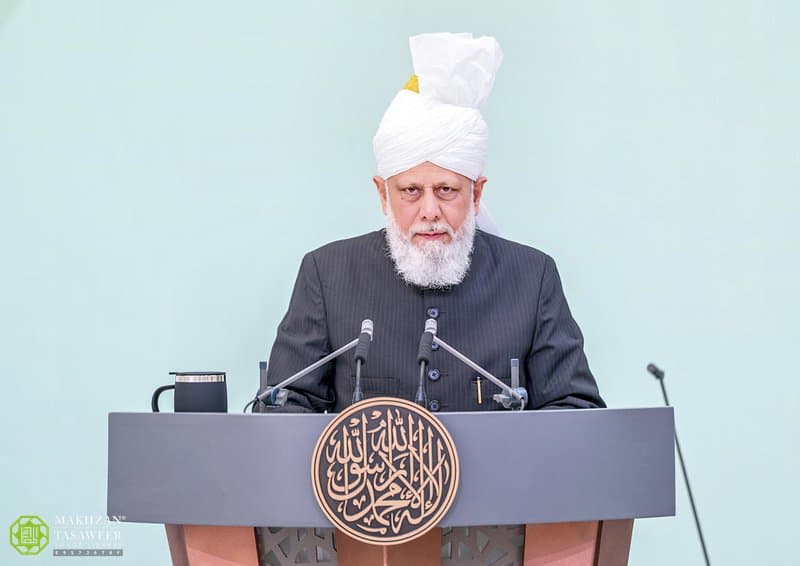
After reciting the tashahhud, ta‘awwuz and Surah al-Fatihah, Hazrat Khalifatul Masih V (aa) said:
I have been discussing the simplicity and simple lifestyle of the Holy Prophet (sa). In the previous week, I also described the simple manner and method in which he ate and drank, among other matters. Continuing on from this, I shall mention some further details today about his simple lifestyle.
In one instance, Hazrat Musleh-e-Maud (ra) mentions the following:
“Each and every action of the Holy Prophet (sa) was imbued with simplicity and free from formality. Those who are accustomed to looking at the wealthy of this era would assume that, like them, the Holy Prophet (sa) also ate such exquisite food and that a royal banquet would be presented before him. They would be shocked to find out that the reality was the complete opposite. On the one hand, the Holy Prophet (sa) was a perfect example of simplicity; on the other, he was also an example to the world in his simple lifestyle. (That is, he was an example in every matter.)
“Hazrat Aisha (ra) relates that she said to her nephew Hazrat Urwah, ‘O nephew, we used to see the crescent moon, and then the next crescent moon would appear and then the next (that is, it often happened in the household); in this way, we saw three crescent moons (i.e. the lunar month would begin, a month would pass, and the next lunar month would begin) and two months would pass but no fire [for cooking] used to be lit in the houses of the Holy Prophet (sa).’ I mentioned the details of this in the previous sermon.
“The questioner asked, ‘Then what did you used to eat?’ Hazrat Aisha (ra) replied, ‘We would suffice on dates and water. Yes, it was also the case that the neighbours from the Ansar had milk goats, so they would gift the Holy Prophet (sa) some milk, and he would give this to us to drink.’
“Allah, Allah! How simple was his life, that no fire would be lit for two months at a time, and he would suffice with only dates and water or milk! Muslims should feel ashamed when witnessing the state of affairs. (There are wealthy people even among the Muslims.) Nowadays, they are overtaken by this illness of extravagance in their eating and drinking.”
Whilst trying to emulate them, those of a lesser standing try to spend similar amounts on food, and indeed act in this manner.
Hazrat Musleh-e-Maud (ra) has stated in his sermon:
“If one were to fully investigate, they would find that the Muslims spend the majority of their wealth on food and drink and remain in debt.”
Even today, I know from many of the letters I receive that indicate that financial demand is increasing. This increase is because our dietary standards have deteriorated and we feel we must have the finest food, whereas one should make do within the income they earn.
Hazrat Musleh-e-Maud (ra) writes:
“Here, it should also be noted that whilst the Holy Prophet (sa) was an example of simplicity, he did not approve of asceticism. If the most exquisite food was presented before him, he would eat from it. He would not reject good food out of self-denial. This is the excellence which the Holy Prophet (sa) holds over others, for he came for the whole world, not for a specific people or group. For this reason, he was to be perfect in every quality. While he was perfect in his simple lifestyle, he did not completely refrain from using good things. But in general, he would live a simple life, and he would only eat to live and to have the strength to work.”
In relation to this, Hazrat Musleh-e-Maud (ra) further states:
“Now look at this life in its totality, a person who is a king and has everything at his disposal; who could eat the most exquisite of foods if he so wills, and sit at lavish tables full of food, yet despite the ability to do this, he at times suffices on dates and water to quench his hunger, and at other times on barley bread. Sometimes he eats wheat bread, but it is from unrefined flour. No grand table of food is laid out before him, nor is food served in large platters. Instead, he eats simple food on an ordinary mat. Yet despite living so simply, he can work a thousand times more than those who eat the best food in this world and look after their bodies.
“The Holy Prophet (sa) also set an example by using the most exquisite foods; at the same time, he also set an example through his simple lifestyle for wealthy people whose ultimate goals are to have the finest foods and garments.” (Sirat-un-Nabi, Anwar-Ul-Ulum, Vol. 1, pp. 564-567)
As has been mentioned, the Holy Prophet (sa) would also eat good food. In this regard, there is the following narration:
“Ja‘far bin Amr bin Umayyah told me that his father said to him that it has been narrated that he had seen the Holy Prophet (sa) cutting meat from the shoulder of a goat to eat it. He was suddenly called for the prayer, so he left the knife there and then offered the prayer without performing the ablution.” (Sahih al-Bukhari, Kitab al-wudhu, Hadith 208, [Translation], Vol. 1, Nizarat Isha’at, p. 293)
He had performed the ablution prior to this, which is why there was no need to do it again.
The Promised Messiah (as) stated:
“The Islamic Sharia has not prohibited one from using a knife to eat. (Nowadays it is normal to use a knife and fork to eat.) Indeed, he forbade insisting on a particular word or action out of artificiality (there should not be such ostentation; rather, one should adopt simplicity) lest one begin to resemble another nation (because some nations only eat with a knife and fork). Otherwise, it is evident that the Holy Prophet (sa) used a knife to cut and eat meat. And he did this so that the Ummah would not be troubled. It is permissible to eat in this manner when one needs to, but to strictly eat in this way and show such pretence and to show contempt for other manners of eating is forbidden. This is because, gradually, a person reaches a point of imitation where they even cease to observe physical cleanliness like them.” (That is to say, there are certain nations that, if you begin to follow them and imitate every action of theirs, then just as they do not clean themselves [after relieving themselves] one would do the same. Even though Muslims are commanded to purify themselves. Thus, a time eventually comes when a person begins to abandon even the small matters and other commandments which, though they seem trivial, are actually of great significance. This is why one should not be pretentious. Indeed, should the need arise, there is nothing wrong with eating food in this manner [with knife and fork].
Then the Promised Messiah (as) states:
مَنْ تَشَبَّہَ بِقَوْمٍ فَھُوَ مِنْہُمْ
“This means that one should not adopt these practices as an obligation; otherwise, doing so occasionally out of a valid necessity is not forbidden. When one nation heedlessly imitates another nation, they become counted among them.”
He further states: “For example, sometimes due to the volume of work (speaking about himself), while sitting and writing, I say to put the food on a table and eat at the table. Yet, this does not mean I would eat exclusively at a table; I would also sit and eat on a floor-mat or upon a charpoy [traditional woven bed found in the subcontinent]. Therefore, in such matters, one should simply keep fulfilling one’s basic needs in view. In this Hadith, the word ‘Tashbih’ is to rigidly adhere to such practices as a fixed tradition. Otherwise, the simplicity of our religion is such a virtue that other nations have envied it and wished that such teachings existed within their own faiths. Indeed, the English have praised it, and they have adopted many principles by taking them from the Arabs, yet today, for the sake of ritualism, they feel compelled and cannot abandon them.” (Malfuzat, 2022, Vol. 4, p. 49)
In an account regarding one of the marriages of the Holy Prophet (sa) and his walima [marriage ceremony dinner organised by the groom], it is narrated by Hazrat Anas (ra): “The Holy Prophet (sa) freed Hazrat Safiyya (ra) and then married her.” Upon this, Hazrat Thabit (ra) asked Hazrat Anas (ra), “O Abu Hamza, what dowry did the Holy Prophet (sa) give her?” He replied, “The Holy Prophet (sa) freed her.” He freed her from slavery, and this was her dowry. He then married her.
Later, while they were still on the journey, Hazrat Umm Sulaim (ra) adorned Hazrat Safiyyah for the Holy Prophet (sa) and sent her to him in the night. Thus, in the morning, the Holy Prophet (sa), who was a bridegroom, came out and said: ‘Whoever has anything, let them bring it forth,’ and he laid out a leather mat. One person brought dates while another brought clarified butter.” The narrator says. “I believe he also mentioned sattu [a drink made from ground barley water and sugar].” Nonetheless, he continues, “Then he combined everything and kneaded it, and all the guests seated ate it. And this was the Holy Prophet’s (ra) Walima reception.” (Sahih al-Bukhari, Kitab as-salat, Hadith 371, [Translation], Vol. 1, Nizarat Isha’at, pp. 475-477)
As mentioned in the previous Friday sermon, the Holy Prophet (sa) would accept even the smallest gift. Regarding this, there is another narration: Hazrat Abu Hurairah (ra) narrates that the Holy Prophet (sa) said, “If I was invited to eat a goat’s shoulder or trotter, I would surely accept the invitation, and if the shoulder or trotter of a goat was sent to me as a gift, I would surely accept it.” (Sahih al-Bukhari, Kitab al-hibah, Hadith 2568, [Translation], Vol. 4, Nizarat Isha’at, p. 615)
Meaning even if the smallest gift were sent to him with sincerity, he would surely accept it.
Hazrat Zainul Abideen Waliullah Shah Sahib (ra) writes in the commentary on this hadith of the Holy Prophet (sa) from Bukhari, “The intent of the Holy Prophet (sa) here was to explain that he would not reject even the simplest invitation for food and the smallest gift.
“In a narration from Tabarani, Hazrat Umm Hakim al-Khuza’iah (ra) asked the Holy Prophet (sa), ‘Do you dislike gifts?’ The Holy Prophet (sa) replied, ‘Rejecting a gift is extremely disliked. Even if I am invited to eat trotters, I would accept the invitation.’ The Holy Quran counts the acceptance of a humble item as a gift among noble morals. Good morals demand that even if a small thing is given as a gift, it should be accepted. It is understood that Hazrat Umm Hakim al-Khuza’iah (ra) wished to gift something to the Holy Prophet (sa) but was worried that the gift would not be worthy of the Holy Prophet’s (sa) eminence. The Holy Prophet (sa) clarified through his statement that both the one giving and the one receiving a gift should not think that their gift is insignificant, or that it is against one’s status. The Holy Prophet’s (sa) previously mentioned command is a cure for both a sense of superiority and a sense of inferiority, which are curses that cause class disparity within a society. One section is declared a higher class, and the other is declared lower. This division causes societal harmony to crumble. The Holy Prophet (sa) sought to remove this disparity and division with this statement: تَھَادَوْاوَ تَحَابُّوْا.” (Sahih al-Bukhari, [Translation], Vol. 4, Nizarat Ishaat, p. 615) That is, “give one another gifts, and increase your love for one another”. This is a commandment.
The Holy Prophet (sa) would also accept everyone’s invitations. Hazrat Anas bin Malik (ra) relates: “A tailor invited the Holy Prophet (sa) for a meal that he had prepared. I also accompanied the Holy Prophet (sa) on this occasion. The man presented the Holy Prophet (sa) with barley bread and gravy that contained pieces of gourd and dried meat. I observed that the Holy Prophet (sa) was picking and eating the pieces of gourd from around his plate. From that day onward, I too began to prefer gourd.” (Shamail-un-Nabi, Imam Tirmidhi, p. 62, Hadith 155, Noor Foundation)
In this regard, Hazrat Musleh-e-Maud (ra) states: “A Companion narrates that on one occasion, the Holy Prophet (sa) was brought a meat dish that also contained gourd. With his hands, he picked pieces of gourd and ate them because he thoroughly enjoyed them. However, there also came a time when he would have no food at all.
“How foolish is he who questions why the Prophet Muhammad (sa) ate fine meat; how foolish is he who questions why the Prophet Muhammad (sa) partook in drinks made of fine honey; how foolish is he who questions why the Prophet Muhammad (sa) indulged in good food; for such a person does not see that the Prophet Muhammad (sa) also endured long periods of hunger, and he also tied stones to his stomach (when the hunger was unbearable).
“He also had days when a poor woman came to his home asking for food, and Hazrat Aisha (ra) states, ‘On that day, even we ourselves did not have anything to eat. After searching the entire home, I only managed to find a single date, and I handed that over to the woman. The woman put the date in her mouth and split it into two parts. She had her two daughters with her. She gave one half of the date to one daughter, and the other half to the other daughter.’
“Hazrat Aisha (ra) was quite impacted by the mother, and whilst recounting this incident to the Holy Prophet (sa), she said, ‘O Messenger (sa) of Allah! She was very hungry, and we did not have anything to eat at home except a single date. I gave that to her, but O Messenger (sa) of Allah, she did not eat the date herself. Instead, she split it in half and gave one piece to one daughter and the second piece to her other daughter.’ In response, the Holy Prophet (sa) said, ‘Aisha, if two daughters are born to a family and their parents raise them well, God surely grants those parents Paradise.’
“Thus, the Holy Prophet (sa) also endured such days when he would remain hungry for extended periods. However, when he was subjected to long periods of hunger, did he ever question God as to why he had to endure hunger?
“Today, if people receive slightly less food than usual, they cause an uproar.
“A person who does not complain of a lack of food during long periods of hunger is deserving of every comfort of the world, because he is content in every condition. He does not ask of his Master as though he is entitled to anything, but he takes and makes use of a thing when the Bestower grants it. When he is not given anything, he does not utter a word of displeasure.” (Khutbat-e-Mahmud, Vol. 29, pp. 61-62)
When a person speaks about the life of the Holy Prophet (sa) or studies it or hears about it, they will observe that in every single occurrence of his life, there are morals, wisdom and guidance to be learned. This is exactly what we witnessed in the aforementioned narration. In Introduction to the Study of the Holy Quran, whilst mentioning the life of the Holy Prophet (sa), Hazrat Musleh-e-Maud (ra) states:
“In respect to eating food and drink, the Holy Prophet (sa) would always observe simplicity. If his food ever had too much salt, not enough salt, or if the food was ill-prepared, he would never express any displeasure. As far as it was possible, he would eat such food and try to protect the sentiments of the cook; however, if the food was not worthy of consumption, he would simply refrain from eating it without making it apparent that the food caused him discomfort. Before beginning his meal, the Holy Prophet (sa) would sit upright and attentive toward his food. He would explain, ‘I do not like this arrogant practice, whereby people recline casually while eating.’” Just as I mentioned in the previous sermon as well, “‘as if they are not in need of the food.’ Whenever the Holy Prophet (sa) would receive food, he would distribute it amongst his Companions. Once, the Holy Prophet (sa) received some dates. He estimated the number of his Companions and calculated seven dates for each Companion.” He was living a simple life, in a simple environment, and thus he gave seven dates to each of his Companions.
“Hazrat Abu Hurairah (ra) narrates that the Holy Prophet (sa) never ate his fill of even barley bread. Once, he was passing by when he saw that some people had roasted a goat and were having dinner. When they saw the Holy Prophet (sa), they invited him, but he refused. The reason for his refusal was not because he did not like roasted meat; rather, he did not like such ostentatious practices. In their near vicinity were the poor, before whose eyes these people were roasting goat meat and enjoying it. Otherwise, according to other narrations, it is proven that the Holy Prophet (sa) would also partake in roasted meat.
“Hazrat Aisha (ra) also narrates that the Holy Prophet (sa) never ate to his fill for three consecutive days, and this remained the case until his demise.” (Dibacha Tafsir-ul-Quran, Anwar-ul-Ulum, Vol. 20, pp. 376-377)
Many of us who are able to eat fine foods ought to also remember the poor and needy during our meals, setting aside charity or any amount to assist them; in this manner, we could feed many impoverished people. Those who reside here are in far better circumstances than those living in poorer countries; thus, we should extend our help to them as well.
Hazrat Ibn ‘Abbas (ra) narrates: “On the day of the Conquest of Mecca, the Holy Prophet (sa) went to visit Umm Hani bint Abi Talib. At the time, he was hungry and inquired if she had any food they could eat. She said, ‘I only have a few pieces of dried bread, and I am embarrassed to present those before you.’ He said, ‘Bring them to me.’ There were no formalities, only simplicity. He dipped the pieces of bread in water. She brought salt for him. The Holy Prophet (sa) asked if there was any broth, upon which she said, ‘O Messenger (sa) of Allah, I have nothing except vinegar.’ The Holy Prophet (as) asked her to bring it. He poured the vinegar over the food and ate it, and thanked Allah the Almighty. Then, he said, ‘How excellent is vinegar as a broth. O Umm Hani, a home that has vinegar cannot be considered poor.’” (Al-Mu‘jam al-Saghir, Imam Tabarani, Dar Al-Kotob Al-Ilmiyah, pp. 67-68)
In another narration, the Holy Prophet (sa) states, “Vinegar is a broth consumed by the Prophets.” (Sunan Ibn Majah, Kitab al-at‘imah, Hadith 3318)
Hazrat Abu Ubaidullah bin Ali (ra) narrates from his grandmother, Hazrat Salama (ra), that Hazrat Hasan bin Ali (ra), Hazrat Ibn Abbas (ra) and Hazrat Ibn Ja’far came to her and said: “Prepare for us a meal that the Holy Prophet (sa) used to like and enjoyed eating.” To this she replied: “O my sons! It was such simple food that we would not like to eat it now.” They said: “Why would we not? Please prepare something for us.” The narrator says: “She stood up and crushed some barley and then placed it in a cooking pot. She put in a small amount of olive oil and chillies as well as some ground condiments. She then placed it in front of them and then said: ‘This is the food that was once given to the Holy Prophet (sa) and he enjoyed it.’” (Shamail-un-Nabi, Imam Tirmidhi, Hadith 171, Noor Foundation, pp. 66-67)
Hazrat Aisha (ra) narrates: “I never heard the Holy Prophet (sa) use harsh language against anyone, nor were his clothes piled up.” (Sunan Ibn Majah, Kitab al-libas, Hadith 3554)
He had excellent morals, but the actual purport here was that he never had a pile of clothes. He lived a very simple life and had one set of clothes. He did not have another set of clothes that could be folded away to be worn at a later time. At times, if the clothes needed to be washed, he would leave the house before the clothes had even dried and wet patches were still visible. (Sirat-un-Nabi, Shibli Nu’mani, Vol. 1, Part 2, Maktabatul Harmain, p. 193; Sunan an-Nasa‘i, Kitab at-taharah, Hadith 296)
This was the level of his simplicity, the likes of which an affluent person can never achieve, nor has anyone ever demonstrated such a standard.
Hazrat Ibn Umar (ra) narrates that on one occasion Hazrat Umar (ra) saw Utarid Tamimi selling a striped silky outfit in the market. He was an individual who would frequently visit kings and received presents and gifts from them. Upon this, Hazrat Umar (ra) said: “O Messenger (sa) of Allah, I have seen Uttarid selling a striped silky outfit in the market. If you purchase it, you can wear it when different Arab delegations come to visit you. It will leave a good impression on them.” The narrator states: “I believe he also said that he can wear it on Fridays.” Upon this, the Holy Prophet (sa) stated: “Only those people wear silk in this life, who will have no share for them in the hereafter.” Sometime later, the Holy Prophet (sa) received some striped silk outfits. He sent one to Hazrat Umar (ra), one to Hazrat Usama bin Zaid (ra) and one to Hazrat Ali bin Abi Talib (ra) and said: “You can cut these up to make shawls for your wives or other clothes for them.” The narrator states: “Hazrat Umar (ra) took his outfit and brought it along to see the Holy Prophet (sa), then said: ‘O Messenger (sa) of Allah! You sent this to me, (i.e. the silk outfit), but yesterday you said such and such about the outfit of Uttarid. (i.e. that it is wrong). But despite this, you sent it to me; what is the reason behind this?’ The Holy Prophet (sa) replied: ‘I did not send it to you so that you should wear it; rather, I sent it to you so that you may make use of it. So that you can give it to your wives to wear.’ When Hazrat Usama bin Zaid (ra) came, he was wearing the outfit. The Holy Prophet (sa) examined him closely, from which he understood that the Holy Prophet (sa) was displeased with him. He submitted: ‘O Messenger (sa) of Allah! Why do you look at me in such a manner when it was you who sent this to me?’ He replied: ‘I did not send it so you can wear it. I sent it to you so you can give it to the women in your home.’” (Sahih Muslim, Kitab al-libasi wa z-zinah, Hadith 3838, [Translation], Vol. 11, Noor Foundation, pp. 149-151)
In the previous sermon, I explained that silk was used as a show of grandeur and prestige or to show beauty. However, adornment is a prerogative for women; men should not adorn themselves in this manner. Or they should not wear an outfit that indicates a sign of arrogance. (Fath-ul-Bari, Vol. 10, Aaram Baagh Karachi, p. 351)
Hazrat Hafsah (ra) narrates that Utarid bin Hajib brought silk fabric which had been given to him by the Chosroes. Hazrat Umar (ra) said, “O Messenger (sa) of Allah, shall I not buy this cloth for you?” The Holy Prophet (sa) said, “Only such a person would wear it who has no part of the hereafter.” (Al-Mu‘jam al-Kabir, Vol. 23, Maktabah ibn Taimiyyah, p. 216)
Whilst mentioning this expensive cloak and the incident of Hazrat Umar (ra) liking this cloak for the Holy Prophet (sa), Hazrat Musleh-e-Maud (ra) states:
“The Holy Prophet (sa) adopted so much simplicity in his attire that upon reading about it today, I truly became embarrassed. Although circumstances today have changed and it is necessary to make changes according to evolving circumstances, on account of my love for the Holy Prophet (sa), despite the changing circumstances, I still feel embarrassed. Hazrat Umar (ra) relates, ‘Once, there was a cloak that I liked which had been brought by a merchant to be sold. I took it to the Holy Prophet (sa) and said, “O Messenger (sa) of Allah (sa), why don’t you buy this? It can be worn on Eid and other such occasions, and it would look nice.”’ Hazrat Umar (ra) says, ‘After hearing what I said, the Holy Prophet’s (sa) countenance became red’. In other words, he greatly disliked this and said, ‘These sorts of things apply to Caesar and Chosroes. Umar, Allah the Almighty has not decreed these things for us.’ […]
“Even if we remove the difference of the changing times from the degree of simplicity the Holy Prophet (sa) observed in his attire (meaning that times have changed and the simple attire of that era no longer exists today), the simplicity adopted by the Holy Prophet (sa) in his clothing still stands as a benchmark of profound simplicity.
“It is true that the availability of fabric was less at that time, which is why their prices were higher, while fabric is quite cheap today. The clothes worn by the wealthy at that time are worn by the poor of today. The clothes worn by the poor today were a sign of wealth at that time […] Despite this difference between the two eras (there was indeed a great difference; there have been great advancements), even if this difference were to be accounted for, or removed completely, the Holy Prophet’s (sa) life still stands to be extremely simple. The truth is, without this, the means for the entire world’s progress would not have existed. (Khutbat-e-Mahmud, Vol. 19, pp. 844-845)
This is because the Holy Prophet (sa) was to reform the entire world, and he was thus to establish the absolute best example. However, aside from silk, the Holy Prophet (sa) did not forbid men from wearing good clothes. In one narration, it is recorded that Hazrat Abdullah bin Mas‘ud (ra) relates that the Holy Prophet (sa) said: “Such a person who possesses even an iota of arrogance will not enter paradise.” A man said, “One desires to wear good clothes and good shoes.” The Holy Prophet (sa) said, “Allah the Almighty is Beautiful and loves beauty. Wear good clothes and good shoes. Arrogance is to consider oneself better than others and to deny the rights of others while considering them to be inferior – this is arrogance.” (Sahih Muslim, Kitab al-iman, Vol. 1, Hadith 123, Noor Foundation, p. 83)
Even if one is to wear good clothes, then they can; however, they should not consider others to be inferior, nor should they become arrogant, or refuse the rights of others.
Abu Burdah narrates, “Hazrat Aisha (ra) brought to us a sheet and a thick waistcloth [garment covering lower half of the body and said, ‘When the Holy Prophet (sa) passed away, he was wearing these very two sheets.’” (Sahih al-Bukhari, Kitab al-libas, Hadith 5818, [Translation], Vol. 14, Nizarat Ishaat, p. 242)
This is further explained in another hadith from Sahih al-Bukhari as follows: Abu Burdah relates, “Hazrat Aisha (ra) brought a mended sheet to us. She took it out and said, ‘The Holy Prophet (sa) passed away while wearing this.’” (Sahih al-Bukhari, Kitab al-libas, Hadith 3018, [Translation], Vol. 5, Nizarat Ishaat, p. 455)
Even that sheet had been mended.
Hazrat Samurah bin Jundab (ra) related that the Holy Prophet (sa) said: “Wear white clothes because they are the purest and best clothes; and bury your deceased in them.” (Sunan at-Tirmidhi, Hadith 2810)
Hazrat Aisha (ra) narrates: “The Holy Prophet (sa) said to me, ‘If you wish to meet me in the hereafter, then you should consider this world to be like the means of a traveller; and avoid the company of the wealthy; and do not abandon wearing any clothes until you have mended them.’” (Sunan at-Tirmidhi, Hadith 1780)
The Holy Prophet (sa) encouraged the habit of simplicity within his family as well. He gave this guidance and set this example for the poor as well, and he strove to make his family an example for this, so that no poor person fell into any sort of inferiority complex. He also advised the affluent that those whose attire is only to be seen by others and is a means of ostentation become far removed from remembering the hereafter. Thus, one should wear good clothes, all the while remaining mindful of the hereafter.
Then, one should also remain mindful of the poor. With regard to shunning arrogance in the clothes one wears, the Holy Prophet (sa) enjoined wearing simple clothes to avoid any sort of arrogance or wearing such clothes that would lead one to think too highly of oneself. Hazrat Abu Hurairah (ra) narrates that the Holy Prophet (sa) said: “On the Day of Judgement, Allah the Almighty will not look towards a person who dragged his waistcloth out of arrogance.” (Sahih al-Bukhari, Kitab al-libas, Hadith 5788, [Translation], Vol. 14, Nizarat Ishaat, p. 212)
There is nothing inherently wrong in wearing a long waistcloth. The Holy Prophet (sa) said to Hazrat Umar (ra) and to Hazrat Abu Bakr (ra) that this did not apply to them because they were not arrogant. This applied to those who wore long clothes and then dragged them out of arrogance. (Sahih al-Bukhari, Kitab faza’ili ashabi n-nabiyy, Hadith 3665, [Translation], Vol. 7, Nizarat Ishaat, pp. 156-157)
Hazrat Abu Hurairah (ra) narrates that the Holy Prophet (sa) said: “When a person was walking arrogantly whilst wearing two sheets and was feeling very happy about himself, Allah the Almighty buried him in the ground, and he will continue to sink in the ground until the Day of Judgement.” (Sahih Muslim, Kitab al-libas wa az-zinah, Hadith 3881, [Translation], Vol. 11, Noor Foundation, pp. 179-180)
Hazrat Abdullah bin Umar (ra) relates that the Holy Prophet (sa) said: “A person who puts on the garment of fame in this world will be adorned by God in the garment of disgrace on the Day of Judgement and will be burned in the fire.” (Sunan Ibn Majah, Kitab al-libas, Hadith 3607)
Hazrat Abu Dharr (ra) relates that the Holy Prophet (sa) said: “A person who wears the garment of fame (in other words, clothes that are worn to attain fame, to show off or for ostentation), Allah the Almighty will turn away from them until they abandon such clothes.” (Sunan Ibn Majah, Kitab al-libas, Hadith 3608)
Hazrat Miqdam bin Ma’di Karib (ra) says: “I heard the Holy Prophet (sa) say, ‘The worst vessel that a person fills is the stomach. A few morsels are enough for the son of Adam.” In other words, the stomach is also a type of vessel; if it continues to be filled, it will become ruined. The Holy Prophet (sa) said that “A few morsels are enough for the son of Adam to keep them standing upright. Eat enough to maintain your health. If it is necessary, then a third of your stomach is for food (If one has enough food to eat to their fill, then one should eat enough to fill a third of their stomach.) Leave one third of your stomach for fluids and leave a third in order to breathe.” (Sunan at-Tirmidhi, Abwab-ul-Zuhd, Hadith 2380)
Not only did the Holy Prophet (sa) teach simplicity in diet, he also taught the etiquettes of eating. One should not eat to their fill. One should not eat so much that it becomes difficult for them to breathe. Today, people who experience stomach issues are given the same advice by doctors as was given 1,400 years ago by the Holy Prophet (sa).
Hazrat Aisha (ra) relates that a bowl of milk and honey was presented to the Holy Prophet (sa), who said, “I do not need two drinks in one, nor two broths in one pot. I do not say that this is unlawful, but I would not like Allah the Almighty to hold me accountable for the excessive use of worldly provisions.” (That is, he did not approve for himself even of drinking milk mixed with honey, or of eating two broths [in a single meal].) He continued, “I show humility for the sake of Allah, and whoever does so, Allah raises him in status; whoever acts arrogantly, Allah will humiliate and ruin him. Whoever adopts moderation, Allah will make him self-sufficient, and whoever remembers death often, Allah will love him.” (Al-Mu’jam al-Ausat, Hadith 4894, Vol. 3, Dar-ul-Fikr, p. 382)
Hazrat Musleh-e-Maud (ra) states:
“Because people who lead simple lives are accustomed to enduring hardship, they hardly feel it in times of difficulty. For example, we observe these days that the challenges facing the people of Europe are routine for us. (This was said at that time, and the same is true today.) What they consider hardship and affliction is luxury and comfort to us, so we do not even notice those hardships. (If one looks at poorer or developing nations, they are unaware of certain things, whereas here, people become distraught if they lack something.) What are people saying these days? They claim that a great calamity has befallen them simply because they do not have good clothes to wear. Yet, this should not be the slightest cause for concern for a true believer.”
Hazrat Musleh-e-Maud (ra) continues:
“Just a few days ago, some people told me that it is becoming difficult to find clothes. I replied, ‘So what?’ The condition of a true believer is such that if he is able to acquire new clothes, he does so, and if he is not, it is of no concern to him. He can simply stitch a patch on his old clothes and get by. I then told them that the clothes of the Holy Prophet (sa) and his companions had patches stitched on them, and asked whether we are better than they were, that we cannot stitch patches on our own clothes. In fact, during the time of the Holy Prophet (sa), there were people who had very few clothes. Some had an upper garment but no trousers, while others had trousers but no upper garment.
“There was a young boy in the time of the Holy Prophet (sa), (Hazrat Musleh-e-Maud [ra] related an account); he had memorised a large part of the Holy Quran. On one occasion, some people submitted to the Holy Prophet (sa) that there were people in a certain area who required an Imam to lead them in Salat. And so, the Holy Prophet (sa) sent that young boy.”
This example concerns a man who owned no trousers. Given the present economic conditions, people are, as I mentioned earlier, complaining that they lack this or that. If a world war were to break out, who knows how much worse matters would become? We should therefore remain mindful of this. In any case, I was relating the example of the young boy. The Holy Prophet (sa) sent the young boy to lead the prayers and appointed him as their Imam.
“In the time of the Holy Prophet (sa), the men would stand in the front rows, and the women would pray in the rows behind. Once, while he was leading the congregational prayer, he raised his head from sajdah [prostration] and said, ‘Allahu Akbar’ [Allah is the Greatest]. One of the women raised her head slightly earlier. The young boy’s upper garment was quite short, and he did not have any trousers. Her glance happened to fall upon him, and she noticed that he was [partially] exposed. This was in the early period of Islam, and she began to cry out, ‘O people! Cover the private areas of your Imam!’ So the people collected some funds and bought him a cloth to tie around his waist.”
Hazrat Musleh-e-Maud (ra) states:
“Would you say this young boy’s respect was any less because he did not have a lower garment? Today there are many exceedingly wealthy and distinguished people, yet the standing of this young boy is undoubtedly far greater. Indeed, in the sight of God, his rank exceeds that of all those wealthy people who fall short of him in taqwa [righteousness]. We never say ‘May Allah be pleased with him’ after the names of the mighty rich of this world, and we would refuse even if compelled. Yet, we would certainly say ‘May Allah be pleased with him’after this young boy’s name. If someone verbally insulted a mighty king, a believer’s heart would not be grieved, but if someone verbally insulted this young boy, a believer’s heart would be pained, because he knows the boy was a companion of our beloved master. Thus, not even a mighty king of this world receives the respect that is given to this young boy.”
Hazrat Musleh-e-Maud (ra) continues:
“I told those friends that they should not feel a sense of loss over being unable to acquire new clothes, but should instead pray to God Almighty that there is no shortage of grain. As long as people continue to receive grain, we can say, in light of the way of life Islam teaches us, that no calamity has befallen us. Food is a provision essential to the sustenance of life, and so long as it is not in short supply, one feels no hardship. Everything else is secondary, and whether or not one obtains it makes no real difference. Nowadays, the bread in England is referred to as ‘black bread’ (this was at the time of the Second World War), as it consisted of grain mixed with other ingredients. Consequently, people would bemoan that the bread was black.”
In those days, the bread produced was black. Hazrat Musleh-e-Maud (ra) states:
“However, our people eat bread made from pure millet, and they do not experience this as any kind of hardship. By contrast, if even a little something was added to the flour, they (that is, the people of England, Europe and other developed nations) would cause an uproar, claiming that a calamity had befallen them because they would have to eat bread of a darker shade.”
This he mentioned during the Second World War. He further stated:
“Millions of people in our country eat millet and barley. In some areas, they even make flatbread [rotis] from finger millet (which is a fine grain).”
Hazrat Musleh-e-Maud (ra) states:
“I have also eaten flatbread made from finger millet, and it is very thick and coarse. This grain grows spontaneously, and people use it in times of famine. In our country, however, people eat millet, barley and finger millet without crying over it or feeling that they are being subjected to great hardship. The people of Europe, by contrast, eat better food than we do, yet they cry out that they are suffering great hardship. They experience this hardship because they have failed to act upon the teachings of Islam. Had they followed those teachings, they would have adopted simplicity in their diet and clothing, and would therefore not have experienced any hardship. Indeed, they would not even have fought one another. The reason they are fighting each other is that one nation is seeking to seize the wealth of another.” (Khutbat-e-Mahmud, Vol. 24, pp. 172-174)
This is the case today as well. Wars are taking place in order to seize the wealth and land of others. Just as I have mentioned many times before, the conditions of war are increasingly worsening, and if the war widens in scope, Europe and the whole world will face great difficulties with regard to food supplies. Hazrat Musleh-e-Maud (ra) gave the example of India at that time. By contrast, people in Africa and other less developed countries live on a simple diet and are content even if they have basic food. They will be able to endure the hardships of war, whereas Europe and other developed nations will not be able to bear such conditions and will be greatly distressed. We should therefore reflect upon our own condition as well and develop contentment within us. We should strive to lead simple lives and follow the example and counsel of the Holy Prophet (sa). One should certainly eat good food and wear good clothes if one has the means. However, to become wholly dependent on such things, or to become greatly distressed over them, is wrong. We should also pray that Allah the Almighty protects the world from such calamities and restrains those who, driven by their personal egos, are bent on falling into the pit of destruction. If the current conditions persist, a world war will be inevitable, and the destruction that follows it will be as well. Instead of seizing the wealth and land of others, such people should seek to help their own people. May Allah the Almighty also enable us to remain firm upon virtues.
(Official Urdu transcript published in the Daily Al Fazl International, 20 November 2026, pp. 2-8. Translated by The Review of Religions.)