

Friday Sermon
5 December 2025
Muhammadsa: The great exemplar
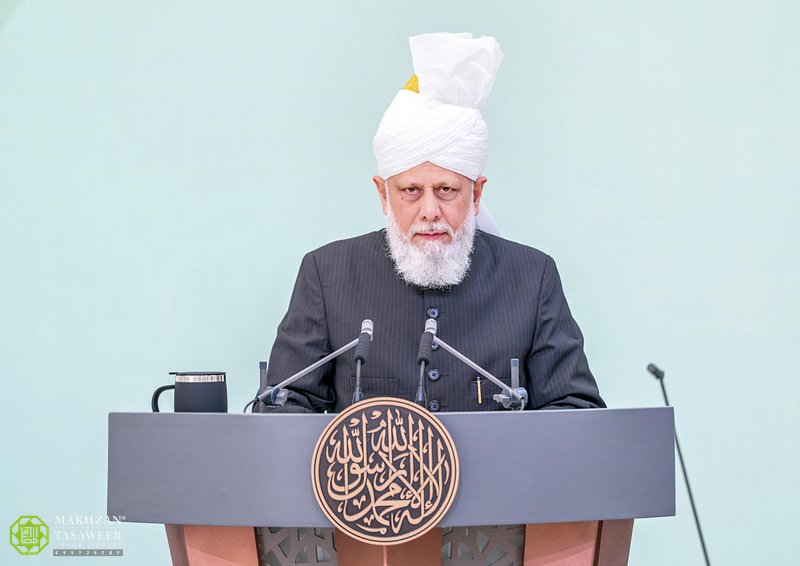
After reciting the tashahhud, ta‘awwuz and Surah al-Fatihah, Hazrat Khalifatul Masih Vaa stated:
In the previous sermon, it was mentioned that Hazrat Ka’b bin Malik and some other Companions remained behind on the occasion of the Battle of Tabuk, and the Holy Prophetsa subsequently expressed his displeasure at this. Hazrat Musleh-e-Maudra has also discussed this and admonished the Jamaat through this. He states:
“In the ahadith, it is recorded that three believers did not participate in this battle. In the ahadith, a lengthy statement of one of them has been recorded. He (i.e., the Companion) says: ‘When I went to the Holy Prophetsa after his return, I inquired from the people whether or not any of the others who stayed behind had come as well, what excuses they presented and how they were treated.’ They said that people came and presented excuses as soon as they arrived and said, ‘O Messengersa of Allah! Pray for our forgiveness.’ In return, the Holy Prophetsa prayed for them. He further says (i.e., Hazrat Ka’b), ‘I also thought of presenting an excuse and being saved from rebuke. However, another thought came to mind, and I asked the Companions about who had already come. They named a few individuals, but they were all hypocrites. They only mentioned two believers and said that they did not present any excuses. On the contrary, they acknowledged their mistake. Upon this, I thought to myself, why should I join the hypocrites? Rather than presenting excuses, which cannot be deemed as valid excuses, it would be better to clearly say that I made a mistake and that the Holy Prophetsa could deal with me as he pleased. As this thought entered my mind, I decided to confess to my mistake, and by doing so, Allah the Almighty protected me from joining the hypocrites. I went and clearly told the Holy Prophetsa that it was due to my indolence and negligence that I did not participate in the battle; there was no other valid excuse. Upon this, the Holy Prophetsa said that “until Allah the Almighty reveals His decree in relation to you, we will break our ties with you.”’ The name of this Companion was Ka’b bin Malik. He says: ‘This decision caused us great distress as only Muslims were living in Medina and not even anyone from among the hypocrites dared to speak to us.’”
I have mentioned this entire incident very briefly, as I have already presented the details in the previous sermon. Hazrat Musleh-e-Maudra mentioned this in a sermon, and as I said, he also referenced this incident in order to impart guidance to the Jamaat. Hazrat Musleh-e-Maudra states: “I have seen here (this was referring to Qadian in 1936) that regarding those whom it is stated they must not be spoken to (that is, those who have been handed a punishment), they go to the houses of Ahmadis in the local areas. It appears as if the locals are heedless and are not even aware of this. Some Ahmadis here are nourishing vipers in their chests, but they should remember that these vipers can neither harm God nor His Messengersa nor the Khalifa. They can only harm those who are hosting them. By the grace of Allah the Almighty, we are safe, because who can bite the one whom Allah the Almighty takes into His protection? They will only bite those whom they are able to bite. It is regrettable that although they are able to see, they are turning a blind eye to the movement of these vipers.”
In that time, certain trials had arisen due to which he had to give such instructions. In short, he goes on to say that in Medina, not even the hypocrites would speak to them.
“Ka‘b bin Malikra further narrates: ‘A few days after this instruction, it became known that the Messengersa of Allah had said that even their wives and children should separate from them. Among the three of us, one Companion was elderly. His wife went to the Holy Prophetsa and said, ‘O Messengersa of Allah, my husband is already nearing his end. He neither eats nor sleeps, and due to his old age, he is constantly in need of help. He has not been capable of conjugal relations for some time now. If you permit, I can assist him with food and drink.’ The Holy Prophetsa replied, ‘Alright – you may give him this much help.’
“Hazrat Ka‘bra says, ‘This made me think that perhaps I should also request similar permission. But then I thought – he is an elderly man, whereas I am young. It would not be appropriate for me. So I said to my wife, “Go to your parents’ home, lest I call you one day and you refuse.” I did not think anyone else would speak to me. Due to the Holy Prophet’ssa love and compassion, I thought that, seeing my distress, he might take pity on me.
“‘For this reason, I would go to his gathering and loudly say “assalamu alaikum” [peace be upon you], then look to see whether his blessed lips moved. But he would not reply. I would become anxious, thinking perhaps his lips had moved, but I had not seen it. Then I would leave that sitting, return once again, say “assalamu alaikum” loudly, and look at his lips. Then I would leave again. But he would not reply – though occasionally he would glance at me from the corner of his eye.’
“He continues: ‘When many days passed, I went to my cousin, with whom I always ate and lived. He was working in his orchard. I said, “My brother, you are my confidant. We have always lived together and kept nothing hidden from each other. You know very well that I am a sincere Muslim and that there is not a fibre of hypocrisy in me. I have come today in great anxiety to ask you – tell me, am I a hypocrite?” He did not reply. He only raised his gaze to the sky, which meant: “Allah and His Messengersa know best.”’
“He then says, ‘When such a brother – my closest confidant – gave me this answer, it felt as though the earth had become constricted for me. I panicked, climbed over the orchard wall and ran toward the city in a frenzy. When I neared Medina, a man approached me and asked, “Are you so-and-so?” I said, “Yes.” He handed me a letter and said, “This is from such-and-such king” – a Christian Arab ruler under the Roman Empire.
“‘I opened the letter. In it, he had written: “We have learned that you are one of the nobles amongst the Arabs, yet Muhammad[sa] has humiliated you, while you deserved to be honoured. If you come to us, we will treat you according to your true rank.”’
“Ka‘b bin Malikra continues: ‘My heart was already in a state of distress from the answer my brother (i.e., by the answer his cousin had given him when he went to the orchard. He was deeply distressed at the time). When I read this letter, I was overcome by a state of shock, and I thought: “This is Satan’s last attack. It should not be the case that this causes me to stumble!” So I said to the messenger, “Follow me.” Nearby, a man was lighting a furnace. I tore the letter into pieces and threw it into the fire. I said, “Tell your king that this is my answer.”’
“These were the final moments of their trial. Eventually, Allah the Almighty showed mercy and revealed to the Messengersa of Allah that their mistake had been forgiven.” (Khutbat-e-Mahmud, Vol. 17, Friday Sermon 9 October 1936, pp. 655-658)
In another place, Hazrat Musleh-e-Maudra states:
“Just observe how great a lesson can be drawn from the incident of Ka’b bin Malik. He fought alongside the Holy Prophetsa in all battles. He was even present in the Conquest of Mecca. Yet, owing to indolence on his part, he remained behind in the Battle of Tabuk. The Holy Prophetsa gave him such a severe punishment that he did not even return his greetings of peace. He forbade the Muslims from speaking to him. To the extent that even his wife was ordered to stay separate from him. It was during this time that the messenger of the Ghassanid king brought a letter in which it was written: ‘Your companion has not shown you due regard; come and stay with me.’ Ka’b said, ‘This is the final onslaught from Satan,’ and with this, he put the letter in the furnace. He then told the messenger to relay his message to his king.”
Given the situation at the time, Hazrat Musleh-e-Maudra further states:
“There are some members of the Jamaat who, if they are questioned on a matter, reply by saying that ‘No consideration has been shown for our services and we were not shown due regard.’ It should be remembered that the administrative system of the Jamaat is one matter, and the services one renders are a separate matter. And in order to uphold the system of the Jamaat, the person who makes an error must be questioned, irrespective of who they may be. Therefore, in line with the command of God, strive in the way of faith in such a manner that Satan runs away. But do not do it for the sake of receiving praise, nor do it so that one may be spared from the consequences of their mistakes. Furthermore, do not boast of your favours before God Almighty, nor employ taunts or injury. Serve Islam through all means.” (Khutbat-e-Mahmud, Vol. 5, Friday Sermon 27 July 1917, pp. 527-528)
One should not remind of the favours conferred by them; this should be the spirit in which one should serve and seek to attain the pleasure of Allah. This was an excerpt from the early sermons of his Khilafat; the first one was from 1936.
The journey of the Battle of Tabuk proved to be such a wise and blessed journey that the awe of the Muslims was established over the whole region of Arabia, and in a short time, the flag of Islam began to wave over all of Arabia. (Dibacha Tafsir-ul-Quran, Anwar-ul-Ulum, Vol. 20, p. 363)
Thus, regarding this as well, Hazrat Musleh-e-Maudra has stated that, “After the return from Tabuk, the people of Ta’if also came and accepted their authority. (Before, they were adamant on fighting but then they accepted their rule.) Subsequently, various tribes came turn by turn and asked for permission to live under Islamic rule, and in a short period, the Islamic flag began to wave over all of Arabia.”
After returning, there was also a campaign, which is called the expedition of Hazrat Khalid bin Walid, which was towards Najran, to the Banu ‘Abd al-Madan, who were from among Banu Harith bin Ka‘b. Abd al-Madan, to whom the attribution of the tribe is made, was the forefather of Banu Harith, and his name was ‘Amr bin Yazid. According to the narration of Ibn Sa‘d, this expedition occurred in Rabi al-Awwal in 10 AH, whereas according to Ibn Hisham, this expedition took place in Rabi al-Akhir or Jumada al-Ula of 10 AH.
In The life and Character of the Seal of Prophets, Hazrat Mirza Bashir Ahmad Sahibra has stated the date of the expedition of Khalid bin Walid towards Najran as Rabi al-Awwal, 10 AH. (Ibn Sa’d, Al-Tabqat Al-Kubra, Vol. 2, Dar Al-Kotob Al-Ilmiyah, Beirut, 1990, p. 128; Ibn Hisham, Al-Sirah al-Nabawiyyah, Dar Al-Kotob Al-Ilmiyah, Beirut, 2001, p. 861; Ibn Habban, Al-Sirah al-Nabawiyyah Wa Akhbar-ul-Khulafa, Vol. 2, Part 3-4, Al-Kotob Al-Thaqafiyyah, Beirut, 1987, pp. 385-386; Sirat Khatam-un-Nabiyyeen, p. 833)
Nonetheless, the details are as follows: the Holy Prophetsa instructed Hazrat Khalid to invite them to Islam three times before fighting, i.e., the people towards whom the expedition was sent. If they accept, then it is better; otherwise, fight them. This meant that if they attempted to fight you, even then, you should give them the invitation to Islam’s teachings three times. If, after that, they still desire to fight, then so be it; wage war against them.
Thus, Hazrat Khalid did exactly that and all of them became Muslims. Hence, Hazrat Khalid stayed among them (meaning he only preached to them, and a war did not occur), and they became Muslims. Hazrat Khalid stayed among them and began teaching them about Islam, the Book of Allah, and the Sunnah of the Holy Prophetsa and this was exactly what the Holy Prophetsa had instructed Hazrat Khalid.
After this, Hazrat Khalid sent a letter to the Holy Prophetsa. In the letter he wrote: “To the Messengersa of Allah from Khalid bin Walid. May the peace, blessings and mercy of Allah be upon you, O Messengersa of Allah. I praise that God besides Whom there is no deity. After this: O Messengersa of Allah, may Allah send mercy upon you. You sent me to Banu Harith and instructed me to invite them to Islam for three days. Then if they accept Islam, I should stay among them and teach them the commandments of Islam, the Holy Quran, and the Sunnah of the Prophetsa. And if they do not accept Islam, then I should wage war against them. (Some matters are not detailed, and in other places, certain matters and reports are found, but the teaching of Islam is not that Islam should be forced upon anyone. The meaning was that if they do not enter a treaty, or if they still attempt to fight, then permission is given to fight against them.) So, I came to them, and according to your instruction, I invited them to Islam for three days, and I sent riders to them saying: ‘O Banu Harith, accept Islam, and you will remain safe.’ Thus, the people accepted Islam and refrained from war. (He preached, and they accepted Islam. From this phrase, it also becomes very clear that they refrained from war; if the opponents did not initiate the war, they did not do so either. These people had not gone to wage war; they had gone to preach, and this is what they did. Then he writes:) Now I am residing among them and am informing them of the commandments and prohibitions of the religion. Whatever command shall later be issued by you, I shall act according to it. May the peace, mercy and blessings [of God] be upon you, O Messengersa of Allah.’”
The Holy Prophetsa replied to this letter of Hazrat Khalid, saying: “In the name of Allah, the Gracious, the Merciful. From Muhammad, the Messengersa of Allah, to Khalid bin Walid. Peace be upon you. I praise that God besides Whom there is no other deity. After this: Your letter reached us along with its messenger, and I have come to know that Banu Harith have accepted Islam, and before any battle took place, they bore witness to ‘There is no god but Allah, Muhammadsa is the Messenger of Allah’, and this is the guidance of God, which He bestowed upon them. So, give them the glad tidings of God’s reward and make them fear the punishment of God. And take some of their men with you and come to us. May the peace, mercy and blessings of Allah be upon you.”
Hearing this instruction, Hazrat Khalid, along with some members from the Banu Harith tribe, presented himself before the Holy Prophetsa. The names of the people he brought with him are as follows: Qais bin Husain, Yazid bin Abdil Madan, Yazid bin Mu‘ajjal, Abdullah bin Qarad, Shidad bin Abdullah, and Amr bin Abdullah. When these people presented themselves before the Holy Prophetsa, he asked, ‘Who are these people? It seems like they are from the land of al-Hind?’ The Holy Prophetsa was told, “O Messengersa of Allah, these people belong to the tribe of Banu Harith.”
These people then addressed the Holy Prophetsa, saying, “We bear witness that you are Allah’s Messengersa and that there is none worthy of worship besides Allah.”
The Messengersa of Allah replied, “I also bear witness that there is none worthy of worship except Allah, and that indeed, I am His Messengersa.”
The Messengersa of Allah then asked them, “Are you those people who cause their enemy to flee when you engage them in battle?”
They remained silent. Nobody from among them spoke. The Messengersa of Allah asked them a second time, but they remained quiet again. Not one of them responded. He asked them a third time, and they did not respond. Finally, he asked them a fourth time – are you those people who used to cause your enemies to flee? Meaning they thought themselves to be very powerful.
Finally, Yazid bin Abdil Madan stepped forward and replied, “O Messengersa of Allah, we are indeed those people; when we engage our enemy in battle, we cause them to flee.” He repeated this four times – that indeed we are brave and experienced in warfare, but now this has come to pass.
The Messengersa of Allah replied, “If Khalid had not written to me that you all have accepted Islam, I would have had you all beheaded.”
Yazid responded: “We are neither indebted to you nor to Khalid.” He had just accepted Islam and so responded in this manner.
The Holy Prophetsa asked them, “Then who are you grateful to?”
He replied, “O Messengersa of Allah, we are grateful to Allah Who enabled us to be guided through you.” He also gave an excellent response too.
The Holy Prophetsa replied, “You have spoken the truth.”
The Holy Prophetsa then said, “Tell me, by what means did you use to fell your enemy in battle during the age of ignorance?”
They replied, “We used to fight as a united front. We knew that if we fought as one, we would be victorious, and no one would be able to overpower us. When Islam came and caused all the tribes to unite, the people of our tribe understood that this unity is too strong to compete with and not only is it better not to engage with them in battle, but we should accept Islam because it is the true religion.”
The Holy Prophetsa appointed Hazrat Qais bin Husain as the leader of the Banu Harith tribe. And either at the end of Shawwal or the beginning of Dhul-Qa‘dah, bid these people farewell. Four months after these people returned to their tribesmen, the Messengersa of Allah passed away. (Ibn Hisham, Al-Sirah al-Nabawiyyah, Dar Al-Kotob Al-Ilmiyah, Beirut, 2001, pp. 861-863)
The final expedition that the Holy Prophetsa took part in was Tabuk, while the final expedition he dispatched was that of Hazrat Usama.
The details of this expedition have already been mentioned in the accounts of Hazrat Usama and Hazrat Abu Bakrra, but I will briefly mention some of the context to the battle here as well. There is a narration in Sahih al-Bukhari by Hazrat Anas bin Malik, who stated that the Holy Prophetsa informed people of Hazrat Zaid, Hazrat Ja‘far and Hazrat Abdullah bin Rawaha’s demise before any news of their death reached the people. He explained that Zaid had taken the flag. (There was an expedition that took place before Usama’s expedition.) He explained that Zaid took the flag but was martyred. Then Ja‘far took the flag, and he too was martyred. Then Ibn Rawahah took the flag, and he was also martyred. The Holy Prophet’ssa eyes welled with tears while he described this account. He continued explaining; then finally, a sword from among the swords of Allah – Hazrat Khalid bin Walid – took the flag, until God Almighty granted him victory over the enemy. (Sahih al-Bukhari, Kitab al-manaqib, Hadith 3757, [Translation], Vol. 7, p. 243)
Upon returning from the Farewell Pilgrimage, when the Holy Prophetsa reached Medina, there no longer remained any threat to the people of Medina from the south. However, the danger from the Byzantines in the north still persisted. The Christians took great pride in their strength; thus, an attack from their side could occur at any time. Moreover, retribution for the martyrs of the Battle of Mu’tah had not been exacted. In that battle it was owing to the skill of Hazrat Khalid bin Walid that the Muslim army succeeded in returning to Medina.
Not many days had passed after the Holy Prophetsa returned from Hajj when, a few days later, he ordered that an army under the command of Hazrat Usamah bin Zaid be dispatched to launch an attack on Syria. (Muhammad Husain Haikal, Hiyat-e-Muhammad, Abu Afzal Muhammad Khan, p. 597)
The preparations for the army of Usamah were completed on Saturday, two days before the passing of the Holy Prophetsa, and its preparations had begun prior to the onset of his final illness. Towards the end of Safar, the Holy Prophetsa had instructed for preparations to be made to fight against the Byzantines. He called for Hazrat Usama and said, “Set out towards the place where your father was martyred.” Hazrat Zaid was martyred in that same place in an earlier battle. The Holy Prophetsa said, “Go there and trample them – i.e., the enemy – with your horses. I have appointed you as the commander of this army.” (Ibn Hajr, Fath-ul-Bari, Vol. 8, Qadeemi Kutub Khana Maqabil Aram Bagh, Karachi, p. 192)
In another narration, it is recorded that the Holy Prophetsa said, “Trample Balqa and Darum with your horses.” Balqa is a region in the land of Syria situated between Damascus and Wadi al-Qura. Darum is a place in Palestine after Gaza on the route to Egypt. While instructing the departure towards Syria, he said, “Then at daybreak launch an attack upon the people of Ubna.” Ubna is the name of a place in Syria towards Balqa. He further said, “Travel swiftly so that you reach them before the news of your advance reaches them. Thus, if Allah grants you victory, then do not prolong your stay there, and take guides with you for the route, and send informers and scouts ahead of you.”
The Holy Prophetsa tied a banner for Hazrat Usama with his own hands. He then said, “In the name of Allah, perform jihad in His path, and fight against him who denies Allah. Do not commit treachery. Do not kill women or children and do not desire confrontation with the enemy.” This clause, too, points to the danger from the enemy – that if the enemy attacks, then one must fight, but one must not desire confrontation. He said, “You may not be aware, but perhaps you may be tried through this. But you should say: ‘O Allah, be sufficient for us against them in whatever manner You please and avert this war away from us.’” Thus, he taught this prayer as well: that war is not necessary; if war can be averted, then avert it.
He continued, “If they clash with you and if battle ensues and they gather together raising a clamour, even then dignity and silence are incumbent upon you. Then fight with composure and dignity, and do not quarrel among yourselves, otherwise you will become cowardly, and your awe and prestige will vanish. Become unified, and say: ‘O Allah, we are Your servants and they too are Your servants. Our forelocks and their forelocks are in Your hand, and You alone can be sufficient against them.’ And know that Paradise lies beneath the shade of the swords.”
Hazrat Usama departed bearing the banner tied by the hand of the Holy Prophetsa and entrusted it to Hazrat Buraydah bin Husayb. He gathered the army at Jurf. Jurf is a place three miles north of Medina. From among the honourable Muhajirin and Ansar, not a single person remained who was not called for this expedition. Among them were Hazrat Abu Bakr, Hazrat Umar, Hazrat Abu ‘Ubaidah bin al-Jarrah, Hazrat Sa‘d bin Abi Waqqas, Hazrat Sa‘id bin Zaid, Hazrat Qatadah bin Nu‘man and Hazrat Salamah bin Aslam: all of them were placed under the command of Hazrat Usama. Some people began to say, “This youth has been made a commander over the most eminent of the Muhajirin. Among them are great and senior Companions! How can a young boy be appointed as their leader?”
When these comments reached the Holy Prophetsa, he became greatly displeased. At that time, his blessed head was wrapped with a cloth, and he had covered himself with a cloak. He ascended the pulpit, praised and glorified Allah, and said:
“O people! The words that some of you have uttered concerning Usama’s appointment as commander have reached me. If you object to my appointing Usama as leader, then know that you had objected before when I appointed his father as a leader. By God, he was fully deserving of leadership, and after him, his son too is deserving of it. He was among those dearest to me, and indeed, both father and son are of such noble character that only goodness can be thought of them. Therefore, think well of this man (i.e., Usama), for he is among the best of you.”
The Muslims who were to depart with Hazrat Usama would go to bid farewell to the Holy Prophetsa and then proceed to join the army at Jurf. Meanwhile, the Holy Prophet’ssa illness intensified, but he continued to urge them, saying: “Dispatch Usama’s army! Let them march ahead without delay.”
On Sunday, the pain of the Holy Prophetsa became more severe. When Hazrat Usama returned from the camp, the Holy Prophetsa was unconscious. He returned because he learned of his critical condition.
That day, the people had given the Holy Prophetsa some medicine. Hazrat Usama knelt down and kissed him. The Holy Prophetsa could not speak, but he raised both his hands toward the heavens and then placed them on Usama’s head. Hazrat Usama says, “I understood that he was praying for me.”
Hazrat Usama then returned to his army. On Monday, he came again to the Holy Prophetsa and found that he had somewhat recovered. The Holy Prophetsa said to him:
“Go forth with the blessings of Allah the Almighty.”
Thus, Hazrat Usama departed from the Holy Prophetsa and went to his army, ordering them to prepare for departure. But before they could set out, a messenger came from his mother – Hazrat Umm Aiman, the mother of Usama – bringing news that:
“It would seem that the Holy Prophetsa is in his final moments.”
Upon hearing this, Hazrat Usama immediately returned to the Holy Prophetsa, accompanied by Hazrat Umarra and Hazrat Abu Ubaidah. The Holy Prophetsa was nearing his demise at the time. Soon after this, he passed away.
Owing to his demise, the Muslim army returned from Jurf to Medina. Hazrat Buraidah bin Husaib brought back Hazrat Usama’s standard and fixed it at the door of the Holy Prophetsa.
According to one narration, when Hazrat Usama’s army had reached Dhu Khushab, the Holy Prophetsa passed away. Dhu Khushab is a valley about a night’s journey from Medina, on the route to Syria. In any case, the army returned.
After the demise of the Holy Prophetsa and the pledge of allegiance to Hazrat Abu Bakrra, Hazrat Abu Bakrra ordered Hazrat Buraidah bin Husaib to take the banner to Usama’s house and instruct him to proceed with his mission.
Hazrat Buraidah took the flag to the place where the army had first encamped. (Tarikh al-Tabari, Vol. 2, Dar Al-Kotob Al-Ilmiyah, Beirut, 2012, p. 244; Ibn Sa’d, Al-Tabqat Al-Kubra, Vol. 2, Dar Al-Kotob Al-Ilmiyah, Beirut, 2012, pp. 146-147; Subul al-Huda wa al-Rashad, Vol. 6, Dar Al-Kotob Al-Ilmiyah, Beirut, 1993, p. 248; Ibn Kathir, Al-Bidayah Wa Al-Nihayah, Vol. 3, Part 6, Dar Al-Kotob Al-Ilmiyah, Beirut, 2001, p. 302; Mu’jam-ul-Buldan, Vol. 1, Dar Al-Kotob Al-Ilmiyah, pp. 101 and 579-580; Furhang-e-Sirat, Zawar Academy Publications Karachi, 2003, pp. 87, 114 and 119)
The army consisted of three thousand men, among whom, according to one report, was a cavalry unit of one thousand. Another narration states that Hazrat Usama bin Zaid was sent towards Syria with seven hundred men. (Sharh Al-Allamah Al-zarqani ‘ala Al-mawahib Al- Ladunniyyah, Vol. 4, Dar Al-Kotob Al-Ilmiyah, Beirut, 1996, p. 155; Subul al-Huda wa al-Rashad, Vol. 6, Dar Al-Kotob Al-Ilmiyah, Beirut, 1993, p. 250; Ibn Kathir, Al-Bidayah Wa Al-Nihayah, Vol. 3, Part 6, Dar Al-Kotob Al-Ilmiyah, Beirut, 2001, p. 302)
It is related that on the second day after the Holy Prophet’ssa demise, Hazrat Abu Bakrra made a public announcement:
“The expedition of Usama will be completed as planned. No one from among the army of Usama shall remain behind in Medina. All of them must join the army at Jurf.” (Tarikh al-Tabari, Vol. 2, Dar Al-Kotob Al-Ilmiyah, Beirut, 2012, p. 244)
Hazrat Musleh-e-Maudra has described the situation as follows:
“When the Holy Prophetsa passed away, the whole of Arabia fell into apostasy. Even courageous men like Hazrat Umarra and Hazrat Alira were momentarily disheartened at the sight of this great turmoil. Shortly before his passing, the Holy Prophetsa had prepared an army to march towards the Roman territories and had appointed Hazrat Usama as its commander. However, the army had not yet departed when the Holy Prophetsa passed away.
“At his demise, when Arabia rose in rebellion, the Companions thought: ‘If, during such a time of revolt, the army of Usama is sent away towards the Roman frontiers, then only elderly men, women and children will remain behind in Medina, and there will be no means left for the city’s defence.’
“Therefore, they proposed that a delegation of the senior Companions should go to Hazrat Abu Bakrra and request him to delay the dispatch of the army until the rebellion subsides.
“Accordingly, Hazrat Umarra and other leading Companions went to him and presented their request to delay dispatching the army until the rebellion subsides.
“When Hazrat Abu Bakrra heard this, he replied with great indignation:
“‘Do you wish that after the demise of the Messengersa of Allah, the very first act of Abu Quhafah’s son should be to halt the army that the Holy Prophetsa himself had ordered to be dispatched?
“‘By Allah, even if the enemy were to invade Medina, and dogs were to drag the bodies of Muslim women through the streets, I would still not withhold this army which the Holy Prophetsa had commanded to go forth!’
“It was this faith and courage that Allah had instilled in Hazrat Abu Bakrra through His Word:
مُحَمَّدٌ رَّسُوْلُ اللّٰهِ وَ الَّذِیْنَ مَعَهٗ اَشِدَّآءُ عَلَى الْكُفَّارِ
“[Muhammad is the Messenger of Allah. And those who are with him are hard against the disbelievers, tender among themselves (48:30)]
“Just as when a current is passed through an ordinary wire it becomes charged with immense strength, likewise, through their attachment to the Holy Prophet Muhammadsa, his followers became embodiments of: اَشِدَّآءُ عَلَى الْكُفَّارِ “[hard against the disbelievers].” (Sair-e-Ruhani (6), Anwar-ul-Ulum, Vol. 22, pp. 593-594)
The Promised Messiahas has also described the dispatch of Usama’s army in his blessed book Sirr-ul-Khilafah:
“Ibn Athir writes in his chronicles: ‘When the news of the demise of the Messenger of Allah, peace and blessings of Allah be upon him, reached Mecca, its Governor, ‘Itab ibn Usaid, went into hiding and Mecca was shaken to the core, and it seemed imminent that its people would renounce Islam. He also records—The common and elite of every tribe in Arabia apostatised. Hypocrisy came out in the open, and Jews and Christians started looking for favourable opportunities. (In other words, they observed that the Muslims were weakened and could now be attacked.) Muslims were like sheep on a rainy night due to the loss of their Prophet, their small number and the multitude of their enemy. (They were like sheep soaked in the rain and immobilised.)
“It was at such a time that the people said to Hazrat Abu Bakr: ‘These people only consider the army of Usama to be the Muslim army, and, as you can see, the Arabs have rebelled against you. It is, therefore, not prudent to separate yourself from these soldiers.’ Upon this, Hazrat Abu Bakr said: ‘By the One who has my soul in His Hand, even if I am convinced that wild, predatory animals would snatch me away, I would still send out Usama’s army in accordance with what the Messenger of Allah had commanded. I will never go against a decision taken by the Messenger of Allah, peace and blessings of Allah be upon him.’” (Sirr-ul-Khilafah, Ruhani Khazain, Vol. 8, p. 394 [footnote], Urdu Translation, Nazrat-e-Ishaat Rabwah, pp. 188-189)
In short, Hazrat Abu Bakrra upheld and carried out the command of the Holy Prophetsa exactly as it had been given.
He instructed that all those Companions who had been appointed to the army of Usama by the Holy Prophetsa should immediately rejoin it, saying: “No person whom the Messengersa of Allah included in the army of Usama shall remain behind. I will not grant anyone permission to stay back. Even if he has to go on foot, he must join the army.” Not a single person remained behind – all of them went with the army. (Sharh Al-Allamah Al-zarqani ‘ala Al-mawahib Al- Ladunniyyah, Vol. 4, Dar Al-Kotob Al-Ilmiyah, Beirut, 1996, p. 155)
In any case, regarding Hazrat Abu Bakrra dispatching this army, it is written that when, according to Hazrat Abu Bakr’sra command, Usama’sra army gathered in Jurf, Hazrat Abu Bakrra himself went there and inspected the army and arranged its ranks.
Regarding this, it is also mentioned that Hazrat Abu Bakrra said to Hazrat Usama, “If you consider it appropriate, leave Hazrat Umarra behind so that he may assist me in my work,” as Hazrat Umarra was also included in that army. Hazrat Usama agreed to this. (Tarikh al-Tabari, Vol. 2, Dar Al-Kotob Al-Ilmiyah, Beirut, 2012, p. 246)
After this incident, whenever Hazrat Umarra met Hazrat Usamah, even after he was elected as the Khalifa, he would address Usama saying:
السلام علیک ایھا الامیر
Meaning, “O leader, peace be upon you.” In response, Usama would say:
غَفَرَ اللّٰہُ لَکَ
[“May Allah grant you forgiveness.”]
Hazrat Abu Bakrra instructed Hazrat Usama: “You must fully carry out everything that the Holy Prophetsa instructed you to do. Do not show any negligence whatsoever in fulfilling the commands of the Holy Prophetsa.” (Al-Kamil Fi Tarikh, Vol. 2, Dar Al-Kotob Al-Ilmiyah, Beirut, 2006, pp. 199-200; Al-Sirah Al-Halabiyyah, Vol. 3, Dar Al-Kotob Al-Ilmiyah, Beirut, 2002, p. 294; Tarikh al-Tabari, Vol. 2, Dar Al-Kotob Al-Ilmiyah, Beirut, 2012, p. 246)
The details of the battle have already been mentioned previously, so I will leave that aside. Just as the Holy Prophetsa had said, this army returned victorious. The enemy was either killed or taken prisoner. Not a single Muslim life was lost in the battle. According to narrations, this army returned to Medina after remaining away for 40 to 70 days.
Hazrat Abu Bakr’sra love for the Holy Prophetsa was such that he said regarding Usama’s flag, which the Holy Prophetsa had tied with his own hands, “How could it be that the son of Abu Quhafah should undo the knot of that flag which the Holy Prophetsa himself tied with his hands?” Consequently, when the army of Usama returned, the knot of that flag was not untied, and that flag remained in Hazrat Usama’s house thereafter, until Hazrat Usama passed away. (Al-Kamil Fi Tarikh, Vol. 2, Dar Al-Kotob Al-Ilmiyah, Beirut, 2006, p. 200; Ibn Sa’d, Al-Tabqat Al-Kubra, Vol. 2, Dar Al-Kotob Al-Ilmiyah, Beirut, 2012, p. 147; Munir Muhammad Al-Ghazban, Al-Maseeratul Islamiyyah Li Jil-ul-Khilafah Al-Rashidah Al-Majlid Al-Awwal Abu Bakr Siddiq, Dar-ul-Islam, 2015, pp. 34-35)
اللّٰھُمَّ صَلِّ عَلیٰ مُحَمَّدٍ وَاٰلِ مُحَمَّد
[“O Allah, send blessings upon Muhammadsa and the people of Muhammadsa.”]
With this, the series on battles and expeditions concludes. I will see about presenting other aspects from the life of the Holy Prophetsa in the future, insha-Allah.
At this time, I also wish to mention two deceased members and will lead their funeral prayers afterwards, insha-Allah.
The first is respected Azizur Rahman Khalid Sahib, a missionary of the Jamaat, who recently passed away in America at the age of 79.
اِنَّا لِلّٰہِ وَاِنَّآ اِلَيْہِ رٰجِعُوْنَ
[“Surely, to Allah we belong and to Him shall we return.”]
The deceased’s maternal grandfather was Hazrat Mian Rang Ali Sahibra, a Companion of the Promised Messiahas. Regarding his admission to Jamia, Azizur Rahman Khalid Sahib relates that when he was in seventh grade, one day during the assembly at Talim-ul-Islam High School, Hazrat Maulana Qazi Muhammad Nazir Sahibra came and delivered a lecture on the need and importance of devoting one’s life. This lecture had a profound effect on many students. When the lecture ended, the deceased felt a strong desire to devote his life. He went straight to Jamia, and after a brief interview, he was admitted in 1960. He obtained the Shahid degree from Jamia in 1969. It took him nine years to complete Jamia as he had suffered a train accident, which caused serious injuries, resulting in him falling behind by two years. Despite this, he did not give up, and his life was saved. He used to say that it was through the prayers of Hazrat Khalifatul Masih IIIrh that his life was saved.
After becoming a missionary, he served abroad in Sierra Leone, Nigeria, Ghana, Tanzania and Zanzibar. In Pakistan, he served in various places as a missionary. Upon returning, he continued serving in Tahrik-e-Jadid, in Wakalat-e-Ishaat in Rabwah. His grandson, Hamza Obaidullah, who is also a missionary and a graduate of Jamia, says that Azizur Rahman Sahib used to tell him that there were times in Africa when he would boil rice, sprinkle salt over it and eat it; there would be no curry or other food available. At times, even such simple food would not be available, not even boiled rice, and sometimes they had to remain hungry for several days. These were the kinds of sacrifices made by the early missionaries, which today’s missionaries should keep before them.
His son, Anisur Rahman Anas, says that he would never allow food to be wasted. Even at Jalsa, many times, instead of having food served on a plate, he would simply eat the leftover pieces of bread from the tables. He would say, “If the Promised Messiahas could eat these pieces of bread, why can’t we?” From his youth, he was devoted to Tahajjud. He was kind, sociable, compassionate, pious, hardworking and loyal. He had a deep bond of love with Khilafat. The deceased was also a musi. He was with me in Ghana while I was there. He worked with great loyalty, effort and simplicity. He served selflessly. He is survived by two sons and three daughters, and many grandchildren. May Allah the Almighty grant the deceased forgiveness and mercy and elevate his station.
The second mention is of respected Eddi Humaedi Sahib from Indonesia. On 22 November, after completing Umrah, he suddenly fell ill, and due to that illness, he passed away in Medina at the age of 77.
اِنَّا لِلّٰہِ وَاِنَّآ اِلَيْہِ رٰجِعُوْنَ
[“Surely, to Allah we belong and to Him shall we return.”]
Ahmadiyyat entered his family in the 1930s when his maternal uncle, Muhammad Rauf Sahib, pledged allegiance through Hazrat Maulana Rahmat Ali Sahibra. Afterwards, his maternal grandfather and mother also accepted Ahmadiyyat. His son-in-law, Basuki Ahmad Sahib, is a missionary. He says that day and night, he had a passion for propagating the message, and it was always his longing to give his life in the path of propagation. He says that whenever he met him, propagating the message was always his preferred subject of conversation, and his method of preaching was a source of inspiration for many missionaries.
His daughters also write that he would go to the mosque before the call to prayer and spend time engaged in the remembrance of Allah. He recited the Holy Quran daily, studying the translation and commentary. He would mark the verses important for preaching. He never abandoned the Tahajjud prayer. Even at the age of 76, he would travel on a motorcycle for preaching. He used to tell his children, “Do not fall short in financial sacrifice; this is the right of Allah. To the utmost extent, offer as much sacrifice as you can. And beware, never use even a single penny from the Jamaat’s funds; you will be held accountable.”
The group leader who accompanied him during Umrah writes that throughout the pilgrimage, he would keep saying, “When I return from here, I will preach, and I will tell people that members of the Ahmadiyya Jamaat perform the worship of Hajj in Mecca.” When the doctor saw him after he became ill and then passed away, he said, “God Almighty has accepted his good deeds, as he has been granted the honour of burial in Jannat-ul-Baqi.” He passed away there, and he was buried there in Jannat-ul-Baqi.
In Pakistan, Ahmadis are not allowed to bury their deceased in their own cemeteries. And if the grave of another Muslim is nearby, they say, “You cannot come near it.” But Allah the Almighty granted him the opportunity to be buried in Jannat-ul-Baqi. Now, let those people try to dig up his grave from there. They would never have the courage to do so. These clerics will themselves meet their end soon, insha-Allah.
The Secretary for Tabligh in Indonesia, Ghanawun Wardi Sahib, says that he was a successful and extremely passionate preacher, who truly made the motto “Do not let a single day pass without doing tabligh” the principle of his life. He had an old motorcycle, on which he would travel to far-off villages. He would also go to areas where there was opposition to the Jamaat, and as a result of his preaching, he brought hundreds of people into the fold of Ahmadiyyat. He says that he had a very strong bond with Khilafat, full of love and affection. By the grace of Allah, he was a musi. He is survived by four daughters and ten grandchildren. As mentioned, one of his sons-in-law is also a missionary. May Allah the Almighty grant him forgiveness and mercy and elevate his station.
(Official Urdu transcript published in the Daily Al Fazl International, 26 December 2025, p. 2-8. Translated by The Review of Religions.)