
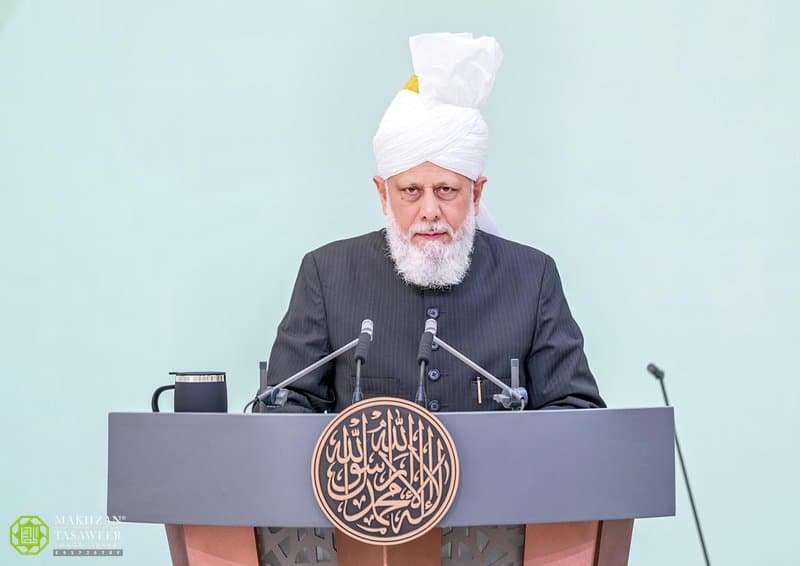
After reciting the tashahhud, ta‘awwuz and Surah al-Fatihah, Hazrat Khalifatul Masih V (aa) stated:
In the previous Friday sermon, I presented accounts of the humility and meekness of the Promised Messiah (as), as well as his guidance in this regard. Today, I will also mention some accounts and some of his guidance in relation to this.
Hazrat Sheikh Muhammad Isma’il Sahib relates that the excellent moral qualities of the Promised Messiah (as) were such that even when those people, who were ever engaged in opposing the Promised Messiah (as) and did not spare any such opportunity, would come and knock at his door, I observed that the Promised Messiah (as) would immediately meet them barefoot and as soon as he saw them, he would reply to their greeting with utmost kindness and ask if they and their families were well and healthy. Following this, he would enquire of them why they had come to visit him. They would then express their need. Upon this, he would ask them how much [money] they needed, and he would then give them more than what they needed and say: “If you need more, then take more!” (Rawayat Ashab-e-Ahmad, Vol. 2, pp. 395-396)
He would treat even his opponents with utmost kindness, and he would always present himself before them with modesty and never display any arrogance.
Hazrat Mirza Bashir Ahmad Sahib (ra) relates that he heard Munshi Zafar Ahmad Sahib say that Maulvi Sher Ali Sahib told him that once, Miran Bakhsh Sudai, who was mentally impaired, was coming from the main mosque and called the Promised Messiah (as) by his name. He did so rather disrespectfully, as he was mentally impaired, so what else could be expected? He shouted: “O, Ghulam Ahmad!” The Promised Messiah (as) immediately stopped and replied: “Yes.” The Promised Messiah (as) took no offence at all and asked: “What do you wish to say?” He replied in Punjabi: “You should first extend the salaam [Islamic greeting of peace]!” This poor man considered himself to be a person of authority. The Promised Messiah (as) said: “Assalamu alaikum [peace be upon you]!” The man then said: “Pay the mu‘amla [land tax]!” Landowners had to pay this mu‘amla, which was a form of tax from the government. In any case, upon hearing this, the Promised Messiah (as) took out a handkerchief from his pocket and gave him four or eight annas. The man rejoiced and returned, singing couplets of praise. (Siratul Mahdi, Vol. 1, Narration 805, p. 734)
Thus, the Promised Messiah (as) never took offence even at the words of a mentally impaired individual and would even stop for such a person.
Master Nazir Hussain Sahib relates that whenever I accompanied my father to visit the Promised Messiah (as) in Qadian, and he was informed that Hakim Marham-e-Isa Sahib had arrived, I have always observed that as soon as he was informed, he would immediately come out [to receive him]. He would also offer him something to eat, and on some occasions, he would personally go and bring the food. He further writes that the Promised Messiah (as) would meet his guests with such simplicity that at times, I saw him come out holding a pen in his hand and at other times, he would come out barefoot. That is, if he was seated in a room at home, he would come out in that very state upon hearing a knock at the door. If the Promised Messiah (as) were in the mosque and a guest arrived, he would often stand up and shake hands with him. Similarly, if he was engaged in conversation with someone else and a guest arrived, sat beside him and sought to shake hands with him, he would immediately turn his attention towards him and enquire after his health and well-being. In short, the Promised Messiah (as) would receive everyone visiting him with utmost humility. (Rawayat Ashab-e-Ahmad, Vol. 3, p. 173)
Hazrat Mufti Muhammad Sadiq Sahib relates that “I remember that on one occasion, I had come to Qadian from Lahore. This was probably in 1897 or 1898. The Promised Messiah (as) seated me in the Mubarak Mosque. The mosque was small at that time. He then said: “Please take a seat; I shall bring some food.” Having said this, he went inside. I assumed that he would send the food through one of his attendants. However, after a few minutes, when the door opened, I saw him carrying a tray of food with his own hands and bringing it to me personally. He looked at me and said: “Please start eating; I will bring some water.” He says that out of affection, tears started flowing involuntarily. If the Promised Messiah (as), who is our guide and leader, is serving us in this manner, then to what extent should we serve one another?” (Zikr-e-Habib, p. 258)
A narration illustrating the simplicity and humility of the Promised Messiah (as) is related by Hazrat Mirza Bashir Ahmad Sahib (ra) with reference to a lady named Mai Bholi (Mai Jiwan).
She stated:
“Once, when Huzoor (as) came to our village, I roasted some newly harvested wheat and brought it to him (he came to her village). He distributed it among those who were with him, tasted some himself, and expressed his pleasure. Whenever Huzoor (as) would come for a walk in the area, he would offer the Ishraq [voluntary pre-noon] prayer in our simple mud mosque. We would present him with saag and roti [spinach dish and bread] and he would never show any displeasure or reluctance. Rather, he would gladly accept our hospitality.” (Siratul Mahdi, Vol. 2, Narration 1318, p. 202)
Hazrat Munshi Zafar Ahmad Sahib of Kapurthala relates:
“The Promised Messiah (as) would not sit with the door open (he wouldn’t sit with the door open). Rather, he would always sit with the door locked.”
He continues, “Hazrat Sahibzada Mian Mahmud Sahib would come every little while and say, ‘Abba, open the door,’ and the Promised Messiah (as) would get up and open it.
“On one occasion, I came to visit him. Huzoor (as) was sitting on a simple mat. Upon seeing me, he lifted a bedstead himself and carried it inside.
“I said, ‘Huzoor (as), I can carry it.’
“He replied, ‘It is too heavy; you will not be able to lift it.’
“He then told me to sit on the bed. After placing it down, he seated me upon it and said regarding himself, ‘I am comfortable sitting down here on the floor. You sit on the bed.’”
He says, “At first I declined, but he insisted, saying, ‘Please sit without hesitation,’ so I complied.
“I was feeling thirsty and glanced towards the water pots, but there was no drinking vessel nearby. Seeing this, Huzoor (as) asked, ‘Are you thirsty? I will bring some water.’
“He then went downstairs to the women’s quarters and brought back a glass. After that he said, ‘Wait a moment.’
“He went downstairs again and returned with two bottles of sweet cordial that someone had sent from Manipur. It was a very delicious drink. The Promised Messiah (sa) said:
“‘These bottles have been kept here for a long time because we had intended that we would first serve them to a friend before drinking them ourselves. Today I remembered them.’
“He prepared a drink from the cordial and offered it to me. (He said that he would first give this gift he received to a friend to drink before drinking it himself.) I said, ‘Huzoor, please drink some first.’ (He told the Promised Messiah [as] to drink first from the glass in which he poured the drink, and only then would he drink from it.)
“He took a sip and then handed the glass to me, and I drank it. When I praised the drink, he said:
“‘Take one bottle with you and serve the other to the friends outside.’
“From those two bottles, he had perhaps taken only that single sip. Following his instruction, I took the bottles away.” (Ashab-e-Ahmad, Vol. 4, pp. 168-169)
Similarly, Hazrat Mirza Bashir Ahmad Sahib (ra) relates that Aisha Sahiba, daughter of Ahmad Jan Sahib, narrated:
“In 1906, when my mother passed away, Amma Ji, the wife of Hazrat Khalifatul Masih I (ra), took me into her home. She arranged breakfast and looked after me. Four or five days later, Hazrat Ummul Momineen (ra) took me into her own house.
“At the place where the kitchen now stands, Amma Jan (ra) was having my hair washed. A woman was pouring water over my head (while Amma Jan [ra] herself was washing the hair of this girl whose mother had passed away). Hazrat Ummul Momineen (ra) would apply soap to my hair and wash it.
“The woman who was helping was pouring too much water. The Promised Messiah (as) was walking nearby. When he noticed this, he took the water vessel from her and began pouring the water over my head himself, slowly and gently, while Hazrat Amma Jan, Ummul Momineen (ra), combed my hair.
“The Promised Messiah (as) said: ‘In this way, the lice will come out.’ (Siratul Mahdi, Vol. 2, Narration 1509, p. 285)
(Because her mother had been ill for a long time before passing away, there had been no one to care properly for her, and lice may have developed in her hair. Also, in those days it was also a common occurrence in that region.)
The Promised Messiah (as) therefore instructed:
“‘Wash the hair in this manner, and continue combing it like this; the lice will come out.’”
He had no hesitation in helping even with household chores.
Mufti Muhammad Sadiq Sahib (ra) relates:
“Once I was searching for water for ablution, holding a jug in my hand, and I entered through that door which leads from Masjid Mubarak to the private quarters of the Promised Messiah (as), intending to hand the jug to one of the Promised Messiah’s (as) attendants so that they might bring water from inside. Coincidentally, the Promised Messiah (as) came out from within and, seeing me standing there, asked, ‘Do you need water?’ I replied, ‘Yes, Your Holiness (as).’ The Promised Messiah (as) took the jug from my hand and said, ‘I will bring it myself.’ He then went inside, filled it with water, and brought it back to me.” (Zikr-e-Habib, pp. 257-258)
Hazrat Mirza Bashir Ahmad Sahib (ra) relates that Murad Khatoon Sahiba, the respected wife of Dr Khalifa Rashiduddin Sahib (ra), stated that once Hazrat Ummul Momineen (ra) and everyone present together ate mangoes. (It was mango season, and at that time there were mostly the kind of mangoes that are sucked [rather than cut].) In the courtyard, two or three piles of peels and seeds accumulated. Many women were sitting there, and a large number of flies began to gather. They became engaged in conversation and did not immediately think about cleaning up.
She said that she was also sitting there at the time, and some female attendants were also present. (There were female workers and attendants present at the time.) During this, the Promised Messiah (as) came, and when he saw this, he himself took a jug, mixed phenyl [disinfectant] in it, and poured it over the piles of mango peels in the courtyard with his own hand so that the flies would go away and the place would be cleaned and not create any smell. (Siratul Mahdi, Vol. 2, Narration 1470, p. 261)
Instead of saying anything to anyone, he demonstrated through his own action that cleanliness should be done promptly. Here, alongside his humility, his attention to hygiene is also evident.
A delegation, which included some notable citizens of Lahore, among them Dr Allama Iqbal and Sir Shahabuddin, came to meet the Promised Messiah (as). Describing this meeting, Babu Ghulam Muhammad Sahib (ra) relates that after dinner at night, when charpoys [traditional woven beds] were distributed, I took a strong and large charpoy. However, Chaudhry Shahabuddin Sahib, who was later known as Sir Shahabuddin, took it from me and occupied my charpoy instead.
The Promised Messiah (as) came and enquired from everyone whether they were comfortable. Everyone said they were fine. But when he reached me, I was standing worried because my charpoy had been taken by Chaudhry Shahabuddin. I said, “Your Holiness (as), my charpoy has been taken by Chaudhry Shahabuddin, and I am wondering where I should sleep.” He said, “Wait, I will bring a charpoy for you.”
He went away, and quite some time passed without a charpoy arriving. I then looked through the courtyard door of the Promised Messiah’s (as) residence and saw a man quickly making a charpoy, while the Promised Messiah (as) was sitting beside him, holding a lamp in his hand and lighting the way for him.
Seeing this, I felt deeply ashamed. I stepped forward, as the door was open. I said, “Your Holiness (as), please give me this lamp.” But the Promised Messiah (as) replied, “Only one round is left now.” Observing these noble morals of the Promised Messiah (as) had such an impact on me that tears came to my eyes. Looking at the Promised Messiah’s (as) blessed countenance, I kept saying to myself: “This can never be the face of a liar.” (Lahore Tarikh-e-Ahmadiyyat, pp. 217-218)
The testimony of the late Mirza Ismail Baig, who served the Promised Messiah (as), is as follows: Prior to his claim, when the Promised Messiah (as), in obedience to his father’s instruction, would travel to pursue legal cases, there would often be a horse as a means of transport and I would generally be in his company – but whenever he set out, he would do so on foot, and he would have me ride the horse while he walked himself. He says: I would repeatedly refuse and submit, “Huzoor (as), I feel ashamed.” He would reply: “I feel no shame in walking on foot – why should you feel shame in riding?” Whenever he set out from Qadian, the Promised Messiah (as) would always have me mount first, and when rather less or more than half the distance had been covered, I would dismount, and he would ride. And in the same way, when returning from court, he would first have me ride the mount, and then he would ride on the mount himself afterwards. And when he did ride, he would let the horse go at whatever pace it naturally walked, so that as I walked alongside him I would not be put to any difficulty. (Abdul Qadir Sabiq Saudagar Mul, Hayat-e-Tayyabah, p. 16)
Hazrat Mirza Bashir Ahmad Sahib (ra) relates that Maulvi Sher Ali Sahib (ra) told him: whenever the Promised Messiah (as) needed to enquire about something from Maulvi Muhammad Ali Sahib, instead of calling for him to come, he would himself go to Maulvi Sahib’s small room.
Hazrat Mirza Bashir Ahmad Sahib (ra) adds: I should mention that during the lifetime of the Promised Messiah (as), Maulvi Muhammad Ali Sahib used to reside in a part of his house – the Promised Messiah (as) had given him one of the rooms, and his working office was in that small chamber situated to the east of Masjid Mubarak. (Siratul Mahdi, Vol. 1, Narration 394, p. 357)
It was there that the Promised Messiah (as) would himself go to him. It is a matter of regret that Maulvi Sahib did not draw the lesson from the Promised Messiah’s (as) humility that he ought to have drawn, and in the end his pride brought about his own ruin.
The editor of Al Hakam writes regarding the simplicity of the Promised Messiah (as): when he went out for a walk, there was no distinction maintained – no one was required to keep back – and indeed there were times when eminent Companions would notice that dust was being kicked up while they walked and the Promised Messiah (as) was behind them. Dust would rise from the unpaved roads, yet the Promised Messiah (as) never gave even a passing thought to such a thing. It frequently happened that people walking behind him would accidentally knock against him or his shoe would come off by someone’s foot knocking against his, or his walking stick would fall from the knock – yet no one ever saw or heard him express the least displeasure or show any particular preference. He never said: “Can you not be a little more mindful?”
On many occasions in the mosque it so happened that he was seated among the Companions and a stranger arrived, who went forward and shook hands first with Maulana Maulvi Abdul Karim or Hazrat Hakeem-ul-Ummah [Hazrat Khalifatul Masih I (ra)], supposing one of them to be the Promised Messiah (as) – and those two elders would then point out where the Promised Messiah (as) was seated. In short, he always made the conduct of his master, the Holy Prophet Muhammad (sa), his own conduct, and it was that very example he displayed throughout his life. (Malfuzat, 2022, Vol. 2, p. 270, footnote)
There is a narration from Dr Basharat Ahmad Sahib as follows:
The wife of Nawab Muhammad Ali Khan of Malerkotla passed away. The Promised Messiah (as) went to the graveyard with the funeral procession and led the funeral prayer himself. The grave was not yet ready. I too was with the funeral procession. He says: people became occupied in looking at the grave, and I too turned my attention in that direction. After a little while, when I looked around, the Promised Messiah (as) was nowhere to be seen. I looked about anxiously, and then caught sight of him sitting alone on the ground in one corner of the garden. I quickly spread a white sheet beneath a tree and went to him, submitting: “There is direct sun here – please come and sit in the shade of the tree over there.” The Promised Messiah (as) said: “Yes, that is right,” and came and sat on the sheet in the shade of the tree. I sat down nearby. He says: before long, when people noticed that the Promised Messiah (as) was sitting beneath the tree, they began coming over to him. Now, as each person arrived, the Promised Messiah (as) would say to them: “Come, come – please sit here,” and would himself shift back, seating the newcomer on the sheet. People continued to arrive, and he continued to move back and seat each one on the sheet – until, after no great length of time, I looked and found that the Promised Messiah (as) was sitting on the bare earth while all his Companions sat upon the sheet. Those who came, absorbed in the joy and eagerness of visiting and meeting him, did not notice what was happening – that the Promised Messiah (as) had moved to the ground while they sat on the sheet. But he says: I was watching in, and inwardly being greatly affected by this – and at the same time my faith was growing, that what a station Allah has bestowed upon him, and what depths of meekness and humility reside within his soul. (Mujjadid-e-A‘zam, Vol. 2, pp. 1293-1294)
During the days when the debate with Abdullah Athim was taking place in Amritsar, Munshi Zafar Ahmad relates an incident from that time: he says, we were staying – most probably at the house of Karim Bakhsh – when Colonel Altaf Ali Khan joined our company and said to me that he wished to meet the Promised Messiah (as) in private. The Colonel was wearing a coat and trousers and was clean-shaven. I said to him: “Please go inside – we shall not allow anyone else to come in from outside.” So the Colonel went in and remained alone with the Promised Messiah (as) for close to half an hour. When the Colonel came out, his eyes were brimming with tears, streaming down his face. I asked him: “What was discussed between you that you are in such a state?” He said: “When I went inside, the Promised Messiah (as) was sitting deep in his thoughts on a reed mat – though in truth only his knee was on the mat, the rest of him on the ground. I said: ‘Your Holiness is sitting on the ground.’ The Promised Messiah (as), thinking that perhaps as a Colonel I would not wish to sit on the mat, took off his turban cloth, unwinding his turban – and spread it on the ground, saying to me: ‘Please sit here, Colonel. Perhaps you do not wish to sit on the mat – here, let me spread this cloth, please sit upon it.’ Removing the cloth from his own head and spreading it on the ground.” The Colonel said: “Upon seeing this, my tears flowed, and I submitted: ‘Although I have been baptised’” – meaning I had accepted Christianity – “‘I am not so bereft of faith as to sit upon Your Holiness’s turban cloth.’” The Promised Messiah (as) replied: “There is nothing wrong with it – no harm at all. Please sit quite freely.” In any case, he says: “I moved the cloth aside with my hand and sat upon the mat, and began to tell him of my condition – that I drink heavily and commit other sins as well, that I know nothing of God or the Prophet by name – but I now declare before you that I repent of Christianity and become a Muslim. Despite all that I had embraced Christianity – but now, having seen your state and heard your words, I become a Muslim. However, the vices that have taken hold of me seem very difficult to leave behind.” The Promised Messiah (as) said: “Recite istighfar [seek forgiveness], and form the habit of offering the five daily prayers.” This is the remedy – if sins have taken root and a person has strayed from religion, let him recite istighfar abundantly and pay focus to his prayers. He says: “for as long as I sat in his presence, my state kept changing and I wept continuously, and in that very state I made the pledge that I would certainly recite istighfar and offer my prayers – this I pledged – and having taken his leave, I departed. The impression made upon my heart that day still remains with me still.” This Colonel had attended that very debate and used to sit on the side of the Christians – but he inherently possessed a good nature, and Allah the Almighty enabled him to accept Islam once again. (Ashab-e-Ahmad, Vol. 4, pp. 150-151)
Maulvi Abdul Karim Sialkoti Sahib (ra) relates an incident from 1896, or thereabouts, as he published this account in 1900 and was describing something that had occurred four years earlier. He states: “The members of the Promised Messiah’s (as) household had gone to Ludhiana. It was the month of June, and the inner portion of the home had recently been built. In the afternoon, I lay down on a charpoy that had been laid out there. At the time, the Promised Messiah (as) was leisurely walking nearby. At one point when I woke up, I saw that the Promised Messiah (as) was lying on the floor beneath my charpoy. Startled, I sat up out of respect. With great affection, the Promised Messiah (as) asked, ‘Why have you got up?’ I submitted, ‘How can I remain asleep on a charpai while you are lying below?’ Smiling, he replied, ‘I was keeping watch for you. The boys were making noise, and I was stopping them so that your sleep would not be disturbed.’” (Hazrat Sheikh Yaqub Ali Irfani (ra), Sirat Hazrat Masih-e-Maud [as], p. 147)
Hazrat Munshi Imam Din Sahib describes the scene at the time of his pledge of allegiance as follows: “In 1894, I pledged allegiance at the blessed hand of the Promised Messiah (as). My brother Munshi Abdul Aziz Sahib and Bhai Jamal-ud-Din Sahib of Sikhwan were with me until it was time for the evening prayer. After the prayer had been offered, Munshi Sahib gestured towards me and submitted to the Promised Messiah (as), ‘Your Holiness, please accept his pledge of allegiance.’ The Promised Messiah (as) said, ‘Let him come inside.’ When I entered the Bait-ul-Fikr alone, the Promised Messiah (as) sat near the foot of a charpoy and instructed me to sit at the head of it. At first, I hesitated, but when the Promised Messiah (as) repeated the instruction, I sat down. He then took my pledge of allegiance. I was astonished to see this sort of treatment from the Promised Messiah (as). On the one hand, were those [so-called] spiritual guides beside whom no one could even sit as an equal and on the other hand, was Allah the Almighty’s Promised Messiah, who seated an insignificant servant at the head of the charpoy, in a better seat. Although my brother Munshi Abdul Aziz Sahib had not entered the room, he was observing this scene from outside.” (Ashab-e-Ahmad, Vol. 1, p. 112)
Hazrat Munshi Zafar Ahmad Sahib states: “Once, in Ludhiana, the late Munshi Arora Sahib and I submitted to the Promised Messiah (as), ‘At some point, Your Holiness should pay a visit to Kapurthala.’ In those days, the railway had not yet reached Kapurthala. The Promised Messiah (as) promised, ‘We shall certainly visit one day.’ Shortly thereafter, the Promised Messiah (as) came to Kapurthala one day without informing us in advance. He arrived by horse carriage and, after alighting at the carriage stand, he went to the Fatehwali Mosque in the Nazdika Khan area of Kapurthala. Hafiz Hamid Ali Sahib was accompanying him. From the mosque, the Promised Messiah (as) sent the local cleric, who was not an Ahmadi, to inform either Munshi Arora Sahib or Munshi Zafar Ahmad Sahib of his arrival.”
He continues: “Munshi Arora Sahib and I were at the court office, where we worked as shorthand writers, when the cleric came and informed us, ‘Mirza Sahib is present in the mosque, and he has sent me to inform you.’ Astonished, Munshi Arora Sahib said in Punjabi with a tone of displeasure, ‘Would Mirza Sahib really come and stay at your mosque? How could that be? Do not lie.’ I said, ‘We should at least go and see.’ So Munshi Sahib quickly tied his turban and set out with me. When we entered the mosque, we saw that the Promised Messiah (as) was lying on the floor, while Hafiz Hamid Ali Sahib was pressing his feet. Nearby, there was a bowl and a spoon, from which it seemed that perhaps he had taken a drink of milk or eaten bread soaked in it. Munshi Arora Sahib submitted, ‘If Your Holiness was going to come this way, you should have informed us. We would have come to Kartarpur station to receive you.’ The Promised Messiah (as) replied, ‘What need was there to inform you? I had made a promise to you, and I had to fulfil it. Now, I have fulfilled it.’” (Ashab-e-Ahmad, Vol. 4, pp. 141-142)
The Promised Messiah (as) states:
“My state of affairs is that whilst engaged in Prayer, if someone is in pain and their cry reaches my ears, I feel moved to go to their aid and give them sympathy insofar as possible, even if I am compelled to break my Prayer. It is against the principles of morality not to stand by a brother who is in pain and distress. If you can do nothing else, at least pray for them. What to talk of our own, I even say that you ought to show the same example of morality and sympathy to Hindus and others. One must not possess a thoughtless nature.”
This was not merely advice; rather, as is evident from all the accounts that have been narrated, this was the very practice which the Promised Messiah (as) adopted.
The Promised Messiah (as) further writes:
“On one occasion, I was going out for a walk. A man named Abdul-Karim, who was a village registrar of lands, was also with me. He was somewhat ahead of me and I was walking at some distance behind. On the way, a frail, old lady of about seventy or seventy-five years of age met us. She gave a letter to Abdul-Karim and asked him to read it to her, but he scolded her and moved her away. This broke my heart. Then, the old lady gave me the letter. I took the letter and stopped. Then, I read the letter to her and explained its contents to her in detail. At this, Abdul-Karim was deeply ashamed, because he had to wait anyway, and was deprived of spiritual reward as well.” (Malfuzat, Vol. 2, pp. 176-177)
Had he read the letter with humility, it would have been better for him.
Hazrat Mirza Bashir Ahmad Sahib (ra) states:
“This humble one submits that whenever the Promised Messiah (as) met someone, he did so with a smile, and at once the worries and distress of the person meeting him would disappear. Every Ahmadi felt that upon entering his company, all the griefs of the heart were washed away. The moment one’s eyes fell upon his smiling countenance; a wave of joy would course through the entire body.
“It was a habit of the Promised Messiah (as) to listen attentively even to the most ordinary person and to reply with great affection. Each person felt, in his own way, that the Promised Messiah (as) loved him more than anyone else. Some people, unaware of the etiquette required in the gatherings of the Prophets of Allah, and being simple and unlettered, would continue narrating irrelevant stories at great length. Yet the Promised Messiah (as) would sit quietly and listen, and he would never say to anyone that they should cease talking.” (Siratul Mahdi, Vol. 1, Narration 247, p. 227)
“A person came in the presence of the Promised Messiah (as). He wanted to prostrate and place his head on the feet of the Promised Messiah. The Promised Messiah (as) moved his head with his hand and said: ‘This manner of conduct is not permissible. One should say [assalamu alaikum – ‘Peace be upon you’] and shake hands.’” (Malfuzat, Vol. 9, p. 256)
Hazrat Mufti Muhammad Sadiq Sahib writes:
“A poor Ahmadi man from Kashmir, who was tall in height and possessed deep sincerity, would walk the entire distance from his village to Qadian by foot. His name was Aqalju. Once, he had arrived in Qadian at a time one morning when the Promised Messiah (as) was setting out to go for a walk. That Kashmiri man was also standing in the square. When he saw the Promised Messiah (as), he was overcome with love, and as he wept, he placed his head upon the Promised Messiah’s (as) feet. The Promised Messiah (as) bent down, lifted him up and said, ‘This is not permissible. One should not prostrate before any human being.’” (Zikr-e-Habib, p. 162)
That is, a person must never prostrate before anyone, nor bow down at anyone’s feet.
Hazrat Maulvi Abdul Karim Sahib Sialkoti (ra) writes: “There was once an occasion when an individual came to our mosque who was infatuated and accustomed to visiting ascetics and the custodians of shrines seen in the world today.” He further writes: “When he came to our mosque, the man was surprised to see the people conversing with the Promised Messiah (as) so freely and said to him: ‘There is a lack of respect in your mosque; people speak to you without fear.’”
The man, who was accustomed to sitting in the gatherings of religious leaders, said to the Promised Messiah (as) that there is no respect in his mosque. People were sitting in his gathering candidly and conversing with him without any fear. He was implying that they were not showing the Promised Messiah (as) due respect.
“The Promised Messiah (as) responded: ‘It is not my practice to sit in a fierce and frightful manner so that people should fear me as they are terrified of a carnivorous beast. I extremely detest the idea of sitting like an idol. I have come to abolish idol worship, not so that I should become an idol myself and people worship me. Allah the Exalted knows well that I do not give myself preference over others even in the slightest. In my opinion, there is no worse an idol worshipper and no one more wicked than an arrogant person. An arrogant person does not worship any God at all; in fact, he only worships himself.” (Hazrat Sheikh Yaqub Ali Irfani (ra), Sirat Hazrat Masih-e-Maud [as], p. 314)
Hazrat Mirza Bashir Ahmad Sahib (ra) narrates an account of Munshi Zafar Ahmad Sahib. He states that on one occasion, upon his return from Delhi, the Promised Messiah (as) alighted at Amritsar. Hazrat Ummul Momineen (the wife of the Promised Messiah [as]) was also accompanied by him. The Promised Messiah (as) took one of his sons into his lap, who was perhaps Mian Bashir Ahmad Sahib, and took a heavy bag under his other arm. (That is to say, he lifted the child on one side and lifted the bag on the other) and directed me, saying, “You may take the paandan [a box containing betel leaf and other essentials].” Munshi Zafar Sahib was present at the time, so he directed him to take the paandan, which was small. I submitted, “Your Holiness, kindly give the bag to me.” The Promised Messiah (as) replied, “No.” Upon my request once or twice, the Promised Messiah (as) repeated the same answer. In any case, I held the paandan and we set off. In the meantime, two or three young Englishmen who were present at the station said to me, “Ask His Holiness to stand still for a moment.” And so, I submitted, “Your Holiness, they are asking if His Holiness may stand still for a moment.” His Holiness stood still. (The Englishmen were also at the same station.) In that very condition, they took a photograph of the Promised Messiah (as) – whilst he held a child and also his bag. They desired to take a photograph of him. Despite his great simplicity, those people were impressed by the Promised Messiah’s (as) personality, and they remarked, “We desire to take a photograph of this honourable gentleman.” (Siratul Mahdi, Vol. 2, pp. 58-59, Narration 1073)
Hazrat Malik Maula Bakhsh Sahib narrates:
“A gentleman named Mian Jan Muhammad used to reside opposite our house in Amritsar and he would talk a lot. He had practically memorised the book of the Promised Messiah, Surma-e-Chashm-e-Arya, and despite being illiterate, he used to debate vigorously with the Aryas. He developed the psychiatric ailment – (a form of depression whereby a manic state would ensue). Whenever he met someone, he would relate the details of his ailment in a very long and detailed manner, making them stand for a considerable time. People grew weary of listening to him, and they began to avoid him. Someone suggested that he should go to Qadian and seek treatment from Hazrat Maulvi Hakeem Noor-ud-Deen Sahib. He replied, ‘He is a man of high standing; when will he listen to my tale?’ (He said, ‘Why would Hazrat Khalifatul Masih I [ra] listen to his lengthy tale?’) That person responded, ‘No, he is a man of excellent morals; he will certainly listen to you.’ Therefore, that man came to Qadian.
“It so happened that when he arrived and alighted from the horse-carriage, at that very moment, the Promised Messiah (as) accompanied by his Companions, was returning from a walk. The driver of the horse carriage remarked that the Promised Messiah (as) was coming. And so, the gentleman alighted from the carriage and went straight to shake his hand and began to relate the condition of his illness in the anxious manner that he would. He began to recount a long, drawn-out story.
“The tale became so lengthy that everyone grew weary, yet the Promised Messiah (as) remained standing calmly, holding his hand in his own, listening to everything. Ultimately, Mian Jan Muhammad Sahib himself (who was the patient) said, ‘Now my mouth has become dry; I can speak no further. I have been speaking for such a long time and you continue to listen.’ Upon this, the Promised Messiah (as) observed, ‘Very well, you should proceed to the guest house, eat and drink something, and then, having related your condition to Maulvi Sahib’ (meaning Hazrat Hakeem Maulvi Noor-ud-Deen Sahib [ra]) – ‘get some medicine from him.’
“Accordingly, this individual, having refreshed himself, presented himself before Maulvi Sahib (i.e., Hazrat Hakeem Noor-ud-Deen Sahib [ra]) and commenced the same lengthy tale. Hazrat Maulvi Sahib (ra) swiftly wrote a prescription and handed it over. He had only narrated a little when he [Maulvi Sahib] understood; since he was a physician, he understood what the illness was. He wrote the prescription and said, ‘I am aware of your ailment, and there is no need to hear its details.’ He took the prescription but remarked, ‘They used to say that Maulvi Noor-ud-Deen Sahib possesses excellent morals, but what comparison does he bear to the morals of Hazrat Mirza Sahib!’ This had such a profound effect upon him that he pledged allegiance.”
Previously, he had not pledged allegiance, but did so because of this. It is said that the late Dr Ibadullah Sahib narrated this incident in his presence and he [Jan Muhammad] also confirmed it. (Ashab-e-Ahmad, Vol. 1, pp. 143-144)
Similarly, Hazrat Mirza Bashir Ahmad Sahib (ra) writes that Master Allah Ditta Sahib has related this account through writing that on one occasion, the Promised Messiah (as) was seated in the Ahmadiyya Building in Lahore, when a frail, weak, elderly person named Mustaqeem arrived from Sharaqpur Bhaini to meet with the Promised Messiah (as). Amidst the crowd of people, he could not reach the Promised Messiah (as), and called out in a loud voice, “Your Holiness, I have come only to meet you.”
The Promised Messiah (as) directed, “Allow the respected elder to come forward.” He was an old man but he could not stand up properly. Upon this, the Promised Messiah (as) directed, “Do not cause distress to this elderly gentleman,” and then the Promised Messiah (as) himself stood up, came to him, and sat beside him. (Siratul Mahdi, Vol. 1, Narration 740, p. 672)
Hazrat Mirza Bashir Ahmad Sahib (ra) relates from Dr Mir Muhammad Ismail Sahib, that when the Promised Messiah (as) once proceeded to Dera Baba Nanak in the company of some Companions in order to see the Chola of Baba Nanak Sahib, the members of the Jamaat spread some cloths beneath a tree and sat there along with the Promised Messiah (as). Maulvi Muhammad Ahsan Sahib was also among those present.
When the people of the village heard of the Promised Messiah’s (as) arrival, they began to gather there. Of those who arrived first, a few mistook Maulvi Muhammad Ahsan Sahib for the Promised Messiah (as) and, shaking hands with him, sat down. After three or four persons had thus shaken hands, it was realised that they were under a misapprehension. Thereafter, Maulvi Muhammad Ahsan Sahib would direct every such person who came forward to shake hands with him towards the Promised Messiah (as), saying, “The Promised Messiah (as) is here.” (Siratul Mahdi, Vol. 1, Narration 401, p. 307)
Hazrat Sheikh Abdul Qadir Sahib writes that his elder son, Hazrat Mirza Sultan Ahmad Sahib, used to say that his father did not spend his life as a Mughal nobleman. Though he was of noble descent and a Mughal by lineage, he lived life with utmost simplicity and meekness.
Kanhaiya Lal Sarraf of Qadian relates that on one occasion the Promised Messiah (as) had to travel to Batala and instructed him to arrange for a horse-carriage. When the Promised Messiah (as) reached the canal, he remembered that something had been left behind at home. He left the driver there, and himself returned on foot. Meanwhile, the driver found other passengers at the bridge and proceeded to Batala. It appears that the Promised Messiah (as) then went to Batala on foot.
Kanhaiya Lal says: I summoned the driver and reprimanded him severely, saying, “Wretched man! If it had been Mirza Nizam-ud-Din, you would have remained there even if you had to wait three days; but because this is a righteous and dervish-natured person, you abandoned him and left.” He further relates that when the Promised Messiah (as) came to know of this, he summoned him and said, “How could he have remained waiting for my sake? He received his fare and went on his way. Why did you wrong him?” (Hayat-e-Tayyabah, pp. 15-16)
The Promised Messiah (as), advising the members, states:
“Every one of you ought to strive and wake for Tahajjud prayer; and also offer special supplications in your five daily prayers when you stand after the ruku‘. Repent from anything and everything which displeases God. Repentance is to abandon all the evil deeds and situations which cause the displeasure of God, and to bring about a sincere change; to move forward and adopt righteousness. One ought to hold morality in high regard, for this too brings the mercy of God; refine your habits; be free from anger and replace it with humility and meekness. Along with the reformation of your morals, give charity to the extent of your means.” (Malfuzat, Vol. 1, p. 215)
This was the guidance the Promised Messiah (as) imparted to the members of the Jamaat. Then he further stated:
“It is necessary for the righteous to live a life of humility and modesty. This is an aspect of piety (that is to live a life of humility and modesty) by which we must combat undue anger. To refrain from anger was the final and most trying stage experienced by many a great saint and the Truthful. Vanity and pride stem from anger; and in certain cases, anger itself is the result of arrogance and conceit. For anger comes about when an individual gives superiority to themselves over another. I do not desire that members of my community should consider themselves superior or inferior, behave arrogantly, or look down upon one another. God knows who is superior or inferior. This is a form of neglect that reeks of contempt. I fear that this contempt may grow like a seed and ruin such a person. Certain people meet those of high standing with immense respect, but truly great is the one who listens to a lowly person with humility, comforts them, gives importance to their opinion and does not rebuke them in a manner that would cause them grief. God Almighty states:
وَلَا تَنَابَزُوۡابِالۡاَلۡقَابِؕ بِئۡسَ الِاسۡمُ الۡفُسُوۡقُ بَعۡدَ الۡاِیۡمَانِۚ وَمَنۡ لَّمۡ یَتُبۡ فَاُولٰٓئِکَہُمُ الظّٰلِمُوۡنَ
“‘Do not call one another by nicknames. Bad indeed is evil reputation after the profession of belief; and those who repent not are the wrongdoers.’ (The Holy Quran, 49:12)”
Explaining this further, the Promised Messiah (as) states:
“Do not call upon one another in a hurtful manner out of irritation. For this is the way of the sinners and the transgressors. A person who scoffs at another shall not meet death until they too are subjected to the same. Do not look down upon your brethren. When all drink from the same stream, who knows which of you is destined to drink more than the other? Worldly definitions cannot afford a person honour and greatness. In the sight of God Almighty, great is the one who is righteous.
اِنَّ اَکۡرَمَکُمۡ عِنۡدَ اللّٰہِ اَتۡقٰکُمۡؕ اِنَّ اللّٰہَ عَلِیۡمٌ خَبِیۡرٌ
“‘Verily, the most honourable among you, in the sight of Allah, is he who is the most righteous among you. Surely, Allah is All-Knowing, All-Aware.’ (The Holy Quran, 49:14)” (Malfuzat, Vol. 1, pp. 35-36)
May Allah the Almighty enable us to cultivate true humility and meekness within ourselves, and, having pledged allegiance to the Promised Messiah (as), may we become those who act in accordance with the true teachings of Islam and fulfil its due right with sincerity and steadfastness.
(Official Urdu transcript published in the Daily Al Fazl International, 26 June 2026, pp. 2-8. Translated by The Review of Religions.)