
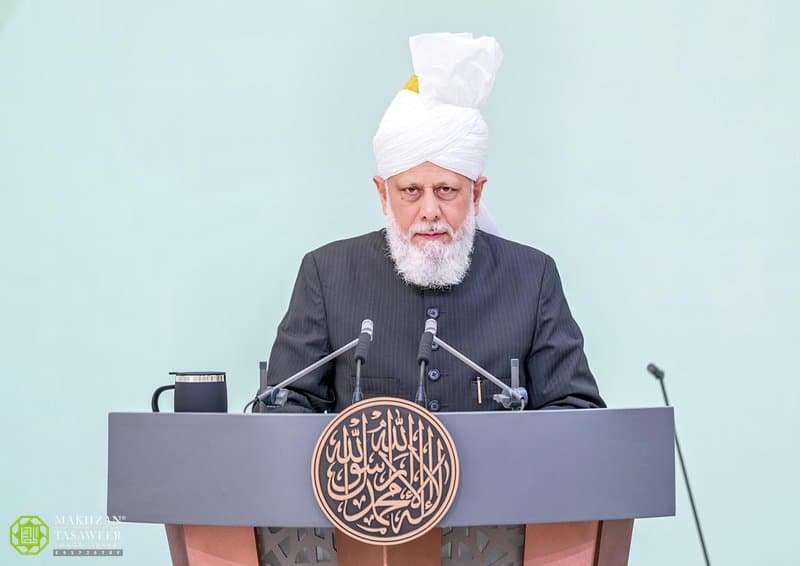
After reciting the tashahhud, ta‘awwuz and Surah al-Fatihah, Hazrat Khalifatul Masih V (aa) stated:
While discussing the life and character of the Promised Messiah (as), I mentioned some incidents of his standard of truthfulness. Today, I will continue narrating a few incidents. A case was filed against the Promised Messiah (as) by Dr Henry Martyn Clark, who alleged attempted murder. This was an extremely perilous case.
The Promised Messiah (as) said that this case filed by Henry Martyn Clark was so serious that it could even have resulted in the death penalty. The Promised Messiah (as) gave the example of the case which the Jews, under the Roman government, brought against Jesus (as) and said:
“A similar case was filed against me, with the difference that while the case against Jesus (as) was brought up by the Jews, in my case it was a reverend clergyman and doctor, i.e., Dr Martyn Clark, who accused me of attempted murder. The evidence he mustered seemed thorough, so much so that even Maulvi Abu Sa’eed Muhammad Hussein Batalvi, an arch-enemy of this Jamaat, appeared as a witness and did his utmost to establish the case against me. The case was heard by Captain Douglas, the Deputy Commissioner of Gurdaspur, who is now posted, probably in Simla.
“The case was duly heard and completed and all the witnesses against me were produced with great fanfare and clamour. In the circumstances, not even the best of lawyers could say that I would be acquitted. The prevailing situation, and other factors, demanded that the case be committed to the Sessions, who could have sentenced me to transportation for life or even to death. (I.e., he could also have been sentenced to life imprisonment.) But just as God forewarned me about the case, so did He reveal to me in advance that I would be acquitted. A large number of people belonging to my Jamaat knew about this revelation. When the case reached a stage when the prosecution and my opponents believed that the magistrate would commit the case to the Sessions, Captain Douglas told the Police Superintendent that he had a hunch that the case was a frame-up and he (the judge) couldn’t believe that such an attempt was ever made and that the defendant sent someone to murder Dr Clark. He asked the superintendent to investigate the case himself.” Allah the Almighty placed it in the judge’s heart to tell the police commander to reinvestigate the case.
The Promised Messiah (as) continues: “This was the time when not only were my opponents busy plotting against me, but also those who claimed that their prayers were heard and accepted, were tearfully soliciting God to punish me (they were even praying). But who can fight God? I also know that some people approached Capt Douglas and tried to influence him, but he, being a just and fair magistrate, told them that he could not be a party to such an outrage (he said he could not make a wrongful conviction).
“In short, when the case was entrusted to Capt Le Marchand for a renewed investigation, he summoned Abdul Hamid and told him to state the truth. Abdul Hamid repeated the same old story he had related before the Deputy Commissioner. Actually, at the very start, he was warned that the slightest deviation from his original statement would render him liable to prosecution; that is why he repeated the same statement he had made earlier on. The Police Superintendent told him that he had already related the same story, but the Deputy Commissioner was not satisfied that he was telling the truth. When Captain Le Marchand again told him to tell the truth, he started crying and fell at the feet of the Captain, imploring him for protection. The Captain reassured him and told him to go ahead. At this, he came out with the truth. He confessed that he had been coerced into making his earlier statement and deposed that Mirza Sahib had never sent him to murder anyone.
“The Captain was overjoyed at this statement and sent a telegram to the Deputy Commissioner that he had solved the case. The case once again came up for hearing at Gurdaspur. Capt Le Marchand was sworn in and recorded his affidavit.”
The Promised Messiah (as) states that in the court at that time, “I could notice that the Deputy Commissioner was visibly pleased that the truth had come out. But he was also furious at the Christians who had given false evidence against me. Addressing me, he said that I had the right to file a suit against them. But, as I am totally disinclined to litigation, I said I didn’t want to enter into any litigation, for my suit was filed with God. At this, Capt Douglas straightaway wrote down the judgment and read it out to a large number of people who had gathered there. Addressing me, he said, ‘Congratulations, you stand acquitted.’
“[…] At the time, it seemed as if the whole world was lined up against me, and this is what usually happens: when people decide to hurt you, the whole world turns against you; it is God alone Who comes to the rescue of His true servants.” The Promised Messiah (as) said that Allah the Almighty saved him on account of his truthfulness. (Lecture Ludhiana, Ruhani Khazain, Vol. 20, pp. 268-270)
Regarding this same case, a non-Ahmadi lawyer named Maulvi Fazal Din testified to the truthfulness and noble character of the Promised Messiah (as), which was exhibited during this case. His statement has been recorded by Hazrat Sheikh Yaqub Ali Irfani (ra) in his book Hayat-e-Ahmad, in which he writes:
“Another magnificent incident relating to morality, which testifies to the truthfulness of the Promised Messiah (as), also became manifest in this very case and demonstrated the extent of his love for truth.
“Listen to this account in the words of the late Maulvi Fazal Din Sahib, a lawyer, as narrated by my sincere contemporary, Lala Dina Nath, editor of the newspapers Desh and Hindustan.” These were the names of two newspapers, of which this Hindu man was the editor. He was also a friend of Hazrat Sheikh Yaqub Ali Irfani (ra).
He states:
“You know how greatly I revere Mirza Sahib. I consider his rank and status to be extremely lofty. Although, regarding his claims, from a psychological point of view. (This was the opinion of the lawyer.) I believe that he made a mistake in understanding and that his claims are not true. Nevertheless, he is certainly a righteous man, a great soul, and a deeply spiritual person of an exceptionally high rank. This belief of mine about him was formed by a particular incident.”
He relates this incident as follows:
“You know Hakim Ghulam Nabi Zubdat-ul-Hukama, and you also know Maulvi Fazal Din Sahib, the lawyer.”
Here, the Hindu editor is narrating the incident, and he is now relating the words of Maulvi Fazal Din Sahib.
He continues:
“You also know Maulvi Fazal Din Sahib, the lawyer. People would gather at Hakim Sahib’s home in the evenings, and I too would go there. One day, several friends were gathered there, and by chance, the mention of Mirza Sahib came up. One person began opposing him, but in such a manner that it was beneath the standards of decency and morality.”
The Hindu editor, upon hearing this, says:
“The late Maulvi Fazal Din Sahib became greatly stirred after hearing this. With great passion, he said:
“‘I am not a disciple of Mirza Sahib, nor do I believe in his claims – whatever the reason may be. However, I firmly believe in his great personality and his moral excellence.
“‘I am a lawyer, and people from every class come to me in connection with legal cases. I have seen thousands upon thousands of people, and through other lawyers as well. Even very righteous individuals – about whom one could never imagine any kind of pretence or showing off – when advised legally in court matters, did not hesitate to alter their statements if they thought it necessary.
“‘But in my entire life, I have only seen Mirza Sahib as the one person who never strayed from the truth in the slightest.
“‘I was his lawyer in one of his cases (referring to the case involving Henry Martyn Clark), and in that case, I drafted a legal statement for him and presented it before him. After reading it, he said, “There is falsehood in this.”
“‘I replied, “An accused person’s statement is not given under oath, and legally he is permitted to say whatever he wishes.”’”
Upon this, the Promised Messiah (as) said:
“The law may permit a person to say whatever he wishes, but Allah the Almighty does not permit it. Allah has not granted permission for someone to lie, nor indeed is this even the true intent of the law. Therefore, I can never agree to make a statement that is contrary to the facts. I will present the matter exactly as it is.”
Maulvi Sahib (the lawyer) then said:
“I said to him, ‘You are knowingly putting yourself into difficulty.’”
Upon this, the Promised Messiah (as) replied:
“To knowingly put oneself into danger would be for me to make a legal statement in order to gain an unlawful advantage and thereby incur the displeasure of my God. That is something I can never do, no matter what may happen.”
Lala Dina Nath Sahib (the editor of the newspapers) narrated this incident to Sheikh Yaqub Ali Irfani Sahib. He said that, “Maulvi Fazal Din Sahib used to say that the Promised Messiah (as) said these words with such vigour that a unique expression of passion and fervour appeared upon his face. After hearing this, I said (i.e., the lawyer said to the Promised Messiah [as]), ‘You will not benefit from my legal representation.’ Upon this, he replied, ‘I have never even imagined that any benefit would come through your advocacy or through the efforts of any other person, nor do I believe that anyone’s opposition can destroy me. My trust is only in God Almighty, Who sees my heart. I appointed you as my lawyer because it is only appropriate for one to utilise the means available to them, and since I know that you are honest in your work, I appointed you. (This is merely an outward means which ought to be used, and that is why I am using it. I am not dependent upon you.)’”
Maulvi Fazal Din Sahib used to say that he again submitted, “This statement is what I recommend.” The Promised Messiah (as) replied, “No. Submit exactly the statement that I myself have written, without caring about the outcome or result. Not a single word should be changed. And I tell you with complete certainty that it will be more effective than your legal statement, and the result that you fear will not come to pass. Rather, God willing, the outcome will be good. And if it is even supposed that the result does not appear favourable in the eyes of the world – meaning that I am punished – even then I do not care, because at that time I will be happy that I did not disobey my Lord.”
Lala Dina Nath used to say, “Maulvi Fazal Din Sahib presented the defence of the Promised Messiah (as) with great passion and sincerity in this manner, and that he immediately wrote down the Promised Messiah’s (as) statement right there. Such is the wondrous power of God’s manifestation, that he was acquitted on the basis of that very statement that he had written.” Maulvi Fazal Din Sahib described his truthfulness and his courage and bravery in accepting every hardship for the sake of truth, which created a dense emotional atmosphere among those present in the gathering. Even those who were sitting outside and were opposing him, fell silent. At this, some people asked him, “Then why do you not become his follower?” He replied, “That is my personal decision, and you have no right to question me about it. I consider him a perfectly truthful person, and I hold immense respect for him in my heart.” (Dr Abu Salam Shahjahanpuri, Kitabiyat Pakistan ke Akhbarat-o-Rasa’il 1947 Tak, pp. 120 and 236, Muqtadirah Qaumi Zaban, Islamabad, 1987; Al Hakam, No. 41, Vol. 37, 14 November 1934, pp. 3-4; Hayat-e-Ahmad, Vol. 4, pp. 566-569)
Regarding this same incident, there is another narration from Master Nazir Husain Sahib. He says, “The late Maulvi Fazal Din Sahib, Advocate of the High Court, was deeply attached to the Promised Messiah (as) and would generally accompany him in his legal cases. He told me that he considered the Promised Messiah (as) to be at the highest echelon of truthfulness. When I asked regarding this, he narrated an incident concerning the Promised Messiah (as). He said that in one case between the Promised Messiah (as) and Deputy Martyn Clark Sahib, a man named Abdul Hamid testified that the Promised Messiah (as) had sent him to kill Martyn Clark. At that time, the late Maulvi Fazal Din Sahib, acting as legal counsel, said to the Promised Messiah (as), ‘In court, you should simply say that you do not know Abdul Hamid. After that, we will handle the rest of the proceedings ourselves. (You should just state that you do not know him.)’ The late lawyer used to say that he assured the Promised Messiah (as) in every possible way that if he would only make this statement, then his success in the case would be certain; otherwise, acquittal was impossible. The lawyer said that after listening to his suggestions, the Promised Messiah (as) replied, ‘I have come into the world to establish truthfulness. I will never tell a lie, even if I am hanged. I know Abdul Hamid. He used to come to Qadian. I can never deny knowing him, no matter what happens.’
“The lawyer, the late Maulvi Fazal Din Sahib, says that he then submitted, ‘Saving one’s life is obligatory. Therefore, if you do not wish to lie, then at least give such an answer that it is not clearly understood that you know him. (Do not lie, but give a vague response.)’ Upon this, the Promised Messiah (as) replied, ‘I cannot even do that. God has sent me into the world to present His example. I am not prepared to present such an example merely to save my life. Even if my life is lost while speaking the truth, I will still have succeeded.’
“The late Maulvi Fazal Din Sahib (who was a non-Ahmadi) said, “At that point we became completely hopeless. When the Promised Messiah’s (as) statement was read out in court, he openly admitted that he knew Abdul Hamid. At this, we became convinced that acquittal was now impossible. However, when they witnessed the help that God granted him in that case, they were astonished at how God helped His appointed one, and how, in such a grave case, he was honourably acquitted and emerged successful.’” (Rawayat Ashab-e-Ahmad, Vol. 3, pp. 173-174)
The Promised Messiah (as) states:
“The Companions (ra) of the Holy Prophet (sa) readily sacrificed their lives but never shied away from declaring the truth. They carried out such empire-building that its parallel cannot be found. What was the reason for this? They had sincerity, veracity, and loyalty. Those who seek such prudence are atheists. Those who have trust in God Almighty and do something for His sake, know that the help of God Almighty will arrive. Therefore, they do not hesitate to declare the truth.”
Those who truly belong to Allah do not utter falsehood, nor do they withhold the truth.
“If the question is put to me, ‘You claim to be the Promised Messiah?’ then I will show how I respond to it. Things do not work out without truth and manly courage. So many cases were brought against me, but what was the outcome? Can anyone say that I backtracked out of fear of these matters? This is shirk [associating partners with Allah].
“I am convinced that God exists, and He helps His sincere servants. Verily, verily, I say that Allah the Exalted is with the one who declares لَا اِلَہَ اِلَّا اللہُ [‘There is none worthy of worship except for Allah’] with a sincere heart. Islam is the only religion that brings this essence into being.” (Malfuzat [English], Vol. 9, pp. 390-391)
This blessing was not confined to him alone; rather, the Promised Messiah (as) states that this applies to everyone. Whoever proclaims it with sincerity of heart and places true faith in Allah the Almighty shall be saved.
There is also a mention of the testimony by a Hindu man who knew the Promised Messiah (as) from his childhood. He states:
“I have known Mirza Ghulam Ahmad since childhood. He and I are of the same age. I have always maintained close contact with Qadian, and even now I observe that the excellent morals and noble habits he possesses today were present in him from the very beginning.” He was speaking about the character of the Promised Messiah (as). He further writes: “He was truthful, trustworthy and virtuous. Indeed, I am of the opinion that Parmeshwar himself descended upon the earth in the form of Mirza Sahib, and that Parmeshwar is manifesting his splendours through him.” (Hazrat Pir Sirajul Haq Numani, Tadhkirat-ul-Mahdi, p. 303)
The Promised Messiah’s (as) eldest son, Mirza Sultan Ahmad Sahib, writes: “My father remained constantly engaged in the service of religion. The members of the household had complete trust in him, and the people of the village also placed full confidence in him. Even those relatives who were otherwise opposed to him were so convinced of the righteousness of the Promised Messiah (as) that, in disputes, they would say: ‘Whatever he decides shall be acceptable to us.’ Everyone regarded him as trustworthy and truthful.” (Sirat-ul-Mahdi, Vol. 1, Part 1, Narration 196, p. 200)
Hazrat Musleh-e-Maud (ra) states:
“The Promised Messiah’s (as) father was concerned about how he would earn a living since he did not have any interest in managing property, nor did he want to take up any employment. There was a Sikh from a nearby village whose two sons would often visit our grandfather (Hazrat Musleh-e-Maud [ra] says that he would visit his grandfather). One of them narrated an incident to me that the elder Mirza Sahib once said to him, ‘Go and speak to Ghulam Ahmad, who is of a similar age to you. Advise him that if he can’t help in managing the family estate, then I shall arrange some employment for him.’ And so, he conveyed this message to the Promised Messiah (as) and mentioned that his father was becoming displeased that he did not engage in any occupation. He also mentioned that his father said that ‘upon my demise, would he rely on whatever is left over from his brother’s wealth for the rest of his life?’ And so, if he wills, I can arrange for his employment.
“Upon hearing this, the Promised Messiah (as) said, ‘My father worries unnecessarily. Let him know that I have already become occupied in the One Whose service I wanted to be in.’ Despite the fact that our grandfather was a man engaged in worldly pursuits, the Sikh says that when he conveyed this response of the Promised Messiah (as), he became silent and then said, ‘If my son, Mirza Ghulam Ahmad, has said this, then indeed he has spoken the truth, for he never utters a lie.’” (Halat-e-Hazirah ke Mutallaq Jamaat-e-Ahmadiyya ko Ahm Hidayat, Anwar-ul-Ulum, Vol. 13, pp. 512-513)
Hazrat Mirza Bashir Ahmad Sahib (ra) relates:
“I remember very well, and I can never forget this incident, that in 1916, when the late Mr Walter, who was the Secretary of the All-India YMCA, came to Qadian in order to investigate the Ahmadiyya Movement, he expressed a desire to meet one of the old Companions of the Founder of the Ahmadiyya Movement. At that time, the late Munshi Arora Sahib was present in Qadian. Mr Walter was introduced to him in the Mubarak Mosque.
“After some initial conversation, Mr Walter asked Munshi Sahib: ‘What was the strongest proof that convinced you of the truthfulness of Mirza Sahib?’
“Munshi Sahib replied: ‘I am not a highly educated man, nor am I acquainted with many scholarly arguments. However, the thing that influenced me the most was the very person of Hazrat Sahib himself. I have never seen anyone more truthful, more honest, or possessing greater faith in God than he. Upon seeing him, no person could say that he was false. As for me, I was simply devoted to his very countenance and did not know many intellectual arguments.’
“Having said this, the late Munshi Sahib became so overwhelmed with the memory of the Promised Messiah (as) that he burst into tears and wept uncontrollably until he was overcome with sobbing.
“At that moment, the condition of Mr Walter, who was conducting the interview, was such that one could say all colour had drained from his body. His face became completely pale, like a freshly washed white sheet. Later, in his book The Ahmadiyya Movement, he made particular mention of this incident and wrote, ‘A person who has produced such followers through his companionship cannot, at the very least, be called an impostor or a deceiver.’” (Ashab-e-Ahmad, Vol. 4, pp. 94-95)
Hazrat Mian Rahim Bakhsh Sahib relates: “I came across a man by the name of Muhammad Ibrahim, who was an Ahmadi. We spoke for a short while, and I found myself convinced. That night, I had a dream in which all four of us brothers were lost in a mountain cave, unable to find our way out. I had climbed up from one side and made my way to the top, where I saw a train in motion – but it was running at a very great height above the ground. I stood bewildered, wondering how I was to board it. A man standing above called out to me, saying: ‘Take hold of the rope that hangs down from the sky, and only then will you be able to ascend.’” He saw all this in a dream. He says, “In the morning, Ibrahim Sahib arrived at my door. I told him my dream, and he took out the Holy Quran and explained to me the meaning of the verse:
وَاعۡتَصِمُوۡا بِحَبۡلِ اللّٰہِ
“[‘And hold fast by the rope of Allah.’ (The Holy Qur’an, 3:104)]
“I wrote a letter to pledge allegiance straightaway. The reply came that the pledge of allegiance had been accepted, but that I must come to Qadian in person. This reply came to me from the Promised Messiah (as) – or from whoever wrote it, whether his secretary or another. So I made my preparations for Qadian without delay.
“When I boarded the train to Batala at Amritsar station, there were two or three Sikhs in my compartment who asked me where I was headed. I said: ‘To Qadian.’ They replied: ‘Mirza’s Qadian?’ I said: ‘Yes, that is where I am going. Tell me then, what is he really like?’ – I asked this not out of doubt, for I had already seen the dream, but simply for my own further reassurance, wanting to hear what others had to say about the Promised Messiah (as). They said: ‘He is very well known – he claims to be God.’” This is what the Sikhs said. It was their way of understanding it, for according to the nature of their thinking, his actual claim was that he had been sent with divine revelation and had been sent to call people back to God Almighty.
In any case, he says: “Purely out of mischief (even though he had already taken the pledge of allegiance, a mischievous impulse came over him) I said to them: ‘I know Mirza Sahib. In Sialkot, he and my father were both in employment together and used to smoke cannabis together.’” He said it merely in jest, as one’s faith is weak in its early stages. Nevertheless, he told them that the Promised Messiah (as) used to smoke cannabis with his father.
At this, those very Sikhs said, “Mian, do not ever say such a thing. He is a man of great simplicity and purity – a man of the most complete truthfulness and trustworthiness. He is so renowned for it that people cite him as a byword: if someone speaks the truth, people in our community say, ‘Are you the son of Mirza Ghulam Murtaza?’ His truthfulness and integrity have become a proverb among us. He used to play with us in childhood and would recite from books to us – he was the son of a chieftain, that is, the Promised Messiah (as), was the son of the chieftain of Qadian – and we held him in great respect. He gradually changed over time, and there came a period when he withdrew entirely indoors and would not come outside (meaning the Promised Messiah [as] had adopted a life of seclusion). He sat inside working his magic (these were superstitious people with no grounding in religion, and their notion was that he sat inside practising some form of sorcery). And he has cast his spell for four miles in every direction around Qadian,” meaning he had won people over entirely and compelled the acknowledgement of his truth. “Whoever came to him from any faith, he would prove himself truthful in the light of their own religion and prove their religion to be in error. He says he has come from the heavens.” These were the things the Sikh told him.
So, having heard all of this, he says: “When I then arrived at the guest house in Qadian, there were three or four young men there. I thought to myself, let me put this to the test – let me see whether I have made the right choice or not. So I spoke to those young men sharply and with some harshness, but they responded with nothing but gentleness and the finest of manners, in spite of my rudeness – for I wanted to observe what their moral training was like. Against my sharpness, they met me with great softness and courtesy. I told them I wished to meet Mirza Sahib. They said, ‘He has gone for a walk just now; a meeting will be difficult.’
“As I wandered about Qadian, my heart grew restless. On account of the intense heat, I resolved to turn back and leave.” His faith had not yet firmly taken root, so on the way, he encountered an Arab, who said to him: ‘Brother, you have come to Qadian – you must see the Promised Messiah before you leave. If you have come all this way, then go back only after meeting the Promised Messiah (as). This time will not come again. Others will come, but this presence will not be found again.’ (The opportunity is here – go and meet him). But I paid no heed and told the coachman to set off immediately. The heat had worn me down, and the meeting had not come about, and so I had resolved to return.”
He says, “Just then, the call to prayer was said. I said to myself that I would depart after offering prayers. I turned back towards the mosque. The Arab he had met earlier – the one who had urged him not to leave – came to him and said: ‘Brother, from that very moment I have been in prostration, praying to Allah that He keep you here so that you may see the Promised Messiah (as).’” Such was the sincerity of that Arab. He had said he was going to leave, so the Arab said, that there is only one recourse: to present oneself before Allah and fall into prostration. He said, “I have been in prostration from that moment, praying for you, that you may see the Promised Messiah (as) before you go.”
He then says: “I saw the Promised Messiah (as). He came and sat in the gathering. I stood before him – my beard, head and moustache all shaved clean. (It was the fashion even in those days among those who followed such fashion trends.) The Promised Messiah (as) sat with his head bowed downward. I said to myself, until I see this man’s face, I cannot have complete certainty. Though I had taken the pledge of allegiance by letter, complete certainty had not yet settled in my heart. (And from his account, it seems it truly had not.) After a little while, the Promised Messiah (as) lifted his face and looked up. In that moment, my heart declared: ‘You are truthful.’ When I saw his face, a voice rose from within my heart saying, ‘he is truthful and true.’ After a little while, he raised his head again, and I said: اٰمَنَّا – I have believed – و صدقنا – and I affirm your truth. You are truthful. The third time he looked up, I was, as it were, utterly surrendered. Then the congregational prayer began, and after offering it, the Promised Messiah (as) began to go inside, when a man standing by the door entreated him: ‘Your Holiness, please pray for me.’ He replied: ‘You are already within my pledge of allegiance – I pray even for my enemies.’” (Rawayat Ashab-e-Ahmad, Vol. 4, pp. 362-363)
Hazrat Khalifa Nizamuddin Sahib (ra) relates:
“I had gone from Sialkot to Shikarpur in Sindh for employment. There, I heard a great deal in opposition to the Promised Messiah (as). I had friends in Amritsar, so I travelled there from Shikarpur. From Amritsar, I intended to proceed to Sialkot, but I remained asleep and missed two trains bound for Sialkot. When I awoke, I learned that the trains had already left. Immediately, the thought occurred to me that Mirza Sahib’s town was nearby and that I ought to at least see him.
“I then enquired when the next train for Batala would depart. I was informed that it would depart after half an hour. I purchased a ticket and arrived in Batala, from where I walked to Qadian. I arrived there around the time of the Asr prayer [the late afternoon prayer] and met Hazrat Maulvi Abdul Karim Sahib (ra).” He knew him from his days in Sialkot, as he too was from there.
He says:
“He was very pleased to see me. We offered the Asr prayer together. The next morning, Maulvi Abdul Karim Sahib informed the Promised Messiah (as) about me, and then, near the small opening from the mosque window, the Promised Messiah (as) accepted my pledge of allegiance.”
He says: “Merely upon beholding the countenance of the Promised Messiah (as), my heart became fully assured that the world may be false, but this face could not be that of a false person. There was a unique attraction in His Holiness’ (as) countenance. Such a light radiated from it that it captivated hearts.” (Rawayat Ashab-e-Ahmad, Vol. 4, p. 365)
Similarly, Hazrat Hakim Abdur Rahman Sahib (ra) relates: “When my respected father pledged allegiance to the Promised Messiah (as) and went to Chak Number 276, near the Gojra post office in District Lyallpur, he preached extensively in that region, and the people appointed him as their Imam. When he began teaching the Holy Quran and the subject of the death of Jesus (as) arose, he explained the matter of the death of Jesus (as) in great detail. The people were astonished.”
He says, “There was a man named Wazir Din, who was the local representative of the village. One day, Wazir Din said to Hakim Sahib, ‘I require a large cooking pot. (In those days, influential people would often keep large pots to prepare food for the poor or for large gatherings and functions held by the village chiefs. Good-quality cooking pots are available in Gujranwala. Come with me there and let us purchase one.’ I replied to him, ‘If you wish to buy a large cooking pot of good quality, then let us instead go to Batala, where even better ones are made.’
“When we reached Batala, I said to Chaudhary Wazir Din, ‘Mirza Sahib resides nearby in Qadian. He is truthful, and I have already pledged allegiance at his hand. You should come along as well.’ Upon this, Chaudhary Sahib said, ‘I attest that he is indeed truthful.’ Chaudhary Sahib already knew about the Promised Messiah (as), as he said, ‘In Sialkot, Mirza Sahib and I were both employed together. I was a land registrar, and he worked in the office.’”
As Hakim Sahib and Chaudhary Sahib went to get the cooking pots, they discussed the Promised Messiah (as) and Chaudhary Wazir Din remarked that the Promised Messiah (as) must certainly be truthful because “I saw him during our days of employment in the office. He never accepted a bribe, nor did he ever utter a lie. He was exceedingly pious and righteous. Such a man could never make a false claim. (He said that he had personally witnessed the Promised Messiah’s [as] youth; such a person cannot possibly make a false claim.) Come, I shall accompany you.” Thus, Chaudhary Sahib immediately went along and pledged allegiance to the Promised Messiah (as). (Rawayat Ashab-e-Ahmad, Vol. 4, pp. 373-374
Mian Feroz Din Sahib relates: “My grandfather’s name was Mian Nizam Din. During the period when the Promised Messiah (as) came to Sialkot for employment, my grandfather arranged a rented house for him in the Salu Gujar quarter. The Promised Messiah (as) also had a gold ring made by my grandfather, weighing six mashas and sent it to his home. Thus, my grandfather enjoyed a very close relationship with the Promised Messiah (as). When the Promised Messiah (as) made his claim of being the Messiah, my grandfather pledged allegiance after some time and told the entire family, ‘I have known him from the days when he was employed here. Therefore, all of you should pledge allegiance to him at once. This cannot be the countenance of a liar.’ Thus, my entire family pledged allegiance to the Promised Messiah (as) in 1892.” (Rawayat Ashab-e-Ahmad, Vol. 4, p. 374)
Hazrat Mirza Bashir Ahmad Sahib (ra) narrates: “Munshi Abdul Aziz Sahib Aujalvi related, ‘Around 1890, I was serving as a land registrar in the village of Jagatpur Kohliyan, Tehsil Gurdaspur. In 1891, after great effort, I secured my transfer to the village of Sikhwan in Tehsil Gurdaspur. At that time, I was not an Ahmadi, though I had heard mention of the Promised Messiah (as). I was not opposed to him; however, the one thing that held me back was that all the religious scholars were against him.
“‘After arriving in Sikhwan, I became acquainted with Mian Jamal Din Sahib, Imam Din Sahib, and Khair Din Sahib. They gave me the Promised Messiah’s (as) book Izala-e-Auham to read. After offering prayer, I began reading the book. As I continued reading it, the truthfulness of the Promised Messiah (as) became embedded in my heart like a firmly driven nail, and all my doubts vanished. A few days later, I travelled to Qadian with Mian Khair Din, and I had my very first glimpse of the Promised Messiah (as) near the Gol Kamra [Round Room]. I said to Mian Khair Din Sahib, “This is not the face of a liar.” Thereafter, I pledged allegiance.’” (Sirat-ul-Mahdi, Vol. 1, Part 3, p. 617, Narration 659)
Similarly, Hazrat Mirza Bashir Ahmad Sahib (ra) narrates another account of Hazrat Chaudhry Zafrulla Khan Sahib: “The Honourable Sir Chaudhry Muhammad Zafrulla Khan Sahib stated to me in writing that ‘When I had the opportunity to behold the Promised Messiah (as) for the very first time in Lahore, at that time in my heart there was no criticism whatsoever concerning his beliefs. The impression that took root in my heart at that very moment was only this – that this person is truthful, and whatever he says is true. Moreover, Allah the Almighty instilled in my heart such a love for him that this alone became, for me, the fundamental proof of the truthfulness of the Promised Messiah (as). Although I was but a child at the time, from that day until now, I have never at any point felt the need for any further proof.
“‘Thereafter, such incidents continued to occur successively as became the means of strengthening my faith, but I accepted the Promised Messiah (as) merely upon beholding his blessed countenance and that very impression remains, to this day, the greatest proof for me of the truthfulness of his claims. In this respect, I consider myself to have been an Ahmadi from 3 September 1904, the very day on which I first saw him.’” (Sirat-ul-Mahdi, Vol. 2, Part 4, p. 37, Narration 1036)
Likewise, Hazrat Mian Sadr Din Sahib states: “When I pledged allegiance, I said to my father, ‘Do you know why people are coming to Qadian in such numbers?’ He replied, ‘I do not know.’ I said, ‘Mirza Sahib says that he is the Promised Messiah.’ My father replied, ‘This statement must be true. I have observed this person since childhood; he does not utter a lie.’” (Rawayat Ashab-e-Ahmad, Vol. 4, pp. 93-94)
The Promised Messiah (as) states:
“Now observe how God has completed His proof upon you in such a manner that, by establishing thousands of arguments in support of my claim, He has granted you the opportunity to reflect as to what degree of insight and understanding the person possesses who calls you towards this Jamaat, and how many proofs he presents. Furthermore, you cannot level against my earlier life any allegation of fault, false accusation, falsehood, or deceit, so that you may suppose that perhaps this too is a lie uttered by one who had previously been accustomed to falsehood and slander. Which one among you can criticise any aspect of my earlier life? Thus, it is the grace of God that from the very beginning He kept me established upon righteousness, and for those who reflect, this itself is a proof.” (Tazkiratush-Shahadatain, Ruhani Khazain, Vol. 20, p. 64)
Whilst admonishing us, the Promised Messiah (as) states:
“Remember that when the truth influences one fully, it becomes a light which in every darkness guides the one who adopts it and safeguards one in difficult times.” (Malfuzat [English], Vol. 3, p. 157)
May Allah the Almighty enable us to understand this reality, to remain established upon truthfulness and always to act in accordance with the highest standards of truthfulness.
(Official Urdu transcript published in the Daily Al Fazl International, 29 May 2026, pp. 2-7. Translated by The Review of Religions.)