
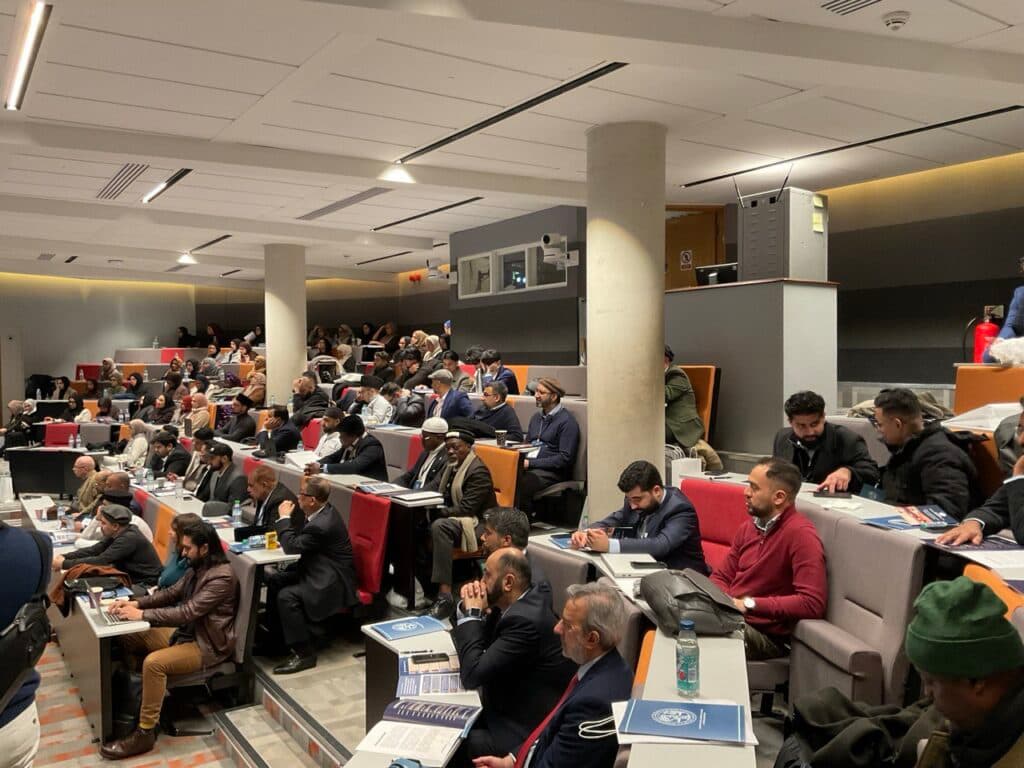
Tahmeed Ahmad, Al Hakam
The International Ahmadiyya Muslim Lawyers Association (IAMLA) is a global body of more than 900 Ahmadi Muslim lawyers, jurists, law students and former members of the judiciary. They have members in over 28 countries worldwide. The IAMLA are dedicated to serving humanity and securing human rights for all, particularly the marginalised and vulnerable. (ahmadi-lawyers.org)
On 7 February 2026, the IAMLA held its inaugural international symposium. It was titled International Law on Trial: Justice in a Divided World and held at the Brunei Gallery Lecture Theatre, SOAS University of London. The event brought together Ahmadi Muslim lawyers from across the world and invited legal professionals to reflect on the state of international law amid growing global division.
The symposium took place at a time when we are witnessing growing concerns that international law is being undermined. Treaties and international organisations are facing pressure as nations withdraw from them or fail to fulfil their obligations. The wars in Gaza and Ukraine, as well as recent developments in Venezuela and Greenland, serve as clear examples. Issues such as climate justice, international criminal law, arms control and free trade are all being affected by this situation.
The event marked a significant milestone for IAMLA, with over 100 Ahmadi lawyers flying in from nine countries. Total attendance was close to 250, with the hall at near full capacity, indicating both the relevance of the topic and strong interest among legal professionals.
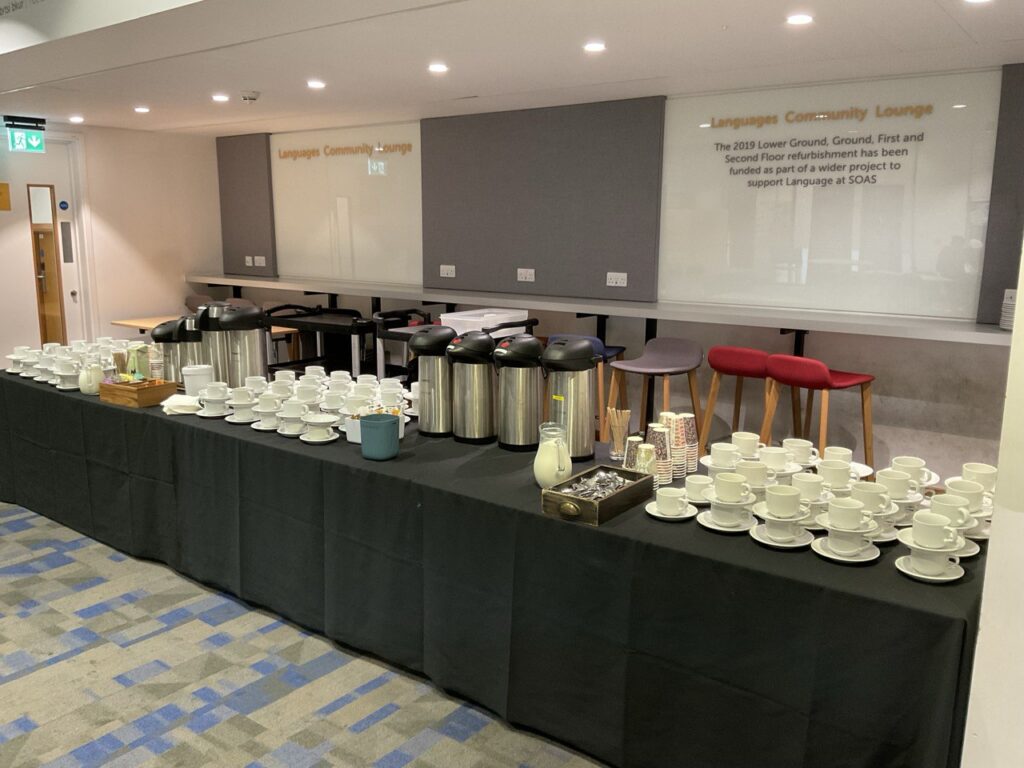
Registration commenced at 8:30 am, with attendees receiving a detailed programme upon entry. Breakfast and light refreshments were provided. The symposium opened at 9:00 am and began with the recitation of the Holy Quran.
The event was hosted by Amjad Mahmood Khan Sahib, who began by reading Hazrat Mirza Masroor Ahmad, Khalifatul Masih Vaa‘s special message. This was followed by a series of panel discussions on various topics. A brief break was held at noon, followed by a panel on climate justice, lunch and prayer.
The exhibition
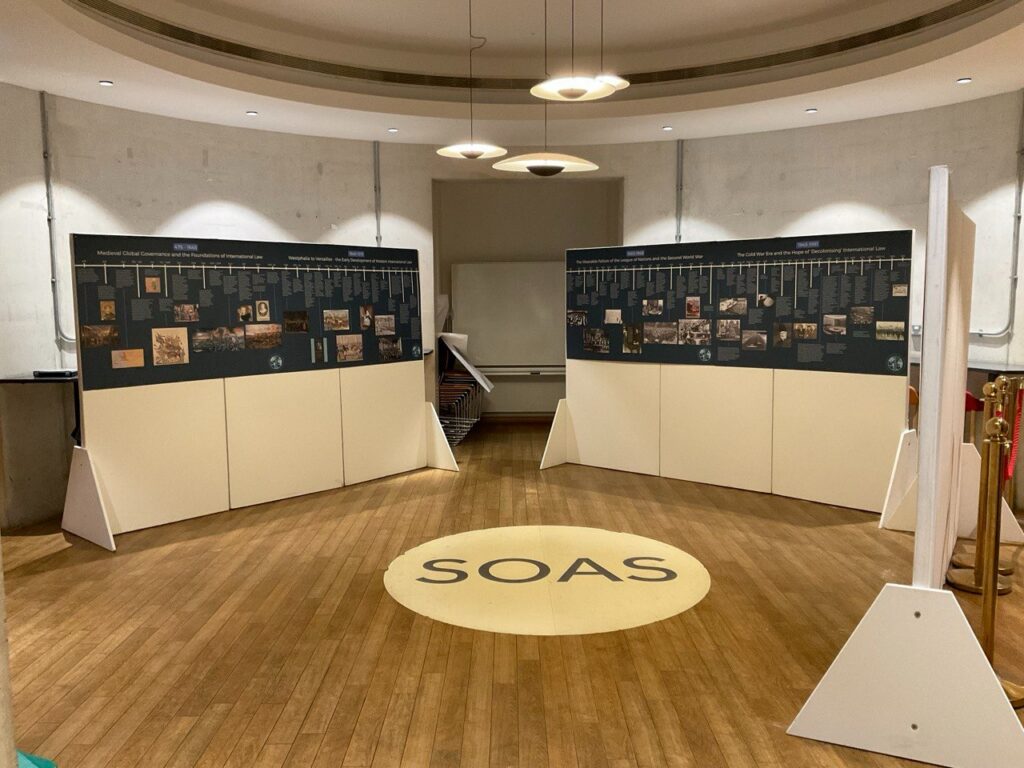
During the break, attendees received a guided tour of an exhibition on the history of law and the evolution of global governance since Emperor Justinian. The exhibition compared different ages of political turmoil, highlighting the misuse of the Veto and the unrest that follows when international law is manipulated for personal gain.
Panel discussions and panellists
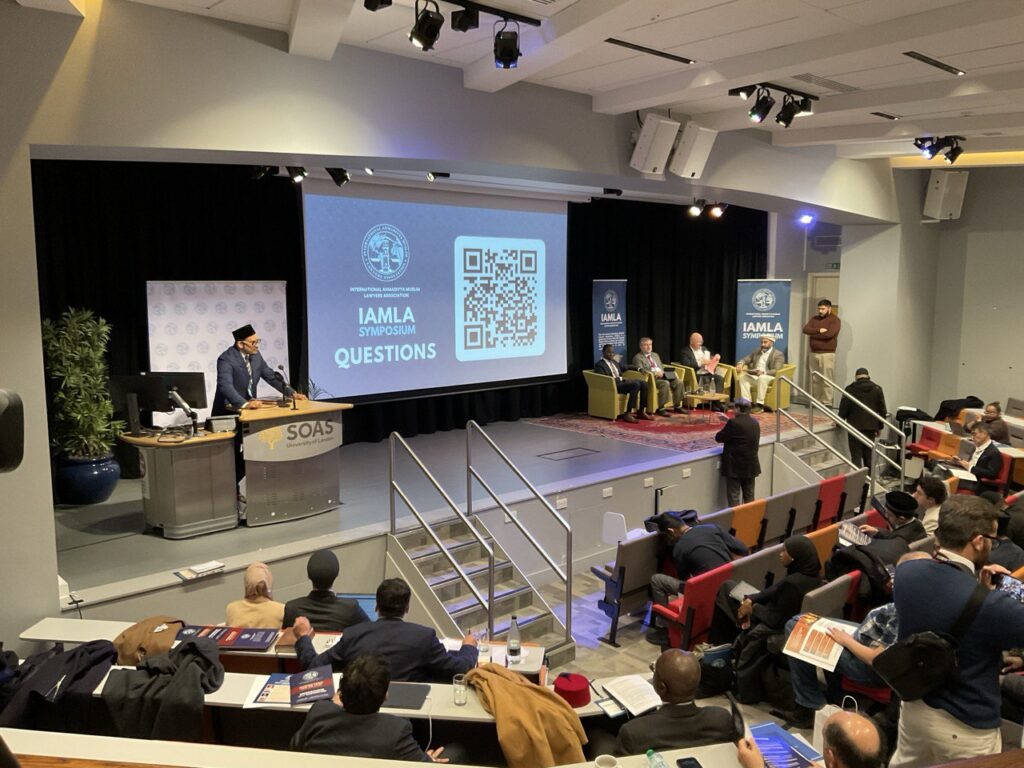
The symposium featured an impressive list of internationally recognised speakers. The programme was organised into five panel discussions conducted throughout the day. Attendees were invited to submit questions, which were later incorporated into the discussion. The panels were divided into the following topics:
Panel 1: The Accountability Gap and Armed Conflicts: Are International Humanitarian Law and International Criminal Law Fit for Purpose?
Panel 2: Constitutional Discrimination Against Religious Minorities: International Human Rights, National Blasphemy Laws, and the Shrinking Space for Refugee Protection
Panel 3: Defining the Limits of Free Speech: Legal, Political and Social Dimensions of Freedom of Expression Laws
Panel 4: Climate Justice and Just Transitions: A Multifaceted Challenge for the International Community
Panel 5: What is the Role of International Law in Ensuring Justice in a Divided World?
The speakers who participated in the various panels included:
Jonathan Butterworth, Chairman, International Ahmadiyya Muslim Lawyers Association (IAMLA)
Professor Satvinder Juss, Professor of Law, King’s College London
Dr Yenn Lee, Deputy Head of the Doctoral School, SOAS
Peter Oborne, Associate editor of Middle East Eye and former chief political commentator of The Daily Telegraph
Victor Kattan, Assistant Professor of Public International Law at the University of Nottingham
Nada Ali, Lecturer at SOAS Law School, researching the politics of international criminal law
Ján Figel, former EU Commissioner and EU Special Envoy for Freedom of Religion or Belief
Marco Respinti, Italian journalist and Director-in-Charge of The Journal of CESNUR
Mohamed Elsanousi, Commissioner of the US Commission on International Religious Freedom
Professor Alison Scott-Baumann, Professor of Society and Belief at SOAS
Professor James (Jim) Cavallaro, former President of the Inter-American Commission on Human Rights
Kamran Mustafa, specialises in public international law and global governance
Kiiza S. Hussein, an environmental lawyer, social entrepreneur
Dr. Kamal-Deen Ali, the Director General of the Ghana Maritime Authority
Zamzam Ibrahim, a climate justice advocate and community organiser
Qudus Malik, an international human rights lawyer with over 15 years of experience
Farooq Aftab, the General Counsel of the International Human Rights Committee (IHRC)
Dr Nazila Ghanea, the UN Special Rapporteur on freedom of religion or belief
Dr Nicholas Levrat, currently the UN Special Rapporteur on Minority Issues
Amjad Mahmood Khan, Lecturer in Law at University of California Los Angeles (UCLA) Law School
Mubarak Waseem, a Barrister at Essex Court Chambers, in Lincoln’s Inn Fields
Message from Hazrat Khalifatul Masih V
A special message from Hazrat Mirza Masroor Ahmad, Khalifatul Masih Vaa, was presented. Huzooraa began by highlighting the growing disregard for international laws by major powers and the resulting injustice it creates. He pointed out that many lawyers prioritise money over justice and truth. However, Ahmadi lawyers should stand apart from such practices by upholding truth and remaining dedicated to justice.
“Without doubt, it is necessary for lawyers to strive to right every wrong, to tirelessly advocate against injustice and to work towards ending the conflicts that afflict the world. Indeed, this is a foremost duty for all Ahmadi Muslims and is the reason that I, for over twenty years, have been urging all nations and all peoples to adopt true justice and to strive for peace and security in the world.”
Huzooraa cited Hazrat Chaudhry Sir Zafrulla Khanra as a role model for all Ahmadi lawyers. He highlighted Islamic principles of justice and the Holy Quran’s teachings on international law. Huzooraa emphasised the increasing injustices in today’s world and how they contribute to its decline. He expressed concern that the world is heading toward destruction.
“Today, you have chosen ‘International Law on Trial: Justice in a Divided World’ as your theme and while this topic is commendable, the reality is that law and order at all levels of society, not just internationally, are on trial today. This, as I have already made clear, is because the fundamental principle of justice is under a sustained attack. Thus, let it be clear that, until true and absolute justice is established there can be no lasting peace in the world.”
The message concluded with a call for a pledge from all Ahmadi lawyers, along with a prayer for the world to rectify itself and uphold justice.
“Therefore, it is my sincere request to all of you that, in your deliberations today, you reach a consensus amongst yourselves pledging to make whatever sacrifices are required in order to defend justice and to focus seriously and wholeheartedly on this mission. If you are collectively resolved to do this, it is possible, at least to some extent, that you may be able to make a real and positive difference globally. Otherwise, as I have repeatedly stated, all signs point only towards unimaginable destruction.”
Conclusion of the symposium
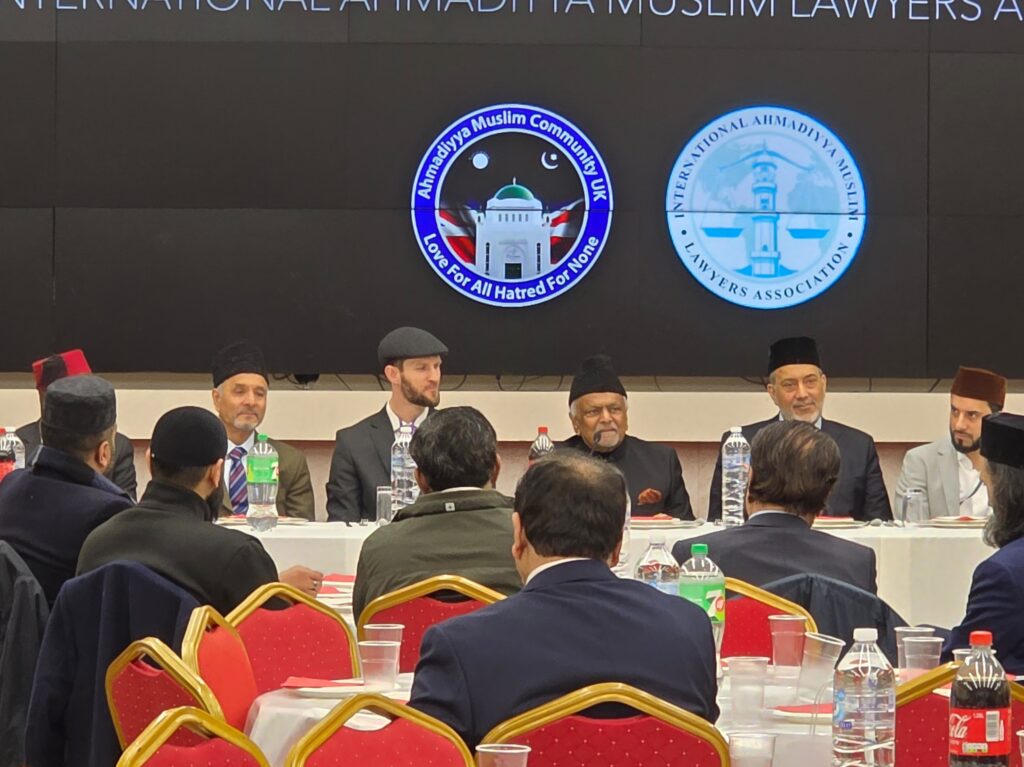
The symposium concluded at 4:45 pm with an address by Jonathan Butterworth, Chairman of IAMLA. He emphasised the points raised by Hazrat Khalifatul Masih Vaa in his message. Following the formal close of the symposium, attendees later gathered for a dinner at Baitul Futuh Mosque hosted by AMA UK.
Interview with the chairman of IAMLA
Al Hakam had the opportunity to interview the Chairman of IAMLA, Jonathan Butterworth sahib. Here is what he had to say:
“This symposium was inspired particularly by the guidance of His Holiness, Hazrat Mirza Masroor Ahmadaa, the fifth Khalifa and head of the worldwide Ahmadiyya Muslim community. He has, in many of his Friday Sermons and addresses over recent years, been calling on Ahmadi Muslims to raise their voice against injustice that has seen in the world.”
Butterworth Sahib highlighted the significant injustices occurring globally and how Huzooraa has been drawing attention to Ahmadi Muslims, urging them to raise their voices.
“His Holiness has established the International Ahmadiyya Muslim Lawyers Association, and so we feel a special duty as lawyers because we have the knowledge and capacity to be able to speak in terms of international law and use legal mechanisms to help to achieve justice, and we felt a particular duty that we should raise our voice on these topics.”
“As for why the theme ‘International Law on Trial’ was chosen for the symposium, we had a meeting with the worldwide presidents of the IAMLA, and asked them to propose themes. His Holiness then gave us guidance on those themes, and the theme Huzooraa approved was ‘International Law on Trial: Justice in the Divided World.’”
Butterworth Sahib told us that the aim was to focus on tackling three key points:
- International law is under trial in this era and major changes are taking place
- In its essence, international law is there to ensure justice
- The UN, which came into place after World War II to promote peace and human rights through international law, has failed
“These were the three themes that we looked to cover within that broader symposium title, and then we broke that down into five different panel discussions.
“By the grace of Allah, we received a very special message from Hazrat Khalifatul Masih Vaa. Our plan will be to fulfil our work on this. There is a number of different actions we are looking to take in relation to this symposium, and then we will seek further guidance for next year.”
Butterworth Sahib emphasised the Quranic injunction to protect the rights of God and His creation as a key objective of IAMLA. He said, “Whatever work we are doing is always guided by that, and the symposium is just one part of that wider work, but certainly from our side we will be looking to continue it, and we will be seeking guidance on that.
“I would like to highlight the end of Huzoor’saa message. Huzooraa called on all Ahmadi Muslims lawyers to make a pledge to make whatever sacrifices are necessary to defend justice, and to paraphrase, to sincerely and wholeheartedly focus on this mission.
“That is actually something that we have already sought to implement, so on the day after the symposium, we had our closing session in Morden and we gathered the many lawyers who attended from all around the world, and they signed this pledge to defend justice and to focus sincerely and wholeheartedly on this mission.”
Butterworth Sahib shared with us further instructions from Hazrat Khalifatul Masih Vaa:
“Huzooraa has approved for the established national lawyers’ associations in each country to hold their own events where they convey this message. Our main focus is to share this message of Huzooraa, because, as many of the non-Ahmadi speakers recognised, this type of address is very rare. Many of them who are non-Ahmadi Muslims have not heard anything like this. They are used to addresses by politicians and religious leaders, some of them mention this, but they have not heard something like this. They gave their various reasons, but for most, it was so clear, honest, frank and impartial that it resonated deeply with them. So, what we now want to do is continue to share this message of Huzooraa beyond the symposium.”