
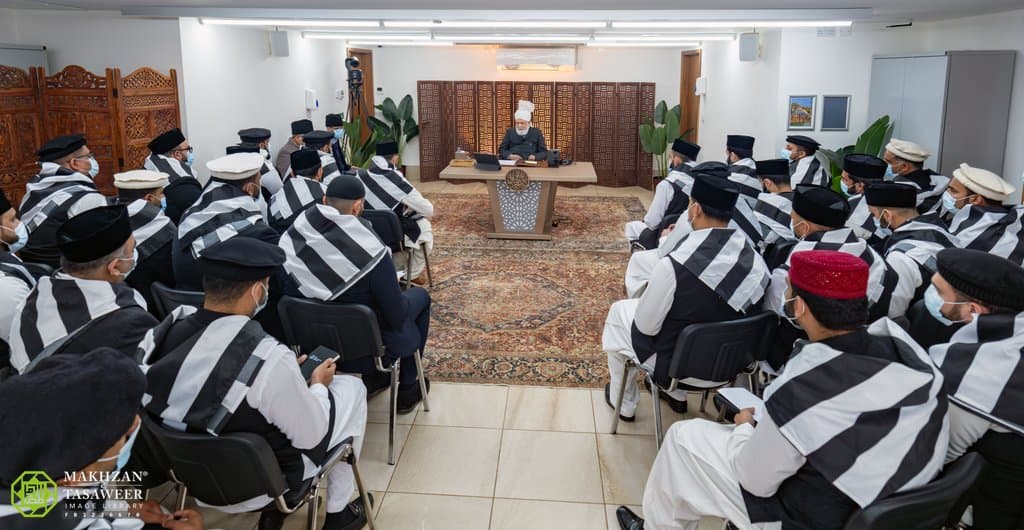
Islamabad, Tilford, UK, 10 May 2026: The national amila of Majlis Khuddam-ul-Ahmadiyya UK was blessed with a mulaqat with Hazrat Mirza Masroor Ahmad, Khalifatul Masih V (aa).
During the mulaqat, members of the national amila and regional qaideen introduced themselves and received guidance from Huzoor (aa) regarding their departmental responsibilities, the spiritual foundations of service, tabligh, tarbiyat, education, service to humanity, professional development, SEND support, regional engagement and mosque attendance.
Work according to the constitution and seek Allah’s help
At the outset, Huzoor (aa) asked whether departmental reports were being submitted, whether a plan of action had been prepared and whether work was being carried out in accordance with the constitution. Huzoor (aa) said that this was the essential point: work should be carried out according to the prescribed system and with the thought that all such service is being done for the sake of faith.
Huzoor (aa) reminded the amila that work done for faith especially requires the help of Allah the Almighty and that without Allah’s help such work cannot be accomplished. Therefore, the rights owed to Allah must be fulfilled first, after which blessings are placed in one’s work. For this purpose, Huzoor (aa) said, prayer, salat, nawafil and supplication are necessary. In worldly work, a person may rely on knowledge and ability, but in the service of faith, one must turn entirely towards Allah.
Following this opening guidance, the members introduced themselves and their respective responsibilities.
Introductions and assigned responsibilities
Huzoor (aa) spoke with the naib sadran and enquired about their professional backgrounds and assigned duties. One Naib Sadr mentioned his work with the Muhasibah Committee and Islamabad events and Huzoor (aa) asked about his finance background, upon which he explained that he served as a senior accountant at AMJ International.
Another Naib Sadr mentioned that he worked as an IT contractor in the central government; he oversaw matters including delegation, jaidad, GDPR and sustainability. Another was overseeing the Winter Retreat, international trips, Baitul Futuh event management, missionary engagement and other departments. A further Naib Sadr mentioned his professional work in marketing for The Times and his responsibilities connected with Ishaat and the national Ijtema.
Speaking with the Motamid, Huzoor (aa) asked how much time he was able to give, noting that the Motamid has to devote considerable time to the department. The Motamid explained that he gave what time he could and that, following Huzoor’s (aa) recent guidance, he had begun going to the office daily. Huzoor (aa) asked whether this was being done out of compulsion and when the Motamid replied that he was working with interest, Huzoor (aa) said that he should continue doing so and pray to Allah to make up for any remaining shortcomings.
Huzoor (aa) also spoke briefly with the Additional Mohtamim Umumi, who mentioned his duties connected with Hifazat-e-Markaz and other responsibilities.
Khidmat-e-Khalq and service to those in need
The Mohtamim Khidmat-e-Khalq reported that, at the beginning of the year, the department had launched two campaigns: a winter campaign and a Ramadan campaign. When Huzoor (aa) asked what had been achieved through the winter campaign, including how many blankets, jerseys and warm clothes had been distributed in poorer countries, the Mohtamim explained that their focus had been on work within the UK, while the Ramadan campaign had raised £120,000 for Humanity First.
Huzoor (aa) drew attention to the homeless in the UK, noting that many people sleep outside shops with sleeping bags and cover themselves with bin bags. The Mohtamim said that the department also arranged homeless-feeding sessions across the country. Huzoor (aa) then asked whether they provided such people with food or support for rent, noting that such people often face the choice of either eating or paying rent.
Paying off debt and avoiding a legacy of financial burden
Speaking with the Mohtamim Maal, Huzoor (aa) asked what property or buildings Majlis Khuddam-ul-Ahmadiyya had, apart from the guest house. The Mohtamim mentioned the Sara-e-Masroor guesthouse, acquired in 2023.
Huzoor (aa) then asked about the financial commitments associated with the property and instructed that reserve funds should be used to clear them as quickly as possible. Huzoor (aa) advised that the organisation should not leave behind a legacy whereby the next Sadr or Mohtamim Maal would inherit a Majlis still burdened with debt. He instructed that the debt should be cleared.
Tabligh, Waqf-e-Arzi and the need for honest feedback
The Mohtamim Tabligh was asked what target had been set for tabligh. He explained that, in order to activate khuddam, a Waqf-e-Arzi scheme had been launched in November. By the grace of Allah, 11 Waqf-e-Arzi sessions had taken place, during which members carried out door-to-door work around mosques. He reported that 561 khuddam had participated.
Huzoor (aa) asked what had been achieved through this. The Mohtamim said that the participants had been trained in order to build their confidence. He explained that the plan was to arrange mosque open days, invite neighbours door-to-door and set up “Ask Islam” stalls in town centres, so that khuddam could become more confident and their hesitation in doing tabligh could be reduced.
Huzoor (aa) then referred to the recent debate involving Jamaat representatives and asked: “Has there been any benefit from it? From the Jamaat’s perspective too, has there been any benefit for khuddam, or has it benefited others?” The Mohtamim said that it had been beneficial for him personally and for many khuddam. Huzoor (aa) observed that some non-Ahmadis had commented that their own representatives had not answered properly, while some Ahmadis felt that the Jamaat’s presentation could also be improved. Huzoor (aa) asked whether feedback had been taken from khuddam on how such efforts could be improved. When the Mohtamim said that feedback from khuddam had not yet been taken, Huzoor (aa) said that it was his responsibility to do so.
Huzoor (aa) explained that they had become helpers in this work and should provide feedback, suggest strategies, present options and advise on how improvement could be achieved. The initial approach should not be regarded as the final word. Huzoor (aa) said: “They can give advice to the Jamaat’s Secretary Tabligh.” Feedback should be taken from qaideen and khuddam so that improvement may follow.
Huzoor (aa) said that one should not merely say that the result was good, praise it and then leave the matter. No one is 100% perfect. Flaws, shortcomings and weaknesses should be identified, studied and addressed. The department should form a team, consider how matters should be presented and then offer constructive feedback. Huzoor (aa) also asked whether the overall result had been good and the Mohtamim replied in the affirmative.
Accepting one’s fault as a means of progress
During the introductions, Huzoor (aa) spoke to a Mu‘avin Sadr and recalled a childhood incident in which he had tumbled during a race at Hadeeqatul Mahdi. When the Mu‘avin Sadr replied that it had not been his fault because the path was downhill, Huzoor (aa) advised him to develop the habit of accepting one’s fault. Huzoor (aa) said that when a person acknowledges their fault, they then tries to improve and this leads to good progress.
Tarbiyat begins with personal example
Speaking to the Mohtamim Tarbiyat, Huzoor (aa) first asked what tarbiyat work he was doing and then asked about his own observance of congregational prayers. Huzoor (aa) said that the Mohtamim should strive to offer prayers in congregation himself. If office-bearers themselves offer prayers in congregation, recite the Holy Quran, give attention to nawafil, prayers and zikr-e-ilahi, then their tarbiyat work will produce better results.
Huzoor (aa) emphasised that the first requirement is to present one’s own example. Otherwise, there are many people who can merely deliver speeches. The real task is to instil the habit of salat among khuddam, then to instil the habit of reciting the Holy Quran. Thereafter, short passages from the writings of the Promised Messiah (as), as well as from the sermons of the Khulafa, should be shared with khuddam so that they remember them. Huzoor (aa) said that khuddam should develop both knowledge and courage, as both are needed.
Sanat-o-Tijarat and helping idle youth into work
The Mohtamim Sanat-o-Tijarat reported the number of khuddam of working age, aged 18 and above, and said that the department was trying to identify each person’s professional status, including what work they did and where they were employed.
Huzoor (aa) instructed that attention should also be given to those who had left education, were idle or had fallen into bad company. He mentioned those who may have become involved in drugs or other addictions. Huzoor (aa) advised that such individuals should also be listed and given some form of work, even if small, so that they can earn and become occupied in something constructive.
Huzoor (aa) said this should be done in coordination with the Tarbiyat department. If Sanat-o-Tijarat and Tarbiyat work together through a coordinated programme, many young people can be looked after and helped.
Physical health and securing sports facilities
The Mohtamim Sehat-e-Jismani reported on sports being organised, including football, padel, badminton and table tennis and said that activities were taking place two to three days a week. Huzoor (aa) asked what sports khuddam were being made to play locally and the Mohtamim mentioned football, cricket, table tennis and badminton.
Huzoor (aa) asked whether khuddam had their own teams in grounds or played through other clubs. The Mohtamim said that Majlis Khuddam-ul-Ahmadiyya currently had an external cricket team in London, while most other activities remained internal. He also mentioned a council ground in Kingston and said that a ground had been obtained for this year, while efforts were being made to secure a permanent ground. Huzoor (aa) said that there is also a team of khuddam from Islamabad in Tilford.
Student data and university engagement
The Mohtamim Umur-e-Tulaba was asked how many university-going students there were. He reported that data had been collected for 597 undergraduate and master’s students and that 60% of the data collection process had been completed since November. Huzoor (aa) instructed that the remaining data should also be updated.
Talim, grassroots classes and creating interest in reading
Speaking with the Mohtamim Talim, Huzoor (aa) asked what the education programme was. The Mohtamim explained that the department was working to strengthen the grassroots level by encouraging two classes per month in every majlis and by having the team visit those classes. He said that content was being provided, positive feedback was being received and the focus was on teaching Jamaat beliefs and addressing common allegations through local, regional and other events.
Huzoor (aa) said that some religious knowledge should also be developed through books. The Mohtamim mentioned that Zikr-e-Ilahi had been recommended in light of the year’s theme, “Hamara Bahisht Hamara Khuda Hay (Our Paradise lies in our God)”. Huzoor (aa) asked how many people actually read the book. He said that merely telling people to read would not be enough. Short summaries should be prepared and sent in between, so that interest is created. Once interest develops, individuals may then read the full text in more detail. Huzoor (aa) said that this would require effort and hard work.
When the Mohtamim said that quizzes were also prepared so that those who said they had read could answer them, Huzoor (aa) remarked that this was work requiring considerable effort.
Waqf-e-Nau: ensuring guidance reaches every home
Speaking with the Mu‘avin Sadr for Waqf-e-Nau, Huzoor (aa) asked about the Waqf-e-Nau Ijtema and the attendance. Huzoor (aa) also asked what effect the Ijtema had produced and whether the attendees had simply listened to speeches and left. He instructed that points from the guidance should be extracted and given to every waqif-e-nau, reaching every home. These reminders should continue to be sent from time to time, highlighting the matters that require attention and the work that must be done.
SEND and safeguarding: Improving data and tailored activities
The Mu‘avin Sadr for SEND and safeguarding reported that, according to the data so far, there were 95 atfal and khuddam with SEND and that an external play-area activity had recently been arranged for them.
Huzoor (aa) asked whether there were only 95 with special educational needs. The Mu‘avin Sadr said that this was the current data, though the actual number was definitely higher. Huzoor (aa) instructed that the data should be reviewed and improved.
Huzoor (aa) asked what help was being offered to those with special needs. The Mu‘avin Sadr said that there were relatively few specific activities as part of Majlis Khuddam-ul-Ahmadiyya and that feedback from the recent event suggested there should be more such events.
Huzoor (aa) advised that different groups should be formed and that suitable games and activities should be explored. Small tournaments could be held every few months so that they remain attached to the Majlis. Huzoor (aa) also drew attention to wheelchairs and adapted sports, asking whether sports such as hockey or football could be arranged in suitable ways and instructed that all such possibilities should be considered.
Guidance to regional qaideen
Thereafter, Huzoor (aa) spoke with each national amila member and regional Qaid present, asking the qaideen about their tajnid and the level of activity among khuddam.
Speaking with the Qaid of Baitul Ehsan Region, Huzoor (aa) asked whether they were receiving many opportunities for service due to guests staying there and whether the khuddam handled those duties or left them to the Jamaat administration. The Qaid said that they tried to serve wherever they were given the opportunity and according to the guidance received from the Regional Amir.
Speaking with the Qaid of Middlesex Region, Huzoor (aa) asked about his work. The Qaid explained that he ran a printing company specialising in custom clothing such as jumpers, hoodies and jackets and that much of the clothing seen at Jalsa was produced by his company. Huzoor (aa) asked whether he gave concessions for Ijtema-related items. The Qaid said that he aimed to provide items at cost price and did not take profit, upon which Huzoor (aa) expressed appreciation.
The real measure is the percentage of active khuddam
Speaking with the Qaid of Baitus Subhan Region, Huzoor (aa) asked how many khuddam were in the region. The Qaid reported 422 khuddam and 565 khuddam and atfal combined. Huzoor (aa) then asked how many were active. The Qaid said that 25 attended daily prayers, while around 150 attended Jumuah.
Huzoor (aa) asked what the remaining 300 were doing. When the Qaid said that some attended Ijtema and other Jamaat programmes, Huzoor (aa) said that there should at least be some level of regular attendance: for example, attending one prayer at the mosque, such as Isha, Maghrib or Fajr or attending monthly meetings.
Huzoor (aa) instructed the qaideen to give attention to this and not become relaxed simply because a few people attend or because two rows form in the mosque. The real matter is to see what percentage of members are active and this number should be increased as much as possible. Huzoor (aa) said that this is the work of qaideen.
Speaking with the Qaid of North West Region, Huzoor (aa) asked which areas were included and the Qaid mentioned the five qiadats of Manchester, as well as Liverpool, Bolton, Blackburn and Preston. The Qaid said that members were cooperative and mentioned that, in the previous month, they had held an amila meeting after Fajr, which had produced the highest attendance and that they were trying to begin with prayer.
Huzoor (aa) instructed that they should increase this effort, bring khuddam closer and attach them to the mosque. He said that this is the real work and if this is not achieved, then there is no benefit to the organisations. If at least 70% attendance in prayers is not being achieved and members are not reciting the Holy Quran, then the desired promising results are not being produced. Huzoor (aa) said that every Qaid should make effort in this regard and that the benefit of appointing missionaries in such roles would be realised only if spirituality also increases through them.
Guidance for office-bearers and missionaries
Speaking with the Naib Motamid, Huzoor (aa) asked whether he was working properly in the Itimad department. Huzoor (aa) advised him to focus on prayers and also referred to the guidance he had given to missionaries in his address at the Jamia Ahmadiyya convocation. Huzoor (aa) said that although this guidance was especially for missionaries, it also applied generally to all those who become office-bearers.
Conclusion
At the end of the mulaqat, Huzoor (aa) concluded by reiterating the guidance he had given at the start: they must establish a connection with Allah, maintain a spirit of service and always remember that whatever work they do is being seen by Allah and must be done for His sake. This was followed by a group photo.
Editor’s note: This report has been amended to reflect the relevant wording more accurately.
(Summary prepared by Al Hakam)