
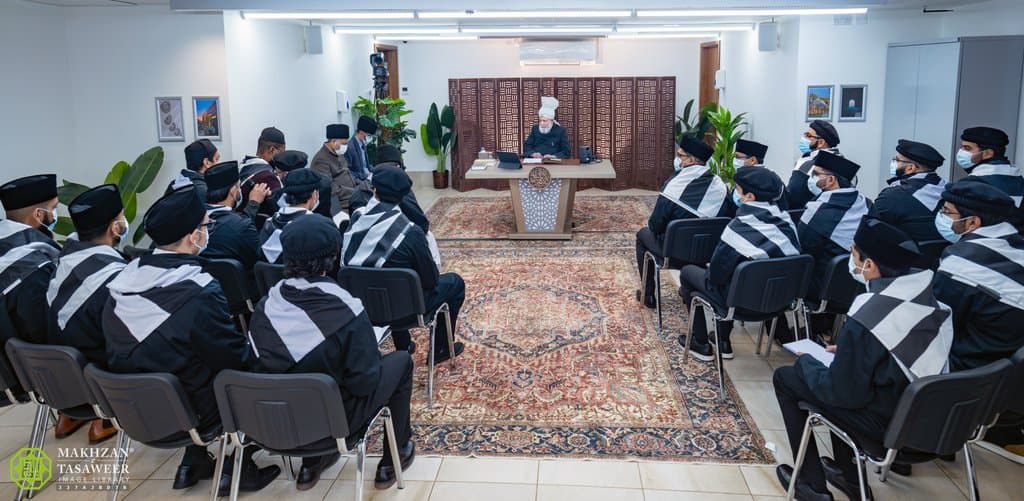
Islamabad, Tilford, 25 October 2025: A delegation of 25 khuddam from the Midwest Region of Majlis Khuddam-ul-Ahmadiyya USA had the blessed opportunity of a mulaqat with Hazrat Mirza Masroor Ahmad, Khalifatul Masih Vaa.
The meeting commenced as Huzooraa graced the hall with his presence and extended his salaam. Huzooraa first addressed Sadr Sahib MKA USA and then the amir-e-qafilah, Syed Raza Ahmad Sahib, who briefly introduced the delegation. Following this, each of the khuddam had the opportunity to introduce himself, mentioning his family background and his academic and professional pursuits.
During the introductions, Huzooraa engaged with several of the young men. One khadim expressed his desire to study electrical engineering and then dedicate his life (waqf). Another khadim said he wished to study media, with the ultimate aim of dedicating his life to serving in MTA International. Another khadim stated his intention to attend Jamia Ahmadiyya, to which Huzooraa enquired if he would be willing to go to Jamia in Ghana, which the khadim affirmed.
Huzooraa imparted direct and poignant advice to the members of the Waqf-e-Nau scheme. He explained that for a waqif-e-nau, the five daily prayers and the recitation of the Holy Quran with its translation are the absolute fundamentals. Only by mastering these, he guided, can one truly be called a waqif-e-nau and begin to fulfil their pledge. To another, Huzooraa counselled that merely having a beard is not enough; one must also embody the true characteristics and spiritual qualities of a life devotee.
After the introductions, the khuddam were graciously granted permission to ask questions for their guidance.
On engaging older khuddam with humility
A khadim serving as a zaeem sought guidance on how to effectively encourage khuddam who are older than him to attend the mosque and participate in Jamaat programmes.
Huzooraa advised him to approach them with great humility and respect. He should tell them that although he is younger, he has been given a responsibility and just as he himself comes for prayers, he requests them to do the same. Huzooraa shared his own experience from when he served as a zaeem in his neighbourhood, where many of the khuddam under his charge were older than him, including some of his own relatives and uncles. He would remind them that while their relationship outside the mosque was one of family, within the Jamaat, the sanctity of the Nizam-e-Jamaat must be respected.
Huzooraa guided the khadim to explain to these elder members, with politeness, the importance of participating in Jamaat programmes. He should especially explain to them that attending the five daily prayers is a divine command. He should appeal to their sense of responsibility as role models, explaining that by coming to the mosque, they are setting a vital example for their own children, who will follow in their footsteps. Furthermore, he should adopt a humble approach by telling them that, as he is young, it is their duty to guide his moral training and that by setting a good example, they will help him become a better Ahmadi Muslim. By speaking with such humility, Huzooraa stated, all will be well.
Memories of the Companions of the Promised Messiahas
A khadim requested Huzooraa to share some memorable incidents from his youth in the company of the Companions of the Promised Messiahas.
Huzooraa explained that during his youth, most of the Companions were either very elderly or had already passed away, so he did not have the opportunity for extensive sittings with them. However, he shared some cherished memories from his childhood and teenage years.
He recalled meeting Hazrat Maulana Ghulam Rasul Rajekira, who was known for being a man of great piety and was always ready to raise his hands in prayer for others. He also remembered visiting Hazrat Hafiz Shahjahanpurira, an elderly Companion who was a man of profound knowledge and possessed an extraordinary memory even in old age. His room was filled with bookshelves, yet he knew the exact location of every single book on every shelf.
Huzooraa also shared faint but poignant memories of being in the presence of Hazrat Musleh-e-Maudra and listening to him, as well as recalling his sermons and speeches, though not their specific content. He then spoke of his grandfather, Hazrat Mirza Sharif Ahmadra, a Companion and the youngest son of the Promised Messiahas. He recounted how his grandfather would focus on their moral training by asking the children to read the newspaper or the Holy Quran aloud to him. He would lie down and close his eyes and while the children might think he was not paying attention, he would immediately correct even the slightest mistake in their Quranic recitation, showing that he was listening intently.
Huzooraa also mentioned having seen Hazrat Maulvi Muhammad Hussainra, who lived to a very old age and recalled a meeting with Hazrat Mirza Bashir Ahmadra when he was about 11 or 12 years old. He remembered the immense humility of Hazrat Mirza Bashir Ahmadra, who, despite his great status, would ask even the children to pray for his health and for Allah to make his life easy. These, Huzooraa said, were the kinds of beautiful interactions he was blessed to have with those elders.
The boundless mercy of Allah: Rewards vs punishments
A young man asked for the wisdom behind why the reward for a good deed is greater than the punishment for a bad deed.
Huzooraa explained that this is a manifestation of Allah’s infinite generosity and mercy. God Almighty desires to bestow the best of rewards upon His obedient servants. For this reason, He has decreed that a good deed will be rewarded doubly or even more, while a sin will be counted only as a single bad deed. Huzooraa pointed out that in mathematical terms, this system means that one’s good deeds can effectively nullify one’s bad deeds. This itself is a sign of Allah’s ever-merciful nature. Instead of questioning this favour, Huzooraa guided, one should be happy and deeply grateful. This divine gesture should inspire a person to thank God, increase their obedience to Him and strive to fulfil their duties to Him more than ever before.
On sportsmanship and tarbiyat
A khadim noted that sometimes during sports events at the Ijtema, arguments and poor behaviour can be observed. He asked how this can be curtailed.
Huzooraa stated that the first principle is to instil a true sportsman spirit. The sports programmes within the Jamaat are not life-and-death competitions; they are for recreation and brotherhood and should be treated as such. The more important aspect, however, is moral training. He emphasised that it is the collective responsibility of the Khuddam-ul-Ahmadiyya Amila, the parents and the Tarbiyat Department to train children from a young age to behave with dignity and grace on the sports field. Huzooraa added that while the Jamaat does have a system of punishment, such as banning teams or individuals who misbehave, the ultimate goal should be to foster such excellent moral training that these incidents do not occur in the first place.
Protecting children from materialism
A question was asked on how parents can protect their children from materialism as they pursue higher education and careers, so that they do not divert from the remembrance of Allah.
Huzooraa explained that the foundation is laid by the parents. They must teach their children the principles of Islam from a young age and set their own personal example before them. Parents must be regular in their five daily prayers and should supplicate not only for themselves but also for their children, praying that Allah may keep them on the straight path.
Alongside prayer and personal example, consistent interaction is crucial. Huzooraa guided that every day or at least once a week, the entire family should sit together to discuss matters of faith, listen to a dars, watch an MTA programme, or read from a Jamaat book. Through this regular interaction, children learn that faith is a priority in their household. When they see their parents giving precedence to their religion over all worldly matters, they will naturally follow in their footsteps.
Cherished memories of Khulafa
A khadim requested Huzooraa to share some incidents from his time with the previous Khulafa-e-Ahmadiyyat.
Huzooraa stated that it was difficult to recall specific events offhand, but he shared some blessed memories. He recalled that by the time he was old enough to be fully aware, Hazrat Khalifatul Masih IIra was often unwell, but even then, he would continue to impart counsel.
He then shared a memory of Hazrat Khalifatul Masih IIIrh. As a student, Huzoor’saa father had mentioned to Hazrat Khalifatul Masih IIIrh that he slept a lot and studied less. With a smile, Huzooraa recounted that Hazrat Khalifatul Masih IIIrh lovingly advised him to sleep as much as he needed to and then, after being fully rested, to sit down and study properly.
Huzooraa also narrated an incident from the time of the 1974 anti-Ahmadiyya riots in Pakistan. Ahmadi students had been expelled from university for their safety. Hazrat Khalifatul Masih IIIrh instructed Huzooraa to go back to the university with one or two other Ahmadi boys, reassuring him that no one would harm him. Despite his father’s concerns about the danger, Huzooraa resolved that as the Khalifa had given a command, he had to go. Just as Huzoorrh had said, he himself was not harmed by anyone. However, his two companions were caught and beaten by non-Ahmadis and ironically, a police case was then registered against them and they were jailed. In this, the word of Hazrat Khalifatul Masih IIIrh was fulfilled.
Huzooraa also spoke of his relationship with Hazrat Khalifatul Masih IVrh, both while serving as a life-devotee in Ghana and later in Rabwah. He would receive instructions from Huzoorrh and always tried his utmost to follow them completely. Huzooraa added that he would constantly pray that he might never displease the Khalifatul Masih. These, Huzooraa said, were some of the small but significant memories he could share.
Guidance for expectant parents
Guidance was sought for a newly-married couple who are expecting their first child.
Huzooraa explained that the guidance for raising children is universal, whether it is the first child or the last: parents must set a pious example before them.
However, he gave specific counsel regarding the role of the husband. He explained that a wife goes through a particularly difficult phase after childbirth and it is the husband’s duty to help her during this time. He should be humble, kind, loving and caring towards her. The husband should not expect the wife to bear the full burden of night-time feedings and nappy changes. He should help her so that she can get the rest she needs.
The Promised Messiahas wrote that if men knew the immense pain and difficulty of childbirth, they would not be able to endure it even once. Therefore, a husband must not add to his wife’s difficulties during this time, but should foster a relationship of love and support to protect her from any form of trauma or depression.
On managing multiple responsibilities
A khadim who is working full-time and studying part-time, while also serving as Nazim Talim, asked for advice on managing these overwhelming responsibilities.
Huzooraa advised that as a young and healthy person, he has the potential and strength to manage it all. The key is organisation. He should dedicate a few hours to his studies regularly after work each day and give time to his Khuddam-ul-Ahmadiyya duties on the weekend. Huzooraa stressed the importance of creating a detailed daily schedule or chart that allocates time for work, study, sleep, prayers and service. By following a well-organised plan, he can manage all his responsibilities effectively.
Strengthening one’s bond with the Jamaat and Khilafat
The final questioner asked how to strengthen his own connection with the Jamaat and Khilafat and how to help other khuddam who do not come to the mosque regularly.
Huzooraa explained that the first and most fundamental connection must be with Allah the Almighty. If one’s relationship with Allah is strong, all other connections will follow. This is achieved by fulfilling the rights of Allah, foremost among which are the five daily prayers offered on time. By regulating one’s life, waking for Fajr and making an effort to read and understand the Holy Quran, one’s bond with the Jamaat will naturally grow, because the Jamaat is what calls us towards these very deeds.
The purpose of Khilafat is also to guide people towards Allah. By listening to and acting upon the counsels given in sermons and addresses and by praying to Allah for the capacity to do so, one’s bond with Khilafat is strengthened.
To bring other khuddam closer, one must first set their own example and then build genuine friendships with them. The mosque programmes should also be made more interactive and engaging, with question-and-answer sessions and topics that are of interest to them. Even if they are initially attracted through sports, this provides an opening for them to become attached to the mosque and they will gradually begin to participate in other programmes as well.
The mulaqat concluded with the khuddam having the honour of a group photograph and each attendee was graciously gifted a pen by Huzooraa before he took his leave.
(Summary prepared by Al Hakam)