
During the second half of the 19th century, the Arya Samajists and Christians were running a malicious campaign against Islam, objecting to the teachings of the Holy Quran and attempting to malign the blessed character of the Holy Prophet Muhammad (sa). At that juncture, Hazrat Mirza Ghulam Ahmad (as) of Qadian undertook the task to defend Islam and its Holy Founder (sa).
From a young age, Hazrat Ahmad (as) had a great passion for serving Islam. In the 1860s, while he was staying in Sialkot as an employee, he was seen as a passionate defender of Islam amid the rising attacks from the Christian missionaries.1
The 1870s in British India witnessed a rapid intensification of anti-Islamic rhetoric. It was at that time that Hazrat Ahmad (as) challenged the Arya Samajists and Christians, and wrote articles for some of the prominent periodicals of that time.
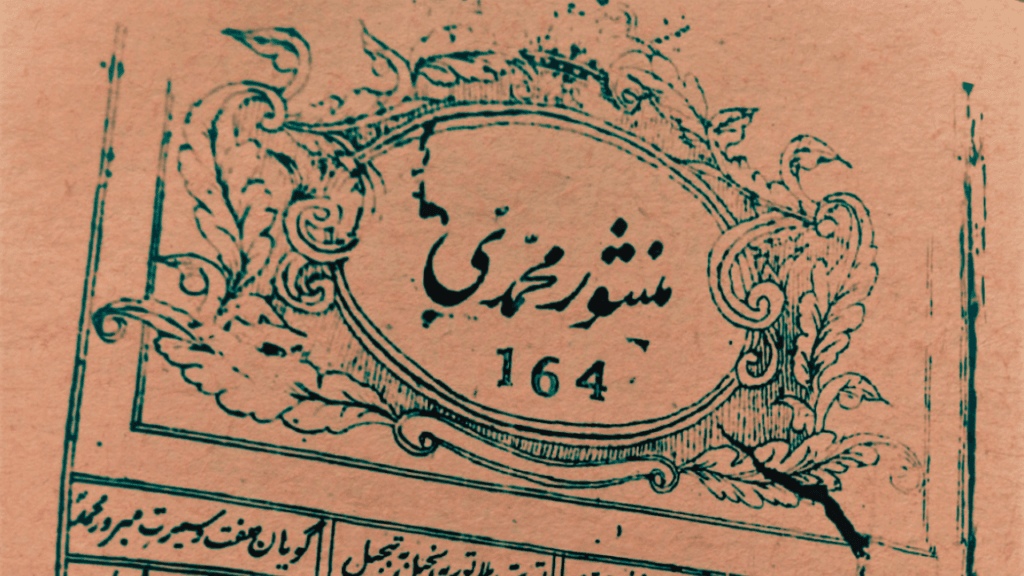
One of those periodicals was the Manshur-i-Muhammadi of Bangalore. Its editor was Maulvi Muhammad Sharif Sahib, and it was printed at the Matba‘ Bahr-ul-Islam, Bangalore. This periodical, published three times a month, made its first appearance in the world of journalism on 20 Jamadi-ul-Thani 1289 AH, corresponding to 25 August 1872.
Regarding the early life of Hazrat Ahmad (as), it is mentioned in Tarikh-e-Ahmadiyyat that Hazrat Ahmad’s (as) earliest known writing, with his own name, was published in the Manshur-i-Muhammadi of Bangalore on “25 Dhul Qa‘dah 1294 AH, corresponding to 25 August 1872.”2
This account suggests that Hazrat Ahmad’s (as) earliest article in Manshur-i-Muhammadi, with his own name, was published in the year 1872. However, it seems to be the result of some confusion. This is because, firstly, the corresponding date for 25 Dhul Qa‘dah 1294 AH is 1 December 1877, not 25 August 1872; secondly, we find no article with Hazrat Ahmad’s (as) name in the 25 August 1872 issue of Manshur-i-Muhammadi.
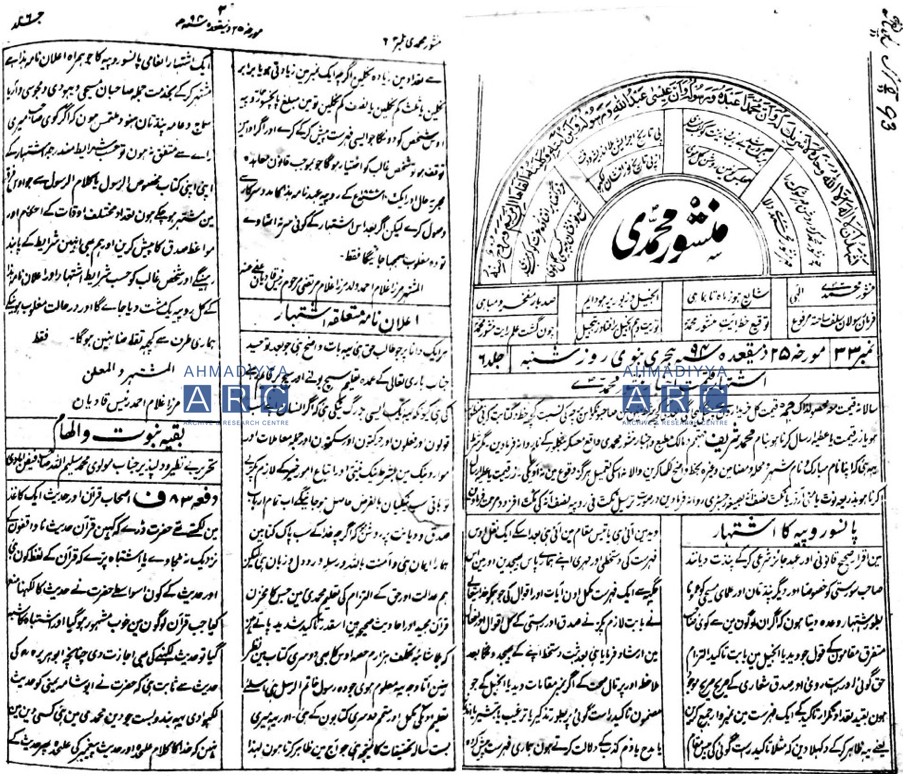
Moreover, mentioning Hazrat Ahmad’s (as) earliest known writing, Hazrat Maulvi AR Dard (ra) states that “through the pages of the Manshur-e-Muhammadi (issued from Bangalore from August 25th, 1872) dated 25 Dhiqa‘da, 1294 A.H., No. 33, Vol. 6, Ahmad (as) made an important announcement.”3 Here, Dard Sahib (ra) has mentioned the date of 25 August 1872 as the date when Manshur-i-Muhammadi began its publication, not as the publication date of Hazrat Ahmad’s (as) earliest writing.
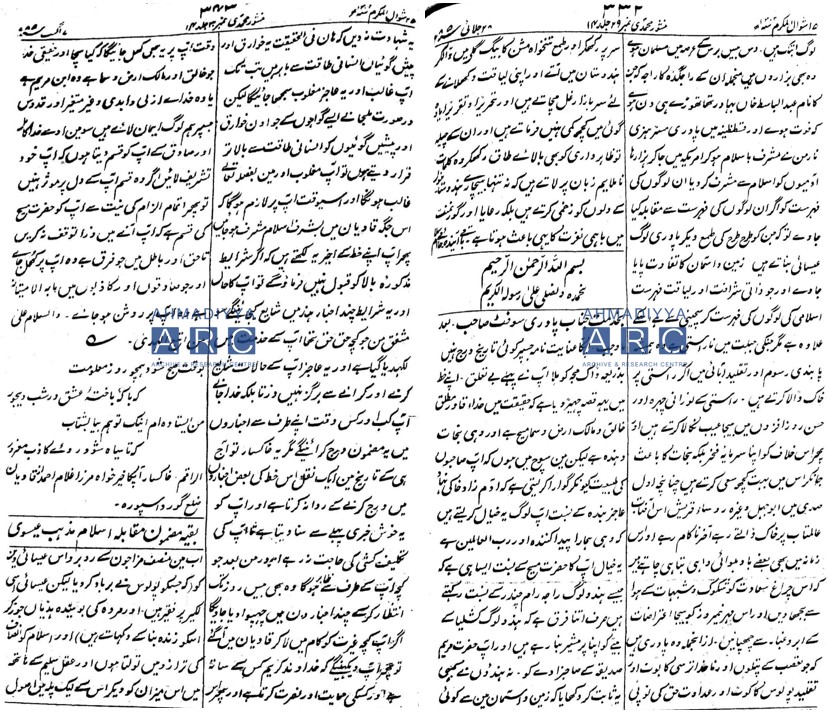
When we take a look at the 1 December 1877 issue of Manshur-i-Muhammadi, there we find a tract, an announcement and an article by Hazrat Mirza Ghulam Ahmad (as).4 The titles of these three pieces are as follows:
- 500 Rupaya ka Ishtihar (A tract for a reward of 500 rupees)
- E‘laan Nama Muta‘alliqa Ishtihar (An announcement related to the tract)
- Iqraarat Sawami Ji Pandit Dayanand Saraswati (The admissions of Sawami Ji Pandit Saraswati)
These writings included a challenge in which Hazrat Ahmad (as) declared that truthfulness in all human relationships is the foundation of all other virtues and that we could judge the true worth of a religion by the measure of emphasis which it laid upon truthfulness. After 20 years of research, Hazrat Ahmad (as) said, he had come to the conclusion that there was no other religion in the world which stressed the importance of this virtue to the extent that Islam did. He offered 500 rupees to the followers of any religion who could prepare a list of quotations from his standard scriptures which might exceed, equal or amount to one-half or even one-third of the quotations which he would bring forth from Muslim scriptures on the subject.5
Then, we find that a lengthy article, comprising various parts, started to appear in Manshur-i-Muhammadi on 25 Muharram 1295 AH, corresponding to around 31 January 1878, and was titled Hindu Sahibon ki Hidayat (Guidance of the Hindus).6
The last part of this article was published on 15 Rabi-ul-Thani 1295 AH, corresponding to approximately 17 April 1878.7
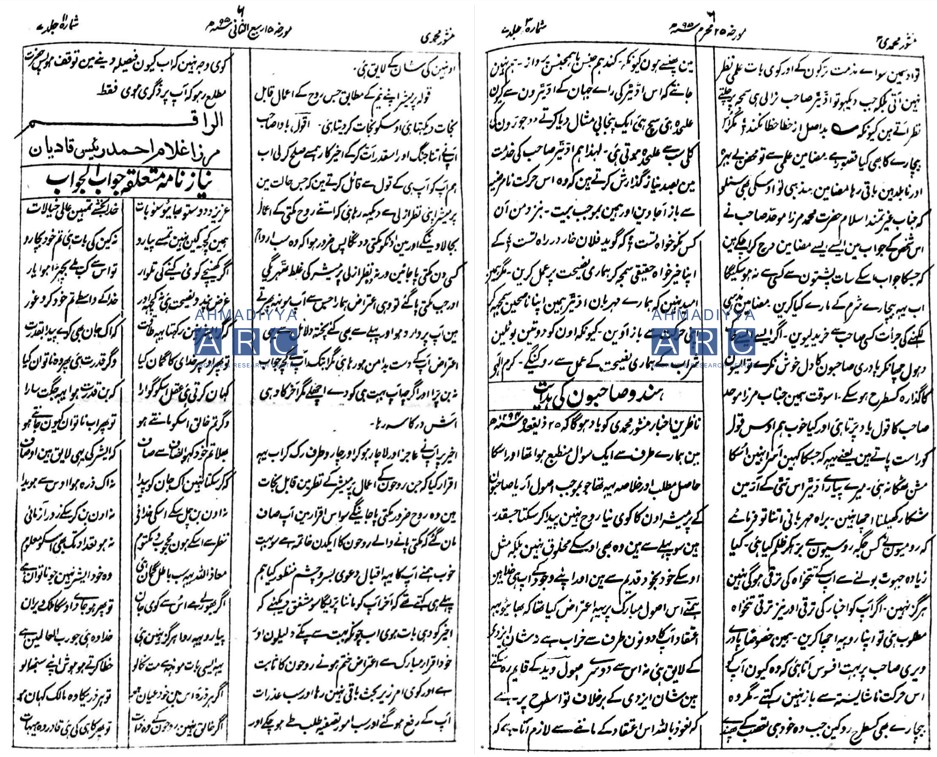
This above-mentioned issue of Manshur-i-Muhammadi also included an Urdu poem of Hazrat Ahmad (as), entitled Niaz-Nama Muta‘alliqa Jawab al-Jawab (A friendly message regarding the rejoinder).8 The poem commenced with the following couplet:
عزیزو دوستو بھائیو سنو بات
خدا بخشے تمہیں عالی خیالات
“O dear ones, friends, brothers! Please listen; May God grant you noble thoughts.”
The first part of another article was published on 25 Jamadi-ul-Awwal 1295 AH, corresponding to around 27 May 1878, titled Tabsarah Muta‘alliqa Ishtihar 500 Rupaya (A review of the tract for 500 rupees reward).9
The second part of this article was published in the following issue.10 The same issue of Manshur-i-Muhammadi included another article of Hazrat Ahmad (as), titled Bawa Sahib ki Shara‘it Matluba Parcha Safir-i-Hind 23 Farvari ka Ifaa‘ Aur Neez Chand Umur Waajib-ul-Arz […] (Fulfilment of the conditions as demanded by Bawa Sahib in Safir-i-Hind dated 23 February and some other points worth mentioning […]).
It is evident from Hazrat Ahmad’s (as) articles, which were published in Manshur-i-Muhammadi in the late 1870s, that even before Barahin-e-Ahmadiyya, he had been occupied in responding to the attacks on Islam.
These articles are currently the earliest known writings of Hazrat Ahmad (as). His writings of that time can be found in the first volume of Majmu’ah-e-Ishtiharat and the second volume of Ruhani Khazain.
When Hazrat Ahmad (as) started publishing Barahin-e-Ahmadiyya, the Manshur-i-Muhammadi published various announcements about this book and wrote lengthy reviews as well. These reviews beautifully shed light on the need for such a work, as Islam was being attacked from all sides.
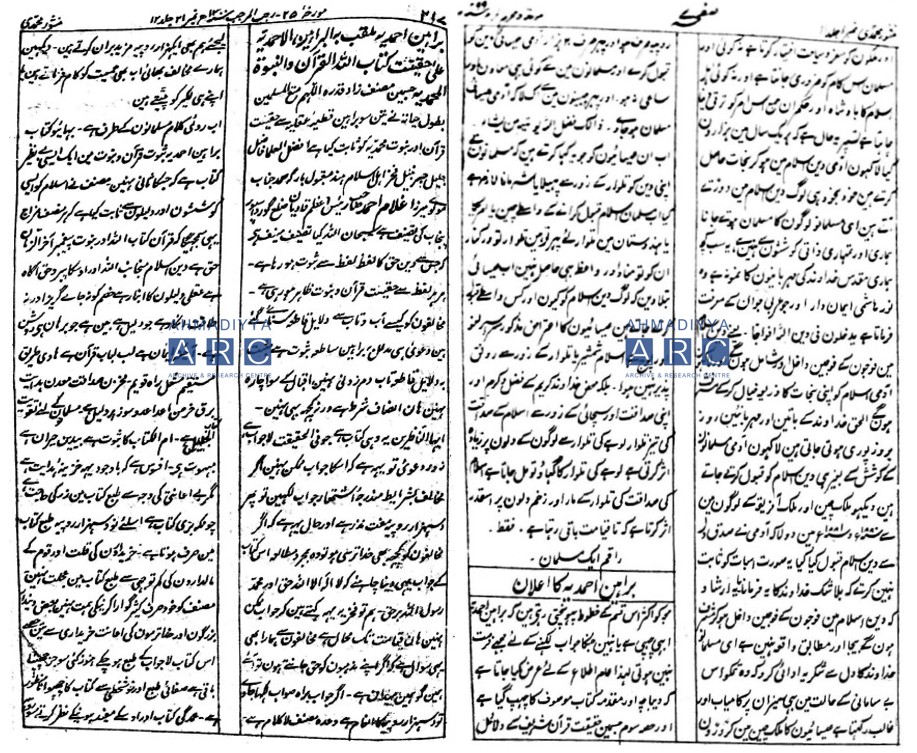
In Manshur-i-Muhammadi’s issue of 5 Muharram 1299 AH, corresponding to around 27 November 1881, an announcement from Hazrat Ahmad (as) was published, titled Barahin-e-Ahmadiyya ka E‘laan – Announcement about Barahin-e-Ahmadiyya.11
In this announcement, Hazrat Ahmad (as) wrote that he was regularly receiving letters in which people would ask as to whether Barahin-e-Ahmadiyya had been published or not. Responding to such queries, Hazrat Ahmad (as) wrote:
“The Preamble and the Introduction of the said book has been published and the Part III – comprising the arguments of the Holy Quran’s truthfulness and a refutation to the doubts of Arya Samaj, Brahmo Samaj and Christians – is being printed from the Matba‘ Safir-i-Hind Amritsar whose owner and editor is Rev Rajab Ali Sahib.”12
Huzoor (as) further mentioned that there was a delay in printing due to some issues faced by the owner of the printing house, however, Hazrat Ahmad (as) had been recently informed that the printing would resume soon.13
In one of the reviews on Barahin-e-Ahmadiyya, published on 25 Rajab 1300 AH, corresponding to around 31 May 1883, the Editor of Manshur-i-Muhammadi wrote that while Islam was being attacked from all directions, the author of Barahin-e-Ahmadiyya has set out 300 conclusive arguments in proof of the truthfulness of the Holy Quran and the prophethood of the Holy Prophet Muhammad (sa).14
He wrote:
“Subhan-Allah [Holy is Allah]! What a wonderful writing this is, each word of which proves the truthfulness of the True Faith [Islam] and each word of it manifests the truthfulness of the Quran and of the prophethood [of the Holy Prophet Muhammad (sa)]. The opponents [of Islam] have been presented with bright and conclusive arguments.”15
Another review was published in the said newspaper on 15 Jamadi-ul-Akhir 1301 AH, corresponding to around 11 April 1884.16
In this review, the Editor wrote that Mirza Ghulam Ahmad Sahib, Raees-e-A‘zam Qadian District Gurdaspur Punjab, has written this book to prove the truthfulness of Islam upon its deniers. The Editor described Hazrat Ahmad (as) as the pride of the Indian Muslims and the accepted one in the Court of Allah.17
During the year 1885, Manshur-i-Muhammadi published the transcript of various ishtiharat and correspondence of Hazrat Mirza Ghulam Ahmad (as).
For instance, in the issues dated 18 July 1885, 28 July 1885, 7 August 1885, 25 September 1885 and 5 October 1885. These issues included correspondence with Lala Sharampat Rai, Munshi Indarman Moradabadi, Rev Soft and Maulvi Niaz Ahmad Sahib.
This was a very significant year since it was in 1885 when Hazrat Ahmad (as) invited people of all religions and walks of life, both in India and the West, to stay at Qadian for a year in order to witness the signs in favour of the truthfulness of Islam.
It is important to mention here that the Editor of Manshur-i-Muhammadi, in editorial notes, would highly commend Hazrat Ahmad’s (as) services for Islam.
One of its editorials in 1887 was titled Mirza Ghulam Ahmad Sahib ki Masaa‘i-e-Jamila – Magnificent efforts of Mirza Ghulam Ahmad Sahib.18
The Editor wrote that “Mirza Sahib has not invented anything new,” but rather, he is only striving to revive the lost glory of Islam. He wrote that Mirza Ghulam Ahmad Sahib is a truthful and courageous man, and it is through his recent endeavours that Islam is attaining very fruitful results. The Editor mentioned that Hazrat Mirza Ghulam Ahmad (as) has written many books in defence of Islam. He named Huzoor’s (as) then recent work, titled Surma-e-Chashm-e-Arya, and wrote that it has proved the superiority of the Holy Quran.
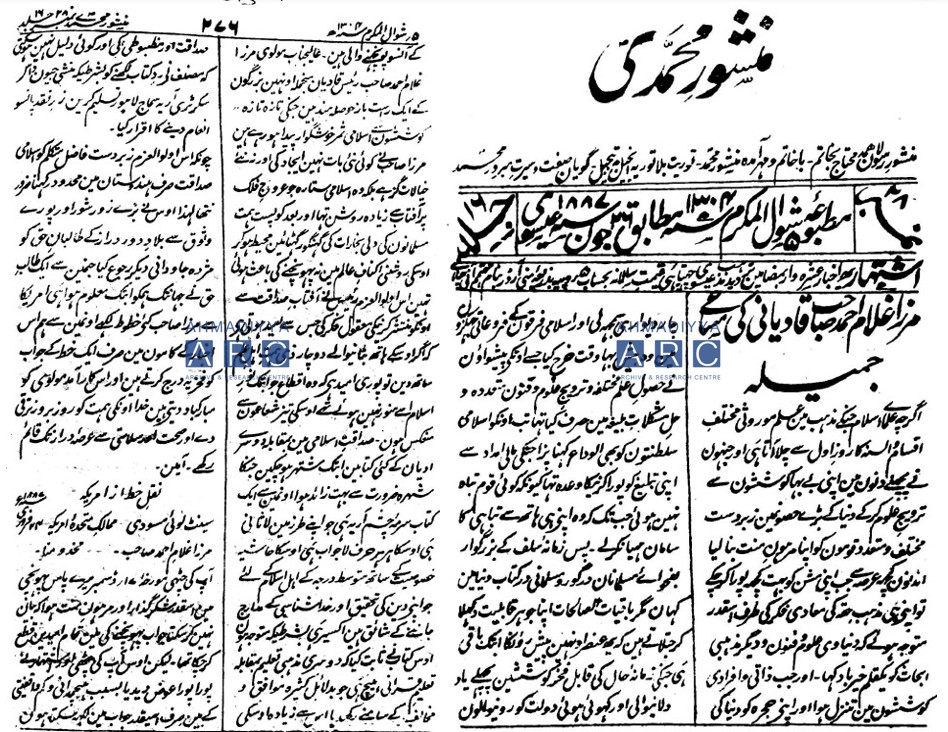
The Editor continued by mentioning that Hazrat Mirza Ghulam Ahmad (as) did not limit his efforts to India alone, but rather, he endeavoured to spread the truth of Islam all over the world. He was indicating Hazrat Ahmad’s (as) challenge of 1885, when he invited people of all religions and walks of life, both in India and the West, to stay at Qadian for a year in order to witness the signs in favour of the truthfulness of Islam.
As a result of these endeavours by Hazrat Ahmad (as), the Editor stated, recently an American individual named Alexander Russel Webb has written multiple letters to Mirza Sahib. This was followed by the Urdu translation of one of the letters from Alexander Russel Webb to Hazrat Ahmad (as), dated 24 February 1887.19
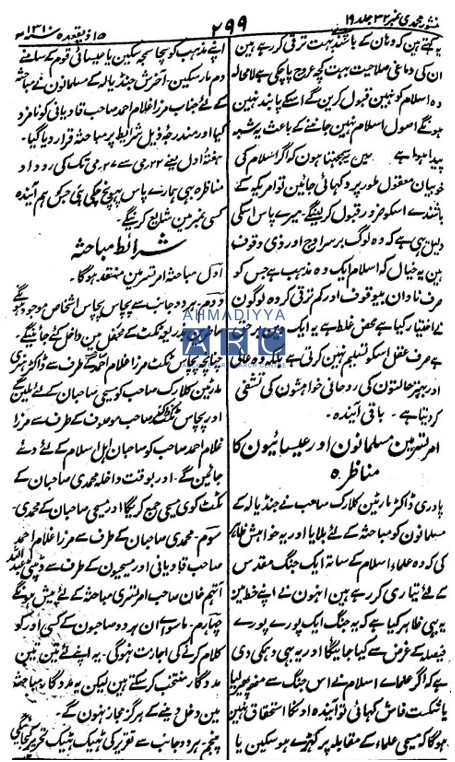
In 1893, a debate took place between the Muslims and Christians in Amritsar, where Hazrat Ahmad (as) represented Islam. Manshur-i-Muhammadi published articles about this debate as well. For instance, the issue of 15 Dhul Qa‘dah 1310 AH, corresponding to around 2 June 1893, published an article titled Amritsar mein Musalmanon aur Isaa‘ion ka Munazirah (A debate between the Muslims and Christians in Amritsar).20 The article mentioned that the Muslims of Jandiala have nominated Hazrat Mirza Ghulam Ahmad (as) as the representative of Islam.
In short, Hazrat Mirza Ghulam Ahmad’s (as) early writings in Manshur-i-Muhammadi and the appreciation received from the Editor of this periodical highlight that he was a great defender of Islam and that he had an unwavering passion to establish its truthfulness.
Endnotes
1. “The Promised Messiah’s residence in Sialkot: 1861 to 1868”, alhakam.org, 19 March 2021
2. Tarikh-e-Ahmadiyyat, Vol. 1, p. 118
3. Life of Ahmad, p. 78
4. Manshur-i-Muhammadi, 1 December 1877, Vol. 6, No. 33, pp. 1-2 and 6-7
5. Ibid., pp. 1-2; Life of Ahmad, pp. 78-79
6. Ibid., 31 January 1878, Vol. 7, No. 3, pp. 6-8
7. Ibid., 17 April 1878, Vol. 7, No. 11, pp. 4-6
8. Ibid., pp. 6-7
9. Ibid., 27 May 1878, Vol. 7, No. 15, pp. 2-9
10. Ibid., 6 June 1878, Vol. 7, No. 16, pp. 3-5
11. Ibid., 27 November 1881, Vol. 11, No. 1, pp. 7-8
12. Ibid.
13. Ibid., p. 7
14. Ibid., 31 May 1883, Vol. 12, No. 21, pp. 212-218
15. Ibid., p. 217
16. Ibid., 12 April 1884, Vol. 13, No. 17, p. 195
17. Ibid.
18. Ibid., 26 June 1887, Vol. 16, No. 28, pp. 275-279
19. Ibid.
20. Ibid., 2 June 1893, Vol. 19, No. 32, pp. 299-300