
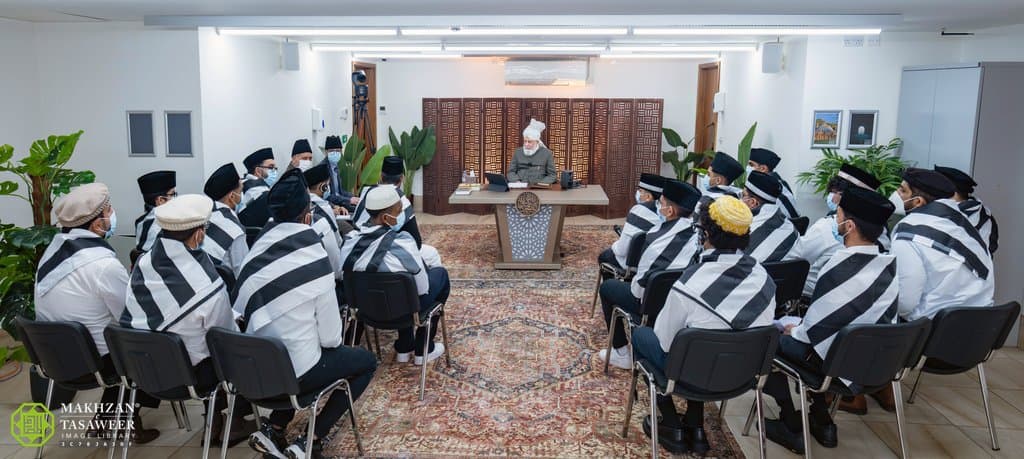
Islamabad, Tilford, UK, 14 December 2025: A delegation from Majlis Khuddam-ul-Ahmadiyya Italy was graced with the opportunity to meet Hazrat Mirza Masroor Ahmad, Khalifatul Masih Vaa, in a mulaqat. Upon his arrival, Huzooraa extended his salaam to all those present before taking his seat. The session commenced with an individual introduction for each khadim. Following these introductions, the members were granted the opportunity to seek guidance on a vast array of issues.
The purpose of biological diversity and the station of humanity
The session opened with an enquiry regarding the rationale behind the creation of a vast array of biological life forms when humanity was intended to be the primary inhabitant of the earth.
Huzooraa explained that Allah the Almighty is the Sovereign Master of the Universe and His creative power is manifested through the diversity of life. It was explained that according to the Holy Quran, nothing has been created without an underlying purpose or reason; every living entity plays a specific role. (Surah Aal-e-‘Imran, Ch.3: V.192)
Huzooraa detailed that while humans are designated as Ashraf-ul-Makhluqat, the most noble of all created beings, this status is predicated on their superior intellect and spiritual potential. He referred to the sociological perspective of man being a “social animal,” yet distinguished by education and moral capacity. The khuddam were reminded that all other elements of creation, including animals, flora and even inanimate objects like mountains and stones, have been essentially placed in the service of humanity.
Elaborating on this point, Huzooraa pointed out that the Holy Quran mentions how animals are provided for transport and sustenance. (Surah al-Mu’min, Ch.40: V.80) Furthermore, many creatures serve a medicinal purpose; for instance, the periodic shedding of a snake’s skin is utilised in treatments for ocular health. Similarly, various homoeopathic and conventional medicines are derived from substances like snake venom, proving that even things that appear harmful possess qualities that benefit human health. Huzooraa exhorted the youth to be grateful, noting that Allah has effectively made the entire world a ‘servant’ to mankind and it is the duty of humans to utilise these resources for the betterment of life.
Attaining Allah’s nearness and becoming the ‘delight of the eyes’ for the Khalifa
A khadim enquired about the practical steps required to attain the nearness of Allah the Almighty and how an Ahmadi can truly become a source of comfort and joy or the “delight of the eyes” for the Khalifa of the Time.
Huzooraa responded by stating that the path to Allah’s nearness is through absolute obedience to the commandments of Allah. He explained that since Allah is our Creator, it is incumbent upon us to be grateful servants.
The primary expression of this gratitude, Huzooraa stipulated, is through the formal acts of worship. He remarked that Allah has made the path to His nearness remarkably accessible; He commands us that we present ourselves before Him at least five times a day in prayer to express our thanks for the blessing of being human. Huzooraa admonished the youth to reflect on the fact that they were created as humans with the potential for spiritual excellence rather than as lesser animals.
Huzooraa further expounded that the mission of the Promised Messiahas was to bring about a spiritual revolution, mirroring the transformation the Holy Prophetsa effected in his Companions. Huzooraa explained that if Ahmadis today become true Muslims, adhere to the Holy Quran and follow the mission of the Promised Messiahas and the system of Khilafat, they will naturally become the “delight of the eyes” for the Khalifa. True joy for the Khalifa lies solely in seeing the members of the Jamaat become exemplary Ahmadi Muslims.
The innate nature of belief and the vicissitudes of doubt
A question was raised regarding why, if the existence of God is ingrained in human nature, some individuals experience contrary thoughts or doubts.
Huzooraa explained that such thoughts often arise because people do not put in the necessary effort to search for God. He observed that in moments of extreme crisis or helplessness, even those who claim to be atheists instinctively cry out to a higher power, often using phrases like “Oh God.” This, Huzooraa noted, indicates that a latent recognition of a Creator exists within the subconscious of every human being.
Huzooraa referred to the Quranic depiction of people caught in a storm at sea; in their desperation, they remember Allah, yet once they are safely returned to shore, they return to their ways of neglect or even speak against God. (Surah al-‘Ankabut, Ch.29: V.65) He compared this to human relationships, asking whether it would be considered moral to forget the favours of a friend once a need has been met. Huzooraa elucidated that a truly noble person is one who remains grateful even in times of ease. He instructed that if one remains steadfast in the remembrance of Allah and maintains regularity in prayer, these fleeting doubts and contrary thoughts will be replaced by conviction and gratitude.
Navigating overthinking and the preservation of mental well-being
The khuddam sought guidance on how to manage the tendency to overthink, particularly before sleep, concerning future anxieties and worldly entanglements, which can lead to significant mental stress.
Huzooraa advised that Allah the Almighty has provided spiritual remedies for such distress. He specifically recommended the recitation of Ayat-ul-Kursi and the three quls (Surah al-Ikhlas, al-Falaq and an-Nas) before sleeping.
Huzooraa explained that one should reflect deeply on the attributes of Allah mentioned in these Surahs: His power, His protection from evil and His role as the Sovereign. By falling asleep while meditating on the majesty of God and seeking His protection from the mischief of the envious and the whisperings of the soul, a person’s mental entanglements begin to dissolve. Furthermore, Huzooraa highlighted the importance of the Isha prayer as a means to offload the day’s burdens. He encouraged the youth to pray for ease in their affairs and to adopt a routine of sleeping early and rising for Tahajjud. He reminded them of the Quranic assurance that it is in the remembrance of Allah that hearts find true comfort and satisfaction. (Surah ar-Ra‘d, Ch.13: V.29)
Outward appearance vs inward obedience
A khadim expressed that out of love for the Khalifa, many youth desire to emulate his dress and manner of speech, yet they are sometimes mocked by others for “trying to become the Khalifa.”
Huzooraa responded with great kindness, stating that as long as the intention is rooted in sincere love, such imitation is commendable. He referred to a historical precedent where a person asked the Promised Messiahas about followers who adopt his appearance. The Promised Messiahas had replied that a person’s level of love determines the degree to which they try to imitate the beloved and there is no inherent evil in this.
Huzooraa shared the example of Mirza Abdul Haq Sahib, a long-serving Amir from Sargodha, who was born at the turn of the century. After performing the bai‘at of Hazrat Musleh-e-Maudra, he resolved to adopt Huzoor’sra appearance, including his specific style of turban and coat and maintained this practice throughout his life.
However, Huzooraa provided a vital caveat: outward imitation must be accompanied by inward obedience. He explained that it is wrong to adopt the physical appearance or speaking style of the Khalifa while ignoring his core instructions, such as the requirement to be regular in the five daily prayers. True imitation, Huzooraa concluded, involves striving to achieve the spiritual objectives for which the system of Khilafat was established and responding wholeheartedly to the Khalifa’s call for moral reformation.
Why haste in salat hinders spiritual evolution
The discussion then focused on the fast-paced nature of modern life and the common tendency among youth to rush through their daily prayers. A khadim enquired how one might compensate for the resulting lack of spirituality.
Huzooraa began by observing the irony in human behaviour: while a person will dedicate ample time to sitting and enjoying a meal, ensuring they are fully satiated, they often treat the five daily prayers as a burdensome task to be completed as quickly as possible. He admonished that if a person recognises that rushing their prayer is a mistake, they must take conscious steps to rectify it by slowing down and performing the prayer with due diligence. He noted that even those with the busiest of schedules must find the time to pray properly and thus there is no excuse for the average person to rush.
To illustrate the severity of this issue, Huzooraa narrated a well-known account from the life of the Holy Prophetsa. While sitting in a gathering in the mosque, the Holy Prophetsa observed a man arrive and perform his prayer hastily. When the man came to greet him, the Holy Prophetsa instructed him to go back and pray again, stating that he had not truly prayed. This occurred three or four times until the man confessed that he did not know how to pray any better. The Holy Prophetsa then taught him that prayer must be performed with composure, involving the praise of Allah, the invocation of blessings on the Prophetsa (i.e., durud) and deep reflection. Huzooraa remarked that without these elements, the physical movements of prayer are merely hollow rhythmic motions, rather than true worship. (Sahih al-Bukhari, Kitab al-ist‘zan, Hadith 6251)
Huzooraa also referred to the writings of the Promised Messiahas, who compared the hasty prostrations of some worshippers to the pecking of a hen as it eats grain. (Malfuzat, Vol. 3, p. 258) He elucidated that Allah is not in need of such mechanical prostrations. When we rush our prayers, we are essentially demonstrating that we give more importance to our worldly work than to our Creator. Huzooraa warned that such an attitude prevents the descent of Allah’s blessings. He clarified that true prayer is not merely something to be done in times of crisis, but a consistent discipline where the work of the faith is given precedence over the work of the world.
The khuddam were presented with the example of Hazrat Chaudhry Zafrulla Khanra. While present in the royal court of the Queen, he became restless as the time for prayer approached. Despite the strict protocols of the court, he informed the authorities that he had to leave for his prayers. His firm adherence to his faith was such that the royal administration eventually established a protocol for him, ensuring he was never hindered from his prayers. Huzooraa noted that when a person shows such resolve, even the worldly powers are forced to respect them.
Huzooraa concluded by reminding the youth that the purpose of going to the “Divine Court” is to ask from Allah. He asked them to consider how they would behave when meeting a worldly president or minister; they would wait patiently and present their case with great care and detail until they were satisfied. It is, therefore, a sign of extreme spiritual blindness to approach the King of Kings with haste, expecting Him to be pleased with a few hurried movements.
Death of Jesusas
The discussion moved toward the Jamaat’s belief regarding the death of Jesusas and whether non-Ahmadi Muslims and Christians would be held accountable for their belief in his physical survival in heaven.
Huzooraa stated that the concept of shirk – associating partners with Allah – is a grave transgression. He pointed out that the Holy Quran explicitly denies that Jesusas is the son of God and emphasises the absolute Oneness of Allah. To suggest that a human being could survive for thousands of years, Huzooraa noted, is a dangerous idea that could shake the very foundations of the earth and the heavens.
Huzooraa explained that the Promised Messiahas proved the death of Jesusas using 30 distinct verses of the Holy Quran. Huzooraa observed that the belief held by many non-Ahmadi Muslims – that Jesusas is alive – actually serves to support the Christian claim of his divinity.
Interestingly, Huzooraa mentioned that a segment of modern Muslim scholars is beginning to concede that Jesusas has indeed passed away and will not return physically. However, he lamented their stubbornness, as they refuse to accept Hazrat Mirza Ghulam Ahmadas as the Promised Messiah despite the prophecy of the Holy Prophetsa regarding a Messiah appearing from among the Muslims. Huzooraa stated that by denying the advent of the Messiah while admitting Jesusas is dead, they are effectively betraying both the Quran and the Hadith.
As for their accountability in the Hereafter, Huzooraa remarked that while Allah will certainly question them, the exact nature of His judgement remains with Him alone.
Religious experience vs psychological influence
A khadim enquired how to respond to members of other faiths who claim to have experienced a connection with their religion, such as Christians seeing Jesusas in dreams.
Huzooraa clarified that Ahmadi Muslims believe in the truth of all Prophets, including Jesusas and Mosesas. According to Islamic theology, Prophets were sent to every nation on earth.
Huzooraa explained that if a person sees Jesusas in a dream, it does not necessarily validate their current religious framework as the final truth. He elucidated the psychological aspect of dreams, noting that if a person is constantly immersed in a particular thought or fear, such as the fear of drowning, they may eventually see it in their dreams. Thus, many such experiences are the result of deep-seated psychological influence rather than a revelation.
Furthermore, Huzooraa encouraged the youth to point out to Christians that their own scriptures contain prophecies about the coming of a final Prophet. He noted that Jesusas himself stated he was sent only for the “lost sheep of Israel,” (Matthew, 15:24) whereas the Holy Prophet Muhammadsa was sent as a mercy for the whole of mankind. (Surah al-Anbiya, Ch.21: V.108) Huzooraa instructed that instead of confronting them by denying the truth of their prophets, khuddam should argue that while Jesusas was a true prophet, his own teachings require followers to accept the Universal Prophetsa who was to follow him in the Latter Days.
Jihad of the sword vs the message of peace
When asked how to respond to those who challenge the peaceful message of Islam, Huzooraa directed the youth to the context of the Holy Quran. He explained that the Quranic permission to fight was granted only in circumstances where Muslims were being persecuted, their rights were being denied and they were being killed for their faith. It was a permission for defensive retaliation, not an injunction for unprovoked aggression. (Surah al-Hajj, Ch.22: V.40)
Huzooraa emphasised that the fundamental teaching of the Holy Quran is one of love, peace and harmony. He urged the khuddam to increase their own knowledge before engaging in such debates. He specifically recommended the study of World Crisis and the Pathway to Peace, a compilation of his addresses that provides comprehensive arguments from the Holy Quran regarding global peace. He noted that this book is available in many languages, including English and German.
The necessity of literature in local languages
During a brief interaction with the Jamaat’s missionary, Huzooraa enquired about the Italian translation of World Crisis and the Pathway to Peace. Upon being informed that it was not yet available, Huzooraa emphasised the urgency of this task. He remarked that such literature is an essential tool for reaching the public and conveying the true message of Islam. He noted that in countries like Germany, people are actively reading the book in German and appreciating it and the same should be facilitated for the people of Italy to ensure the message of the Jamaat is disseminated effectively.
The nature of miracles among non-Muslims
The final question addressed the authenticity of miracles, such as the survival of Pope John Paul II during an assassination attempt and whether everything happens for a predetermined reason.
Huzooraa affirmed that miracles can and do happen and they are not limited to Muslims; even atheists can experience extraordinary events.
Huzooraa explained that Allah sometimes manifests such signs to demonstrate His existence to humanity. When a person witnesses something extraordinary after seeking help or praying, it serves as a sign to strengthen their conviction in a Higher Power. However, Huzooraa clarified that the occurrence of a miracle in a particular religious context does not mean that the religion itself is the final truth. Allah shows signs to people across all nations – even to pagans in remote parts of Africa – to simply say, “I do exist.”
Huzooraa also reiterated the distinction between a true sign from God and a psychological effect. He used the example of someone who is afraid of water, seeing dreams of drowning; such dreams are reflections of the mind’s anxieties rather than Divine intervention. He concluded that while many incidents are real manifestations of God’s power, others are merely the mind’s reaction to its environment.
The mulaqat concluded with the khuddam being blessed with the honour of a group photograph with Huzooraa. Huzooraa then took his leave.
(Summary prepared by Al Hakam)