
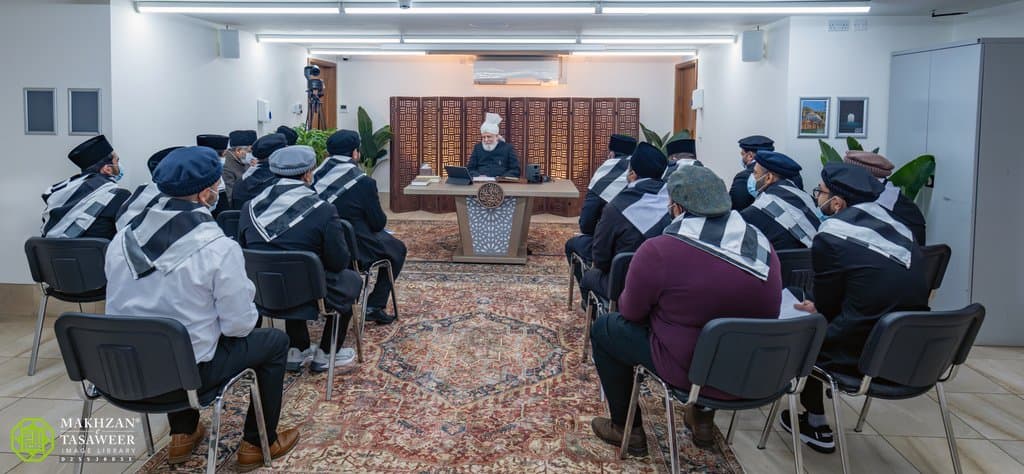
Islamabad, Tilford, 5 December 2025: Members of Majlis Khuddam-ul-Ahmadiyya USA’s Virginia Region were granted a mulaqat with Hazrat Mirza Masroor Ahmad, Khalifatul Masih Vaa.
At the outset, Huzooraa arrived, conveyed greetings to all present and took his seat. Each khadim was given the opportunity to introduce himself. After this, the khuddam sought permission to present their questions, which Huzooraa graciously allowed.
Maintaining harmony with close relatives
A khadim asked how one should respond when emotional distress is caused by injustice or hurt from close relatives.
Huzooraa advised that one should pray for such relatives, seeking that Allah the Almighty grants them understanding and wisdom. Alongside this, a person should also pray for personal strength and patience to endure with dignity. Huzooraa guided that, where appropriate, one should speak to the relatives directly and enquire about the reasons behind the hurtful conduct, so that misunderstandings may be removed and relationships repaired.
Huzooraa emphasised that the Holy Quran and the Holy Prophetsa teach believers to behave as brothers to one another and to adopt compassion and mercy in mutual dealings. (Surah at-Tawbah, Ch.9:V.71; Surah al-Fath, Ch.48:V.30; Surah al-Hujurat, Ch.49: V.11) He highlighted the importance of sitting together, communicating calmly and nurturing reconciliation. Huzooraa indicated that when people remain divided, external forces often benefit from their disputes, while conflicts within families and communities persist. Therefore, one should search for the real causes of disagreement, make efforts to remove them, avoid prolonged resentment and cultivate the habit of making peace.
Facing bullying or discrimination at school
A khadim asked how an Ahmadi Muslim should respond to bullying or discrimination in school settings.
Huzooraa explained that in many societies, those who identify culturally with religion may still be distant from belief in God and such attitudes can lead to mocking or bullying of people of faith. He indicated that prejudice can hence be directed not only at Muslims but at others as well, though some groups may be treated differently due to social or institutional pressures.
Huzooraa advised that Ahmadis should respond with calmness and confidence, explaining that they follow a faith they believe to be true and that one should not judge an entire teaching based on the wrong actions of individuals. He urged the khadim to explain that Islam’s true teachings are rooted in love, compassion, service to humanity and moral conduct.
Huzooraa advised that such matters should be addressed with gentle and respectful conversation, not harshness. He noted that when someone is kindly confronted with the inconsistency of condemning a faith while engaging in harmful behaviour themselves, those who possess a sense of shame may feel embarrassed and reconsider their conduct. Those who persist stubbornly should be ignored.
Huzooraa further counselled that Ahmadis should not respond by generalising negatively about other groups. He drew attention to the Islamic teaching of refraining from insulting the objects of reverence of others, as such actions can provoke further hostility and worsen the situation. (Surah al-An‘am, Ch.6:V.109) He reassured the khadim that maturity, self-control and dignified conduct, coupled with a clear presentation of Islamic values, form the best response in such circumstances.
A cherished memory of Huzoor’saagrandmother
A khadim requested Huzooraa to share memories of his time with his grandmother.
Huzooraa recalled that when she was alone, he would sometimes sleep in her room, not only in his childhood but into his teenage years as well. He described her as a sincere and warm-hearted elder who harboured no ill feelings for anyone and treated children with tenderness and affection.
Huzooraa also remembered observing her devotion in prayer during the night. He related that she would rise for Tahajjud and repeatedly implore Allah the Almighty for mercy, grace and goodness. He added that her general counsel and nurturing manner reflected the loving guidance typically shown by caring grandmothers.
The observance of Eid Milad-un-Nabi
A khadim asked whether Eid Milad-un-Nabi should be observed and, if so, in what manner.
Huzooraa explained that this practice was not observed in the earliest centuries of Islam and remains absent in many Muslim lands, while it became more common, particularly in parts of South Asia. He stated that when hostile propaganda against Islam intensified, Hazrat Khalifatul Masih IIra initiated gatherings in which the life and noble character of the Holy Prophetsa were to be presented and defended.
Huzooraa emphasised that the Companionsra and the era of Khilafat-e-Rashidah did not observe such a celebration as a formal religious occasion.
He further explained that the true objective of even what Hazrat Musleh-e-Maudra initiated is not limited to a single day of speeches or outward displays. Rather, the sirah of the Holy Prophetsa should be studied, taught and practised throughout the year.
Huzooraa further indicated that if any observance becomes an occasion for hostility, abuse or neglect of the Holy Prophet’ssa actual teachings – as has been observed at some of the recent gatherings of the non-Ahmadis – it loses its purpose. Therefore, he advised that Ahmadis should focus on continuously presenting the beautiful and practical model of the Holy Prophetsa and striving to embody those virtues in daily life.
Guidance for Ahmadis interested in public service
A khadim asked, in view of political polarisation, what guidance exists for Ahmadis who wish to pursue public service and how commitment to Ahmadiyyat can be balanced with responsibilities towards those they serve.
Huzooraa observed that certain political currents in the West, particularly forces aligned with anti-Islam sentiment, often operate within broader networks of influence. He stressed that the effective response is to spread awareness of Islam’s true teachings of love, harmony, peace and justice.
Huzooraa reminded the khuddam that he had long encouraged, especially those in the United States, to systematically convey these teachings within their circles of influence, yet many people still remain unfamiliar with Ahmadiyyat and the peaceful message of Islam. He highlighted that Islam commands care for the poor, support for orphans, the resolution of disputes and the establishment of absolute justice and that these principles should be presented clearly to society.
Huzooraa guided that Ahmadis should emphasise the shared citizenship and loyalty owed to one’s country, reminding them that love for one’s homeland is an integral moral principle within Islamic teaching. He explained that while any state may act against those who violate laws or undermine constitutional order, it is unjust to target peaceful and constructive citizens – whether they are professionals, workers, scientists, businesspeople or others who contribute positively to national progress.
Huzooraa described the promotion of Islam’s authentic message as a collective responsibility for Khuddam, Ansar, Lajna and the entire Jamaat. He also noted that in some contexts, negative perceptions of migrants are compounded when individuals seek benefits without striving to work and contribute. He therefore urged that Ahmadis should be exemplary in diligence, lawful conduct and civic responsibility.
Huzooraa said:
“Those who belong to the right wing are, in reality, opposed to Islam […]
“To counter this, we must spread the true teachings of Islam. It was for this reason that, some 15 or 18 years ago, I said to all countries – and in particular I said to the Americans – that the Islamic teaching, the message of Islam, the message of love, harmony and peace, should be conveyed to the whole world. I said that each year this message ought to reach a further five to ten per cent of the people. But you did not carry out this task. Even now, many people do not know about Ahmadiyyat.
“So, wherever your circle extends, within that you should explain the teachings of Islam – what the teachings of Islam are. What are the teachings of Islam? Islam says: take care of the poor; take care of the orphans; bring disputes to an end; there must be absolute justice. And only recently, at the Humanity First conference, I spoke a little about what Islam desires. In the mosques, I continually speak about what Islam desires. In recent days, when the Cardiff mosque was inaugurated, I explained these matters there as well. Listen to those two addresses; in them I have set these points out. And on countless occasions I have travelled to different places and explained the teachings of Islam – what you worldly people do, and what Islam says. These teachings I have been explaining everywhere. So read those. […]
“Nowadays, there are already those who are opposed to Islam, as before – they exist – but those who are being further turned against Islam, we can still stop them. Many of my various addresses have been published under the title World Crisis and the Pathway to Peace, have they not? You will find many points in that. Take those, and on that basis explain Islam’s basic teaching of peace and love.
“At this stage, there is no need to preach to them that they should come towards the religion. Rather, tell them that Islam gives this teaching, yet you speak against it. And we too, who were born here, are also citizens of this country, and the teaching of Islam is precisely that love of one’s country is part of faith. […]
“Therefore, to say, ‘We are right wing; expel the foreigners,’ and so on […] All right, as for those people who are breaking the law, who do not respect the law and constitution of the country – by all means, remove them. But those who are living peacefully and contributing to the progress of your country – and among them are engineers, doctors, businesspeople and scientists – they are benefiting you, so why do you expel them?
“In reality, the background to this is precisely that there is an anti-Islamic agenda. To counter this anti-Islamic agenda, we shall have to raise people’s awareness of what the true teachings of Islam are. We must strive for this. This is our great challenge. Therefore, Majlis Khuddam-ul-Ahmadiyya must also do this, Majlis Ansarullah must also do this, the Jamaat must do this, and Lajna Imaillah must do this. The rest is all politics. […]
“Then there are also certain mistakes in some countries: some immigrants who come here wish to take social help from these countries and do not work. If they were to work, be hard-working and become taxpayers, then these questions would not even arise.”
A suitable age for mobile phone use
A khadim asked what age is appropriate for Ahmadi boys and girls to have mobile phones, especially as children often observe their peers using devices in schools and mosques.
Huzooraa reiterated that he has long cautioned against excessive screen time. He highlighted that prolonged and unnecessary use of mobile phones, tablets and similar devices can affect eyesight and mental development. He also noted the growing trend in educational systems where, at certain ages, schools themselves provide or require digital devices for classwork and homework, complicating the issue for parents.
Huzooraa pointed out that some countries, such as Australia, have begun taking legislative or policy measures to restrict mobile phone use for children under a certain age, illustrating a broader realisation of harm associated with early and unregulated exposure. He advised that parents should explain to children that the harms often outweigh the benefits and that any necessary use should be limited and purposeful. He also suggested that daily screen time should be kept within a sensible limit of an hour, rather than becoming a routine source of distraction.
Recognising the acceptance of prayers
A khadim asked how one can know whether Allah the Almighty has heard prayers offered for personal problems.
Huzooraa explained that when a difficulty is removed, or a matter is resolved by Allah the Almighty, this provides reassurance that prayers have been heard. However, if an answer is not immediately apparent, one should continue supplicating with perseverance. He drew attention to the principle that Allah the Almighty has invited believers to obey Him, worship Him and observe His commandments.
In this regard, Huzooraa advised that a young person should begin by praying for steadfastness in offering the five daily prayers regularly and on time, especially ensuring discipline in Fajr and maintaining punctuality in all salat. He explained that salat regulates life and nurtures the spiritual state through which prayers become more meaningful.
Huzooraa also emphasised that effort must accompany prayer. He recalled an incident from his student years when he feared failure after a poor examination. He described how he prayed consistently over an extended period until the result was announced and that the outcome was eased in a way that allowed him to pass. Through this example, Huzooraa illustrated that sincere prayer, coupled with perseverance and personal effort, becomes a means for Allah’s help and comfort.
Overcoming social media addiction and protecting family life
A khadim asked how one can address the growing problem of social media addiction and remain focused, as much beneficial time is being lost.
Huzooraa indicated that a person already recognises this as a moral and practical harm. He explained that when someone knowingly persists in a damaging habit, it reflects a lack of resolve rather than a lack of awareness. He used a humorous anecdote to illustrate how people sometimes pretend to be heedless while actually being fully conscious of what they are doing.
Huzooraa highlighted that social media addiction damages family bonds, social relationships and professional productivity. He noted that instead of thinking creatively about improvement in work, business or personal growth, people often waste hours consuming trivial or harmful content. He explained that the structure of digital platforms is intentionally designed to encourage endless scrolling from one item to the next, pulling a person deeper into time-wasting and, at times, morally corrosive material.
Huzooraa further warned that even when one opens beneficial content, adjacent temptations and inappropriate material can appear, gradually harming the mind and spiritual state. He advised that one should adopt the Quranic principle of turning away from vain and useless pursuits and that believers must develop firm willpower and a clear determination to avoid such distractions. (Surah al-Mu’minun, Ch.23: V.4)
Huzooraa recommended seeking Allah’s help through istighfar and regular prayer, asking to be protected from futile and harmful engagements. He also urged parents to reflect on their own habits, as children naturally imitate what they observe at home. He noted that when family members sit together yet remain absorbed in their separate screens, meaningful conversation disappears and relationships weaken. This can eventually deprive parents of opportunities for moral guidance and tarbiyat.
Huzooraa advised that families should foster shared interaction, respectful social etiquette and purposeful use of technology. He stressed that if one intends to view a specific beneficial programme, one should limit oneself to that purpose and avoid wandering into unrelated and damaging content. Through discipline, prayer and consistent family examples, this modern challenge can be gradually overcome.
Strengthening and safeguarding faith
A khadim asked how one can effectively correct and strengthen faith.
Huzooraa guided that faith is strengthened through turning to Allah the Almighty with humility and prayer. He advised repeatedly praying for steadfastness and for an increase in faith and drawing spiritual help from the supplications taught in Surah al-Fatihah, seeking guidance on the straight path.
Huzooraa stressed the importance of safeguarding the five daily prayers and reciting the Holy Quran with a conscious effort to understand its meaning. He explained that merely identifying as Muslim or Ahmadi Muslim without understanding Islamic teachings does not nurture faith. Therefore, one should study the Quran attentively and also read Jamaat literature.
Huzooraa added that those who are not comfortable with Urdu should benefit from English translations and collections of the writings of the Promised Messiahas on various topics, including compilations such as The Essence of Islam. He stated that through prayer, religious knowledge and consistent worship, faith grows stronger and more stable.
Conclusion
At the conclusion of the mulaqat, the khuddam were granted the honour of a group photograph with Huzooraa. Thereafter, Huzooraa took leave, bringing the mulaqat to an end.
(Summary prepared by Al Hakam)