
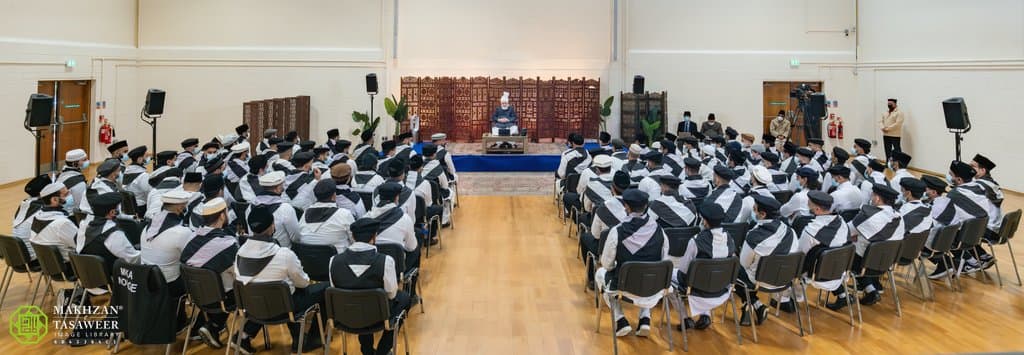
Islamabad, Tilford, UK, 19 April 2026: Khuddam from Majlis Khuddam-ul-Ahmadiyya Norway were blessed with a mulaqat with Hazrat Mirza Masroor Ahmad, Khalifatul Masih V (aa).
During the mulaqat, the khuddam had the opportunity to seek guidance from Huzoor (aa) on matters relating to Waqf-e-Nau, the jihad of the pen, Dajjal, the Hereafter, children’s tarbiyat, the future of civilisation, the concept of Khatam an-Nabiyyin, marriage, mental health, media, science, brotherhood and spiritual reform.
The sacrifices required of waqifeen-e-nau today
A question was asked about how waqifeen-e-nau could develop the patience, sincerity and spiritual strength of the Companions of the Holy Prophet (sa), even though they do not face the same severe trials.
Huzoor (aa) said that this itself was a matter for gratitude, for Allah had not placed them in the same trials as the Companions. He explained that the Companions of the Holy Prophet (sa) endured great persecution, gave immense sacrifices and, when wars took place, offered sacrifices of their lives. Huzoor (aa) said that in the present age, while some Ahmadis still attain martyrdom in places such as Pakistan, Burkina Faso and elsewhere, the Jamaat as a whole is not being required to offer life-sacrifice collectively in the same way as many of those earlier believers.
For this reason, Huzoor (aa) said, Ahmadis should be grateful to Allah and dedicate all their abilities, potential, education, knowledge and intellect to the service of faith. He explained that today, in general, the sacrifices most required are those of time and wealth, though one must always remain ready for the sacrifice of life if such a need arises.
Huzoor (aa) advised waqifeen-e-nau to first acquire religious knowledge. They should read the Holy Quran, learn its translation, study its commentary and understand what Allah has commanded and what He has forbidden. They should then act upon those commandments and refrain from what Allah has prohibited.
Huzoor (aa) further emphasised the importance of worship, saying that waqifeen-e-nau should establish the habit of offering all five daily prayers. It was not enough to offer three or four prayers or to miss Fajr if one failed to wake up. Rather, they should become regular in all five prayers and act upon the commandments of the Holy Quran.
Huzoor (aa) explained that this is the jihad of the present age. He said that this is the era of the jihad of the pen, not the jihad of the sword. The knowledge Allah has granted through the Holy Quran, Hadith and the Promised Messiah (as) must be spread. He said that the Holy Prophet (sa) had also described a greater jihad after returning from battle and that this greater jihad included conveying the message of the Holy Quran. (Kitab al-Zuhd al-Kabir, Al-Bayhaqi, Edited by Amir Ahmad Haydar, Beirut: Mu’assasat al-Kutub al-Thaqafiyyah, 3rd ed., 1996, p. 165)
Huzoor (aa) advised the khuddam to show practical examples, become true Ahmadi Muslims, improve their morals and convey the message through character. He said that people were first drawn to the Holy Prophet (sa) through his excellent morals and truthfulness. In the same way, if Ahmadis display high morals, people will turn towards them and become receptive to their message.
He also advised that khuddam should write articles in newspapers, especially in the West, where many things are written against Islam. They should explain the true and peaceful teachings of Islam and make clear that the disorder being created in the world is not in accordance with Islamic teachings. Huzoor (aa) said that this too is a form of jihad in the present age and that if opposition arises, it should be endured with patience.
Dajjal, Ya’juj and Ma’juj and the deceptive forces of the present age
A question was asked about the coming of Dajjal and the idea of a false messiah. The questioner mentioned that Ahmadis understand, through the Promised Messiah (as), that Dajjal represents a system and that we are already living in its age.
Huzoor (aa) explained that Dajjal is not mentioned by name in the Holy Quran; rather, the Quran mentions Gog and Magog [Ya’juj and Ma’juj]. (Surah al-Kahf, Ch.18: V.95) He explained that Ya’juj and Ma’juj were to attack from every direction, disturb the peace of the world and create destruction, whereas Dajjal was connected with the corruption of faith and the spread of deceptive teachings.
Huzoor (aa) said that the age of Dajjal did not begin merely in the present day; rather, it had already begun more than a century ago, when systematic attacks were being made against Islam and large numbers of Muslims were being drawn away from their religion, including through Christian missionary efforts. It was in accordance with the prophecy of the Holy Prophet (sa) that the Promised Messiah (as) appeared at that time and Ahmadis accepted him.
Huzoor (aa) said that the same forms of deception [dajl] continue today in different guises. At times they appear in the form of worldliness; at times in the name of religion; and at other times through atheism and ideologies that turn people away from God. He said that atheistic forces also partake of the nature of Dajjal, because they seek to remove people from faith. Those who do not turn towards Allah and who create disorder in the world, both materially and spiritually, share in these dajjalic and destructive tendencies.
Huzoor (aa) said that Ahmadis must protect themselves from these influences and counter them by spreading the teachings brought by the Promised Messiah (as). He also indicated that he had written a detailed response on this subject, which would be published in Al Hakam or Al Fazl and advised that it should be read.
Righteous spouses and reunion in the Hereafter
A question was asked about whether, if one spouse passes away before the other, that spouse later comes to know of the other’s death.
Huzoor (aa) explained that if one spouse has entered Paradise and the other has also lived righteously and enters Paradise, then they will meet in the next world and will come to know of one another. However, if one spouse was righteous and entered Paradise while the other was sinful and was punished, then the matter would be different. Allah may inform the righteous spouse of the other’s state, but the sinful spouse would not be with them.
Huzoor (aa) therefore said that both husband and wife should strive to perform good deeds so that both may enter Paradise and be reunited there.
Explaining global crises to children through faith
A parent asked how the current global situation could be explained to young children in a way that was reassuring and rooted in faith and how children could best be prepared for the future.
Huzoor (aa) advised that children should be told that when people in earlier ages became corrupt and turned away from Allah, divine punishments came upon them. The Holy Quran and history mention various peoples who were destroyed through earthquakes, storms, winds and other calamities because they rejected Allah and became immersed in wrongdoing.
Huzoor (aa) said that in the time of the Holy Prophet (sa), such natural calamities did not come in the same way; rather, the opponents of Islam were tested through wars and Islam was granted victory while the enemy was destroyed. He explained that if, in the future, wars come to an end, Allah may still test people through other means, as happened to earlier peoples, including earthquakes, rain, fire and other forms of calamity.
Huzoor (aa) said that children should therefore be taught always to bow before Allah, seek His protection and pray for His mercy. Through this, one may be saved from the punishments and calamities that came upon earlier peoples.
The future of civilisation and the role of the Jamaat
A question was asked regarding earlier civilisations that reached their peak and then came to an end and what future Huzoor (aa) saw for the present civilisation and the role of the Jamaat within it.
Huzoor (aa) explained that the life of the world follows a divinely appointed spiritual order. Referring to the writings of the Promised Messiah (as), Huzoor (aa) spoke of the 7000-year spiritual cycle associated with the dispensation of Adam. [The Promised Messiah (as) explained that 6000 years of this era had passed and that the Promised Messiah was to appear at the end of the sixth millennium, while the seventh millennium was to be the age of the supremacy of God and His Messiah, the spread of faith, virtue and righteousness. (Lecture Lahore, UK: 2008, pp. 40-59)]
In this context, Huzoor (aa) explained that Prophets appeared at different times for the reformation of their respective ages. In the present age, Allah sent the Promised Messiah (as), in accordance with His promise and the prophecy of the Holy Prophet (sa), for the reformation of the world and as the Reformer of the final millennium.
Huzoor (aa) said that the Holy Prophet (sa) had foretold that after the Promised Messiah (as), the system of Khilafat would be established: “And the Holy Prophet (sa) said that after him, the system of Khilafat would begin. And it has begun.”
Speaking of the final period of the world’s spiritual history, Huzoor (aa) explained that faith would first reach a state of ascendancy and people would accept it widely. Thereafter, at some later stage, decline would again appear, ultimately leading to the Day of Judgement at the time appointed by Allah: “When these final thousand years of the world’s remaining life, through which we are now passing, come to an end, then religion will first reach a peak; people will accept it. After that, corruption will again arise and then the Day of Judgement will also come.”
Huzoor (aa) added that the exact time is known only to Allah: “Whether that is some 500 years from today, or 600 years, or 700 years, or whenever Allah wills it.”
Before that final decline, Huzoor (aa) explained, the mission of the Promised Messiah (as) is to be fulfilled. The Promised Messiah (as) was sent to establish the religion of Islam in the world and to manifest the spiritual authority of the dispensation of the Holy Prophet (sa): “The Promised Messiah (as) said that Allah the Almighty has sent me to establish religion in the world; to establish the rule [spiritual authority] of the Holy Prophet (sa) in the world.”
Huzoor (aa) said that Islam will spread throughout the world and those who remain outside it will be left with little standing in comparison. However, after that period of ascendancy, corruption may again arise. At such a time, the Khalifa of that era, following the Promised Messiah (as), may adopt stricter measures for reform. If corruption becomes complete, Allah will bring the world to an end.
Huzoor (aa) therefore directed attention towards righteousness and the moral training of future generations. He advised Ahmadis to remain virtuous and to continue instructing their future generations in goodness, so that they may be protected from calamities. Such calamities, he explained, appear at different times and in different forms, including earthquakes, storms, tsunamis, floods and wars: “The only way to be saved from these is that we act upon virtues and continue instructing our future generations until the end that they should do good, so that we may remain protected from these calamities.”
Huzoor (aa) said that the age will not reach its final state of corruption until the prophecies of the Holy Prophet (sa) regarding the Latter Days and the Promised Messiah (as) have been fulfilled. He concluded by emphasising that individual people may fall away if they abandon righteousness, but the faith itself will remain established: “If you remain righteous, you will remain included. If you do not practise righteousness, then Allah will remove individuals one by one, but the religion will remain established. No calamity will befall the religion.”
Explaining Khatam an-Nabiyyin in an age of short attention spans
A question was asked about how Ahmadis could explain the belief in Khatam an-Nabiyyin, that the Holy Prophet Muhammad (sa) is the Seal of the Prophets, in a world where research suggests people have very short attention spans and how this belief can be explained without being misunderstood as a denial of his finality.
Huzoor (aa) said that, given the short attention spans of people today, Majlis Khuddam-ul-Ahmadiyya and the Jamaat should share short passages and clips through websites and social media, explaining what prophethood means, what is meant by the Holy Prophet (sa) being Khatam an-Nabiyyin and which prophecies the Holy Prophet (sa) made. He said that if people cannot read a full article, they can still read or watch something for three, four or five minutes.
However, Huzoor (aa) explained that in Norway and similar Western societies, the more fundamental issue is that many people no longer believe in Allah at all. Many who are nominally Christian are not practising Christians. Therefore, before discussing whether the Holy Prophet (sa) is the final Prophet, one must first speak to them about the existence of God. Once belief in God is understood, then one can speak about prophethood and the Seal of the Prophets.
Huzoor (aa) said that short clips and passages about the existence of God should be shared regularly on social media. Those who have an interest will listen or read and those who do not, cannot be forced, for the Holy Quran teaches that religion cannot be spread by compulsion. (Surah al-Baqarah, Ch.2: V.257)
With Muslims, however, the approach is different. If Muslims raise this issue, then the prophecies of the Holy Prophet (sa) should be presented, along with relevant ahadith. Huzoor (aa) referred to the statement of Hazrat Aisha (ra) that one should say that the Holy Prophet (sa) is Khatam an-Nabiyyin, but should not say that no Prophet can come after him. (Musannaf Ibn Abi Shaybah, Juz’ 6, Hadith 2019) He advised that the Ishaat and Tabligh departments should gather such ahadith and share them gradually through social media, then elaborate upon them further in tabligh.
The two Gardens and the believer’s paradise in this world and the next
A question was asked about the hadith stating that the world is a prison for the believer and a paradise for the disbeliever (Sahih Muslim, Kitab az-zuhdi wa r-raqa’iq, Hadith 5242) and how this relates to the Quranic verse in Surah ar-Rahman, which states that for one who fears standing before his Lord, there are two Gardens. (Surah ar-Rahman, Ch.55: V.47) The questioner asked what is meant by the two Gardens.
Huzoor (aa) explained that those who worship Allah experience such joy in worship even in this world that they feel as though they have entered Paradise. He referred to the Holy Prophet (sa), whose comfort and delight lay in prayer. (Sunan an-Nasa’i, Kitab ‘ishrati n-nisa’i, Bab hubbi n-nisa’i, Hadith 3940) Through worship and nearness to Allah, a believer gains a form of paradise even in this life.
Huzoor (aa) said that when a person increases in spirituality, inclines towards goodness and turns away from worldly wrongs, Allah grants them happiness even in this world. The believer dislikes sin and worldly corruption and seeks Allah through worship and good deeds. This brings inner joy and contentment and that itself is a form of paradise.
He further explained that good deeds also bring joy when they benefit others. When a person performs a good deed and another person is grateful, the doer feels happiness in the heart. Likewise, when a person offers prayer and finds peace in the worship of Allah, that too becomes a form of spiritual coolness and paradise.
Huzoor (aa) said that these same deeds will then lead to the greater Paradise in the next world. Thus, the two Gardens refer to the joy and paradise of nearness to Allah in this life and the greater Paradise of the Hereafter.
Huzoor (aa) contrasted this with the outlook of those who oppose or reject religion. Such people think that worshippers have placed themselves in difficulty and deprived themselves of worldly pleasures. In reality, however, believers are building Paradise for themselves in this world and the next, while those who appear outwardly happy in worldly indulgence may be preparing punishment for themselves in the Hereafter. Huzoor (aa) said that when the relevant Quranic verses are read together, they answer and explain each other.
Career, marriage and safeguarding piety
A khadim asked what factors should be considered when choosing a career and deciding when to start a family, particularly if one has not yet completed education or does not have the financial means to provide for a family.
Huzoor (aa) asked where the questioner was originally from and was told that he was half-Pakistani and half-Norwegian. Huzoor (aa) explained that a young man should ideally have his own means and should not place the burden of his own household and his wife’s expenses upon his parents. He advised that one should complete one’s education, obtain employment and become independent before marriage.
However, Huzoor (aa) added that if a person feels that he cannot safeguard his piety without marriage, then he may speak to his parents and ask for their support. In such a case, the parents may assist with accommodation and expenses for him and his wife. Nevertheless, Huzoor (aa) said that the better course is to complete education first, secure a job and then marry once one is independent.
Depression, anxiety and remembering Allah
A question was asked about depression and anxiety and how a person can keep faith strong while also receiving help from a psychiatrist.
Huzoor (aa) explained that many anxieties arise because people become too immersed in worldliness and forget faith, worship and the commandments of Allah. When worldly desires increase, a person begins to suffer anxiety over marriage, finances, employment, housing, cars and other ambitions. Economic crises, job losses and unfulfilled desires then lead to further distress.
Huzoor (aa) said that if a person’s anxiety is for the sake of religion, such as concern that faith is not spreading, then one should pray to Allah that He may create the means for His sovereignty to be established in the world. But most anxiety today, he said, is rooted in worldliness.
Huzoor (aa) explained that Allah has given one remedy: to remember Him, worship Him, pray to Him and do good deeds. The Holy Quran states that hearts find comfort in the remembrance of Allah. (Surah ar-Ra‘d, Ch.13: V.29) Therefore, one should seek Allah’s grace and turn towards Him.
At the same time, Huzoor (aa) made clear that if a person reaches an extreme state of depression or anxiety, then they should consult a doctor or psychologist and take medication or treatment where needed. Once some improvement begins, they should also turn more fully to Allah, for without remembering Allah, nothing can truly be attained.
Protecting children from un-Islamic ideas in schools
A question was asked about ideas being taught to children in schools and nurseries that sometimes contradict Islamic teachings and how Ahmadi parents can protect their children and strengthen their faith and morals.
Huzoor (aa) said that in some countries, laws were now being changed so that certain matters are not taught at the nursery level and are delayed until later grades. He mentioned that, in relation to gender issues, there has also been greater recognition in some places that parents must be involved.
Huzoor (aa) said that such ideas are present in these countries and are part of the attacks of dajjalic forces, for they distance people from religion and from God and draw them into wrong conduct and worldliness.
He repeated the advice he had given many times in sermons and addresses: parents must work hard with their children and spend time with them. When children return from school, parents should sit with them and ask what they learned. If they mention ideas that are contrary to Islam, parents should explain calmly that Islamic teaching says something different. Children may not fully understand everything at once, but parents should continue explaining in an age-appropriate manner.
Huzoor (aa) said that children should be taught that they may accept what schools teach in subjects such as science, geography, history and mathematics, but where morality and religion are concerned, they must remain firm upon their faith. In such circumstances, parents must work harder.
He mentioned that in some countries, including America and Canada, some families have turned to homeschooling because of these issues. Even if parents cannot homeschool, Huzoor (aa) said, they can at least give time to their children. Parents know their children’s timetables and can identify the days when such topics are taught, then sit with them afterwards and explain Islamic teachings.
Huzoor (aa) advised parents to explain who they are, what their responsibilities are, why they worship Allah, why Allah has prohibited certain things and what is good or harmful in those matters. He said that sometimes such topics must be discussed openly, though within the bounds of modesty. Parents should become friends with their children so that the children feel able to share everything with them.
Media, wealth, science and turning people towards Allah
A question was asked about the great influence of media, wealth and science in the present age and how these things can be used in a way that turns people towards Allah rather than towards worldliness.
Huzoor (aa) said that it is the work of Majlis Khuddam-ul-Ahmadiyya and the Jamaat to respond to wrong ideas that appear in the media, on the internet and on social media. Religious knowledge should be acquired and then used to respond to false or harmful claims.
Regarding science, Huzoor (aa) explained that science itself is knowledge. He referred to the statement of the Promised Messiah (as) to a scientist from New Zealand, explaining that there is no contradiction between the word of Allah and the act of Allah. The word of Allah is His revealed knowledge, while science is the practical study of His creation. True science proves the realities that Allah has placed in the world. (“Professor Clement Wragge’s first meeting with the Promised Messiah”, www.alhakam.org)
Huzoor (aa) gave the example of Dr Abdus Salam, who was a scientist and Nobel laureate, yet took inspiration from the Holy Quran. Science did not harm him; rather, he understood science in light of the Quran.
Huzoor (aa) therefore said that science is not the cause of spiritual decline. The danger lies in wrong thoughts, harmful media and the race for money. When a person recognises Allah, worships Him and fulfils the purpose of life, he will try to protect himself from such influences.
Huzoor (aa) advised that Majlis Khuddam-ul-Ahmadiyya should work actively in this field. Teams or cells should be formed to respond to harmful material on social media and to guide those who become distracted by it. Tarbiyat programmes should also identify the modern influences that pollute minds and explain how to protect oneself from them. He said that this requires continuous effort.
Perfecting one’s light in the Hereafter
A question was asked about the prayer mentioned in Surah at-Tahrim, where believers pray that Allah may perfect their light and forgive them. (Ch.66: V.9) The questioner asked how this perfected light would be manifested in the Hereafter.
Huzoor (aa) explained that “light” refers to the commandments of Allah, acting upon those commandments and adopting the true teachings. This is the light a believer should seek to acquire in this world and it is this light that will benefit a person in the next life.
Huzoor (aa) said that this light will lead a person to Paradise and become a means of attaining Allah’s pleasure. The good deeds performed in this world will become a means of forgiveness. He explained that the verse refers to true believers who are free from hypocrisy. It is such believers whose light is perfected and it is through their righteous deeds that they enter gardens beneath which rivers flow.
Huzoor (aa) said that the light represents good deeds. The actions performed in this world will appear in the next world in the form of rivers, rewards and blessings. The prayer for the perfection of light means that Allah may increase and complete those good deeds so that they become a means of full forgiveness and salvation.
Activating disconnected khuddam through friendship
A question was asked about how a qaid can activate khuddam who do not maintain contact with the Jamaat and do not respond when approached.
Huzoor (aa) advised that such khuddam should be met socially and personally, without immediately asking them for chanda or telling them to attend meetings. First, relationships must be built.
He said that strong and active khuddam, whose own faith is firm and who are capable of forming a friendship with such individuals, should be encouraged to develop ties with them. The qaid and amila members themselves should also build friendships. First, those disconnected khuddam should be brought closer through genuine personal contact. Once closeness is established, then the purpose of the Jamaat and Majlis activities can be explained. Huzoor (aa) said that this is the proper method of tarbiyat.
Ending old grievances and building unity among khuddam
A question was asked about how the youth can move beyond old grievances and become more united as khuddam.
Huzoor (aa) asked why people fight over small matters and allow grievances to arise at all. A believer should not behave in this way. He referred to the teaching that one brother should not remain angry with another for more than three days, yet people sometimes continue disputes for months. (Sahih al-Bukhari, Kitab al-adab, Hadith 6065)
Huzoor (aa) said that quarrels often spread from one person to families and relatives: someone says something about another’s brother, father, mother or sister and then disputes spread across families. Such quarrels should be avoided.
Huzoor (aa) reminded them that the Holy Prophet (sa) taught that believers are brothers and should honour one another. The first requirement is good morals. For the sake of Allah, believers should treat one another with love and live as brothers. If believers remain united as brothers, their strength remains; if not, their strength is lost.
Huzoor (aa) said that the Holy Quran describes believers as compassionate among themselves. (Surah al-Fath, Ch.48: V.30) If this thought develops, matters improve. If one adopts a negative mindset, quarrels continue; if one adopts a positive mindset, quarrels end. He said that some people try to end disputes, while others search for excuses to fight. The sensible people should advise those who look for excuses to quarrel and encourage them to act with wisdom. When both sides begin to speak sensibly, matters start to improve.
When life feels meaningless
A question was asked about what a person should do when life feels meaningless.
Huzoor (aa) said that life feels meaningless when worldliness becomes dominant. If one believes in Allah, believes that Allah hears prayers and believes that Allah removes difficulties, then life cannot truly be meaningless. A person should pray to Allah and seek Him.
Huzoor (aa) explained that life becomes meaningless only when a person forgets Allah. If one offers the five daily prayers, supplicates in them, seeks forgiveness and keeps Allah before oneself in all matters, then life does not remain meaningless. To make life meaningful, one must search for Allah, turn towards the five daily prayers and offer them with eagerness and reflection.
Huzoor (aa) warned that worldly people, when life appears meaningless, may even speak of suicide. But one who recognises Allah does not think in this way. The remedy is to leave excessive worldliness and turn towards Allah.
Homoeopathy and other systems of treatment
The final question was about homoeopathy, the placebo effect and modern scientific views regarding alternative medicine.
Huzoor (aa) said that homoeopathy is a form of knowledge and a line of medicine. He also mentioned herbal medicine, native medicine, Ayurvedic medicine and allopathic medicine. He explained that allopathy has become dominant today because far more research and money are invested in it. Pharmaceutical companies spend vast sums on research, obtain promising results, advertise heavily and promote their medicines through representatives who visit doctors and present prepared information.
Huzoor (aa) said that allopathy certainly has treatment and benefit, but it also involves major investment, marketing and profit. He advised that if one wishes to study medicine, that is a good thing and one should certainly become a doctor if one has the ability.
Huzoor (aa) also said that many allopathic doctors use homoeopathy. A person who has properly studied medicine has detailed knowledge of the human body, anatomy and related sciences and therefore can treat better than someone who has only completed a short homoeopathy course. Thus, those with full medical knowledge who also understand homoeopathy may be able to treat more effectively.
Conclusion
At the conclusion of the mulaqat, the khuddam had the opportunity to have a group photograph with Huzoor (aa), after which the mulaqat came to an end.
(Summary prepared by Al Hakam)