
Why should we study history? It is a question that once occupied my mind. After all, history seems to belong entirely to the past – to people who are no longer with us, events that have long since concluded and stories that can never be rewritten.
In a world that is constantly moving forward, it often seems more sensible to devote our attention to the future rather than turning back the pages of the past.
At least, that was how I used to think.
Everything changed in 2022 when I was entrusted with the responsibility of researching and documenting the history of Lajna Imaillah Indonesia, during the centenary celebrations of Lajna Imaillah.
At first, I regarded the task as little more than documentation. It involved reading old reports, verifying dates, tracing reliable sources and compiling them into a coherent historical record. I assumed it would be an exercise of the mind more than the heart.
Gradually, however, my perspective began to change. Behind every report I read lay sacrifices I had never imagined. Behind faded black-and-white photographs were men and women who had devoted themselves to the betterment of the Jamaat.
Some remained steadfast despite opposition. Others spent their entire lives serving quietly, never seeking recognition yet becoming pioneers of initiatives whose benefits continue to this day.
As my work continued, so did my journey. What began with documenting the history of Lajna Imaillah eventually expanded into researching the history of the Indonesian Jamaat itself. With every page I turned, my admiration deepened. I came across names that had once meant nothing to me – individuals who had made remarkable contributions in their own time, yet whom I came to know only through the lasting fruits of their sacrifices.
It was then that I realised something I feel is rather profound. I was not merely studying history – I was learning how to love the Jamaat.
We come to know someone through their story
As I reflected further, I began to notice a familiar pattern. Often, we grow to love our own families because of the stories we inherit from them. They are stories of shared joys and sorrows, of hardships endured together and of sacrifices made for one another.
Some families preserve these memories through old photographs. Others pass them down through conversations, as grandparents recount the lives of those who came before them. Such stories are not told merely for the sake of nostalgia but so that each new generation understands where it came from.
Imagine a child listening to stories about his grandfather – how he built a life from almost nothing, worked tirelessly to provide for his family or remained steadfast in his principles despite countless hardships. The grandchild never witnessed any of these events. In fact, he may have been born many years after they had taken place. Yet when the story comes to an end, he often says with quiet admiration, “My grandfather was an extraordinary man.”
Nothing about the child has changed in that moment. Yet everything about the way he sees his family has. He now realises that he belongs to something far greater than himself. Perhaps this is true of everything we genuinely come to love. The more deeply we know something, the more naturally our appreciation and affection for it grow.
Should this not also be true of the Jamaat?
The Jamaat is far more than an organisation through which we receive spiritual guidance. It is a spiritual family, built upon prayers, sacrifices and unwavering devotion across generations. If we truly wish to appreciate the value of this blessed Jamaat, we must first become acquainted with the lives of those who devoted themselves to nurturing and strengthening it.
The same principle applies to our love for the Holy Prophet Muhammad (sa). How is it that we love someone who lived more than 14 centuries ago? We discover the answer through studying his blessed life. We journey alongside him through its pages – witnessing his courage, his unwavering obedience to Allah, his moments of grief, his unmatched patience and ultimately his triumph as the greatest guide of mankind.
Perhaps this is one of the ways in which Allah the Almighty nurtures love for His chosen servants. None of us has ever seen the Holy Prophet (sa) with our own eyes. Yet who can read of the anguish of Ta’if without feeling sorrow? Who can reflect upon the hijrah or the sacrifices of the Companions (ra) at Badr without being deeply moved?
Our love has grown through the stories faithfully preserved and passed down from generation to generation.
History as a means of tarbiyat
The longer I spent researching the history of the Jamaat, the more I realised that I was not merely reading history. In many ways, history was reading me.
Every account I came across seemed to pose questions that were not easily answered. Had I lived in their time, would I have shown the same steadfastness in the face of opposition? Would I be willing to sacrifice my time, my comfort and my personal ambitions for the progress of the Jamaat? Could I have served sincerely without ever expecting my name to be remembered by future generations?
These questions have never been fully answered. Yet perhaps that is precisely where the value of history lies. It does not merely tell us who our predecessors were; it quietly invites us to reflect upon who we are today.
Perhaps this is why the Holy Quran repeatedly recounts the lives of the Prophets and the experiences of earlier peoples. These narratives are far more than historical records. They serve as mirrors, inviting every reader to ask, “Had I been in their place, how would I have responded?”
Allah the Almighty states: “Assuredly, in their narrative is a lesson for men of understanding.” (Surah Yusuf, Ch.12: V.112)
The Quran does not present these accounts simply to preserve the memory of the past. Rather, it describes them as ibrah – lessons that awaken the heart, inspire reflection and guide one’s actions.
The same divine method of spiritual training continues to this day through the institution of Khilafat. How often have we listened to the Friday Sermons of Hazrat Khalifatul Masih V (aa) and found ourselves revisiting the blessed life of the Holy Prophet (sa), the extraordinary sacrifices of his Companions (ra) or the inspiring incidents from the life of the Promised Messiah (as)?
Upon reflection, one realises that Huzoor (aa) is not merely recounting history. Through every incident, he gently directs our attention towards a more important question: How should we embody these noble examples in our own lives today?
History, therefore, never remains a collection of stories from the past. It becomes a means of tarbiyat – a living source of guidance that continues to shape our faith, our character and our service to the Jamaat.
Looking back to move forward
An arrow can only move forward if the bow is first drawn back. The greater the pull, the farther the arrow will fly toward its target.
History works in much the same way. To look back is not to dwell in the past. Rather, by understanding the sacrifices and struggles of those who came before us, we gain a clearer sense of direction as we continue the journey of the Jamaat today.
When we realise how this Jamaat was built – through countless sacrifices, heartfelt prayers and unwavering devotion – we no longer regard it as something that has always existed. Instead, we begin to appreciate that the blessings we enjoy today are the fruits of prayers offered, sacrifices made and steadfastness shown by those who came long before us.
Perhaps that is why, whenever I open old archives now, I no longer search merely for names or dates. I search for traces of love for the Jamaat and almost every page bears witness to it. Many of the names recorded there may no longer be widely known. Yet their sacrifices continue to live on through the mosques they helped establish, the initiatives they pioneered and the generations whose faith they helped nurture.
It was then that I came to understand that history is far more than a record of past events. It is a testimony to love expressed through sacrifice. And perhaps that is its greatest lesson. Loving the Jamaat does not always begin with extraordinary acts of service. More often, it begins by knowing those who loved it before us.
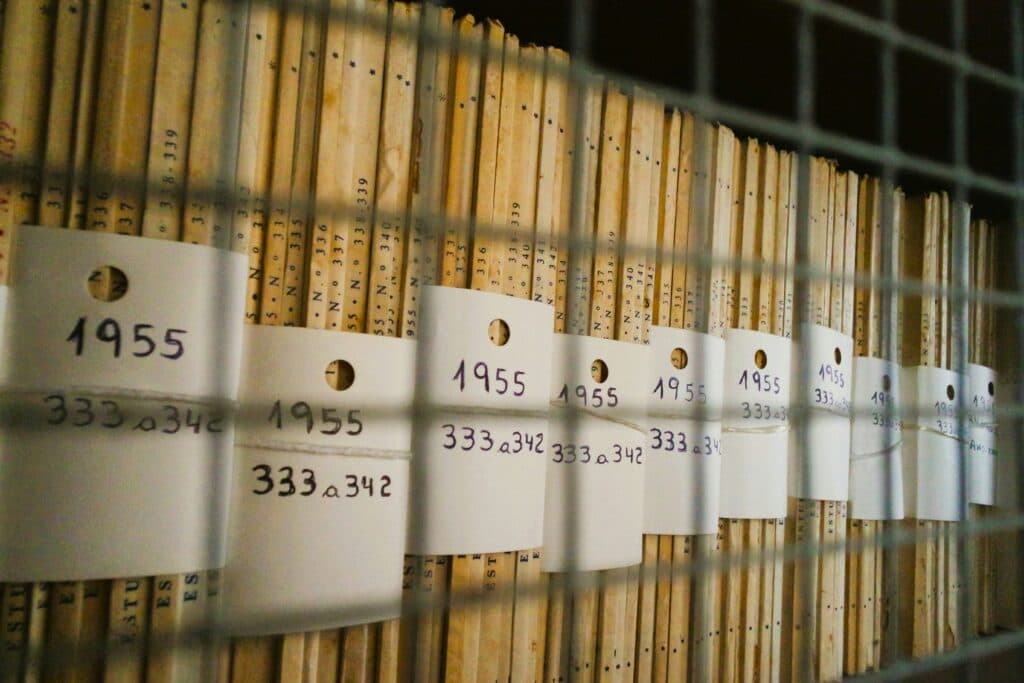
Today, I no longer see the archives as stacks of ageing documents. Instead, I see a collection of stories about men and women whose sincere sacrifices helped build and strengthen this beloved Jamaat. Perhaps that is where every journey of love begins: by first taking the time to know the story.