
Daniyal Mahmood Ahmad, UK
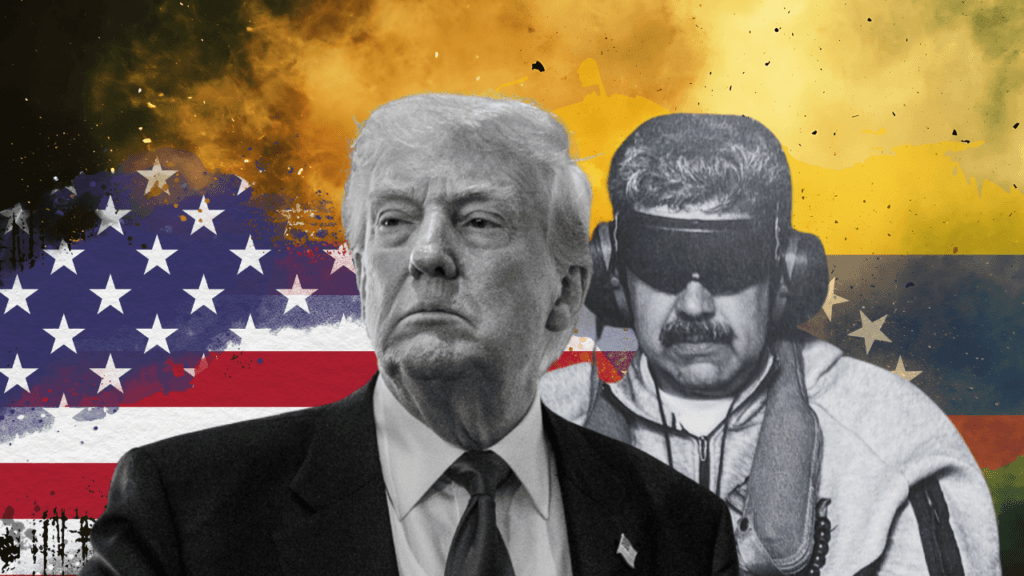
In the early hours of Saturday, 3 January 2026 – two days after Trump announced his New Year’s resolution to establish world peace – social media was flooded with news of US airstrikes on military targets in Venezuela. This initial shock was followed by an even greater shock; US President Donald Trump announced that Venezuelan President Nicolas Maduro and his wife had been “captured and flown out of the country”. The charge: Narco-terrorism. Trump went on to share an image on his platform – Truth Social – of Maduro being transported to the US.
This has been followed by mixed sentiments across social media, depending on the algorithms and how your feed might be curated. Whilst some Venezuelans are celebrating the removal of Maduro, the “despot”, others are vehemently denouncing Trump as the “despot” and his actions as illegal.
With regard to international law – or whatever is left of it since its double standards were exposed during the Israel-Gaza conflict and the Russia-Ukraine war – many are calling this an act of terror and an illegal operation waged against a sovereign country.
There is no doubt that a portion of the Venezuelan people were unhappy with Maduro, and of course, there were many who supported him, but whether he was the right leader for the country or not can often turn into an unfruitful debate.
What can be done, however, is study and investigate the past to learn what might be in store for Venezuela, the US and potentially even the international community.
Iran: When a leader tries to nationalise
A look through history can give us some interesting parallels to what might be unfolding in front of our very eyes.
In 1951, Iran elected its first democratically elected prime minister, Mohammad Mosaddegh. Due to Iran being rich in oil reserves, the UK and the West had a vested interest in the country, since they were extracting that oil and filling their coffers. When Mosaddegh decided to nationalise Iran’s oil, it all came crashing down for the new democracy.
The whole situation, as well as the domino effect that it caused, has been summarised by Harvard Business School:
“Many of the West’s political problems in the Middle East and in Iran in particular can be traced to the overthrow of Prime Minister Mohammad Mossadegh by military forces supported by the American CIA and the British MI6 in August 1953. Mossadegh, at the head of a newly-elected nationalist government, had nationalized the Iranian oil industry that had been controlled by the Anglo-Iranian Oil Company (AIOC), now known as BP.
“Since 1908, the AIOC had been producing enormous revenue for London, and control of Iranian oil was essential to the British Empire. In order to gain Washington’s assent to the coup, the Americans had to be convinced that Mossadegh represented a geopolitical threat, not merely an economic one.
“Ever since, the overthrow of Mossadegh has been seen as evidence of the extent of the supposed neo-imperialist motivations of the West in the post-colonial world.”
Mossadegh was assassinated. The democratically elected leader of a sovereign state – for the sake of oil companies and their profits – and this is causing the nation to spiral into whatever it is now.
And since respected institutions like Harvard Business School admit that Western intervention is what caused today’s problems in that region, you’d expect Western leaders to learn from those mistakes and not repeat them.
Iraq: A repeated mistake
Only a few decades later, news headlines raged on about Saddam Hussein and his WMDs (weapons of mass destruction). And so, the US and its Western allies felt obliged to rid the country of the despot and bring freedom to its people and the region in general from that threat.
The resulting freedom: Millions of people dead, whether directly or indirectly, and a country and its infrastructure in ruins.
Was Saddam the right leader for his people? That depends on who you ask, but there are many Iraqis (especially those who died as a result of the invasion) who might have preferred to sort out their problems with Saddam in-house, rather than having the US invade.
Needless to say, Saddam was executed. Coincidentally, Iraq has a lot of oil, which is an important common factor throughout these historical examples.
Libya: Never again, surely
Then came Libya’s turn. General Muammar Gaddafi had been ruling Libya with an iron fist, not allowing any democratic elections and providing free housing, free electricity, free land, free education, free health care and much more to his people.
But he wasn’t aligned with the West, so he had to go. And go he did, as many would have seen in videos circulating on social media in those days.
The result of the freedom brought by the US and its Western allies? Well, a free country where elections could take place. Also, destroyed infrastructure, poverty, hunger and amongst many other things, amongst the chaos, a newly established slave market. The sweet smell of “freedom”.
Another dead leader, another major oil reserve (9th largest in the world) given “freedom”. Another destroyed civilisation.
Venezuela’s future
In light of these atrocious results of such “freedom” based operations and wars, one can only be so optimistic about Venezuela’s future. The playbook is the same, so why shouldn’t the result be? Maduro, just like the others, was a sovereign leader of a sovereign nation which just happened to be sitting on large oil reserves. Was he the right person? That is for the Venezuelans to decide.
With regard to Venezuela’s oil reserves, its future seems to be set in stone as Trump announces that the US will be “strongly involved” in the industry.
In any case, this act of aggression, whether right or wrong, clearly goes against Trump’s claim to have ended wars and not to begin any new ones.
And since Maduro has been captured, Trump has declared that the US will “run” the country temporarily. He went on to say that US oil companies will fix Venezuela’s “broken infrastructure” and “start making money for the country” and that if needed, a second, much larger strike will be carried out on the country if needed. This is obviously being disputed by the Vice President of Venezuela, Delcy Rodriguez who claims that Maduro is the country’s only president.
It is only a matter of time before we see how the country responds. Will it give up its sovereignty and oil for “freedom”? And what about the opposition leader, the Nobel Peace Prize winner who has repeatedly declared her intentions to foster warmer relations with Israel? Where does this fall in all of the chaos?
In any case, it would be interesting to see whether the “international community” that vehemently defended Israel’s “right to defend itself” also keeps the same stance regarding Venezuela, or will the double standards and hypocrisy be exposed once again?
Justice, which has remained elusive for decades and has allowed the injustices of powerful nations to escalate to a critical point, may still prove to be the force that saves countless lives and safeguards their futures. This is what the Holy Quran teaches:
“O ye who believe! be steadfast in the cause of Allah, bearing witness in equity; and let not a people’s enmity incite you to act otherwise than with justice. Be always just, that is nearer to righteousness. And fear Allah. Surely, Allah is aware of what you do.” (Surah al-Maidah, Ch.5: V.9)