
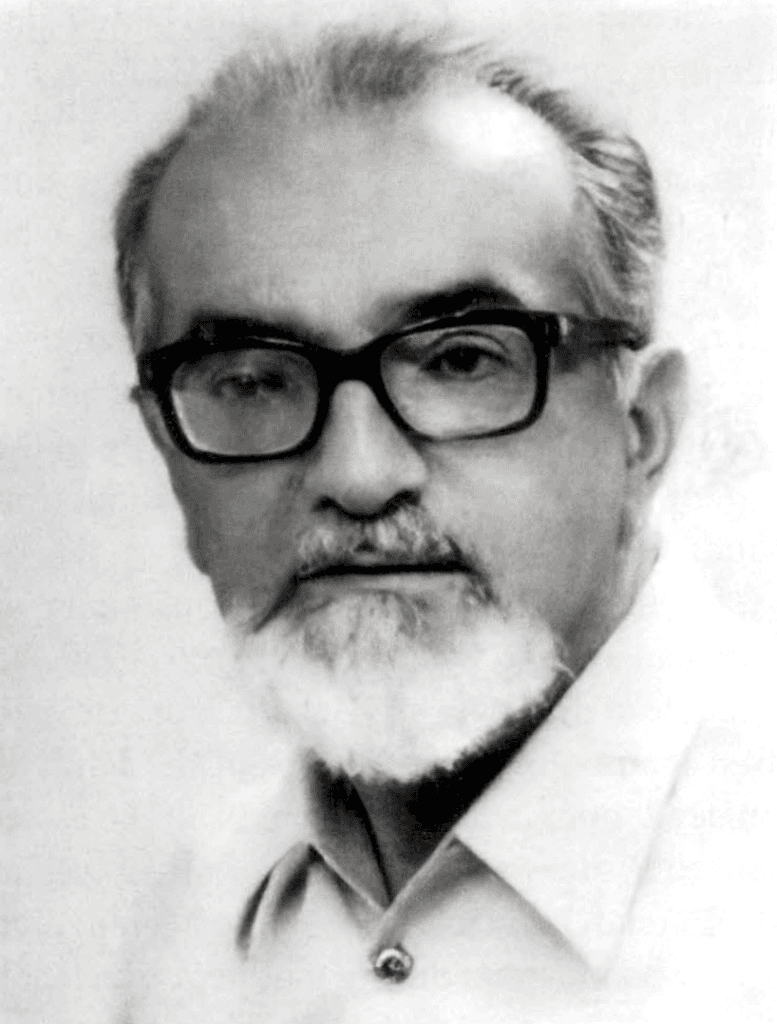
Awwab Saad Hayat, Al Hakam
In February 1955, Alessandro Bausani, a renowned Italian professor, visited Rabwah, the newly established headquarters of the Jamaat in Pakistan. He toured various Jamaat offices and buildings and delivered a scholarly lecture on the promotion of Islamic studies in Italy. He was also honoured with the opportunity to meet Hazrat Musleh-e-Maudra. (Al Fazl, 15 February 1955, pp. 1, 8)
Alessandro Bausani
Professor Alessandro Bausani (1921–12 March 1988) initially served at the University of Naples “L’Orientale,” where he taught Indonesian, Persian and Urdu literature. He later taught Islamic studies at the Università di Roma “La Sapienza.” In addition to his native Italian, he was well versed in several Oriental languages. Among his many scholarly contributions, he also produced a translation of the Holy Quran into Italian. (“BAUSANI, Alessandro”, treccani.it)
Professor Bausani devoted considerable effort to translating the works of eminent Persian scholars and poets, thereby making a significant contribution to the appreciation of Persian literary heritage in the West. Al Fazl reports that, during this period, he toured universities in Pakistan, delivering lectures on various aspects of Islam at institutions across West Pakistan. On this occasion, he also visited Rabwah to see the headquarters of the Ahmadiyya Muslim Jamaat in Pakistan, at the invitation of Wakalat-e-Tabshir.
Lecture at Rabwah
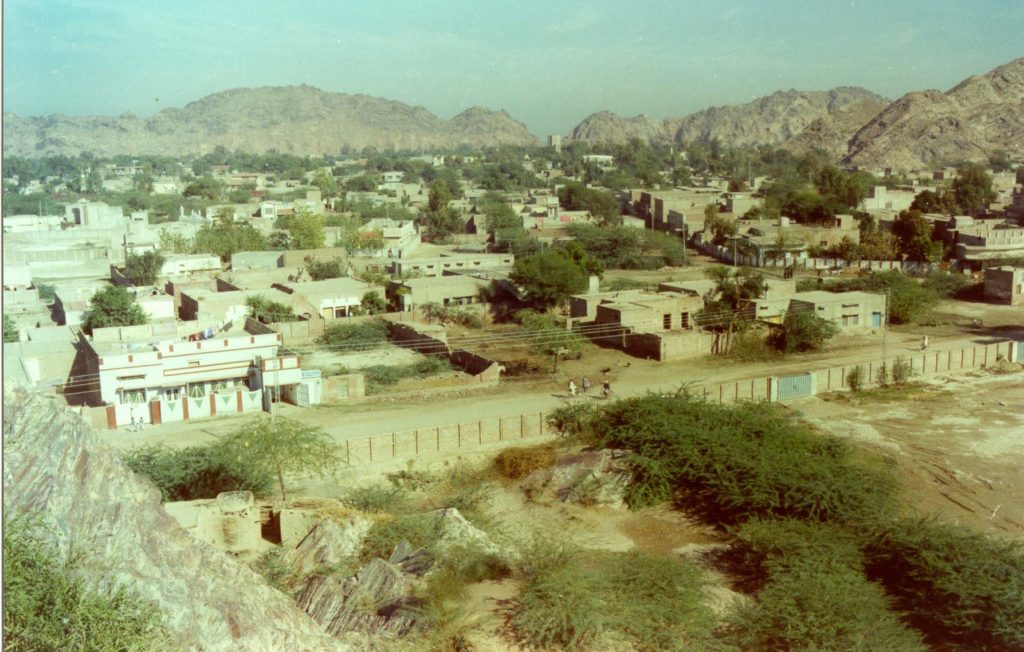
According to Al Fazl, on this occasion, Professor Alessandro Bausani delivered a lecture in English at Talim-ul-Islam College, Rabwah, on the subject “The Promotion of Islamic Studies in Italy.” In his address, he emphasised that, although the research conducted thus far by Italian Orientalists on Islamic principles might not always appear entirely free from bias from a Muslim perspective, it nevertheless remained independent of imperialist or colonial interests. He noted that missionary motives occasionally influenced such research; however, the practical benefits of these scholarly efforts could not be ignored.
Professor Bausani explained that Italian scholars had travelled to the universities of Andalusia to study the fundamental Islamic sciences. He then highlighted the various phases in the promotion of Arabic sciences and Islamic studies in Italy. In this context, he pointed out that, as early as the eleventh century, numerous works on medicine, law and other core Islamic disciplines had already been translated into Latin and Italian, benefiting not only Italy but the whole of Europe.
Despite this engagement with Islamic sciences, he remarked, strange and unfounded misconceptions about Islam had nevertheless spread throughout Europe – misconceptions so far removed from reality that they bore little resemblance to the truth. Today, however, as a result of modern research, the authentic teachings of Islam and the true events of the life of the Holy Prophet Muhammadsa have come to light, rendering those baseless notions utterly absurd.
The distinguished guest further observed that such prejudice was rooted purely in political circumstances. During the thirteenth and fourteenth centuries, a change began to take place, and despite discouragement and opposition from certain rulers, Italian Orientalists commenced a direct study of Islam. Gradually, realism prevailed over prejudice. Consequently, in 1509, the Arabic text of the Holy Quran was published in Italy for the first time. Later, in 1684, the first Arabic dictionary and a Latin translation of the Holy Quran, accompanied by brief annotations, were published. Although this was not the first translation of the Quran, it could nonetheless be regarded as the finest of its time.
Referring to the works of Orientalists, Professor Bausani highlighted the contributions of Italian scholars across different periods. He observed that even in works produced after the fourteenth century, traces of bias – contrary to the Muslim point of view – could still be found; yet, the independent-minded reader could not remain unaffected by the intellectual openness reflected in them. He read selected excerpts from certain Orientalists’ writings, noting that, while they raised objections to Islam based on their understanding, they also acknowledged several of its merits.
At the conclusion of the lecture, the president of the session, Respected Chaudhry Asadullah Khan Sahib, Barrister-at-Law, expressed gratitude to the learned speaker. The proceedings of the session had earlier commenced with the recitation of the Holy Quran by Mr Amri Ubaidi Sahib of British East Africa. (Al Fazl, 15 February 1955, pp. 1 & 8)
Question-and-Answer session
Following the lecture, a question-and-answer session was held. In response to a question posed in Arabic by Respected Maulana Abul Ata Sahib, Principal of Jamia-tul-Mubashireen, Professor Bausani stated that, in addition to the University of Rome, where Arabic and Islamic studies were taught, two separate institutions had also been established in Italy devoted exclusively to the teaching of Oriental studies.
He further explained that these institutions regularly published academic journals featuring research articles on Islam and other religions of Asia. In particular, he noted that Rivista degli studi orientali, published by the University of Rome, had on occasion also included information relating to Ahmadiyyat. (Ibid.)
Engagements in Rabwah
During his stay in Rabwah, Professor Bausani was honoured with an audience with the Head of the Ahmadiyya Muslim Jamaat, Hazrat Khalifatul Masih IIra. He also toured the offices of Sadr Anjuman Ahmadiyya and Tahrik-e-Jadid and visited educational and research institutions, including Jamia-tul-Mubashireen, Talim-ul-Islam College, Talim-ul-Islam High School and the Fazl-e-Umar Research Institute.
Following the aforementioned event at Talim-ul-Islam College, Wakālat-e-Tabshir hosted a tea reception in honour of Professor Bausani. The gathering was attended by the nazirs and wakils of Sadr Anjuman Ahmadiyya and Tahrik-e-Jadid, along with members of the college faculty and several other guests. On this occasion, the Wakil-e-Tabshir, Sahibzada Mirza Mubarak Ahmad Sahib, introduced Professor Bausani to the foreign students pursuing their studies in Rabwah. (Ibid.)
A change in view
If we take a closer look at the Rivista degli Studi Orientali, we can understand why it was so prominent in the professor’s mind. At the same time, he was visiting Rabwah, the journal published his groundbreaking article on Alama Muhammad Iqbal. Reading this article reveals that Alessandro Bausani had a limited understanding of the Ahmadiyya Jamaat, as the information he presented was derived from secondhand sources. (Rivista degli studi orientali, Vol. 30, Fasc. 1/2 (Febbraio 1955), pp. 55-102)
In later publications, the professor demonstrated a much better understanding of the Ahmadiyya Jamaat after visiting Rabwah. Previously relying on secondary sources and limiting mentions of the Jamaat to footnotes, he now includes detailed extracts and notes that reflect firsthand experience. In Bausani’s later work, “L’Islam: Una religione, un’etica, una prassi politica,” his tone towards the Ahmadiyya Muslim community is notably more balanced, offering a more comprehensive look at its beliefs and history. (L’islam: Una religione, un’etica, una prassi politica, 1980, pp. 121-125)
“Their center, following the partition of India, was transferred to Pakistan, to a semi-desert locality called Rabwah, near Lahore, where – almost by enchantment (the Ahmadiyya are very few in number and methodical) – a veritable city has arisen, almost exclusively inhabited by Qādiyānīs.” (L’islam: Una religione, un’etica, una prassi politica, 1980, p. 124)
Whether this change was influenced by his visit to Rabwah in February 1955 cannot be stated with certainty, but the contrast with his earlier writings is clear.