
For some, Ramadan is a month of careful indulgence instead of disciplined restraint. Kitchens stay busy, tables overflow at sehri and iftar, and anticipation centres on food more than reflection. But the Islamic commandment of fasting was revealed to refine hearts. It has one clear aim: taqwa (righteousness). Allah states in the Holy Quran: “O ye who believe! fasting is prescribed for you […] so that you may become righteous.” (Surah al-Baqarah, Ch.2: V.184)
The Holy Prophetsa said: “A human being fills no vessel worse than his stomach. A few morsels are sufficient to keep his back straight.” (Sunan Ibn Majah, Hadith 3349)
From this hadith, it is clear that merely staying hungry is not enough. This is why the Holy Prophetsa warned: “Whoever does not give up false statements, evil deeds, and speaking bad words to others, Allah is not in need of his leaving his food and drink.” (Sahih al-Bukhari, Hadith 6057) Again, he said: “Many fast, yet gain nothing from it except hunger and thirst.” (Sunan Ibn Majah, Hadith 1690)
In this regard, the Promised Messiahas also explains: “It is in the nature of man that the less he eats the more purified his soul becomes and his powers of experiencing visions increase. The intent of God Almighty through this is to decrease one form of nourishment, and increase another.
“One who is fasting should always keep in view that the purpose is not to just remain hungry, but that he should remain engaged in the remembrance of God Almighty, so that he may attain a state of detachment and separation [from the world]. Thus, fasting means that man give up one bread that nourishes the body alone, and gain another that is the source of satisfaction and satiation of the soul.” (Malfuzat [English], Vol. 9, p. 43)
If fasting does not strengthen righteousness, self-control, and devotion to Allah, its purpose is lost. In recent years, Hazrat Khalifatul Masih Vaa has also advised restraint, especially in food and iftar gatherings, teaching us that this month is supposed to reduce excess and cultivate discipline. Let us go over some of this guidance.
Simplicity in suhoor and iftar
Hazrat Khalifatul Masih Vaa stated:
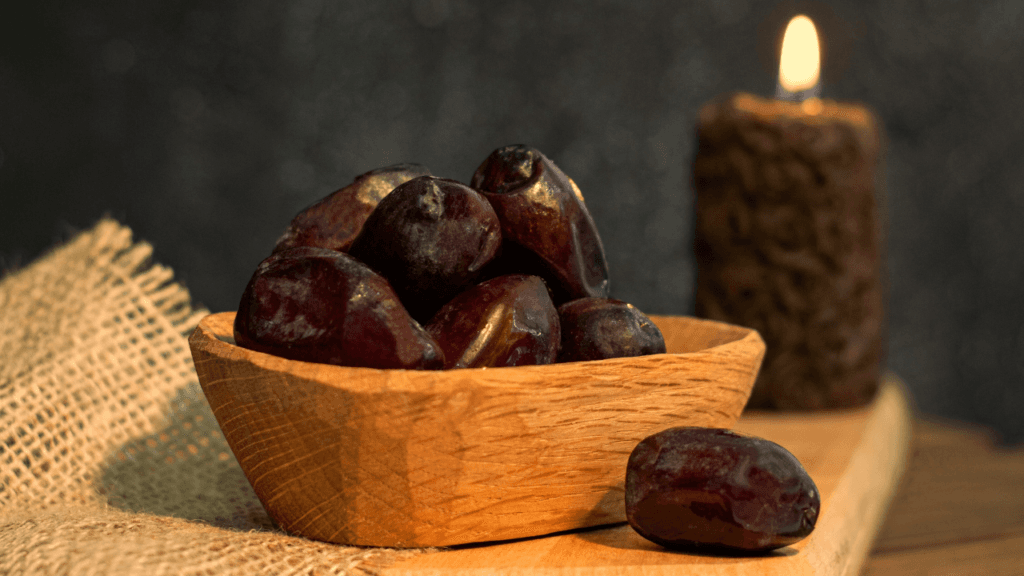
“Whatever I normally eat for breakfast, I eat the same for sehri, and whatever meal I usually eat in the evening, I eat the same for iftar. And at the time of iftar, since it was the sunnah of the Holy Prophetsa to break his fast with a date, I also break my fast with a date. Other than this, I do not eat pakoras, samosas, chaat, or other unnecessary dishes as you do. I do not like to eat so much that I feel discomfort after the evening meal and then struggle to wake up in the morning for the fast.
“Maintain the same routine, and in this way you will also enjoy your sehri. As a society, we have turned it into a tradition that something special must be eaten at sehri and iftar during Ramadan, and as a result we unnecessarily increase our expenses. On the one hand, food costs rise without need; on the other, the stomach is upset and discomforted, and during the fast, the entire day is spent in lethargy.
“The true enjoyment of fasting lies in maintaining one’s normal diet – beginning and ending the fast with the same types of food one ordinarily eats. And the money saved by not indulging in lavish iftar meals should be given in charity to those in need.”
Guidance on iftar gatherings
Huzooraa emphasised:
“The real objective is to develop righteousness. If this is not the case, then the purpose of fasting is nullified. Nowadays, for a large number of Muslims, the case is not even about going hungry, especially among the rich. They eat with great diligence at the time of sehri [eating before sunrise to start the fast] and iftari [breaking the fast at sunset]. […]
“Besides, I am not in favour of these grand and lavish iftar parties that take place. They have now become a form of pretentiousness and innovation. During Ramadan, greater attention should be given to reading, teaching, listening to, and reciting the Holy Quran. Greater attention should be given to the remembrance of Allah. Greater attention should be given to worship. However, what actually happens in place of this is that people of different professions come from their jobs and occupy themselves with eating at iftar gatherings.
“And as for those who give out the iftari invitations, instead of giving attention to reading the Quran, Hadith, the remembrance of Allah and worship, they remain engaged in efforts to make the best arrangements, to have everything for iftar, and in making the best iftar meals, in order for them to be praised for making such excellent iftar arrangement[s]. Hence, all these things are not the purpose of Ramadan, and they only take one away from righteousness. […]
“For the sake of Allah, if we abstain from those things which are otherwise lawful, then surely Allah the Almighty will look upon us with His mercy and will put our Satan in chains. We shall continue to cross the vast field of virtues without any kind of obstacle, and by the grace of Allah, the fort of worship and remembrance of God shall continue to shield us from satanic onslaughts.” (Friday Sermon, 15 March 2024)
Hosting iftars and feeding others
On iftar arrangements, Huzooraa further clarified in a virtual mulaqat:
“People host iftar invitations in their homes, do they not? This should not be done. If there is a poor person […], you can send it to their houses.
“If a Jamaat function is being held – such as an organised iftar programme – then the administration may arrange it. However, the administration must themselves remain mindful that they must recite the Holy Quran and that their worship is properly observed. If, alongside this, they are able to prepare a simple iftar, then they may do so.
“Nowadays, it has become a common practice in people’s homes that family members remain occupied with iftar preparations from morning until evening because they have planned an iftar dinner. When the time for prayers arrives, they say, ‘Let us combine the prayers; there is no harm in doing so since we have an iftar dinner.’ Then people invite those whom they prefer, and gatherings are held. This is what I have instructed people to abstain from.”
This guidance from the Khalifa of the time is essential for our spiritual progress during this blessed month. Ramadan is not meant to be comfortable. Its power lies in the restraint of appetite, of social indulgence, and of distractions for the sake of Allah. Righteousness is the true feast of Ramadan. When the day ends, may we feel closer to Allah – not just fuller. Amin!