
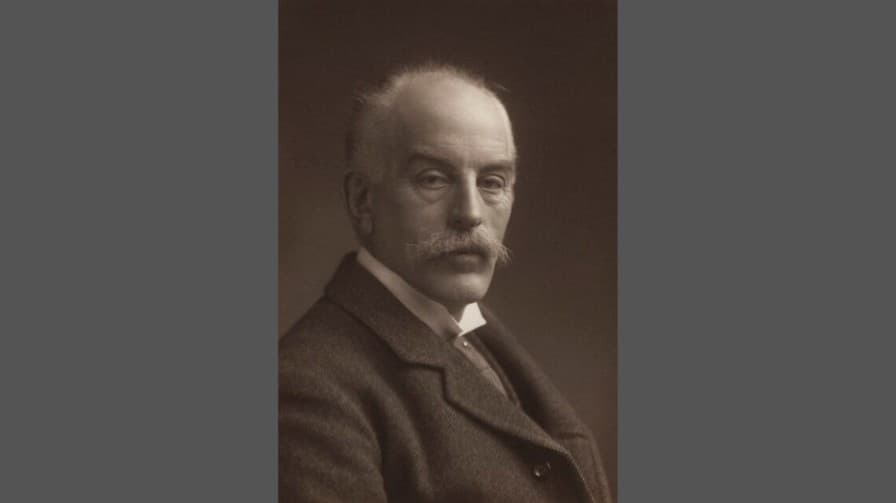
Awwab Saad Hayat, Al Hakam
Background of Sir James Wilson
Sir James Wilson (1853-1926) was a distinguished British civil servant who played a crucial role in Punjab’s administration during British rule in India. Born in Scotland, he was educated at the University of Edinburgh and Oxford before joining the Indian Civil Service in 1873. His tenure included serving as Secretary to the Government of India in the Department of Revenue and Agriculture (1903-1908).
In early 1908, he was appointed as the Financial Commissioner of Punjab, where he spearheaded the Triple Canal Irrigation Project, a transformative initiative for the region’s agriculture. His contributions to famine relief and governance earned him a knighthood (KCSI) in 1909.
Visit to Qadian
On 21 March 1908, Sir James Wilson, then Financial Commissioner of Punjab, visited Qadian, accompanied by Charles Montague King, Deputy Commissioner of Gurdaspur.
His delegation included the Settlement Officer, his private secretary, Mr Singha (Revenue Officer of Gurdaspur), and the Tehsildar of Batala. The group stayed in Qadian for a day and departed the following morning, 22 March 1908.
This visit holds significance in Ahmadiyya history, as it took place just weeks before the passing of Hazrat Mirza Ghulam Ahmad, the Promised Messiahas.
Malik Salahuddin Sahib, the author of Ashab-e-Ahmad, writes:
“Since the establishment of the Ahmadiyya Community, this was the first time that such a high-ranking official, second only to the Governor, stayed in Qadian. The growing importance of Qadian was due to the Ahmadiyya Muslim Community, making hospitality arrangements the responsibility of the Jamaat.” (Ashab-e-Ahmad, Vol. 2, pp. 483-484)
According to Badr, such a high-ranking British official had not visited Qadian in almost 50 years.
The arrangements for the distinguished guest and his entourage were managed by the Sadr Anjuman Ahmadiyya.
Historically, during the time of the Promised Messiah’sas father, many high-ranking British officials frequently visited Qadian. However, Hazrat Ahmadas had completely distanced himself from worldly grandeur, focusing solely on his divine mission.
Reception in Qadian
The Financial Commissioner’s convoy arrived in Qadian at 11 in the morning. The Ahmadiyya Muslim Community welcomed the officials with a formal reception near Talim-ul-Islam School. A delegation from Qadian, led by Mirza Sultan Ahmad Sahib (then the official head of Qadian’s local administration), along with Khawaja Kamaluddin Sahib and his brother Khawaja Jamaluddin, rode on horseback to receive the guests a mile outside Qadian.
Hazrat Mirza Bashir-ud-Din Mahmud Ahmadra also received the guests on horseback.
The reception was arranged at Rehti Chilla, an open area where temporary accommodation and tents were set up for the guests. This land was later purchased for Madrasa Ahmadiyya. A special gate with “Welcome” inscribed on it was erected, and flower pots were arranged on both sides of the pathway leading to the guest tent. A platform was also built for the guests.
Hazrat Sheikh Yaqub Ali Irfanira narrates:
“I was responsible for the construction of the welcome gate and other arrangements for the Financial Commissioner’s visit. The construction was carried out by the workers of Hazrat Nawab Muhammad Ali Khanra.” (Ashab-e-Ahmad, Vol. 2, p. 484)
Additionally, Malik Qadir Bakhsh Sahib, Tehsildar of Batala, played a significant role in organising the arrangements. During the Financial Commissioner’s visit to Batala, three such guest camps were set up, one of which was in Qadian.
Hazrat Hakim Maulvi Nooruddinra was among those who welcomed the guests. He recalled meeting the Financial Commissioner earlier in Shahpur when he was serving as the Deputy Commissioner there, which Sir James Wilson confirmed.
The Financial Commissioner also visited the clinic of Hazrat Maulvi Nooruddinra.
Maulvi Muhammad Ali Sahib introduced the distinguished members of the Jamaat who were present in Qadian due to the Holi holidays. Badr published a list of these prominent figures, along with their designations and areas of residence (Badr, 26 March 1908, p. 2).
Inspection of Madrasa Ahmadiyya
After some rest, the Deputy Commissioner expressed his desire to inspect Madrasa Ahmadiyya.
At the school entrance, teachers and prominent figures welcomed him. The Deputy Commissioner met all the attendees, examined each classroom and department with great interest, and expressed his satisfaction. He also reviewed the plans for the new building of Talim-ul-Islam School and requested the visitors’ book to record his remarks.
He wrote:
“Visiting this school today has given me great pleasure. It is evident that the trustees of this institution are sincerely dedicated to education. Undoubtedly, their commendable efforts will succeed in spreading education in this district. A reasonable piece of land has been purchased for the school outside the town, and the architectural plan I have seen promises the construction of a beautiful building on this site.”
(Signed) C. M. King, Deputy Commissioner Camp Qadian, 21 March 1908
Hazrat Maulvi Sher Alira, the headmaster, welcomed the officials and answered their enquiries about the school.
On behalf of the community, Khwaja Kamaluddin Sahib invited them to a meal, which they accepted. As per the instructions of the Promised Messiahas, food from the langar was sent to their camp.
Hazrat Sheikh Yaqub Ali Irfanira narrates:
“Large cauldrons of pulao and zarda were prepared and sent. The Promised Messiahas instructed that even their animals and dogs should be given quality food and that none of the food sent should be returned as being surplus. I initiated the conversation about this meal arrangement with Mr King, the Deputy Commissioner.”
Meeting with the Promised Messiahas
Upon learning that the Financial Commissioner wished to meet him, Hazrat Mirza Ghulam Ahmadas arrived at their camp at 5 pm. A large crowd gathered to witness this historic moment. Sir James Wilson received the Promised Messiahas with great courtesy.
For almost an hour, Hazrat Ahmadas spoke about the teachings of Islam, emphasising its foundation on rational arguments and divine signs. He clarified that Islam had never spread by force but rather through reason and the fulfilment of heavenly prophecies. Addressing the misconception of a “bloody Mahdi”, he stated:
“Please refer to my book on this subject. We consider the concept of a bloody Mahdi to be incorrect. Our belief is that Islam spreads through strong arguments and divine signs, not by the sword. The wars fought in Islam were all defensive. The idea that Islam spread by the sword is a fabrication by its opponents.”
As the conversation continued, Sir James Wilson expressed a desire to discuss non-religious matters. However, Hazrat Ahmadas politely declined, saying:
“You are a worldly ruler, and God has appointed me as a ruler of the spiritual domain. Just as you have fixed times for certain matters, so do we. Now is the time for our prayers.”
With this, Hazrat Ahmadas concluded the meeting and returned home.
The visit of Sir James Wilson to Qadian was recorded in Badr and Al Hakam and later compiled in Tarikh-e-Ahmadiyyat, Vol. 2, pp. 517-518. This meeting remains a testament to the dignified and intellectual approach of the Promised Messiahas in presenting Islam to influential figures of the time.