
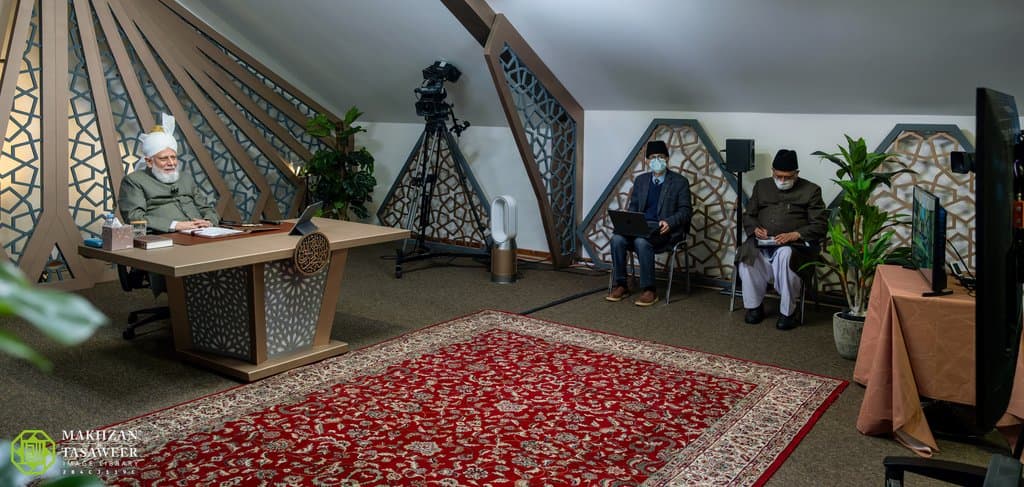
On 8 February 2026, members of the Ahmadiyya Muslim Women Students’ Association (AMWSA) Sweden were blessed with a virtual mulaqat with Hazrat Mirza Masroor Ahmad, Khalifatul Masih Vaa. Huzooraa presided over the meeting from the MTA Studios in Islamabad, Tilford, UK.
After conveying salaam and taking his seat, Huzooraa invited a student to recite a portion of the Holy Quran. The student recited verses 103-104 of Surah Aal-e-Imran, followed by their Urdu translation by another student.
Huzooraa then addressed the AMWSA President and enquired about the composition of the audience, asking how many were university students and how many were in secondary or pre-university education. After the students raised their hands to indicate their respective levels, it was confirmed that the total attendance in the hall was 82.
Following this, the floor was opened for questions.
Priorities for AMWSA and balancing knowledge
A student asked for guidance on the future roadmap for AMWSA, specifically how members could progress in both religious and worldly fields to become responsible servants of the Jamaat.
Huzooraa remarked that he had addressed these themes in numerous addresses to Lajna Imaillah and in his sermons. He stated that the advice given to men applies equally to women and the work being done by the male students’ association (AMSA) should also be undertaken by AMWSA.
Huzooraa emphasised that students must excel in their chosen secular fields. Whether pursuing a degree, post-graduation or a PhD, they should aim for the top positions. When they achieve academic excellence, people will naturally ask about their background. This provides an opportunity to identify as Muslims and explain that seeking knowledge is a religious injunction given by the Holy Prophetsa. (Sunan Ibn Majah, Hadith 224) He also instructed to learn half the faith from his wife, Hazrat Aishara. Huzooraa noted that the Holy Prophetsa granted women a high status regarding education and Ahmadi women must manifest this through their achievements.
Huzooraa further instructed that alongside secular education, they must advance in religious knowledge. They bear the responsibility of training the next generation, guiding their younger siblings and influencing their broader environment to convey the true message of Islam.
Regarding tabligh, Huzooraa observed that in modern societies, people are often detached from religion due to materialism. Therefore, direct preaching may not always be effective immediately. Instead, Huzooraa advised AMWSA to organise seminars in their universities or other venues on secular topics such as history or science, inviting non-Muslims to attend. Such events generate interest and allow for a gradual introduction to the Jamaat, helping to dispel misconceptions and present the true image of Islam. Huzooraa said:
“And this is precisely your task: to make yourselves recognised, to establish your identity and to show people the true picture of Islam – that this is the correct picture of Islam which we are presenting. This is Islam’s teaching.”
Understanding Divine attributes
A student asked how one should understand the instruction to adopt the attributes of Allah, given that some attributes, such as Al-Mutakabbir, seem exclusive to Allah. She asked how a human can distinguish between attributes to adopt and those where one must remain humble.
Huzooraa replied that the Holy Quran instructs believers to take on the “colour of Allah”. (Surah al-Baqarah, Ch. 2: V. 139) He explained that this means striving to reflect Allah’s attributes within human limits, while recognising that a person cannot attain the exalted station that is proper to Allah alone.
To illustrate how an attribute’s sense differs when applied to Allah and when applied to human beings, Huzooraa cited the attribute Ash-Shakoor (the Most Appreciative). He explained that Allah does not “give thanks” to a servant in the human sense; rather, in this context, Ash-Shakoor signifies that Allah values and acknowledges those who obey His commands. When the related quality appears in a servant, however, “shukr” carries its familiar meaning: that when someone does one a kindness, one expresses gratitude and offers thanks.
With regard to Al-Mutakabbir, Huzooraa clarified that it does not mean that Allah is arrogant. Rather, it denotes Allah’s absolute greatness: Allah is supremely Great and none can ever reach His rank. Huzooraa added that, when this attribute is considered with reference to a human being, it does not take the form of pride; instead, it should appear as breadth of spirit and moral fortitude, cultivated alongside humility – so that one is not upset by trivial matters, does not fall into quarrels and does not harbour resentments. Developing such forbearance, he explained, is itself a form of inner greatness.
Huzooraa concluded that, in this way, the “colour” changes in its human application: one should strive to conduct oneself in one’s surroundings in accordance with the higher moral qualities indicated by the attributes of Allah. This, he said, is the meaning of being “coloured” with the colour of Allah.
Global conflict and the role of Ahmadis
A student asked about the Quranic prophecy regarding Ya’juj and Ma’juj (Gog and Magog) causing disorder. Referencing the political situation involving Greenland, Denmark and the USA, she asked how Ahmadis should understand these prophecies in the current context.
Huzooraa stated that whether the issue concerns Greenland, Palestine or other regions like Ukraine, major powers are often seen creating disorder to establish their supremacy. Huzooraa identified the forces as the Dajjal or the Antichrist mentioned in ahadith, who seek to dominate the world through deception and force. He noted that, regrettably, some Muslim nations also rely on these powers for weaponry and support, effectively aiding them.
Huzooraa explained that the Promised Messiahas came to break this power of Dajjal through spiritual means. Seeing these geopolitical developments should compel Ahmadis to focus more on prayers, on tabligh and on spreading the peaceful teachings of Islam to both Muslims and non-Muslims. Huzooraa said:
“For this, we should strive – and the way to do so is this: how can we counter it? That we must, as far as possible, demonstrate Islam’s teaching through our actions as well and convey Islam’s message too and say to people: if you desire peace in the world, if you wish to save the world from disorder, if you want to protect yourselves and your future generations from destruction, then keep away from the [evil] things.”
Huzooraa remarked that the major powers have reached a peak in their desire for control, leading to conflict amongst themselves and against Muslims. Citing the example of the USA seeking an airbase in Greenland, Huzooraa noted that yielding even a small piece of land to such powers often leads to them expanding their control further.
Ahmadis, as followers of the Dhul-Qarnayn (the one with two centuries), have the duty to counter this disorder. Huzooraa advised the students to study the Quran and its commentaries, build a strong relationship with Allah and focus on prayer. He urged them to demonstrate the true teachings of Islam through their actions to warn the world that safety from destruction lies only in avoiding such conflicts and injustices. Huzooraa said:
“That is why I am presently delivering sermons on love for Allah the Exalted. The life and character of the Holy Prophetsa is narrated precisely so that we may become those who act upon it ـ– that we should also pay attention towards love for Allah the Exalted, we should also pay attention towards prayers and our actions should be righteous. In the future, insha-Allah, if the opportunity arises, attention will also be drawn towards righteous deeds – namely, what the Holy Prophet’ssa conduct was like in every matter and how we are to act upon it.”
Guidance for students facing visa issues
Another student raised a concern regarding some Ahmadi youth who migrate abroad for studies but leave their education incomplete due to visa issues or financial difficulties, often resorting to menial jobs. She asked for advice on how to encourage them to return to higher education.
Huzooraa first clarified the context, noting that this issue generally pertains to students migrating from poorer nations to wealthier ones, rather than those already living in Sweden. He observed that while some face genuine financial struggles, others arrive with the intention of using a student visa as a gateway to seek asylum and earn money quickly.
Huzooraa noted that talented and sincere students usually find a way to continue their education, even if they have to pause while their asylum claim is processed. He mentioned that the Jamaat also assists talented students with fees where possible. However, due to those who misuse student visas solely to settle abroad, some governments have introduced stricter barriers, which unfortunately affect genuine students as well.
Facing World War III with faith and planning
A ninth-grade student asked how a Muslim can survive a potential World War III and how one should plan for the future when the world seems so unstable.
Huzooraa replied that if a war breaks out, bombs do not differentiate between Muslims and non-Muslims. However, Huzooraa referenced an Urdu couplet of the Promised Messiahas, stating that those who love Allah will be saved from the “fire” of conflict:
آگ ہے پر آگ سے وہ سب بچائے جائیں گے
جو کہ رکھتے ہیں خدائے ذوالعجائب سے پیار
[“There is a fire, but all those shall be saved from this fire who possess love for the God of Great Wonders.”]
He assured her that while the Jamaat as a whole will, insha-Allah, be preserved, individuals must strive to build a strong relationship with Allah to attract His grace.
Huzooraa firmly advised against falling into “tired thinking” or depression by wondering if life will continue. He stated that a believer must trust in Allah, which entails ignoring the uncertainty and continuing to plan and strive for the future. He advised the student to pursue her studies in science or medicine if she has the aptitude and to work hard as long as there is life.
Huzooraa said:
“People of the world, after all, love the world, do they not? In a hadith I related in a sermon a few days ago, the Holy Prophetsa said: ‘What have I to do with the world?’ Yes, Allah the Exalted has bestowed blessings in this world; one should benefit from them and plan accordingly. And the purpose of life in this world – if we, as Ahmadi Muslims, understand that purpose and strive to fulfil it – then that purpose is: to worship Allah the Exalted, to become His grateful servant, to act upon His commandments and to fulfil the rights due to His servants. If we do all these things, we shall remain safeguarded from it as well and it is with this very outlook that we shall continue to plan.
“If, instead, we sit thinking that we do not even know whether we shall remain alive in this world or not, then it will lead to the onset of the illness of depression – we will become depressed. Therefore, so long as life remains, keep striving, keep struggling and for as much life as Allah the Exalted has granted, seek help from Allah the Exalted, make good planning for it and strive to excel in whatever your field may be.”
Navigating local culture and identity
A student asked to what extent an Ahmadi should be influenced by the local culture and environment and how much of it is acceptable to adopt.
Huzooraa asked about her field of study, to which she replied she was studying a pre-school teaching course. Huzooraa advised her to adhere to religious injunctions, including observing the hijab, offering prayers, helping God’s creation and maintaining modesty. He stated that one must strictly avoid aspects of the local culture that conflict with Islam, such as drinking alcohol or dancing, etc.
However, Huzooraa clarified that traditions and cultural aspects that do not conflict with Islam can be adopted. He emphasised that loyalty to one’s country is part of faith; therefore, one should integrate by serving the country and adopting its positive traits. Huzooraa noted that if Ahmadi women manifest high morals and a spirit of service, locals will respect them and their choices, including their modest dress.
Overcoming the sense of ‘statelessness’
A student asked how to deal with the feeling of having “no homeland”. She compared the opposition in Pakistan to the bias sometimes faced in Sweden as a foreigner and Muslim.
Huzooraa recited the following couplet:
مایوس و غمزدہ کوئی اس کے سوا نہیں
قبضے میں جس کے قبضۂِ سیفِ خدا نہیں
[“None is more hopeless and grief-stricken than he, who does not hold the handle of the sword of God in his hand.”]
He advised her not to despair. He contrasted the situation in Pakistan – where Ahmadis face legal bans on practising their faith, calling the azan, offering prayers, reciting the Holy Quran or even saying salaam – with Sweden, where religious freedom exists. Huzooraa described the bias in the West as often being “hidden” but noted that no one prevents Ahmadis from worshipping, reciting the Holy Quran or professing the faith in Islam.
Huzooraa termed the feeling of statelessness as a form of despondency that does not behove a believer. He urged the students to interact with locals, build friendships and demonstrate good character. Through positive interaction, prejudices will fade and people will become sympathetic friends.
Career uncertainty and trust in Allah
A student asked how students can maintain trust in Allah when their career paths feel uncertain.
Huzooraa explained that this uncertainty usually stems from a few causes: lack of real interest in the subject, low confidence, reluctance to put in the necessary effort or choosing a field that does not match one’s aptitude. He noted that competitive routes such as medicine require sustained hard work and strong results in key subjects like chemistry, physics and biology. Similarly, options such as engineering depend heavily on maths and physics and success in law also demands commitment and suitability.
Huzooraa advised students to make thoughtful, informed choices rather than copying friends or relatives without reflection. He encouraged them to assess their own interests and strengths and to consult teachers directly for an honest evaluation of their abilities and the subjects they should pursue.
He also mentioned that jamaats should have a career planning and guidance committee to help students understand their aptitude and plan accordingly.
He reassured the student that there is no need for despair: once a suitable path is chosen, consistent hard work alongside prayer will bring progress and Allah does not allow sincere effort to go to waste.
Conclusion
Towards the end of the meeting, Huzooraa spoke briefly with the Sadr Lajna Imaillah and the Sadr AMWSA. Huzooraa offered prayers for the attendees, conveyed his salaam and the meeting concluded.
(Summary prepared by Al Hakam)