

A glimpse into the rich history of the Ahmadiyya Muslim Jamaat
23 January 1953: Regarding the preservation of all the names of those who contributed to Tahrik-e-Jadid in the first 19 years, on this day, Hazrat Musleh-e-Maudra said:
“Now, this 19-year period is drawing to a close, which was an extraordinary time. Although we will continue to offer chanda towards it afterwards, that phase has ended wherein we termed ourselves as ‘sabiqun al-awwalun’ and ‘daftar awwal’. It is the end of an era. Therefore, in my view, a booklet should be published to maintain a record of their sacrifices at the end of this 19-year period so that they can be cited as an example for others […] In the future also, similar plans should be made to preserve the names [of these 5,000 soldiers] so that the generations to come strive to follow in their footsteps and so that we can present these people as an example for the generations to come. However, you should remember that this chanda is for life and this scheme shall live on forever.” (Khutbat-e-Mahmud, Vol. 34, p. 25)
Following this instruction, on behalf of Tahrik-e-Jadid Anjuman Ahmadiyya Pakistan, Chaudhry Barkat Ali Khan Sahib (Wakil-ul-Mal) published a 500-page book, in which the name of every contributor was given, along with details of their residence and their contributions. Later on, Hazrat Musleh-e-Maudra gave the instructions to form different dafatir [batches] of Tahrik-e-Jadid based on 19-year terms.
To read more, see: “5,000 soldiers of Tahrik-e-Jadid’’ at alhakam.org (30 October 2020, pp. 6-7).
23 January 1965: During Jalsa Salana Rabwah, in December 1964, Hazrat Dr Hashmatullah Khanra Sahib delivered the address in which he recalled his precious memories with the Promised Messiahas. This speech was published in Al Fazl on this day.
To read the English rendering of this emotional and educational piece, see: ‘‘A companion remembers the Promised Messiah’’ at alhakam.org (19 March 2021, pp. 11-13).
24 January 1900: Al Hakam reported on this day that Hazrat Seth Abdur Rahmanra of Madras was in Qadian and sought permission from the Promised Messiahas to return to Madras for some important work. He had also received a telegram to return. The Promised Messiahas said, “It is absolutely imperative for you to remain here during this blessed month.”
Mentioning his Ramadan routine, the Promised Messiahas also said, “I am ready to make such a prayer in your favour that would even move mountains […]. During these days, I sit with my friends less than usual and remain in solitude for longer. This is truly to the benefit of my friends. I pray in seclusion with time and freedom and spend a better part of the night in prayers.” (Al Hakam, Vol. 4, No. 3, 24 January 1900, pp. 1-6)
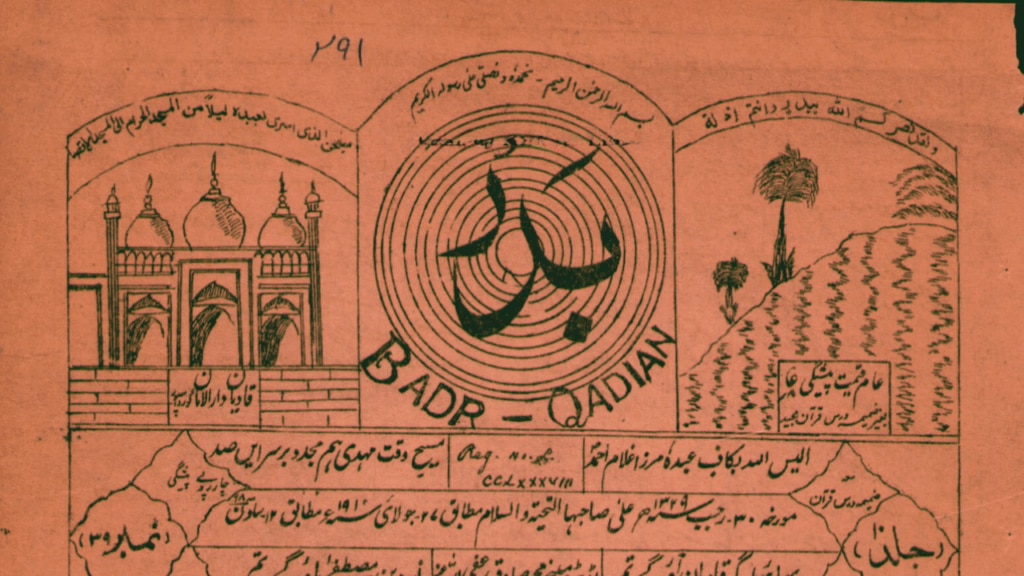
24 January 1909: On this day, with the approval of Hazrat Khalifatul Masih Ira, Hazrat Mir Nasir Nawabra published an announcement in the Badr, stating that given the growing need for amenities in Qadian, four types of buildings were urgently required, for which, he announced, Hazrat Khalifatul Masih Ira had not only given approval, but had also donated 260 rupees. The four buildings he intended to build were:
- A mosque near the boarding house (It was this mosque that would later be known as the Noor Mosque, which housed the election of Hazrat Khalifatul Masih IIra in 1914)
- A male hospital (later to be known as Noor Hospital)
- A female hospital to be named Ummul Mominin Ward
- A care home by the name of Dar-ul-Zu‘afa to house the old and frail
To read more about the history of Noor Hospital, see: “The Jamaat’s First Hospital” at alhakam.org (2 November 2018, p. 3).
25 January 1901: When Queen Victoria passed away in January 1901, the Ahmadiyya press paid tribute to her by publishing her biography and by reminding readers of how benevolent her reign had been. A memorial service was also arranged at the residence of Hazrat Nawab Muhammad Ali Khanra Sahib on Friday on this day in Malir Kotla, where the great services of the Empress were remembered and prayers were offered for her. After two other addresses, Hazrat Nawab Muhammad Ali Khanra Sahib delivered an address where he referred to the gratitude that Hazrat Ahmadas had all along expressed for the great Queen.
To read this part of history along with facts, see: ‘‘Remembering Queen Elizabeth II – Our benevolent monarch’’ at alhakam.org (8 September 2022, pp. 00-00).
25 January 1923: Hazrat Musleh-e-Maudra, through his various speeches and addresses, instilled within missionaries the spirit of determination and taught them to work in every field and to face every challenge with purpose and high spirits. Al Fazl reported on this day that the advice given by Hazrat Musleh-e-Maudra to Hazrat Maulvi Muhammad Dinra, on his departure for the United States, included, “The one who is disappointed never succeeds; the one who contemplates his future endeavours, even while [his neck is] under the sword, succeeds.”
To read the missionary efforts of Jamaat, see: ‘‘Pioneer Missionaries: Part 1 – Sacrifices and achievements’’ at alhakam.org (5 August 2022, pp. 10-11).
26 January 1973: On this day, Hazrat Khalifatul Masih IIIrh initiated the planting of trees to make Rabwah a lush green city and announced a scheme to plant 10,000 trees. (Khutbat-e-Nasir, Vol. 5, pp. 19-34)
27 January 1954: A copy of the Dutch translation of the Holy Quran was presented to Ghulam Muhammad, Governor-General of Pakistan, on this day. This valued gift was from Hazrat Musleh-e-Maudra and was delivered by a special delegation of Jamaat members.
The delegation consisted of Sahibzada Mirza Mubarak Ahmad Sahib, Hazrat Malik Ghulam Faridra, Syed Shah Muhammad Sahib and Maulvi Abdul Maalik Khan Sahib. It would not be out of place here to mention that when all Muslim sects and political groups were bent on proving Jamaat-e-Ahmadiyya as non-Muslim, the Jamaat had completed translations of the Holy Quran in various languages and was presenting these translations to the President of Indonesia, the Governor-General of Pakistan and other influential personalities, as well as making it accessible to the general public. For further details, see Tarikh-e-Ahmadiyyat, volume 16, page 413.
27 January 2012: During his Friday sermon on this day, Hazrat Khalifatul Masih Vaa mentioned Ravil Bukharaev Sahib of Russia, who had passed away in January 2012. He was a well-known Russian poet, journalist, writer, translator and devout member of Jamaat. He worked for the BBC Russian Service and after his retirement, he devoted his life to the Jamaat. He translated many books of the Jamaat into the Russian language. To read more, see: ahmadipedia.org.
28 January 1944: During his Friday sermon on this day, Hazrat Khalifatul Masih IIra announced that he was termed the Musleh-e-Maud by God. Huzoorra shared details of his vision with Jamaat members in public. (Khutbat-e-Mahmud, Vol. 25, pp. 49-65)
28 January 1945: On this day, a group of Buddhists arranged a multi-faith event in Kanpur, India. An Ahmadi missionary also attended and shared the Jamaat’s views about other religions. On behalf of Jamaat-e-Ahmadiyya, Maulvi Ghulam Ahmad Arshad Sahib delivered a speech on the topic of Islam being the universal religion. (Tarikh-e-Ahmadiyyat, Vol. 9, p. 559)
29 January 1926: On this day, a special jalsa was held in Qadian, which included 24 speeches in different languages. This jalsa was special, as it was the first of its kind. Hazrat Mufti Muhammad Sadiqra supervised the project. The final speech of this unique jalsa was delivered by Hazrat Musleh-e-Maudra.
In his speech, Huzoorra alluded to a prophecy of Prophet Jesus’as disciples that they would speak in different languages. He said that the meeting and the speeches made in it were clear proof of the truthfulness of the Promised Messiahas. (Tarikh-e-Ahmadiyyat, Vol. 4, p. 553)