
Tamseel Mushtaq, Graduate, Jamia Ahmadiyya UK
Since 2014, each graduating class of Jamia Ahmadiyya UK would visit Spain for a month-long tabligh trip. Due to the Covid-19 pandemic, these trips were paused. The programme resumed in 2024 after a four-year break. This year, the graduating class of 16 students visited Spain from 29 September to 5 November 2025. The following is a diary of one of the graduates.
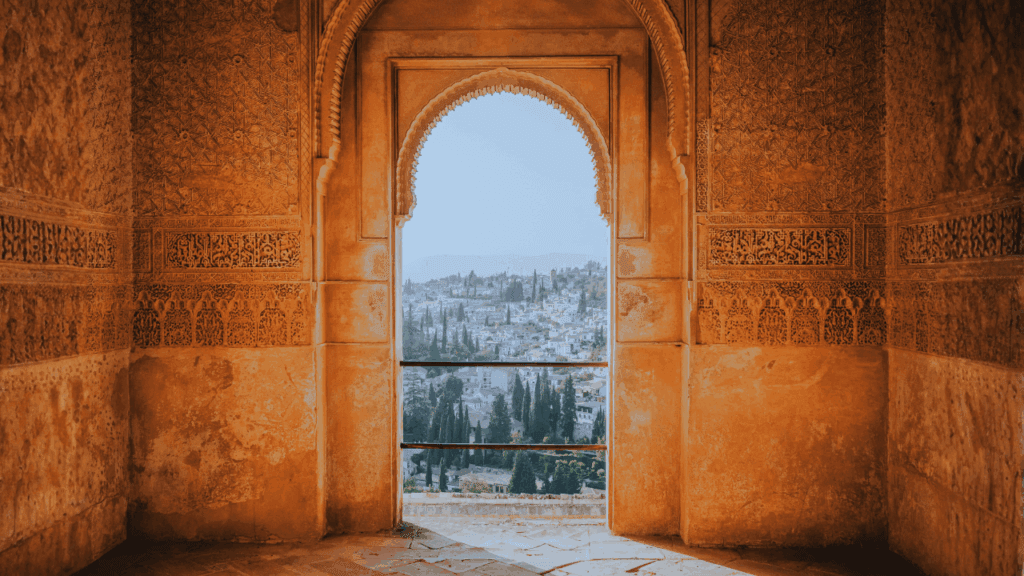
29 September 2025: I have just landed in Spain, completely unaware that the coming month would unfold stories and surprises that would prove to be life-changing. Unaware, also, that I was stepping onto a land carrying the traces of a forgotten Islamic past. The country is beautiful with vast landscapes – its horizons stretch across one of the world’s largest expanses of olive trees.
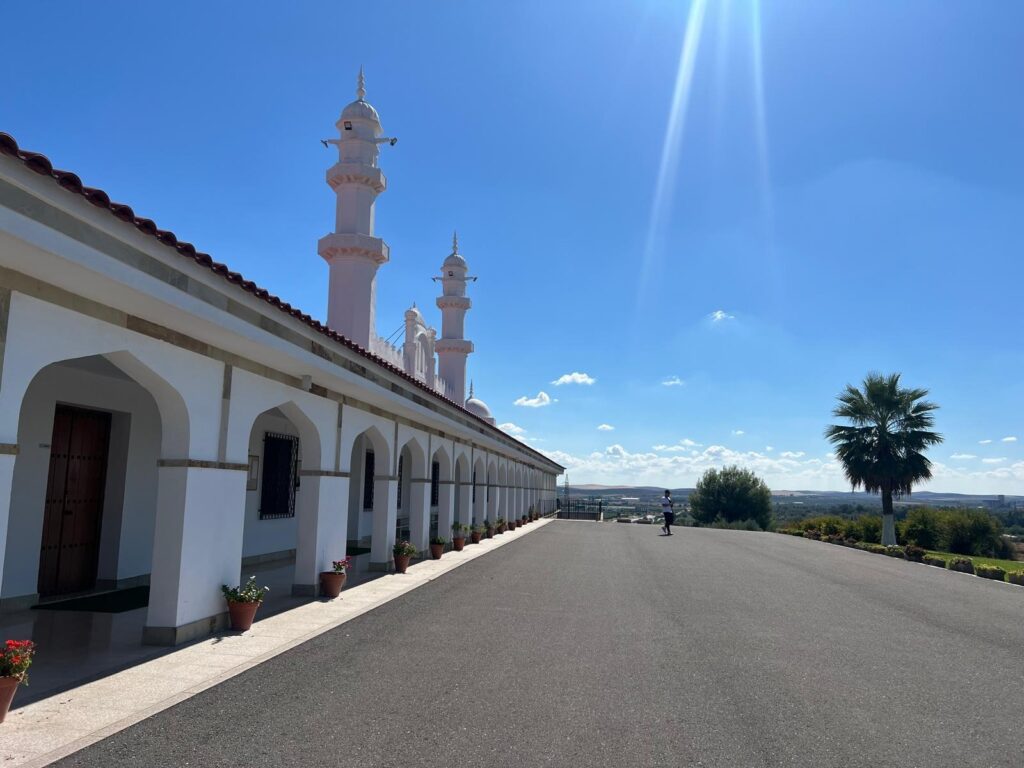
The drive from Malaga Airport to the Basharat Mosque in Pedro Abad was filled with questions. As I travelled through the roads of Al-Andalus, I found myself wondering why Hazrat Khalifatul Masih Vaa has been sending newly graduated missionaries here since 2014, to a land once Muslim, now covered in the ways of the West.
Around me were Cordoba’s arches, Sevilla’s courtyards and Granada’s palaces; yet, I did not know the stories buried beneath their stones. The sign outside the Basharat Mosque read La Mezquita [The Mosque]. Yet I did not know that this strange, pleasing word would hold layers of history and emotion that I would take with me on a journey of writing.
What I did know, however, was that I came to fulfil a mission. The same mission that seventy-nine years before me, respected Karam Ilahi Zafar sahib had started: the revival of Islam in the Iberian Peninsula.
Approaching the Basharat Mosque for the very first time was surreal – an emotional blend of pride and sorrow. Sorrow, because Islam had been torn from this land through deception, hatred and the cruelty of the Reconquista. For seven long centuries, this peninsula had stood barren without the call to prayer. And yet, in that very same moment, an immense pride rose within me, like the first vegetation emerging at the bottom of an ancient olive tree, long thought dead. Because it was Jamaat-e-Ahmadiyya that revived the light of Islam here once more.
This mosque stood before me as a living testimony that the prayers and guidance of Hazrat Khalifatul Masih IIIrh and the tireless efforts of Karam Ilahi Zafar Sahib had not been hollow. He had arrived in Spain with nothing, yet he left behind a house of God that still propagates peace and calls people towards God, a mosque whose quiet, golden presence feels like oil pressed from history itself.
As I stood there, I felt the weight of his sacrifices. Sacrifices that make my own struggles seem small, almost insignificant… if I can even dare to call what I do “sacrifice” at all.
1 October 2025: I was grouped with four colleagues for a journey through northern Spain. Each of us was given this assignment: to spread the message of God by distributing 1,000 leaflets every day. We were headed to the very region where respected Karam Ilahi Zafar Sahib had first entered Spain,1 and ironically also where Islam’s decline in Spain began.2 A local khadim was appointed as our guide and supervisor, and, as we would soon discover, someone with whom we would create memories none of us would forget.
Now, there was no turning back; seven years of Jamia training had prepared us for tabligh. Our journey began from the south, just like Tariq ibn Ziyad did in 711, when he crossed the Strait of Gibraltar with a small but determined army.3 Facing the mighty Visigoth King Roderic at the Battle of Guadalete, Tariq knew the enormity of the challenge. He urged his soldiers to sink their ships,4 leaving no option for retreat, declaring two options: victory or death. His army pressed on with courage, and in doing so, began the Islamic rule of Al-Andalus.
Today, the Khalifa of the time has called upon us to revive that light, especially in the West, which came with the advent of the Promised Messiahas. We advance into Spain just like Tariq’s soldiers, who crossed into unknown lands with courage. However, we were equipped not with weapons, but with tabligh and prayers. We stepped into this once-upon-a-time Muslim land as olive seeds: small, firm and full of curiosity.
Remarkably, our assigned local khadim was also named Tariq, as if history itself had lent us a companion to symbolise the courage we would acquire on this journey.
2 October 2025: Our first destination was Pamplona, the capital of Navarre. Immediately, I started picturing people running through the streets ahead of a herd of bulls, during the San Fermin Festivals. A sea of red and white, the beating of feet on cobblestones and an excitement that made me eager to discover the city for myself.
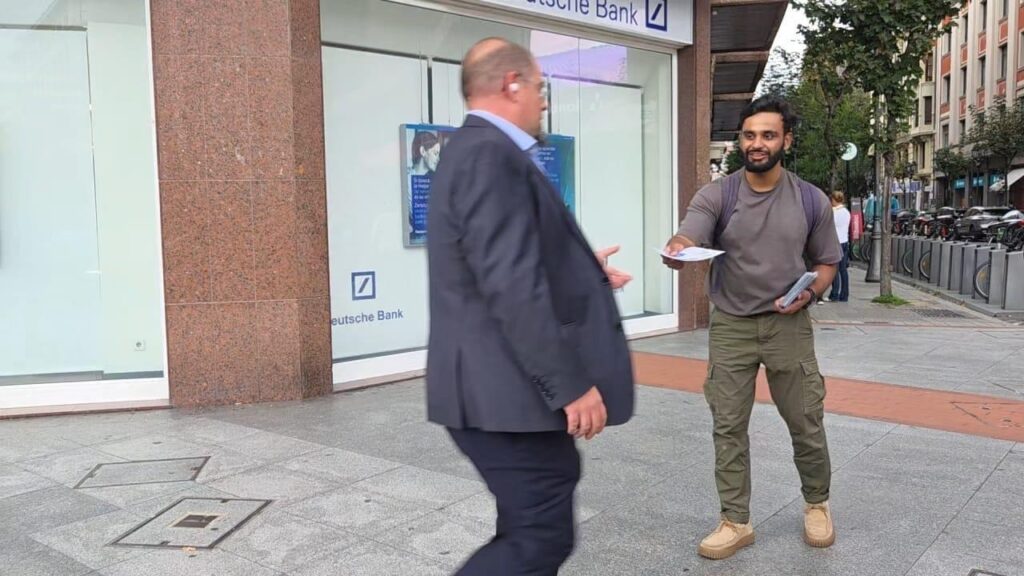
Two days had passed, and we realised that handing out a thousand leaflets a day was not going to be easy. With every pedestrian, we offered the same bright smile and warm “Hola! Mensaje de paz!” [Greetings! A message of peace!], and the initial surge of leaflets being handed out lifted my spirit. But as the rejections slowly increased, it affected my confidence. I prayed that our intention, namely, to bring these people a little closer to God, would somehow shine through. But when hearts are not ready to listen, what more could I do?
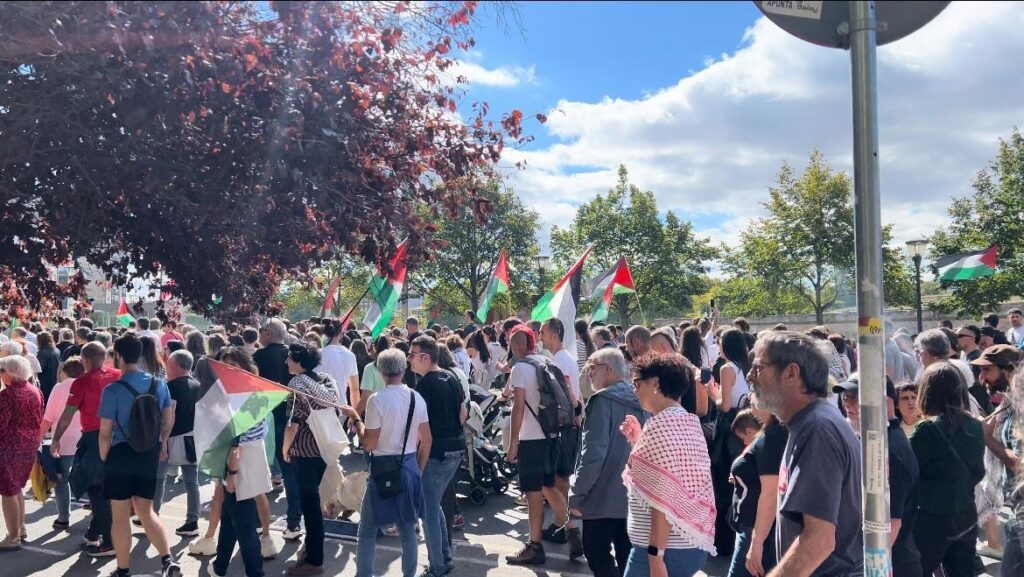
Then, while walking through the heart of the city centre, something unexpected grabbed my attention – a distant chant, faint but insistent, passing through the noise of the streets. I paused. It wasn’t music. It wasn’t chatter. As I walked toward the sound, it grew louder, stronger, until the words struck the air clearly:
“Boycott Israel, Palestina Ascatu!”
[Boycott Israel, Free Palestine]
The scene I stepped into amazed me. This was the largest popular protest in support of Gaza since the genocide began two years ago.5 I smiled with a strange blend of awe, respect and disbelief.
The historical accounts I read this morning flashed before me as I witnessed this. This was Navarre, the same land that once maintained close ties with the Muslim Kingdom of Cordoba,6 which allowed Muslims to serve in its army,7 the land that stood firm when the Spanish Inquisition tried to harass its Muslim citizens,8 a place where simultaneity once lasted centuries. Seeing thousands march now, determined by belief and compassion, felt like a quiet echo of that past, just like an ancient olive tree, distorted by time, yet sending up new shoots of memory from deep roots.
Before I knew it, I found myself stepping into the crowd. I pulled out my leaflets and began handing them out. One after another, barely able to keep up. Faces blurred past me. In just fifteen minutes, I had given out more than 400 leaflets. Alhamdulillah.
5 October 2025: I am standing on a beautiful bridge over the Urumea River. From this viewpoint, I can see more bridges along the coast, each one more outstanding than the previous. The place is alive with visitors: English voices, French conversations and a mix of accents from every corner of the world. Locals are taking leaflets with a warm eskerrik asko [Thank you very much (Basque)] instead of gracias [Thank you (Spanish)]. The curved bay, bridges and hills watching over it all make the picture clear: San Sebastian.
Standing at the corner of one of the old bridges, handing out leaflets, I noticed a middle-aged man approaching. His posture hinted disapproval, yet I decided to offer him a leaflet. He declined with quiet pride:
“No thank you, I’m a practising Christian.”
His fluent English surprised me. He said he was from Malmo in Sweden, but when I mentioned our beautiful mosque in his city, he mumbled that there were “too many Muslims” there.
I was surprised – how could someone so educated and civil still hold bitterness towards a faith rooted in peace, love and reason? I reminded myself that my purpose wasn’t to win arguments but hearts. So, I encouraged him, as a rational person, to explore Islam for himself and to read the Holy Quran with an open mind. His reply stunned me. He questioned how Muslims could claim to follow a “rational” religion when, in his view, they had offered “nothing to the world but terror,” while advancement and knowledge belonged to the West.
As he spoke, I instantly remembered the Islamic Golden Age, from Al-Khwarizmi’s groundwork for modern mathematics to Ibn Sina’s famous Canon of Medicine. From Al-Zahrawi, the father of surgery, to Ibn al-Haytham, the father of optics. Even the former American president, Barack Obama, once made the comment “it was Islam […] that carried the light of learning through so many centuries, paving the way for Europe’s Renaissance and Enlightenment” – this came from the president of one of the most powerful Western nations.9
I prayed rabbi zidni ilma [My Lord, increase me in knowledge] in my heart and replied, “Let’s leave religious differences aside and please name one modern technology you admire the most, and I’ll show you how a Muslim contributed to it.” He looked at me, surprised. “Anything?” “Yes, anything!” I replied. He chose the automobile with the certainty that it was purely a Western invention.
So, I showed him on my phone how Ismail al-Jazari, in 1206, invented the crankshaft, a mechanism essential to today’s engines,10 converting rotary motion into reciprocating motion, and he designed the early camshaft as well. For a moment, he just stared at my phone screen, stunned into silence, as he started to rethink his beliefs about these inventions.
9 October 2025: Today we are heading to the Basque city of Bilbao, where, with a renewed passion, we vowed to triple our daily leafleting goal. We left early in the morning with our breakfast and lunch packed, determined to triple our daily goal. With prayers in our hearts and leaflets in our hands, we spread out across the city. I chose a crowded, busy roundabout; the kind of place where people rush past without looking up. Still, I stood there with a bright smile, a warm voice, and a simple greeting: “Hola! Mensaje de paz!” [Greetings! A message of Peace]
Hours passed. Some people accepted the leaflets with curiosity, others with indifference, and a few tore them up right in front of me. Then, very unexpectedly, a young, Muslim man approached me and asked why I was doing this. When I told him that I had become a missionary of the Ahmadiyya Muslim Community and dedicated my life to the propagation of Islam, his face lit up. He said it was beautiful that in such a fast-moving, materialistic world, our community still sends people to spread peace with sincerity.
Then, he did something remarkable: he asked if he could help. I handed him fifty leaflets. He stood a little ahead of me and began distributing them. But half an hour later, he returned, exhausted. He said, “this is impossible”; he couldn’t understand how we continued smiling despite the rejections and even hateful looks. His words made me realise the following:
This was the same Spain that built the Mezquita of Cordoba as a hallmark of its civilisation. The same Spain that produced Ibn Arabi and his monumental Al-Futuhat al-Makkiyya. The same Spain that nurtured Ibn Rushd and his enduring rationalist legacy.
But today, the conditions are painful to witness. Many Muslims feel ashamed to openly embrace Islam before the Spanish public, which is hurtful to even mention. Those who once shaped Spain’s culture and history now struggle for acknowledgement. Those who were once leaders have become its servants.11 These historical turns are overwhelming; they cannot simply fade away. Eight centuries of Muslim rule is no small chapter, yet today, its legacy survives only faintly, as the last trace of oil from an olive pressed long ago.
13 October 2025: A few days passed as we continued leafleting from morning to evening, moving through villages where previously leafleting had not been done. Each new stop meant new people, new streets and a fresh chance to let another corner of Spain encounter the message of the true Islam.
Our next stop was Santander, a breathtaking place full of warmth and smiling faces. I walked up and down the hills of the Palacio de la Magdalena, and it felt so unreal: the sea shimmering to my left, a palace rising ahead, children laughing in the parks, and I, in the middle of all this, handing out leaflets and calling humanity back to its Creator. Every few hours a bundle of 200 leaflets disappeared into the hands of the Spanish. My backpack grew lighter, but my feet grew heavier with the daily average of 20,000 steps.
Then, a moment occurred that I will never forget. A cabdriver called me over and asked what I was doing. I explained that we came to spread a message of peace, that the world’s problems can only be solved when people recognise its Creator, Allah. He paused while reading the leaflet carefully and shouted for the passenger he had just dropped off.
In that very moment, my heart skipped a beat, like an olive caught just before the press. Was this about to become an argument? A misunderstanding? Another heated exchange?
But God had written something completely different. The driver handed the leaflet to his passenger and declared, “Esta es la solución a todos tus problemas.” [This is the solution to all your problems]. He stated further, “Recognise Allah, and your dark days will turn into bright ones.” Then he hugged me, praised the work we were doing, and took a handful of leaflets from me. “I’ll keep these in my car,” he said. “Everyone who enters will get one.”
I stood there, overwhelmed. I realised, once again, that my responsibility is simply to obey the Khalifa of the time and deliver the message. The turning of hearts is entirely in God’s hands, just like He says: “Surely thou wilt not be able to guide [all] whom thou lovest; but Allah guides whomsoever He pleases…” 12
17 October 2025: Two weeks had passed since I arrived in Spain to spread the message of Islam, travelling from city to city to experience its rich culture and inviting them towards their Creator. Yet with every passing day, one question pressed harder on my mind: How did Islam disappear from this land where it once flourished for centuries? My curiosity led me to read extensively and look for answers during the long driving hours.
I learned that the Muslims built one of the world’s greatest civilisations on this peninsula, reaching its peak during the Caliphate of Cordoba (929–1031).13 Abd al-Rahman III declared himself Caliph, although he was not divinely guided, and transformed Cordoba into a centre of knowledge, opposing Baghdad and Cairo.
The Great Mosque of Cordoba rose to glory, described as an “Ornament of the World”.14 But internal weakness began to undermine this greatness.15 By 1031, the Caliphate collapsed into dozens of “Taifa” Kingdoms or party kings: Seville, Granada, Valencia, Toledo, each competing for ultimate power.16 This destruction opened the door for the advancing Christian kingdoms of Castile, Leon, Aragon and Portugal.
And so, I understood that Islamic Spain did not fall because of mere attacks from outside; it crumbled from within, weakened by the very divisions that caused Muslims to forget the intentions and unity with which they had once set out.17
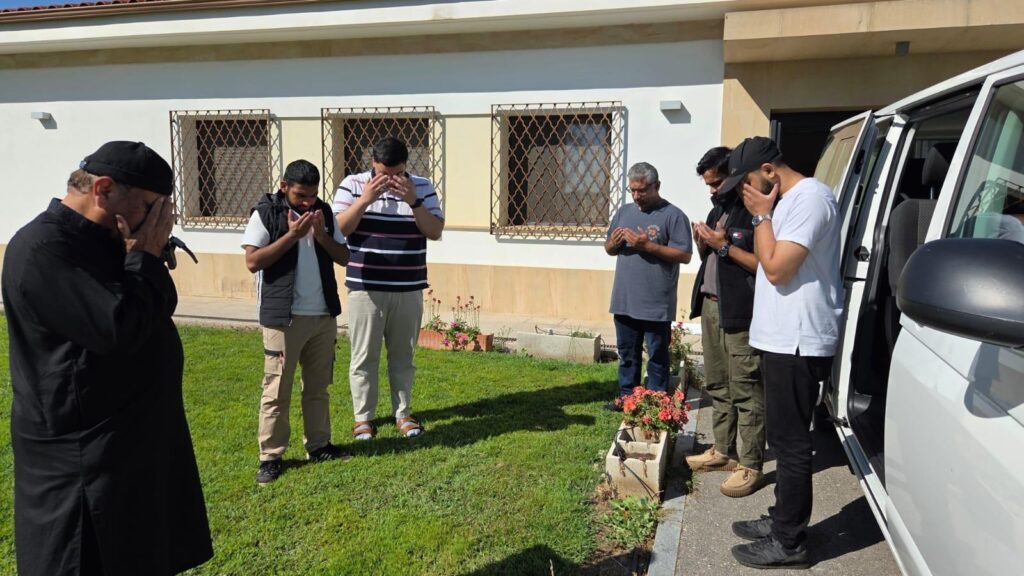
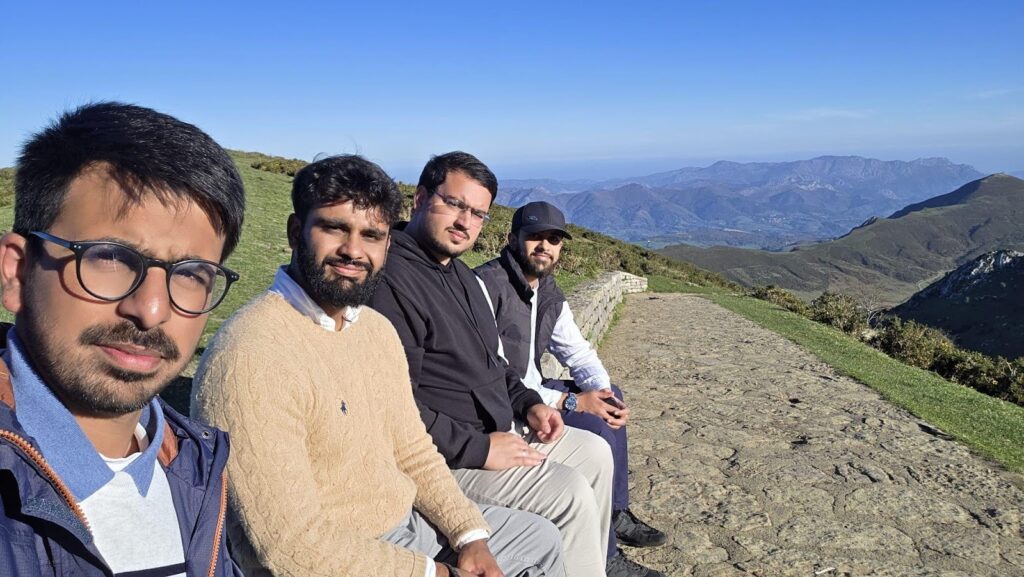
Since it was a Friday, we decided to offer the jummah prayer somewhere special. We drove toward the Asturian mountains, and while driving, I admired the surroundings just like a tourist: the curving roads through the hills, the petrol stations standing silent in the middle of nowhere, and the narrow mountain paths. It all felt surreal. We arrived in Covadonga to see the famous lakes. As we ascended, the valley opened before us and the lakes became visible. We are all taken aback and in awe of the beauty before us.
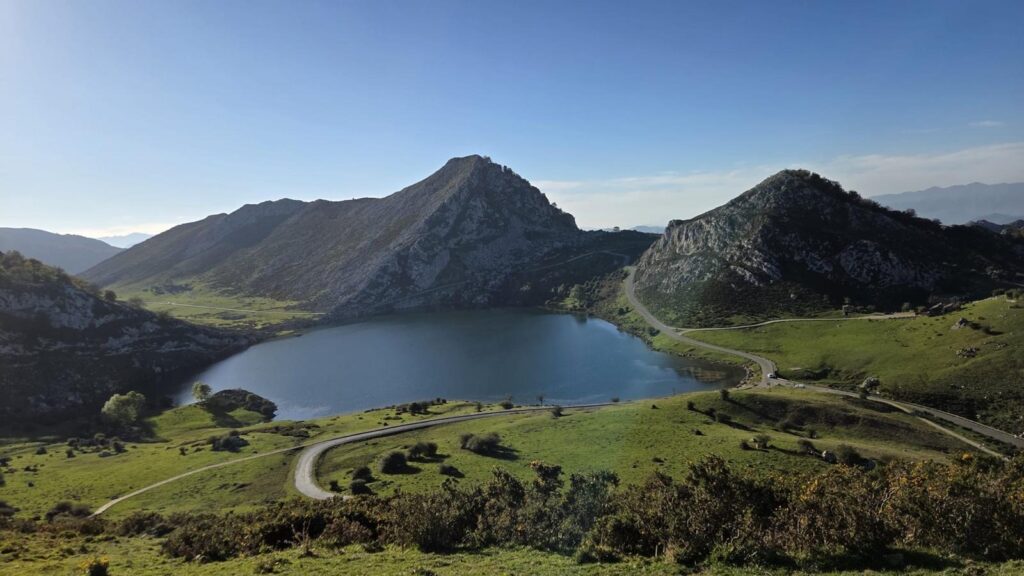
At the top, we searched for a quiet place to offer the jummah prayer. In the open field, we bowed our heads before Allah, unaware of the weight of history touching our foreheads.
After the prayer, Tariq shared a piece of history that changed the entire atmosphere. The land on which we had just prayed was not just a scenic viewpoint. It was Covadonga, the site of the Battle of 722, the pioneer battle of the Christian Reconquista. It was here that Don Pelayo withdrew with a small band of Asturians into the mountains, taking shelter in a cave with part of his force and deploying other detachments on either side of the gorge. The Umayyad commander Al-Qama, accompanied by Governor Munuza, attempted here to beat the last hope of resistance. Al-Qama besieged much of Asturias, but at Covadonga, he made the wrong decision by sending his troops into the steep valley. From the surrounding slopes, Asturians rained arrows upon them, and at the right moment, Pelagius led a surprise attack from a hidden cave. Al-Qama fell in battle, and his forces withdrew in confusion. Pelagius defeated Munuza as well, ending Umayyad control of the northern mountains.18 The monument of ‘La Santina’ stands as a memory of that turning point.
Standing there, we realised that this was the soil where the plot to erase Islamic civilisation from Spain first took root. The very mountains around us had witnessed the birth of the resistance that would eventually repossess Toledo in 1085,19 triumph at Las Navas de Tolosa in 1212,20 and cause the fall of Granada in 1492.21
At that moment, I understood our Jamaat’s mission more clearly than ever. The land where history once recorded swords and battles, today it records tabligh and prayers, and the quiet revival guided by the Khalifa of the time.
21 October 2025: Today, I experienced something I never would have imagined happening to me. I was leafleting in a town called Carballo, near A Coruña. At one point, a man approached me on his own and asked for the leaflet I was handing out. He took it and began reading it as he walked away.
About half an hour later, when I passed that same spot again, a small group of men noticed the leaflets in my hand. One after another, they began shouting abusive words and insults at me; words I had never experienced before. It was shocking, but at the same time, strangely moving.
In that moment, Hazrat Musleh-e-Maud’sra words to the missionaries came to my mind:
“The Companions gave their lives for the faith; at the very least, one should not fear hearing insults. Pity on the disciple whose ears have not heard the insults directed at his spiritual master, and pity on the follower who did not bear the hardship his master bore.”22
What happened today felt like a blessing from Allah, an honour to bear even a small portion of the trials faced by those before me. Just as the finest olive only reveals its true richness when pressed, faith too shows its quality when placed under pressure. And in that sense, I felt grateful to be among those who are tested because they believe in the truth.
26 October 2025: Santiago de Compostela – the destination of pilgrims walking the Camino and home to the grand Cathedral of St. James. A city overflowing with Christian believers, where travellers arrive to pray, take pictures, eat the famous almond cakes and seek spirituality. And there we were: right in the middle of this Christian hub, handing out leaflets, inviting people to recognise their Creator, calling them toward Islam with nothing but words of peace.
As I stood there, I couldn’t help reflecting on the layers of history beneath my feet. Inside the Cathedral, in a stone niche, stands the dramatic effigy of St. James in full medieval armour, seated on a horse, sword raised above his head. Legends claim that he appeared during the Battle of Clavijo in 844, leading Christian soldiers to victory against a much larger Muslim army.23 For the next seven centuries, Santiago was adopted as the divine mentor of Christian forces.
“Santiago y cierra, España!”[St. James and strike, Spain!] This became the war cry of the Christian armies as they fought to repossess Iberia from its Muslim rulers.24 The slogan survived long after the battles ended, even being revived in the 1930s through Ramiro de Maeztu’s right-wing magazine Acción Española.
And here we are, centuries later, standing in that same city with leaflets, prayers and a message of peace. Our target is not to take over any land; our task is merely to win hearts. This is the same spirit that Khalifatul Masih III, Hazrat Mirza Nasir Ahmadrh, expressed to the whole world when asked by a reporter: “How do you conduct your mission in Europe?” He replied, “We try to win the hearts.”25
31 October 2025: This was our final day in the northern stretches of Spain. A month ago, when we began this tabligh journey, I could not have imagined how far Allah would bring us. We had walked through rain-soaked mornings and sun-drenched afternoons, our efforts pressing on like olives pressed in a mill. We had faced days of rejection and others where we exceeded our targets threefold. There were moments of ease, tasty meals, kind smiles, and days that ended with aching feet, hunger, and stressed hearts. Yet every step, every leaflet, every encounter had shaped us, much like the legacy of Al-Andalus, where Islamic Spain once breathed knowledge, art, and faith.
Tomorrow, we begin our morning in Madrid, and by nightfall, we will return to the south. Granada, the anchor of Islamic Spain, awaits us. Respected Karam Ilahi Zafar Sahib entered Spain from the north and spent his final five years serving in Granada.26 In the same spirit, we will conclude our leafleting journey there.
2 November 2025: We are fortunate to stay in the very apartment which was blessed by the presence of Khalifatul Masih IV, Hazrat Mirza Tahir Ahmadrh, and where Karam Ilahi Zafar Sahib once resided. In the morning, we set out from here, just as he did for his mission of tabligh, stepping into the streets of Granada, a city that was once the pinnacle of Al-Andalus. Walking through its narrow streets, the smell of Arabic bakeries mingling with the scent of fresh mint tea, and people sitting leisurely along the streets, I could almost imagine walking through Muslim Granada. But the reality soon returned that the city’s past magnificence is now merely a memory.
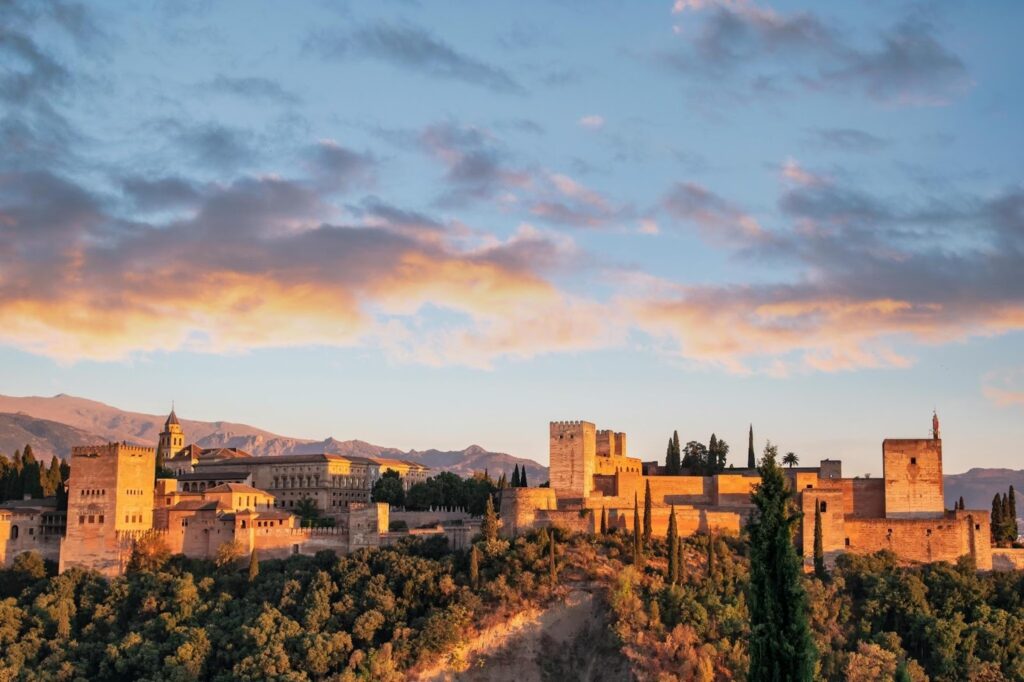
From a modern mosque in Granada, we could admire the Nasrid palace Alhambra. And its magnificence became clear, indicating the time when Granada stood as the last upholder of Muslim Spain. While the Christians had conquered every other Muslim kingdom, Granada resisted. The last Muslim king, though ruling only this city, still wielded such influence that, even with France supporting the Christian forces, the city remained unconquered. King Ferdinand of Castile, realising the difficulty of taking Granada, offered peace – the citizens could leave with their belongings.27
The Christians allowed the Muslims to load their ships with their possessions alongside their libraries and depart from the city. But only a short distance from Granada, the ships were deceivingly sunk. A few survivors reached their homeland by small boats, while countless others drowned, taking with them centuries of knowledge. During the Muslim era, Granada was dotted with thousands of gardens and hundreds of libraries, some holding even up to 150,000 books. This was not a loss for Islam, but a loss for the advancement of mankind.
Modern scientists get puzzled today by the Muslim technologies of that time, like the complex water system that boosts water from the rivers upwards to the Alhambra and defies gravity, as the palace is constructed on an elevated plateau, the Sabika Hill.28 It is a testament to the brilliance of a civilisation that once enlightened the Iberian Peninsula.
4 November 2025: Today marks my final day in the land of Al-Andalus. Our flight to London departs tomorrow morning. And just as the night before leaving for Spain seemed long and restless with excitement and curiosity, so does this very night. I remember that night searching, reading and wondering about the coming month. Spain, whose horizons stretch across one of the world’s largest expanses of olive trees, is a land which is blessed by the footsteps of three Khulafa of the Promised Messiahas. In those late hours before coming to Spain, I had come across the divine revelation given to Khalifatul Masih IIIrh 29:
وَمَنۡ یَّتَوَکَّلۡ عَلَی اللّٰہِ فَہُوَ حَسۡبُہٗ ؕ اِنَّ اللّٰہَ بَالِغُ اَمۡرِہٖ ؕ قَدۡ جَعَلَ اللّٰہُ لِکُلِّ شَیۡءٍ قَدۡرًا
This stayed with me through every town I visited, every article I read and every person I met. And now, on this final night before departure, after all that I have witnessed and learned, I understand one aspect of the revelation. Today, it is only Jamaat-e-Ahmadiyya which is united under the umbrella of a divinely guided Khalifa. Centuries ago, a Khilafat was declared on this very land, yet the people were divided, and so the lamp of that Khilafat dimmed. But now… now is the age of Islam’s revival. Our mission is to sow the seeds of Islam’s true message under the guidance of the Khalifa of the time. Just as Spain’s horizons are lined with endless olive trees, so too will these seeds of peace, unity, and tauhid take root.
Perhaps we will not live to see their fruit. But neither does the olive tree yield its bounty quickly. The prophecy of Khalifatul Masih IIIrh will unfold, and one day Spain will once again echo with the chants of ‘la ilaha illallah’. And the lamp of God’s tauhid will light this land again, because:
“Allah is the Light of the heavens and the earth. The similitude of His light is as a [lustrous] niche, wherein is a lamp. The lamp is in a glass. The glass is as it were a glittering star. It is lit from a blessed tree – an olive – neither of the east nor of the west, whose oil would well-nigh glow forth even though fire touched it not. Light upon light! Allah guides to His light whomsoever He will. And Allah sets forth parables to men, and Allah knows all things full well.”30
And, pondering on this night about the past and the future, I have realised: the story of Islam in Spain has most definitely not ended.
Endnotes
1. “Letter from the Northern Border of Spain”, alhakam.org, 13 April 2018
2. “Battle of Covadonga”, britannica.com, 11 November 2024
3. “Tariq ibn Ziyad”, ebsco.com, 2022
4. Spain aur SicilY me Tabligh-e-Islam aur Jamaat Ahmadiyya, Anwar-ul-Ulum, Vol. 18, pp. 354 [Translated by the Author]
5. “Spain: two million on the streets against genocide in Gaza say – enough is enough!”, marxist.com, 6 October 2025
6. W. Montgomery & Pierre Cachia, A History of Islamic Spain, 2017, pp. 34
7. The New Cambridge Medieval History, 2002, Vol. 2, pp. 289
8. Brian A. Catlos, Muslims of Medieval Latin Christendom, c.1050–1614, 2014, pp. 220
9. “Remarks by the President on a new beginning”, obamawhitehouse.archives.gov, 4 June 2009
10. “Ismail al-Jazari”, en.wikipedia.org, 22 October 2025
11. Spain aur Sicily me Tabligh-e-Islam aur Jamaat Ahmadiyya, Anwar-ul-Ulum, Vol. 18, pp. 357 [Translated by the Author]
12. Surah al-Qasas, Ch. 28: V. 57
13. Brian A Catlos, Muslims of Medieval Latin Christendom, c.1050–1614, 2014, pp. 30
14. “Cordoba”, lotzintranslation.com, 19 December 2017
15. W Montgomery & Pierre Cachia, A History of Islamic Spain, 2017, pp. 31
16. W Montgomery & Pierre Cachia, A History of Islamic Spain, 2017, pp. 74
17. Spain aur Sicily me Tabligh-e-Islam aur Jamaat Ahmadiyya, Anwar-ul-Ulum, Vol. 18, pp. 353 [Translated by the Author]
18. “Battle of Covadonga”, britannica.com, 11 November 2024
19. “Siege of Toledo”, britannica.com, 29 July 2024
20. “Battle of Las Navas de Toloso”, britannica.com, 9 July 2025
21. “The conquest of Granada”, britannica.com, 9 July 2025
22. Hazrat Mirza Bashir-ud-Din Mahmud Ahmadra, Zarreen Hidayaat (Baraei Muballigheen), 2020, Vol. 1, pp. 3 [Translated by the Author]
23. “The Battle of St. James the Greater at Clavijo”, artic.edu, 2025
24. “¡Santiago y cierra, España!”en.wikipedia.org, 28 August 2025
25. “Winning Hearts the Might of Morals”, annida.ca, 1 October 2024
26. “Maulana Karam Ilahi Zafar Sahib”, issuu.com, October 2020
27. Spain aur Sicily me Tabligh-e-Islam aur Jamaat Ahmadiyya, Anwar-ul-Ulum, Vol. 18, pp. 353 [Translated by the Author]
28. “The Spanish city where water defies gravity”, www.bbc.com, 29 April 2022
29. “A Vision Realised”, www.alhakam.org, 6 April 2018