
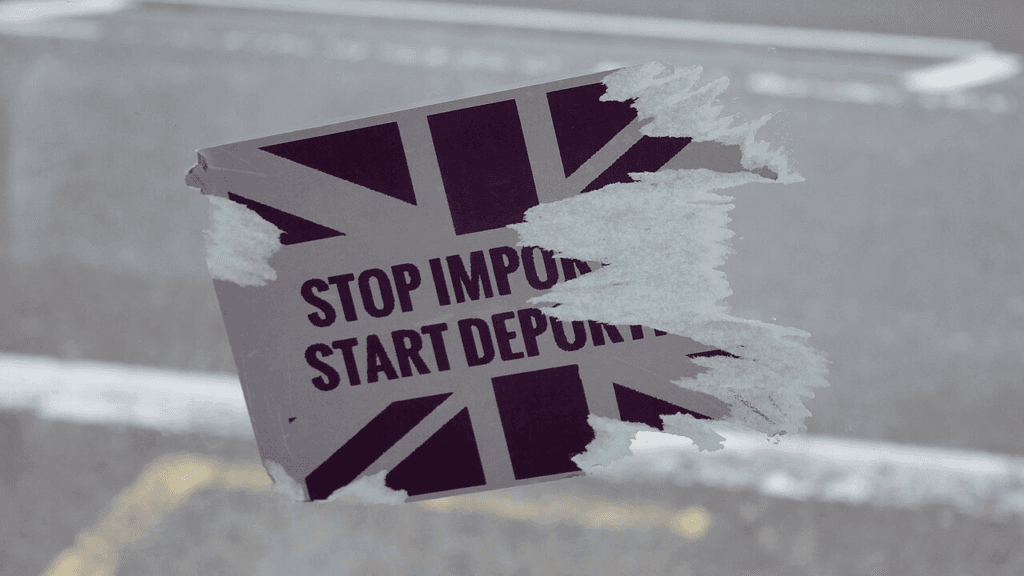
The march that brought tens of thousands of supporters of Stephen Yaxley-Lennon, known publicly as Tommy Robinson, to central London on 16 May 2026 was called “Unite the Kingdom.” The phrase is civic in register, even generous. It implies that the assembled crowd has something to offer the country, a repair to make, a solidarity to build. What it does not announce is the question that any honest observer of the event must eventually face: a kingdom united in opposition to whom?
The rally formed up near Kingsway, moved through the Strand to Parliament Square, where the stage and the speeches gathered under the Union Jack, St George’s Cross and Welsh dragon flags, in a display of visual patriotism. The Guardian reported Islamophobic and ethnonationalist hate speech, flyers distributed to the crowd promoting identitarian slogans and speakers calling from the stage for Muslims to leave the country. The organisers framed all this as a turning point, the beginning of something rather than a repetition. The Metropolitan Police, which deployed approximately four thousand officers across a day that also required policing the FA Cup Final and a separate pro-Palestinian march, had already warned publicly that previous events organised under this banner had featured anti-Muslim chanting.
The civic contrast of that Saturday was striking: while central London braced for nationalist friction, a short distance away in Surrey, the Ahmadiyya Muslim Community was gathering for its National Peace Symposium. Yet in the capital, Muslim Londoners and people from other minority groups were, police noted, avoiding central London and transport hubs, changing plans because they feared crossing paths with the march’s supporters.
The police documented a measurable change in civic behaviour: a community altering its movements in a city it calls home because a public event had made the street feel hostile. Rhetoric that reaches into the logistics of private life, a route reconsidered, a station avoided, a daughter advised against travelling visibly Muslim through the centre of the capital on a particular Saturday, has done something far more concrete than merely give offence.
Free speech is the first objection raised in arguments like this. It always is. It is a serious claim, and it deserves a serious answer. Criticism of religion, including criticism of Islam, must remain free. A religion that makes public claims about human life, morality and God must expect public scrutiny. Those who regard Islam’s teachings as false have every right to say so, to argue against them, publish criticisms and challenge Muslims in debate. None of that should be restricted. To demand such a restriction would itself violate a principle the Quran states plainly in Surah al-Baqarah, Ch.2: V.257: there should be no compulsion in religion. Muslims are the audience of this verse. The constraint it places falls on their own conduct.
A line does exist, however, between the intellectual freedom to contest religious ideas and the political project of casting a religious community as alien, removable or unworthy of equal civic standing. These are different enterprises, and collapsing them is a failure of the very precision that free speech, at its most defensible, is supposed to require.
The House of Lords drew this line when the matter came before it this year on 20 May. Lord Mohammed of Tinsley described the reaction of his own sons, one working for the railways, the other in the NHS, who asked whether people were “questioning our existence” in this country. A speaker at the rally had apparently pointed at the Palace of Westminster and declared that Islam must be removed from it. The government minister responding was direct: the right to criticise religion is protected; it does not extend to incitement, intimidation or conduct prohibited under the Public Order Act 1986. The law does not distinguish on grounds of faith. He was right to say so. Equal protection has one test: what applies to one community applies to all. Had equivalent calls for a religious community to leave its country of birth been made from a public stage about any other faith group, prosecutorial consideration would already be underway, political condemnation would not have needed coaxing and broadcasting regulators would have responded with far less patience. That gap is itself a form of harm, signalling that legal protection, for all its formal universality, is applied with a different quality of urgency depending on who is being targeted.
Police later confirmed 43 arrests across both protests on the day, with 20 linked to Unite the Kingdom and nine of the eleven hate-crime-related arrests attributed to the same event. These are alleged offences. Charges and any prosecutions remain a matter for the Crown Prosecution Service. Treating the figures as proof that every attendee was a criminal would itself be unjust.
The political utility of the ‘two-tier policing’ narrative becomes clear when set against these specific figures. Arrests were indeed made across both protests. The difference lies in the character of the offences: nine of eleven hate-crime arrests came from a single event. That transforms the accusation of ‘two-tier policing’ from a critique of law enforcement into something else entirely – a rhetorical shield designed to reframe the prosecution of anti-Muslim incitement as state persecution and a demand that the law lower its gaze when faced with ethnonationalist hostility.
The figures say something about the character of the occasion, even so. Calls from a public stage for members of a religious community to be removed from the country of their birth carry a different freight from debate about theology or migration policy. History is specific about where that language, left without adequate response, tends to lead.
Belonging operates below the level of law. Something closer to a quality of civic relationship, the accumulated and largely unexamined confidence that one may move through public space, speak, contribute and live without being required to justify one’s presence. A significant public event that platforms rhetoric casting a community as alien or provisional causes damage extending well beyond individuals who happen to be in the crowd’s path. It corrodes the fabric of mutual recognition that makes civil life possible at all.
Mustafa al-Dabbagh, writing in the Middle East Eye in the days after the march, put it this way: British Muslims teach in the country’s schools, seek care in its hospitals, serve in its public institutions and face the same pressures over housing, healthcare and the cost of living as their neighbours. To suggest otherwise is to misrepresent Britain. A nation’s strength, he argued, is measured by the quality of trust between its people, by how well it holds together, rather than by how efficiently it excludes.
The question this march raises is a civic one: at what point does public rhetoric cross from argument about ideas into systematic pressure on a community’s right to be treated as full members of a shared society? And when that line is crossed without adequate response from law, politics or public institutions, what does it communicate to the community being targeted and to everyone else watching? Belonging ought not to be a grant made at the pleasure of those who feel entitled to revoke it. Britain is our home. That sentence should not need writing.
The march belongs to a political climate in which genuine anxieties over housing, strained services, stagnant wages and the persistent feeling that political institutions no longer hear ordinary people have been given a specific ideological direction. That direction points, with increasing confidence, at Muslim communities and migrants as the source of the difficulty.
Muslim families in Britain share the same pressures as their neighbours: the same waiting lists, the same school runs, the same worry about next month’s rent. Nobody’s mosque caused the housing shortage. The community praying on a Friday afternoon did not design the economic settlement that has left so many people feeling abandoned. But a politics that names an enemy is easier to sell than a politics that confronts structural failure, and the far right has always understood this arithmetic.
The Race Equality Foundation observed in its response to the march that silence from political and media institutions is not, in practice, neutral. Mainstream commentary that declines to name racism and Islamophobia explicitly creates what the Foundation called a permissive environment. “Silence is not neutral”, the Foundation stated. The 2024 riots, in which mosques and hotels housing asylum seekers were attacked, demonstrated that the distance between normalised street rhetoric and organised violence can be alarmingly short. Whatever the individual motives of those who attended on 16 May, the event gave public legitimacy to a politics of exclusion. Its social function matters more than the intentions of those who attended.
The crosses carried through the streets and the chants of “Christ is King” call for a careful reading. Faith deployed as identity armour and faith practised are two quite different things. Christians who reject this co-option of their tradition were in fact present near the march route that afternoon, setting up tables to listen, pray and model a different response. Their presence was less visible than the crosses on the march. It generally is.
Claims of millions attending circulated widely on social media, and Yaxley-Lennon himself made such assertions on the day. Full Fact established that this was false. Police put the figure at approximately 60,000; an independent expert in crowd dynamics told Full Fact the idea of millions was “completely fanciful.” A crowd of 60,000 is large enough to warrant serious attention without needing inflation. But this exaggeration serves a psychological purpose rather than an arithmetical one. A number, amplified sufficiently, becomes a verdict: the country has already turned and the tide cannot be reversed. Spectacle manufactures its own authority. Claiming millions on the day is a statement about truth, and an Islamic moral framework regards it as gravely as anything else the march produced.
Communal grievance narrows the argument; justice widens it
The Holy Quran commands in Surah an-Nisa, Ch.4: V.136, that believers be strict in observing justice even when doing so against themselves or those nearest to them. The verse closes the exemption that tribal loyalty is always tempted to carve out.
For the Ahmadiyya Muslim Jamaat, a community with an intimate, historical understanding of the ruin that follows when a state allows majoritarian rhetoric to render a minority’s citizenship provisional, this injunction carries the full weight of lived experience. To demand that the law protect a community from incitement requires an absolute, unyielding commitment to impartial justice in return. An Ahmadi Muslim analysis of the Unite the Kingdom march must therefore acknowledge, without hesitation, what other voices in the Lords debate also raised: both protests policed on 16 May produced arrests for alleged hate crimes. The equal application of law must cover antisemitism, anti-Muslim hatred and all other protected characteristics with the same rigour and the same urgency. There is no defensible hierarchy of acceptable targets.
This is the crux of the moral argument. Surah al-Maidah, Ch.5: V.9, states the obligation still more plainly: “Be always just”, and places it specifically against the temptation to let the enmity of an opposing party licence injustice toward them. A Muslim response to a hostile political movement must describe that movement accurately and argue against it honestly. Anger does not excuse exaggeration. Exaggeration does not serve justice.
Surah al-Hujurat, Ch.49: V.13, puts the question of unity to all of humanity: God made people in nations and tribes “that you may recognise one another.” Difference is the precondition for the moral exercise of recognition across difference. A unity purchased by erasing or expelling that difference deserves a plainer name: uniformity.
Hazrat Mirza Masroor Ahmad (aa), the head of the worldwide Ahmadiyya Muslim Jamaat, has addressed the Islamic framework governing speech, tolerance and public peace with consistency. Conscience must remain free. The answer to speech one finds offensive is not disorder. Public peace requires that justice be done and protection afforded impartially. The canonical traditions, recorded in Sunan an-Nasa’i, state that a true Muslim is one from whose tongue and hand fellow human beings are safe. Huzoor (aa) has applied that principle in his own addresses to all other peaceful people in society.
On the same day as the march, Huzoor (aa) addressed the National Peace Symposium 2026 and stated that justice is a universal principle applicable to all people, whether religious or not. That address stated a moral standard prior to the march and one that will outlast it. The Promised Messiah, Hazrat Mirza Ghulam Ahmad (as) consistently emphasised that the Islamic moral framework rests on fulfilling two fundamental obligations: the rights owed to God and the rights owed to His creation. Within this paradigm, sincere loyalty to a society that guarantees peace and freedom of conscience is a profound religious duty. Loyalty to country, therefore, is active service to the conditions of peace that make civil life possible for everyone living within it: the active refusal of both passivity before injustice and silence before hatred.
The Ahmadi Muslim position here is demanding, precisely because it demands the same things from itself that it demands from others. It means accepting equal law even when it does not favour us, refusing exaggeration when it would feel vindicating and treating loyalty to country as active service to its moral health rather than grievance about its failings.
The name “Unite the Kingdom” will not survive honest examination unless the unity it promises extends to all the kingdom’s inhabitants, including those who pray differently or dress differently or trace their families to other parts of the world. A unity purchased by making some neighbours feel their home is provisional is no unity. Conditional tolerance is always revocable and the condition can always be tightened.
Britain has both the institutions and the moral vocabulary to do better than this. Those institutions must apply their stated principles without exemption: the same response to speech targeting Muslims as to speech targeting any other community, the same resistance to a slowly expanding permissive environment. A country’s social strength is tested precisely by how it protects those who have been made to feel their presence is provisional. Belonging cannot be treated as a probationary status, subject to the shifting moods of a crowd.
The moral test for any society, in the end, is whether it acts as though everyone already belongs, before anyone is forced to prove it.