Anees Reis, Japan

The call of “I am Present”, the testimony of noble human nature, the vastness of the universe and the evidence encountered across East and West together constitute manifest proof of the existence of the Supreme Being of God.
Does God exist? This question has been debated for centuries. Despite its antiquity, it continues to feel fresh and urgent in every age due to its status as a fundamental human necessity. On the one hand, sound human nature remains ceaselessly inquisitive and restless in its search for its Creator and Sustainer; on the other, deniers of God persist in rejecting the existence of the Supreme Being, hurling new objections and some even ridiculing people of faith.
On 20 December 2025, a formal debate was held in the capital of India, New Delhi, between Mufti Shamail Nadwi, who presented the case for theism, and the renowned lyricist Javed Akhtar, who presented the case against. The debate was titled “Does God Exist?”
On this occasion, the theist representative, drawing upon philosophical reasoning, advanced the argument from contingency (Imkan al-Wujud), stating that the existence of the universe is not necessary in itself; rather, it necessarily requires a Being whose existence is essential (Wajib al-Wujud). Otherwise, everything would have to be deemed causeless and purely accidental.
Similarly, while explaining the principle of cause and effect, he presented the First Cause – God Almighty – as a transcendent Being who is not dependent upon any cause and for whom it is not necessary to posit a creator. According to him, this Being constitutes the fundamental basis of the creation of the universe; however, a proper understanding of this reality requires avoiding the fallacy of infinite regress.
In contrast, Mr Javed Akhtar, while criticising God and religion, raised questions concerning the existence of evil and the prevalence of injustice in the world. Reiterating conventional objections, he argued that if God exists and is omnipotent, why do phenomena such as oppression, sin, the mass killing of children and sexual violence against women occur? He further questioned the limits of human free will in the presence of an omnipotent God and asked how these two concepts could be reconciled.
Mr Akhtar has, on various television programmes and social media platforms, openly expressed that he does not believe in the philosophy of God and religion. He regards the concept of God as a construct of the human mind and a mere illusion. Owing to his persistent criticism of Islam, his association of wars, conflicts and acts of brutality in the world with religion and his objections to God framed in an illogical manner, he has emerged as an active representative and spokesperson of contemporary atheistic thought.
Generally, ilhad (الحاد) is understood to denote the denial of the existence of God, whereas dahriyyat (دہریت) refers to a systematic intellectual discourse and movement concerned with the theoretical foundations, arguments and ideological formation of that denial. In the present age, ilhad is no longer merely a personal outlook; instead, it has become a permanent component of the mindset and conduct of many individuals, while dahriyyat has assumed the form of an organised and active movement, mounting sustained attacks on religion and on the existence of the Supreme Being of God.
This movement does not confine itself to opposing belief in the God of religion alone; it also adopts a harsh and aggressive stance against the religious way of life itself. Consequently, it is no longer accurate to view ilhad and dahriyyat merely as philosophical or rational issues, for they have become broad social and cultural realities which, in specific contexts, stand in open confrontation with religious communities and people of faith, at times reaching the level of entrenched prejudice.
The promotion and defence of atheism are now being pursued through the media and modern means of communication. Alongside this, political influence and substantial financial resources also appear to be operating in the background, further reinforcing this trend.
When one considers contemporary atheistic thought and organised atheism (New Atheism), figures such as Christopher Hitchens, Richard Dawkins, Sam Harris and Daniel Dennett are widely regarded as the principal architects of this movement. Indeed, these four are commonly referred to as the Four Horsemen of New Atheism. Among them, Hitchens attributes religion to coercion and intolerance; Dawkins regards God as a delusion; Harris considers religious belief to be a source of violence and extremism, advocating what he terms The End of Faith; while Dennett views religion as a human invention.
Yet, despite the organised atheistic movement and its continual new assaults, the number of those who believe in God continues to grow. According to a Pew Research survey published in February 2025:
Roughly eight in 10 Americans believe “there is something spiritual beyond the natural world, even if we cannot see it.” Similar or slightly larger numbers say they believe that God or a universal spirit exists (83%) and that humans have a soul or spirit in addition to a physical body (86%).
In other words, an overwhelming majority of the American public – exceeding 80 per cent – not only affirms the existence of a spiritual realm but also believes in God, acknowledging a supreme and transcendent Being who is the spirit of the universe.
Innate goodness and the call of ‘I am Present’
Among the proofs for the existence of the God, the most compelling is the noble human nature (fitrat-e-salima), which in every age has remained restless in its search for its Creator and Lord. In other words, a disposition has been embedded within the human being that inclines one towards the recognition of God. The truth is that the proclamation of “I am Present” by the Living God bestows such a degree of inner certainty that, in comparison, the arguments and voluminous writings of atheists, materialists, agnostics and philosophers alike appear insignificant. This recognition is neither dependent upon philosophical reasoning nor in need of rational or logical proof; rather, it is an inner consciousness implanted within the human being.
The Holy Quran articulates this reality by referring to the covenant of alast (اَلَسْت) in the spiritual realm, wherein Allah the Almighty took a pledge from every human soul that it would affirm the Oneness of God, believe in His unity and associate none with Him. When Allah asked the children of Adam in the spiritual realm, “Am I not your Lord?” they all instinctively responded, “Yes, indeed; You are our Lord.”
It is this very voice of human nature that has echoed for thousands of years across East and West. The ancient inhabitants of Australia are seen to believe in a Supreme and Exalted Being, just as those living in the remote regions of Africa place their faith in a Being who is a remover of difficulties, merciful and gracious, a hearer of prayers and a source of support amid human sorrow and restlessness. Even in materialistic societies, although traditional attachment to religion may have diminished, amid the clamour of the world and the glare of its lights, a cry nonetheless rises time and again from their hearts and souls: “O our Lord, we are in search of You.”
تو نے خود روحوں پہ اپنے ہاتھ سے چھڑکا نمک
اُس سے ہے شورِ محبت عاشقانِ زار کا
“With Your own hand, You seasoned every soul (with love); from that (divine touch) arose the restless cry of yearning hearts.” (Durr-e-Sameen, p. 10)
This innate proof of the existence of God has repeatedly manifested itself as a light and illumination emerging, from time to time, across the East and West, in the form of the collective testimony of the world’s religions. It is this very testimony that a large group of Prophets and righteous individuals have presented from every corner of the globe: that we have one God, Who has existed from eternity and will remain forever; He is living and self-subsisting, one and without partner. We have spoken to Him and received guidance from Him; we have found Him merciful and gracious and have witnessed in Him all those perfections that can be conceived in a deity worthy of worship.
It is this same testimony of noble human nature that at times emerged through the voices of Plato and Aristotle and at other times resonated in the words of Imam al-Ghazalirh, al-Farabi and Ibn Rushd. At one point, René Descartes affirmed the existence of God as a reality; at another, Kant sought to establish God’s existence through moral arguments. Likewise, whether it was Isaac Newton or Galileo Galilei, Louis Pasteur or Albert Einstein, all advanced in the fields of knowledge and science while remaining affirmers of the existence of God.
God as the First Cause and the Ultimate Cause of all causes
In the aforementioned debate, arguments for the existence of God were presented by employing the concepts of the contingency argument and infinite regress, repeatedly demanding from his opponent definitive proof for the non-existence of God. It remains a striking asymmetry that, while atheists possess little beyond insistence and assertion in denying God’s existence – lacking any conclusive or decisive proof capable of compelling believers to abandon their faith in the Divine Being – those who affirm belief in God possess an abundant reservoir of rational, transmitted, philosophical and logical arguments that cannot easily be ignored.
The boundless expanses of the universe, the astonishing order and precision of natural laws and the comprehensiveness of cosmic creation all bear witness to the existence of a Creator behind this beautiful and well-ordered system. Billions upon billions of celestial bodies suspended in space, together with the extraordinarily subtle and elegant laws of nature, testify to a Creator and Lord whose wisdom and power encompass all things. Moreover, not only the visible stars, planets and radiant galaxies, but also the hidden realities of dark matter and dark energy point towards a Creator who is supremely Subtle, All-Aware, All-Knowing and All-Powerful.
Among the numerous proofs for the existence of God is the Cosmological Argument. According to this argument, the universe operates under the principle of cause and effect. Everything that exists within the cosmos has some reason, cause or explanation and there must ultimately be a Being who is the Cause of all causes (Musabbab al-Asbab).
A common objection raised here is that if every effect has a cause, then this chain must extend back to a First Cause or Prime Mover. In order to prevent this discussion from descending into an endless regress, the concept of infinite regress was invoked, explaining that if one were to continue indefinitely in search of the cause behind every cause, one would fall into an interminable and futile cycle of argumentation.
Classical proofs for the existence of God, therefore, maintain that the chain of causes must terminate at some point. Reflection upon the vastness of the universe and its creation necessitates the affirmation of a Necessary Being (Wajib al-Wujud) – a Being who is not dependent upon anything else, whose existence is intrinsic and who alone can be the ultimate source of all causes. This Being may be described as the Necessary Being or the First Cause – the Prime Mover and Creator of the universe.
The Holy Quran brings this infinite regress to an end by declaring:
ہُوَ الۡاَوَّلُ وَالۡاٰخِرُ وَالظَّاہِرُ وَالۡبَاطِنُ ۚ وَہُوَ بِکُلِّ شَیۡءٍ عَلِیۡمٌ
“He is the First and the Last and the Manifest and the Hidden and He knows all things full well.” (Surah al-Hadid, Ch.57: V.4)
That is, He alone is the First and the Last; He alone is the Manifest and the Hidden; and beyond this, He possesses perfect knowledge of all things. The Holy Quran further states that this cause of all causes and Creator of the universe is so unparalleled in His majesty and grandeur that even the vastness and awe of the cosmos pale into insignificance before Him:
لَیۡسَ کَمِثۡلِہٖ شَیۡءٌ ۚ وَہُوَ السَّمِیۡعُ الۡبَصِیۡرُ
“There is nothing whatever like unto Him; and He is the All-Hearing, the All-Seeing.” (Surah ash-Shura, Ch.42: V.12)
In other words, nothing can be likened to Him and the Creator of the heavens and the earth is not a blind, deaf or mute artisan; rather, He is One who hears and sees with perfect perception. Yet He is not a material or visible entity. The Creator of the universe is a non-physical and supernatural reality, and those who do not turn away from evidence and truth arrive at this reality through conscious and sincere inquiry.
Just as creation appears restless and yearning for union with its true Creator and object of worship, so too is our Creator and Lord prepared, like a compassionate and loving mother, to embrace His creation. The Holy Quran declares:
لَا تُدۡرِکُہُ الۡاَبۡصَارُ ۫ وَہُوَ یُدۡرِکُ الۡاَبۡصَارَ ۚ وَہُوَ اللَّطِیۡفُ الۡخَبِیۡرُ
“Eyes cannot reach Him but He reaches the eyes. And He is the Incomprehensible, the All-Aware.” (Surah al-An‘am, Ch.6: V.104)
That is, human sight is incapable of fully comprehending God or attaining complete knowledge of Him; yet that Subtle and All-Aware God, through His perfect subtlety and wise power, descends towards humanity and makes His presence known to it.
Likewise, the Contingency Argument holds that since the universe and all created beings are contingent beings (mumkin al-wujud) – that is, their existence was not necessary in itself, yet they nevertheless came into being – they must depend upon a Being who is Himself dependent on nothing else. Such a Being is the Necessary Being (Wajib al-Wujud). Because the universe is subject to change, transformation and eventual dissolution, it cannot itself be a Necessary Being; instead, it stands in need of a supreme and transcendent Creator of the universe.
Refuting the confusion propagated by atheists, the Holy Quran declares:
اَمۡ خُلِقُوۡا مِنۡ غَیۡرِ شَیۡءٍ اَمۡ ہُمُ الۡخٰلِقُوۡنَ
“Have they been created for nothing, or are they themselves the creators?” (Surah at-Tur, Ch.52: V.36)
That is, did all this come into existence without any cause, or are they their own creators? The Holy Quran further states:
کُلُّ مَنۡ عَلَیۡہَا فَانٍ وَّیَبۡقٰی وَجۡہُ رَبِّکَ ذُو الۡجَلٰلِ وَالۡاِکۡرَامِ
“All that is on it (earth) will pass away. And there will remain only the Person of thy Lord, Master of Glory and Honour.” (Surah ar-Rahman, Ch.55: V.26-27)
In other words, that which is perishable and contingent cannot possibly be its own creator. The reality is that our Lord is the One who is free from extinction – the Everlasting Being whose majesty and glory endure forever.
An open call to all believers in God
Never in history have people of religion faced a challenge as formidable as the present one, in which ilhad and dahriyyat are assaulting religion and the very concept of God with their full force and intensity. Indeed, in many countries and regions, the foundations of society are increasingly being constructed upon the denial of God. The confidence and finality with which atheists propagate the non-existence of God gives the impression that they possess an overwhelming arsenal of arguments and proofs that have conclusively demonstrated that the “existence of God” is nothing more than an illusion or human invention. Regrettably, this is far from the truth.
Beyond their insistence upon denying God, atheists possess no scholarly, rational, moral or logical evidence that truly negates God’s existence. In fact, the sum total of their arguments amounts to nothing more than the claim that they do not possess knowledge of God – that is, they have been unable to reach God through their senses or through reason alone. This position is, in essence, a stance of ignorance (عدمِ علم), yet they have mistaken this lack of knowledge for non-existence and, with absolute certainty, have not only denied God’s existence but have made it their obligation to reject it outright.
In these circumstances, it is the duty of people of faith to demonstrate unity and solidarity, to set aside internal religious disputes and to unite upon the shared belief in the Supreme Being of God. By activating their shared values, they should adopt such a grand and far-reaching strategy in response to ilhad and dahriyyat that it would bring about a revolution in the unity of humankind, the like of which history would find difficult to parallel.
It is reasonable to expect that the theist representative from this debate will take the initiative to bring people together upon the shared belief in God, confront ilhad and dahriyyat through reasoned arguments and evidences and seek benefit from all those across the world who possess a treasury of proofs for the existence of God. Indeed, the truth of the matter is that all adherents of religion and all believers in God should unite under a single banner to uphold the supremacy of their Creator and Sustainer – the Eternal and Everlasting God.
At a time when the world is increasingly absorbed in materialism and drifting towards denial of the existence of God Almighty, the Founder of the Ahmadiyya Muslim Jamaat, Hazrat Mirza Ghulam Ahmadas of Qadian, proclaimed to the entire world this revitalising glad tiding:
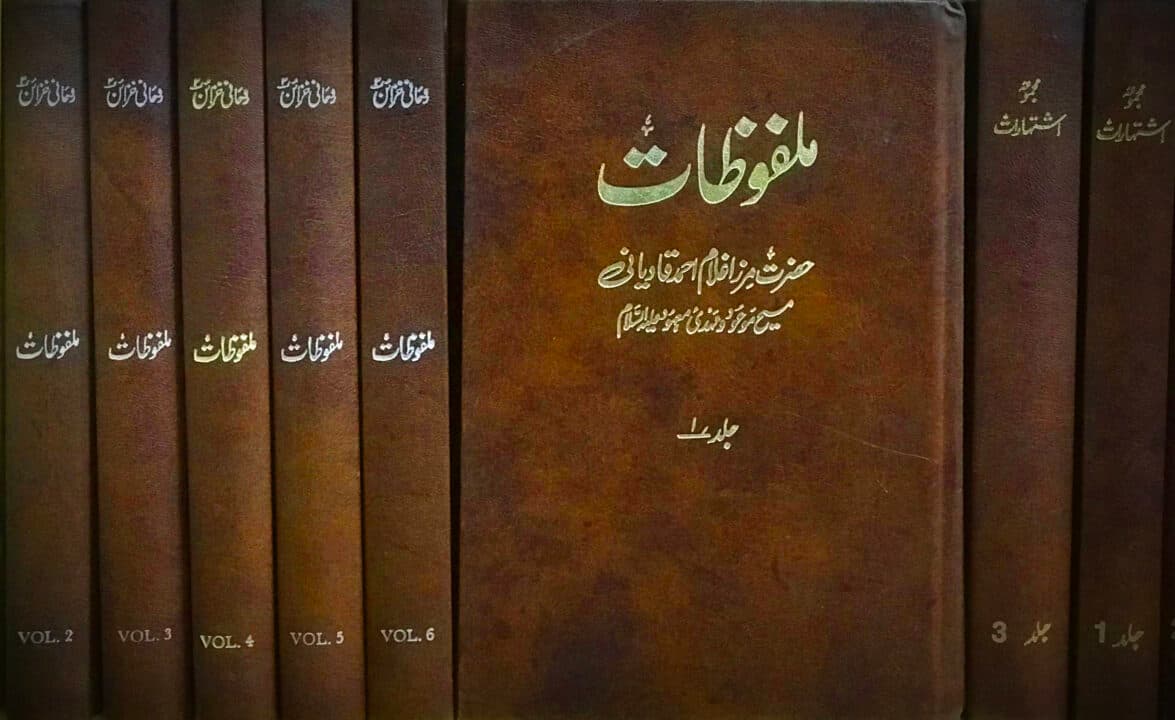
“Come! I shall tell you where the living God is and with which nation He is: He is with Islam. At this time, Islam is the Tur of Moses (Mount Sinai), where the Divine discourse continues. That God, who used to speak with the prophets and then became silent, now speaks in the hearts of Muslims.” (Anjam-e-Atham, Ruhani Khazain, Vol. 11, p. 346)
The profound concept of the Oneness of God (Tawhid) presented by Islam and the manner in which the Founder of the Ahmadiyya Muslim Jamaat expounded the existence of the Supreme Being of God in its light with such comprehensiveness and elegance constitute a discourse that deeply resonates with the hearts and souls of those endowed with noble human nature. I hope that all those who believe in the existence of God will attentively listen to the voice of the one who speaks from experience and bears testimony to the irfan (recognition) and ma‘rifat (cognisance) of God. The Promised Messiahas states:
“Our God is that God Who is alive even now as He was alive before. He speaks even now as He used to speak before. And even now He hears as He heard before. It is a false notion that in these times He only hears but does not speak. On the contrary, He hears and also speaks. All His Attributes are eternal and everlasting. None of His Attributes is in abeyance, nor will it ever be. He alone is the One without any associate; He has no son, nor has He any wife. He alone is Peerless and there is no one like Him. And He is the One Who is unique in that none of His Attributes are exclusively possessed by anyone beside Him. He has no equal. He does not share His attributes with anyone. None of His powers is less than perfect. He is near, yet far and He is far, yet near.” (The Will [Al-Wasiyyat], p. 12)
In Barahin-e-Ahmadiyya, he states:
“He is the Source of all grace and the ultimate Cause of all light and the Fountainhead of all mercies. His True Being is the support of the whole universe and the refuge of all high and low. It is He who brought everything out of the darkness of nothingness and bestowed upon it the robe of existence. There is no other being that exists in its own right, or is eternal, or is not the recipient of His grace.” (Barahin-e-Ahmadiyya [English], Part III, p. 92)
In Haqiqatul Wahi, the Promised Messiahas states:
“The Being of God is unseen beyond the unseen, concealed beyond concealed and extremely hidden. The reasoning faculties of humans cannot discover Him on their own. No rational argument can constitute an incontrovertible proof of His existence, because the reach and access of reason is limited to the extent of realising the need for a Creator by reflecting upon the created beings in the universe. However, to acknowledge the need for His existence is one thing, but it is quite another to arrive at the stage of ‘ainul-yaqin [certainty by sight] that God, the need for whose existence has been acknowledged, does indeed exist. However, since the methodology of reason is imperfect, incomplete and doubtful, not every philosopher can recognise God through reason alone.” (The Philosophy of Divine Revelation [Haqiqatul Wahi], pp. 139-140)
In Al-Wasiyyat, he states:
“He is the sum total of all Perfect Attributes and He is the Manifestation of every True Praise. He is the source of all that is Good and encompasses all Powers and He is the source of all forms of Beneficence. He is the One to Whom everything returns. He is the Lord of all the realms. He possesses every Perfection and is free from all defects, imperfections and weakness. It is His sole prerogative that all those who belong to the earth as well as all those who belong to the heavens should worship Him. Nothing is impossible for Him. All souls and their potentialities and all particles and their potentials are His and only His creation. Nothing comes into existence without Him. He reveals Himself through His Powers, His Omnipotence and His Signs. We can attain Him only through Him. He always reveals His Being to the righteous and shows them His Omnipotence – and this is the only means by which He is recognised and the path He favours is recognised.” (The Will [Al-Wasiyyat], p. 13)
The Promised Messiahas states:
“By virtue of all His excellences, God is One and has no partner. He suffers from no shortcoming. He comprehends all perfect attributes and manifests all holy powers. He is the Originator of all creation and Source of all grace. He is the Lord of reward and punishment and everything returns to Him. He is near despite being far and is distant despite His proximity. He is above everything, but we cannot say that there is anyone below Him. He is the most Hidden, but it cannot be said that anything is more manifest than He is. He is Self-Existent and everything subsists because of Him. He sustains everything but nothing sustains Him. Nothing has come into being or sustains itself without Him. He encompasses everything, but we do not know in what way. He is the Light of everything in heaven and earth. Every light shines through Him and every light is a reflection of His Being.” (Lecture Lahore, pp. 8-9)