

Hazrat Maulana Abdur Rahim Dardra(1894-1955)
Meeting with the Chief Rabbi
On 29 October 1925, I met the Chief Rabbi, the highest religious authority of the Jews in Britain. He was a man of short stature, bearded, and of a clerical appearance. He expressed his sympathy regarding our martyrs of Kabul. I said to him that I had come to convey my gratitude, for our religion teaches that one who does not thank people does not truly thank God either. He remarked that this was an excellent teaching and asked me to write down the exact wording of this expression of gratitude. I recorded it for him word by word.
When will the Messiah come?
The Chief Rabbi asked a few questions about the mosque and about the Ahmadiyya Jamaat. After responding to these, I said that, with his permission, I would also like to ask a few questions. He replied that I was most welcome to do so.
I said, “You are the foremost Jewish scholar in Britain. Please tell me why no prophet is now born among your people, whereas it is evident from the Bible that prior to the Messiah, prophets continued to arise among the Children of Israel. Yet for the past twenty years, no one has even made such a claim.”
He replied that their law had come to an end, and that although various other kinds of individuals might arise among them, a prophet could not.
I then asked whether he believed in the advent of Jesus. He replied in the affirmative. I said, “You are now gathering once again in Palestine. When, then, is the Messiah to come? Is there any sign regarding his advent? How will people recognise him when he comes, and how long is one to wait in expectation of his arrival?”
He responded, “I cannot say anything definite. God alone knows when he will come. Forty years ago, could anyone have foretold such great transformations in the world? In the same way, we believe that he will come, but we cannot say when. That knowledge rests with God alone. As for people accepting him, the answer is that truth spreads of its own accord. When he comes, people will recognise him themselves.”
I asked, “Will everyone recognise him of their own accord, and will all accept him? Why, then, did Moses have to confront Pharaoh?”
He replied, “In fact, these are matters pertaining to our own religion and do not concern you.”
I said, “Please do explain the matters of your own religion, so that something may at least become clear.”
He replied, for example, “One principle is that if anyone attempts to come and alter the past history of the Jews, I will not accept him.” I said, “Does this mean that what you understand Judaism to be is itself the true religion and the right path?” He replied, “Yes.”
Challenge
I asked, “In your view, what is the true purpose of religion? Is it to reach God and establish a relationship with Him, or is there something more?”
He replied, “Yes, that is indeed its purpose.”
I said, “Since you regard your religion as true, and I regard Islam as the true faith, let us resolve the matter through a challenge. You should pray for certain patients suffering from incurable diseases, and we, too, shall pray. Then we shall see who God supports.”
He replied that he was not prepared for this. I pressed him repeatedly, but he did not agree. He then said, “Present this to the Christians.” I replied, “This shows that you have no real confidence in your own religion.” At this, he fell completely silent.
I said, “You too must one day stand before God, as must I. He is my God, just as He is your God and the God of all. Therefore, I wish to state this to you plainly: the one who was to come has already come; apart from him, no one else will come. Your people waited before and will continue waiting until they die, but no one will descend from heaven. My task was to convey this message to you, and I have done so. I have brought this book, Ahmadiyyat, [or the True Islam]. I request you to read it carefully.”
He accepted the book with thanks and said, “Very well, I shall read it.”
Lectures in Portsmouth
Last week, three lectures by Malik Ghulam Farid Sahib[ra] MA, were held in Portsmouth. This city is the largest among the towns in southern England, and by the grace of God, our Jamaat is also established there. Notices regarding Malik Sahib’s[ra] lectures were published in the local daily newspaper, which also carried brief reports of his addresses.
On Saturday evening at 7:30 pm, Malik Sahib[ra] delivered a lecture at the Theosophical Society of Portsmouth on The British Empire and Islam. By presenting statistical evidence, he demonstrated that the British Empire was, in fact, the largest Islamic empire of the time.
Whereas the total Muslim population of all other independent Muslim countries amounted to approximately 27 million, the number of Muslims within the British Empire exceeded 115 million. Through the audience present – and, by extension, the British public at large – he drew attention to the fact that while there was reason to take pride in the British Empire being the largest Islamic empire, there was also a corresponding responsibility to familiarise oneself with the religious, moral, and political needs, aspirations, and conditions of its Muslim subjects.
Malik Sahib[ra] further stated that there was a divine wisdom underlying the fact that the British Empire had become the greatest Islamic empire in that era, namely that the Reformer of the Age was destined to be a Muslim.
Drawing parallels between the British Empire and the Roman Empire, in relation to the Promised Messiah and Jesus of Nazareth, Malik Sahib[ra] remarked that it would be beneficial for the British nation to study the claims and teachings of that Supreme Reformer, whose servitude they were destined to attain under the decrees of Divine providence.
The second lecture, delivered by Malik Sahib[ra], was on The Status of Women in Islam. In it, he explained in detail that the social and inheritance rights, as well as the moral and spiritual status, granted to women by Islam have not been accorded by any other religion.
The third lecture, delivered at St John’s Spiritualist Church, was entitled Islam – the Religion of Mankind.
One significant benefit of Malik Sahib’s[ra] visit to Portsmouth was that a friend named Bimley, who had previously accepted Islam through Maulvi Abdul Rahim Sahib Nayyar[ra] had later severed ties with us for certain reasons, met Malik Sahib[ra] and formally reaffirmed his entry into Islam.
He stated, “I had become an Ahmadi, then I went astray in various ways, but I have now reached the conclusion that peace of heart can only be attained in Ahmadiyyat.” His first Islamic name is Abdullah Bimley. May Allah the Exalted grant him steadfastness, amin.
Miscellaneous
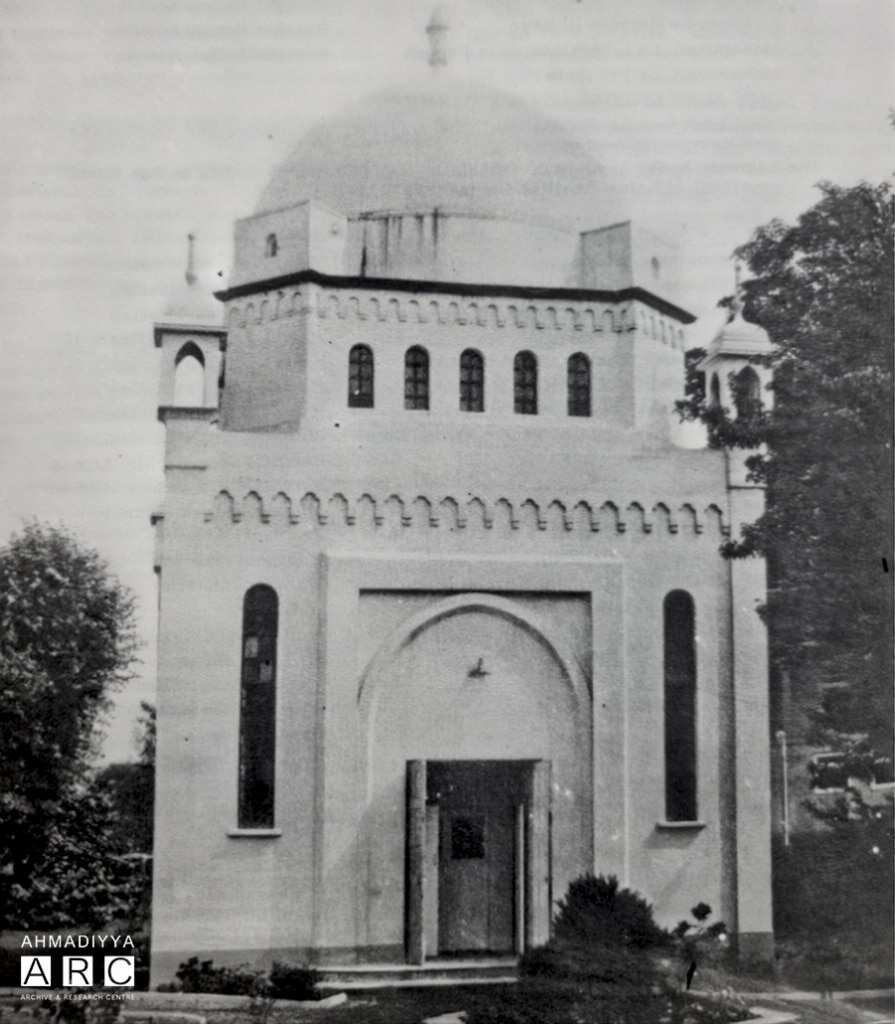
By the grace of God, the construction of the mosque is progressing. The November issue of The Review of Religions has been dispatched today. In addition to our esteemed brother Abdul Rahim Khan Sahib Khalid, son of the late Hazrat Nawab Sahib, one of our Nigerian brothers, Gabrial Martin, has also passed the Bar examination on this occasion with exceptionally high marks. He is now preparing for the LLB in London. Instead of three years, he completed the Bar examination in two years with distinction. May Allah the Exalted grant him abundant progress, amin.
Our respected brother, Sheikh Zafar Haq Khan Sahib, succeeded in the competitive examination for the ICS [Indian Civil Service]; however, it is regrettable that he was unable to pass the medical examination.
For the completion of the [London] mosque, I request friends to offer special prayers.
Wassalam, AR Dard.
Lecture on Life after Death
In its issue of 6 November 1925, the Wandsworth Borough News, London, published a summary of a lecture delivered by Malik Ghulam Farid Sahib[ra] MA at the Ahmadiyya Lecture Hall, 63 Melrose Road, Southfields, on the above-mentioned subject, [i.e., Life after Death]. The newspaper writes as follows:
“In order to elucidate his theme, the learned lecturer addressed, from the Islamic point of view and in concise form, the following five fundamental questions:
“(1) What is the human soul? (2) The origin of the soul. (3) Where does the soul go after its separation from the body? (4) The growth and development of the soul. (5) The state of the soul after death.
What is the human soul?
“In response to the first question, Malik Sahib[ra] explained that Islam teaches that the life and existence of the soul are entirely distinct in themselves. It is the soul through which human beings acquire understanding and perception of matters that lie beyond the grasp of the five senses.
“The relationship between humanity and God finds its central point in the human soul, which serves as the recipient and locus of the manifestations of Divine majesty and grandeur. Its connection with the body is of such a subtle nature that it has no parallel among any of the phenomena known to us.
“Through this connection with the imaginative faculty of the brain and the perceptive faculty of the heart – both of which exercise complete control over the external senses and are themselves dependent upon them – the soul operates in a manner that remains beyond full human comprehension.
“Scientists and psychologists have thus far been unable to fully understand the nature of the relationship between the soul and the heart. Nevertheless, there is not the slightest doubt that a delicate connection exists between the two and that, by virtue of this connection, the soul ascends into the brain in an unknown manner, in much the same way as oil rises in a wick, and then, through the brain, manifests itself in diverse functions and modes of action.
The origin of the soul
“With regard to the second question, Malik Sahib[ra] explained that the soul is not brought from somewhere outside and forcibly inserted into the earthly body; rather, it is generated from within it and develops alongside it.
“The soul is a subtle essence which, following the various transformations of the body, is formed from it in much the same way as wine is produced from barley. When the relationship between soul and body reaches the stage at which the completion of that phase is intended, movement begins in the heart, and life enters the body.
“Thus, the soul possesses its own distinct existence, while the body is a receptacle which, after the soul’s emergence, contains it within itself.
Where does the soul go after separation from the body?
“Regarding the third question, Malik Sahib[ra] stated that Islamic teaching holds that it is essential for the soul to reside in some form of body, for it is only through a body that it can manifest its powers. As long as the body remains capable of expressing these powers, the soul remains within it; when it is no longer capable, the soul departs from it. This departure of the soul is called death.
“However, upon leaving the earthly body, the soul immediately adopts another ‘body’, for it cannot exist without a body.
The growth and development of the soul
“In response to the fourth question, Malik Sahib[ra] explained that just as the human body is formed through stages involving plant and animal elements, and after this formation acquires the shape recognised as human, and then, through various transformations and states of weakness and helplessness, attains all the capacities necessary for entry into worldly life, so too does the soul pass through comparable stages after death.
“The first stage through which the soul must pass is the stage of the grave. This should be regarded as analogous to the earliest condition of the human being, when life is instilled in the embryo. During this stage, the soul undergoes innumerable transformations and begins to acquire a new form of life and a new type of sensations. Eventually, just as a child, upon reaching a particular stage within the mother’s womb, becomes the means for the birth of a soul, this soul in turn gives rise to another soul and itself serves as a body for that newly generated soul.
“Upon reaching this point, the soul is then transformed into a second state, in exactly the same manner as an embryo is transferred from the womb into an independent existence. Like a newborn child, it has absolutely no awareness or perception of the transformations and changes that occur during this period.
“When the duration of this stage also comes to an end, the soul enters a third stage. The condition of the soul at this stage resembles that of a young adult who has reached maturity. It becomes fully conscious of the state of life after death, after which it is placed in Paradise or Hell in accordance with its condition and deeds.
The state of the soul after death
“With regard to the fifth question, Malik Sahib[ra] stated that life after death constitutes a link in the chain of this very life. Thus, when we say that a person has died, it means nothing more than that his soul has taken flight from the body, for death does not befall the soul, nor does there ever come a time when the soul becomes lifeless. It is an inherent attribute of the human soul to remain alive, and for this reason, even the faintest signs of lifelessness can never overtake it.
“Death is a step in the soul’s advancement, by means of which it becomes capable of manifesting its powers and capacities in an excellent manner. In other words, the period for the full expression of the inherent tendencies of the human soul begins only after it has flown free from the cage of the four elements.”
(Translated by Al Hakam from the original Urdu, published in the 8 & 15 December 1925 issue of Al Fazl)