

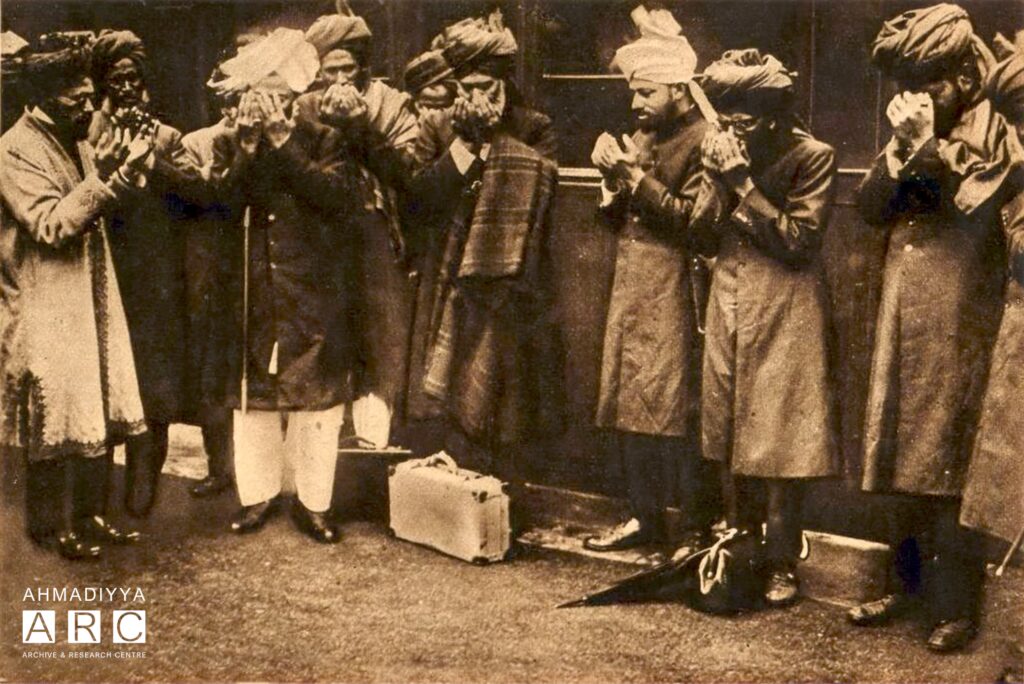
A year after his return from England, Hazrat Mirza Bashir-ud-Din Mahmud Ahmadra, Khalifatul Masih II, reflects upon the West’s apparent indifference towards religion and the deeper spiritual realities concealed beneath it. While acknowledging the material progress and religious apathy prevalent in Europe, he argues that this indifference masks an underlying attraction towards faith and reverence for God. His observations lead to a hopeful conclusion – that despite its advanced spiritual malaise, Europe is not beyond cure and that through sympathy, perseverance and the universal principles of Islam, a path towards genuine spiritual and international peace remains open.
Hazrat Khalifatul Masih IIra states:
“It has been a full year since I left England, but the kind treatment which the English people extended to me and my companions during my brief sojourn in England and the attention accorded to me by the English press are yet fresh in my mind. I had gone to England with a heart full of sympathetic feelings for England and the British people. On my return, I found that those feelings had intensified.
Western material progress and religious apathy
“It is true that a general apathy towards religion prevails in all Western countries on account of the great material progress they have made. England is no exception in this respect. It has had its share of this indifference towards religion. I was conscious of this fact and therefore, when I left England last year, I was more solicitous of her spiritual welfare than when I had entered it.
Hidden reverence for religion
“Notwithstanding my consciousness of British apathy towards matters religious, I had, after a deep and careful study of the British mind and the different influences that are affecting it, returned convinced that beneath this apparent indifference lay concealed a liking for and attraction towards religion and though an impenetrable layer of irreligiousness had spread over the English mind, yet England was not absolutely devoid of love and reverence for religion.
Not beyond spiritual cure
“This filled me with greater certainty that England is not beyond the pale of spiritual cure and though the disease is very serious and is in an advanced stage, yet there is hope for her to rally. It requires only perseverance and sympathy on the part of her physicians and the patient shall recover. Then shall the erring flock enter the Master’s fold and the prodigal son shall come to his Father and he shall see that his Father shall not demand from him the shedding of blood for the remission of his sins and his restoration to His favour, as Christianity of today teaches, but as Islam teaches, from which Christianity in its pristine form did not differ a jot, shall accept the sacrifice of his sincere repentance and heartfelt contrition and shall make merry and be glad and shall kill a fatted calf on the return of His penitent son.
East-West unity under the banner of the Messiah
“Those will be the days when all distinctions of East and West shall vanish and all would be God’s servants and the Easterners shall look upon the West as their home and the Westerners shall regard the East as their own. All shall gather under the banner of the Messiah who has been raised a second time to give salvation to the world and shall be presented before the Greatest of all Prophets, Muhammad, peace be upon him, who is the last and the Most Perfect Divine Manifestation. Then shall the whole world say with great joy:
“‘Let His Kingdom be upon earth as it is in heaven.’” [Matt. 6:10]
How the West is moving towards Islam
“I clearly perceive that God is manifesting sign after sign to bring about the desired end and is providing means after means for the same object. The tongue is chanting the praise of Christianity, but the hearts are being attracted towards Islam. The question of divorce is being solved in accordance with Islamic teachings, the objections against polygamy are weakening, women are given their rights on the lines laid down by Islam and a vigorous campaign is being conducted against the use of wine. Sundry other problems are being solved in the light of the Islamic teachings.
“Though the excellence and superiority of the teachings of Islam are not openly acknowledged because old-standing enmities are not so readily got rid of, yet the everyday changes demonstrate that the West, unconsciously and against its will, is coming over to Islam.
The Locarno Pact and Islamic principles of peace
“But what I at present wish to draw the attention of the Western people to is the Locarno Pact. Up till now, Europe has been following the Islamic teachings in social matters. In politics, she thought, she was too advanced to stand in need of guidance from any other quarter. But the Locarno Pact is Europe’s practical admission of the fact that in politics and international problems as well, Islam is the best guide and without acting upon its teachings, no success is possible.
Engagement with the League of Nations
“During my stay in England last year, two representatives of the religious branch of the League of Nations came to see me and they desired that, being the head of a large community, I should use my influence in getting the branches of the League established in India and help those who are already engaged in this work. I had told the aforesaid gentlemen that though the League of Nations had not yet been constituted on such lines so as to establish peace and tranquillity in the world, yet as it was a step in the right direction, I would lend every possible support to it.
“I told them as well that Islam has laid down some lines and principles on which a League of Nations could be made. According to these principles, when two nations which are members of the League go to war against each other, the other nations should, as arbitrators, hear the cases of the belligerent parties and then decide how mutual understanding could be brought about between them. If either of the parties concerned refused to accept the League’s award, they should all unite to fight against it till it submitted to the decision of the League and refrained from encroaching upon the rights of the other party. When the war was over, the victors, to feed fat their grudge or to make the most of the victory, should not impose new financial burdens upon the vanquished and should not make preposterous demands which render the foundations of war stronger and firmer. They evinced their entire sympathy with the scheme but said that the time had not come when the League could be constituted on these lines because mutual mistrust and suspicions were not removed yet and some big powers had not accepted the membership of the League.
“I have outlined the above-said scheme in my book, entitled ‘Ahmadiyyat or True Islam,’ which was originally written for the Conference of Living Religions within the British Empire. I have made it quite manifest in the book that a League of Nations established on these lines only could restore peace in the world.
Why the Locarno Pact succeeded
“I consider it a great heavenly sign that in less than a year, God has made the European nations follow the lines of the scheme outlined by me. Where the League failed, the Locarno Pact has succeeded in establishing peace in Europe because only that Pact can bring about peace in which the interests of all the parties are equally safeguarded and which, if violated by one party, should be vindicated by the united strength of all other parties. Take off from the Pact the clauses about mutual cooperation and the equal representation of all interests and the armed intervention of all parties against that party which violates it and it will become a mere scrap of paper.
“The difference in this Pact and the treaty which the German Chancellor styled as ‘a scrap of paper’ is that in that treaty the interests of one party were quite safe and no provision was made to defend the interests of the other party. Belgium enjoyed every protection, but no safeguard was provided for the German frontiers. Compelled by the existing circumstances and fearing lest Belgium, which was inclined towards France, should give the latter’s armies a passage through her territories, Germany committed that breach of trust which shall remain forever an indelible blot on the names of those in whose hands were then the reins of Germany’s politics. But in the present Pact, as the interests of all parties are equally safeguarded, it has succeeded in creating an atmosphere of trust and confidence. This is the line of action suggested by Islam.
“The second distinctive feature of this Pact is that all the signatories have pledged themselves to armed intervention on behalf of the injured party and the international relations could not be based on a satisfactory basis without this clause.
“Though the Locarno Pact has been signed by a few nations only, if pacts were made among different countries on the same lines and in the same spirit, the possibility of future wars would be greatly reduced.
Islam and the dawn of a new era in European politics
“Europe is delighted and justifiably delighted that a new era has dawned in European politics and there is no doubt about it that the Locarno Pact is the precursor of a new era. But what is that era? It is the era of Islam, which, in order to base international relations on a better and firmer footing, had suggested this line of action.
“Is it then too much to expect of the serious-minded people of Europe that when they have practically accepted the scheme suggested by Islam for establishing peace, they will make verbal acknowledgement also of the excellence of Islamic teachings and will express their indebtedness to Islam, which is the bounden duty of all noble-minded people.
“I pray that the new era, for which the foundations are laid on the teachings of Islam, may prove an era of real peace, because Islam means ‘to give peace.’
“What harm did the boycott of Russia by other powers do to her? If she was isolated on one side, she contracted relations and established her influence on other sides. A boycott could coerce into submission only that country which depends on other countries for its very life. A big country sustains no serious loss on account of such a boycott; neither can all its neighbours maintain this boycott against it, because some financially weak nations take advantage of such an opportunity to improve their fiscal condition.
“When a nation is bent upon shedding innocent blood and reducing a sister nation to slavery, particularly when she is advised by other nations that she is not justified in what she is doing, nothing can check such a nation from her inhuman and unjust course except for the fear of or actual armed intervention by other nations in favour of the aggrieved party. By providing this most important clause, the Locarno Pact has done much greater service in creating an atmosphere of mutual trust and confidence than the League Protocol had done.
A call to Europe’s moral and spiritual vanguard
“I pray also that God may vouchsafe strength to those thousands of British and other European people who are convinced in their hearts of the excellence and truth of the teachings of Islam, that they should come forward and should prove themselves the vanguard of the era which is about to dawn.
“True, it is the vanguard which always suffers most, but it is they who constitute the vanguard that deserve undying fame and endless reward. It is they whose memories are perpetuated in this world and whose souls in the next are guided to the interminable summits of spiritual altitude. I appeal to the noble feelings of these great souls that they should extend us their hand of sympathy and help in this apparently doomed-to-failure task of the propagation of Islamic ideas and should tarry no longer. They should come forward and should faithfully and bravely discharge that sacred obligation which they owe to their own selves, to the whole of mankind, to coming generations, nay, to humanity and to the cause of truth, justice and morality. Then they shall deserve to be called God’s elect and then shall they claim Him as their own.” – Khalifatul Masih II
(Transcribed and edited by Al Hakam from the original English, published in the January 1926 issue of The Review of Religions)