

Rameen Masood, Leicester, UK
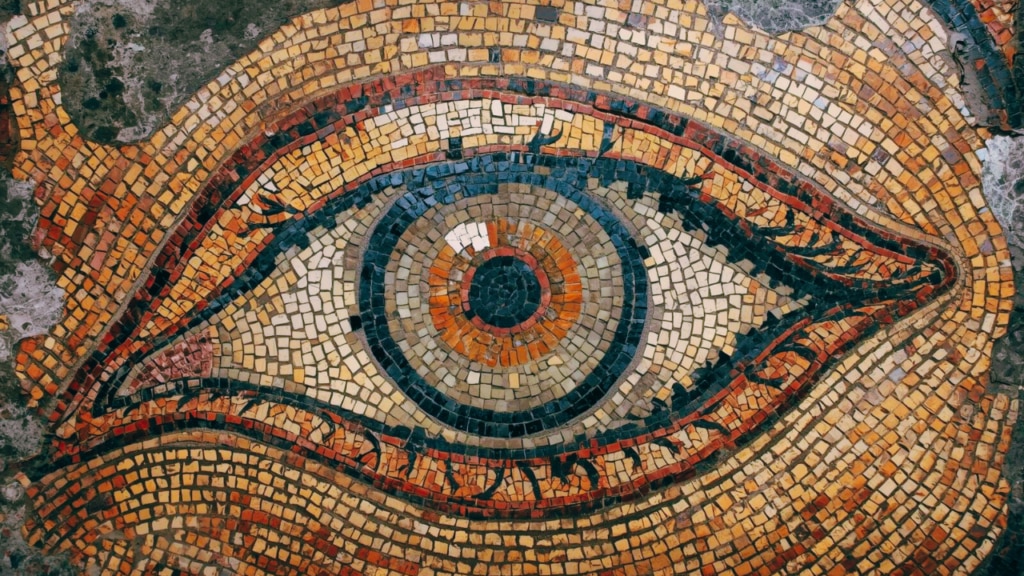
God states in the Holy Quran: “Eyes cannot reach Him but He reaches the eyes. And He is the Incomprehensible, the All-Aware.” (Surah al-An‘am, Ch.6: V.104)
Medicine has a way of changing how you look at things long before it changes what you know. One day, you realise you no longer see a limb, a heart, a liver, or a brain in quite the same way. You begin to see organ systems. A grand design. And the hand of a Supreme Creator.
For me, this realisation has always existed, but learning about the eye made it feel more palpable than ever. Since starting medical school, every organ has left me in awe, and learning about the eye continues to fill this goblet of wonder. Perhaps it’s because such a small organ carries such an astonishingly glorious level of intricacy. Or perhaps because it reminds us so insistently that not all seeing per se is done with light alone.
Intricacies of the eye
Often described as the second most complex organ in the human body (the first is the brain), the eye is extraordinary not simply due to the ambit of its vision but because of what it invites us to reflect upon. During my ophthalmology block, this sense of wonder deepened further.
Those who have studied the eye, even briefly, will understand this well: the more you learn about it, the more you realise how much there’s still to learn. Layer upon layer, cornea, lens, retina, each meticulously arranged. The sclera, episcleral, Bruch’s membrane, the retinal pigment epithelium – the list goes on. Structures so small, yet so precious.
And yet, I often think about how casually we speak of sight. We wake up and open our eyes. We see the world all around us. Colour, movement, faces, texts. Yet, we rarely pause to reflect.
More than what meets the eye
Whilst learning about the eye, I came across the Arabic word for the eye, “ayn,” which, quite fascinatingly, is also translated as “a spring of water.” Thematically speaking, water brings countless connotations to mind and is essential for life to thrive. In a similar vein, it can be propounded that our eyes are springs of spiritual life.
There is an unseen facet to vision that medicine alone can’t fully account for. We can map photoreceptors and explain how light becomes perception; nevertheless, there remains something unresolved. It may sound arcane, but there are aspects of sight which exist beyond the confines of diagrams and definitions. The Quranic verse cited at the beginning reminds us that while our eyes may fail to reach the Almighty God, He reaches the eyes. This adds an extra blanket of meaning to what we consider sight to be and explores the idea that seeing is also about our willingness to receive.
I think this notion became particularly apparent to me recently as I saw various ocular conditions which medicine could treat and those it could only slow. Retinal detachments that required urgent referrals, dry age-related macular degeneration that progressed slowly, almost reminiscing how despair doesn’t always arrive all at once. Metamorphopsia, where straight lines seem wavy, presents a prejudiced version of reality. So, the diseases of the eye can bring a person to such a stage where the eye remains physically present, but it no longer offers the truth.
Seeing what can’t be seen
And this, I think, seems like an apt segue into the realm of spiritual sight. The loss of physical sight is undoubtedly devastating. The true weight of this can only be understood by those who endure it. But what pains me even more is how easily the disease of spiritual blindness spreads, discreetly engulfing all that comes its way. It’s quite scary how one person’s dulled conscience can become another’s point of reference. In fact, over time, distortion can begin to mistakenly feel crystal clear. After all, even the eye can adjust to darkness if we stay in it long enough.
This is why I have come to realise the importance of praying for insight and wisdom. Knowledge by itself is often insufficient unless we know how to employ it rightly. Prayer is needed for the ability to recognise when something is amiss, even if it appears familiar. It fosters the courage to admit when our vision needs correcting.
This is exactly why Allah taught the Holy Prophetsa to pray:
رَّبِّ زِدۡنِیۡ عِلۡمًا
“O my Lord, increase me in knowledge.” (Surah TaHa, Ch.20: V.115)
Similarly, the Promised Messiahas was also taught this prayer by Allah:
رَبِّ أَرِنِي حَقَائِقَ الْأَشْيَاءِ
“[O] Lord, show me the reality of things.” (Tadhkirah, 2018, p. 990)
Therefore, it is clear that seeing the unseen requires more than anatomy. It requests a connection between the inner self and the wider universe as everything moves in obedience to the Lord of the heavens and earth. Regarding this, the Promised Messiahas eloquently elucidates:
“Therefore, a muttaqi (or a righteous person) must, to a certain degree, make an intentional struggle. For when such a person attains the rank of a salih (or a virtuous servant), the unseen no longer remains hidden to such a person. A stream gushes forth from within such a one and reaches God. An individual of this nature witnesses God and His love with their eyes.” (Malfuzat [English], Vol. 1, p. 27)
This realisation compels us time and again to loudly profess the unity of Allah and declare that there is a Supreme Creator responsible for the creation of the eyes. With its mind-perplexing complexity, how can one even fathom that the eyes came into existence by mere chance and without the command of al-Khaliq (the Creator) and al-Musawwir (the Fashioner)?
Unequivocally, the eye is but one of the innumerable remarkable creations of the Almighty God. How, then, can we ever render our thanks to Him? Truly, how benevolent is our Lord that even when our eyes cannot reach Him, He still reaches the eyes. May Allah the Almighty, who is al-Wahhab (the Bestower), bless us with spiritual insight and the ability to perceive His manifestations, both the seen and the unseen, as He pleases. Amin!