Friday Sermon
23 January 2026
The Prophet’ssa love for Allah: A model of devotion and tranquil worship

After reciting the tashahhud, ta‘awwuz and Surah al-Fatihah, Hazrat Khalifatul Masih Vaa stated:
The various aspects of the life of the Holy Prophetsa were being mentioned. In the previous sermons, his love for Allah was being mentioned, and I will further discuss this very subject today as well. The manner and beauty in which the Holy Prophetsa worshipped have previously been discussed. Today, I will present some references from the Ahadith, as well as the writings of his ardent devotee, the Promised Messiahas and how he depicted the status and rank of the Holy Prophetsa and his love for Allah.
In one narration, it is recorded that Hazrat Hudhaifahra relates: “One night, I offered prayers with the Holy Prophetsa. He began with Surah al-Baqarah. I thought that he would go into ruku‘ [bowing position] after 100 verses, but he continued on. I then thought that he would go into ruku‘ after completing the chapter, but he continued further. Then I thought he would go into ruku‘ [at this point], but he began reciting Surah an-Nisa, and then he started reciting Surah Aal-e-Imran as well. He recited in a very soft tone and slowly. Whenever he recited a verse glorifying Allah, he would glorify Him. Whenever he recited a verse containing a supplication, he would supplicate. And whenever he recited a verse seeking refuge with Allah the Almighty, he would seek refuge. He then went into ruku’ and said:
سُبْحَانَ رَبِّیَ الْعَظِیْم
“‘Holy is my Lord, the Most Great.’ His ruku‘ was as long as his qiyam [standing position].
“(It was a very long ruku‘). Then he said:
سَمِعَ اللّٰہُ لِمَنْ حَمِدَہٗ
“‘Allah listens to him who praises Him’. He then remained in qiyam for a long time, almost equal to the length of his ruku‘. Following this, he went into sajdah [prostration] and said:
سُبْحَانَ رَبِّیَ الْاَعْلٰی
“‘Holy is my Lord, the Most High’, and his prostration was almost as long as his qiyam.” (Sahih Muslim [Translation], Kitab salati l-musafirina wa qasruh, Hadith 1283, Noor Foundation, pp. 270-271)
Such was the manner in which he offered voluntary prayers, as witnessed by a Companion on one occasion.
Similarly, Hazrat Aishara relates that one night, the Holy Prophetsa stood in prayer reciting only a single verse of the Holy Quran. (Sunan at-Tirmidhi, Abwab as-salat, Hadith 448)
That is, after Surah al-Fatihah, he repeatedly recited only one verse during the qiyam. In one narration, a Companion relates that he recited several long chapters, while in this narration, it is stated that he prolonged his qiyam by [reciting] a single verse. In relation to how long his qiyam was, a previous narration of Hazrat Aishara has already been mentioned, and I have discussed this in my previous sermons, that his qiyam, ruku’, and sajdah were so lengthy and so beautiful that words fail to describe them. (Sahih al-Bukhari, Kitab as-manaqib, Hadith 3569)
Likewise, Hazrat Abu Dharrra relates that the Holy Prophetsa stood up for worship and continued to recite a single verse repeatedly until morning. The verse was:
إِنْ تُعَذِّبْهُمْ فَإِنَّهُمْ عِبَادُكَ وَإِنْ تَغْفِرْ لَهُمْ فَإِنَّكَ أَنتَ الْعَزِيْزُ الْحَكِيْمُ
“If Thou punish them, they are Thy servants; and if Thou forgive them, Thou surely art the Mighty, the Wise.” (Sunan Ibn Majah, Kitab iqamati s-salat wa s-sunnati fiha, Hadith 1350)
Due to his love for Allah the Almighty and due to the compassion he had in his heart for the creation and servants of God, he continued to pray for their forgiveness, that although Allah the Almighty has the power to punish them, yet he prayed that He forgives them, for this supplication itself has also been taught by Allah the Almighty.
Then it is narrated by Hazrat Aishara that during the lifetime of the Holy Prophetsa, a solar eclipse occurred. The Holy Prophetsa stood up to lead the prayer. He observed a very long qiyam (as is performed in the eclipse prayer). He then performed a long ruku‘ – the ruku‘ was for a very long time. He then raised his head and again stood for a long time, though shorter than the first qiyam. Then he went into ruku‘ again for a long time, though shorter than the first ruku‘. Then he went into sajdah, then stood again and remained standing for a long time, though shorter than the previous qiyam. He then went into ruku‘ for a long time, though shorter than the previous one. Then he raised his head and stood, remaining standing for a long time, though shorter than the previous qiyam. Then he went into ruku‘ and prolonged it, though shorter than the previous ruku‘, and then went into sajdah.
Thereafter, the Holy Prophetsa completed the prayer, and the sun had become bright again. He then addressed the people with a sermon. He praised Allah and glorified Him, and then said:
“The sun and the moon are among the signs of Allah, and they do not eclipse because of the death or the life of any person. So when you see them, proclaim the greatness of Allah, supplicate to Him, observe the prayer and give charity.”
He then said: “O community of Muhammadsa! There is no one more protective of their honour than Allah when His male servant should commit adultery, or His female servant should commit adultery.”
This is a deeply stirring warning and admonition: do not provoke the sense of honour of Allah by becoming entangled in sins. Seek mercy from Allah and avoid inciting His sense of honour.
Then he said: “O community of Muhammadsa! By Allah, if you knew what I know, you would weep much and laugh little.”
Then he said, “Hearken, have I conveyed the message?” (Sahih Muslim [Urdu Translation], Vol. 4, Kitab al-kusuf, Hadith 1490, Noor Foundation, pp. 58-59)
That is, he had delivered the message to them.
Thus, he drew attention to turning towards Allah, worshipping Him, and humbling oneself before Him, and said that in this lies your survival and your life. And if you were to know the depth of these matters as I know them, you would give up laughter, weep more, and supplicate to Allah abundantly.
Thus, attention was drawn to the fact that we too should give great importance to prayers and should establish a special bond with Allah the Almighty.
Regarding supplication on the battlefield, Hazrat Abdullah bin Abbas narrates that Hazrat Umar bin al-Khattabra told him that on the day of [the battle of] Badr, the Messengersa of Allah looked at the idolaters and saw that they were 1000 in number, whereas his Companions were 319. The Holy Prophetsa turned his face towards the Qiblah, then stretched out both his hands and began to call upon his Lord aloud, saying:
اَللّٰھُمَّ انْجِزْ لِیْ مَا وَعَدْتَّنِیْ اَللّٰھُمَّ اٰتِ مَا وَعَدْتَّنِیْ اَللّٰھُمَّ اِنَّکَ اِنْ تَھْلِکْ ھٰذِہِ الْعِصَابَۃَ مِنْ اَھْلِ الْاِسْلَامِ لَا تُعْبَدْ فِی الْاَرْضِ
“O Allah, fulfil for me what You have promised me. O Allah, grant me what You have promised me. O Allah, if You allow this small band of Muslims to be destroyed, You will not be worshipped on the earth.”
Facing the Qiblah, with both hands outstretched, he continued to call upon his Lord aloud, until his cloak slipped from his shoulders. (That is, his body was trembling due to intense weeping and supplication, and because of this, his cloak fell.) At that moment, Hazrat Abu Bakrra came to him, picked up his cloak and placed it back upon his shoulders. Then he embraced the Holy Prophetsa from behind and said:
“O Messengersa of Allah, your earnest, imploring supplication before your Lord is sufficient for you. He will surely fulfil the promises He has made to you.”
Thereupon, Allah the Almighty revealed the following verse:
اِذۡ تَسۡتَغِیۡثُوۡنَ رَبَّکُمۡ فَاسۡتَجَابَ لَکُمۡ اَنِّیۡ مُمِدُّکُمۡ بِاَلۡفٍ مِّنَ الۡمَلٰٓئِکَۃِ مُرۡدِفِیۡنَ
This is a verse of Surah al-Anfal. “When you implored the assistance of your Lord, and He answered you, saying, ‘I will assist you with a thousand of the angels, following one another.’”
Thus, Allah aided him through the angels. (Sahih Muslim [Urdu Translation], Vol. 9, Kitab al-jihadi wa s-siyar, Hadith 3295, Noor Foundation, pp. 150-151)
The Promised Messiahas states that:
“In the Holy Quran, the Holy Prophet, may peace and blessings of Allah be upon him, was repeatedly given the promise of the victory over the disbelievers, but when the Battle of Badr – which was the first battle of Islam – started, the Holy Prophet, may peace and blessings of Allah be upon him, began supplicating and praying, and these are the words that issued from his tongue:
اَللّٰھُمَّ اِنْ اَھْلَکْتَ ھٰذِہِ الْعِصَابَۃَ فَلَنْ تُعْبَدَ فِی الْاَرضِ أَبَدًا
“‘O my Lord! If you destroy these people (they were just 313 men or, according to some narrations, 319), none will worship You till Doomsday.’ When Hazrat Abu Bakr, may Allah be pleased with him, heard these words from the mouth of the Holy Prophet, may peace and blessings of Allah be upon him, he submitted, ‘O Prophetsa of Allah, why are you so perturbed? God has given you the firm promise that He will give victory.’ He said, ‘This is true, but I am keeping my eyes on the fact that He is in need of no one.’ That is to say, God is not obligated to fulfil any promise. Now, it must be understood that when the Holy Prophet, may peace and blessing of Allah be upon him, observed this much deference to etiquettes of respect of God, why should one turn aside from this accepted belief of all Prophets, may peace be upon them, that sometimes God’s prophecy is fulfilled literally and sometimes it is fulfilled metaphorically and figuratively?” (Zamima Barahin-e-Ahmadiyya, Part V, Ruhani Khazain, Vol. 21, pp. 255-256)
After narrating this incident, he also said to those opponents who objected that his prophecies were not fulfilled, that there are different ways in which prophecies are fulfilled. Sometimes they are fulfilled literally, and sometimes in another form, but Allah the Almighty certainly fulfils the promise He has made. In any case, we should remain bowed before Allah the Almighty at all times, lest due to Allah the Exalted’s self-sufficiency there arise any interruption in this. It should not come to an end; rather, the support and help of Allah the Almighty should always remain with us.
The Promised Messiahas states:
“Understand it well that true monotheists are those who do not make the slightest display of their virtues and are not afraid of the world in accepting the truth. They do not care if the world becomes alarmed by any of their actions. Some say that the extent to which the Companionsra used to strive or fast is not proven in the case of the Holy Prophet, may peace and blessings of Allah be upon him. Some of the Companionsra had well-nigh reached a life of asceticism. (Meaning they were so inclined towards faith that they abandoned the world). It does not follow from this that they were (God forbid) superior to the Holy Prophet, may the peace and blessings of Allah be upon him. In fact, the Holy Prophet, may peace and blessings of Allah be upon him, was compelled by Allah the Almighty to come before the world. (He was occupied in the worship of Allah the Almighty and was intoxicated in His love. His entire life was devoted to the Being of Allah the Almighty. But Allah the Almighty instructed him to appear before the world.) His habit of living behind a veil had not gone away. Who knows how much striving and worship he remained engaged in secretly.”
In the same way, the incident of the cemetery has already been mentioned earlier. By narrating it, he proved the Holy Prophet’ssa desire to worship in solitude. It was the turn of Hazrat Aishara for the Holy Prophetsa to visit her house, however when she awoke, she found the Holy Prophetsa was not present. She became very surprised. She searched but couldn’t find him. She went out in search of him and found him in the cemetery, where the Holy Prophetsa was engaged in supplication with intense fervour, saying: “O my God, my soul, my life, my bones, my every hair has prostrated before You.” The Promised Messiahas presented the incident in this manner and stated:
“Had Hazrat Aishara not informed others of this matter, who would have known what kind of relationship the Holy Prophetsa had with his Lord – how much he worshipped, and how he would worship in concealment and in complete privacy, hidden from people. Such was the state of his spiritual striving and worship.
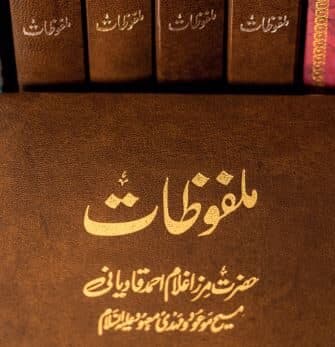
“Indeed, Allah the Almighty instils this habit in such people – the habit of concealment – and therefore the world is not fully aware of their true condition. They do not do anything for the sake of the world. The One with Whom they have dealings and a relationship knows and sees everything, wherever they may be.” (Malfuzat, 2022, Vol. 8, pp. 214-215)
That is, they worship Allah the Almighty, they love Him, and He is fully aware of every matter. Such people do not act for the sake of worldly display.
Then, in one place, he states that the state of the Holy Prophet’ssa enjoyment of the world, or worldly possessions and benefits, was such that once, Hazrat Umarra went to meet him. He sent in a young boy to seek permission for him to meet him. The Holy Prophetsa was lying on a mat made from date palm. When Hazrat Umarra entered the room, the Holy Prophetsa sat up. Hazrat Umarsa saw that the whole house was empty, without any decorations of any sort. There hung only a sword on a hook, and the date-palm mat upon which he sat, the pattern marks of which were still visible on the Holy Prophet’ssa blessed back. Seeing this, Hazrat Umarra burst into tears. The Holy Prophetsa asked him, “What has made you cry, O Umar?” He replied, “Caesar and Chosroes possess every means of comfort, luxury and opulent commodity at their disposal, while you, who are Allah’s Messengersa and the king of both worlds, lie on date-palm mats such that their patterns leave an imprint along your back.”
The Holy Prophetsa replied, “O Umar, what care do I have for material things? I spend my days like a wayfarer en route upon his camel to his destination. Along the sandy path of the desert, owing to extreme wind gusts and heat, he sees a tree and seeks to cool down in its shade for just long enough that he stops sweating, and then he resumes his journey.” (Malfuzat, 2022, Vol. 6, pp. 228-229)
Similarly, Hazrat Abu Hurairahra relates that when God Almighty revealed the verse “وَأَنْذِرْ عَشِيْرَتَكَ الْأَقْرَبِينَ”, which means, “And warn thy kin,” the Holy Prophetsa stood up and declared, “O people of the Quraish, secure your own souls, for I shall not avail you anything against Allah Almighty.” Meaning that if you do good works and incline toward God Almighty, worshipping Him and delving deep into His love, then you will be saved. Otherwise, I will not be able to save you.
Then, addressing his other relatives and tribesmen, he said:
“O children of Abd Manaf, I shall not avail you a whit against Allah. O Abbas, son of Muttalib, I shall be of no use to you against Allah. O paternal aunt of Allah’s Messengersa, Safiyyah, I shall not be able to save you against Allah, and O Fatima, daughter of Muhammadsa, ask whatever of my wealth you wish, but know that I shall not be able to save you against Allah.” (Sahih al-Bukhari, Kitab at-tafsir, Hadith 4771)
Meaning that only your worship and your relationship with Allah will save you.
Compared to his love and adoration for God Almighty, he did not even care about his own life. Thus, when the Holy Prophetsa began preaching, the Quraish went to Abu Talib, telling him to stop his nephew from finding fault with their idols; otherwise, “we will stop him ourselves – don’t try to get in our way then.” They expressed that they had asked him before as well to get his nephew to desist, but he did not stop him. Now they had come again to ask him. So, either they would take things into their own hands to stop him from saying what he says about them, or they would oppose Abu Talib and his nephew until one of them was annihilated.
When the Quraish said this to Abu Talib, he called for the Holy Prophetsa and said to him, “O my brother’s son, don’t put me in a situation that I haven’t the strength to bear.”
The Holy Prophetsa thought that perhaps his uncle would give up supporting him and hand him over to the Quraish. Thus, the Holy Prophetsa replied, “By God, O uncle of mine, even if these people place the sun in my right hand and the moon in my left, I shall not back down in fulfilling my duty and shall persist in my mission until God Almighty either brings it to completion, or I die in this mission.”
Then, the Holy Prophetsa stood up and started to make his way out when Abu Talib called him and said, “O my nephew, do whatever you wish. By God, I shall not give you over to them in exchange for anything.” (Al-Sirah Al-Nabawaiyyah, Ibn Hisham, Dar-ul-Kotob Al-Ilmiyyah, Beirut, Lebanon, pp. 199-201)
This incident has been recorded in Sirat ibn Hisham. The Promised Messiahas has also mentioned this incident. He states:
“When these verses were revealed – that the idolaters are ‘rijs’ (impure); ‘sharr al-bariyyah’ (the worst of creation), ‘sufaha’, i.e., foolish; the progeny of Satan; and that their deities are fuel for the Fire, and fuel for Hell – Abu Talib called for the Holy Prophetsa and said:
“‘O my nephew, due to your denunciation, the people have become incensed greatly, and it is nigh that they will destroy you and me as well. You have declared their intelligent ones to be foolish, called their elders the worst of creation, named their revered deities firewood of Hell and fuel for the Fire, and, overall, have deemed them to be impure and the progeny of Satan. Out of goodwill, I advise you to restrain your tongue and desist from these insults; otherwise, I do not possess the strength to stand against the people.’
“In reply, the Holy Prophetsa said, ‘O uncle, these are not insults; rather, it is the manifestation of reality and the statement of the true state of affairs at its proper place. Indeed, this is precisely the task for which I have been sent. If death overtakes me because of this, then I willingly accept such a death for myself. My life is devoted to this very path; I cannot refrain from proclaiming the truth out of fear of death. And O uncle! If you are wary of your own weakness and hardship, then withdraw from giving me protection. By God, I have no need of you. I shall never desist from conveying commandments of God. The commandments of my Master are dearer to me than my own life. By God, if I am killed in this path, then I wish to be brought back to life again and again, so that I may always continue to die in this very path. This is not a state of fear; rather, I experience the utmost delight in enduring suffering in His cause.’” (Izala-e-Auham, Part 1, Ruhani Khazain, Vol. 3, pp. 110-111)
In the commentary on this, Hazrat Musleh-e-Maudra writes:
“It is evident that throughout his entire life, the Holy Prophetsa was immersed in divine love. Despite bearing immense communal responsibilities, he would remain engaged in worship day and night. When half the night had passed by, he would get up for the worship of God Almighty and remain engaged in worship until morning. Hence, the Holy Prophetsa stated that since it is a true reality that I am an intimate friend of God Almighty and that God Almighty, through His grace, has granted me His nearness, then is it not my duty that I should express gratitude to Him to the extent possible? After all, gratitude is rendered in response to a favour,” (i.e., when Allah the Almighty has bestowed a favour upon him, it is incumbent upon him to offer thanks.)
“Similarly, he would not undertake any major task without divine permission. When the command of God Almighty came, only then would he act. Thus, we observe that despite the intense cruelties inflicted by the people of Mecca, he did not leave Mecca until revelation descended upon him from God Almighty, and through revelation, he was instructed to depart therefrom. In view of the severity of the persecution inflicted by the people of Mecca, he granted the Companions permission to migrate to Abyssinia; they expressed their wish that he too should accompany them. He replied that he had not yet received permission from God Almighty and that his leave had not been granted.
“At a time of oppression and hardship, when people gather their friends and relatives around themselves, the Holy Prophetsa directed his community to migrate to Abyssinia and depart, while he himself remained alone in Mecca, because his Lord had not yet commanded him to migrate. Whenever he heard the word of God, his eyes would involuntarily fill with tears, particularly those verses in which he was directed towards his responsibilities. Accordingly, Abdullah bin Mas‘udra relates:
“‘One day, the Holy Prophetsa told me to recite some verses of the Holy Quran to him. I responded, ‘O Messengersa of Allah! The Holy Quran has been revealed upon you directly; how could I recite a portion to you?’
“The Holy Prophetsa stated, ‘I like to have others recite the Holy Quran to me so that I may listen to it.’” Hazrat Abdullah bin Mas‘udra says, “I began to recite Surah an-Nisa to him until I reached this verse:
فَکَیۡفَ اِذَا جِئۡنَا مِنۡ کُلِّ اُمَّۂٍ بِشَہِیۡدٍ وَّجِئۡنَا بِکَ عَلٰی ہٰؤُلَآءِ شَہِیۡدًا
“‘What will be the condition when We will bring forth from every nation their prophet, and stand him before his people and pass judgement on that nation, and We will also stand you before your nation and take them to account.’ Then the Holy Prophetsa said, ‘Enough, enough.’ I looked towards him, and tears were flowing from his eyes.” (Dibacha Tafsir-ul-Quran, Anwar-ul-Ulum, Vol. 20, pp. 382-383)
I have narrated this account before as well, but each time it is mentioned, it reveals a new perspective of the Holy Prophet’ssa fear and love for Allah the Almighty.
In connection with divine love, history records the incident of the Holy Prophet’ssa injuries during the journey to Ta’if. In the 10th year of Prophethood, after the demise of Abu Talib, when the Quraish intensified their persecution against the Holy Prophetsa, he proceeded to Ta’if. He stayed in Ta’if for 10 days and continued to invite the people to Islam, but no one accepted his call.
When the leaders realised that the youth might respond positively to his message – lest repeated exhortations lead them to accept it – they incited the miscreants against him. They began pelting him with stones until blood flowed from both his feet. Hazrat Zaid bin Harithahra was also with him. Whenever stones were hurled, Hazrat Zaid would attempt to shield him with his own body, to the extent that Zaid himself sustained multiple wounds to his head. (Al-Tabaqat Al-Kubra, Vol. 1, Dar-ul-Kotob Al-Ilmiyyah, Beirut, p. 165)
It is narrated in Sahih al-Bukhari concerning this incident that the Holy Prophet’ssa noble wife, Hazrat Aishara, related that she once asked the Holy Prophetsa whether there had come upon him a day more severe than the Day of Uhud, when he was injured. The Holy Prophetsa replied, “The most severe hardship I had endured at the hands of your people was the ordeal I faced on the Day of ‘Aqabah – that is, in Ta’if – when I went to Ibn ‘Abd Yalil bin ‘Abd Kulal and conveyed the message to him, but he did not give the response I had hoped for. I then departed from there, concerned and in my own thoughts, until I reached Qarn al-Tha‘alib, a small mountain near Mina. There, this state of anguish was alleviated. I raised my head and saw that a cloud was shading me. I saw within it the angel Gabriel, who called out to me and said that ‘Allah had heard what your people had said concerning you – that Allah had heard all the treatment meted out to him and the responses given to him – and that Allah had sent to him the angel that governs the mountains, so that he might command him to do whatever he wished regarding them.’”
The Holy Prophetsa, further related that “the angel of the mountains then called out to me and said ‘Salaam’, and then said, ‘O Muhammadsa, command whatever you wish concerning them. If you so desire, I shall cause these two mountains to collapse upon them,’” meaning that they would be crushed beneath them.
The Holy Prophetsa, replied, “No. Rather, I hope that Allah will bring forth from among their progeny people who will worship the One God and will not associate anything with Him.” (Sahih al-Bukhari, Kitab bud’i l-khalq, Hadith 3231; Furhang-e-Sirat, 2003, p. 235)
Thus, even here, his compassion prevailed. He saved those people, and later – after the conquest of Mecca – within some time, their descendants also accepted Islam.
The Promised Messiahas, while elucidating the rank and station of the Holy Prophetsa, states:
“That high degree of light which was granted to man – that is to say, upon the perfect man – was not within the angels, the stars, the moon, or the sun; neither was it in the oceans and the rivers of the earth, nor was it in rubies, emeralds, sapphires, diamonds, or pearls. In short, it was not in any earthly or heavenly object. It was only in man, that is, the perfect man, whose most complete, highest, and loftiest, and most perfect example was our Lord and Master, the Chief of the Prophets, the Chief of all living ones, Muhammad, the Chosen One, may peace and blessings of Allah be upon him. So that light was bestowed upon this [perfect] man and, according to their ranks, upon all those who bear some degree of the same nature and disposition.”
That is, to those who accept him and act upon his sunnah.
Then, explaining what that trust was which had been bestowed upon man, the Promised Messiahas said:
“The word trust refers to all the faculties of the Perfect Man – his intellect, knowledge, heart, soul, senses, fear, love, honour, dignity, and every spiritual and physical bounty that Allah the Almighty grants to the Perfect Man. Then the Perfect Man returns all these trusts to God Almighty in accordance with the command of the Quran:
اِنَّ اللّٰہَ يَاْمُرُكُمْ اَنْ تُؤَدُّوا الْاَمٰنٰتِ اِلٰٓى اَھْلِھَا
“[‘Verily, Allah commands you to make over the trusts to those entitled to them.’]
“That is, he annihilates himself in Him and dedicates his being in the way of God. The trusts which Allah had granted him, he expends entirely in obedience to God and for the attainment of His pleasure, so that the trusts may be duly discharged and the love of God may be gained in abundance.”
Thus, this was the exalted manifestation of trust which the Holy Prophetsa fulfilled by losing himself entirely in the love of God. Clarifying this further, the Promised Messiahas said:
“This supreme, complete, and perfect state was found in our Master, our Guide, our Leader – the unlettered, truthful, and trustworthy Prophet, Muhammad, the Chosen Onesa – as God Himself testifies in the Holy Quran:
قُلْ اِنَّ صَلَاتِيْ وَنُسُكِيْ وَمَحْيَايَ وَمَمَاتِيْ لِلّٰہِ رَبِّ الْعٰلَمِيْنَ ۔ لَا شَرِيْكَ لَہٗ وَبِذٰلِكَ اُمِرْتُ وَاَنَا اَوَّلُ الْمُسْلِـمِيْنَ ۔‘‘پھر فرمایا’’وَاَنَّ ھٰذَا صِرَاطِيْ مُسْتَقِـيْمًا فَاتَّبِعُوْہُ وَلَا تَتَّبِعُوا السُّـبُلَ فَتَفَرَّقَ بِكُمْ عَنْ سَبِيْلِہٖ ذٰلِكُمْ وَصّٰىكُمْ بِہٖ لَعَلَّكُمْ تَتَّقُوْنَ
“[‘Say, “My Prayer and my sacrifice and my life and my death are all for Allah, the Lord of the worlds. He has no partner. And so am I commanded, and I am the first of those who submit.”’]
“Then, God states:
وَاَنَّ ھٰذَا صِرَاطِيْ مُسْتَقِـيْمًا فَاتَّبِعُوْہُ وَلَا تَتَّبِعُوا السُّـبُلَ فَتَفَرَّقَ بِكُمْ عَنْ سَبِيْلِہٖ ذٰلِكُمْ وَصّٰىكُمْ بِہٖ لَعَلَّكُمْ تَتَّقُوْنَ
“[‘And say, “This is My path leading straight. So follow it; and follow not other ways, lest they lead you away from His way. That is what He enjoins upon you, that you may become able to guard against evils.”’]
“Furthermore, God states:
قُلْ اِنْ كُنْتُمْ تُحِبُّوْنَ اللّٰہَ فَاتَّبِعُوْنِيْ يُحْبِبْكُمُ اللّٰہُ وَيَغْفِرْ لَكُمْ ذُنُوْبَكُمْ وَاللّٰہُ غَفُوْرٌ رَّحِيْمٌ
“[‘Say, “If you love Allah, follow me: then will Allah love you and forgive you your faults. And Allah is Most Forgiving, Merciful.”’]
“Then, God states:
فَقُلْ اَسْلَمْتُ وَجْہِيَ لِلّٰہِ
“[‘Say, “I have submitted myself to Allah.”’]
“God then further states:
وَاُمِرْتُ اَنْ اُسْلِمَ لِرَبِّ الْعٰلَمِيْنَ
“[‘And I have been commanded to submit myself to the Lord of the worlds.’]”
He explained:
“Say to them that my prayers, my striving in worship, my sacrifices, my living, and my dying are all for Allah alone and in His cause – the same God Who is the Lord of all the worlds, Who has no partner. And I have been commanded to this, and I am the foremost of those who submit. That is to say, from the beginning of the world to its end, there is no other perfect man like me who has attained such an exalted degree of self-annihilation for God, and who has returned to Him all the trusts entrusted to him.
“In this verse is a clear refutation of those ignorant monotheists who claim that the superiority of our Holy Prophetsa over the other prophets is not absolute, and who, quoting weak traditions, say that the Holy Prophetsa forbade anyone from considering him superior even to Jonah, son of Matta. Such ignorant people fail to understand that even if that narration were authentic, it would only reflect the Prophet’ssa humility and modesty, which was our beloved leader’s disposition. Every statement has its time and context. If a righteous person signs a letter as ‘the most humble servant of Allah’, can one conclude from that that he is, in fact, worse than all people – even idolaters and sinners – and that he himself confesses to being so? How ignorant and spiritually dishonest such reasoning would be.”
The Promised Messiahas said:
“It must be reflected upon carefully that when Allah, the Exalted, Himself names the Holy Prophetsa the First of those who submit, and appoints him as the Leader and Chief of all who obey and submit, and declares him the first to return all the divine trusts to God, then after this, how can any believer in the Quran dare to speak in a manner that diminishes his exalted rank?
“In this very verse, Allah the Almighty has described various degrees of submission, but has declared the highest of them to be that which was granted to the nature of the Holy Prophetsa.”
The translation of the remaining verses that were read out is as follows:
“Allah the Exalted says to His Messenger:
“‘Tell them, this is My path, the straight one; so follow it and do not follow other paths that will take you far from God.’ Tell them: ‘If you truly love Allah, then come and follow me; adopt my way, which is the highest reality of Islam, and then Allah will love you and forgive your sins.’ Tell them: ‘My way is that I have been commanded to surrender my entire being to God and to devote myself wholly to the Lord of all the worlds.’ That is, I have effaced my own existence so that, as He is the Lord of the worlds, I become the servant of all creation, wholly belonging to Him and to His cause. Thus, I have given over my entire being and all that I possess to Allah; nothing of mine remains – all that is mine now belongs to Him.” (Aina-e-Kamalat-e-Islam, Ruhani Khazain, Vol. 5, pp. 160-165)
This was the exalted comprehension of the station and rank of the Holy Prophetsa, which Allah the Almighty granted to the Promised Messiahas, and which he conveyed to us. Yet despite this, our opponents allege that, God forbid, we dishonour the Holy Prophetsa and give a higher rank to the Promised Messiahas. May Allah protect every Ahmadi from their mischief.
In one instance, the Promised Messiahas states:
“I always wonder what a sublime Prophet this Arabian Prophet is, whose name is Muhammad (thousands upon thousands of blessings and peace be upon him). One cannot fathom the limit of his sublime status, and it is not given to man to estimate the extent of his spiritual effectiveness. It is a pity that his rank has not been recognised as it should have been. He is the champion who restored to the world the Tauhid [oneness of God] which had disappeared from the world; he loved God to the extreme, and his soul melted to the extreme out of sympathy for mankind. Therefore, God, Who knew the secret of his heart, exalted him above all the Prophets and all the first ones and the last ones and bestowed upon him all that he desired within his lifetime. It is he who is the fountainhead of every grace, and anyone who claims any superiority without acknowledging his grace is not a human being but is the spawn of Satan, because he (the Holy Prophetsa) has been bestowed the key to every exaltation, and he has been given the treasure house of every understanding. He who does not receive through him is deprived forever. I am nothing and possess nothing. What am I, and what do I amount to? I would be ungrateful if I were not to confess that I have found true Tauhid through this very Prophet. I have attained the recognition of the Living God through this same perfect Prophet and through his light. The honour of converse and communion with God, through which I behold His countenance, has been bestowed upon me through the same Great Prophet. The rays from this Sun of Guidance fall upon me like sunshine, and I continue to be illumined only so long as I am facing towards it.
“Those who adhere to the notion that one who does not believe in the Holy Prophet, may peace and blessings of Allah be upon him, or turns apostate but remains firm in Tauhid and considers God to be One without any partner will attain salvation and shall suffer no harm on account of his disbelief or apostasy […] are indeed ignorant of the true meaning of Tauhid […] But mere belief that He is One is not enough for salvation; rather, salvation depends on two things:
“1. One is the absolute conviction in the Being and Oneness of God Almighty.
“2. Second is that such perfect love for the One Glorious God should be instilled in one’s heart that, as a consequence of its influence and dominance, obedience to God Almighty should truly become the delight of one’s heart, without which he could not live at all. Love for the Divine should trample and obliterate love for all besides Him.
“This is true Tauhid that can never be achieved except through following our lord and master, Hadrat Muhammad, may peace and blessings of Allah be upon him. Why can it not be achieved? The answer is that the Being of God is unseen beyond the unseen, concealed beyond concealed, and extremely hidden. The reasoning faculties of humans cannot discover Him on their own. No rational argument can constitute an incontrovertible proof of His existence, because the reach and access of reason is limited to the extent of realising the need for a Creator by reflecting upon the created beings in the universe. However, to acknowledge the need for His existence is one thing, but it is quite another to arrive at the stage of ‘Ain al-Yaqin [certainty by sight] that God, the need for whose existence has been acknowledged, does indeed exist. (Reason can only take one to the stage of recognising that God exists, as many people say, but they do not know who God is). However, since the methodology of reason is imperfect, incomplete, and doubtful, not every philosopher can recognise God through reason alone. Rather, most people who seek to discover God solely through reason become atheists in the end. Their reflections on the created things in the earth and heavens cannot benefit them at all. They ridicule and mock God’s elect, contending: ‘There are thousands of things throughout the world whose existence we do not find useful, and our research in them does not indicate any such creativity that would prove the existence of a Creator (when they employ reason they are unable to explain why certain things exist); on the contrary, the existence of these things is entirely pointless and useless.’ It is a pity that such ignorant people do not understand that the lack of knowledge about something does not entail its non-existence (just because one doesn’t know about something doesn’t negate its very existence).
“There are hundreds of thousands of such people in the world today (now they are in the millions) who consider themselves superior intellectuals and philosophers, yet they vehemently deny the existence of God Almighty. It is obvious that if they had found any strong rational argument, they would not have denied the existence of God Almighty. Nor would they have repudiated the existence of God Almighty with extreme shamelessness, disdain, and ridicule, had they been proven wrong by an irrefutable rational argument for the existence of the Glorious Maker. So, no one can be delivered from the storm of doubts while sailing in the ark of the philosophers (interacting only with philosophers or adopting their views cannot rid one of doubts. There is a storm of doubts in the hearts of these philosophers who are becoming deniers of God’s existence); rather, he would certainly drown and will forever be deprived of the elixir of pure Tauhid.
“Now ponder how false and foul the notion is that Tauhid can be achieved, and salvation can be attained, without the medium of the Holy Prophet, may peace and blessings of Allah be upon him. (If one wishes to know true Tauhid, to truly know about God, they will have to deeply study the teachings of the Holy Prophetsa and understand the Holy Quran.) O ignorant ones! How can there be faith in His Tauhid until there is perfect certainty in the existence of God? Know for sure, therefore, that certainty of Tauhid can be achieved only through a Prophet, as our Holy Prophet, may peace and blessings of Allah be upon him, convinced the atheists and pagans of Arabia of the existence of God Almighty by showing them thousands of heavenly signs. Even to this day, true and perfect followers of the Holy Prophet, may peace and blessings of Allah be upon him, present those signs to the atheists. What is really true is that, until a person observes the living powers of the Living God, Satan does not depart from his heart, nor does true Tauhid enter into it, nor can he be convinced with certainty of the existence of God. This pure and perfect Tauhid is attained only through the Holy Prophet, may peace and blessings of Allah be upon him.” (Haqiqatul-Wahi, Ruhani Khazain, Vol. 22, pp. 118-121)
In this era, this teaching has been clearly elucidated by the Promised Messiahas. The Promised Messiahas further states:
“Have you any notion what was the strange event that occurred in the wasteland of Arabia when hundreds of thousands of the dead were revived within a few days, and those who had been misguided through generations exhibited Divine complexion, and those who were blind began to see, and those who had been dumb began to utter words of Divine wisdom, and the world underwent a revolution which no eye had seen before and no ear had heard of. Do you know how all this came about? It was the supplications during dark nights of one who had lost himself in God which caused a revolution in the world, and showed such wonders as could never have been expected from that Unlettered and Helpless one.
اَللّٰھُمَّ صَلِّ وَ سَلِّمْ وَبَارِکْ عَلَیْہِ وَاٰلِہٖ بِعَدَدِ ھَمِّہٖ وَ غَمِّہٖ وَحُزْنِہٖ لِھٰذِہِ الْاُ مَّۃِ وَاَنْزِلْ عَلَیْہِ اَنْوَارَ رَحْمَتِکَ اِلَی الْاَبَدِ
“‘Send down Thy blessings and peace, O Allah, on Muhammadsa and his people according to the amount of pain and anguish he felt for his Ummah, and pour down upon him the light of Thy mercy forever.’”
He then states:
“I too have observed from personal experience that the effect of prayers far excels that of water and fire. In fact, nothing in the chain of natural causes is as gloriously potent as prayer.” (Barakat-ud-Dua, Ruhani Khazain, Vol. 6, pp. 10-11)
May Allah the Almighty enable us to offer prayers whilst treading this path; prayers that are granted acceptance. May He enable us to offer prayers in the true sense and truly grant us the ability to become true believers who do justice to offering prayers and strive to follow the example established by the Holy Prophetsa.
(Official Urdu transcript published in the Daily Al Fazl International, 13 February 2026, pp. 2-7. Translated by The Review of Religions.)