
Day 1
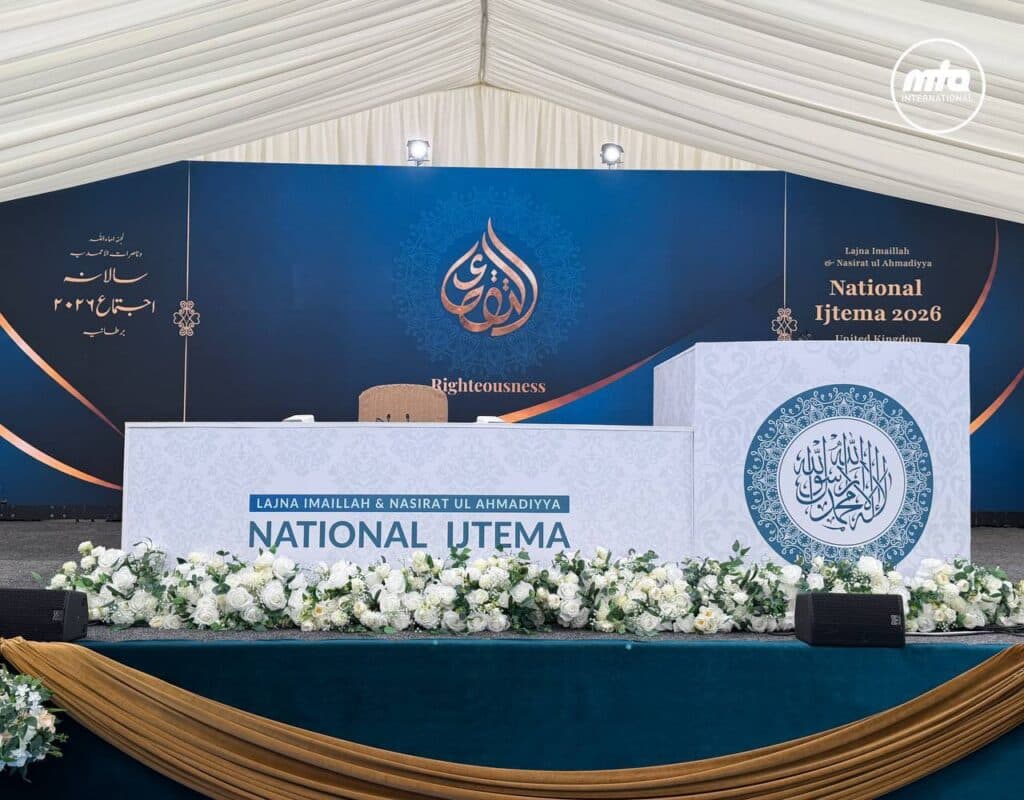
The first day of the 47th annual ijtema for Lajna Imaillah and Nasirat-ul-Ahmadiyya UK took place on 18 September 2026. By 3:45 pm, an atmosphere of friendly competition took its place as the Tilawat and Hifz-e-Quran competitions began. All competitions were conducted across different marquees to ensure prompt completion.
This was followed by an English presentation on “Taqwa in the Digital Age and Social Media” by Homaira Chaudhry Sahiba. The speech tackled the ever-growing benefits and dangers of the digital age within the 21st century; not shying away from the advantages it can offer while also unveiling the cautious concerns it carries along with it.
Homaira Sahiba discussed the ways in which the Jamaat constructively utilises technology for the cause of faith, how it can be a blessing that connects one to Khilafat, grants access to the Holy Quran, Friday Sermons, various other gems of knowledge and history, as well as providing services for the Jamaat.
However, she also shed light upon the ways in which it may become a distraction, how even Huzoor (aa) has reinforced the point that love for Allah the Almighty cannot develop if you procrastinate or delay prayers in favour of scrolling on social media for “just one more minute.”
One must always remember that technology follows the direction of our taqwa; it can be a blessing or a source of harm – the choice is ours and it is dependent on our discipline and obedience towards taqwa. This neatly tied in with this year’s ijtema theme – a reminder that “one must bear in mind that only when one has the fear of Allah the Almighty in one’s heart can one abstain from every kind of evil and this fear of Allah ought to manifest itself as love for Him”, in other words, taqwa. (Friday Sermon 26 March 2004; Khutbat-e-Masroor, Vol. 2, p. 220)
Following these eye-opening words, the English poetry competition got underway with participants having scripted and researched their own poetry on some of the following topics: faith and kindness, taqwa, Lajna Imaillah, Khilafat, the legacy of Lajna Imaillah and many more!
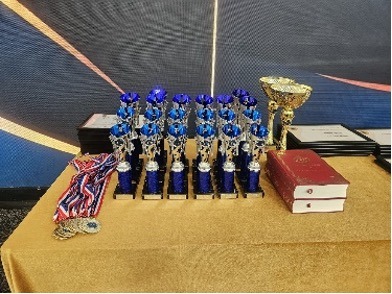
This set the stage for the Academic Awards distribution – the names of the nominees shared with Huzoor (aa) during the ladies session at Jalsa Salana UK 2026 were awarded a medal and certificate alongside a signed copy of the Holy Quran by both Sahibzadi Amatul Waris Farah Dahri and Sadr Lajna Imaillah UK. In addition to the academic awards, a prize distribution ceremony for the previous competitions was also scheduled.
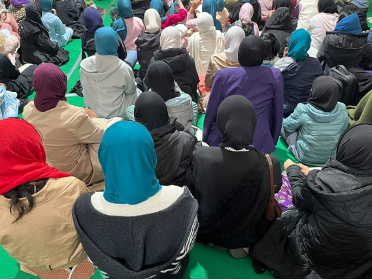
The session ended with a silent prayer, but the ijtema site was still buzzing with events and gatherings. One was the outdoor sitting with Sadr Lajna Imaillah UK, National Nasirat Secretary, Sahibzadi Amatul Waris Farah Dahri and Bibi Yusra Sahiba who were hosting the nasirat in the outdoor stage area.
The young future of the Jamaat sat gathered around the panel as they were handed comforting cups of hot chocolate and given the opportunity to ask any question that came to mind. The members questioned and learnt about topics such as purdah, Humanity First and when young girls should start wearing the hijab.
Others displayed curiosity of what it is like to be National Sadr and asked what the role feels like. Through this, the girls learnt about the importance of such responsibilities and how they should be deemed as humbling rather than something to brag about. Sadr Sahiba referred back to the teaching of the Holy Prophet (sa), reminding the girls that the leader of a people should be their servant.
Day 2
The morning session of the second day commenced and the morning programme continued with the English speech and nazm competitions. Matina Hakim Sahiba also delivered a presentation entitled “Taqwa – The Shield of a Believer in a Materialistic World”. Her presentation served as a timely reminder of the purpose behind the ijtema: to strengthen one’s relationship with Allah the Almighty and striving to live according to His commandments.
She reminded the audience of the prayer:
“O my God, owing to Your love, I wish to abandon all those deeds which You have forbidden and adopt all those deeds which You have commanded. However, in order to attain Your nearness, I require Your blessings! O Allah, through Your grace, make me righteous!” (Friday Sermon 26 March 2004; Khutbat-e-Masroor, Vol. 2, p. 220)
AMRA lectures
Meanwhile, the AMRA programme was taking place on the Lajna side of the ijtema gah. Beginning at 10:15 am, the lectures’ marquee hosted a series of presentations and discussions delivered by academics and women with expertise in various fields. The marquee was filled from the outset, with many attendees standing or seeking seats as they eagerly listened to the sessions.
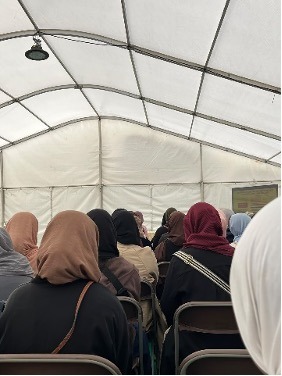
The first presentation, “Walking the Path of Taqwa in a Modern World”, was delivered by Dr Saira Rashid Sahiba. Inviting the audience to reflect on the amount of time they spend looking at screens, she posed a thought-provoking question: where is Allah Almighty in all of this? Drawing upon the verse, “O ye who believe! let not your wealth and your children divert you from the remembrance of Allah […]” (Surah al-Munafiqun, Ch.63: V.10), she encouraged listeners to examine how frequently they remember Allah the Almighty and what causes them to become heedless of Him.
This was followed by Reem Shraiky Sahiba’s presentation, “Can Faith and Reason Co-Exist? An Academic Examination”. She explored how knowledge can deepen a person’s sense of wonder, particularly when the study of science reveals the complexity and beauty of creation. Rather than diminishing belief in the Creator, an understanding of the natural world can, for a believer, deepen appreciation of His creation.
She concluded by quoting the Promised Messiah (as):
“This is exactly what my mission is and this is what I have been proving that there is absolutely no conflict between science and religion. Rather, religion is in complete accord with science. And no matter how much science advances, it will never be able to show that the teachings of the Holy Quran and the principles of Islam are false.” (Malfuzat [English], Vol. 10, p. 555)
A panel discussion entitled “Is there a Conflict Between Being a Muslim and a Loyal British Citizen?” was subsequently conducted by Dr Anne Marie Lonescu Sahiba, Tooba Khokhar Sahiba and Dr Hibbah Saeed Sahiba. Another presentation, “Materialism through the Ages and the Role of Taqwa in Addressing its Ills”, was delivered by Ayesha Mahmood Malik Sahiba. She reminded the audience of the Holy Quran’s warnings against becoming consumed by worldly pursuits and encouraged listeners to recognise the importance of taqwa in protecting the soul from the distractions of materialism.
There was also the opportunity for the older nasirat to attend a transition event in the AMWSA Marquee for girls who are becoming part of Lajna Imaillah UK this year. This was a new, voluntary event at the ijtema which came out of a shura proposal. This discussion taught the older nasirat the differences between being a nasirah and a member of Lajna Imaillah, as well as introducing shura and nizam, and the importance of making sure every voice is heard within them.
At approximately 12:50 pm, participants eagerly gathered for the prize distribution ceremony. The morning session then concluded with silent prayer, followed by a lunch break.
Afterwards, the marquee soon filled with thousands of women from across the UK, who gathered in anticipation of Huzoor-e-Anwar’s (aa) address. The full report of the session can be read here.
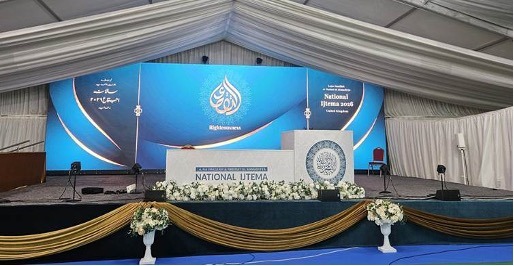
Subsequently, a programme exclusively for new converts was held, while a separate sitting of students with National Sadr Sahiba UK and the National Secretary Umur-e-Talibaat, Rabia Choudhry Sahiba, took place in the outdoor stage area, offering practical guidance on navigating university life while remaining steadfast in one’s faith. Emphasis was placed on making positive use of university and social settings to convey the message of Islam while maintaining openness and confidence in one’s Ahmadi identity.
In matters concerning education and living away from home, the importance of seeking the counsel of parents and carefully considering one’s responsibilities was highlighted. The panel also addressed the challenge of maintaining spiritual routines alongside academic demands, stressing that lasting habits are developed gradually through consistency rather than attempting too much at once.
Drawing upon the example and teachings of the Promised Messiah (as), it was emphasised that perseverance in small, regular acts of worship and righteousness – including the five daily prayers, Tahajjud and the study of the Holy Quran – can strengthen one’s faith and bring greater discipline and purpose to everyday life.
As evening fell, dinner was served, followed by Maghrib and Isha prayers. The day ended with hearts strengthened through spiritual nourishment, minds enriched by knowledge and spirits uplifted by the blessings of a memorable ijtema.
Day 3
The third and final day of the ijtema began and the extempore speech and Urdu speech competitions took place. Eventually, another set of Academic Awards for GCSE and A-Level students, alongside the previously mentioned competition prizes and SEND, New Converts and the National Exhibition prizes, were also distributed.
Aside from these displays of talent and devotion, the Umur-e-Talibaat marquee also catered to students exclusively with an assortment of talks, presentations and activities available for students to partake in. The department also housed the Book Exchange scheme within their marquee which allowed those with unwanted textbooks, revision guides or any form of educational resource to leave behind for another who may make greater use of it.
Across the three days, the AMWSA team (hosts of students and organisers of many of these activities and lectures) also raised awareness of the ongoing warfare within Palestine and the ways in which Humanity First have been providing aid, a transition event for new students who would be joining AMWSA, walk-in sessions for prospective university students with subject-specific representatives, as well as arts and crafts activities being held during lunch.
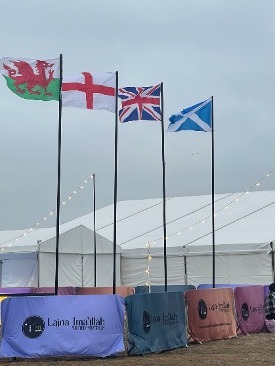
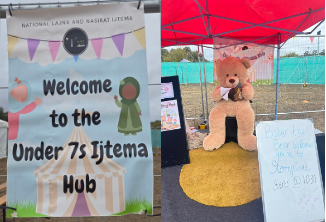
Of course, nasirat had activities scheduled for all three days! Children would be registered for the day and given an activity book to work their way through. Each complete activity won the children a sticker and regardless of their progress by the end of it, all the under 7s were awarded a medal.
However, the team also made sure to utilise this time to help develop and build these young children’s confidence by granting them a safe space to participate in the adults events, just on a more leisurely level; children were welcome to pick any Quranic verse, any nazm and any speech topic with the hopes that it would enable them to become more comfortable with the process.
The under 7s were also taken through activities teaching them about animals and fruits mentioned in the Holy Quran, stories of the Holy Prophet (sa), taqwa, Urdu and even Arabic. A funfair comprising bouncy castles and blow-up activities were also accessible for the younger attendees.
Additionally, attendees were also offered a variety of activities and lectures to participate in, courtesy of the AMRA and Exhibition Marquee. The AMRA team had many talks scheduled such as “Evidence for the Existence of God: Philosophical and Scientific Perspectives”, “Examples of Taqwa from the Life of the Holy Prophet Muhammad (sa)”, “The Holy Quran’s Description of Success: What Does It Mean to Truly Win?”, “Strategies for Building Resilience in Everyday Life” and even a panel discussion focusing on “Materialism: A Barrier to Sincere Worship of Allah”.
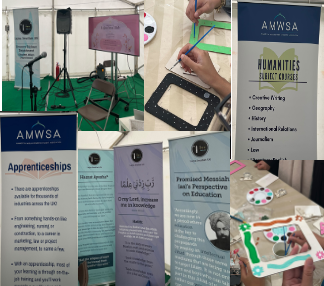
New and exciting exhibitions were also on display, courtesy of the AMRA department. Two notable mentions should be made to the Escape Rooms and the Space VR activities! Attendees were gifted the opportunity to visit space, explore planets and even watch a rocket show through one simple VR headset! Not only were participants left with greater scientific knowledge, but also greater admiration and gratitude for Allah the Almighty and His immense creations.
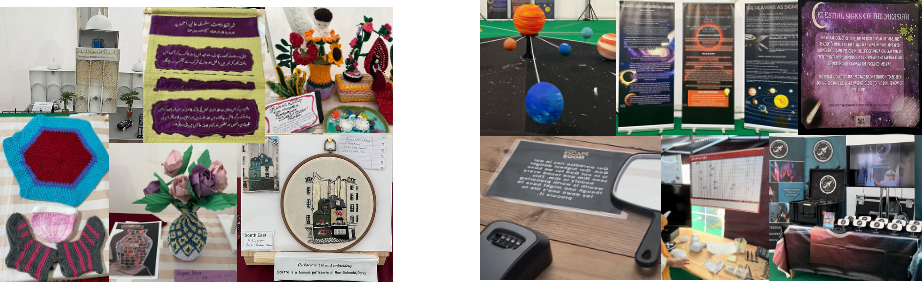
Next came the Escape Rooms, which really and truly drew in a colossal crowd into the marquee. Within the same marquee, neighbouring this scientific innovation was the Trade and Industry Department; an artistic showcase of talent and creativity.
With the morning session competitions and selection of activities having been productively completed, members hurried into their marquees or near loudspeakers, in an attempt to gather and listen to National Sadr Sahiba’s annual ijtema speech.
This year, in the Umur-e-Talibaat marquee, the AMWSA presidential elections were conducted simultaneously in preparation for the next academic year. The ijtema grounds boasted many different facilities and departments such as the Tuck Shop, an Ice Cream van, the Bazaar, a Nappy Changing Marquee, Homeopathy, The Review of Religions and the SEND Marquee to name a few.
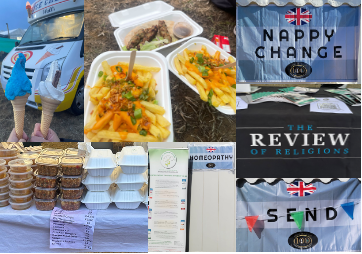
By around 2:25 pm, the post-lunch session commenced with a recitation from the Holy Quran and its translation. The programme then moved on straight to the English quiz competition and the Bait Bazi competition. Next followed the prize distributions of these respective competitions.
Finally, the greatly anticipated arrival of Huzoor (aa) came as members began settling in their marquees. Upon his arrival on the men’s side of the ijtema, participants offered congregational Zuhr and Asr prayers behind Huzoor (aa). Then, live from the men’s side of the ijtema site, Huzoor (aa) delivered his address. The full report can be read here.
The event taught and encouraged all its visitors to everlastingly love Allah the Almighty, to devote their lives to the cause and guidance of Allah their Creator, to pursue the happiness of Allah their Provider and therefore, also remain grateful for these bounties and blessings; thus to instil taqwa within one’s self.