
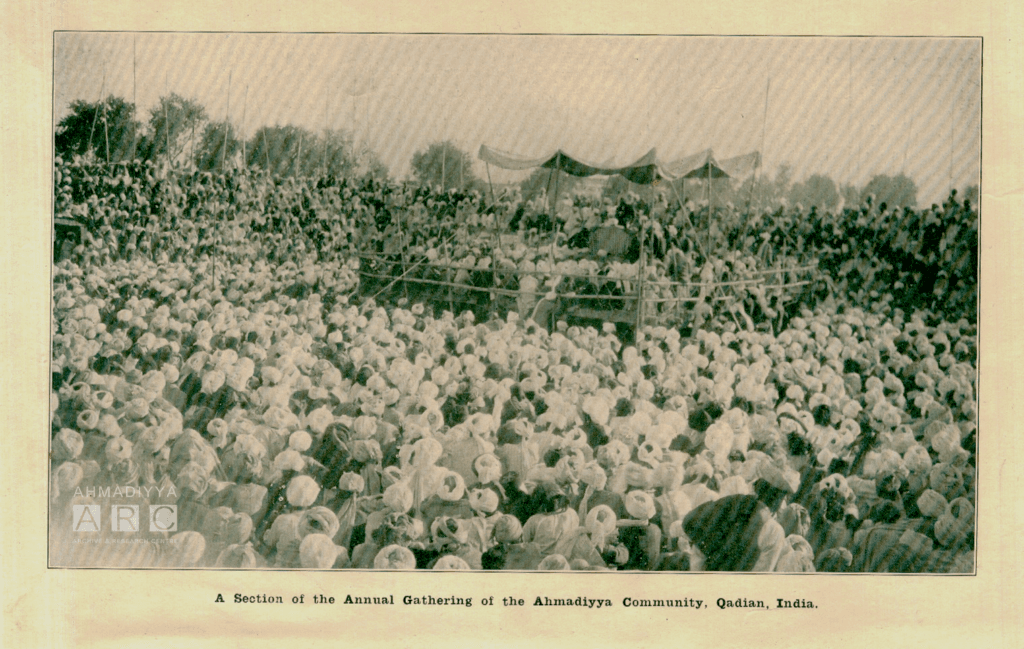
Jalsa Salana Qadian
The annual gathering of the Ahmadiyya Muslim Community was held on 26, 27, and 28 December [1925] at Qadian, the headquarters of the Jamaat. Members from all parts of India and from Mauritius and East Africa flocked to hear the illuminating and educative speeches of His Holiness, Hazrat Khalifatul Masih II[ra], [then] head of the Ahmadiyya Muslim Jamaat. The lowest computation places the number present at 11111 souls.
Opening
Hazrat Khalifatul Masih II[ra] opened the meeting with a brief address followed by prayer. The welcome address was read by KS Farzand Ali Sahib on behalf of Mir Muhammad Ishaq Sahib, the chairman of the reception committee.
Speeches
Speeches were made by Messrs Qasim Ali Sahib, Muhammad Yusuf Sahib, Sarwar Shah Sahib, Muhammad Sadiq Sahib, Abdur Rahman Sahib, Fatih Sayal Sahib, AR Nayyar Sahib, Khalil Ahmad Sahib, Roshan Ali Sahib, Zafrulla Khan Sahib (Barrister-at-Law), and Mirza Sharif Ahmad Sahib, on various subjects.
Hazrat Khalifatul Masih’s[ra] lecture
Hazrat Khalifatul Masih II[ra] spoke on 27 and 28 [December 1925] consecutively, each day for four hours, on “The Way of the Seekers,” in which he dwelt at length on the ways by treading which a seeker can acquire complete immunity from sins and can attain to perfect realisation of God and close communion with Him. The speech was listened to with rapt attention as usual.
Bai‘at and management
Around 400 persons joined the fold of Hazrat Ahmadas on this occasion The management was vested in Mir Muhammad Ishaq Sahib. The anniversary was a complete success in every way.
Lajna address
Ahmadi ladies held their separate gatherings under the auspices of the central women’s association, which is known as Lajna Imaillah. Hazrat Khalifatul Masih II[ra] delivered a three-hour speech in the Lajna as well. Around 8000 ladies took part in the meetings. Some 350 ladies joined the Ahmadiyya Movement.
Religion and science
“The time has come”, says the Modern Review, “when religion should shake hands with science in a spirit of fellowship. The feeling of enmity and quarrel that has created today a yawning gulf separating the one from the other must give way to one of mutual confidence, and they should unite as friends and help each other towards the realisation of a common end, which is Truth. So far as we understand, the whole conflict is due to a misconception that is bound to disappear with a better knowledge and understanding of each other’s function and province.”
We do not think there ever was or there can ever be any conflict between science and religion. The function of science is to fathom the secrets of nature, which is the work of God. Religion, on the other hand, raises man to the highest pinnacles of moral eminence and enables him to attain to real and true communion with the Supreme Being. Science makes us masters of natural forces; religion gives man the power to know God, to respond to Him, to live in Him.
International friendship
Sir Willoughby Dickinson, speaking at St Mark’s Church, Kennington, on “The promotion of international friendship between the Churches”, said the most important thing people were working for was to find a means to prevent war, and for this purpose the League of Nations had been established, and was doing valuable work. But even the League of Nations would be helpless unless the relations between the various races could be made more friendly. That was the object which the Association for Promoting International Friendship through the Churches had in view.
Who can solve this issue?
But the question is whether the politician or the priest or the philosopher can solve the complicated racial, economic and colour problems that are undermining the foundations of the peace of the world. The dawn of the millennium requires a Messiah to come. He is Ahmadas of Qadian, Punjab, India.
Mahatma Gandhi and Islam
Speaking in the Indian National Congress, Mr Gandhi said:
“Someone has said (I do not know where, but only recently), that Europeans in South Africa dread the advent Islam – Islam that civilised Spain, Islam that took the torchlight to Morocco and preached to the world the Gospel of brotherhood. The Europeans of South Africa dread the advent of Islam, for they are afraid of the fact that if the native races embrace Islam, they may claim equality with the white races. They may well dread it. If brotherhood is equality of coloured races that they dread, then that dread is well-founded. For I have seen that any Zulu embracing Christianity does not ipso facto come on a level with all Christians, whilst immediately he embraces Islam, he drinks from the same cup and eats from the same dish as a Mussalman. That is what they dread.”
Islam’s distinction
The power of Islam lies in the fact that it knows no caste nor colour. The Islamic Brotherhood transcends all barriers of country or nationality. It is all-comprehensive. Therein lies its superiority over other religions.
Toleration in Islam
According to Tabari, when Jerusalem submitted to the Muslim armies, the terms granted by Hazrat Umarra, the second Successor of the Holy Prophet Muhammad, peace and blessings of Allah be upon him, in which the inhabitants of the city were allowed protection of life and property and the free and undisturbed exercise of their religion, were as follows:
“In the name of God, the Compassionate, the Merciful!
“This is the security which Umar, the servant of God, the commander of the faithful, grants to the people of Aelia. He grants to all, whether sick or sound, security for their lives, their possessions, their churches and their crosses, and for all that concerns their religion. Their churches shall not be changed into dwelling places, nor destroyed, neither shall they nor their appurtenances be in any way diminished, nor the crosses of the inhabitants, nor aught of their possessions, nor shall any constraint be put upon them in the matter of their faith, nor shall any one of them be harmed.”
(Transcribed and edited by Al Hakam from the original English, published in the February 1926 issue of The Review of Religions)