
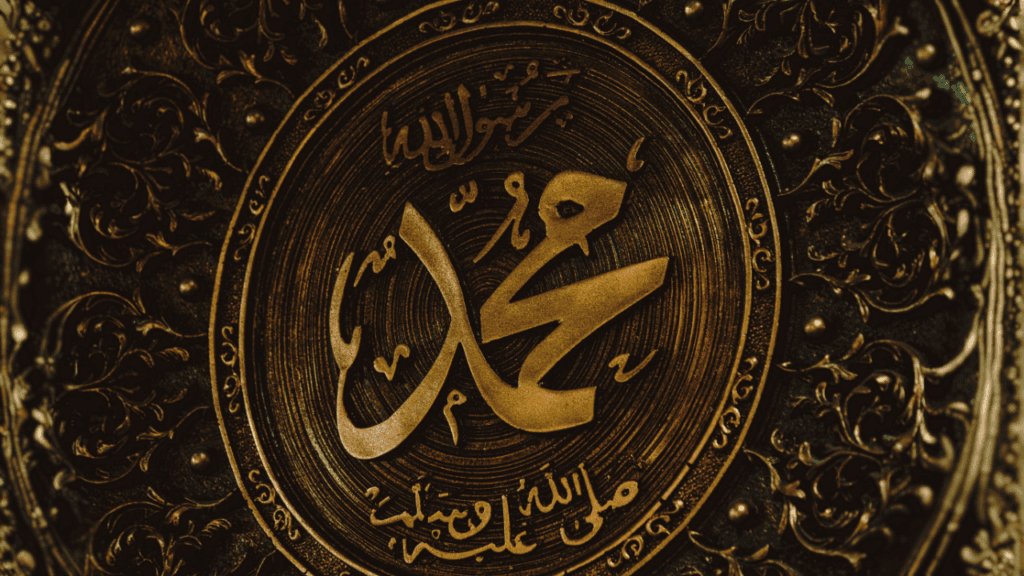
Sheharyar Bajwa, Student, Jamia Ahmadiyya UK
The Holy Prophet, peace and blessings of Allah be upon him, had a blessed face which was أَزْهَرَ اللَّوْن “radiant in complexion” and أَبْيَضُ مُشْرَب “white with a reddish tinge.” His eyes were large and dark with long lashes, and his brows were finely curved and naturally separate. His cheeks were smooth, his mouth beautifully wide and his teeth were أفلج الثنيّتین “slightly spaced and shining.” When he smiled, it lit his whole face with a softness that the Companionsra never forgot. (Shamail al–Tirmidhi, Hadith 7-14)
إِذَا تَكَلَّمَ رُئِيَ كَالنُّورِ يَخْرُجُ مِنْ بَيْنِ ثَنَايَاه
“When he spoke, it was as if light came out between his front teeth.” (Mishkat al-Masabih, Hadith 5797)
His hair was naturally wavy, neither straight nor tightly curled. At times it reached his earlobes and at times his shoulders. He would part it on some occasions and leave it unparted on others. His beard was thick and full, dignifying his appearance.
A Companionra is reported to have said:
كَأَنَّ عُنُقَهُ جِيدُ دُمْيَةٍ فِي صَفَاءِ الْفِضَّة
“His neck was as if it were the neck of a finely crafted statue in the purity of silver.” (Shamail al-Tirmidhi, Hadith 7)
يَتَلأْلأُ وَجْهُهُ، تَلأْلُؤَ الْقَمَرِ لَيْلَةَ الْبَدْر
“His face shone with the radiance of the moon on the night of the full moon.” (Ibid.)
Hazrat Abu Hurairara said:
مَا رَأَيْتُ شَيْئًا أَحْسَنَ مِنْ رَسُولِ اللَّهِ صلى الله عليه وسلم
“I did not see anyone more handsome than the Messengersa of Allah, peace and blessings of Allah be upon him.”
كَأَنَّ الشَّمْسَ تَجْرِي فِي وَجْهِه
“It was as if the brightness of the sun had shone from his auspicious face.”
He continued: “I never saw anyone walk faster than the Messengersa of Allah. It was as if the earth was folded up for him. We would tire ourselves out (trying to keep up), while he did not seem concerned in the least.” (Jami at-Tirmidhi, Hadith 3648)
Hazrat Alira said the Holy Prophetsa “walked as if going downhill, energetically. He was neither short nor tall. I have never seen anyone like him before or since.” (Musnad Ahmad, Hadith 1122)
When walking, the Holy Prophetsa did not drag his feet, nor did he lift them harshly. When he turned, he turned his whole body. When he spoke to someone, he faced them entirely, giving them his full attention. His gait, his posture, and the calmness with which he sat all carried a quiet majesty – a humility that neither diminished his presence nor allowed it to overwhelm. (Shamail al-Tirmidhi, Hadith 7)
He stood with balanced, natural height – “neither conspicuously tall nor short.” His chest was broad, his shoulders strong and his limbs well-built. His palms were wide and firm, and his joints powerful. (Ibid.)
His physical strength can be gathered from many incidents, two of which are as follows:
During the digging of the trench before the Battle of the Ditch, the Companionsra came across a huge rock that none of them could break. They struck it repeatedly but their blows made no difference. The Holy Prophetsa descended into the trench, took the pickaxe and struck the rock himself. With each strike, a spark flashed, and a portion of the boulder shattered until it broke completely. (Sahih al-Bukhari, Hadith 4101)
Rukanah ibn Abd Yazid, may Allah be pleased with him, a renowned wrestler of the Quraish, was famed in Mecca for his unmatched strength and wrestling skills. Once, Rukanah challenged the Holy Prophetsa to a wrestling contest. The result? صَرَعَهُ النَّبِي – “the Prophetsa wrestled him to the ground.” (Sunan Abi Daud, Hadith 4078)
This did not happen once, but to Rukanah’s astonishment, the Holy Prophetsa threw him down three times. This left Rukanah deeply impressed by the strength and skill of the Holy Prophetsa, leading him to accept Islam.
The endurance and physical prowess of the Holy Prophetsa are also reflected by how he would regularly hike up to the cave of Hira for prayers. This hike is roughly three miles from the Ka‘bah at an elevation of 600 meters, which, at a time when the terrain was undeveloped and extremely rocky, would have required an extremely strong and healthy physique.
His majesty and presence
Many could not even fully look at him out of reverence and awe. On his deathbed, Hazrat Amrra bin al-Aas said:
ما كانَ أحَدٌ أحَبَّ إلَيَّ مِن رَسولِ اللهِ صَلَّى اللَّهُ عليه وسلَّمَ، ولا أجَلَّ في عَيْنِي منه، وما كُنْتُ أُطِيقُ أنْ أمْلأَ عَيْنَيَّ منه إجْلالًا له، ولو سُئِلْتُ أنْ أصِفَهُ ما أطَقْتُ؛ لأَنِّي لَمْ أكُنْ أمْلأُ عَيْنَيَّ منه
“No one was more beloved to me than the Messengersa of Allah, and no one was greater in my eyes than him. Out of reverence for him, I could not gather enough courage to look fully at his face. If I were asked to describe him, I would not be able to, for I never filled my eyes with a full glimpse of him.” (Sahih Muslim, Hadith 121)
After accepting Islam, addressing the Holy Prophetsa, Hazrat Thumamahra ibn Uthal declared:
يَا مُحَمَّدُ وَاللَّهِ مَا كَانَ عَلَى الأَرْضِ وَجْهٌ أَبْغَضَ إِلَىَّ مِنْ وَجْهِكَ فَقَدْ أَصْبَحَ وَجْهُكَ أَحَبَّ الْوُجُوه
“O Muhammadsa, by Allah! There was no face on the face of the Earth that was more hateful to me than your face, but now your face has become the most beloved of all faces to me.” (Sahih al-Bukhari, Hadith 4372)
Bravery and courage
The Messengersa of Allah was the epitome of bravery and courage, embodying steadfastness and valour without any arrogance.
In Sahih al-Bukhari, the Holy Prophetsa is reported to have described five unique distinctions that set him apart from all other prophets. The first was: نُصِرْتُ بِالرُّعْب “I have been reinforced with awe” (Sahih al-Bukhari, Hadith 335). This means that whenever an enemy stood before the Holy Prophetsa, Allah would instill fear and awe into their hearts.
In battle, he always led from the heart of the war. The Companionsra would seek protection behind the Prophetsa during war, as reported by Hazrat Bara’ bin Azibra:
إِذَا احْمَرَّ الْبَأْسُ نَتَّقِي بِهِ وَإِنَّ الشُّجَاعَ مِنَّا لَلَّذِي يُحَاذِي بِهِ . يَعْنِي النَّبِيَّ صلى الله عليه وسلم
“When the battle grew fierce, we, by God, would seek protection by his side, and the bravest among us was he who confronted the onslaught – and it was the Holy Prophetsa.” (Sahih Muslim, Hadith 1776b)
At the Battle of Uhud, when the enemies launched a sudden attack and exposed the Muslim army, the Holy Prophetsa, sword in hand, stood facing the enemy attack and endured severe injuries. A rock struck his face and his tooth was broken. Another blow caused his helmet to jam into his cheek. He also fell unconscious. Yet he rose again and continued fighting and leading the Companions to safety.
When the Muslims faced the ambush of the archers in the Battle of Hunayn and the enemy shower of arrows overwhelmed the army, many of the new converts to Islam fled – the Holy Prophetsa , on the other hand, stood firmly facing the enemy and declared:
أَنَا النبيُّ لا كَذِبْ أَنَا ابنُ عبدِ المُطَّلِب
“I am the Prophet; that is no lie. I am the son of Abd al-Muttalib.” (Sahih al-Bukhari, Hadith 4315)
He did not stop there. He dismounted from his mule, took a handful of sand and hurled it into the faces of the enemy. The enemy’s eyes filled with dust and they turned and fled. (Sahih Muslim, Hadith no. 1777)
The Holy Prophetsa embodied not only intense awe but also immense humility. He accepted no praise for himself, reminded others of his servitude to Allah and carried authority without arrogance.
Once a man came to the Holy Prophetsa shaking and awe-struck. The Holy Prophetsa said to him:
هَوِّنْ عَلَيْكَ فَإِنِّي لَسْتُ بِمَلِكٍ إِنَّمَا أَنَا ابْنُ امْرَأَةٍ تَأْكُلُ الْقَدِيد
“Be calm, for I am not a king. Verily, I am only the son of a woman who ate dried meat.” (Sunan Ibn Majah, Hadith 3312)
Hazrat Alira, who was raised by the Holy Prophetsa, provides a beautiful description summarising the characteristics of the Holy Prophetsa:
“He was the best of the people in generosity, the most truthful of the people in speech, the gentlest of them in temperament and the noblest of them in social speech. If someone saw him unexpectedly, he was awestruck by him, and if someone came to know him, he loved him. His describer says: ‘I have never seen the like of him neither before him nor after him.’” (Shamail al-Tirmidhi, Hadith 6)
Hazrat Anasra bin Malik, who served the Holy Prophetsa for ten years, said:
لَمَّا كَانَ الْيَوْمُ الَّذِي دَخَلَ فِيهِ رَسُولُ اللَّهِ صَلَّى اللَّهُ عَلَيْهِ وَسَلَّمَ الْمَدِينَةَ أَضَاءَ مِنْهَا كُلُّ شَيْءٍ فَلَمَّا كَانَ الْيَوْمُ الَّذِي مَاتَ فِيهِ أَظْلَمَ مِنْهَا كُلُّ شَيْءٍ وَمَا نَفَضْنَا أَيْدِيَنَا عَنِ التُّرَابِ وَإِنَّا لَفِي دَفْنِهِ حَتَّى أَنْكَرْنَا قُلُوبنَا
“When the day came on which God’s Messengersa entered Medina, everything in it shone; but when the day came on which he died, everything in it was dark. We did not brush the earth off our hands when we were engaged in burying him, and we felt sore at heart.” (Mishkat al-Masabih, Hadith 5962)