
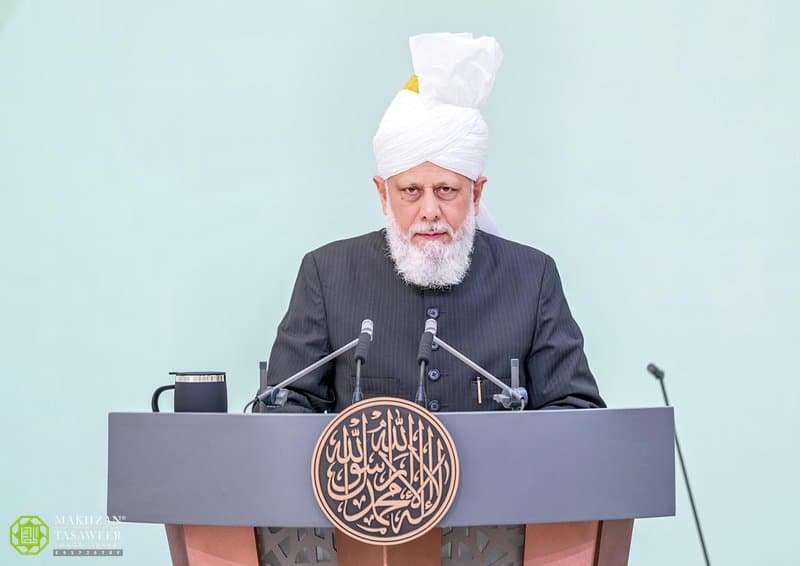
Friday Sermon
16 January 2026
The Prophet’ssa supreme love for Allah
After reciting the tashahhud, ta‘awwuz and Surah al-Fatihah, Hazrat Khalifatul Masih Vaa stated:
In one of my previous sermons, I mentioned an aspect of the life of the Holy Prophetsa in relation to his love for Allah. I will discuss this in further detail today. Even in his youth, and prior to his claim to prophethood, the fervour of divine love within him was such that he would become restless because of it and withdrew to a cave, engaging in sincere prayers to his Beloved.
Speaking of this love, the Promised Messiahas states:
“I find that summer also has a special connection with spiritual growth. Look at the Holy Prophet, may peace and blessings of Allah be upon him, that Allah the Exalted gave him birth in a city like Mecca, and then he would go alone to the cave of Hira to worship Allah the Exalted during those summers. What an extraordinary time that must have been! He must have carried a water bag with him. The essential point is that when love and passion develop for Allah the Exalted, a dislike and aversion to the world and the people of the world come into being. A natural liking for solitude and seclusion arises. This was also the condition of the Holy Prophet, may peace and blessings of Allah be upon him. He had become so lost in the love of Allah the Exalted that he found complete pleasure and delight only in this solitude. He spent many nights alone in a place where no means of rest and comfort were available, and one would be afraid to even travel to it. This also shows how brave and courageous he was. When the relationship with God Almighty is strong, courage also comes; this is why a believer is never cowardly. The people of the world are cowards; they do not possess real courage.”
“Upon hearing these matters, i.e., how one can develop a strong relationship with God Almighty and that such people prefer solitude and seclusion, some people raise objections as to why these prophets and messengers have wives and children? If they prefer seclusion to such an extent, why do they have wives and children? Why do they marry, walk through the markets and eat and drink as well? The Holy Quran has mentioned this as well. However, it is unfortunate that those who raise such objections do not realise that their case is either like the case of an individual who goes to someone’s house to beg, or like the case of a person who is a friend and merely intends to visit him. Now, if that friend of his places pilau [seasoned rice dish], etc., in front of his friend, then how is he to be blamed for this? Two individuals are going – one to beg and the other as a friend.
“If the host is hospitable towards him, as he is his friend, how then is he to be blamed for this? That is, the individual who has gone to visit his friend is not at fault. This friend becomes elated when his friend eats the food. However, the beggar is only given a stale piece of bread, and if he stays for longer, he is thrown out. There are two types of treatment – the beggar and the friend are treated differently; the friend is not treated in this manner and is thrown out. In fact, the host is pleased if his friend stays longer and eats and drinks. Nevertheless, the beggar and the friend are treated differently. The friend is welcomed and received hospitably, while the beggar is given something and sent away.”
He then stated:
“This is indeed the case with God’s prophets and His appointed ones. All that comes before them is not the result of their selfish desires. They find all pleasure and comfort in remaining occupied in the remembrance of Allah the Exalted. They actually like solitude, where they express their heart’s desires and wishes to their Beloved and want no one to see them in this state. Moreover, these relationships are for their perfection.” (Malfuzat, 1984, Vol. 7, pp. 407-408)
That is, their relationship of love with Allah the Exalted is directed toward attaining the very highest standard.
While describing the worship of Allah in the Cave of Hira, Hazrat Aishara has narrated in great detail a hadith which the Holy Prophetsa himself related to her. Hazrat Aishara narrates:
“The very first form in which revelation began for the Messengersa of Allah was through true dreams during sleep. Whatever dream he saw would come to pass with the clarity of the true dawn. (He would see very truthful dreams, and their fulfilment would follow immediately.) Thereafter, a love for solitude was instilled in him, and he would stay alone in the Cave of Hira, engaging in worship there. This worship would continue for a number of nights, which he would complete before feeling the need to return to his family. For this purpose, he would take provisions with him (meaning food and other necessities). Then he would return to Hazrat Khadijara and take further provisions for a similar number of nights.
“Eventually, the Truth came to him while he was in the Cave of Hira. An angel came to him and said, ‘Recite.’ He replied, ‘I cannot. I do not know how to read.’”
The Messengersa of Allah used to say – as Hazrat Aishara narrates – “that the angel then seized me and pressed me so firmly that my strength reached its utmost limit. Then he released me and again said, ‘Read.’ He replied, ‘I will not. I cannot read.’ The angel seized me again and pressed me forcefully a second time, to the point that I lost consciousness. Then he released me and said, ‘Read.’ He replied, ‘I cannot read.’ The angel then seized me a third time, pressed me forcefully, then released me and said:
اِقۡرَاۡ بِاسۡمِ رَبِّکَ الَّذِیۡ خَلَقَ ۚ خَلَقَ الۡاِنۡسَانَ مِنۡ عَلَقٍ اِقۡرَاۡ وَرَبُّکَ الۡاَکۡرَمُ
“‘Convey thou in the name of thy Lord Who created, created man from a clot of blood. Convey! And thy Lord is Most Generous.’ (The Holy Quran, 96: 2-4)
“Taking these verses with him, the Messengersa of Allah returned from the Cave of Hira.
“When he came home to Hazrat Khadijara, his heart was trembling. The Holy Prophetsa said to Hazrat Khadijara, ‘Cover me, cover me.’ So she wrapped him in a cloth until his fear subsided. Then he related the entire incident to Hazrat Khadija and said, ‘I fear for my life.’
“Hazrat Khadijara replied, ‘Never! By God, Allah will never disgrace you. You maintain ties of kinship, you bear the burdens of the weak, you practise virtues that have disappeared, you show hospitality to guests, and you help people in times of hardship in the cause of truth. (He always stood by the truth despite difficulties.)’
“Thereafter, Hazrat Khadijara took him to her cousin Waraqah bin Naufal, the son of Asad bin ‘Abdul ‘Uzza. Waraqah had embraced Christianity during the era of ignorance and knew how to read and write Hebrew. He would write from the Gospel in Hebrew whatever Allah willed. He had become very old and had lost his sight.
“Hazrat Khadijara said to him, ‘O son of my uncle, listen to what your nephew has to say.’ Waraqah asked him, ‘O my nephew, what have you seen?’ The Messengersa of Allah informed him of all that he had seen. Waraqah said to him, ‘This is the bearer of the Law whom Allah sent to Mosesas. If only I were young; if only I lived to see the time when your people would expel you.”
Allah’s Messengersa, “Will they expel me?” He replied, ‘Yes. No one has ever brought a message like the one you have brought without being opposed. If I live to see that time, I will support you with full resolve.’
“Soon after this, Waraqah passed away, and revelation was suspended for a period of time.” (Sahih al-Bukhari [Translation], Vol. 1, Kitab bad’i l-wahyi, Bab kayfa kana bad’u l-wahyi ila Rasulillahsa…, Hadith 3, Nizarat Ishaat, Rabwah, pp. 5-7)
The Promised Messiahas states:
“The fact of the matter is that, on the basis of the teaching of the Holy Quran, I understand this issue as follows. On the one hand, Allah the Exalted outlines his attributes of benevolence, mercy, kindness, and favours, and describes Himself as Rahman [Gracious]. And on the other hand, He says:
أَنْ لَّيْسَ لِلْإِنْسَانِ إِلَّا مَا سَعَى
“‘And man will receive only that which he strives for.’ (The Holy Quran, 53: 40)And:
وَالَّذِينَ جَاهَدُوا فِيْنَا لَنَهْدِيَنَّهُمْ سُبُلَنَا
“‘And those who strive to meet us [they strive], We shall surely enable them to come towards Our paths.’” (The Holy Quran, 29: 70)
He further states that by saying this, Allah the Almighty has made “His blessings have been made contingent upon endeavouring and striving. Moreover, we also have the conduct of the Companionsra as a great and noble example for us. Look and ponder upon the lives of the Companionsra. Did they attain those lofty ranks merely by offering the routine Prayers? Of course not! Quite the contrary, in order to attain the pleasure of God, they did not care even for their own lives; they sacrificed their lives in the way of God like sheep and goats. Only then were they able to attain that status.”
In the company of the Holy Prophetsa, the Companions strove to attain the love of God, and for this, they became ready for every sacrifice, and they did indeed offer sacrifices. Then they attained such a rank by which Allah the Almighty became pleased with them.
The Promised Messiahas states:
“Most people, in my experience, are such that they expect to be granted those same lofty ranks instantaneously through some magical breath [of a mentor], thereby gaining access to the Heavenly Throne. [He states,] Who could there be who is greater than our Noble Messengersa? He was the Best of Men and the Best of Messengers and Prophets. When he did not do those things with the blow of his breath, then who else could there be who could do so? Consider all the toil he undertook in the cave of Hira. Only God knows how long he spent in his supplications and entreaties. He endured all manner of toil and trouble for self-purification. Only then did the bounty from God Almighty descend upon him.
“The crux of the matter is, indeed, that unless and until a person brings a death and a state of annihilation upon himself in the way of God, no concern is shown from the other side. However, when God sees that a person has put forth his utmost effort and has brought ‘death’ upon himself in order to find Him, then He manifests Himself upon him, and blesses him, and elevates him by the show of His might.” (Malfuzat, Vol. 10, pp. 256-257)
Then in another place, the Promised Messiahas states:
“The nature of prophets is such that they do not desire fame. No prophet ever desired fame. Our Noble Prophetsa also liked seclusion and solitude. For the purpose of worship, he would move away from people into a solitary cave, which was the Cave of Hira. This cave was so terrifying that no human being could ever dare enter it, but he had chosen it because no one would come there out of fear. He desired complete solitude. He did not like fame at all. But the command of God came:
يَـٰٓأَيُّهَا ٱلۡمُدَّثِّرُ قُمۡ فَاَنۡذِرۡ
“That is, ‘O he who is wrapped in a cloak, stand and warn the people.’ (The Holy Quran, 74:2-3)
“In this command, a compulsion is observed, and for this reason it was commanded with compulsion, that you must leave the solitude which you liked.” (Malfuzat, 1984, Vol. 7, p. 44)
Thus, when the love of Allah the Almighty reached its extreme, and his striving also reached its extreme, then Allah the Almighty sent him into the world to spread His final law. He further states that this was love and adoration for Allah the Almighty, but it was also a striving, due to which Allah the Almighty then bestowed him innumerably. And every human being, according to his own rank, until he makes an effort and strives, encounters difficulty in reaching Allah the Almighty. In the love of Allah the Almighty, the state of the Holy Prophet’ssa prayers was such that Mutarraf narrates from his father that he said: “I came to the Holy Prophetsa while he was offering prayer. There was a sound like the noise of a boiling pot, coming from his chest.” (Sunan an-Nisa‘i, Kitab al-Sahw, Bab al-Buka’ fi al-Salat, Hadith 1215)
He was weeping and lamenting with such intensity that it seemed as though water was boiling in a pot. Similarly, in one narration, Hazrat Aishara relates – which I have already mentioned in a previous sermon – that he would perform so much worship and would stand for worship that his feet would become swollen. (Sahih al-Bukhari, Kitab at-afsir [Tafsir of Surah al-Fatihah], Bab qawluhu ‘La-yaghfiru lakAllahu ma taqaddama…’, Hadith 4837)
Hazrat Musleh-e-Maudra, while mentioning the love and worship of the Holy Prophetsa, states at one place – I have also mentioned this small portion earlier in a sermon before the last one, where I spoke about the life of the Holy Prophet, but there is some further detail about it, which I will also mention. From this, further clarification of the Holy Prophet’ssa love and passion for Allah the Almighty becomes evident.
Hazrat Musleh-e-Maudra writes that:
Hazrat Aishara relates that when the Messengersa of Allah was on his deathbed, owing to extreme weakness, he was unable to lead the daily prayers. Thus, he instructed Hazrat Abu Bakrra to lead the prayers. When Hazrat Abu Bakrra began to lead one of the prayers, the Messengersa of Allah felt somewhat better and so left his house to join the prayers. Hazrat Aishara relates that when, after instructing Hazrat Abu Bakrra to lead the prayers, the Holy Prophetsa felt a bit better; he used the support of some men to make his way to the prayers. She relates that the scene still flashes before her eyes: how the Holy Prophetsa would drag his feet on the way owing to extreme pain. When he arrived in the mosque, and Hazrat Abu Bakrra indicated that he wished to make way for the Prophetsa to lead instead, the Holy Prophetsa stopped him and motioned for Hazrat Abu Bakr to continue leading. Then the Holy Prophetsa was brought near Abu Bakr, and he sat down by him. After this, the Holy Prophetsa began his prayer, and Hazrat Abu Bakr followed along, while the rest of the congregation followed Hazrat Abu Bakrra.
This hadith highlights that no matter how grave his ailment may have become, the Messengersa of Allah never neglected the remembrance of Allah. Often, it is observed that people forget all forms of worship because of minor sicknesses. Congregational prayers and other conditions of prayer are commonly neglected. But the condition of the Holy Prophetsa was such that, let alone minor ailments, even in this illness, which eventually led to his demise, in which he would repeatedly lose consciousness and was unable to even stand, when the time for prayer came, he could not remain behind in a quiet home. At that moment, despite such extreme sickness, he leaned on the shoulders of two men and, his steps stumbling, ensured he showed up for congregational prayers. On the surface, this may seem like a minor point, but look at the extreme level of sickness from which the Holy Prophetsa was suffering, and then look at the deep zeal for worship that possessed him to come to the mosque using the support of two men, and you will realise that this incident is not an ordinary one. Rather, it is like a mirror that reflects the unwavering passion for worship that abounded in his heart. Every person possessed of understanding can comprehend that the worship of Allah was his sustenance, without which he felt no real pleasure in life. It is to this that he made reference by saying that the coolness of his eyes was in salat.
In terms of the Sharia, he was under no obligation to make his way to the mosque or to offer the prayer in congregation, because Islamic law does not compel one who is sick to fulfil such conditions.
If someone is sick, he can offer prayers at home. But this was the Sharia of love. On one side is the command of the Islamic Sharia, but the Holy Prophet’s expression of enacting the Sharia was based on deep love of God. Those are the rules of Sharia, but these are affairs of divine love. These were the dictates of love which transcended mere rules, and from which love and fidelity dripped like water.
No doubt, the Sharia permitted the Holy Prophetsa to offer his prayers at home. But the love that he possessed for the remembrance of Allah compelled him that, come what may, he should fulfil the remembrance of Allah with all of its conditions intact and remember his Beloved. When this was the condition of his deep love and loyalty in a state of sickness, then one can estimate what the condition was when he was healthy. One can imagine the passion with which he must have engaged in the remembrance of his true Beloved.
The Holy Prophetsa possessed such a powerful love for God Almighty that he would immediately ignite with tremendous passion at the mere mention of his Beloved. He possessed such undying love for God Almighty that in both health and sickness, the remembrance of Allah was his sustenance. And it was this very spirit that he wished to inculcate within his people and his Ummah, that they too should adopt this way.
In the previous sermon, I mentioned a brief hadith pertaining to some aspects of the Holy Prophet’s life. There are certain details that need to be mentioned again; for that reason, I will mention them. On one occasion, the Holy Prophetsa went to Bani Amr bin Auf in order to resolve a matter. There was a quarrel and dispute between them, and so the Holy Prophetsa went to resolve the argument. Whilst this was going on, the time for prayer drew near, and the muezzin called the adhan. He then went to Hazrat Abu Bakrra and asked him if he would lead the people in prayer and he would recite the iqamat [shorter call to prayer recited before the start of prayer]. Hazrat Abu Bakr responded in the affirmative. Thus Hazrat Abu Bakrra stood up to lead the Prayer. In the meantime, the Holy Prophetsa also arrived. The people were engaged in the Prayer. During this time, the Holy Prophetsa passed from one side, moved forward, and stood in the first row. When news of his arrival spread, the people began clapping so that Hazrat Abu Bakr might become aware of it. However, Hazrat Abu Bakr did not turn his attention in any other direction during the Prayer. They would be completely absorbed in prayer and worship, whereby their attention was not diverted.
When the clapping continued for some time, Hazrat Abu Bakr then became attentive and realised that the Holy Prophetsa had arrived. The Holy Prophetsa indicated to him to remain where he was. At this, Hazrat Abu Bakr raised his hands and offered thanks and praise to Allah the Almighty for this honour. Thereafter, he stepped back and joined the row, and the Holy Prophetsa stepped forward and led the Prayer.
After completing the Prayer, the Holy Prophetsa said, “O Abu Bakr, when I had instructed you, what then prevented you from continuing to lead the Prayer?” Hazrat Abu Bakr replied – as I have mentioned previously – “What standing does the son of Abu Quhafah possess that he should stand ahead of the Messengersa of Allah and lead the Prayer?”
The Holy Prophetsa then turned towards the people and said, “I observed that you raised a clamour by clapping incessantly. If something occurs during the Prayer, one should say ‘SubhanAllah’, for when one says ‘SubhanAllah’, attention will be drawn towards him. As for clapping, that is the practice of women.”
Hazrat Musleh-e-Maudra writes: “Although many other lessons can be drawn from this hadith, at this point I wish to draw your attention to only one matter, namely that throughout his entire life, the Holy Prophetsa tried his utmost, in whatever manner possible, to ensure that people would constantly remain occupied in remembering God Almighty. As for the manner in which he himself remained engaged in the remembrance of God, that has already been described; however, this hadith shows that he desired to see these very words upon the tongue of every individual.”
We should reflect and examine ourselves: do we, too, keep the thought of Allah the Almighty in our hearts at all times in the manner that the Holy Prophetsa desired of his Ummah? Is there such pain and concern within our hearts, or do we turn towards Prayer and the remembrance of Allah the Almighty only for the sake of our worldly objectives and then forget in ordinary circumstances? He further writes:
“There are many incidents which show that the Holy Prophetsa wished for people to frequently remember Allah the Almighty. Thus, upon sneezing, at the commencement of eating and after finishing, at the time of sleeping and waking, after the Prayers, before undertaking any important task, while performing ablution – in short, in most actions – he directed people towards the remembrance of Allah the Almighty. This proves that he not only remained engaged in the remembrance of God himself, but also desired that others should likewise remain occupied in the remembrance of God. This is evidence of the perfection of his love.
Hazrat Musleh-e-Maudra writes: “I have seen many people who, after performing a little worship, become arrogant. After a few days of offering Prayers or engaging in acts of worship, they begin to regard themselves as Pharaohs without means or as the pride of the saints, and the world and all that it contains become contemptible in their eyes. They fail to recognise the true reality even of the greatest of people; indeed, to say nothing of human beings, they even lay claim to having conferred a favour upon Allah the Almighty Himself. They imagine that the worship they have performed is, as it were, a favour done to Allah the Almighty, and that He is indebted to them – God forbid – for had they not worshipped Him, what would He have done otherwise?
“Even amongst those who do not reach such an extreme, there are still many who, despite not reaching that level where they say that ‘what is God doing for us?’, are nevertheless observed to develop a certain measure of arrogance as a result of their acts of worship. Very few are those who, even after engaging in worship, remain firmly established in a state of humility. Indeed, it is precisely this group of the righteous – those who persist in humility despite their worship – who constitute the true company of the virtuous. They remain humble, conceal their worship, and even conceal their love for Allah the Almighty, regarding it solely as His grace that He has bestowed upon them the ability to worship. This, in reality, is the true group of the righteous.”
People often ask: What are good deeds? This question is frequently raised, especially in the present age, by children and by the youth. They also ask how one may know whether Allah the Almighty is pleased. Allah the Almighty is pleased in precisely this manner: that one performs good deeds and performs them solely for the sake of His pleasure. A person is capable of examining himself; there is no need to appoint an external judge. One can oneself discern whether the good deeds one performs are truly for Allah the Almighty, and if they are, then surely they are pleasing to Him.
He further writes, “By this standard, one can then understand what must have been the condition of the Chief of the Righteous and the Leader of the Prophets, the Holy Prophetsa. He was the embodiment of all virtues and the fountainhead of all goodness. He never performed worship for the sake of pride or self-exaltation. In fact, the more he fulfilled the obligations of servitude to Allah the Almighty, the more intense became the fire of his ardent longing. Instead of regarding Allah the Almighty as indebted to him on account of his worship, he himself felt overwhelmed with a sense of humble gratitude, saying: ‘O Allah, whatever opportunity for worship I am granted is granted only through Your grace.’
“His worship bore the character of continuity. When he spent a portion of time in worship, he would reflect that it was a great favour of Allah the Almighty that He had granted him the ability to do so, and that it was necessary to express gratitude for this favour. Overcome by this very sentiment of gratitude, he would then engage in further worship and would again regard this too as a favour of Allah the Almighty – for the ability to express gratitude is not granted to everyone unless God Almighty bestows His grace. (In other words, the opportunity to express gratitude itself is also owing to Allah’s favour.) Thereupon, his ardour and yearning would manifest even more strongly, and he would once again immerse himself in the worship of his Lord.
“Thus, this relationship of servitude and, in return, God’s love for him would continue, and it became so expansive that, on many occasions, his feet would swell due to prolonged standing in worship. The Companions would submit, ‘O Messengersa of Allah, why do you subject yourself to such exertion, when your sins have already been forgiven?’ To this, he would respond, ‘Should I not then be a grateful servant?’
“Hazrat Mughirah bin Shu‘bahra relates that when the Holy Prophetsa would stand for prayer, he would remain standing for such a long duration (this hadith has been mentioned earlier as well) that his feet – or his calves – would become swollen. When people would say to him, ‘Why do you exert yourself in this manner?’ he would reply, ‘Should I not become a grateful servant?’
“By Allah, how profound was this love and devotion to God Almighty! He would stand absorbed in the remembrance of God Almighty, so unaware of his physical being that the circulation of blood would descend towards his feet, causing them to swell. Yet this love would not allow his attention to be drawn to this discomfort. Those around him would look on in amazement, wondering what he was doing. They themselves would feel pain on his behalf and would draw his attention to it, saying, ‘Why do you do this? Why do you subject yourself to such hardship and bear such suffering? One must also have some regard for one’s health and comfort.’
“However, that pain which made others restless and deeply moved had no effect upon him. Instead of reducing his acts of worship or resolving not to stand for such prolonged periods in the remembrance of his Lord, he would dislike such suggestions and respond to them by saying, ‘Should I not be a grateful servant of God? He bestows such favours upon me, grants me such grace, and deals with me with such kindness – should I then not engage in His remembrance in return for His benevolence, or begin to show negligence in His worship?’
“This response was filled with such sincerity and gratitude. And reveals the emotions of his pure heart.
“Does anyone else possess such a burning passion for the remembrance and glorification of God? Can anyone else present such an example? Can any saint of any other people rival his sincerity? Yet observe that while he himself embodied this devotion, he also expected the same from his Ummah.”
Hazrat Musleh-e-Maudra then mentioned how the Holy Prophetsa remained actively engaged in his various responsibilities. “It was not the case that he confined himself solely to worship and abandoned all other duties. Nor was it that he would stand in worship at night and then sleep throughout the day – for had that been so, the depth of yearning and ardour would not have been evident in the same manner as it was when, throughout the day as well, he remained devoted to the propagation of the name of Allah the Almighty and to establishing obedience and submission to Him.
“He himself led the five daily prayers as the Imam. He personally met delegations and envoys who came from distant regions and responded to their requests. He himself commanded military expeditions. He taught the Holy Quran to the Companions. He himself served as judge, resolving throughout the day the disputes that arose among the people.
“He would manage the affairs of wealth and the treasury, oversee the administration of the state, ensure the implementation of Islamic teachings, fulfil the rights of his wives, and even take part in household chores – all during the day. Yet after performing all these tasks, instead of collapsing from exhaustion and remaining in bed until sunrise, he would repeatedly rise to glorify and praise Allah.
“When half the night had passed, he would rise, perform ablution, and stand completely alone before his Lord in utter humility and devotion, at a time when silence and stillness had spread across all directions. He would recite the Holy Quran and remain standing in prayer for such long periods that his feet would swell.
“It was to the extent that Hazrat Abdullah bin Mas‘udra narrates, ‘Once, I stood beside the Holy Prophetsa in prayer, but it became so difficult for me that I felt I would have to break the prayer and run away, for my legs could no longer bear the weight of my body, and I was unable to remain standing any longer for lack of strength.’
“This was the testimony of a man young in age, far younger than the Holy Prophetsa. From this, one can imagine the Holy Prophet’ssa strength and intensity of devotion – that despite his advanced years and despite being occupied all day with other work, he would still stand for such long durations in worship that even young men, and strong young men at that, whose daily exertions were not a fraction of his, could not keep up with him and would tire.
“Why was this worship performed with such intensity? For what reason did he endure this hardship? It was solely because he was a grateful man [of God]. His heart, constantly mindful of God’s favours, was ever drawn towards His remembrance. His heart overflowed with love for Allah the Almighty.” (Taken from Siratun Nabisa, Vol. 1, pp. 131-140)
Abu Salamah bin Abdur Rahman relates that he once asked Hazrat Aishara how the Holy Prophetsa prayed during the month of Ramadan. Ramadan is approaching again, and we should engage in worship not only in Ramadan but before it as well. Nevertheless, Hazrat Aishara replied, “The Messengersa of Allah never offered more than 11 rak‘at (units of prayer) in [the pre-dawn, voluntary] prayer, whether in Ramadan or in any other month.”
How was his prayer? She said, “He would not perform more than 11 rak‘at. He would perform four rak‘at – do not ask about their beauty and length – and then he would perform another four rak‘at – again, do not ask about their beauty and length. After that, he would perform three rak‘at of prayer.”
She said, “I once asked, ‘O Messenger of Allah, do you sleep before offering Witr?’ (Meaning that after the four rak‘at, would he rest briefly before the final three)? The Holy Prophetsa replied, ‘My eyes sleep, but my heart does not sleep – it remains awake in the love of Allah.’” (Sahih al-Bukhari, Kitabh al-manaqib, Bab kana n-nabiyyusa tanama ‘ainuhu wa la yanamu qalbuh, Hadith 3569)
The Promised Messiahas, while describing the Holy Prophet’ssa life and his closeness to God, writes:
“In another instance, describing the nearness of the Holy Prophet to God, the Holy Quran says:
قُلْ إِنَّ صَلَاتِي وَنُسُكِي وَمَحْيَايَ وَمَمَاتِي لِلَّهِ رَبِّ الْعَالَمِينَ
“‘Say, “My Prayer and my sacrifice and my life and my death are all for Allah, the Lord of the worlds.’ (The Holy Quran, 6:163)
“In other words, announce to the people that my condition is such that I have become lost to myself and all my worship is dedicated wholly to God. This alludes to the fact that until a person attains to perfection, they cannot purely worship God. A portion of his worship is devoted to God, while a portion of it springs from selfish motives, because such a one seeks greatness and grandeur for their own self, just as one ought to desire greatness and grandeur for God, this being the essence of worship. Similarly, a certain extent of his worship is for the sake of people because the majesty, greatness, power and authority which ought to be reserved for God alone, he ascribes in part to God’s creation as well. Therefore, he worships God just as he worships his own self and other creations; in fact, he offers a portion of his worship to worldly means at large, for he believes that these means, too, intervene in the process of creation and destruction in the face of God’s will and decree.
“Therefore, such a person cannot be a true worshipper of God Almighty, since at times he associates the grandeur of God with himself, at times with other creation, and still at other times, even with worldly means. On the contrary, a true worshipper is one who reserves all greatness, majesty and authority for God to the exclusion of all else. This is true Oneness of God and when an individual’s worship reaches such a level, it is then that he can be called a true worshipper of God. Just as such a person declares with his tongue that God is One and without a partner, so does he testify to the Oneness of God in practice, i.e., through his worship. It is this very rank of perfection that is referred to in the above verse wherein the Holy Prophet, peace and blessings of Allah be upon him, was instructed to announce to the people that all his worship was for God alone, which means that his inner self, creation at large, and worldly means have no share in his worship.
“Then the verse goes on to state: “My sacrifice is also devoted especially to God alone, and so is my life and my death.” Remember, the Arabic lexicon states that nasikah means ‘sacrifice’, and the word nusuk, which appears in this verse, is its plural form. Furthermore, this word also means worship. Hence, the word employed here applies to both meanings: worship and sacrifice. This demonstrates that worship in its perfect form, in which a person’s ego, creation at large, and worldly means have no part, is in fact a sacrifice; furthermore, perfect sacrifice is actually perfect worship. The verse then states: ‘My life as well as my death is for God.’ This last phrase is an elaboration of the word ‘sacrifice’ so that no one misconstrues this to imply the slaughtering of a goat, cow or camel; and so that it is clearly understood that the words ‘my life and my death is for God alone,’ signify that the purport of sacrifice in this instance is actually the sacrifice of one’s soul. The word qurbani or sacrifice is taken from qurb, which means ‘nearness’, and this alludes to the fact that the nearness of God is attained when all the desires and passions of the flesh are slain.
“In short, this verse is a great proof of the Holy Prophet’s perfect nearness to God. It serves as strong proof of the perfect divine nearness of the Holy Prophet, peace and blessings of Allah be upon him. The verse in discussion states that the Holy Prophet, peace and blessings of Allah be upon him, had become so absorbed and lost in God that every breath of his life and even his death had become wholly God’s, and that ego, other creation and worldly means had no part in his being. His soul had fallen at the threshold of God so sincerely that not the slightest adulteration of anything other than God could be found in it.” (The Honour of Prophets, pp. 15-18)
At another instance, the Promised Messiahas states:
“Although Allah the Almighty has made certain things permissible, it does not mean that one’s entire life should become dedicated to those things. Whilst describing His servants, God Almighty states:
يَبِيتُونَ لِرَبِّهِمْ سُجَّدً اوَّقِيَامًا
“‘And who spend the night before their Lord, prostrating and standing.’ (The Holy Quran, 25:65)
“That is, they spend the whole night for their Lord, prostrating and standing in prayer. Now consider this: how can a person who remains immersed day and night in his wives spend the night in worship in accordance with the will of God? For in the case of such a person, he puts his wives as partners with God. The Holy Prophetsa had nine wives, and despite this, he would spend entire nights in the worship of God.
“One night it was the turn of Aisha Siddiqara to be with the Holy Prophetsa. When a portion of the night had passed, she woke up and saw that the Holy Prophetsa was not there. The thought crossed her mind that perhaps he had gone to another wife. She rose and searched every house, but he was nowhere to be found. At last, she found him in the cemetery, weeping in prostration.
“Observe how the Holy Prophetsa left behind a living, loving wife and went to a cemetery, a place of the dead, where he wept. In this case, could it be that the Holy Prophetsa married his wives for the gratification of the self or the pursuit of lust? (As some detractors allege). Hence, remember well that God’s will is for you to not be dominated by carnal passions, and that a person may have more than one wife if it is for the attainment of complete righteousness, and if a genuine and true need arises.” (Malfuzat, 1984, Vol. 7, p. 66)
The Promised Messiahas generally advised members of the Jamaat that if, whilst keeping righteousness in view, if the need arises, then a person may have more than one wife; however, it must not be the case that a person marries or has more than one wife for the sake of personal desire and lust. Even today, complaints are received regarding this matter. Islam does not permit such conduct. The need must be legitimate and justified. It is for this reason that objections are raised against Islam because those who marry unlawfully give rise to the objection that Islam allows such marriages. But it must be remembered, both by Muslims and by those who raise objections, that there are conditions attached to this permission, and it is essential to fulfil them.
In another narration it is related by Hazrat Anasra that the Holy Prophetsa said – I have also mentioned this hadith in a previous sermon – “Among worldly things, wives and fragrance have been made dear to me, but the thing that I love most, and which is the delight of my eyes, is prayer.” (Sunan an-Nisa‘i, Kitab Ishrah al-Nisa, Bab Hub al-Nisa, Hadith 3391)
I have presented this again because I have found a detailed explanation of this by Hazrat Musleh-e-Maudra. He has explained:
قُرَّةُ عَيْنِي فِي الصَّلوةِ
“‘The delight of my eyes has been placed in prayer.’ This, too, is a distinctive excellence which Islam possesses in comparison to other religions. There is no nation in the world in which regularity in worship has been established in the same manner as Salat. All previous religions either continued to emphasise outward movements, or the times of worship were placed at such wide intervals that spirituality became weakened. Islam alone is such a religion whose followers are called to worship five times a day.”
People should reflect upon the fact that with the five daily prayers have been made obligatory, it is also necessary to offer them, so that spirituality may be preserved and one does not remain engrossed solely in worldly pursuits.
Hazrat Musleh-e-Maudra writes, “Christians and Hindus go for worship once a week. It is possible that some among them may worship day and night, but this refers to congregational worship. The command to worship several times a day was given by the Holy Prophetsa alone. Moreover, the word salat also carries the meaning of supplication, and in this way the Holy Prophetsa laid great emphasis upon prayer. In the acts of worship of other religions, emphasis has been placed upon outward expressions, and attempts have been made to create pleasure in worship through various means. For example, the Aryas and the Christians sing and play music. But the Holy Prophetsa says, ‘I have been granted a form of worship which carries within it true pleasure; a pleasure with which no other religion can compete.’” (Siratun Nabisa, Vol. 2, p. 263)
Thus, it is not singing and music, but the silent worship of Allah the Almighty; recounting His praise and sanctity; extolling His excellences; and then weeping and supplicating. These are the things, and this is the form of worship, that possesses true sweetness. Through it, the love of Allah the Almighty also increases.
Therefore, following the noble example of the Holy Prophetsa, we should strive to attain this standard in our prayers and worship. Only then can we truly be called Muslims.
The Promised Messiahas wrote a letter to Hazrat Mir Nasir Nawab Sahib, in which he stated:
“As for what you have inquired regarding your practical course, you should develop an inclination towards truly following the Holy Prophetsa. There are two aspects for which the Holy Prophetsa showed the highest degree of love: one is prayer, and the other is jihad. With regard to prayer, the Holy Prophetsa said:
قُرَّةُ عَيْنِي فِي الصَّلوةِ
“That is, ‘Delight of the eyes has been placed in prayer’. Regarding jihad, he said: ‘I desire that I be killed in the way of Allah the Almighty, then brought back to life, then killed again, then brought back to life, and then killed again.’”
Having stated this, the Promised Messiahas further said: “In this age, jihad has taken on a spiritual form, and jihad in this form is that one should strive to uphold the message of Islam; respond to the allegations of opponents; spread the excellences of the true religion of Islam in the world; and manifest to the world the truthfulness of the Holy Prophetsa. This is jihad; until such time as Allah the Almighty manifests some other form in the world.” (Maktubat-e-Ahmad, 2022, Vol. 3, p. 9)
Thus, blessings will be placed in our jihad with the pen and our propagation efforts only when we also elevate the standard of our worship and our love for Allah the Almighty. If we desire to take part in this jihad, then we must remain mindful of love for Allah the Almighty and prayers. We must also remain mindful of our acts of worship. Our endeavours will prove blessed only if we do so whilst following the example of the Holy Prophetsa. May Allah the Almighty grant us the ability to do so.
Today, Jamaat-e-Ahmadiyya Bangladesh is conducting its Jalsa Salana. There is considerable opposition in the region. Pray for them as well, that Allah the Almighty may keep them all under His protection, and that their Jalsa may be held peacefully and successfully.
(Official Urdu transcript published in the Daily Al Fazl International, 6 February 2026, pp. 2-8. Translated by The Review of Religions.)