
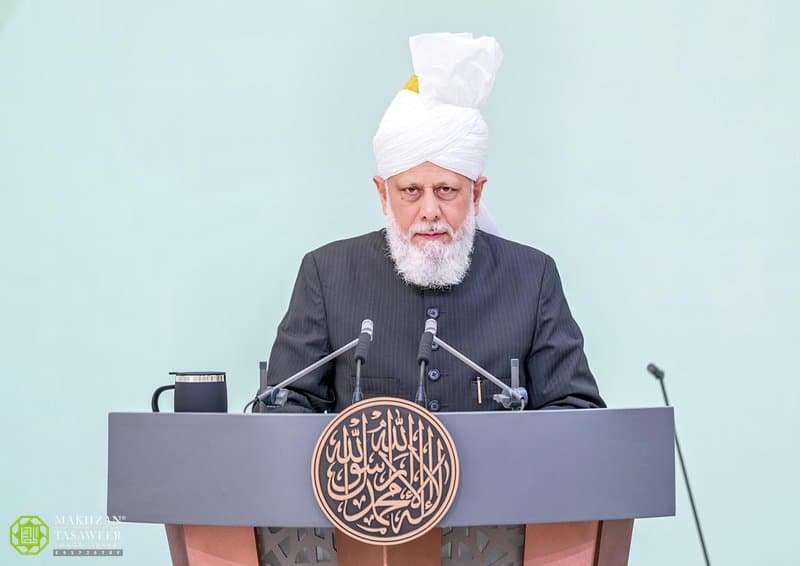
Friday Sermon
2 January 2026
Muhammadsa and the Promised Messiahas: Reflections of the divine love
After reciting the tashahhud, ta’awwuz and Surah al-Fatihah, Hazrat Khalifatul Masih Vaa said:
In the previous sermon, some mention was made of the Holy Prophetsa and his model of love for Allah. In this age, we see a reflection of that same divine love in the actions of his true servant, through his complete obedience and following of his Master. These examples exist even today. That is, the lofty standards of love for Allah, and as a result, the divine favours bestowed upon him and his deep love for God Almighty were felt by people around him.
However, before relating the remaining incidents, I will mention this love in the words of the Promised Messiahas himself. In one place, he states:
“I cannot describe which particular action of mine caused this divine favour to be bestowed upon me. I only feel within myself that, by nature, my heart possesses a pull towards God Almighty, accompanied by loyalty, a pull that nothing can restrain. Thus, this is entirely His grace – among the favours that Allah the Exalted has bestowed upon me.” (Kitab-ul-Bariyyah, Ruhani Khazain, Vol. 13, pp. 195-196, footnote)
As I mentioned in the previous sermon as well, the Promised Messiahas has expressed on many occasions that all of this was granted to him because he was a perfect follower of, and one who deeply loved, the beloved and dear Prophet of Allah, the Holy Prophetsa. As a result, the doors of Allah’s love continued to open for him, and he was granted a deep awareness of it. Thereafter, the rain of Allah’s blessings continued to pour down upon him.
While describing this inner spiritual state and his blessed life, Hazrat Sheikh Yaqub Ali Sahib Irfani writes at one place that the Promised Messiahas wrote:
الْمَسَاجِدُ مَكَانِي وَالصَّالِحُونَ إِخْوَانِي وَذِكْرُ اللهِ مَالِى وَخَلْقُ اللهِ عَيَالِي
“The mosques are my dwelling, the righteous are my brothers, the remembrance of Allah is my wealth, and the creation of Allah is my family.” (Sirat Hazrat Masih-e-Maud, Vol. 3, p. 402)
That is, everything he described revolved entirely around Allah the Exalted.
The Promised Messiahas states at one place:
“I love everything for the sake of God Almighty, whether it is my wife, my children, or my friends. My relationship with everyone is for the sake of Allah Almighty.” (Malfuzat, Vol. 2, p. 184)
This is the very teaching that Allah the Exalted has given and which the Holy Prophetsa proclaimed and instructed to spread.
The greatest manifestation of this teaching in this age is seen through the practical example of the Promised Messiahas, in complete obedience and following of the Holy Prophetsa.
The Promised Messiahas states at one place:
“The truthful remain steadfast even at the time of trials, and they know that in the end God Himself will be their supporter. This humble one, although grateful to God Almighty for the presence of such perfect friends, nevertheless firmly believes that even if not a single person remains with me, and all abandon me and go their own ways, I have no fear. I know that God Almighty is with me. Even if I am crushed and ground down, reduced to something more insignificant than a particle, and if from every direction I face persecution, abuse, and curses, I shall still ultimately be victorious.
“No one truly knows me except the One who is with me. I can never be ruined. The efforts of my enemies are futile, and the schemes of the envious are fruitless. O foolish and blind people! Who among the truthful before me was ever ruined that I should be ruined? Which true and loyal servant did God ever destroy in humiliation that He should destroy me?
“Remember this with certainty and listen attentively: my soul is not one that will perish, and the very fabric of my nature contains no element of failure. I have been granted such courage and truthfulness before which mountains are insignificant. I care not for anyone. I was alone, and I was not displeased at being alone. Will God ever abandon me? Never will He abandon me. Will He ever ruin me? Never will He ruin me.
“My enemies will be disgraced, the envious will be ashamed, and God will grant victory to His servant in every field. I am with Him, and He is with me; nothing can sever our bond. By His honour and majesty, I swear that there is nothing dearer to me in this world or the Hereafter than the manifestation of the greatness of His religion, that His majesty should shine forth and His supremacy be established.
“With His grace, I fear no trial – even if there are not one but a million trials. In the arena of trials and in the wilderness of suffering, I have been granted strength.”
Then, in Persian, he expresses this sentiment in a couplet, saying:
مَن نه آنستُم که روز جنگ بینی پشت من
آن منم کاندر میانِ خاک و خوں بینی سرے
“I am not one whose back you will see on the day of the battle; I am the one whose head you will espy in the midst of dust and blood.”
He tells us, “This is my condition in the love of God Almighty. Therefore, if anyone does not wish to walk in my footsteps – addressing the Jamaat – then he should separate from me. Hardships will certainly come. I do not know which terrifying wildernesses and thorn-filled valleys still lie ahead of me, which I must yet traverse.”
Then he says, “Can we be frightened by earthquakes? Can we become fearful of trials in the way of God Almighty? Can we ever separate ourselves from any trial sent by our Beloved God? We can never do so.” (Anwarul Islam, Ruhani Khazain, Vol. 9, pp. 23-24)
Hazrat Mirza Bashir Ahmad Sahibra relates a narration in which, while mentioning love for Allah the Almighty and the passion of sacrifice for His religion, he states: “Maulvi Sarwar Shah Sahib narrated to me, saying that during the days when the case with Karam Din was proceeding in Gurdaspur and the magistrate had fixed a date, the Promised Messiahas was in Qadian.
“Then, two days before the date of the hearing, Huzooras sent me to Gurdaspur so that I might go there to extract and prepare certain references, because references were to be presented in the following hearing. Huzooras also sent Sheikh Hamid Ali and the cook Abdur Rahim with me to Gurdaspur.
“When we reached the house in Gurdaspur, we called out from below to the late Dr Muhammad Ismail Khan Sahib (who was upstairs), asking him to come down and open the door. The doctor was staying upstairs in the house at that time. Upon our calling out, the doctor began to uncontrollably cry and shout. We called out several times, but he continued crying in the same manner.
“Finally, after a short while, he came downstairs while wiping his tears. When we asked the reason, he said, ‘Muhammad Husain Munshi came to me.’ (He was a clerk in the court, a non-Ahmadi). Maulvi [Sarwar Shah] Sahib used to say that the aforementioned Muhammad Husain was a clerk or court official in some court in Gurdaspur and was a fierce opponent of the Jamaat, and he was among those who would meet Maulvi Muhammad Husain Batalvi. Nonetheless, the doctor (who had come downstairs upon being called) narrated that when he came downstairs, he explained that Muhammad Husain, the clerk, had come and said to him: ‘These days, an Arya gathering had taken place here. Some Aryas had brought their friends to the gathering, so in the same way, he too went there with an Arya friend.
“‘After the proceedings of the gathering, the administration announced that the gathering had concluded and the general public should leave, because some private matters were to be discussed. Accordingly, all non-members stood up to leave. I too began to leave, but my Arya friend said that, “We will go together, you should either sit to one side or wait outside.” Accordingly, I sat there to one side (this is being said by Muhammad Husain Sahib, who is a non-Ahmadi).
“‘Then one person from among the Aryas stood up and, uttering the name of the Promised Messiahas, said to the magistrate that “this man is our fierce enemy and the killer of our leader, Lekhram. Now he is a prey in your hands, and the eyes of the entire nation are upon you. If you let this prey slip from your hands, then you will be an enemy of the nation.” That person said such inciting words of this nature. Upon this, the magistrate replied that “It has already been my intention that, if possible, not only Mirza but also all his companions and witnesses in this case should be sent to hell. But what can be done, the case is being conducted with such cleverness that no place is found to lay hands on it. However, now I make a pledge that whatever happens, in this very first hearing, I will carry out judicial action.”’
“Maulvi Sahib used to say that the doctor narrated: Muhammad Husain said to me, ‘You may not have understood what is meant by judicial action. This means that every magistrate has the authority that, at the beginning or during a case, whenever he wishes, he may arrest the accused without accepting bail and place him in custody.’ Muhammad Husain continued, ‘Doctor, you know that I am a fierce opponent of your Community. (He was a follower of Maulvi Muhammad Husain and also an opponent, and even the name was the same.) But I possess this quality that I cannot see any respectable family being disgraced and ruined, especially at the hands of Hindus, and I know that Mirza Sahib’s family is the most respectable family in the district. Therefore, I have conveyed this information to you so that you may make some arrangements.’ He then also expressed his opinion: ‘In my opinion, there are two suggestions. One is that efforts should be made to have the case transferred from here to the Chief Court. (In those days, the High Court was called the Chief Court.) And the second is that, by whatever means possible, Mirza Sahib should not appear in court at the next hearing, and a medical certificate should be presented.’
“Maulvi Sahib stated that, ‘When the doctor narrated this incident, we all became extremely frightened and decided that a man should immediately be sent to Qadian who would convey these events to the Promised Messiahas. Night had already fallen. We searched for a carriage, looked for a means of transport, an open carriage or a horse. Although many carriages were present, the fervour of opposition was so intense that no carriage or transport could be found. No one agreed; everyone refused. We offered four times the regular fare, but no carriage driver agreed. Finally, we sent Sheikh Hamid Ali, the cook Abdur Rahim, and a third person on foot toward Qadian.
“‘They reached Qadian at the time of the Fajr prayer and briefly submitted the matter to the Promised Messiahas. Huzooras said with indifference, “Very well, we will go to Batala. Khawaja Sahib and Maulvi Muhammad Ali Sahib will meet us there while returning from Lahore.” The Promised Messiahas said that “Khawaja Sahib and Maulvi Muhammad Ali Sahib are coming from Lahore, and we will meet them there. We will discuss with them this entire matter that you have narrated, and we will come to know what has happened regarding the effort to transfer the case.” Sensing the bias of the magistrate, our lawyers had already submitted an application to the Chief Court to have the case transferred to another court.
“‘Thus, he proceeded to go to Batala the same day. On the way, Khawaja Kamaluddin and Maulvi Muhammad Ali Sahib joined him. They informed him that the attempt to move the case was unsuccessful – that the request for transferring the case to the chief court hadn’t worked.
“‘After this, the Promised Messiahas went to Gurdaspur and didn’t tell either of them about this incident. He did not inform them of the news. When the Promised Messiahas arrived at his place of residence in Gurdaspur, as was his habit, he retired to a different room and rested for a bit on a charpai.
“‘At that time,’ Maulvi Sahib describes, ‘the hairs were standing up on the back of our necks out of worry for what would happen now. The magistrate has made a very solemn vow. After a while,’ Maulvi Sahib explains, ‘the Promised Messiahas called for me.
“‘When I went in, I saw that the Promised Messiahas was lying down with both his hands under the back of his head and lying straight. When I entered, he turned to his side so that he began leaning on his elbow, and his head rested upon his palm.
“‘He said to me, “I’ve called you here to listen to the entire account of what happened.”
“‘At this time, there was no one else in the room aside from Mian Shadi Khan, who stood at the door. I recounted the entire incident: how, upon arrival, we found Dr Ismail Khan Sahib crying and how Dr Sahib told us about the arrival of Munshi Muhammad Husain Sahib and then added what Muhammad Husain recounted. The Promised Messiahas continued to listen quietly. When I reached the word “prey,” meaning that he had said that the prey is in my hands, the Promised Messiahas at once shot up and sat upright.
“‘His eyes began shining, and his face became flushed with red, and he said: “Me? His prey? I am not anyone’s prey; I am a lion, and God’s lion at that! Can he even lay his hands upon the lion of God? Let him dare to try it.”
“‘While saying these words, the Promised Messiah’sas voice became so loud that even the people outside the room were taken by surprise and suddenly became attentive. But no one came into the room.
“‘The Promised Messiahas repeated the words “the lion of God” several times, and his eyes, which were normally lowered and partially closed out of humility, began to look like the eyes of a lion, shining with fierceness, and his face became so red that it was difficult to even look at him in that moment.
“‘Then he said, “What shall I do?” After saying all this, the Promised Messiahas said, “What shall I do? I have submitted before Allah that for the sake of Your faith, I am prepared to wear chains in both my hands and feet.”
“‘He meant to say that if I am handcuffed, it makes no difference to me if I am chained up. “But God Almighty states, ‘No – I shall save you from humiliation and shall exonerate you with dignity.”
“‘After this, he began delivering a speech on the love of God and continued to speak for about half an hour on the subject.’” (Siratul Mahdi, Vol. 1, narration 107)
What a profoundly curious understanding of making sacrifices in the way of God’s love he possessed. What deep trust he possessed in God Almighty. This trust was the result of the love that he possessed for God. And he carried the conviction that “because I love God Almighty and I am ready to make any and every sacrifice for Him, He will not allow me to be wasted.”
There’s also another incident like this.
On one occasion, the superintendent police captain Lemarchant suddenly came with police officers to Qadian out of suspicion of Lekhram’s murder, and Hazrat Mir Nasir Nawab Sahib learned of this. He went to the Promised Messiahas in a state of great worry and – in a barely audible voice – submitted that the superintendent was coming with an arrest warrant and handcuffs in hand. The Promised Messiahas at that time was writing his book The Light of the Quran.
He raised his head from writing and calmly said with a smile on his face:
“Mir Sahib, people in moments of joy don bangles of gold and silver, so we will consider that we have donned metal bangles in the love of Allah Almighty.” Then, after some time, he continued: “But it shall not come to pass, for the government of God has its own laws, and He does not humiliate his representatives and appointees in this way.”
And so it happened – they were unsuccessful. (Al Hakam, Vol. 39, 7 June 1936, p. 3; Al Hakam, Vol. 3, 10 July 1899, pp. 1-2)
Similarly, another narration has been recorded by Maulvi Abdul Karim Sahib Sialkoti. He relates that on one occasion, at Jalandhar, he stated:
“At times of trial, our concern is for certain faint-hearted individuals within our Jamaat. It is these faint-hearted people of the Jamaat who weigh upon my mind.” One faces trials, cases are lodged, and there is opposition; it happened to the Promised Messiahas and against the members of his Jamaat as well. Thus, at such times, he stated that he is concerned for certain weak-hearted individuals of the Jamaat, i.e., for some who are weak of faith.
He then said: “My state of affairs are such that even if I were to hear a clear voice saying: ‘You are forsaken and not a single one of your desires will be fulfilled,’ I swear by God’s Being that there would be no decrease in my passion and love for God or in my service to the Faith, because I have already seen God.” (Life of the Promised Messiah, p. 90)
[Meaning:] My trust and certainty are in Allah the Almighty, and there will be no decrease in my love, no matter what may happen.
Similarly, Nawab Mubaraka Begum Sahiba relates a narration. She states: “The most dearly beloved to the Promised Messiahas was Allah the Almighty, which surged through every particle of his body and soul, was manifest at all times in every word and deed of his. I have heard him, even outside the prescribed times of prayer, calling upon his Gracious Lord with intense anguish and yearning. (Not only at the times of the formal prayers, but even in ordinary circumstances, I heard him calling upon Him in supplication with the same anguish and fervour.) And what he would say was: ‘My beloved Allah, my beloved Allah, my beloved Allah.’ He would continue to call out in this manner, as though I could hear that voice even now; it still echoes in my ears, and I see his tears flowing. This scene is before my eyes.”
She then paints a picture of that moment and presents an eyewitness example of his sense of honour and protectiveness for his Beloved – the Eternal and Everlasting God. She states that this was the condition of his prayers, which she herself had witnessed, but she also relates an incident.
She writes: “The Promised Messiahas was in his room, preparing to go outside somewhere. I was with him. Our paternal aunt’s attendant, who later became an Ahmadi as well and is buried in Bahishti Maqbarah [Heavenly Graveyard], came to Hazrat Amma Jan and, considering it a matter of familial obligation on her part, began expressing condolences to him over the death of our uncle, Mirza Imam-ud-Din. She was speaking in Punjabi, as she had just uttered the words, “He was indeed a very good man,” the Promised Messiahas emerged. His blessed face was turning red. Striking his staff upon the ground, he said, ‘Wretched woman! You praise the enemy of my Lord in my house?’ Mirza Imam-ud-Din Sahib had turned away from Islam and used to mock Allah the Almighty. His sense of honour could not tolerate that, while sitting in his own home, such mention should be made.”
Nawab Mubaraka Begum Sahiba writes: “There was such majesty and awe in his voice that the woman fled from there at once. Mirza Imam-ud-Din was an atheist, and so how could the Promised Messiahas ever tolerate that such praise should be lavished upon an atheist? (Tahrirat-e-Mubaraka, pp. 223-224)
In line with the practice of his master, the Holy Prophet Muhammadsa, the Promised Messiahas spent his childhood and youth in the love of God Almighty.
In one narration, Hazrat Mirza Bashir Ahmad Sahib writes:
“A Sikh landowner relates an account. He states that he once conveyed a message of employment to the Promised Messiahas on behalf of our grandfather. He says that a senior officer or landlord asked our grandfather, ‘I hear that you have a younger son, but we have never seen him.’ Smiling, the father of the Promised Messiahas replied, ‘Yes, I do indeed have a younger son, but like a newly-married bride, he is seldom seen. If you wish to see him, go and look for him in some corner of the mosque. He is devoted to the mosque.’” (Sirat-e-Tayyabah, pp. 9-10)
This narration has been further elucidated in detail by Miraj Din Sahib Umar, who writes:
“Go to the mosque and search for him by the taps of the water-bearers. (Go and look where the place of ablution is; the place of the water tank and the taps.) If you do not find him there, do not return in disappointment. Go inside the mosque and search in some corner there. If you do not find him even there, still do not return in despair. Look in the prayer mats; it may be that someone has wrapped him up and stood him there, for he is dead to the world even in this life. Such is his state of being completely lost in God that if someone were to wrap him up and stand him in a prayer mat, he would not even move, nor would he notice.” (Hazrat Masih-e-Maud ke Mukhtasar Halat, p. 67)
Mirza Bashir Ahmad Sahib relates another account. He writes:
“Haji Abdul Majid Sahib Ludhianvi related to me that on one occasion, Huzooras was in Ludhiana. There was a neem [Indian lilac] tree in my house, and as it was the rainy season, its leaves were a most pleasing green. Huzooras said to me, ‘Haji Sahib, look at the leaves of this tree, how beautiful they are.’ Haji Sahib says that at that moment, I observed that his eyes were filled with tears.” (Siratul Mahdi, Vol. 1, narration 95)
He was reminiscing over the power of Allah the Almighty and His love, and as a result, at that moment, tears welled up in his eyes.
Hazrat Musleh-e-Maudra states:
“There was a person here who later became a very sincere Ahmadi, and he developed a close relationship with the Promised Messiahas. However, before this individual accepted Ahmadiyyat, the Promised Messiahas remained displeased with him for 20 years. The reason was that the Promised Messiahas was deeply aggrieved by one of his statements. It so happened that one of his sons passed away. The Promised Messiahas went to his house, along with his brother, to offer condolences and to comfort them. It was their custom that whenever someone came with whom they had very friendly relations, they would embrace him, weep, cry and shriek. In accordance with this custom, they embraced the Promised Messiah’sas elder brother and, while clinging to him and crying, he said: ‘God has committed a great injustice against me.’ Upon hearing this, such aversion took hold of Hazrat Sahib that he did not even wish to see the man’s face. Later, Allah the Almighty granted that person the ability to reform, and he was saved from those ignorant customs.” (Taqdir-e-Ilahi, Anwar-ul-Ulum, Vol. 4, pp. 606-607)
Hazrat Mirza Bashir Ahmad Sahib also relates another narration. Munshi Zafar Ahmad Sahib of Kapurthala states that he related to me in writing that the Promised Messiahas suffered from migraines and experienced dizziness. There was a famous physician whose expertise in this regard was well known, and he treated this illness. He was summoned from a distant place, and his fare was sent. He examined Huzooras and said, “Within two days, I will give you relief; I will cure you.” Upon hearing this, Huzooras went inside and wrote a note to Hazrat Maulvi Noor-ud-Deen Sahib, stating: “I do not wish to seek treatment from this person under any circumstance. What sort of claim to divinity is he making?” He instructed that the return fare be given to him, along with an additional 25 rupees, and sent word from inside that these be handed over to him and that he be dismissed. Accordingly, this was done.
The Promised Messiahas stated: “He says that ‘I will cure you’. Who is there, besides Allah the Almighty, who can cure? The true Healer is none other than Allah the Almighty Himself.” (Siratul Mahdi, Vol. 2, narration 1038)
Similarly, Hazrat Mirza Bashir Ahmad Sahib relates another narration from Munshi Zafar Ahmad Sahib of Kapurthala:
The late Chaudhry Rustam Ali Khan Sahib was an Inspector in the Railways. He had a monthly salary of 150 rupees. He was most sincere and a person of standing within the Jamaat. He would keep only 20 rupees per month for himself and would send the remainder of his entire salary to the Promised Messiahas. This was his constant practice. He had only one son. When the boy fell ill, he brought him to Qadian along with his wife. They stayed in the residence of the Promised Messiahas.
One day, the Promised Messiahas stated that during the night, he had seen in a vision that someone was hurling abuse at his God, which caused him great anguish. The very next day after the Promised Messiahas mentioned this vision, Chaudhry Sahib’s only son passed away. Since he was their only child, the mother of the child was overcome with extreme grief, and in that state, words escaped her lips to the effect: “O oppressor, you have dealt me a great injustice,” addressing God. She continued uttering such expressions, which the Promised Messiahas heard.
Immediately, he came out, visibly grieved and deeply moved, and declared with great intensity that the woman must leave his house at once. The mother of Doctor Mir Muhammad Ismail Sahib, who was a woman of great wisdom and understanding, counselled Chaudhry Sahib’s wife and explained to her that the Promised Messiahas was severely displeased. She repented, sought forgiveness, and stated that she would not even weep any longer. Mir Sahib’s mother then conveyed to the Promised Messiahas that the woman had repented and ceased crying, and requested forgiveness on her behalf. The Promised Messiahas replied, “Very well, let her stay, and make arrangements for the burial of the child.” (Siratul Mahdi, Vol. 2, narration 1119)
Sheikh Yaqub Ali Sahib Irfani, while recording his impressions of the life of the Promised Messiahas, relates that the Promised Messiahas stated:
“Whenever I happened to go to Dalhousie (the Promised Messiahas himself stated this and Irfani Sahib writes in the words of the Promised Messiahas), upon observing the green mountain meadows and flowing streams, an involuntary fervour of praise for Allah the Almighty would arise within me, and I would experience a special delight in worship. I would also observe that the place provided an excellent opportunity for solitude.” (Hayat-e-Ahmad, Vol. 1, Part 1, p. 85)
In a similar manner, while describing this spiritual delight and love for God Almighty, he stated at another place:
“A great pleasure of the love of God – nurtured by the sweetness of union – is placed within their hearts (i.e., the hearts of those who love Allah). If their very beings were to be crushed in the mortar of afflictions, squeezed under severe trials and torments, their very essence would yield nothing but the love of Allah.” (Surma-e-Chashm-e-Arya, Ruhani Khazain, Vol. 2, p. 79, Footnote)
That is to say, such is the love implanted in the hearts of those who love Allah the Almighty that even if they were ground in a mortar, crushed in a grinder, or pressed under the harshest of constraints, nothing would emerge from them except divine love.
Hazrat Mirza Bashir Ahmad Sahibra narrates another account from Malik Maula Bakhsh Sahib, stating:
“When Sahibzada Mirza Mubarak Ahmad Sahib was ill, the concern of the Promised Messiahas regarding his condition was evident. When Sahibzada Sahib passed away, Sardar Fazl Haq Sahib, the late Doctor Ibadullah Sahib, and the narrator himself came to Qadian to offer condolences. However, when the Promised Messiahas arrived at the mosque, he appeared as cheerful as usual – indeed, even more so.
“When the demise of Sahibzada Sahib was mentioned, the Promised Messiahas said:
“‘Mubarak Ahmad has passed away. The word of my Master has been fulfilled. He had already informed me that this child would either pass away early or become profoundly devoted to God. Thus, Allah has taken him unto Himself. What does it matter if one Mubarak Ahmad – or even a thousand sons – are born and all pass away, so long as my Master is pleased and His word is fulfilled? My happiness lies in this alone.’
“Witnessing these circumstances, the narrators state that although they had come to express grief, none of them found the courage to utter a single word of condolence.” (Siratul Mahdi, Vol. 2, narration 1191)
Hazrat Nawab Mubaraka Begum Sahibara writes:
“His true and sincere love for the Pure Being of Allah the Exalted was manifest at all times. On one occasion, I saw him supplicating and weeping, calling upon his Master and Beloved with intense anguish, repeatedly uttering, ‘My beloved Allah, my beloved Allah.’ This I have witnessed with my own eyes. He was a true lover of the Holy Prophetsa, and a devoted lover of his Exalted Lord. The light of that love was visible upon his face, and the same light flowed from his tongue. From his words flowed springs of that spiritual light, yet the blind of sight were unable to perceive them.” (Tahrirat-e-Mubaraka, pp. 312-313)
When the renowned Sufi saint of Ludhiana, Hazrat Munshi Ahmad Jan Sahib, was preparing to depart for Hajj, the Promised Messiahas wrote a letter to him prior to his journey, in which he stated:
“Kindly remember the humble request of this low and worthless one, when by the Grace of Allah, You see the House of God. In that blessed and praiseworthy place, offer this prayer of a lowly servant of God, with utmost humility. Raise your hands in prayer with meekness and total devotion, and supplicate: ‘O the Most Merciful of all who show mercy, Your meek, worthless, and humble servant, full of faults, Ghulam Ahmad, who is in the part of the world called India, supplicates to You, O the Lord of Mercy! Be pleased with me; forgive my sins and transgressions, for You are the Most Forgiving and Merciful. Enable me to do deeds that please You greatly. Put as much distance between my evil self and me as there is between the East and the West. Let my life, my death and every faculty that I possess be for Your sake. Keep me alive in Your love, cause me to die in Your love and raise me among those who love and obey You the most. O the Most Merciful of all who show mercy! Accomplish my mission of propagation that You have entrusted me. Ensure that the service for which You have put zeal in my heart is completed. Cause the truth of Islam to become apparent through this humble one, to all the enemies of Islam. Show the beauty of Islam to those who are yet unaware of the beauties of this faith. Keep this humble one, my friends and my companions, protected by Your forgiveness and mercy. Be with them and be sufficient for them in worldly and spiritual matters. Enable them to achieve Your pleasure. Shower Your blessings and Durood on Your Messenger, his Companions and his followers.’” (Sirat Masih-e-Maudas, pp. 541-542)
I have read some parts of that prayer; perhaps some parts may have been missed out.
In any case, Hazrat Munshi Sahib, in accordance with the instruction of the Promised Messiahas, offered this prayer at the House of Allah and at Arafat during the occasion of Hajj Akbar, together with his group (of pilgrims). We observe how every word of this supplication is imbued with divine love, expressing profound devotion to the One God, and how the Promised Messiah’sas love for Allah radiates from every word he expressed.
The Promised Messiahas states:
“I proclaim that if I come to learn with certainty that the gravest and most severe of punishments would be given to me for loving God Almighty and being obedient to Him, I can swear on oath and say that my disposition is prepared to bear all of these agonies and trials with pleasure and with a passion and yearning of love. Even if I was told with absolute certainty that there would be only punishment and grief, my disposition would feel more pain in taking even one step beyond the pale of obedience and submission to God than I would feel in a thousand, nay, in an infinite number of deaths, agonies and afflictions.” (Malfuzat [English], Vol. 4, p. 252)
The Promised Messiahas further states:
“How unfortunate is the man, who even now, is unaware that there is a God Who has power over all things. Our paradise lies in our God. Our highest delight is in our God for we have seen Him and found every beauty in Him. This wealth is worth procuring though one might have to lay down one’s life to procure it. This ruby is worth purchasing though one may have to lose oneself to acquire it. O ye, who are deprived! Hasten to this fountain as it will satiate you. It is this fountain of life that will save you. What am I to do? How shall I impress the hearts with this good news? What sort of a drum am I to beat in the streets in order to make the announcement that this is your God, so that people might hear? What remedy shall I apply to the ears of the people so that they should listen?
“If you become one with God, rest assured that God too will be yours. God Almighty shall remain awake for you as you sleep. God shall watch over your enemy and frustrate their designs, while you are unmindful of him. You still do not know the extent of God’s powers. Had you known, not a single day would you have grieved over the world. Does he who owns a treasure weep, cry and become sorrowful unto death over the loss of a single coin? Had you been aware of this treasure and knew that at every time of need God is able to fulfil your requirements, why would you look to the world so restlessly? God is a precious treasure; appreciate Him accordingly, for He is your Helper at every step. You are nothing without Him, nor do your resources and your schemes amount to anything.” (Noah’s Ark [Kashti-e-Nuh], pp. 35-36)
Then, expressing his deep love for God in a most beautiful manner, the Promised Messiahas said:
“O my God, my Master, my Beloved Lord, my Dear Master, my True Love – the world calls me a disbeliever. But can I ever find anyone dearer than You? If there were one, perhaps I would forsake You for his sake. Yet I see that when people become heedless of the world, when neither my friends nor my foes have any knowledge of my condition, it is You Who awakens me and lovingly says, ‘Do not grieve, I am with you.’ So then, O my Master, how could it ever be possible, after such favours from You, that I would abandon You? Never – never!” (Life of the Founder of the Ahmadiyya Movement, a speech by Maulana Sharif Amini Sahib, pp. 23-24)
The Promised Messiahas further said:
“I cannot even count the blessings I know of. I recognise You alone as my God.”
And addressing Allah the Almighty, he said:
“It is for this reason that my soul leaps with joy at Your name, just as an infant leaps at the sight of its mother. Yet most people have not recognised me, nor have they accepted me.” (Tiryaq-ul-Qulub, Ruhani Khazain, Vol. 15, p. 511)
This was that divine love and ardent devotion that the Promised Messiahas had developed with God Almighty by following in the footsteps of his master, the Holy Prophetsa. It was this same love of God that he instilled within his Jamaat. He said to be ever ready for every sacrifice. When you sacrifice for the sake of Allah, expressing your love for Him and fulfilling His due, then Allah too will love you in return. He will protect you from every enemy, He will shield you from every pain, and for every deed you perform solely for His pleasure, He will grant you immense blessings – in this world and in the hereafter.
May Allah enable us to become such beloved servants of His – true lovers of Allah.
As people are aware, the new year commenced yesterday. People are exchanging new year greetings with one another as well. Pray that this year brings countless blessings for us. May Allah the Almighty cause the ploys of the opponents and the enemies to be completely destroyed. May He grant success and progress to the Jamaat even more than before. Those of us who live outside (of Pakistan) and particularly in countries where we enjoy freedom and are able to experience the joyous occasion of the new year – people in Pakistan are also celebrating the new year – but at such a time, do remember your fellow brothers in your prayers, who are currently imprisoned due to their faith.
I mentioned recently the case of Mubarak Sani Sahib, who has been sentenced to life imprisonment; there are others who are imprisoned as well. Despite the circumstances they are enduring, they are expressing their gratitude to Allah the Almighty as they enter the new year; they utter no words of complaint. For the sake of acquiring the pleasure of Allah the Almighty, they are clad in iron bangles. May Allah the Almighty swiftly create the means for their release. May Allah the Almighty enable us and those who have been imprisoned due to their faith and all those who are enduring difficulties, to develop an even greater understanding of the love for Allah the Almighty. Owing to the difficulties we are facing, may our love for Allah the Almighty always increase even more than before instead of decreasing. Pray for all those who are facing oppression. May Allah the Almighty grant freedom to everyone who is under oppression and release them from the grip of the unjust and establish peace in the world.
After the prayer, I shall lead funeral prayers in absentia. There are three funeral prayers in absentia:
The first is of Rehana Basmah Sahiba, the wife of Syed Ahmad Sahib Nasir, who recently passed away at the age of 90.
اِنَّا لِلّٰہِ وَاِنَّآ اِلَيْہِ رٰجِعُوْنَ
[“Surely, to Allah we belong and to Him shall we return.”]
By the grace of Allah, she was a musia. She was the great-granddaughter of the Promised Messiahas, the granddaughter of Hazrat Mirza Sultan Ahmad Sahib, the daughter of Hazrat Mirza Aziz Ahmad Sahibra, and the granddaughter of Hazrat Mir Ishaq Sahibra.
After her marriage, she moved with her husband to East Africa, residing in Kenya, where she served the Jamaat under Lajna Imaillah at various administrative levels. Two of her sons are life devotees: Syed Tahir Ahmad, who serves as Additional Nazir Ishaat in Sadr Anjuman Ahmadiyya, Rabwah; and Syed Muzaffar Ahmad, who serves in the Department of Properties.
Her other son – she has three sons – is Anees Ahmad. His daughter, Sultana Sahiba, is married to Dr Mirza Sultan Ahmad Sahib. Another daughter, Farhana, is married to Mirza Kaleem Ahmad Sahib and is the daughter-in-law of Sahibzada Mirza Waseem Ahmad Sahib.
Her son, Syed Tahir Ahmad, writes that she had a deep love for the Holy Quran and would recite it regularly and abundantly. Her love and devotion to Khilafat were profound – a sentiment shared by all her children. She instilled these same values in them.
Her son, Anees Ahmad, writes that she always took part in the joys and sorrows of others and would particularly urge us to pay financial contributions regularly, inquiring whether we had done so. She would also remind us to observe voluntary fasts.
Her daughter, Farhana Fauzia, writes, “Since childhood, I saw my mother regularly offering Tahajjud [pre-dawn voluntary prayers]. She was punctual in her prayers and urged us, children, to offer them on time. Because she recited the Quran so often, she had memorised many long chapters. She would tell us, ‘Recite the Quran aloud.’ Due to her deep study of the Quran, she had developed a remarkable command of it; if we ever erred in recitation, even from afar, she would correct us.
“She was extremely hospitable,” she writes. “In earlier times, before modern conveniences, during winter when hot water was not readily available from a boiler, she would personally heat water early in the morning for guests so they could perform ablution. Her husband, Syed Ahmad Sahib – who was the son of Hazrat Mir Muhammad Ismail Sahibra – was a friend of Hazrat Khalifatul Masih IVrh. Hazrat Khalifatul Masih IVrh would stay at his home sometimes during travel, and he himself recounts that she would always prepare warm water for him for ablution in the mornings. He said that once he thought to wake up very early to heat the water himself so as not to trouble her, but when he awoke, he found that she had already placed warm water for him.”
She faced financial difficulties but managed her household with great dignity and discipline.
As mentioned earlier, she first lived in Kenya, but at the instruction of Hazrat Khalifatul Masih IIIrh, the family returned to Pakistan. Conditions there were no longer as before, yet she spent her time cheerfully and with patience.
Her sister, Atiqa Farzana, writes that she possessed deep devotion to the Jamaat and could not bear to hear a single word against it. Another sister, Durr-e-Shahwar Durdana, writes that she had the habit of waking for Tahajjud without the need for an alarm. “When I was worried about the marriages of my five daughters,” she said, “my sister would tell me not to worry, that Allah would arrange everything – and indeed, He did.” She describes her as patient, grateful, and full of courage.
May Allah the Almighty grant her forgiveness and mercy.
The next mention is of respected Iffat Haleem Sahiba, former Sadr Lajna Imaillah Liberia. She was the wife of Dr Abdul Haleem Sahib, a life-devotee and In-charge of the Clinic in Monrovia, Liberia. She fell ill and went to Holland for treatment. She passed away on 21 December, at the age of 59.
اِنَّا لِلّٰہِ وَاِنَّآ اِلَيْہِ رٰجِعُوْنَ
[“Surely, to Allah we belong and to Him shall we return.”]
By the grace of Allah the Almighty, she was a musia who offered one-third of her wealth. Ahmadiyyat was established in her family through her great-grandfather, respected Muhammad Ali Sahib, who pledged allegiance at the hand of Hazrat Khalifatul Masih IIra.
In July 2004, she went to Liberia with her husband. She spent 21 years there, during which time she served as Sadr Lajna Imaillah on two or three occasions. Even at the time of her demise, she was serving as Sadr Lajna Imaillah.
She was devoted to offering the pre-dawn voluntary prayer (Tahajjud), regular in observing fasts, consistent in the recitation of the Holy Quran, and deeply attached to Khilafat, expressing profound love and loyalty towards it. She fulfilled her administrative responsibilities with great sincerity. She was at the forefront in offering financial sacrifices and gave charity generously. She was known for her hospitality, warmth, excellent morals, and a heartfelt passion for serving those who were suffering. She was a truly virtuous woman.
Not only did she herself recite the Holy Quran with great devotion, but she also arranged special classes for Lajna and taught children the Holy Quran, even organising their “Amin” ceremonies. Hospitality was an outstanding quality in her character. Guests would stay at her home not merely for a day or two, but often for many days, and she would host them wholeheartedly. During the month of Ramadan, she would regularly arrange the pre-dawn meal before the fast and the meal for breaking the fast for those in need. Everyone who knew her mentioned this quality of hers with great affection.
A local Lajna president, Arifa Sahiba, says that her observance of prayers was exemplary. She states that whenever she had the opportunity to visit her home, she observed her punctuality in offering prayers, in that if the time for prayer arrived while work was ongoing, she would say, “First, we will offer the prayer; then, we will continue with the work.” There was never an attitude of completing work first and praying later; rather, prayer always came first before any other work.
Similarly, Farrukh Shabir Sahib, a missionary there, says, “If the personality of Iffat Haleem Sahiba were to be described in just a few words, it would suffice to say that she was the true face of Ahmadiyyat.”
Likewise, a local Liberian missionary, Momo Kromah Sahib, says, “I had numerous opportunities to meet and converse with her, and every time I felt as though I were speaking to a mother whose love for her children knows no bounds.” She did not have any children of her own. She is survived by her husband and two adopted children. One is the daughter of her husband’s brother, whom she took in and raised; she is now 14 years old and currently studying. The other is a Liberian boy, Ahmad Masroor Singhbah, whom she adopted at a very young age and raised like her own child, educating him as well. He is currently a sixth-year student at Jamia Ahmadiyya International Ghana. May Allah the Almighty accept her prayers for these children and grant her forgiveness and mercy.
The third mention is of respected Abdul Aleem Al-Barbari Sahib of Egypt, who also passed away recently at the age of 64.
اِنَّا لِلّٰہِ وَاِنَّآ اِلَيْہِ رٰجِعُوْنَ
[“Surely, to Allah we belong and to Him shall we return.”]
The deceased was a righteous, sincere, and devoted Ahmadi. By the grace of Allah, his wife and daughter are Ahmadis. His wife writes, “My husband loved Allah the Almighty so deeply that it seemed as though he had been created solely to remember Him. He was a man of excellent character and never spoke ill of anyone.” She says, “Throughout our 31 years of married life, he never caused me any distress; rather, he was an exemplary and virtuous husband.”
Both Abdul Aleem Sahib and his daughter accepted Ahmadiyyat in 2008 after watching MTA Al-Arabia. His wife writes, “I strongly opposed this decision and created many difficulties for him, even involving my family in the opposition. Yet both father and daughter remained patient. One day, after prayer, I heard my husband supplicating aloud, repeatedly saying about me: ‘O Lord, either guide my wife or take her far away from me.’” She writes, “This prayer deeply moved me; however, I did not mention this to him. I continued praying, and after one month, by the grace of Allah, I was granted contentment of the heart and the opportunity to accept Ahmadiyyat.” Those who say that they do not receive guidance should know that Allah the Almighty does guide those who seek it with sincerity.
After Abdul Aleem Sahib’s acceptance of Ahmadiyyat, his brothers strongly opposed him, yet he remained steadfast in faith. His brothers even brought a well-known cleric to try to turn him away from Ahmadiyyat, but the cleric failed. Abdul Aleem Sahib’s wife writes, “My husband, in his unique manner, gave him a single response: ‘The truth of the Promised Messiahas is so clear to me and so firmly rooted in my heart that I cannot turn away from my faith, for through the Promised Messiahas I have attained true recognition of Allah the Almighty, which I cannot give up at any cost.’” This is a manifestation of divine love and how the Promised Messiahas instilled it in people’s hearts.
He went to great lengths in his worship.
She says, “Despite severe illness for 11 years, he endured suffering with patience and contentment with divine decree. He would often say, ‘Whoever loves to meet Allah, Allah also loves to meet him.’ Even in his final days, the words ‘Allah, Allah’ continued to flow from his lips.”
The President of the Jamaat in Egypt says, “I always observed a natural expression of love for the Jamaat and Khilafat from him. Some people tried to entangle him in discord, but he remained firmly loyal to his pledge of allegiance. Hundreds of non-Ahmadis from his village joined Ahmadis in offering his funeral prayer.” His son is not Ahmadi, yet he had instructed before his demise that his funeral prayer be led by Ahmadis. Accordingly, the President of the Jamaat led the funeral prayer at a non-Ahmadi mosque, and non-Ahmadis participated in it. As mentioned, his son is not Ahmadi but is of good character and is researching about the Jamaat. May Allah the Almighty grant forgiveness and mercy to the deceased.
Tahir Nadeem Sahib has also written about him. He says, “I met him during a visit to Egypt a few years ago, where Abdul Aleem Sahib narrated the incident of his wife’s acceptance of Ahmadiyyat. He said that while his own faith in the Promised Messiahas had always been firm, Allah the Almighty accepted his prayer through his wife’s acceptance, thereby strengthening his faith even further, because it was unimaginable that the wife who had once become his staunch opponent would now accompany him to every Jamaat gathering and happily participate in Jamaat work, including cleaning, cooking, and all Lajna-related duties.”
May Allah the Almighty continue to increase his wife and daughter in sincerity and loyalty, grant his son the ability to accept Ahmadiyyat, and grant forgiveness and mercy to the deceased.
(Original Urdu published in the Daily Al Fazl International, 23 January 2026, pp. 1-8. Translated by The Review of Religions.)