

Friday Sermon
28 November 2025
Muhammadsa: The great exemplar
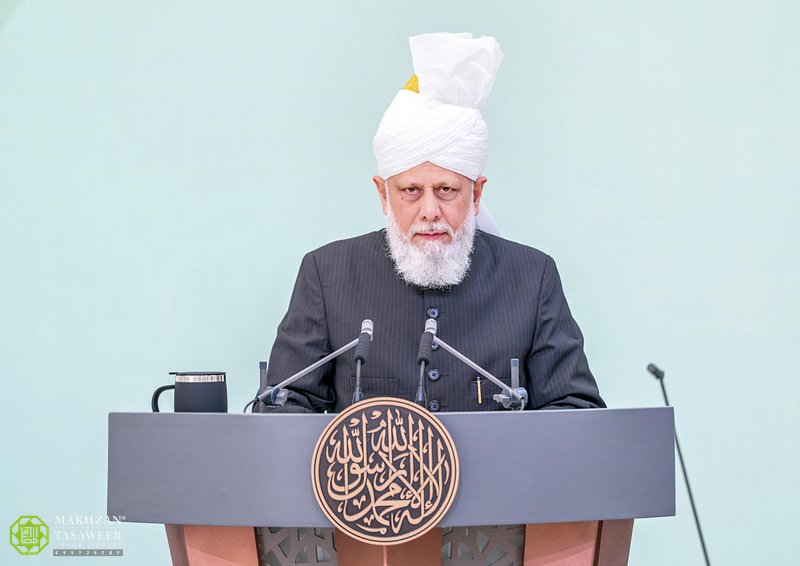
After reciting the tashahhud, ta‘awwuz, and Surah al-Fatihah, Hazrat Khalifatul Masih Vaa stated:
Today, I will mention further details that are recorded in relation to the journey of Tabuk, which I have been mentioning over the previous sermons.
As was mentioned, some hypocrites refused to join the expedition, and they presented various excuses. Furthermore, even after the Holy Prophet’ssa arrival back in Medina, we find narrations of the excuses and justifications presented by the hypocrites for not joining in the expedition. As a matter of fact, this is also mentioned in the Holy Quran. It was the Holy Prophet’ssa practice that upon returning to Medina from a journey, he would first go to the mosque and offer two units of [voluntary] prayer.
When the Holy Prophetsa returned from Tabuk, he entered Medina in the latter part of the morning, and he first offered two units of [voluntary] prayer in the mosque. This was his practice after returning from a journey, as I just mentioned. After completing the voluntary prayer, the Holy Prophetsa remained in the mosque, and people started gathering in order to meet and visit him. Those who did not join the expedition due to their weak faith and hypocrisy also gathered. The hypocrites in particular, whose hopes had been reduced to dust, started making oaths and extended more excuses and justifications in order to save themselves from further shame and embarrassment.
Historians write that these individuals numbered around 80; however, according to some narrations, there were even more. The Holy Prophetsa accepted their superficial excuses, took their pledge of allegiance, prayed for their forgiveness and left their internal state to Allah. (Sahih al-Bukhari, Kitab al-Maghazi, Bab Hadith Ka‘b bin Malik, Hadith 4418, Translated, Vol. 9, p. 308; Musnad Ahmad bin Hanbal, Vol. 5, Musnad Ka‘b bin Malik, Hadith 15865, Alam Al Kotob, Beirut 1998, p. 414; Al-Lu’lu al-Maknun Sirat Encyclopedia, Vol. 9, Maktabah Dar al-Islam, pp. 561-562)
However, this crime of the hypocrites was unforgivable. Therefore, Allah the Almighty informed the Holy Prophetsa about them by way of revelation that they were such impure people that Allah would not be pleased with them.
As such, in Surah at-Taubah, Allah the Almighty says in relation to these people:
یَعۡتَذِرُوۡنَ اِلَیۡکُمۡ اِذَا رَجَعۡتُمۡ اِلَیۡہِمۡ ؕ قُلۡ لَّا تَعۡتَذِرُوۡا لَنۡ نُّؤۡمِنَ لَکُمۡ قَدۡ نَبَّاَنَا اللّٰہُ مِنۡ اَخۡبَارِکُمۡ ؕ وَسَیَرَی اللّٰہُ عَمَلَکُمۡ وَرَسُوۡلُہٗ ثُمَّ تُرَدُّوۡنَ اِلٰی عٰلِمِ الۡغَیۡبِ وَالشَّہَادَۃِ فَیُنَبِّئُکُمۡ بِمَا کُنۡتُمۡ تَعۡمَلُوۡنَ سَیَحۡلِفُوۡنَ بِاللّٰہِ لَکُمۡ اِذَا انۡقَلَبۡتُمۡ اِلَیۡہِمۡ لِتُعۡرِضُوۡا عَنۡہُمۡ ؕ فَاَعۡرِضُوۡا عَنۡہُمۡ ؕ اِنَّہُمۡ رِجۡسٌ ۫ وَّمَاۡوٰٮہُمۡ جَہَنَّمُ ۚ جَزَآءًۢ بِمَا کَانُوۡا یَکۡسِبُوۡنَ یَحۡلِفُوۡنَ لَکُمۡ لِتَرۡضَوۡا عَنۡہُمۡ ۚ فَاِنۡ تَرۡضَوۡا عَنۡہُمۡ فَاِنَّ اللّٰہَ لَا یَرۡضٰی عَنِ الۡقَوۡمِ الۡفٰسِقِیۡنَ
“They will make excuses to you when you return to them. Say, ‘Make no excuses; we will not believe you. Allah has already informed us of the facts about you. And Allah will observe your conduct, and also His Messenger; then you will be brought back to Him Who knows the unseen and the seen, and He will tell you all that you used to do.’ They will swear to you by Allah, when you return to them, that you may leave them alone. So leave them alone. Surely, they are an abomination, and their abode is Hell – a fit recompense for that which they used to earn. They will swear to you that you may be pleased with them. But even if you be pleased with them, Allah will not be pleased with the rebellious people.” (The Holy Qur’an, 9:94-96)
Regarding those who stayed behind from the Battle of Tabuk, Allah expressed His severe displeasure with them, as is evident from this. They were declared to be disobedient. The Holy Prophetsa was forbidden from offering their funeral prayer or praying at their graves. Moreover, they were forbidden from taking part in any future campaigns or being part of any battles. Thus, Allah the Almighty states:
فَرِحَ الۡمُخَلَّفُوۡنَ بِمَقۡعَدِہِمۡ خِلٰفَ رَسُوۡلِ اللّٰہِ وَکَرِہُوۡۤا اَنۡ یُّجَاہِدُوۡا بِاَمۡوَالِہِمۡ وَاَنۡفُسِہِمۡ فِیۡ سَبِیۡلِ اللّٰہِ وَقَالُوۡا لَا تَنۡفِرُوۡا فِی الۡحَرِّ ؕ قُلۡ نَارُ جَہَنَّمَ اَشَدُّ حَرًّا ؕ لَوۡ کَانُوۡا یَفۡقَہُوۡنَ فَلۡیَضۡحَکُوۡا قَلِیۡلًا وَّلۡیَبۡکُوۡا کَثِیۡرًا ۚ جَزَآءًۢ بِمَا کَانُوۡا یَکۡسِبُوۡنَ فَاِنۡ رَّجَعَکَ اللّٰہُ اِلٰی طَآئِفَۃٍ مِّنۡہُمۡ فَاسۡتَاۡذَنُوۡکَ لِلۡخُرُوۡجِ فَقُلۡ لَّنۡ تَخۡرُجُوۡا مَعِیَ اَبَدًا وَّلَنۡ تُقَاتِلُوۡا مَعِیَ عَدُوًّا ؕ اِنَّکُمۡ رَضِیۡتُمۡ بِالۡقُعُوۡدِ اَوَّلَ مَرَّۃٍ فَاقۡعُدُوۡا مَعَ الۡخٰلِفِیۡنَ وَلَا تُصَلِّ عَلٰۤی اَحَدٍ مِّنۡہُمۡ مَّاتَ اَبَدًا وَّلَا تَقُمۡ عَلٰی قَبۡرِہٖ ؕ اِنَّہُمۡ کَفَرُوۡا بِاللّٰہِ وَرَسُوۡلِہٖ وَمَاتُوۡا وَہُمۡ فٰسِقُوۡنَ وَلَا تُعۡجِبۡکَ اَمۡوَالُہُمۡ وَاَوۡلَادُہُمۡ ؕ اِنَّمَا یُرِیۡدُ اللّٰہُ اَنۡ یُّعَذِّبَہُمۡ بِہَا فِی الدُّنۡیَا وَتَزۡہَقَ اَنۡفُسُہُمۡ وَہُمۡ کٰفِرُوۡنَ
“Those who were left behind rejoiced in their sitting at home behind the back of the Messenger of Allah, and were averse to striving with their property and their persons in the cause of Allah. And they said, ‘Go not forth in the heat.’ Say, ‘The fire of Hell is more intense in heat.’ Could they but understand! They must laugh little and weep much as a reward for that which they used to earn. And if Allah returns thee to a party of them, and they ask of thee leave to go forth to fight, say then, ‘You shall never go forth with me and shall never fight an enemy with me. You chose to sit at home the first time, so sit now with those who remain behind.’ And never pray thou for any of them that dies, nor stand by his grave; for they disbelieved in Allah and His Messenger and died while they were disobedient. And their possessions and their children should not excite thy wonder; Allah only intends to punish them therewith in this world and that their souls may depart while they are disbelievers.” (The Holy Qur’an, 9:81-85)
These verses are also from Surah at-Taubah.
There were four types of people who stayed behind from the Battle of Tabuk:
The first were those fortunate individuals who remained behind under the instruction of the Holy Prophetsa to fulfil a necessary duty, such as Hazrat Alira, Ibn Umm Maktumra, Muhammad bin Maslamahra and others. This was the first category.
The second group were those who were excused due to disability or illness. They were extremely poor and weak and did not possess the means for transport. Regarding them, Allah the Almighty declared that they possess a genuine excuse and that He has forgiven them. In fact, as mentioned earlier, the Holy Prophetsa said concerning them that they were with the Muslim army wherever it went – meaning that Allah included them in the same reward and spiritual blessings [as those who had gone forth]. (Sahih al-Bukhari, Kitab al-Maghazi, Hadith 4423, Translated, Vol. 9, p. 320)
The third category was the hypocrites, whose conduct has been strongly condemned, and regarding whom the Holy Quran has decreed permanent displeasure, severe punishment, and warnings.
The fourth category consisted of those who stayed behind only out of laziness. Among them, three companions are especially notable: Hazrat Ka‘b bin Malikra, Hazrat Murarah bin Rabira, and Hazrat Hilal bin Umayyahra. Concerning these three companions, this verse of the Holy Quran was revealed:
وَّعَلَی الثَّلٰثَۃِ الَّذِیۡنَ خُلِّفُوۡا ؕ حَتّٰۤی اِذَا ضَاقَتۡ عَلَیۡہِمُ الۡاَرۡضُ بِمَا رَحُبَتۡ وَضَاقَتۡ عَلَیۡہِمۡ اَنۡفُسُہُمۡ وَظَنُّوۡۤا اَنۡ لَّا مَلۡجَاَ مِنَ اللّٰہِ اِلَّاۤ اِلَیۡہِ ؕ ثُمَّ تَابَ عَلَیۡہِمۡ لِیَتُوۡبُوۡا ؕ اِنَّ اللّٰہَ ہُوَ التَّوَّابُ الرَّحِیۡمُ
“And He has turned with mercy to the three whose case was deferred until the earth became too strait for them with all its vastness, and their souls were also straitened for them, and they became convinced that there was no refuge from Allah save unto Himself. Then He turned to them with mercy that they might turn to Him. Surely, it is Allah Who is Oft-Returning with compassion and is Merciful.” (The Holy Qur’an, 9:118)
The details regarding the incident of الثَّلٰثَۃِ الَّذِیۡنَ خُلِّفُوۡا or “those three who were left behind,” are recorded as follows: In a narration of Sahih al-Bukhari, Hazrat Ka‘b bin Malik himself related this entire account. He states:
“I never stayed behind from any expedition that the Holy Prophetsa undertook except the Expedition of Tabuk. Yes, I also stayed behind from the Battle of Badr, but the Holy Prophetsa did not express displeasure with anyone who was absent from that battle. The Holy Prophetsa had only gone forth with the intention of intercepting a caravan of the Quraish, but Allah brought them face to face with the enemy without the intention of fighting.
“I was also with the Holy Prophetsa on the night of Aqabah when we pledged firmly to remain steadfast upon Islam, and I would not wish that I had been present at Badr in exchange for that night (he considered the pledge on that night at Aqabah to be greater than this), even if the people of Badr were more well-known.
“As for my condition, I had never been so strong and prosperous as I was at the time (he is discussing the incident during the Expedition of Tabuk, when he was very prosperous and strong) when I remained behind the Holy Prophetsa in this expedition. By Allah, never before had I possessed so many mounts; during this expedition, I owned two camels.
“Whenever the Holy Prophetsa intended to depart for a campaign (he gives further details), he would usually conceal his true destination by indicating another direction (which was a strategy of war of the Holy Prophetsa at that time). However, when the Expedition of Tabuk took place, the Holy Prophetsa set out during intense heat, and before him lay a long journey through barren land, facing a powerful enemy in vast numbers.
“Thus, the Holy Prophetsa openly informed the Muslims about their circumstances. (He did not keep this destination secret, and he told them that they were going on this expedition, so that they might prepare properly for this attack.) In fact, he told them exactly which direction he intended to go. The Muslims were great in number alongside the Holy Prophetsa, and there was no register or written record in which their numbers could be recorded.”
Hazrat Ka‘bra was referring to the fact that there was no register in which it was recorded as to who went or not.
Hazrat Ka‘bra would say, “There was no person who wished to be absent except whilst hoping that his absence would remain hidden from the Holy Prophetsa (despite it not being written anywhere, one couldn’t fathom that he would stay hidden from the Holy Prophetsa by being absent) until Allah the Almighty’s revelation concerning him would descend. And the Holy Prophetsa undertook this expedition at a time when the fruits had ripened, and the shades were pleasant.
“The Holy Prophetsa began preparing for the journey, and along with him, the Muslims also began their preparation. And I would depart in the morning (he is narrating his own circumstances) so that I may prepare the provisions of the journey alongside them. (He had a firm intention to go). I would return having done nothing. There was laziness, due to which preparations would not be undertaken. I would say in my heart, ‘I can prepare; I will do it tomorrow.’ This thought caused me to procrastinate until the time came when the people felt the urgency of travelling, and the Holy Prophetsa departed one morning, and the Muslims also departed alongside him. And I had not made any preparation for the travel provisions. I thought that one or two days after the Holy Prophet’ssa departure, I would make preparations and then join him.
“After he had departed, I went out the next morning so that I might prepare provisions, but still I returned having done nothing. Then I went the next day and returned having completed nothing, and this remained the case until the army, travelling swiftly, went very far ahead. I, too, resolved that I would set out and catch up with them, and I wish that I had done this, but this, too, was not destined for me.
“After the Holy Prophetsa departed, whenever I would go out among the people and walk among them, I would be grieved by the fact that I would see only such people who were labelled hypocrites or those who were weak and had been excused by Allah.. And the Holy Prophetsa also remembered me when he reached Tabuk. He was sitting with people in Tabuk at that time, and said, ‘Where is Ka‘b?’ A person from Banu Salama said, ‘O Messengersa of Allah, his two cloaks and his turning to look to his right and left have held him back’ (meaning that perhaps due to arrogance or pride, he did not come).
“Upon hearing this, Hazrat Mu‘adh bin Jabalra said (regarding the statement of that companion), ‘What an evil thing you have uttered regarding Ka‘b. By Allah, O Messengersa of Allah, we have only experienced good from him.’ When the Holy Prophetsa heard this, he became silent.”
Hazrat Ka‘b bin Malikra used to say, “When news reached me that the Holy Prophetsa was returning, I became worried and began to think of lies through which tomorrow I might save myself from displeasure by making an excuse. And within my household, I consulted every wise person regarding this. When it was said that the Holy Prophetsa had arrived, all such false thoughts vanished from my heart, and I understood that I could never save myself from the Holy Prophet’ssa anger through anything containing falsehood. Therefore, I resolved that I would truthfully speak to the Holy Prophetsa.
“The Holy Prophetsa arrived; whenever he would return from any journey, he would first enter the mosque and perform two units of prayer in it, then sit for a meeting with the people. When he did this, those who had remained behind approached him and began to make excuses and to swear oaths, and such people were a little over eighty. The Holy Prophetsa accepted their outward excuses from them and took their pledge and prayed for their forgiveness and entrusted their inner condition to Allah.
“Then I arrived before the Holy Prophetsa. When I conveyed my salutations to him, he smiled with the smile of a displeased person. (It was a smile, but of displeasure). Then he said: ‘Come forward.’ I walked, came forward, and sat in front of him. He asked me, ‘What kept you back? Did you not buy a mount?’ I said, ‘Yes, by Allah, indeed I am such that if I were to sit in front of anyone else in the world besides you, I would think that I would surely be saved from his anger by making an excuse. I have been granted the ability to speak well, but I swear by Allah, I understand well that if today I utter any falsehood to you by which you would become pleased with me, then Allah would soon make you displeased with me. And if I state the truth to you, due to which you will become displeased with me, then I hope for Allah’s forgiveness in this.’”
Hazrat Ka‘bra continued, “‘No, by Allah, there was no excuse for me. By Allah, never was I so established and well-off as I was at the time when I remained behind from the Holy Prophetsa.’ When the Holy Prophetsa heard this, he said, ‘He has spoken truthfully. Stand and leave until Allah decides concerning you.’ (He said, ‘You have spoken the truth, but go from here; now Allah will decide concerning how you will be treated.’)
“I stood and left, and some people from the Banu Salama also stood up and followed me. They said to me, ‘By Allah, we do not know that you ever committed any wrongdoing before this, and you could not even do this; you should have given an excuse to the Holy Prophetsa like those who remained behind had made such excuses. The prayer of the Messengersa of Allah for your forgiveness would have been enough to have your sin forgiven.’ By Allah, these people continued blaming me until I also formed the intention (he says his intention changed) that I might return and refute what I previously said (i.e., that what I had earlier said was wrong, and that I should make some excuse before the Holy Prophetsa). Then, to those who were encouraging me by saying, ‘Go, seek forgiveness, present some other excuse,’ I asked, ‘Is there anyone else with me who has made this type of admission before the Holy Prophetsa, and presented the true matter?’ They said, ‘Yes, there are two other people who have also said what you said, and they, too, have received the same reply that you have received.’ I said, ‘Who are they?’ They said, ‘Murarah bin Rabi‘ Amrira and Hilal bin Umayyah Waqifira.’ They mentioned two such righteous men who had also participated in the Battle of Badr. In both of them was an example for me. When the people mentioned these two to me, I left. And the Holy Prophetsa forbade the Muslims from speaking to us. (That is, he did not return to make an excuse; rather, he went to my house.)
“‘The Holy Prophetsa instructed people not to interact with us. (Referring to those who had remained behind. People began to avoid us as though we were total strangers.) This happened until I felt as though the earth would swallow me up. It was no longer as I knew it. We remained in this state for 50 nights.
“My other two companions confined themselves to their homes out of grief, spending their days weeping. I was younger than them and so was physically stronger in bearing the pain. I would leave my home to join the Muslims during congregational prayers and walk around in the markets, but no one would interact with me. I would also go to the Holy Prophetsa and say ‘peace be upon you!’ while he was seated after having offered prayer. I would wonder if he had moved his lips to respond to my greeting. I would try to steal glances at him, praying close to him to try and see him. When I would pray, he would sometimes glance in my direction, but when I looked at him, he would look away.
“This continued until the stares of onlookers became unbearable to me, so I left and climbed the wall of Abu Qatadah’sra garden. He was my paternal uncle’s son and was more beloved to me than all people. (He went covertly rather than through the front door to remain hidden).”
He says, “I greeted him with the Islamic greeting, but by God, he did not even respond to me. I asked him, O Abu Qatadah, I ask you to swear by Allah and tell me: do I not love Allah and His Messengersa?
“He remained silent.
“I asked him again, asking him to swear by himself. He remained silent again. Then I asked him like this once more, and he replied, ‘Allah and His Messengersa know best.’
“These words caused my eyes to well with tears, and I turned around and climbed over the wall and returned.”
In this state, Hazrat Ka‘bra describes, “While I walked through the markets of Medina, I observed that one of the Nabateans from Syria who had come to sell grain was asking people to tell him about Ka‘b bin Malik’s whereabouts. People started pointing him toward me, and he approached me, giving me a letter from the King of Ghassan.
“The letter said, after greetings, that ‘it has come to my attention that your companion has dealt with you harshly and left you as an abandoned thing, while Allah did not cause you to be born in a household that suffers any humiliation or disgrace such that you should be wasted like this. Come to us, and we will extend leniency to you.’
“When I read this letter, I knew it to be yet another trial.” He was already passing through one trial, and he considered this letter, which the king had sent to entice him, to be certainly another trial. He says, “I took the letter to an oven that was ablaze and threw it in there. When 40 of the 50 nights had elapsed, I saw a messenger carrying a message from the Holy Prophetsa. He said, ‘The Messengersa of Allah commands that you separate yourself from your wife.’ I asked, ‘Shall I divorce her or something else?’ The man replied, ‘Keep away from her and don’t interact with her.’
“The man told both my companions to do the same. I told my wife to go live with her own family until such a time as God Almighty makes a decision concerning me.”
Hazrat Ka‘bra continues, “The wife of Hilal bin Umayyah also had the same restriction placed upon her. So, she came to the Holy Prophetsa and said:
“‘O Messengersa of Allah, Hilal bin Umayyah is extremely old, and he has no servant. Would you dislike it if I were to serve him (cook his food and wash his clothes)?’
“The Holy Prophetsa replied, ‘No, I do not dislike it – but he must not come near you (you may only serve him in that manner).’ She said, ‘By Allah, he is in no state of being inclined towards any such thing. By Allah, from the very day this matter has befallen him, he has been constantly weeping.’”
Hazrat Ka‘bra continues, “Some of my relatives said to me, ‘Why do you not also go to the Messengersa of Allah and ask for similar permission regarding your wife (that she may serve him) just as he gave permission to the wife of Hilal bin Umayyah?’
“I said, ‘By Allah, I will never seek permission for that from the Messengersa of Allah. And I do not know what answer he might give me. Moreover, I am a young man.’ (Hilal was an old man, whereas Ka‘b was younger).
“After that, I remained in that condition for ten more nights, until fifty nights had passed since the time when the Holy Prophetsa had forbidden people from speaking to us. (50 nights had passed in this state). When 50 days of this boycott were completed, I had performed the Fajr prayer one morning and was sitting upon the roof of one of my houses. I was in the very state that Allah has described – my soul felt straitened within me, and the earth, despite all its vastness, had become constricted for me.
“In that very state, I suddenly heard the voice of a man calling out from the top of Mount Sala‘ in a loud voice: ‘O Ka‘b bin Malik! Rejoice!’
“Upon hearing this, I fell prostrate, realising at once that the hardship had been lifted. When the Holy Prophetsa had completed the Fajr prayer, he announced that Allah, in His mercy, had forgiven our error.
“Upon hearing this proclamation, people rushed to give us glad tidings, and messengers were sent to bring the same joyful news to my two companions. One man came galloping towards me on horseback, while another – a man of the tribe of Aslam – ran on foot and climbed up the mountain to call out the glad tidings. His voice, in fact, reached me faster than the horseman’s. (There was one man who was coming to him on horseback, but another man opted to climb a hillock and announce the news from there).
“When the man whose voice I had heard finally arrived with the good news, I immediately took off both my garments and clothed him with them as a gift in gratitude for bringing me the glad tidings.”
He says: “By Allah, at that time I possessed nothing else besides those two garments. I then borrowed two other pieces of clothing, put them on, and made my way to the Holy Prophetsa.
“As I proceeded, groups of people met me one after another, congratulating me on the acceptance of my repentance. They said, ‘Rejoice, for Allah has shown mercy to you and accepted your repentance.’”
Hazrat Ka‘b continues, “Eventually, I entered the mosque and saw the Holy Prophetsa sitting there, surrounded by people. As soon as Talhah bin Ubaidullah saw me, he hurried towards me, shook my hand, and congratulated me. By Allah, no one else from among the Muhajirin rose to greet me except him, and I shall never forget this kindness of Talhah.”
Hazrat Ka‘b said: “When I greeted the Holy Prophetsa with greetings of peace, his face was radiant with joy, and he replied by saying, ‘Rejoice on the best day that has ever passed over you since your mother bore you.’ I asked, ‘O Messengersa of Allah, is this glad tiding from you or from Allah the Almighty?’ He replied, ‘No, it is from Allah.’
“When the Holy Prophetsa was happy, his face would shine as though it were a piece of the moon, and we could recognise his happiness by the radiance of his countenance.
“When I sat before him, I said, ‘O Messengersa of Allah, in gratitude for the acceptance of my repentance, I wish to give up my entire property as charity for the sake of Allah and His Messenger.’
“The Holy Prophetsa said, ‘Keep some of your wealth for yourself, for that will be better for you.’
“I said, ‘Then I shall keep the portion I possess in Khaibar.’
“I further said, ‘O Messengersa of Allah, Allah has saved me because of my truthfulness, and as part of my repentance, I shall speak only the truth for as long as I live. By Allah, I do not know of any Muslim whom Allah has tested more greatly for speaking the truth than He has tested me. From the time I confessed the truth more before the Holy Prophetsa up until this day, I have never deliberately uttered a lie, and I hope that Allah will continue to protect me from falsehood for as long as I live.’
“Then Allah revealed to His Messengersa:
“‘Allah has certainly turned with mercy to the Prophet and to the Emigrants and the Helpers who followed him in the hour of distress after the hearts of a party of them had well-nigh swerved. He again turned to them with mercy. Surely, He is to them Compassionate, Merciful.’”
Hazrat Ka‘b said, “By Allah, after Allah guided me to Islam, He has never bestowed upon me a blessing greater in my eyes than this – that I told the Holy Prophetsa the truth. Praise be to Allah that I did not lie to him, for had I done so, I would have perished as those who spoke falsehood were ruined.”
Hazrat Ka’bra said, “We, the three persons, differed altogether from those whose excuses Allah’s Messengersa accepted when they swore to him. He took their pledge of allegiance and asked Allah to forgive them, but Allah’s Messengersa left our case pending till Allah gave His judgement about it. As for that, Allah said, ‘And He has turned with mercy to the three whose case was deferred.’ What Allah said in this verse does not indicate our failure to take part in the expedition, but it refers to the deferment of making a decision by Allah about our case in contrast to the case of those who had taken an oath before the Holy Prophetsa, and he excused them by accepting their excuses, while we stood by the truth.” (Sahih al-Bukhari, Kitab al-Maghazi, Bab Hadith Ka‘b bin Malik, Hadith 4418, Translated, Vol. 9, pp. 304-317)
At this time, since I am going to mention three deceased members and lead their funeral prayer, I will mention the remainder of these incidents in the future, insha-Allah, which includes what Hazrat Musleh-e-Maudra has recorded in his own way.
Among the deceased I will mention, the first is Hafiz Muhammad Ibrahim Abid Sahib, who was a missionary. He recently passed away at the age of 72.
اِنَّا لِلّٰہِ وَاِنَّآ اِلَيْہِ رٰجِعُوْنَ
[“Verily to Allah we belong and to Him shall we return.”]
He was born in an area of Chakwal. He pledged allegiance at the hand of Hazrat Khalifatul Masih IIIrh in 1967 and entered the fold of Ahmadiyyat. The deceased was born blind. He committed the Holy Quran to memory whilst he was living in his village. He enrolled in Jamia Ahmadiyya in 1967 and obtained his Shahid Degree from Jamia in 1977, along with passing the examination for Arabi Fadil.
As a missionary, he had the opportunity of serving in Islah-o-Irshad Muqami, then as a teacher at Madrasatul Hifz. He also served in a village in Faisalabad. Then he had the opportunity of serving as a missionary in Indonesia for two years. He served in Islah-o-Irshad Markaziyyah, and then he was posted as a missionary to Darul Ziyafat.
An Association for the Blind was also formed, for which he became the secretary in 2000. He also had the opportunity of rendering services in the Khilafat Library. He also learned Braille.
One of his class fellows, Imdadur Rahman Siddiqi Sahib, who is a missionary in Bangladesh, says, “We studied together in Jamia Ahmadiyya Rabwah; Hafiz Sahib was extremely intelligent and wise. He had an excellent memory; if a small portion of a Quranic verse was presented before Hafiz Sahib and he was asked where in the Holy Quran it was from, Hafiz Sahib would think for a minute and then say that the verse was either at the beginning or middle of a certain chapter. Hafiz Sahib would remember well whatever the professors taught at Jamia. Hazrat Khalifatul Masih IIIrh showed particular kindness to Hafiz Sahib, and it was as a result of this that he was given admission into Jamia. He had not received any schooling, yet he obtained an excellent education in Jamia. Whenever he faced any difficulty, he would immediately go to Hazrat Khalifatul Masih IIIrh, and he would seek guidance from him. Hazrat Khalifatul Masih IIIrh showed great kindness to him.”
Similarly, Hanif Mahmud Sahib has also written a great deal about him; I will mention some of it. He says, “Once, I returned from Africa after seven and a half years. I shook his hand and firmly held on to it; however, I did not say anything. Hafiz Sahib recognised me immediately; he mentioned my name and said, ‘When did you get back?’ Even after seven and a half years, just by feeling my hand, he was able to recognise me. Hafiz Sahib also took pride in the fact that he would ensure not to make any mistakes in his recitation of the Holy Quran, and this certainly held true.”
Then, Hanif Sahib has written the following incident that he came here [to the UK] for Jalsa and met me. He told me that he had seen me. At that moment, I said to him, “How have you seen me if you cannot even see?” He replied, “That which I have seen with my heart cannot be seen by the physical eyes.” He possessed a great deal of sincerity and loyalty. Similarly, he had memorised many references from the books of the Promised Messiahas; this is something which various people have also written to me about.
He was able to serve the Jamaat for about 47 years. He had a deeply rooted love for Khilafat. By the grace of Allah, he was a musi. He is survived by his wife, two sons and four daughters. May Allah the Almighty grant him mercy and forgiveness and grant his children patience and forbearance.
The second mention is of Sheikh Abu Bakr George Sahib, who was a local missionary in Liberia. He also recently passed away at the age of 70 after a brief illness.
اِنَّا لِلّٰہِ وَاِنَّآ اِلَيْہِ رٰجِعُوْنَ
[“Verily to Allah we belong and to Him shall we return.”]
He had been battling an ailment of the lungs for some time. He pledged allegiance in 1980 in Sierra Leone and joined the fold of Ahmadiyyat. In terms of worldly means, he was quite well-off. After his retirement, Allah the Almighty placed an extraordinary passion for service to the faith in his heart. Before the age of 60, though he did recite the Holy Quran, it was not much; however, from this age onwards, he placed great emphasis on this and learned the proper recitation of the Holy Quran.
He vowed that he would spend the remainder of his life in service to the faith. Despite not formally being a life-devotee, he practically exhibited a spirit far greater than that of a life-devotee. He was always at the forefront of service to the Jamaat and propagating its message. After one year of fundamental education by the Jamaat through a condensed course, he was appointed as a local missionary. In 2012, he was appointed as a local missionary in his own city. He also had his own home in the city of Ganta, which he dedicated as a centre. He also built a small mosque nearby that house, and he would serve the faith.
In this way, he was honoured to be the first missionary of Nimba County, and he continued to serve here until his demise. In Ganta, he gave his personal plot for the mosque and mission house, upon which the central mosque and regional mission house now stand. Similarly, he also gifted the Jamaat a plot and a small house on the outskirts of Monrovia.
The deceased always maintained a bond of sincerity and loyalty with the Jamaat. Despite old age and weakness, he would continually travel to the remote areas of his county, even though the track was unpaved and extremely difficult. As a result of his preaching efforts, several small towns also came into the fold of Ahmadiyyat.
He was regular in fasting, in offering Salat, and in the recitation of the Holy Quran. He was regular in paying financial contributions, was kind to the poor, participated eagerly in financial sacrifices, and was a righteous and sincere person. By the grace of Allah Almighty, he was a musi. Upon his demise, when the Wasiyyat accounts were calculated, there was an additional surplus of approximately 400,000 Liberian Dollars. He had a deep bond with Khilafat.
He is survived by two wives, three sons and two daughters. May Allah the Almighty bestow His forgiveness and mercy and enable his progeny to maintain a bond of loyalty with the Jamaat.
The third mention is of Samina Bhunnoo Sahiba, who was the wife of Dr Fazal Mahmud Bhunnoo Sahib of Liberia. She too passed away recently.
اِنَّا لِلّٰہِ وَاِنَّآ اِلَيْہِ رٰجِعُوْنَ
[“Verily to Allah we belong and to Him shall we return.”]
She was the granddaughter of Hazrat Maulana Abdur Rahim Dard Sahib, who was a companion of the Promised Messiahas. Dard Sahib also served here [in the UK] as a missionary. The deceased obtained her BA from Rabwah and then completed her MA in Arabic from the Punjab University, Lahore. She spent almost 35 years in Africa alongside her life-devotee husband, facing all manner of challenges with great courage and remaining steadfast in every circumstance. At every stage of life, she fulfilled the demands of life-devotion cheerfully and with full contentment, and in her married life, she endeavoured to foster love and harmony.
Her close relative – her sister-in-law – also writes about her that she played a great role in maintaining and strengthening family relationships and treated everyone with much love and affection.
Abdul Ghani Jahangeer Sahib, In-Charge of the French Desk, writes that Samina Sahiba’s husband was from France, and he had a relationship with him; as a result, he knew Samina Sahiba and her mother. He writes, “Once I asked the deceased whether, after Dr Sahib’s retirement, she would prefer to return to Pakistan or go to Mauritius, as her in-laws were from Mauritius.” She replied, “No, I have become an African. I would not like to go to Pakistan, nor Mauritius; I love Africa, and I wish to remain here forever.”
Since she lived in French-speaking countries, she had become fluent in French as well. He further relates, “Once her mother-in-law said to me: ‘Samina is my favourite daughter-in-law because she remains content with what she has and never complains. Although doctors sometimes have better circumstances, in certain areas – especially in the early stages – their income can be very low, and they must manage on very little. Yet she very patiently and courageously supported her husband, and her husband also upheld his waqf with great sincerity.”
Her mother-in-law relates the following incident: “Her daughter, Anila, who is now a doctor and a life devotee, serving in a hospital, came home from school, and her schoolbag was torn. Instead of buying a new one, she said to her daughter, ‘Wait, I will fix it,’ and she repaired it herself by hand.”
The deceased was extremely simple, regular in offering the five daily prayers, sociable, deeply compassionate, kind, caring towards everyone, prayerful, patient, grateful, hospitable, noble in character and kind to the poor. Some of the early missionaries who went to Burkina Faso also wrote to me that she would take great care of them when they were there, and since they were alone, she would always tend to their needs and would give them food and drink.
She was extremely devoted to Khilafat and expressed her deep love. By the grace of Allah, she was a musia. She had a deep bond of love with Khilafat. She has a brother, Dr Mahmud Atif Sahib, who works at Fazl-e-Omar Hospital, Rabwah, and another brother, Hamid Maqsood Atif Sahib, a missionary of the Jamaat.
May Allah the Almighty bestow His forgiveness and mercy on the deceased and elevate her station. As I have stated, after the prayers, I will lead their funeral prayers in absentia.
(Official Urdu transcript published in the Daily Al Fazl International, 19 December 2025, pp. 2-6. Translated by The Review of Religions.)