
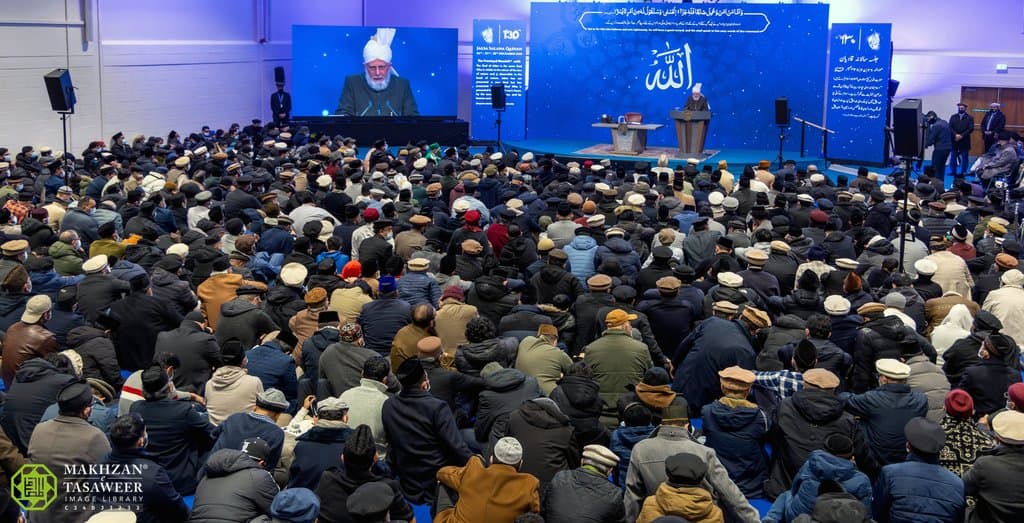
On 28 December 2025, Hazrat Mirza Masroor Ahmad, Khalifatul Masih Vaa arrived at the Masroor Hall shortly after 10:30 am for the concluding session of Jalsa Salana Qadian 2025 from Islamabad, Tilford, UK.
After conveying salaam to those present as well as to viewers connected through MTA, Hazrat Amirul Momineenaa invited Nooruddin Nasir Sahib to recite a portion of the Holy Quran (Surah al-Hashr, Ch.59: V.19-25). Mansoor Ahmad Masroor Sahib read out its Urdu translation. An Urdu poem written by the Promised Messiahas was then presented by Khalid Waleed Sahib.
Thereafter, Huzooraa took to the podium to deliver the concluding address. After tashahhud, ta‘awwuz and the recitation of Surah al-Fatihah, Hazrat Amirul Momineenaa began his address. A brief summary is presented below:
The Promised Messiahas said:
“Do not consider this Jalsa to be equivalent to any ordinary worldly gathering. The fact of the matter is that it is founded upon the pure support of truth and the propagation of Islam. The foundation stone of this Jamaat has been laid by Allah the Almighty Himself, and nations have been readied that will soon come to join its fold.” (Majmu‘ah-e-Ishtiharat [2019], Vol. 1, p. 361)
Huzooraa said that today, we are witnessing that Jalsa Salana gatherings are being held across the world, and just as the Promised Messiahas had foretold, nations are becoming part of these assemblies. The town of Qadian, once unknown to the world, has now become a focal point of global attention. According to the latest information, the current Jalsa includes representation from 37 countries, comprising participants from diverse regions and nations.
This reality stands as clear evidence that the support and succour of Allah the Almighty accompany this Jalsa. However, the true benefit of this gathering can only be attained by those who strive to fulfil the pledge they made with the Promised Messiahas. Only then can we become rightful heirs to the prayers he offered for those who attend the Jalsa.
The Jalsa attendees must have listened to many scholarly and thought-provoking speeches during this Jalsa, but these addresses will only yield benefit in their practical lives if they keep their pledge of allegiance firmly in view. Over time, people often forget the basis upon which they entered into bai‘at and lose sight of the true purpose of being an Ahmadi Muslim.
The Promised Messiahas was raised for the purpose of bringing back, in a practical and transformative manner, those who had drifted away from the true teachings of Islam, so that they might once again become the kind of Muslims the Holy Prophet Muhammad, peace and blessings of Allah be upon him, sought to cultivate. This was the very purpose for which Allah the Almighty sent the Holy Prophetsa who brought about pure and profound transformations among his Companionsra, moulding them into the finest and exemplary Muslims. This objective must always remain at the forefront of our minds.
The Promised Messiahas laid down several conditions in the pledge of bai‘at. Foremost among these conditions is the avoidance of shirk (associating partners with God). Shirk does not merely consist of prostrating before someone; rather, as the Promised Messiahas explained, if a person gives precedence to their own actions, schemes, or ego over Allah the Almighty, they are, in effect, setting up an object of worship alongside God.
The Promised Messiahas stated that those who enter into bai‘at with him must also affirm that they will never speak falsehood, nor will they commit adultery. In the present age, through television and other forms of media, such content frequently comes to the fore which, even if it does not lead to wrongdoing in practice, nevertheless gives rise to immoral and corrupt thoughts. It is therefore essential that we remain vigilant and safeguard ourselves against all such influences.
He further instructed that the five daily prayers should be offered in accordance with the command of Allah and His Messengersa, and that one should strive to observe Tahajjud. Moreover, one should invoke blessings upon the Holy Prophet, peace and blessings of Allah be upon him, seek forgiveness for one’s sins, repeatedly reflect upon the favours of Allah the Almighty, and express gratitude for them.
The Promised Messiahas also stated that one who has entered into a pledge of bai‘at with him must never inflict any form of unjust harm upon the creation of Allah the Almighty in general, and upon Muslims in particular, under the influence of selfish passions – whether through the tongue, the hand, or by any other means.
Furthermore, the Promised Messiahas emphasised that in all circumstances – whether in times of hardship or in times of prosperity – one must remain steadfastly loyal to Allah the Almighty.
Although we repeat these commitments every year and reaffirm that we shall act upon the conditions of bai‘at, we nevertheless often fail to keep them firmly present in our minds.
Some devoted members also write that they have displayed the Conditions of Bai‘at in their homes. This serves as a constant reminder of what the conditions of bai‘at entail, and by reading them regularly, one is continually encouraged towards self-reformation. In this way, it becomes clear how one is to become a true Ahmadi believer and how one is to fulfil the pledge of bai‘at. In times of trial and difficulty, one must never turn away from Allah the Almighty.
Some people write that they have offered many prayers, yet they have not been accepted. This indicates that there is a deficiency in our own efforts as well as in our supplications. There is no refuge for us other than Allah the Almighty before whom we may bow. If we persist steadfastly in this path, Allah the Almighty will surely bestow His grace.
We must also guard ourselves against false customs, immoral practices and the pursuit of base desires, and instead adopt the commandments of the Holy Quran as our guiding code of life. All these matters require serious self-examination. We must ask ourselves whether we are truly acting upon the commands of Allah and His Messengersa in their entirety.
The Promised Messiahas stated that whoever has entered into bai‘at with him must abandon arrogance and adopt virtues such as humility, good moral conduct, gentleness and meekness – only then can one become a true Ahmadi. We should keep all these matters before us and continuously assess the extent to which we are acting upon them.
The Promised Messiahas further stated that honouring faith and showing compassion for Islam, holding it dearer than one’s own life and wealth, is also a requirement for one who has pledged allegiance to him. Moreover, he instructed that the abilities and blessings granted by Allah the Almighty should be utilised for the benefit of mankind. This includes financial sacrifice as well as other means through which service to humanity can be rendered.
The Promised Messiahas further emphasised complete obedience to him – that all these recognised virtues should be practised solely for the sake of Allah the Almighty – and that one should strive to uphold them until the very end of life.
The Promised Messiahas appeared for the sole purpose of removing the dust that had settled upon the face of Islam, purifying it and presenting it afresh in its pristine form. For this mission, a community was to be prepared that would continue this work.
The very purpose of Jalsa Salana is to act upon the teachings articulated by the Promised Messiahas and to assess the extent to which we are implementing them in our lives. He clearly stated that this is a religious gathering, initiated under the special support of Allah the Almighty, so that He may transform us into truly Godly individuals.
All those attending the Jalsa, as well as those participating through MTA, have pledged allegiance upon these very principles. And just as the Promised Messiahas foretold that nations would join this Jalsa, this prophecy too has been fully realised.
Therefore, we must keep these matters constantly before us and make every possible effort to act upon them fully, never allowing ourselves to drift away from them.
The Promised Messiahas explained that in order to act upon these teachings and to guide people onto the straight path, it is essential that we cultivate righteousness (taqwa) within ourselves. On one occasion, he stated that mere rhetoric is of no avail without practical action. If we wish to discharge the true right of bai‘at, we must adopt taqwa. If we do so, we will enter the strong fortress of Allah the Almighty. If we are confronted by nations that view us with hatred and contempt, the only way to withstand such opposition is to purify our inner selves; once we do so, the help of Allah the Almighty will surely be with us.
Some people say that they have offered this prayer and that prayer, seeking worldly matters, yet none of their prayers have been accepted. However, the first question that must be examined is whether we have prayed in order to attain closeness to Allah the Almighty.
Thus, it is only through taqwa that our identity as Ahmadi Muslims can truly benefit us. The Promised Messiahas stated that even if one attains the elementary stages of taqwa, the grace of Allah the Almighty may still be bestowed. If a person lacks taqwa and yet complains that their prayers had not been accepted, this constitutes a matter of ignorance. Accordingly, the Promised Messiahas emphasised that it is incumbent upon every member of his Jamaat to tread the paths of righteousness and to partake of an ever-increasing share of faith.
The Promised Messiahas advised to adopt taqwa so that we may fulfil all those requirements that are essential for his bai‘at. Offer the prayers, and offer them with humility and submissiveness.
Huzooraa stated that many people come to him and say that they offer prayers and supplications. While it is true that they do observe the prayers, greater effort and deeper supplication are still required.
The Promised Messiahas further stated that if one has entered into bai‘at with him, then they must also engage in self-reformation and repentance, and develop a sincere concern for acting upon the commitments they have made with him.
In order to attain these qualities, seeking istighfar is also essential. To rely on supplication and personal schemes while abandoning Allah the Almighty is also a form of folly. The true benefit of bai‘at lies in witnessing a clear and manifest transformation within one’s life.
Although it is permissible to combine prayers and offer them together, it is not acceptable to claim forgetfulness and fail to offer the prayers altogether. Ahmadis, in particular, must safeguard themselves against such negligence.
On the occasion of Jalsa, attention is undoubtedly given to the observance of the prayers and to the offering of Tahajjud. However, when people return to their homes, this level of attentiveness often diminishes. Thus, when the Promised Messiahas drew attention to this matter, his intent was that if the prayers are observed properly and consistently, people will also benefit in their worldly affairs.
Allah the Almighty does not concern Himself with everyone indiscriminately; rather, He shows special concern for the salih (righteous and upright). Cultivate mutual affection and love among each other, and abandon cruelty and mockery.
The Promised Messiahas stated that a tree which bears no fruit is uprooted and discarded by the gardener. Therefore, if we have entered into bai‘at, we must fulfil its conditions so that no opposition may cause us harm. We should establish a firm relationship with Allah the Almighty, so that He Himself may care for us, and no one may be able to cause us any injury.
The Promised Messiahas advised us to live as brothers and exist as one united people. This should be the distinguishing feature of the Jamaat, and indeed one of its defining signs. Remove hostility from among ourselves and occupy ourselves with great and noble works. People will oppose us, but respond to them with gentleness and never allow passion to govern our actions. This is his exhortation; remember it as a solemn testament.
The Promised Messiahas stated that he repeatedly received the revelation that if we become righteous and tread the subtle paths of taqwa, God will surely be with us.
The Promised Messiahas further stated that he is also concerned with identifying truly righteous individuals within his Jamaat and entrusting certain religious responsibilities to them.
Therefore, each one of us should strive to be counted among such people and be prepared to serve in the propagation of faith. By the grace of Allah, a special group of Waqifeen-e-Nau is also being prepared, and they must keep these admonitions of the Promised Messiahas firmly in mind. Every individual should strive to walk the path of taqwa and become an heir to the prayers of the Promised Messiahas.
The Promised Messiahas offered prayers for his followers that they may attain the pleasure of Allah the Almighty and become seekers of His mercy.
If we desire to become heirs to the prayers of the Promised Messiahas – particularly those prayers he offered for participants of the Jalsa – then we must keep the conditions of bai‘at constantly before us.
Huzooraa also drew attention to the importance of displaying the Conditions of Bai‘at in a framed form as a continual reminder.
If we wish for the counsel and prayers of the Promised Messiahas to be fully realised in our own lives, we must act upon his teachings and faithfully fulfil the conditions of bai‘at that we have pledged with him.
Huzooraa then led everyone in silent prayer. Following the prayer, participants from Qadian presented taranas and poems.
At the end, Hazrat Amirul Momineenaa announced the attendance figures for Jalsa Salana Qadian 2025 and also provided updates on the participation at various other jalsas being held simultaneously across the world. Excluding those listening from home, the total number of participants connected through the Jamaat’s system was around 40,000.
(Summary prepared by Al Hakam)