
Omar Farooq, Missionary & Head of MTA USA Studios
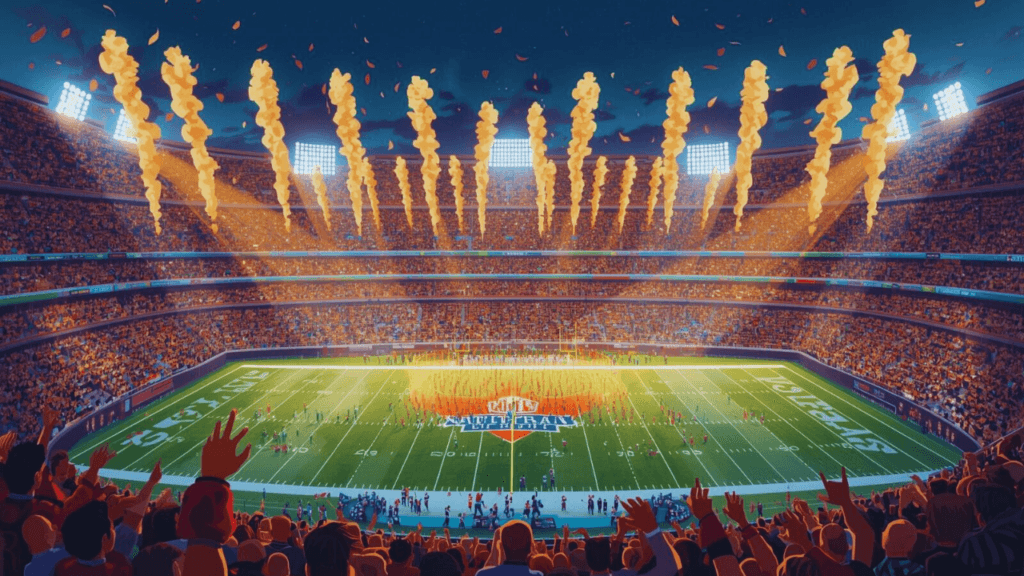
The halftime show in this year’s American Football championship game, known as the “Super Bowl”, was watched by a record-setting 135 million viewers. Shortly after the Super Bowl halftime show concluded, the President of the United States took to social media with his usual blunt style. He wrote on X that it was “one of the worst halftime shows ever” and criticised its tone, presentation and suitability for American family audiences.
The remark was telling, not only for its sharpness, but for what it revealed. A sitting president felt compelled to publicly reject a cultural performance watched by tens of millions across the world. This reaction alone signals that the Super Bowl halftime show is no longer a neutral entertainment segment. It is a site of political, cultural and emotional contention.
For international viewers, this may seem puzzling. Why would a music performance provoke presidential commentary? Why is a football intermission treated as a cultural battleground? To answer that, one must understand what the halftime show has quietly become within American society.
Why the halftime show carries such weight
The Super Bowl is one of the few remaining moments of mass unity in the United States. In an era of fragmented media and polarised politics, it draws together people across race, class, ideology and geography. Families, critics, supporters and skeptics all watch the same broadcast at the same moment.
Because of this, whatever appears on that stage gains immediate national and international legitimacy. The halftime show is not merely seen. It is collectively experienced. That makes it an ideal platform for signaling values, acknowledging tensions and managing national mood.
This is why the halftime show has evolved from simple spectacle into something more functional. It has become a mechanism for cultural management.
A noticeable shift over the last five shows
In just past five Super Bowl halftime performances, a clear and consistent pattern emerges. While the artists and musical styles vary, the underlying structure does not.
Each show prominently features themes of struggle, identity, marginalisation, resistance or social tension. These themes are expressed visually through stage design, symbolism, choreography and tone rather than direct political speech. The performances are emotionally intense, visually disciplined and carefully controlled.
At the same time, none of these shows present demands, solutions or calls for structural reform. The audience is invited to feel, reflect and empathise, but not to act.
This is a critical distinction. The halftime show does not suppress dissent. It reframes it.
From protest to performance
In earlier eras, protest and critique existed outside mainstream platforms. Today, they are increasingly incorporated into them. The halftime show exemplifies this shift.
Rather than excluding uncomfortable conversations, the show absorbs them into art. Social conflict becomes aesthetic. Historical pain becomes symbolic. Anger becomes choreography. What might otherwise disrupt public order is transformed into something consumable.
This approach has a powerful effect. Viewers feel seen. Communities feel acknowledged. Tension is released. The system appears responsive.
In this year’s performance, the lead artist carried out a display of dissent against aggressively enforced immigration and deportation rules, which have mainly targeted South-Americans living in the USA, and members of African backgrounds.
Yet because the critique is contained within a 12 minute performance, it poses no lasting challenge. Once the show ends, the broadcast moves on seamlessly. Commercials resume. Normalcy is restored and the game continues.
Catharsis without consequence
At the heart of this process is catharsis. The halftime show offers emotional release at moments when American society feels strained or fractured. It allows millions to experience a shared emotional peak. To let out a shared sense of resolution.
But catharsis, when detached from accountability, becomes a substitute rather than a solution. Emotional resolution replaces moral reckoning. Perceived representation replaces reform.
This is why the halftime show is so effective. It gives people the feeling that something meaningful has occurred, even when nothing has changed structurally. The pressure is released, not redirected for change. Celebrities participate in perpetuating the mirage, and all the while large corporations who fund the theatre of performance (estimated at $10-20 million USD this year) walk away with an increasing number of eyes, ears and subscriptions tied to their brand.
Why institutions prefer this model
From a systems perspective, this is remarkably efficient. Suppressing dissent often intensifies it. Incorporating it allows institutions to manage tone, timing and outcome strategically.
By hosting controlled expressions of critique, power presents itself as tolerant and inclusive while remaining fundamentally untouched. Difference is embraced, but only within defined boundaries. Resistance is welcomed, but only as performance.
This is strategic. It is not an accident that the ownership of NFL and the corporations that fund these shows are the same that also lobby (openly or hidden) the political parties and individuals involved in bringing about the said suppressive policies.
The President’s reaction in context
The President’s post calling the show “one of the worst halftime shows ever” was not merely a matter of taste. It reflected anxiety about control over the national narrative. When cultural platforms begin to shape emotional and moral discourse independently of political authority, then clearly friction emerges.
The post underscores a deeper reality. The halftime show has become influential enough to provoke a response from the highest elected office in the country. That alone confirms its role as more than entertainment.
A broader moral question
For international audiences, this phenomenon offers an important lesson about modern power. In many societies, dissent confronts authority directly or is openly suppressed. In the American cultural model, dissent is often absorbed, stylised and neutralised through mass media.
The question, then, is not whether these performances are sincere or artistically meaningful. The question is whether public emotion, without moral accountability, can lead to lasting peace and tangible change.
Real change is not performative, it requires deeper reform
The perspective offered by Hazrat Mirza Masroor Ahmad, Khalifatul Masih Vaa, becomes especially relevant in today’s segmented world. In an address, he repeatedly emphasises that global stability cannot be achieved through appearances, rhetoric or symbolic gestures alone.
He states:
“We also find that as a result of mass immigration, restlessness and anxiety are spreading in certain countries. The responsibility for this lies with both parties – the immigrants and the local people. On the one hand some immigrants provoke the locals by refusing to integrate to any degree, whilst on the other hand some of the locals are displaying a lack of tolerance and open-heartedness.” (World Crisis and the Pathway to Peace, 2017, p. 104)
He further states:
“Therefore, to improve the situation and for peace to develop, requires all parties to work together. Governments need to make policies that establish and protect mutual respect, through which hurting the sentiments of others or causing them any type of harm should be outlawed. With regard to the immigrants, they must enter with a willingness to integrate with the local people, whilst the locals should be ready to open their hearts and display tolerance.” (World Crisis and the Pathway to Peace, 2017, p. 105)
This principle speaks directly to issues of migration, displacement and social unrest. When nations ignore the structural causes of inequality and human suffering, emotional expression alone cannot heal the damage. Public displays of unity mean little if the rights of the vulnerable remain unfulfilled.
Hazrat Khalifatul Masih Vaa has time and again reminded us all that:
“I wish to make something very clear, and that is that a relationship of mutual love, affection and loyalty between one person and another cannot be established until a relationship of love, affection and loyalty with the Lord Who created us is developed.” (7th Annual Peace Symposium, Baitul Futuh, 20 March 2010)
Mere performances of dissent and change only reflect a world that prefers emotional relief over moral reform, symbolism over substance and spectacle over justice.
The lights dim. The crowd applauds. The game resumes.
But the work of building peace, rooted in justice, responsibility and moral courage, remains unfinished.