
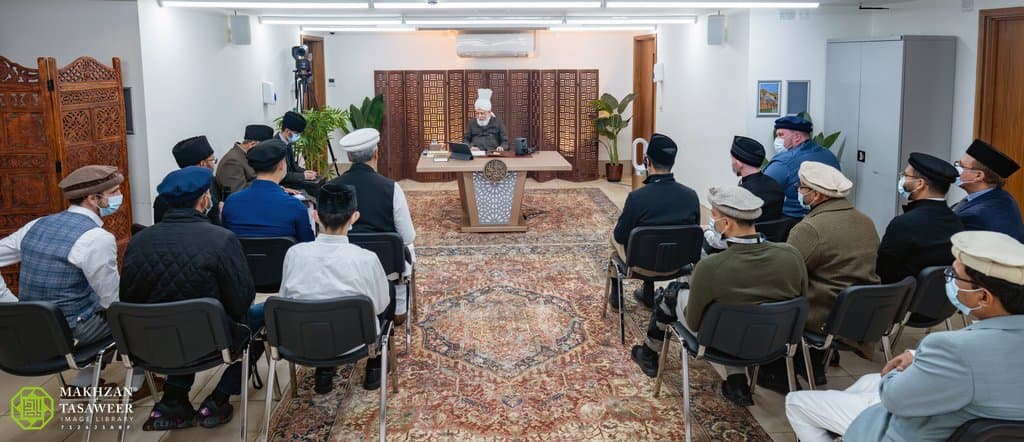
Islamabad, Tilford, 2 February 2026: A group of new converts [nau-mubai‘in] from Canada had the blessed opportunity to meet with Hazrat Mirza Masroor Ahmad, Khalifatul Masih Vaa.
Huzooraa arrived at the meeting and conveyed his salaam to the attendees. After they were seated, Huzooraa asked the National Secretary for Tarbiyat Nau Mubai’in to introduce the group. The secretary explained that the delegation consisted of new converts from Canada.
Introductions and individual interactions
The first attendee introduced himself as hailing from Ottawa. He stated that he had accepted Ahmadiyyat in 2024 and was currently serving as Nazim Sehat-e-Jismani in his local majlis. He shared that he was previously agnostic but had sought a purpose in life. He mentioned his mixed heritage, with a Chinese mother and a Vietnamese father. Upon enquiry, he told Huzooraa that he had read the English translation of the Holy Quran up to Chapter 12. Huzooraa advised him to learn the Arabic text as well. When Huzooraa asked if he had memorised Surah al-Fatiha, the attendee replied that he knew the English translation but not the Arabic yet. Huzooraa emphasised the importance of memorising Surah al-Fatiha in Arabic, noting that it is recited in every rak‘ah of the daily prayers. Huzooraa remarked that having accepted Ahmadiyyat almost two years ago, he should have learnt it by now, adding that with dedication, it would only take a week to memorise.
Next, a convert from Toronto introduced himself. Originally from Punjab, India, he explained that he did not have a Muslim background; he was Hindu but was raised in a village that followed the Sikh faith. He moved to Canada in 2019 as a computer science student. He sought guidance on how to deal with his family, who had cut ties with him following his conversion. Huzooraa advised him to pray for them, maintain contact and demonstrate excellent moral character. Huzooraa instructed him to tell his family that his new faith teaches him to possess high morals. Referencing the Holy Quran, Huzooraa reminded him not to say even “uff” (a word of expression of disgust or disobedience) to his parents and to obey them in all worldly matters, unless they commanded him to commit shirk or associate partners with Allah. (Surah Bani Isra’il, Ch.17: V.24) Huzooraa advised him to remain a dutiful son regardless of their opposition.
A convert from Windsor, Ontario, stated he had accepted Ahmadiyyat three years ago. He described himself as previously agnostic but was drawn to the structure of Islam, particularly fasting and prayers. Huzooraa asked if he offered the five daily prayers, to which he replied in the affirmative, noting he attended the mosque for Fajr. Huzooraa was pleased to hear that he had learnt Surah al-Fatiha.
Another new convert, originally from Guyana, introduced himself. He accepted Ahmadiyyat in 2023. Huzooraa advised him to focus on learning more about the religion.
A convert of Polish heritage, who grew up in Canada, introduced himself. He mentioned that he was the only Ahmadi in his family, while his mother and siblings remained Catholic. He asked for advice on how to do tabligh to his practising Catholic family without causing conflict. Huzooraa advised him to maintain strong bonds with his family and not to break ties. Huzooraa suggested that during casual, friendly moments, he could invite them to ask why he accepted Ahmadiyyat, especially given the current defamation of Islam in the world. Huzooraa encouraged him to increase his religious knowledge, particularly regarding the status of Prophet Jesusas and Mary, so he could answer their questions effectively. Huzooraa stressed patience and kindness throughout this long process.
Another attendee, who works with children with disabilities, stated he accepted Ahmadiyyat in 2023. He mentioned he was raised a Christian and had learned biblical languages, including Hebrew. He told Huzooraa he was currently reading book 25 from the Jamaat’s literature and had read Introduction to the Study of the Holy Quran. Huzooraa commended his knowledge. The attendee mentioned he had mobility issues previously but was now recovered. Huzooraa advised him to continue preaching to Christians and Muslims by explaining the true teachings of Islam and refuting un-Islamic definitions of Jihad.
Another convert, whose family background is from Trinidad, introduced himself. He noted that his father was Catholic but had accepted Ahmadiyyat when the convert was three years old. Huzooraa advised him that although he accepted the faith through his parents, he must personally strive to learn more about religion to ensure he continues to progress.
Another convert, who accepted Ahmadiyyat ten years ago, had a brief exchange with Huzooraa regarding a past knee injury sustained while playing basketball. Huzooraa enquired about his health and recovery.
Navigating family opposition
Following the introductions, an attendee asked how new converts should communicate with their families regarding their conversion, given the cultural and religious challenges.
Huzooraa reiterated that they must maintain good relations with family members. He advised them to demonstrate through their character – by being humble, kind, patient and loving – that Islam has guided them to the right path. Huzooraa stated that actions speak louder than words and witnessing such positive behavioural changes would reassure their relatives.
Preaching through action rather than debate
A new convert stated that he had brought his brother to Ahmadiyyat and his cousin had also converted. He asked how he could spread the message of Allah with respect.
Huzooraa answered that he should do so through his actions. Huzooraa explained that if one becomes an Ahmadi but does not possess good morals or fails to discharge the rights of God’s creation, thinking that merely offering prayer fulfils the rights of Allah, then there is no benefit. Referencing the Promised Messiahas, Huzooraa stated that his followers must fulfil two rights: the rights of Allah (worship and obedience to Quranic guidance) and the rights of mankind. Huzooraa reminded him that the Holy Quran teaches that the enmity of a nation should not prevent one from acting justly even towards enemies. (Surah al-Ma’idah, Ch.5: V.9)
Huzooraa elaborated that tabligh is not merely about debates or arguments regarding whether Jesusas is alive or has passed away or proving the Seal of Prophethood or the advent of the Promised Messiahas. Huzooraa observed that in the modern era, particularly in the Western world, people are often not interested in these theological details; similarly, among many Hindus and Sikhs, religion has become a matter of tradition rather than faith. In such an environment, people observe one’s character. Huzooraa advised that if people see good morals and righteous deeds, they will listen and try to understand the message. Huzooraa cautioned that arguments can always be countered, but the real objective is for Ahmadiyyat to bring about a visible transformation in the person. He urged the attendee to be a practical Muslim who worships Allah and serves humanity, assuring him that the message would then spread automatically.
Guiding family members to Islam Ahmadiyyat
A new convert mentioned that his mother had shown interest in learning about Islam and asked for advice on how to guide her.
Huzooraa advised him to share the essence of Islamic teachings with her: discharging the duties owed to Allah and the duties owed to fellow beings. Huzooraa emphasised that if his mother witnessed a genuine positive transformation in him – where he became kinder, more patient and loving – she would naturally acknowledge the goodness of his faith. Conversely, if his behaviour remained unchanged, she would see no value in his conversion.
Spiritual growth and remembrance of Allah
A new convert asked about ways to grow spiritually and strengthen one’s connection with Allah, beyond offering salat and reading the Quran.
Huzooraa advised him to remember Allah at all times, in every deed and action. He explained that one should always be conscious that Allah is watching over them to prevent wrongdoing. Huzooraa stated that one offers salat to gain the love of Allah and express gratitude for being guided to the true religion. However, Huzooraa cautioned that if a person offers prayers and reads the Quran but subsequently commits bad deeds, there is no benefit and those prayers are wasted.
To maintain this connection, Huzooraa referred to his tahrik and drive to recitate specific prayers daily, including durood (at least 200 times) and istighfar (at least 100 times) and all the other prayers. Huzooraa noted that these azkar keep the mind focused on the fact that one cannot achieve anything without Allah’s help and that good deeds are necessary to gain His pleasure.
Balancing work, life and faith
A new convert asked how to balance family, work, studies and Jamaat responsibilities, noting that he was married and worked seven days a week, teaching and running a business.
Huzooraa emphasised the necessity of giving time to parents, one’s wife and children, noting that they need his company and help. Huzooraa pointed to the life of the Holy Prophetsa as the ultimate role model. He explained that despite having many wives, teaching the Muslims, receiving revelations and dictating them to scribes, the Holy Prophetsa fulfilled his duties to his family and maintained the highest standards of worship. Huzooraa advised the attendee to manage his time effectively, listening to sermons to learn from the character of the Holy Prophetsa.
Choosing a career to serve humanity
A young khadim, aspiring to be a mechanical engineer, asked how young people could choose a career that matches their passion while also serving humanity.
Huzooraa encouraged him to pursue his interest in mechanical engineering. He explained that having such a skill could potentially allow him to serve humanity through the International Association of Ahmadi Architects and Engineers (IAAAE) or by doing Waqf-e-Arzi in poorer countries. Huzooraa added that if he possessed a fertile mind, he could invent technologies helpful to humanity, which would also be a service to the Jamaat.
Serving the faith while working
An accountant, aged 33, asked if it was better to apply for full-time Jamaat service (waqf) or to continue working and do tabligh in his free time.
Huzooraa advised him to continue his job and business while dedicating time to preaching. Huzooraa noted that at his age, having gained experience and maturity, it might be difficult to adjust to the restrictions of full-time waqf. Therefore, Huzooraa recommended that he do preaching independently whenever he found time, rather than placing himself under the constraints of formal life devotion.
Conclusion
The meeting concluded with a group photograph. Huzooraa distributed pens to the attendees, enquired about their travel and accommodation arrangements and prayed that Allah might increase them in faith and knowledge.
(Summary prepared by Al Hakam)