
Daniyal Mahmood Ahmad, Al Hakam
When the world saw death
There once was a prince who took his princess to inspect their army. They got in their royal carriage and visited a relatively recently annexed part of their kingdom. En route with great pomp and splendour, they were cheered and welcomed by citizens who had lined up on the streets.
The route was predetermined and the envoy was well on their way when an assassin threw a bomb at the carriage. Fortunately for the prince, the bomb bounced off the car, and its detonation didn’t cause him and his princess any damage.
As the prince went on, he changed his planned route to visit some people at the hospital who had been injured in the bomb attack. The driver took a wrong turn, right where an assassin was standing. He took his pistol out, aimed at the prince and took his shot.
This fatal moment was the final link in a chain of events which led the world into war. The prince was Archduke Franz Ferdinand, and his assassination took place in Sarajevo, coincidentally on his wedding anniversary, 28 June 1914.
That single bullet ultimately led to 15-22 million deaths in World War I, and since the occurrence of World War II is sometimes linked to the heavy punishment and severe treaty imposed on the Germans after the first war, another 40-50 million deaths occurred.
In total, that bullet was the final domino that led to the loss of 72 million lives. With this perspective, this verse of the Holy Quran suddenly takes on a more literal meaning: “Whosoever killed a person […] it shall be as if he had killed all mankind.” (Surah al-Ma’idah, Ch.5: V.33)
The spiritual, moral and ethical dilemmas involved in unjustly taking a life have always been apparent. Still, the fact that a single assassination could be a cause of so much death and destruction testifies to the ethical standard set by the Holy Quran.
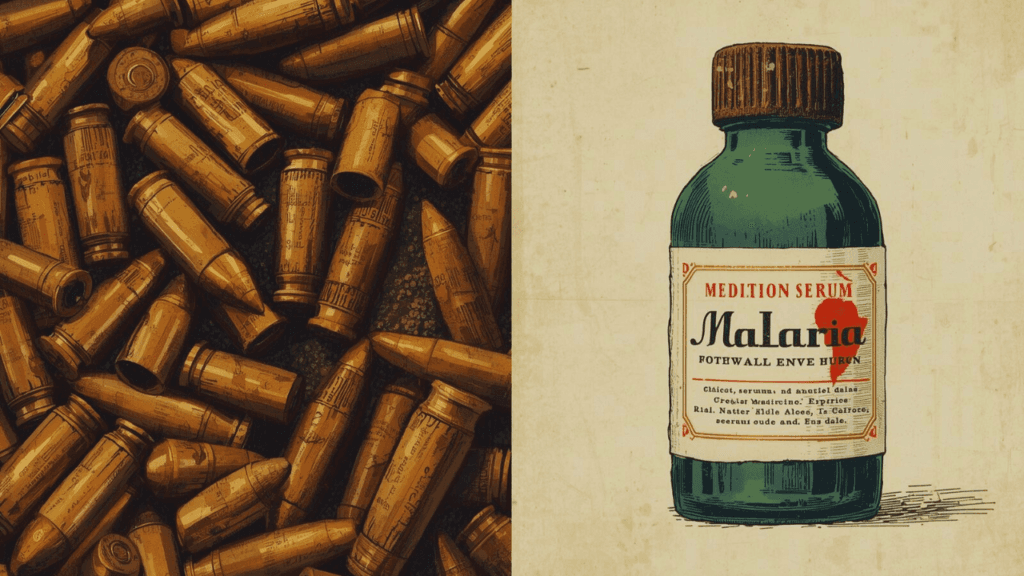
However, whilst one bullet took millions of lives, there was a single scientific discovery which also saved millions.
When the world saw life
Over the span of the 20th century, in addition to the fateful assassination of the Archduke and the resulting conflict, the world was grappling with another lethal assassin – this time in the form of a disease. During the entire century, it is estimated that 150-300 million malaria-related deaths occurred.
Although drugs to treat malaria existed, such as chloroquine, their efficacy was, in reality, quite low due to widespread resistance. That all changed when China launched a secret medical mission called “Project 523” to discover an effective cure for the disease.
Among the team of scientists assigned to the project was a relatively unknown scientist by the name of Tu Youyou, who was trained in traditional Chinese medicine. After years of failure, Tu rediscovered a fourth-century Chinese medical manuscript, which suggested that wormwood (Artemisia annua) could treat intermittent fevers.
She went on to refine the extraction method and made the daring decision to use the medicine on a critically ill malaria patient. That patient’s fever stopped, the malaria parasite count dropped drastically and the patient fully recovered.
This led to further successful human trials. Tu then purified artemisinin, a compound that kills 100% of malaria parasites at an unprecedented speed. In 2006, the WHO (World Health Organisation) even adopted Artemisinin-based Combination Therapies (ACTs) as the global standard for malaria treatment.
This treatment has already saved millions of lives, with over 6 million lives saved in only the past decade or so. It reduced global malaria fatalities by 50% and became the frontline therapy in over 90 countries, saving millions of children in Sub-Saharan Africa.
Tu went on to become the first Chinese woman to win the Nobel Prize, in recognition for discovering the most effective anti-malarial drug in history. China itself managed to gain malaria-free certification by the WHO, having brought down cases of malaria from 30 million in the 1940s to zero in the past few years.
The same verse of the Holy Quran, mentioned above, goes on to state:
“And whoso gave life to one, it shall be as if he had given life to all mankind.” (Surah al-Ma’idah, Ch.5: V.33)
A single person’s life-saving discovery contributed to saving millions of lives worldwide.
This event serves as another authentic testimony to the Holy Quran’s ethical standard.
Human agency and responsibility
Sometimes, verses such as these may sound noble and deeply reflective when looked at surface level. But they also pass the litmus test practically with many examples, such as the millions of deaths during the two World Wars and the millions of lives saved through scientific innovation.
Both of these events prove that one small action, whether a bullet or a serum, can cascade into vast consequences.