Muhammad Abdul Hayee Nasir, Student, Jamia Ahmadiyya International Ghana
Image: Library
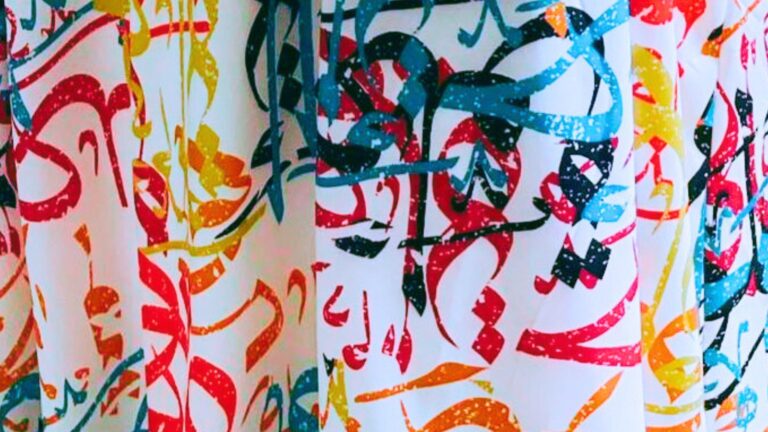
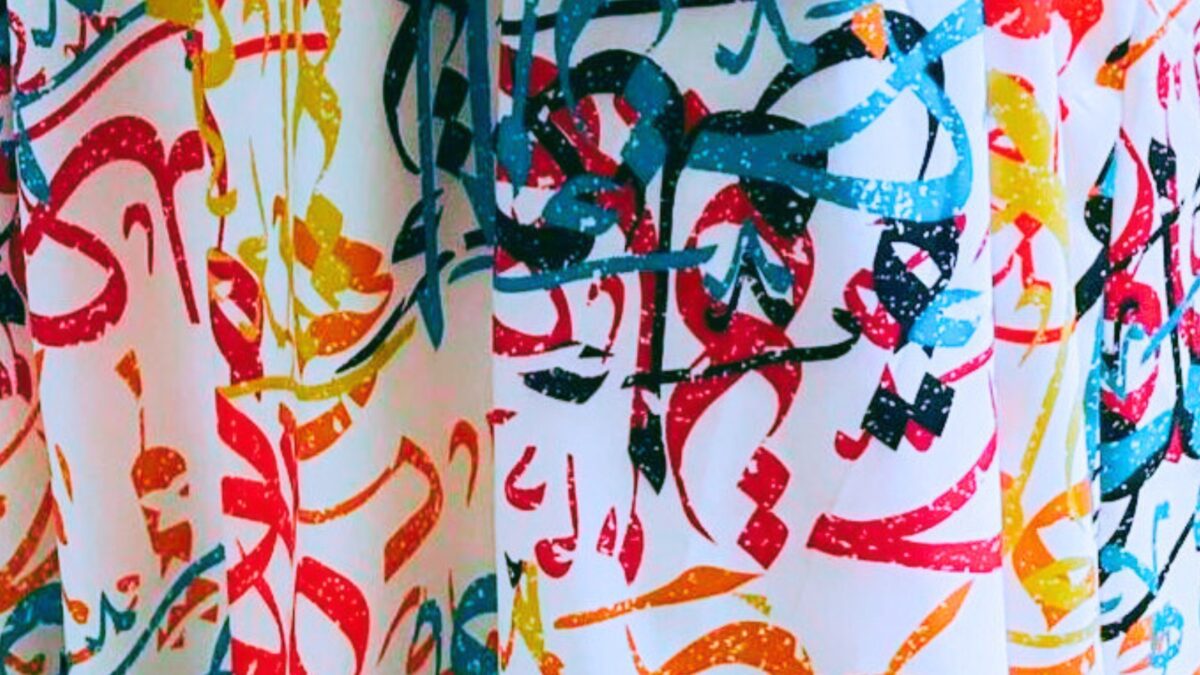
On the morning of 25 February 2024, at a restaurant in Lahore, Pakistan, a disturbing scene unfolded. A woman wearing a shirt adorned with Arabic calligraphy found herself surrounded by an angry mob. The crowd accused her of blasphemy, alleging that the script on her shirt contained verses from the Holy Quran. Within moments, the mob grew to over 300 individuals, demanding her punishment.
In a harrowing video captured by Al Jazeera, the woman – visibly frightened – sought refuge in a corner of the restaurant. Men in the crowd clamoured for her to remove her shirt, even calling for her beheading. (“Arabic calligraphy on dress design causes chaos in Pakistan”, www.aljazeera.com)
The police intervened and negotiated with the mob. Despite the volatile situation, a female officer managed to escort the woman to safety, shielding her from the mob. She put her arm around the woman, now covered by a black robe and a headscarf, and pushed through the crowd. Other police officers formed a chain with their arms to clear their path as people in the crowd pushed against them.
The woman was brought to a police station, where several religious scholars confirmed that the text on her dress was Arabic calligraphy, not verses from the Quran. The police then asked the scholars to record a video stating their findings and that the woman was innocent.
“I didn’t have any such intention, it happened by mistake. Still, I apologise for all that happened, and I’ll make sure it never happens again,” she said, adding that she is a devout Muslim and would never commit blasphemy. (“Pakistan woman in Arabic script dress saved from mob claiming blasphemy”, www.bbc.com)
The religious scholars confirmed that the Arabic calligraphy on the woman’s shirt bore no resemblance to Quranic verses. It was a mere design featuring the word ‘halwa,’ meaning ‘sweet’ in Arabic.
A deplorable condition in Pakistan
This incident sheds light on Pakistan’s blasphemy law, which has become a tool for vigilante “justice”. Under this law, derogatory remarks against the Holy Prophetsa are punishable by death or imprisonment, without proper legal proceedings.
This is the current state of affairs in Pakistan, where anyone can level blasphemy accusations against another individual without proper investigation. The accused person may face dire consequences, including death, without any legal proceedings being initiated against the accusers.
Just last year, in August, a mob burned Christian churches and houses in the east of Pakistan, accusing two members in the community of desecrating the Holy Quran. (“Two Christians arrested in Pakistan over blasphemy accusation”, www.aljazeera.com)
Moreover, this case highlights the plight of Ahmadis, a marginalised community targeted under the blasphemy law. It highlights the harsh realities of unfounded accusations and the subsequent legal struggles endured by members of the Ahmadiyya Muslim Community in Pakistan, reflecting broader issues of discrimination and injustice. (“Pakistan Report 2023”, appgfreedomofreligionorbelief.org)
These are the injustices that are being carried out in a country that claims to follow Islamic teachings.
What does Islam teach us about suspicion?
This is completely against the teachings of Islam. Islam emphasises justice, compassion, tolerance and restraint from baseless suspicions. Quranic teachings urge believers to avoid hasty judgements and uphold justice, regardless of personal biases.
“O ye who believe! Avoid most of suspicions; for suspicion in some cases is a sin. And spy not.” (Surah al-Hujurat, Ch.49: V.13)
This verse clearly instructs us to refrain from suspicion. When faced with uncertainty about a matter, the Holy Quran advises us against making rash decisions. Instead, it advocates for a thorough investigation before passing judgement by proper authorities.
“And follow not that of which thou hast no knowledge. Verily, the ear and the eye and the heart—all these shall be called to account.” (Surah Bani Isra’il, Ch.17: V.37)
This verse also instructs us that we should not follow what we know nothing about. That is, we should not be suspicious about something of which we have no knowledge.
The crowd that gathered around the woman failed to enquire about the true cause of the disturbance. Instead, they blindly joined in after witnessing others shouting at her. Had they adhered to these teachings, such chaos could have been avoided.
Then, Allah the Almighty has commanded men to lower their gaze. He states:
“Say to the believing men that they should restrain their eyes and guard their private parts. That is purer for them. Surely, Allah is well aware of what they do.” (Surah an-Nur, Ch.24: V.31)
Despite Allah’s command for men to lower their gaze, we witnessed hundreds of men shouting at a woman to remove her shirt under the false belief that it bore Quranic verses. They even threatened her life.
Such behaviour contradicts their claim of being upright men and followers of Islam. It highlights their departure from Islamic teachings, raising questions about their sincerity in adhering to Islamic principles.
In the video, we observe blatant disregard for these commandments as men shout at a vulnerable woman to remove her shirt. It is disgraceful that they consider themselves Muslim men! This incident is deeply disturbing, and one can only imagine the consequences if the police had not intervened.
The Holy Prophetsa stated that:
“A Muslim is a brother of another Muslim, so he should not oppress him, nor should he hand him over to an oppressor. Whoever fulfils the needs of his brother, Allah will fulfil his needs; whoever brought his [Muslim] brother out of discomfort, Allah will bring him out of the discomforts of the Day of Resurrection, and whoever screened a Muslim, Allah will screen him on the Day of Resurrection.” (Sahih al-Bukhari, Kitab al-mazalim, Hadith No. 2442)
Instead of demanding forgiveness from the woman, the clerics and the other individuals involved should have apologised to her for mistakenly identifying the Arabic calligraphy on her shirt as Quranic verses.
What is the punishment for blasphemy in Islam?
No such punishment is prescribed in the Holy Quran, or in any of the traditions of the Holy Prophetsa. Islam promotes the need for respect of all religions for the sake of peace in society, but it does not set out any punishment for blasphemy despite the offence it may cause people of faith.
We have evidence in the traditions of the Holy Prophetsa where Abdullah bin Ubayy bin Salul (known as the chief of the hypocrites) continuously abused the Holy Prophetsa and opposed him in Medina.
When he passed away, the Holy Prophetsa stood to offer his funeral prayers but was asked by one of his companions, “O Messenger of Allah! Do you offer the prayer for this man although he said so-and-so on such-and-such day?”. The Holy Prophetsa ignored his statements and continued to offer the funeral prayers of the dead man. (Sahih al-Bukhari, Kitab at-tafsir, Hadith 4670)
The above example shows that the Holy Prophetsa never ordered any punishment for anyone who insulted or abused him or God; on the contrary, he went to pray for them that they be guided aright. (“What is the punishment for blasphemy in Islam?”, www.alislam.org)
So, when the Holy Prophetsa himself never punished anyone for blasphemy, then who are these people to mete out punishment against someone? The saddest part is that the woman was not even guilty of the “crime” that they levelled against her.
In conclusion, the incident underscores the urgent need for reform in Pakistan’s blasphemy laws. It serves as a wake-up call to uphold justice, foster religious tolerance, and prevent the persecution of innocent individuals in the name of religion. May Allah guide the people of Pakistan towards the path of righteousness and compassion. Amin.
A series looking into the allegations raised against Hazrat Ahmad’sas personality, writings, revelations, and prophecies, along with the answers he has provided
Awwab Saad Hayat, Al Hakam
Image: Library
On 1 February 1905, the Promised Messiahas received the following revelation from Allah:
انت منّي بمنزلة ولدي
“You are to Me like My son.” (Tadkhkira, [English] p. 718)
This revelation serves to underscore the mission of the Promised Messiahas to eradicate idolatry and foster Monotheism [Tawhid]. Nonetheless, detractors of the Jamaat distort this message, falsely claiming that Mirza Sahib professed to be God’s son.
The Promised Messiahas clarified the allegorical nature of this revelation and stated:
“Allah the Almighty is Holy, without a son. This revelation is metaphorical. As in this age ignorant Christians have deified Hadrat ‘Isa because of such expressions, divine wisdom determined the use of even stronger expressions with regard to my humble self so that the eyes of the Christians should open up and should realise that there is someone in this ummah [followers of the Holy Prophetsa] for whom stronger expressions have been used than the words on the basis of which they deify ‘Isa.” (Haqiqatul-Wahi – The Philosophy of Divine Revelation, p. 111, footnote)
Further elucidating this point on another occasion, Hazrat Ahmadas stated that God is unequivocally singular, without partners or progeny. However, he highlighted that the Holy Quran employs metaphors, such as equating the Holy Prophet’ssa hand with God’s own, to convey deeper meanings:
يَدُ اللّٰهِ فَوْقَ أَيْدِيهِمْ
“The hand of Allah is over their hands.” (Surah al-Fath, Ch.48: V.11)
Similarly, God commands the Holy Prophetsa to say “يٰعِبَادِ”, i.e., “O my servants” (Surah az-Zumar, Ch.39: V.11), instead of “يا عباد اللّٰهِ”, i.e., “O Allah’s servants”. Moreover, God says, “فَاذْكُرُوا اللّٰهَ كَذِكْرِكُمْ أَبَاءَكُمْ” i.e., “And celebrate the praises of Allah as you celebrated the praises of your fathers.” (Surah al-Baqarah, Ch.2: V.201)
This allegorical speech, as seen in various Quranic instances, underscores the importance of discerning the intended implications of Divine words. Hazrat Ahmadas cautioned against literal interpretations that could lead to misconceptions. (Dafi‘ al-Bala, Ruhani Khazain, Vol. 18, p. 227)
During his visit to Lahore in 1934, Hazrat Musleh-e-Maud, Mirza Bashir-ud-Din Mahmud Ahmadra delivered two lectures at the request of the Punjab Literary League.
Introduction to Punjab Literary League
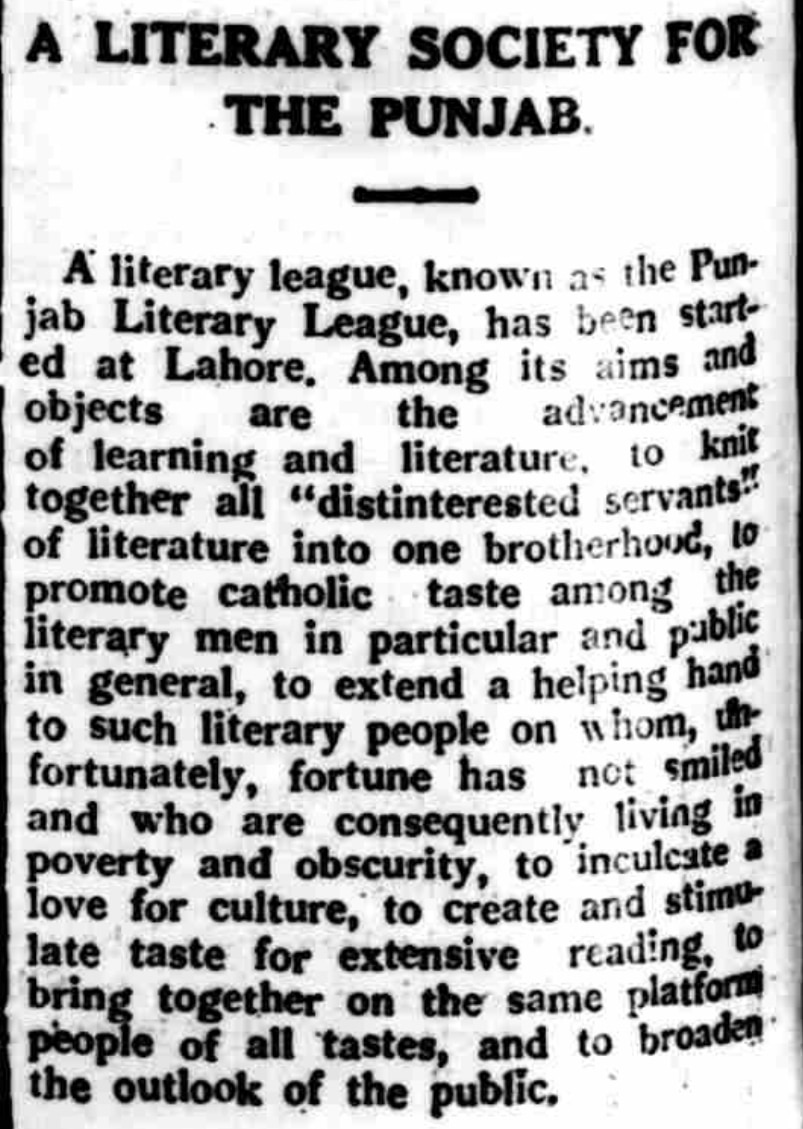
In 1930, the “Punjab Literary League” was established in Lahore with the aim of “advancement of learning and literature, to knit together all ‘distinterested servants’ of literature into one brotherhood” and “to inculcate a love for culture, to create and stimulate taste for extensive reading, to bring together on the same platform people of all tastes, and to broaden the outlook of the public.” (The Civil and Military Gazette, 27 June 1930, p. 16)
The Civil and Military Gazette, 27 June 1930
Announcement about the lectures
The Civil and Military Gazette announced:
“Lectures by Mirza Bashir-ud-Din
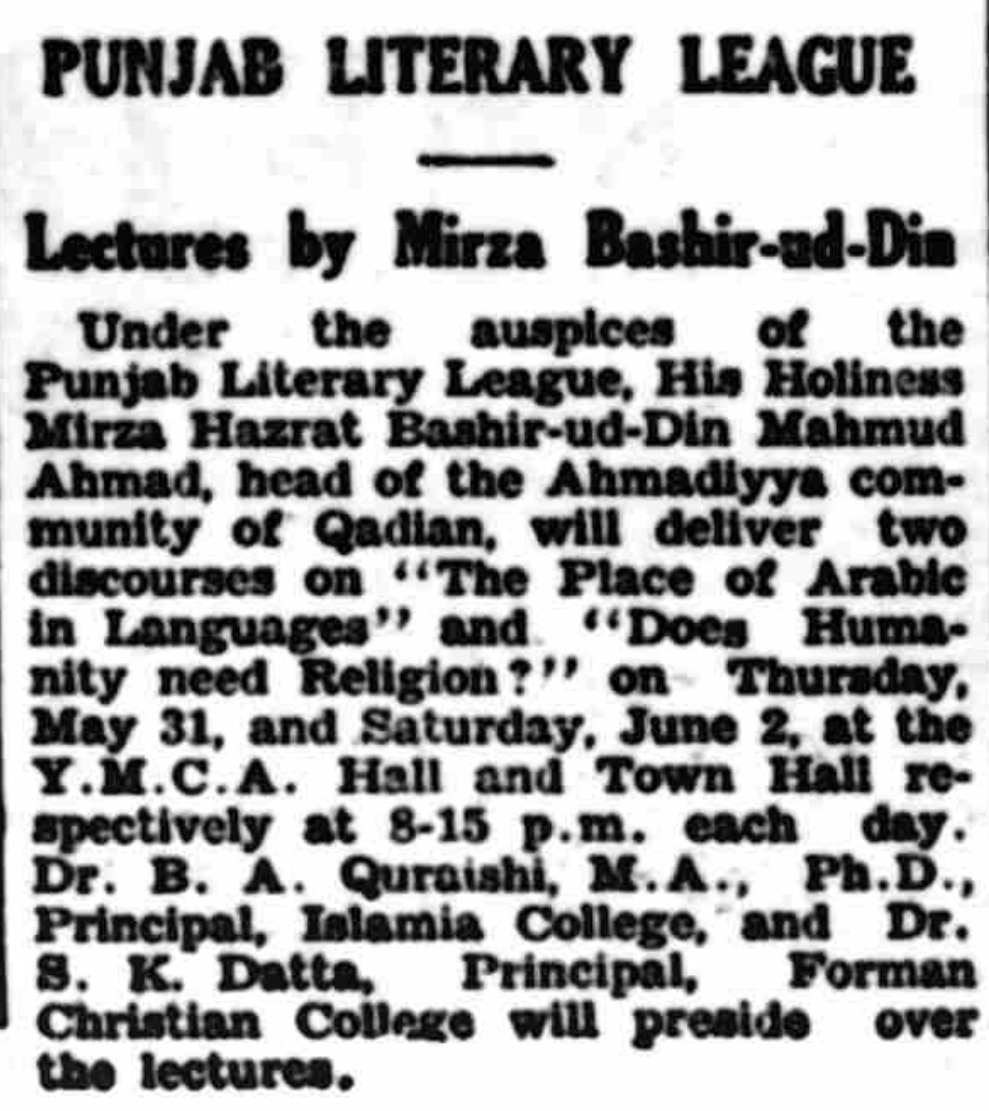
“Under the auspices of the Punjab Literary League, His Holiness Mirza Hazrat Bashir-ud-Din Mahmud Ahmad, head of the Ahmadiyya community of Qadian, will deliver two discourses on ‘The Place of Arabic in Languages’ and ‘Does Humanity need Religion?’ on Thursday, May 31, and Saturday, June 2, at the Y.M.C.A. Hall and Town Hall respectively, at 8-15 p.m. each day. Dr B.A. Quraishi, M.A., Ph.D., Principal, Islamia College, and Dr S.K. Datta, Principal, Forman Christian College will preside over the lectures.” (The Civil and Military Gazette, 30 May 1934, p. 18)
The Civil and Military Gazette, 30 May 1934
First lecture
The first lecture was delivered on 31 May 1934, at the Young Men’s Christian Association (YMCA) Hall, titled “Arabi Zuban ka Maqaam Alsina-e-Aalam mein” – The Place of Arabic in Languages. The session was presided over by Dr Barkat Ali Qureshi, Principal of Islamia College, Lahore.
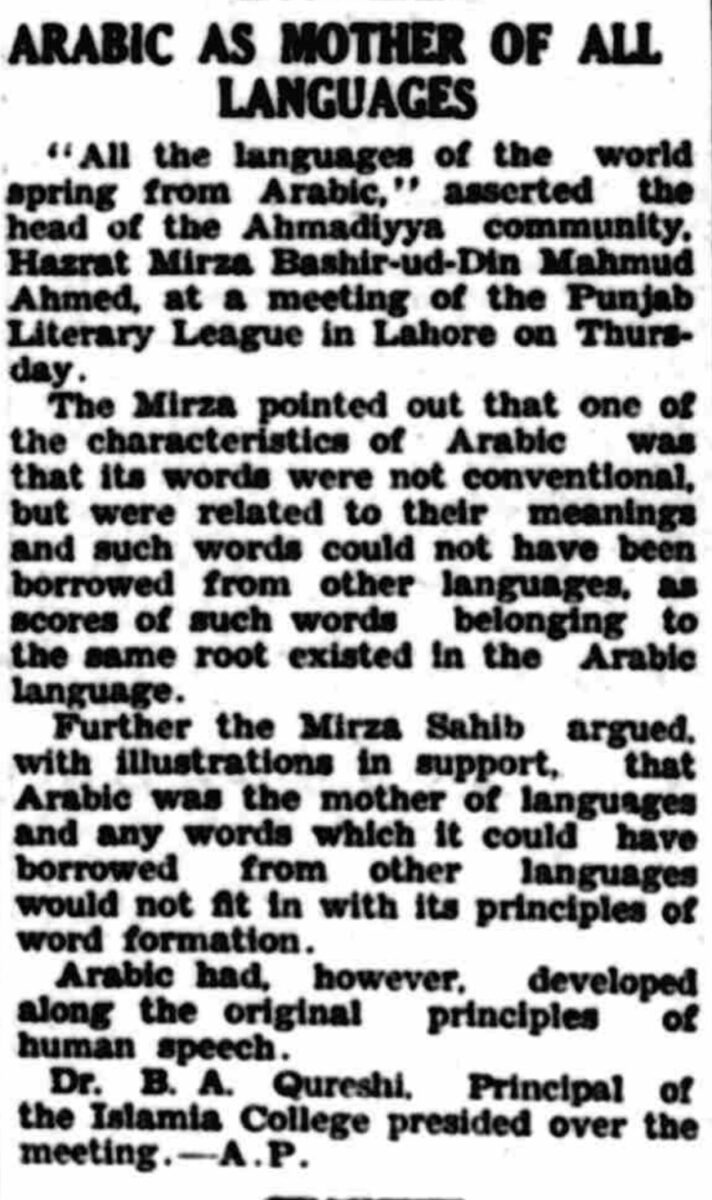
The Civil and Military Gazette reported under the heading “Arabic As Mother of All Languages”:
“‘All the languages of the world spring from Arabic,’ asserted the head of the Ahmadiyya community, Hazrat Mirza Bashir-ud-Din Mahmud Ahmed, at a meeting of the Punjab Literary League in Lahore on Thursday.
“The Mirza [Sahib] pointed out that one of the characteristics of Arabic was that its words were not conventional, but were related to their meanings and such words could not have been borrowed from other languages, as scores of such words belonging to the same root existed in the Arabic language.
“Further, the Mirza Sahib argued, with illustrations in support, that Arabic was the mother of languages and any words which it could have borrowed from other languages would not fit in with its principles of word formation.
“Arabic had, however, developed along the original principles of human speech.
“Dr. B.A. Qureshi, Principal of the Islamia College, presided over the meeting. A.P.” (The Civil and Military Gazette, 2 June 1934, p. 14)
The Civil and Military Gazette, 2 June 1934
During his lecture, Huzoorra said that people generally assume that language is merely a source of conveying one’s expressions, however, this is incorrect. Language holds great historical significance as well. The language of the people of a certain country can indicate which countries they were in contact with, since the names of certain things – which are specialities of another country – make it clear that they had direct or indirect relations with that foreign country. Further, the vocabulary of a certain language depicts a nation’s cultural evolution, whereas, its terminologies about values and religion inform one about their intellectual evolution.
Huzoorra said that he desired to speak on what the study of the Arabic language tells us in regards to its status in front of the other languages. The ancient European historians would declare the Arabic language to be very new in comparison to the ancient languages. However, the German historian, Aloys Sprenger (1813-1893) and English historian William Robertson Smith (1846-1894) disagreed with this idea, and after a comparison of languages, they deduced that the Arabic language is in fact closer to the Semitic language, and also that the Aramaic and Hebrew languages seem to be impacted by the Arabic language.
Huzoorra said that the most ancient Semitic language whose existence has been known is the Samaritan Aramaic language, which became common in Babylon through the Hammurabi family. The traces of this language that have been discovered manifest that, in comparison to the Hebrew and Syriac languages, the Samaritan Aramaic language was closer to the Arabic language. Hence, in addition to the grammar, the composition of the words also suggests this language is more similar to Arabic. Similarly, it is also evident that the names of the Samaritan Aramaic tribes are similar to the Arab names. Thus, these facts suggest that Arabic is the most ancient Semitic language among all known languages.
Huzoorra continued by saying that once the Arabic language is proven to be the most ancient among the known Semitic languages, it comes in the top-tier languages, and its historical time period exceeds 4,000 years. Thereafter, one needs to assess it in comparison to the other ancient languages of the world, as to whether Arabic is impacted by those languages or, in fact, has impacted the other languages.
Huzoorra further said that the connection between these languages can be proven only by one method, and that they must have some common ground. In regards to the common grounds, it is essential that they are present with respect to the fundamental lingual composition, and relate to those things that are prevalent in all countries, and are required in all cultural eras. For instance, the words that are used for mother, father, water, food, anger, and love. These are such things whose expression cannot be abandoned by the people of any era or country. Thus, if common grounds are found between the languages in relation to such things, then one ought to accept that these languages are derivatives of the same source.
Huzoorra said that history is unable to guide us as to which language was, in fact, the source of all languages. Thus, we have only one method available to research this fact and that is for us to ponder over the fundamental composition of the languages.
Huzoorra went on to narrate the hallmarks of the Arabic language. For instance, its words are not conventional but are related to their meanings and such words could not have been borrowed from other languages, as scores of such words belonging to the same root existed in the Arabic language. Any words that it could have borrowed from other languages would not fit in with its principles of word formation. Huzoorra also mentioned that the Arabic language, however, developed along the original principles of human speech. (Al Fazl, 5 June 1934, pp. 1-2)
President’s address
After Huzoor’sra lecture, the president of the session advised the attendees to benefit from this lecture, and expressed his desire to listen to such knowledgeable subjects in the future as well. (Al Fazl, 7 June 1934, pp. 1-2)
Speech by the son of Lala Bhim Sen
This lecture was attended by people from all walks of life, including Lala Kanwar Sen, former Chief Judge Kashmir, who was the son of Lala Bhim Sen. In his speech, he commended Huzoor’sra lecture and particularly mentioned that his father learnt Arabic from Hazrat Mirza Ghulam Ahmadas. He noted that the lecture comprised scholarly and philosophical majesty, and that he had attentively listened to the lecture and benefited a lot. (Ibid. p. 2)
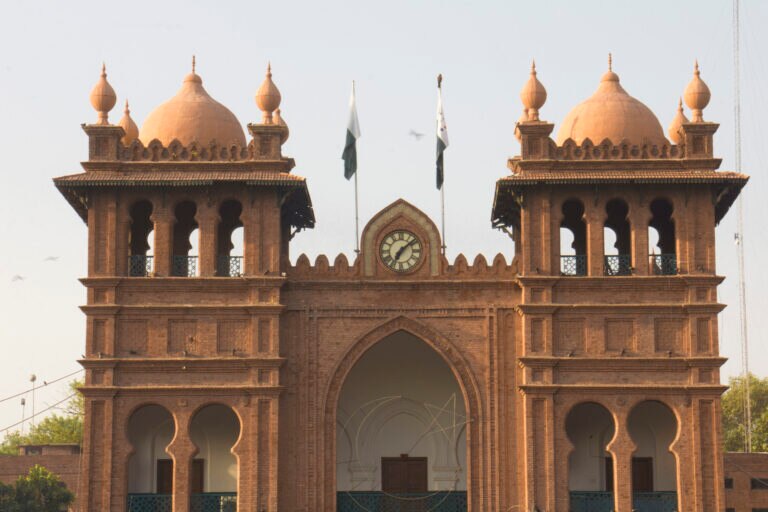
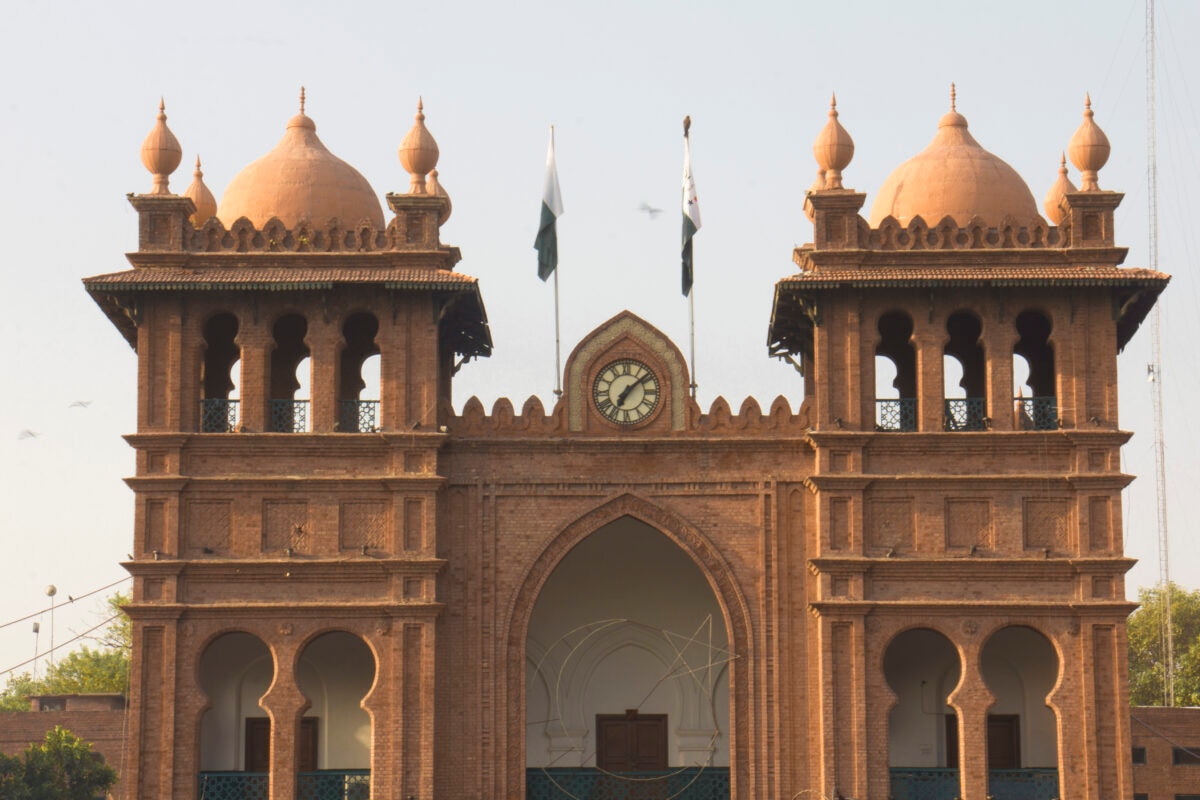
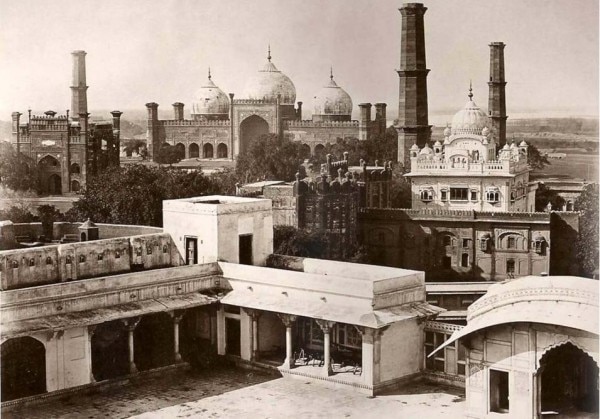
An old view of Lahore
Second lecture
The second lecture was delivered on 2 June 1934, titled “Kiaa Insaan Mazhab ka Mohtaj Nahin?” – Does not Humanity need Religion? – at the Town Hall Lahore. The lecture was attended by people from all walks of life, belonging to various faiths as well.
At the beginning of the session, the dignitaries of the Punjab Literary League welcomed Hazrat Musleh-e-Maudra with a garland of flowers. The session was presided over by Dr Surendra Kumar Datta (1878-1942), Principal of the Forman Christian College. In his welcoming speech, the president called the attention of the audience to attentively listen to the lecture being delivered by such a great personality. (Ibid.)
In his lecture, Huzoorra refuted five prominent objections often raised against the need for religion.
First objection
Huzoorra said that the objection is raised that religion gives rise to violent divergence of opinion, which results in the disturbance of public peace. My heart is filled with grief when I see that, through the misguided activities of some so-called religious people, much disrepute has come to religion. I see that human lives are taken due to trivial disputes relating to the religious festivals of each other. I have read the Vedas and other religious scriptures of the Hindus and I bear witness that Hinduism does not support the shedding of human blood in the manner in which sometimes its misguided followers shed it. And the Holy Quran lends not the faintest support to the view that people should be killed for singing songs before mosques. Islamic teaching is far above creating or tolerating such a mentality. It is most sound and complete in all its different aspects. Christianity, too, gives no encouragement to its followers to pick a quarrel with the adherents of other religions in its name.
Religion exhorts its followers to live peacefully with their fellow beings. But what has science to give us in place of this teaching? Is not science responsible for the creation of the innumerable instruments of destruction that have caused havoc in the past? Are not the poisonous gases and deadly bombs that cause irreparable loss to human life on a dreadfully vast scale the work of science? If you condemn religion on the plea that much innocent human blood has been shed in its name, you will have to condemn science with much greater vehemence on the same plea as well.
Second objection
Another objection is raised that religion has always proved to be a hindrance to the development of human intellect. Mr Bernard Shaw is one of the leading exponents of this seemingly plausible but really untenable view. The protagonists of this theory argue that ‘unless man does experiment or makes mistakes, they cannot acquire true knowledge. If by providing a right and infallible teaching religion has saved mankind from falling into perils, it evidently has dispensed with the necessity for mankind to use their reason to discover what is right and useful for them and what is not.’
Any religion that stands in the way of the development of human reason and exhorts its adherents to follow thoughtlessly, I will be the first person to reject it. However, it is inconceivable that God should Himself endow us with reason and intellect and, at the same time, forbid us to make use of them. It is evidently incompatible with His all-comprehensive wisdom that He should allow such a manifest inconsistency to exist in the world. The fact is that the possession by mankind of the bare knowledge of an unalterable truth cannot conceivably be considered to impede their intellectual progress. If this criterion is regarded as true, then all the inventions that science has made so far should be rejected, and all its established truths spurned on the plea that their acceptance obstructs our intellectual growth. It needs no extraordinary intelligence to understand that if the discovery of a new fact or law bars the door of research and investigation in one direction, it opens up endless new vistas to mankind’s intellectual ambition in another and thus a succession of new problems arises that keep the human mind engaged and this chain of unsolved problems continues, knowing no end. It is not correct to say that the possession by mankind of the knowledge of an unchangeable truth in any way interferes with their intellectual evolution.
It becomes easy to comprehend when we realise the eternal truth that science is the Act of God and religion is His Word and there could conceivably be no conflict between God’s Work and His Word as they proceed from the same Source. Just as in science, the discovery of one truth or natural law leads to research into many other allied subjects, similarly, a truth presented by religion raises many new questions which in turn begin to demand careful study and research.
For instance, alcohol consumption and gambling are prohibited in Islam. The prohibition of alcohol and gambling, according to the Holy Quran, is based on the fact that their disadvantages outweigh their advantages. This commandment has placed in our hands a clear-cut law that we should not use a thing for which the harm is greater than its advantage. In our everyday lives, we come across many things about which the Holy Quran contains no instructions on whether they should be used or shunned. We should test each one of them with the touchstone referred to above. We should use it if its advantages are found to be greater than its disadvantages and leave it if the case is otherwise. The precept embodying the prohibition regarding gambling and the use of intoxicating liquors reveals another important truth that these two things are not wholly devoid of all good.
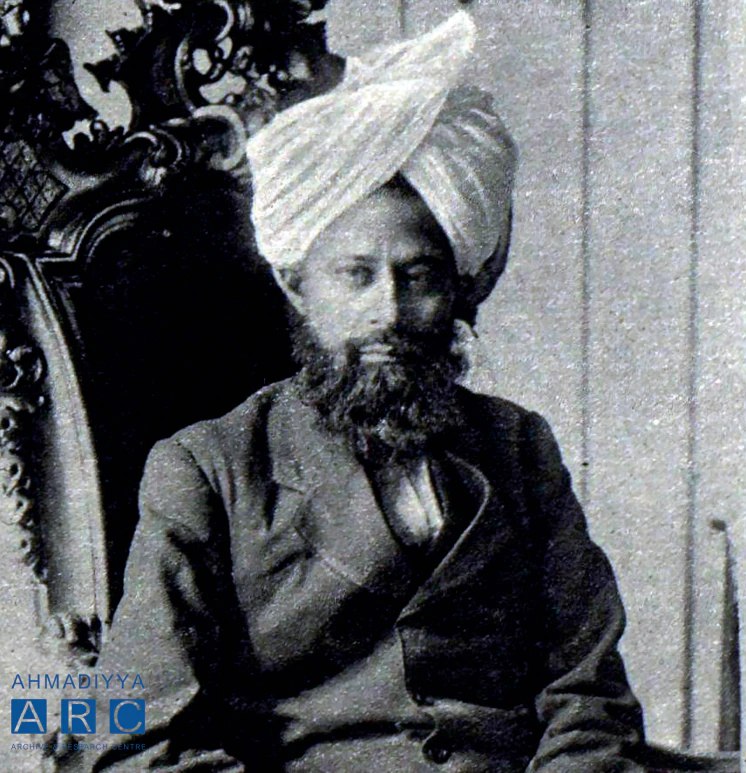
Hazrat Musleh-e-Maudra
Third objection
Another objection that is often raised is that religion engenders superstition in the minds of its votaries, which ultimately bars human progress. The religion does not produce superstition, but rather, an invincible faith and certainty in the hearts of its adherents. If religion may be considered to be responsible for making people superstitious because some “religious” people are superstitious, equally must science be held responsible for making people superstitious because, among scientists too, there are those who are as superstitious and whimsical as some “religious” people are. So if we are to reject religion on this plea, science will also have to be discarded. Those who accuse religion of this charge and have declared science to be free from it have conveniently ignored the fundamental principle that religion being the Word of God and science a study of His Work, there could possibly be no conflict between them.
Fourth objection
Another objection is raised that as human needs vary with the change in circumstances, so, by setting up an immutable code of laws, religion involves them in great difficulties. It is said that about 1350 years ago, the Holy Prophetsa gave to the world a religious system that might be regarded as a suitable code of life according to the then circumstances, but with the passage of so many centuries, tremendous changes have occurred in human circumstances and thus continuing the rigid adherence to those laws has proved an insurmountable impediment in the way of the advancement of contemporary Muslims.
For God, the future is no secret. Being an Omniscient God, He knows as much about the needs and requirements of mankind in the present as He is aware of those that will arise after a thousand or a hundred thousand years. So, if He reveals a teaching and says that it will fully satisfy all human requirements at all times, no change in the conditions of mankind can out-step that teaching, as it has proceeded from an All-Knowing and All-Wise God Who knows mankind’s requirements of past, present and future.
I claim that no change in the circumstances of any people, at any time, can demonstrate a single teaching of the Holy Quran to be impracticable and I am at the disposal of anybody who may endeavour to convince me of the untenability of my claim; and I will readily accept my defeat if a single teaching of the Holy Quran is shown to me to have been in the past or to be at present unsuited to human needs.
Fifth objection
Another objection is raised that religion compels one to believe in things that have no connection with our practical everyday life. It is said that we have to believe in the existence of angels, while it does not concern us in any way whether they exist or not, nor if ever they should exist, does it concern us what their duties are and how they perform them. To refuse to accept a truth propounded by religion on the plea that it does not concern us is beyond comprehension. Every day in the news, we read with interest the accounts of incidents and happenings that do not concern us at all, nor are we benefited in any way by reading them, yet we read them, talk about them and discuss them, because such news form a part of general knowledge, and the possession of extensive general knowledge enriches the intellect and is no mean acquisition. The fact is that becoming informed of things, though they do not concern us in any way and are yet part of general knowledge, is rightly considered to be essential to our intellectual adornment. The primary object of mankind’s existence is to seek and acquire true knowledge. So to refuse to accept an established truth is no sign of sanity. Those who do not believe in the existence of angels are fully justified in demanding from us arguments in support of their existence, but there is no sense in refusing to believe in their existence, even if it is irrefutably proven. I am prepared to prove to anyone who may approach me on this question that the angels are not imaginary beings and they play an important part in shaping our destinies and in guiding us in our daily pursuits. (The Review of Religions, Vol. 33, July 1934, pp. 245-258)
President’s remarks
After Huzoor’sra lecture, the president highly commended the lecture and expressed his desire that the people of Lahore may get more opportunities to listen to such great lectures in the future as well. (Al Fazl, 7 June 1934, p. 2)
It is narrated by Hazrat Ibn Abbasra[…] that “Abu Hurairahra informed me that Allah’s Messengersa said, ‘When I was sleeping, I saw [in a dream] two bangles of gold around my hands and that worried me. And then I was inspired Divinely in the dream that I should blow on them, so I blew on them and both the bangles flew away. And I interpreted it that two liars would appear after me. One of them has proved to be al-Ansi and the other, Musailima.”
(Sahih al-Bukhari, Kitab al-maghazi, Bab wafdi bani hanifah wa hadithi thumamata ibni uthal, Hadith 4374)
“The fact of the matter is that adhering to the concessions granted in the Holy Quran is also an aspect of piety [taqwa]. Allah the Almighty has allowed those who are travelling or unwell to compensate for their [missed] fasts at another time, thus this command too should be followed. I have read that many esteemed figures have opined that fasting while in a state of travel or illness is an act of disobedience because the ultimate goal is to attain the pleasure of Allah, not to follow one’s own desires. The pleasure of Allah lies in obedience to His commands; whatever command He gives should be followed, without adding our own interpretations. His command is clear:
[Whoso among you is sick or is on a journey shall fast the same number of other days. (Surah al-Baqarah, Ch.2: V.185)]
“He has not specified any particular type of journey or illness that qualifies for this concession. I do not fast when travelling or ill, and today, not being in good health, I have not fasted.”
(Al Hakam, Vol. 11, No. 4, 21 January 1907, p. 14)
A glimpse into the rich history of the Ahmadiyya Muslim Jamaat
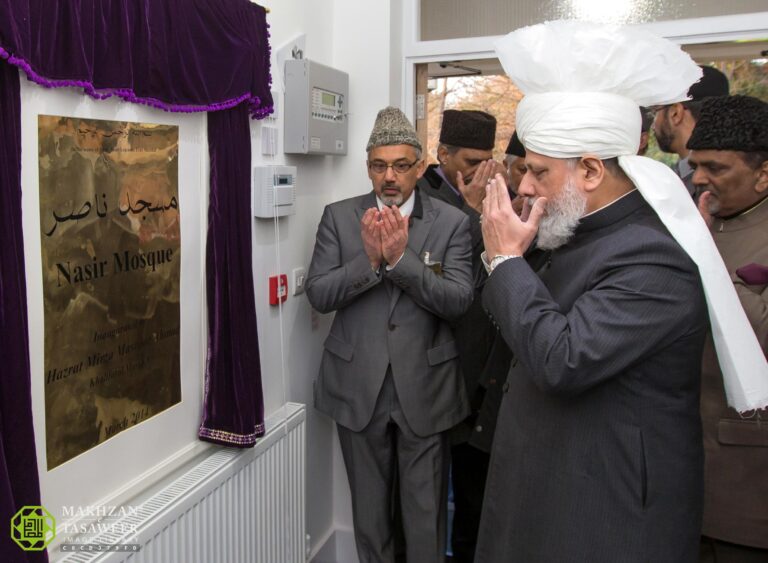
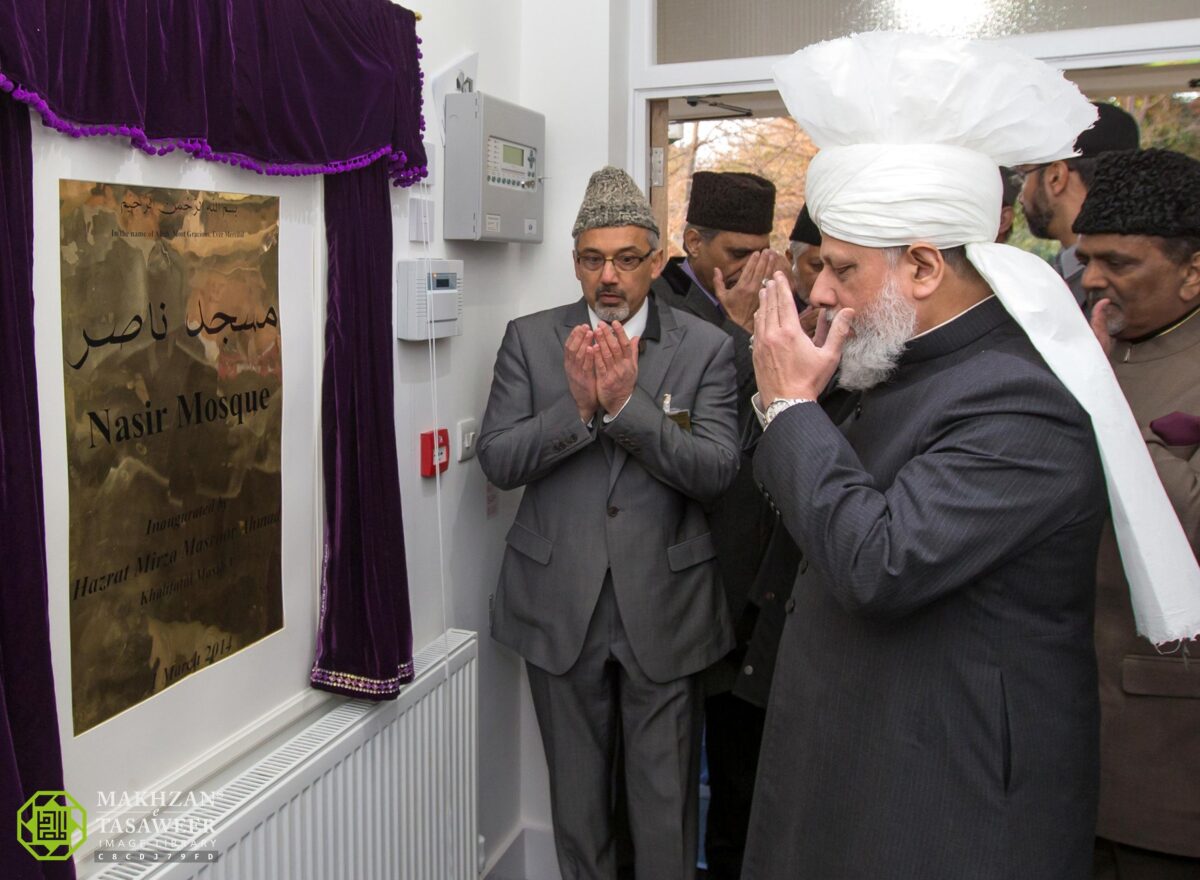
Hazrat Khalifatul Masih Vaa opening the Nasir Mosque, Gillingham, UK
1 March 1940: During his tour of Sindh, on this day, Hazrat Musleh-e-Maudra reached Nasirabad, where he inaugurated a mosque with the Jumuah prayer. During his Friday Sermon, Huzoorra drew the attention of local Ahmadis to their responsibilities concerning the mosque. (Al Fazl, 6 March 1940, p. 2)
1 March 1950: On this day, the Schwerter Zeitung, a German newspaper, wrote under the heading “Islamische Europa-Mission will in Hamburg Moschee bauen” – “Islamic European Mission desires to build a mosque in Hamburg”:
“[Translation] Hamburg is also to receive a mosque, although the building work will still be a long time coming, explained Abdul Latif, the only European missionary of the Islamic Ahmadiyya Movement. […] There is already a mosque in London. In Hamburg, there was initially a small community of spiritual followers of Islam. The Mohammedans [sic, Muslims] believe that Islam will find great understanding in Europe in the future, now that active Islamic communities have been established in many European countries and in America.”
1 March 1972: On this day, Hazrat Khalifatul Masih IIIrh announced the establishment of Majlis-e-Sehat to organise sports and physical exercise for the people of Rabwah, Pakistan. Huzoorrh desired that every resident of Rabwah should exercise daily. (Tarikh-e-Ahmadiyyat, Vol. 28, p. 30)
1 March 2014: On this day, Hazrat Khalifatul Masih Vaa inaugurated the Nasir Mosque in Gillingham, UK. On this occasion, Huzooraa also held an audience with local Ahmadi Muslims. In the evening, a special reception, attended by more than 180 dignitaries and guests, was held to mark the opening of the mosque. (“New Mosque Opened by World Muslim Leader in Gillingham”, www.pressahmadiyya.com)
2 March 1927: On this day, Hazrat Musleh-e-Maudra delivered a lecture at the Bradlaugh Hall in Lahore, titled “Hindu-Muslim fasadat, inka ilaaj, aur Musalmanon ka ainda tareeq-e-amal”, i.e.“Hindu-Muslim relations and the future line of Muslim conduct”.
2 March 1947: On this day, Hazrat Musleh-e-Maudra wrote a letter to MA Jinnah, saying:
“On HMG’s new declaration, Sir M Zafrullah Khan approached Sir Khizar, suggesting that at this critical juncture he should not fail his community. Malik Sahib then asked Sir Muhammad Zafrullah Khan to come to Lahore. As I also, on my way to Sind, had to stay there for one night, Sir Muhammad came there yesterday and discussed the matter with me. Following this, last night, he had a long discourse with Malik Sahib and Qizilbash. They have agreed to resign. […] Now you have a great lever to get Muslim rights from your opponents.” (Jinnah Papers, Vol. 1, Part I, pp. 164-165)
3 March 1907: On this day, Syed Habibullah ICS, who was the magistrate of Agra, arrived at Qadian before the Zuhr prayer. Although the Promised Messiahas was unwell, he showed great hospitality and gave adequate time to the guest.
3 March 1927: On this day, Hazrat Musleh-e-Maudra delivered a lecture, titled “Mazhab aur science”, – “Religion and science”, at the Habibia Hall of the Islamia College, Lahore. The session was presided over by Sir Muhammad Iqbal, and the lecture was organised by the Educational Union Islamia College.
3 March 1995: On this day, Hazrat Khalifatul Masih IVrh commenced a series of sermons about the attributes of Allah, in accordance with one of his dreams. This series continued on during the Fifth Khilafat.
4 March 1932: On this day, Hazrat Maulvi Sher Alira, wrote a letter to the Madras Mail regarding the advent of the Promised Messiah.
4 March 2018: Hazrat Khalifatul Masih Vaa laid the foundation stone for the new administrative block at the Baitul Futuh Mosque complex in Morden, London. The administrative block, which will include multi-purpose halls, offices, and accommodation facilities, is being rebuilt after a fire in September 2015 caused widespread damage at the site. (“Head of Ahmadiyya Muslim Community Lays Foundation Stone for New Administrative Block at Baitul Futuh Mosque”, pressahmadiyya.com)
5 March 1917: On this day, Hazrat Musleh-e-Maudra shared valuable advice with Hazrat Mufti Muhammad Sadiqra and other persons gathered at Madrasa Ahmadiyya about focusing on preaching as opposed to conversion. For more details, see “Twenty pearls of wisdom from Hazrat Musleh-e-Maud’s ‘Guidance for Missionaries’” at alhakam.org (10 November 2023, p. 14).
6 March 1935: The first Ahmadiyya printing press in Kababir, Haifa, under the name Al-Matba‘ah al-Ahmadiyyah, was inaugurated on this day.
7 March 1923: During a speech on this day, Hazrat Musleh-e-Maudra instructed Ahmadis to get ready to offer every possible sacrifice to tackle the ongoing Shuddhi Movement, initiated by the Arya Samaj.
7 March 2008: During his Friday Sermon on this day, Hazrat Khalifatul Masih Vaa drew the attention of the Jamaat towards learning and teaching the translation of the Holy Quran. He emphasised that both the auxiliary organisations and the Jamaat’s system should work together on this important task. Through translation, Huzooraa said, one is able to gain an understanding of Allah’s commandments.
7 March 2015: Mrs Shadiye Heydari, a member of the Swedish parliament (Sveriges Riksdag), visited the Fazl Mosque in London, where she was granted an audience with Hazrat Khalifatul Masih Vaa.
During the 40-minute meeting, Huzooraa spoke about the increasing threat and danger posed by extremism in many parts of the world and advised that politicians should seek to identify the root causes of extremism and build a long-term strategy to counter youth radicalisation. (“Swedish Politician visits Head of Ahmadiyya Muslim Community in London”, pressahmadiyya.com)
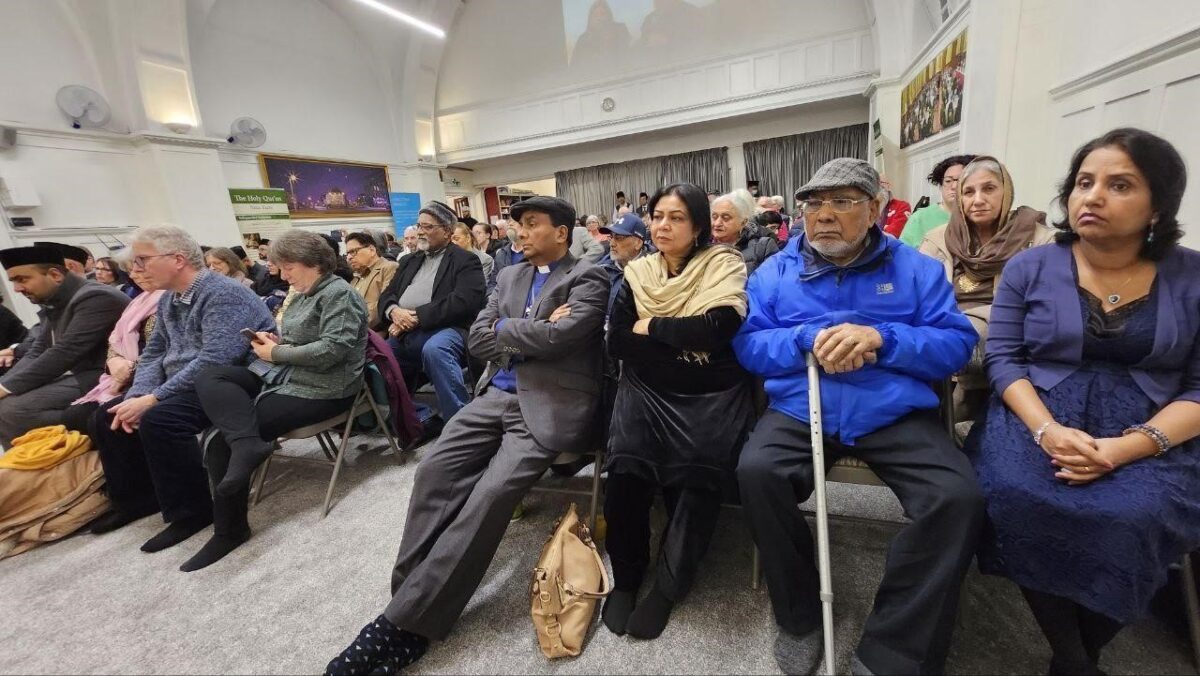
Jamaat-e-Ahmadiyya Glasgow hosted a New Year’s dinner on 14 January 2024, at the Baitur Rahman Mosque, Glasgow, under the theme “Peace Through Unity”, and brought together over 200 guests, including 100 non-Muslims.
A beautiful exhibition about the history of Islam and its sacred places was designed by Lajna Imaillah Glasgow.
The event started with a recitation from the Holy Quran with English translation, followed by an introductory video about the worldwide Ahmadiyya Muslim Community. Missionary Fakhar Ahmad Aftab Sahib delivered a welcome speech, followed by an address by Ataul Mujeeb Rashed Sahib, missionary-in-charge UK, who focused on the pivotal role of unity in promoting lasting peace.
Some of the distinguished guests included Kirsten Oswald, MP for East Renfrewshire, Dr Sandesh Gulhane, MSP for Glasgow Region, and Reverend Mike Fucella, Minister for the Church of Scotland.
The presence of esteemed guests underscored the significance of interfaith dialogue and collaboration in building a cohesive community.
Kirsten Oswald MP, East Renfrewshire, said:
“An inspiring event that promotes unity and understanding. I commend the Ahmadiyya Muslim Community for their commitment to fostering peace in our community.”
Dr Sandesh Gulhane, MSP, Glasgow (Region) expressed:
“The New Year Dinner exemplifies the power of diversity and unity. It is heartening to see communities join hands for a common goal.”
Reverend Mike Fucella, Minister for the Church of Scotland, said:
“A wonderful evening highlighting the importance of harmony among different faiths. Congratulations to AMC Glasgow for organising such a meaningful event.”
An interesting question-and-answer session was also held, followed by a vote of thanks by Muhammad Ahsan Ahmad Sahib. The event ended with a silent prayer.
Guidance regarding basic Islamic issues – which Hazrat Amirul Momineen, Khalifatul Masih Vaa has given on various occasions in his written correspondence and during MTA programmes – is being officially published below for everyone’s benefit.
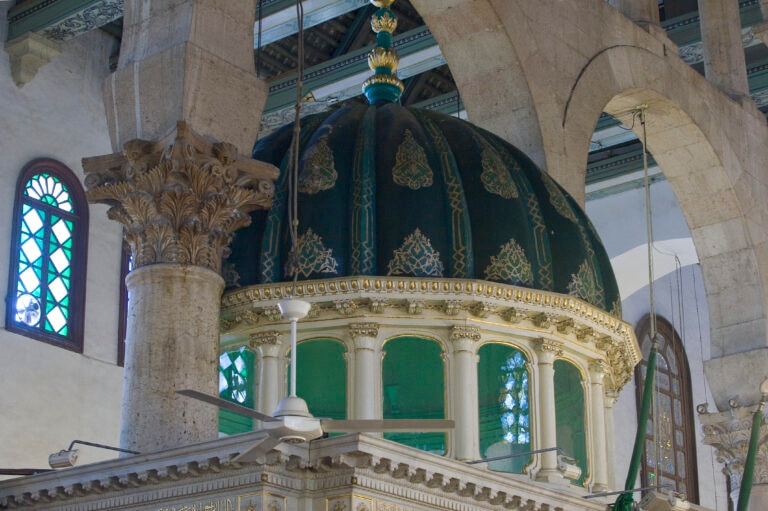
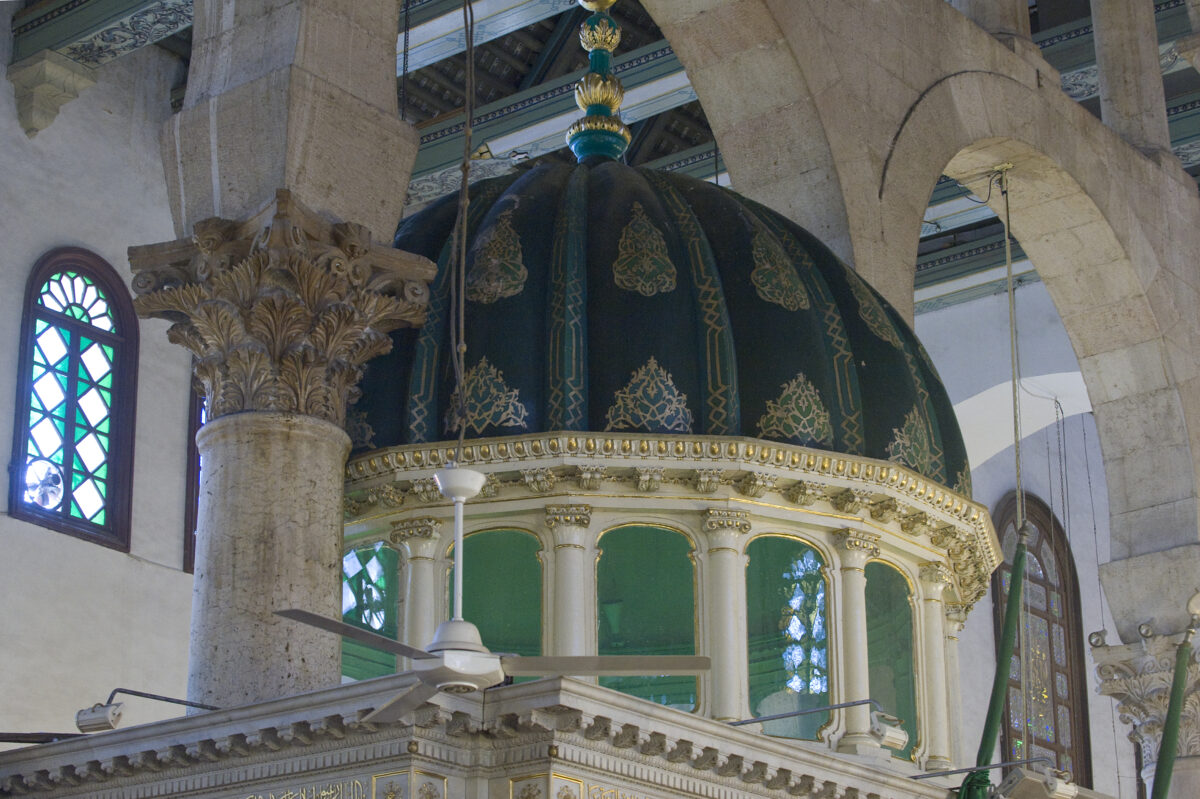
Shrine in Damascus, thought to be of Hazrat Yahya bin Zakariyya (John the Baptist) | Wiki Commons
Was Prophet Yahyaas, i.e., John the Baptist, martyred?
Someone from Pakistan wrote to Hazrat Amirul Momineen, Khalifatul Masih Vaa, stating, “It is the stance of the Promised Messiahas and Hazrat Musleh-e-Maudra that prophets can be killed, and, indeed, Prophet Yahyaas was killed. However, Hazrat Khalifatul Masih IVrh maintained that prophets cannot be killed and the assassination of Prophet Yahyaas is not corroborated by history. These two positions appear to be contradictory. Guidance on this matter is requested.”
Huzoor-e-Anwaraa, in his letter dated 23 November 2022, provided the following answer to this question:
“In the matter of the murder of Hazrat Yahya and Hazrat Zakariya, peace be upon them both, there is a divergence of views in historical and biographical texts, as well as among the opinions of earlier Islamic scholars. In light of the explanations derived from Quranic verses and interpretations of Hadith, there are also varied opinions within the Ahmadiyya Muslim Community. My stance on this aligns with the view of Hazrat Musleh-e-Maudra. I maintain my position, based on the Holy Quran, the sayings of the Holy Prophet Muhammadsa, and the instructions of the Promised Messiahas, that neither the first nor the last prophet of any dispensation, nor a prophet regarding whom Allah Almighty has promised protection from human reach, can be killed. For other prophets, murder does not tarnish their dignity nor detract from their prophetic stature, as being killed [in Allah’s way] is also one way of attaining martyrdom. However, for prophets to meet their end in a state of unfulfilled mission contradicts their esteemed stature. Thus, once a prophet fulfils his divine commission, his departure from this world, be it through natural demise or martyrdom, bears no grounds for objection. Such an end, marked by the completion of their mission, neither invites surprise nor grants the adversaries any satisfaction.
“Hazrat Yahya and Hazrat Zakariya, peace be upon them, were neither the first nor the last prophets of any dispensation, nor is there any explicit covenant from Allah Almighty cited concerning their assured preservation from adversaries. Furthermore, our conviction holds that upon their martyrdom, they had indeed accomplished the duties Allah the Almighty had assigned to them with utmost fidelity.
“The Promised Messiahas unequivocally affirms the assassination of Prophets Yahyaas and Zakariyaas through numerous statements. For instance, while interpreting the following Quranic verse, he articulates:
“‘It translates to, ‘It is your habit, O Children of Israel, that whenever a messenger came to you, you denied some of them and killed others. [Surah al-Baqarah, Ch.2: V.88]’ (Ai’nah-e-Kamalat-e-Islam, Ruhani Khazain, Vol. 5, p. 34)
“In his Arabic work Hamamat-ul-Bushra, he wrote:
وما کان موت القتل نقصًا لأنبيائہ وکسرًا لشأنہم وعزّتہم، وکأيّن من النّبيّين قُتلوا في سبيل اللّٰہ کيحيٰي عليہ السّلام وأبيہ، فتفکّرْ واطلبْ صراط المہتدين ولا تجلس مع الغاوين.
“‘Death through murder does not signify a deficiency for prophets, nor does it degrade their honour or stature. Numerous prophets have been assassinated in the cause of Allah, including Yahyaas and his father. Thus, contemplate and seek the path of those rightly guided, and refrain from associating with those who are led astray.’ (Hamamat-ul-Bushra, Ruhani Khazain, Vol. 7, p. 255, footnote)
“In this work, Tuhfah-e-Golarviyyah, Huzooras states:
“‘The term ‘kama’ as used by the Quran to denote the similarity between Mosesas and the Holy Prophetsa is also employed in the verse کَمَا اسۡتَخۡلَفَ الَّذِيۡنَ, albeit not negating the inherent distinction that exists between them.
“It is noteworthy that the twelfth Caliph of Islam, who was to appear at the turn of the thirteenth century, corresponds to Prophet Yahyaas, whose head was severed for a vile nation (let those with understanding comprehend). Therefore, it is imperative that the twelfth Caliph be a Qurashi, just as Prophet Yahyaas was an Israelite. However, the thirteenth Caliph of Islam, who was to emerge at the beginning of the fourteenth century and was named the Promised Messiah, had to be non-Qurashi, just as Jesusas was not an Israelite. Sayyid Ahmad Barelvi is the twelfth Caliph in the Muhammadan Caliphate, analogous to Prophet Yahyaas and is a sayyid.’ (Tuhfah-e-Golarviyyah, Ruhani Khazain, Vol. 17, pp. 193-194)
In Izalah-e-Awham, he writes:
“‘Likewise, Prophet Yahyaas also called the Pharisees and elders of the Jews ‘brood of vipers’ and had his head cut off due to their wickedness and machinations.’ (Izalah-e-Awham, Pt. 1, Ruhani Khazain, Vol. 3, p. 110)
“In light of the statements of the Promised Messiahas, the stance of Hazrat Musleh-e-Maudra was also that Prophet Yahyaas was indeed murdered. During the era of his Caliphate, a discussion arose regarding this matter, on which he delivered three Friday sermons. In these sermons, he established that Prophet Yahyaas was martyred, and this was also the belief of the Promised Messiahas and his Companions. On one such occasion in these sermons, he stated:
“‘Not once, but on numerous occasions, we have heard from the blessed lips of the Promised Messiahas, in not just one manner but in various tones and contexts, that Prophet Yahyaas was murdered. It is now utterly inconceivable for us to believe that the Promised Messiahas did not hold the view that Prophet Yahyaas was assassinated. It is not merely about what we heard from his blessed lips; we used to have discussions on this matter, and we always asserted that the belief of the Promised Messiahas was indeed that Prophet Yahyaas had been martyred. For instance, Hazrat Khalifatul Masih Ira held the view that a Prophet of Allah cannot be killed, and we would always debate this matter with him, presenting references from the writings of the Promised Messiahas. Eventually, around 1910, he conceded, stating he would no longer discuss this issue; previously, he would always assert that such statements were rhetorical, similar to what Sir Sayyid Ahmad Khan of Aligarh used to say that many statements in the Holy Quran were speculative or allegorical. However, when we persistently presented numerous references and brought forth multiple testimonies to prove that the Promised Messiahas indeed held the belief that Prophet Yahyaas was martyred, he stated that he now believes he should refrain from discussing this matter further. However, Hazrat Khalifatul Masih Ira never claimed in his arguments that he had heard such a belief directly from the Promised Messiahas. He would say, ‘My understanding leads me to this conclusion,’ but when we established that the Promised Messiahas believed that some Prophets were martyred, Hazrat Khalifatul Masih Ira then said, ‘I now choose to remain silent and will never speak on this matter again.’ (Friday Sermon, 26 August 1938, Khutbat-e-Mahmud, Vol. 19, pp. 569-570)
“Regarding the stance expressed by Hazrat Khalifatul Masih IVrh in his durus of the Holy Quran, he did not present his view as definitive but suggested that further research is warranted on this matter. Moreover, in support of his position, he cited a statement from the Promised Messiahas mentioned in the discourses, which states, ‘Since the cross is meant for criminals, it is incongruous with the dignity of a prophet to be crucified. Thus, the Torah states that one who is hanged is accursed. Similarly, ignominious ailments such as syphilis, typically befalling the morally debased, spare the prophets. While the murder of [true] prophets does not detract from their honour, there exists no authenticated instance of a prophet’s assassination. A prophet is not killed by the means used for vile individuals.’ (Al-Badr, No. 12, Vol. 2, 10 April 1903, pp. 90-91; Malfuzat [2016], Vol. 4, p. 356)
“This excerpt is derived from Malfuzat, a compilation of the Promised Messiah’sas pronouncements, as recounted by journalists or editors in their vernacular, based on their auditory recollections. Contrasting this, the extensive corpus of the Promised Messiah’sas writings unambiguously affirms his conviction regarding the assassination of Prophet Yahyaas. The aforementioned passage from Malfuzat does not negate the potentiality of prophets’ assassination but rather delineates the incompatibility of crucifixion, demise from ignoble diseases, or execution by means reserved for the wicked, with the esteemed stature of prophets.”
Addressees of the Holy Quran
pizar_heryanto| Pixabay
Someone from Egypt wrote to Hazrat Amirul Momineen, Khalifatul Masih Vaa, asking, “A friend enquired why the following verse of the Holy Quran mentions the heavens and the earth but not angels and jinn:
“‘Verily, We offered the Trust to the heavens and the earth and the mountains, but they refused to bear it and were afraid of it. But man bore it. Indeed, he is capable of being unjust to, and neglectful of, himself.’” (Surah al-Ahzab, Ch.31: V.73)
Huzoor-e-Anwaraa, in his letter dated 24 November 2022, provided the following answer to this question:
“It is a matter of common sense and is evident in our everyday practices where mentioning a select few items implicitly encompasses others; it is not customary to enumerate each detail repeatedly. This is encapsulated in the renowned Arabic adage, خَيْرُ الْكَلَامِ مَا قَلَّ وَدَلَّ, signifying that the essence of effective communication lies in being concise yet expressive. Thus, the Holy Quran, being a comprehensive book, one of its remarkable qualities is that Allah the Almighty has provided teachings in a concise manner, encompassing broad and detailed matters in succinct words. This unique characteristic of the Holy Quran is illuminated in verses such as وَكُلَّ شَيْءٍ فَصَّلْنَاهُ تَفْصِيلًا [And everything We have explained with a detailed explanation. (Surah Bani Isra’il, Ch.17, V.12)] and وَتَفْصِيلَ كُلِّ شَيْءٍ [And (this book contains) a detailed exposition of all things. (Surah Yusuf, Ch.12: V.111)].
“The Holy Quran adeptly conveys depth in brevity by issuing distinct directives to believing men and women where necessary, yet often addressing believing men alone with commandments that, by implication, apply equally to women without explicit mention.
“Therefore, the answer to your question is that when the Holy Quran mentions the heavens, the earth, and the mountains in the aforementioned verse, it implies all entities within them. This interpretation is also echoed in older exegeses. For instance, Tafsir al-Mazhari states:
وقيل المراد بالعرض الخطاب اللفظي بالسماوات والأرض والجبال أهلها كما في قوله تعالى وَسْئَلِ الْقَرْيَةَ أى أهلها دون أعيانها.
“‘It has also been said that the literal address to the heavens, the earth, and the mountains implies their respective denizens (i.e., the creatures living within the heavens, the earth, and the mountains were offered the trust by Allah), as in the verse وَسْئَلِ الْقَرْيَةَ (‘And ask the town’), where it refers to the people of the town, not the physical town itself.’ (Tafsir al-Mazhari, al-Qadi Muhammad Thanaullah al-Uthmani al-Hanafi al-Mazhari al-Naqshbandi [d. 1225/1810], Vol. 7, [p. 388])
“In the Promised Messiah’sas elucidation of the verse mentioned, it is evident that he interprets the heavens, the earth, and the mountains mentioned in the verse as representing the creatures inhabiting them. In his work, Tawdih-e-Maram, he elucidates:
“This means that, [Allah states,] ‘We presented Our Trust, which signifies Divine Love and the trial followed by complete obedience, to all the angels of the heavens, all creatures of the earth, and the mountains that appeared to be strong entities. However, all these entities declined to bear this Trust and were overawed by its greatness, but man undertook it.’ This was because man possessed two qualities: firstly, he could subdue himself in the way of Allah the Almighty, and secondly, he could reach such an extent in his love for Allah the Exalted that he could completely forget all else but Him.” (Tawdih-e-Maram, Ruhani Khazain, Vol. 3, pp. 75-76)
“Likewise, in Barahin-e-Ahmadiyya, Part 5, he wrote:
“‘[Allah says,] ‘We presented Our trust—which must be rendered back to Us like a trust—to all the creation in the earth and in heaven, but all of them refused to accept it out of apprehension that a default might ensue, but man accepted this trust as he was zalum [able to subdue himself] and jahul [able to be neglectful of himself].’ Both these terms [zalum and jahul] as applied to man, are complimentary and not derogatory in nature. They signify that man had been endowed with the capacity of being harsh upon his own self for the sake of God and he could incline towards God Almighty such as to forget his self. That is why he accepted the responsibility of treating his entire being as a trust and then to expend it in the cause of God.’ (Barahin-e-Ahmadiyya Part 5, Ruhani Khazain, Vol. 21, p. 239)
“‘The Trust that was presented to the angels, the earth, the mountains, and all celestial bodies, which they declined to bear, was undoubtedly first offered to the souls of the prophets and messengers when it was presented to mankind. This is because they are the leaders of humanity and the foremost in truly deserving the essence of humanity.’ (Ai’nah-e-Kamalat-e-Islam, Ruhani Khazain, Vol. 5, p. 169)
“Thus, the allusion to the heavens, the earth, and the mountains in this verse implies and subtly encompasses all beings within them, all of whom shied away from the Trust due to their incapacity to uphold its demands. It was then that man, esteemed by Allah the Almighty as the pinnacle of creation, bravely accepted this Trust, undeterred by potential repercussions.”
(Compiled by Zaheer Ahmad Khan, Head of Records Department, Private Secretariat, London and translated by Al Hakam.)
Opponents of Islam Ahmadiyyat say that Hazrat Mirza Ghulam Ahmadas, the Promised Messiah, claimed that our Holy Master, Hazrat Muhammad Mustafasa, received revelation in Persian. They ask for proof of this.
Often, the following source is quoted to make the case against the Promised Messiahas:
اور آپ سے پوچھا گىا کہ کىا زبان پارسى مىں بھى کبھى خدا نے کلام کىا ہے تو فرماىا کہ ہاں خدا کا کلام زبان پارسى مىں بھى اُترا ہے جىسا کہ وہ اُس زبان مىں فرماتا ہے ’’اىن مُشتِ خاک راگرنہ بخشم چہ کنم‘‘۔
“Again he [the Holy Prophetsa] was asked if Almighty God had spoken to any of His servants in the Persian language and he replied in the affirmative, adding that Almighty God says in the Persian language
اىن مشت خاک را گرنه بخشم چه کنم
which means, “What shall I do with this handful of dust (man) if I do not forgive him.” (Chashma-e-Ma‘rifat, Ruhani Khaza’in, Vol. 23, p. 382, Transl.: Review of Religions, January 1908, Vol. 7, No. 1, p. 10)
First, it will be shown with the help of some references that this saying was in circulation during and before the time of the Promised Messiahas and was classified by some scholars as a statement of the Prophetsa:
Hafiz Husayn Karbala’i (d. 997/1589), known as Ibn al-Karbala’i, in his important hagiographical compendium focused on the saints buried in Tabriz, Rawzat al-jinan wa-jannat al-janan, records the following account:
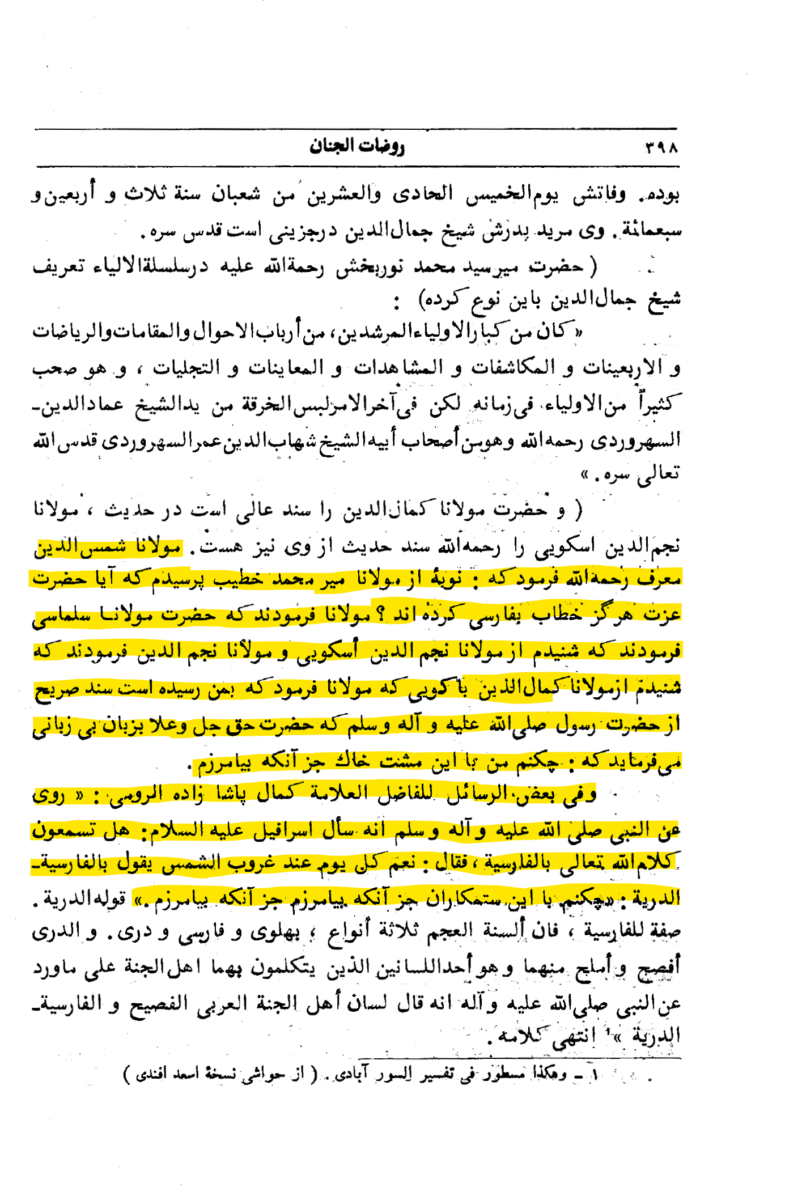
مولانا شمس الدىن معرف رحمه الله فرمود که: نوبهٔ از مولانا مىر محمد خطىب پرسىدم که آىا حضرت عزت هرگز خطاب بفارسى کرده اند؟ مولانا فرمودند که حضرت مولانا سلماسى فرمودند که شنىدم از مولانا نجم الدين أسكويي و مولانا نجم الدىن فرمودند که صريح شنىدم از مولانا کمال الدىن باکوىى که مولانا فرمود که بمن رسىده است سند از حضرت رسول صلى الله عليه و آله وسلم که حضرت حق جل وعلا بزبان بى زبانى مى فرماىد که: چکنم من با اىن مشت خاك جز آنكه بيامرزم.
وفي بعض الرسائل للفاضل العلامة كمال پاشا زاده الرومي: «روى عن النبي صلى الله عليه و آله و سلم انه سأل اسرافيل عليه السلام : هل تسمعون كلام الله تعالى بالفارسية ، فقال : نعم كل يوم عند غروب الشمس يقول بالفارسية الدرية : چکنم با اىن ستمکاران جز آنکه بىامرزم.»
“Mawlana Shams ad-Din Mu‘arrif, may Allah have mercy on him, said: I asked Mawlana Mir Muhammad Khatib whether God, the Eminent, had ever spoken in Persian. He replied that Mawlana Salmasi said that he heard from Mawlana Najm ad-Din Usku’i, and Mawlana Najm ad-Din said that he clearly heard from Mawlana Kamal ad-Din Baku’i that he said that it has reached me through a chain back to the Messengersa that [God,] the Truth, may He be glorified and exalted, says in the tongueless tongue: ‘What can I do with this handful of dust except forgive?’
“And in one of the treatises of the eminent scholar Kamal Pashazade ar-Rumi (d. 940/1534)[, it says]: ‘It is narrated from the Prophetsa that he asked Israfilas: “Do you hear the words of God Most High in Persian?” He replied: “Yes, every day at sunset He says in Persian: “What can I do with these oppressors except forgive?”’”
The editor of the Rawzat mentions in the footnote to the quotation from Pashazade that this was also recorded along the same lines in the Tafsir of as-Surabadi (d. ca. 454/1101)
Rawzat al-jinan wa-jannat al-janan
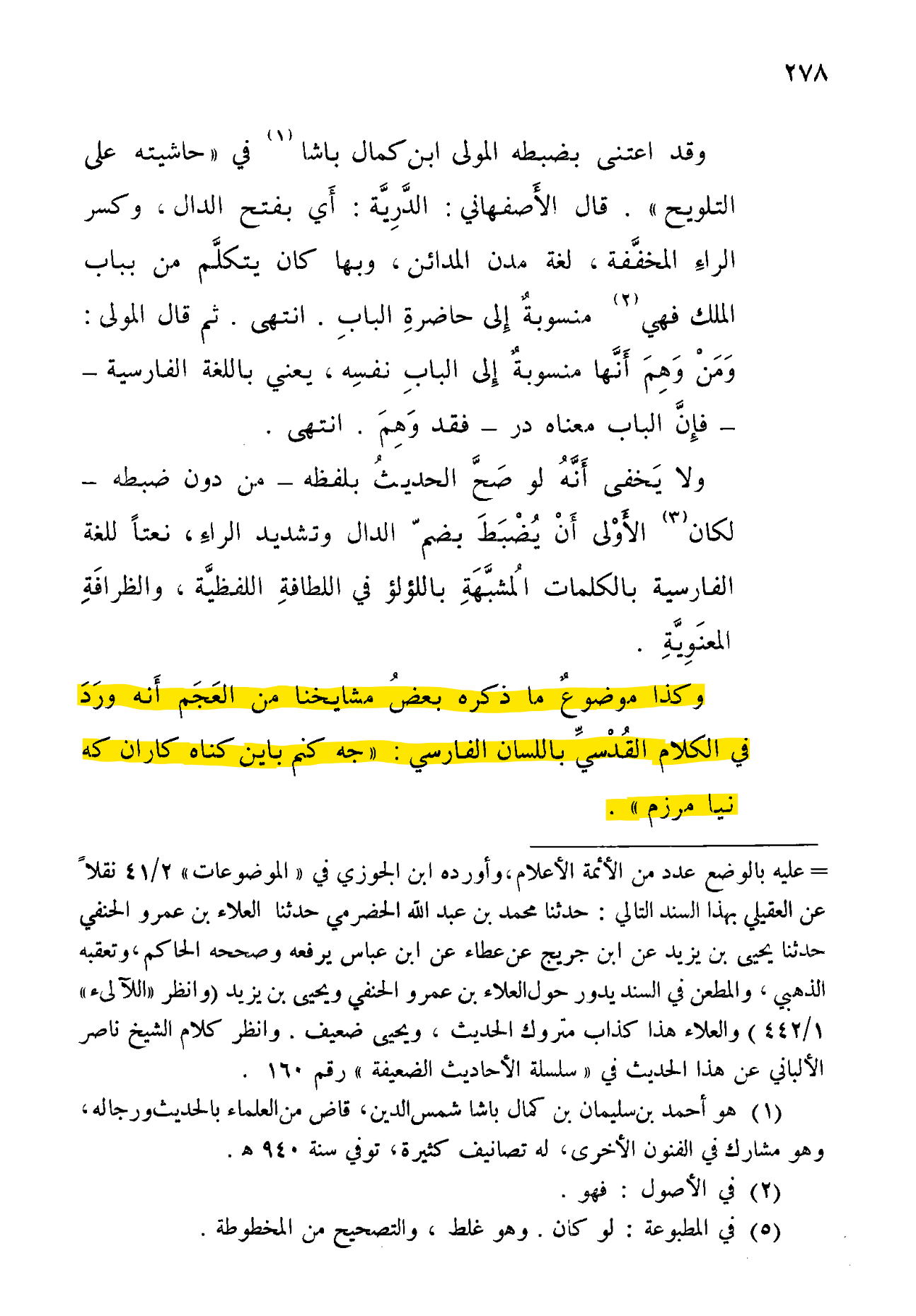
2. al-Mulla ‘Ali al-Qari (d. 1014/1606), the famous Hanafi hadith scholar, notes in al-Asrar al-marfu‘a fi l-akhbar al-mawdu‘a, his major work on fabricated ahadith:
وكذا موضوع ما ذكره بعض مشايخنا من العجم أنه ورد في الكلام القدسي باللسان الفارسي جه كنم باين كناه كاران كه نيا مرزم
“And likewise, what some of our shaykhs from the non-Arabs mentioned, that it occurs in the holy speech in the Persian tongue, “What shall I do with these sinners if I do not forgive them?”, is an unfounded hadith (mawdu’
al-Asrar al-marfu‘a fi l-akhbar al-mawdu‘a
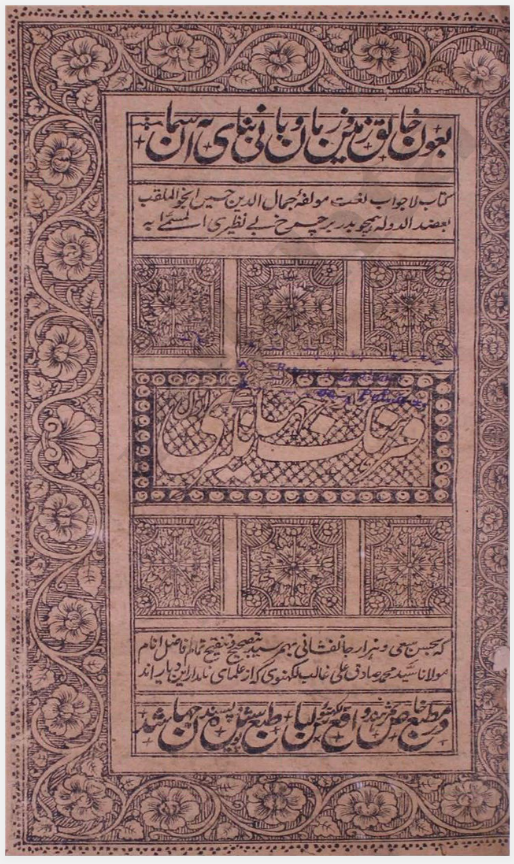
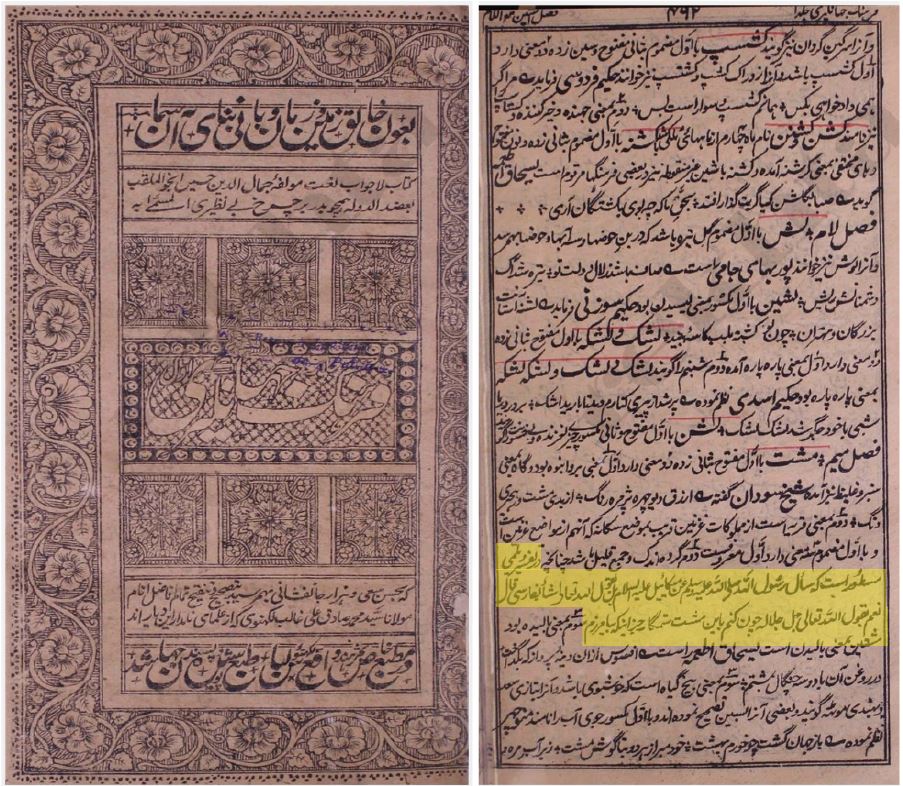
3. This hadith is also in Farhang-i Jahangiri, a Persian dictionary compiled in the 17th century by Mir Jamal ad-Din Husayn Inju (d. 1035/1626). This is one of the most important Persian-language dictionaries produced in Mughal India, often regarded as a standard in the realm of Persian lexicography. It reads:
در تفسىر دىلمى مسطور است که سأل رسول الله صلى الله علىه وسلم عن مىکائىل علىه السلام هل ىقول الله تعالى شىئا بفارسي قال نعم ىقول الله تعالى جل جلاله چون کنم با اىن مشت ستمگار جز اىنکه بىامرزم
“It is mentioned in Tafsir Daylami that the Messenger of Allahsa asked the archangel Michaelas: ‘Does Allah say something in Persian?’ He answered: ‘Yes, Allah the Exalted says: “What am I to do with this handful of oppressors but to forgive?”’”
Farhang-i Jahangiri
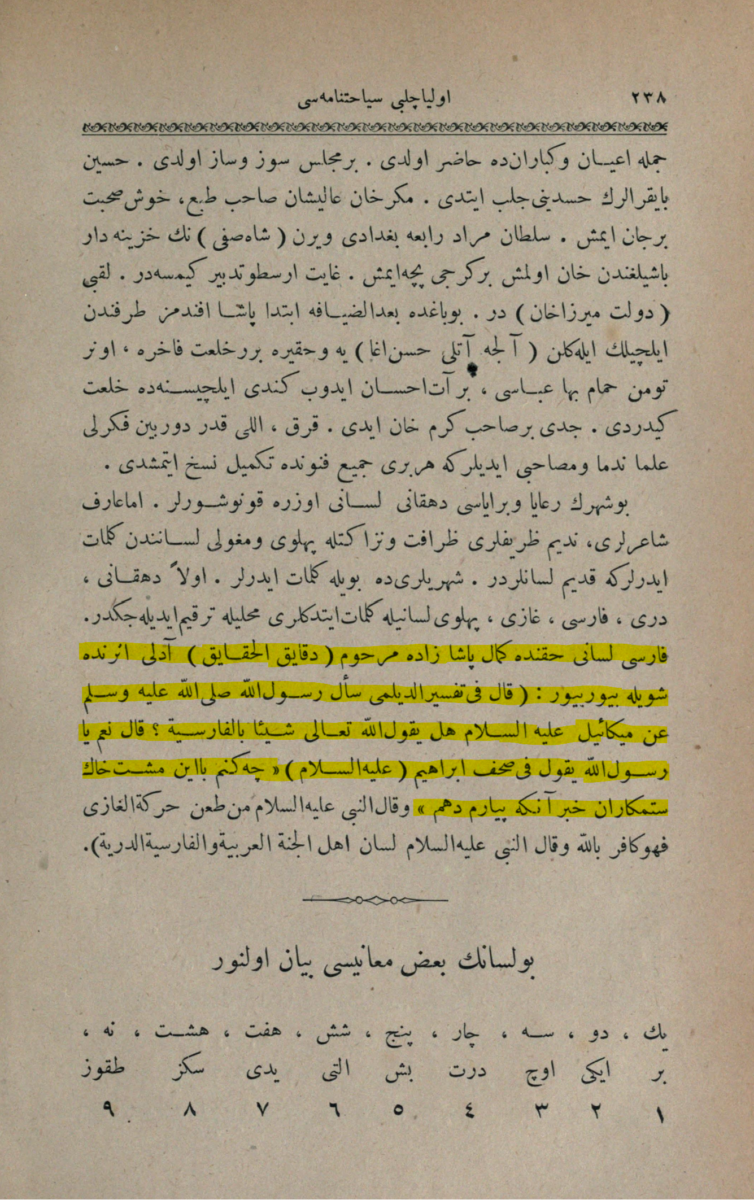
4. Evliya Çelebi (d. after 1096/1685), an Ottoman wayfarer and author, records in his voluminous travelogue Seyahatname, which is one of the greatest travel accounts in Islamic literature:
فارسى لسانى حقنده کمال پاشا زاده مرحوم (دقاىق الحقاىق) آدلى اثرنده شوىله بىورىىور: (قال في تفسىر الديلمى سأل رسول الله صلى الله عليه و سلم عن مىکائىل علىه السلام هل ىقول الله تعالى شىئا بالفارسىه؟ قال نعم ىا رسول الله ىقول فى صحف ابراهىم (علىه السلام) «چه کنم با اىن مشت خاک ستمکاران خبر آنکه پىارم دهم» […])
“The late Kamal Pashazade (d. 940/1534), in his work Daqa’iq al-haqa’iq, quotes regarding the Persian language as follows: ‘It is narrated in Tafsir ad-Daylami: “The Messenger of Allahsa asked Archangel Michaelas: ‘Does Allah the Exalted say anything in Persian?’ He replied: ‘Yes, O Messenger of Allah[sa], He says in the Scriptures of Abrahamas: “What shall I do with this handful of dirt of oppressors, except bring them a Message?”’”’”
The scholar by the name ad-Daylami, whose book is quoted here, is possibly the Zaydi Imam Abu al-Fath ad-Daylami (d. 444/1052).
Seyahatname
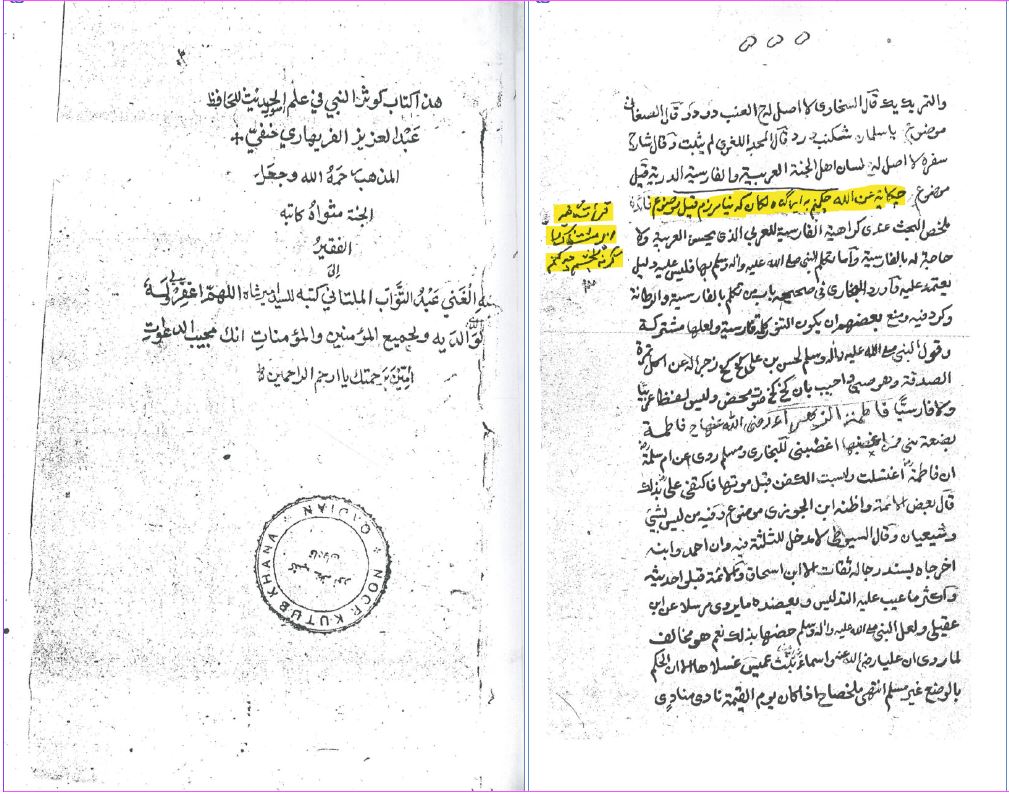
5. ‘Abd al-Aziz Pirharvi (d. 1239/1824), a scholar of Quran, hadith and Islamic philosophy, records this hadith in the second part of his work Kawthar an-Nabi fi ‘ilm usul al-hadith, which deals with fabricated traditions, (mawdu‘at) in the following way:
چکنم به اىن گناہ گاران که نىامرزم
“What am I to do if I do not forgive these sinners?”
And in the footnote, it is written:
قرأت فيه: اىن مشت خاك را گر نه بخشم چه کنم
“I have also read somewhere: ‘If I do not forgive this handful of dust, then what am I to do?’”
Kawthar an-Nabi fi ‘ilm usul al-hadith
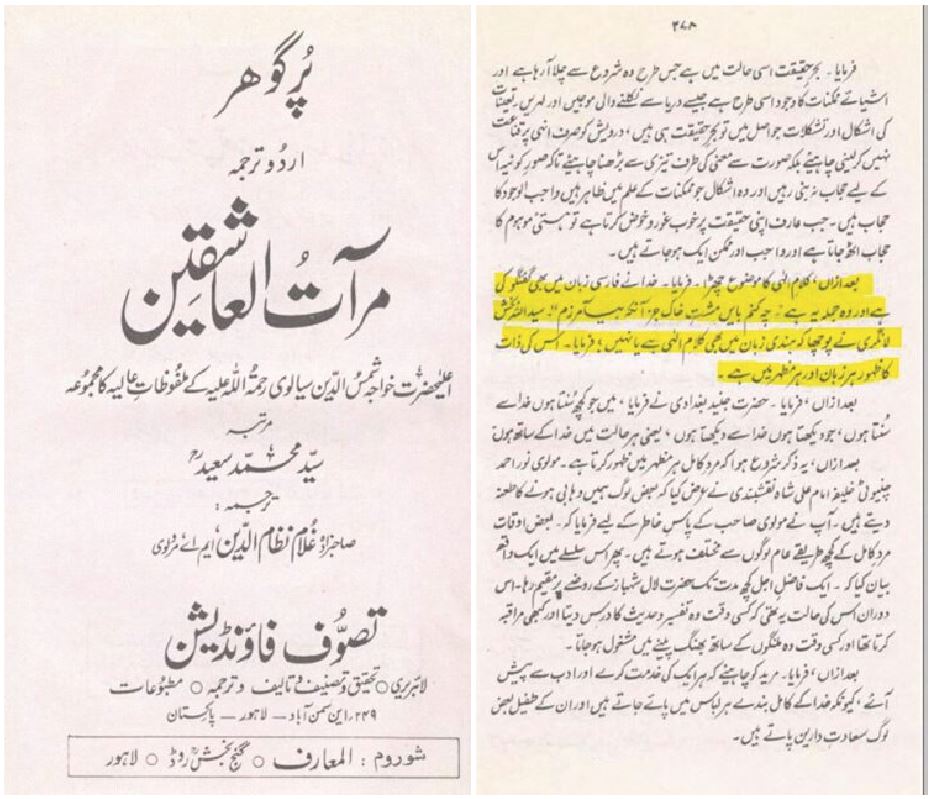
6. It is also written in the Malfuzat of Khawaja Shamsuddin Sialvi (d. 1300/1882), the spiritual leader of the Chishti Sufi order, also known as Shams al-‘Arifin:
“Later, a discussion on the subject of the word of God was initiated. He said: ‘God has also spoken in Persian language and that sentence is this:
چہ کنم باىں مشتِ خاک جز آنکہ بىآمرزم
“Sayyid Allah Bakhsh Langri asked whether the word of God is also in Hindi or not? He said: ‘His being is manifested in every language and appearance.’” (Pur Gohar, Urdu translation of Mir’at al-ashiqin, p. 287)
Mir’at al-ashiqin
If our opponents studied Islamic literature, they would not raise this allegation against the Promised Messiahas as throughout the Hadith corpus it is well established that the Prophetsa used Persian and other non-Arabic words.
Proof of Prophet Muhammadsa speaking in Persian
In ahadith we find many examples of the Prophetsa to have spoken in Persian. For example, it is narrated that Abu Hurairara said:
“The Prophetsa set out in the early morning and I did likewise. I prayed, then I sat. The Prophetsa turned to me and said in Persian: ” اشِكَمَتْ دَرْدْ ” (i.e., Do you have a stomach problem)?’ I said: ‘Yes, O Messengersa of Allah.’ He said: ‘Get up and pray, for in prayer there is healing.’ (Sunan Ibn Majah, Kitab at-Tibb, Hadith 3458)
In fact, Imam al-Bukhari established a whole chapter on in this in the Kitab al-Jihad of his Sahih called: “Bab man takallama bi-l-farisiyya wa-r-ratana” – “Chapter on speaking in Persian and in an unfamiliar accent”
Imam al-Bukhari introduces the chapter with the following two verses:
وَاخۡتِلَافُ اَلۡسِنَتِکُمۡ وَاَلۡوَانِکُمۡ
“And the diversity of your tongues and colours” (Surah ar-Rum, Ch.30: V.23)
“And We have not sent any Messenger except with the language of his people” (Surah Ibrahim, Ch.14: V.5)
Hafiz Ibn Hajar al-‘Asqalani makes the following remarks concerning these two verses in Fath al-Bari, his most renowned commentary on Sahih al-Bukhari:
كأنه أشار إلى أن النبي صلى الله عليه وسلم كان يعرف الألسنة؛ لأنه أُرسل إلى الأمم كلها على اختلاف ألسنتهم، فجميع الأمم قومه بالنسبة إلى عموم رسالته، فاقتضى أن يعرف ألسنتهم؛ ليفهم عنهم ويفهموا عنه.
“It is as if he [Imam al-Bukharirh] indicated that the Prophetsa knew various languages because he was sent to all nations, regardless of their language, so all nations are his people with regard to the generality of his message. This necessitated that he knows their languages so that Hesa could understand them and they could understand him.” (Fath al-Bari, Kitab al-jihad wa-s-siyar)
In this chapter of Sahih al-Bukhari, a narration from Hazrat Abu Hurairara states that al-Hasan ibn ‘Alira took a date from the dates of the sadaqa and put it in his mouth. The Prophetsa said to him in Persian, “Kakh, kakh” كَخٍ كَخwith the intention of saying: ‘Don’t you know that we [the Prophet’s family and progeny] do not eat sadaqa.’ (Sahih al-Bukhari, Kitab al-jihad wa-s-siyar, Hadith No. 3072)
In various Persian dictionaries the meaning of ‘kakh’ is written to throw something away.
Imam al-Bukharira also mentions the following hadith:
حَدَّثَنَا عَمْرُو بْنُ عَلِيٍّ، حَدَّثَنَا أَبُو عَاصِمٍ، أَخْبَرَنَا حَنْظَلَةُ بْنُ أَبِي سُفْيَانَ، أَخْبَرَنَا سَعِيدُ بْنُ مِينَاءَ، قَالَ سَمِعْتُ جَابِرَ بْنَ عَبْدِ اللَّهِ ـ رضى الله عنهما ـ قَالَ قُلْتُ يَا رَسُولَ اللَّهِ، ذَبَحْنَا بُهَيْمَةً لَنَا، وَطَحَنْتُ صَاعًا مِنْ شَعِيرٍ، فَتَعَالَ أَنْتَ وَنَفَرٌ، فَصَاحَ النَّبِيُّ صلى الله عليه وسلم فَقَالَ “ يَا أَهْلَ الْخَنْدَقِ، إِنَّ جَابِرًا قَدْ صَنَعَ سُؤْرًا، فَحَىَّ هَلاً بِكُمْ
It is narrated by Jabir ibn ‘Abdillah: I said, “O Allah’s Messengersa! We have slaughtered a young sheep of ours and have ground one sa‘ of barley. So, I invite you along with some people.” So, the Prophetsa said in a loud voice, “O people of the Trench! Jabir had prepared su’r, so come along.” (Sahih al-Bukhari, Kitab al-jihad wa-s-siyar, Hadith No. 3070)
Su’r is a Persian word that means food for which people are invited to.
Thus, according to Imam al-Bukhari, in both of the above-mentioned ahadith, the Holy Prophetsa used Persian words.
These ahadith do not imply the Holy Prophetsa spoke Persian. Instead, they signify that there is no objection if Persian phrases were Arabised and used. These ahadith highlight the acceptance of such expressions that the Prophetsa used.
al-Jawhari, a grammarian and lexicographer, writes in his as-Sihah, one of the earliest and most significant dictionaries in the Arabic language:
تعريب الإسم الأعجمي أن تتفوّه به العرب على مناهجها
“The Arabisation of the non-Arabic noun is for the Arabs to pronounce them according to their methods.” (al-Sihah, bab al-‘ayn)
An important consideration
These objections are a result of narrow-mindedness. In the Quran we find that Allah the Almighty states:
“And We have not sent any Messenger except with the language of his people” (Surah Ibrahim, Ch.14: V.5)
It is evident from this verse that every prophet’s revelation was in their people’s language. But this applied only to the prophets before the Holy Prophetsa as is evident from the following hadith:
“Hazrat Ibn Abbasra narrated that Allah the Exalted gave excellence to Muhammadsa over the Prophetsas and over the dwellers of heaven. Some people asked, ‘O Abu Abbas, in what manner has Allah given him excellence over the dwellers of heaven?’ He said that Allah the Exalted says to the dwellers of heaven:
“And We have not sent any Messenger except with the language of his people in order that he might make things clear to them. Then Allah lets go astray whom He wills.” (Ch.14: V.5)
“And Allah the Exalted said to Muhammadsa:
وَمَاۤ اَرۡسَلۡنٰکَ اِلَّا کَآفَّۃً لِّلنَّاسِ
“‘And We have not sent thee but for all mankind.’ [Ch.34: V.29]
“So, he sent him to the jinns and mankind.” (Mishkat al-Masabih, Kitab al-Fada’il wa al-shama’il, Hadith No. 5773; Sunan ad-Darimi, Hadith No. 47)
Authenticating this hadith, al-Hakim says the following:
هذا حديث صحيح الإسناد
“This is a hadith with an authentic chain of narration.” (Mustadrak al-Hakim, Kitab at-Tafsir, Hadith No. 3335)
This is to say that the Holy Prophetsa was sent to all nations – who speak all kinds of languages – not just to the Arabs who spoke Arabic.
Now if our Holy Mastersa, who was a messenger for all people, was given wahy – revelation – in the Persian language then why should there be any objection?
The above hadith clearly shows the Prophetsa came for all people and all nations.
Authentication of ahadith
Saints and Sufis of the ummah accept the authentication of ahadith through visions and revelations which the Holy Prophetsa taught us himself:
“If you hear a narration from me that your hearts recognise, settles your hair and skin, and you see it as close to you, then I am most deserving of it. And if you hear a narration from me that your hearts reject, makes your hair stand and your skin crawl, and you see it as far from you, then I am the furthest from it.” (Musnad Ahmad, Hadith No.16058)
In Jami‘ at-Tirmidhi the following account is recorded:
“Ahmad ibn Muhammad ibn Musa narrated to us: ‘Abdullah ibn al-Mubarak informed us, from Ma‘mar, from Khusayf who said: “I saw the Prophetsa in a dream. I said: ‘O Messenger of Allah! The people disagree over the tashahhud.’ He said: ‘Follow the tashahhud of Ibn Mas‘ud.’” (Jami‘ at-Tirmidhi, Kitab as-Salat, Hadith No. 289)
Then in the introduction of Sahih Muslim, Imam Muslim writes:
Suwayd ibn Sa‘id narrated to us, ‘Ali bin Mushir narrated to us, he said:
“Hamza az-Zayyat and I heard from Aban ibn Abi ‘Ayyash something like one thousand hadith. ‘Ali said: ‘So I met Hamza and he informed me that he saw the Prophetsa [in a dream], and he produced for him what he heard from Aban. However, he [the Prophetsa] didn’t recognise any except a small amount of them – five or six [hadith]’.” (Sahih Muslim, Introduction, Hadith No. 79)
Imam as-Suyuti also believed in the authentication of ahadith through visions. Imam as-Suyutirh writes:
“One of the companions, who I think was Ibn ‘Abbasra, saw the Prophet Muhammadsa in a dream and he was made to remember a hadith he kept thinking of. Then he met one of the wives of the Prophetsa, who I think was Maymunara, and told herwhat happened. So, she got up and took out the mirror of the Prophetsa. He[Ibn ‘Abbasra] said that he looked into it and saw the Prophetsa.” (Tanwir al-halak fi ru’yat an-nabi wa-l-malak, p. 17)
Then Imam as-Suyutirh also writes in the same book that many from the salaf and khalaf said they saw the Holy Prophetsa and asked him about matters about which they were confused and he informed them of the solution.
Shah Waliyyullah Muhaddith Dehlvira says that I have ahadith in which the sanad is only me and the Prophet Muhammadsa:
“Amongst the ahadith that I collected in this booklet, I have received some directly from the Holy Pophetsa without any intermediary between him and me. In the remaining, there are two or more intermediaries between him and me.”
The Promised Messiahas also had ahadith authenticated through visions. Hazrat Mirza Bashir Ahmadra writes:
“Hafiz Nur Muhammad, resident of Faizullah Chak, conveyed to me in writing that on many occasions that the Promised Messiahas said: ‘I have met the Holy Prophetsa in a state of wakefulness several times and have had many ahadith authenticated directly through him, whether they are weak or of a lower standard in the eyes of the people.’ This humble one says that what is meant by meeting ‘in a state of wakefulness’ is a vision and the Promised Messiahas used to say that according to muhaddithun, there are many weak ahadith, however, in reality, they are correct and authentic.” (Sirat-ul-Mahdi, Vol. 1, p. 550, narration no. 572)
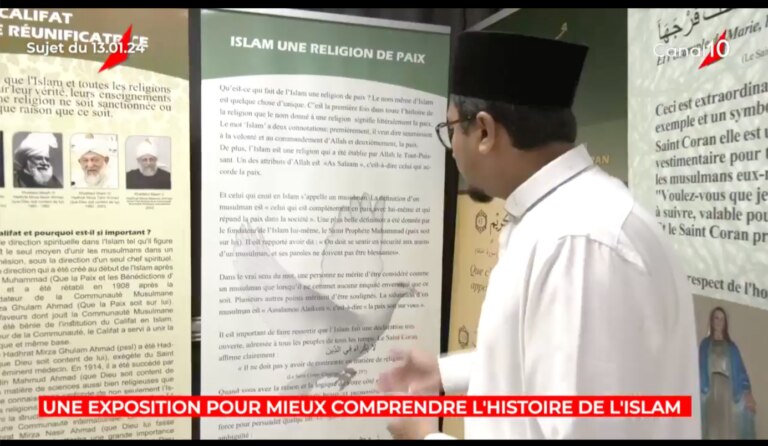
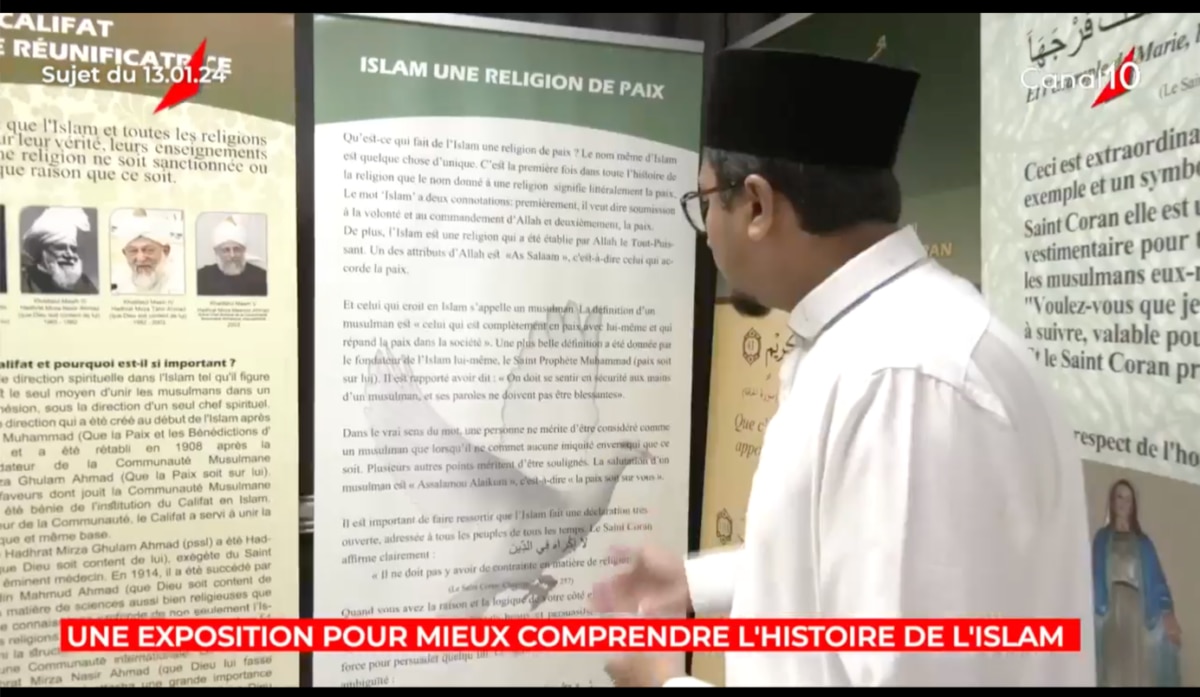
Jamaat-e-Ahmadiyya Guadeloupe organised a Quran exhibition at the Salako Hotel in Gosier Town, attracting 40 attendees from across the region. I had the privilege of being interviewed by both RCI Radio and Canal 10 television channels, with the interviews being broadcast multiple times on their respective platforms.
On 12 January, after Jumuah and Asr prayers, Jamaat members went to the hotel for the preparation of the hall. The exhibition was open to visitors from 9 am to 6 pm. We arranged for every visitor to be accompanied during their visit and to answer any questions they had. Some non-Ahmadi Muslims came to visit the exhibition as well; one of them was a Shia Muslim brother. They were introduced to Jamaat-e-Ahmadiyya and the advent of Hazrat Imam Mahdias.
We have some new tabligh contacts, and, in general, the Quran exhibition was a success, alhamdulillah.
A few guests also noted down their impressions in a notebook after they visited the Quran exhibition; some of them are as follows:
“This Quran exhibition is to present true Islam, i.e., the religion of peace. We were made very welcome, and all our questions were answered.”
“Very good Quran exhibition! We had a great time. Thanks for the welcome. We will meet soon, God-willing.”
“Thank you very much for your efforts to spread the beautiful message of Islam.”