
Home Blog Page 681

Huzoor’s Recollections of April 2003 (English translation)

Click here for Urdu version

Time and Tide Waited for One

Huzooraa Narrates a Momentous Series of Events

The days that ensued the demise of Hazrat Khalifatul Masih IVrh and before the Election of the Fifth Khalifa were turbulent days for the entire Jamaat. A lot has been said and written about that time and its sensitivity, but we always remained curious to know what Hazrat Mirza Masroor Ahmadaa went through. 15 years have passed in this curiosity but thanks to Al Hakam that enabled me to muster up the courage to ask.

A few days ago, in a blessed moment, I enquired about this from Huzooraa and Huzooraa most graciously shed light on it. I have no claim or experience of speedwriting, but Allah enabled me to jot down every word that Huzooraa said in reply. Below, is the translation of the original Urdu narration of events by Hazrat Mirza Masroor Ahmad, Khalifatul Masih Vaa.

Asif M Basit, London

rsz_2rsz_scan_011.jpg

Hazrat Sahibzada Mirza Masroor Ahmadaa, prior to Khilafat

“I arrived home from my office to be told by my wife that Miyan Luqman had called from London to say that Hazrat Khalifatul Masih IVrh had passed away. I immediately called Dr. Nuri sahib who was in London at the time, as a medical advisor to Hazrat Khalifatul Masih IVrh. He confirmed the devastating news. 

This news came as a great shock. The sorrow was overwhelming, but the sensitivity of the situation demanded complete control of emotions as it was a testing time for the entire Jamaat. As Nazir-e-Ala [Chief Secretary], it was my responsibility to organise the series of events that would follow and oversee them.

I called the Private Secretary in London who, I realised, was then unaware of the situation. I asked him to gather all the details and send them to me as soon as possible. 

In the meantime, I called a meeting of the Ulia Committee, which comprised the key officials of Jamaat bodies, like Sadr Anjuman Ahmadiyya and Tehrik-e-Jadid etc. I gave instructions in the wake of the emergency situation. I also had to ensure that visas were up to date and that there were travel arrangements for members of the Electoral College; those whose visas had expired, I ensured that they were given visas as quickly as possible. 

In the meantime, I received the details of the time and cause of Huzoor’srt demise from the Private Secretary. I conveyed these to Miyan Ahmad sahib [the late Sahibzada Mirza Ghulam Ahmad sahib] along with instructions on drafting an announcement to inform the Jamaats around the world. He brought back to me the draft for approval, which was then sent out to all Jamaats and also broadcast on MTA. I had already instructed Sultan Mahmood Anwar sahib to make a formal announcement after the Asr prayer in Masjid Mubarak.

That time was a test of patience. On one hand, there was the grief of Huzoor’srh demise and on the other, the responsibility of fulfilling a crucial duty that had been entrusted to me by Huzoorrh: the duty of supervising the arrangements of Intikhab-e-Khilafat [election of the new Khalifa].

With these mixed emotions, I headed home to prepare for my flight to London. The preparation, by the way, was nothing more than grabbing a few clothes alongside my travel documents and setting off for departure. 

As visas were still being processed for a few members of the Electoral College, it was decided that the members be split into two convoys: one to fly on the same day and the other to leave the following day once the visas had been acquired.

In the first convoy were Miyan Khurshid sahib [the late Sahibzada Mirza Khurshid Ahmad sahib], Miyan Ahmad sahib [the late Sahibzada Mirza Ghulam Ahmad sahib], Miyan Anas Ahmad sahib and myself; we were fourteen members altogether. We set off from Rabwah to Lahore where we were to catch the flight. There was a short transit in Abu Dhabi from where we boarded the London bound flight. 

I had already given instructions from Rabwah about washing and shrouding the body. When we arrived in London, the body had been washed, shrouded and placed in a casket and Huzoorrt was laid in state in Mahmood Hall for members of the Jamaat to pay their respects. I, too, initially paid my respects here in Mahmood Hall. The way one feels upon seeing their Imam in that situation cannot be described in words. But you can imagine; so, imagine what my feelings were in that moment. 

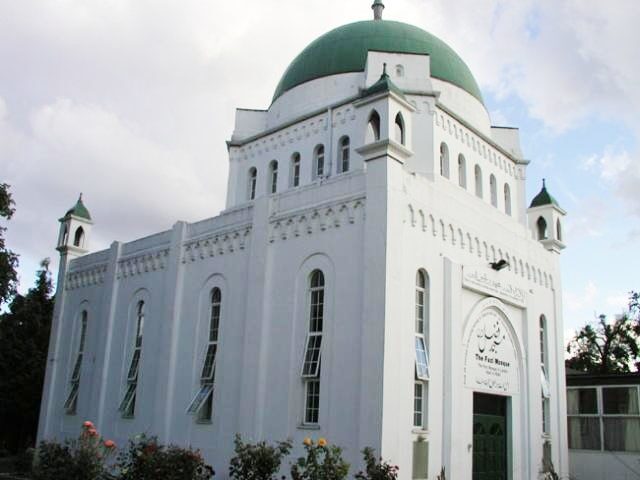
By then, it was time for Namaz [prayers], so we offered Namaz in the Fazl Mosque. Now, Huzoor’srh body had been moved to a room adjacent to Mahmood Hall. I went to that room. A strange moment that was; in the room was Huzoorrh, myself and absolute silence. It was a surreal setting. I stayed there, at Huzoor’srh side, for quite some time, praying for Huzoorrh

Hazrat Khalifatul Masih IVrh, had issued a set of instructions well before his demise, for such an emergency situation. One clause was that before the arrival of Nazir-e-Ala in London, Amir Jamaat UK would be Additional Nazir-e-Ala to oversee necessary arrangements in the meantime. Upon arrival, I took charge from Amir sahib UK and commenced the process for convening the Electoral College, the funeral and the burial etc. Time was short; a lot had to be done and every task required full care and attention. 

By the sheer blessings of Allah, everything was organised in good time. I felt at peace that I had fulfilled my duty. Every moment was spent praying that Allah granted the Jamaat a new Khalifa, and that I and every member of the Jamaat were able to obey the new Khalifa; every moment was spent praying that Allah may keep the Jamaat united. 

This state is, indeed, a state of fear. So of course, there was fear. But there was also firm faith in Allah’s promise that He would replace this state of fear with security. Thus, I was under the strong belief that Allah would grant the Jamaat a new Khalifa and that our fears would be replaced with peace. 

Then came the time for the Election. As a member, I also entered the Fazl Mosque that was full with members of the Electoral College. I stood near the shoes with Chaudhry Hameedullah sahib for a while. Chaudhry sahib, as the senior-most official of the Jamaat, was to preside over the Election, so when he was called to the front, I sat where I was stood, at the back of the Mosque.

The aura of the gathering was such that I did not have the courage to peer up and glance around nor did my conscience permit; a fragile time as it was. Thus, I sat with my gaze down. When my name was presented, I felt instant fear, so I lowered my head. 

When the votes were counted and the announcement made, I was confident that there must have been a mistake in the count. What happened after this made me tremble; there was no choice but to accept the decree of God. The Bai‘at and silent prayer followed. 

How I felt in that moment, the whole world saw on MTA. It was as if the weight of a mountain had been placed on my shoulders. 

It was midnight or even past midnight when I got to [my residence at number] 41, Guest House. There, in my room was I, the darkness of the night and the blessings of my God.

2n46kbr_tswcwwc.jpg

Moments after the Election of Khalifatul Masih V

Huzooraa paused here. Having heard this directly from Huzooraa, I was enchanted and did not know how to ask for more details. But in that precious moment, I felt that I owed more to the readers of Al Hakam and so, built the courage to gather more pearls. “What thoughts had crossed your mind, leaving Rabwah, Huzoor?” Our beloved master, in his humility, replied in a low tone:

“There was so much to be done before my departure that I did not have much else on my mind. However, I had said to my wife that on the seventh day after the Election, I would seek permission from the new Khalifa to return. I was also mentally prepared that the new Khalifatul Masih might not assign me the same responsibility I had. But I pledged to myself that whatever responsibilities were assigned to me, I would perform them wholeheartedly and then return.”

rsz_huzoor_aa.png

I thought that this was it. But my master probably sensed my curiosity.

“Is that it? What else did you want to hear?”

He said this with great affection; the affection that produces valour. I asked, “Your life must have drastically changed after becoming Khalifa. How does it feel?” The reply was simple but enlightening. 

“That moment was a ‘U-turn’ in my life. What I had left behind, remained there and where I am heading to is, by Allah’s will, in constant motion. I was a free man, fond of sowing seeds and harvesting crops – a simple farmer. Then I was appointed as Nazir-e-Ala, and from then on, I had to perform administrative responsibilities. Then, Allah entrusted me with this responsibility.”

As I walked out of Huzoor’saa office, I was spellbound. Before my very eyes were the crops that had yielded out of the seeds sown by this great Khalifa, which he continues to sow. May Allah keep these crops forever waving with the winds of His Mercy, and may the farmer of these crops live long. Amin.

Letter from the Northern Border of Spain

0

The feelings of Ahmadi missionaries upon entering Spain 

Karam Ilahi Zafar sahib and Maulvi Muhammad Ishaq Saqi sahib wrote to Al Fazl a letter, as they set foot on the soil of Spain for the very first time on 9 June 1946:

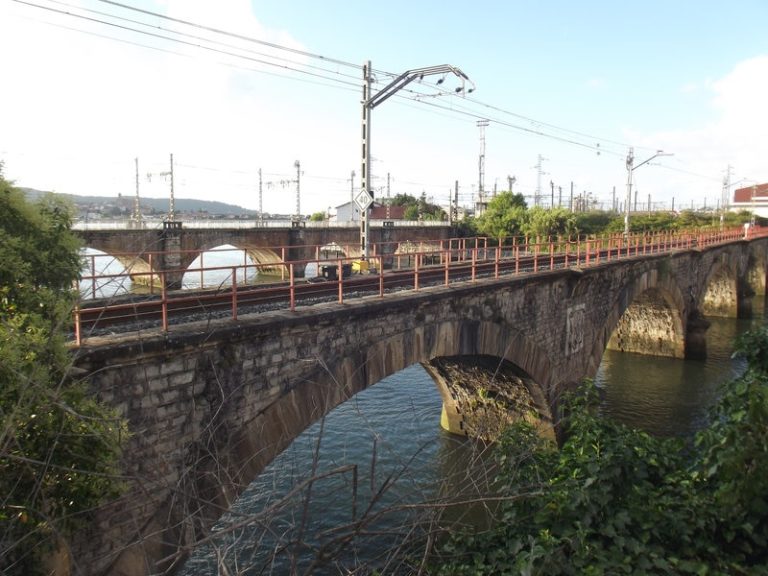
Hendaye is the last station of France at the border. It is by the sea, and a river from the east flows into it. Those living south of the river are part of Spain and those on the northern bank, part of France. But those living on either side of the river are proficient in both French and Spanish. 

A bridge connects both sides of the river. There also is a railway bridge, but due to tension between the two countries, the borders are closed and the rail does not go any further. Porters carry the luggage on carts across the bridge, from where taxis are hired to get to the railway station of Irun which is about a mile away. That is where we are heading to. 

Spain is part of Europe; the Europe that has excelled incredibly in the last two-hundred years. But what we should ask is: Where has this prosperity led to? The world falling away from God; the attempts to kill mankind on earth; the destruction caused by wars; greed, tyranny and oppression. All this is a result of the modern civilization and Europe is having to live through it.

Fourteen-hundred years ago, the Sun of Islam rose not only to brighten up the Arabian lands and turn its beastly population into humans, or heavenly humans rather, but it also shone upon other lands. Spain was one of such lands. 

Today, God desires to brighten the world – especially the western world – with the light of Islam through the advent of the Promised Messiahas; to bring to an end the global unrest and destruction; to promote fraternity and brotherhood among nations and races and to bring into use modern day technology to promote peace through the message of Islam.

To achieve this purpose, we enter this day the land of Spain, the two of us with, apparently, no resources.  Local people look at our turbans and our clothing with astonishment. Little do they know what Allah has in store to fulfil His decree.

Tariq [bin Ziyad], with his armies from Morocco and Algeria, had entered Spain from the south… Me and my companion are not entering Spain with such resources. Our only weapon is tabligh and prayer. We too are entering through a pass in the mountains but not from the south; from the north. Our victory would be to win hearts. To win a heart, one’s heart must be stronger. 

What is the strength of a heart? That we follow the right path with piety; that we have a cordial relationship with God; such a heart that is full of Allah’s love will surely win other hearts. We request everyone to remember us in prayers. Our objectives in Spain require every Ahmadi to very humbly pray to God that He enables us to become true representatives of the Promised Messiahas and Hazrat Musleh-e-Maud[ra].

(Al Fazl, 15 July 1946)

“Burn the Boats” or “Turn the Tables”

0
rsz_1leaflet.jpg

Leaflet from early Ahmadiyya Mission in Spain

Ahmadis all around the world listened to Huzoor’saa recent Friday Sermon from Valencia, Spain on MTA International. 

We have become so used to watching Huzooraa on MTA that rarely do we stop to think about what it has taken to get to this blessed point.

Let’s go half a century back in history and relive this faith-inspiring journey. These two columns cannot tell the whole story, so let’s go to Spain.

Going through the archives of Jamaat Spain, I came across a small flyer that was printed and circulated to spread the message of Islam Ahmadiyyat.

The arrangement of funds and the correspondence between Karam Ilahi Zafar sahib and the Centre in Rabwah is a story in its own right. Funds would have to be arranged, sent over to Spain and then had to be spent very carefully; every penny mattered. Then there is the letter from Karam Ilahi Zafar sahib asking Rabwah for three copies of The Philosophy of the Teachings of Islam to be sent over to the Spain mission. Then there were issues of packaging, parcelling, posting and what not. Letters were exchanged to query if tabligh [preaching] material had been sent, or that it was sent and whether it had been received or not; every letter took up to a couple of weeks to reach either end.

Enter MTA, and along comes a revolution where the delay between Hazrat Khalifatul Masih’s words and it reaching the corners of the earth is merely a second – maybe two in some instances.

rsz_764e44c0-da6a-4ffc-bcd6-f880283daf6c.jpg

MTA’s mobile uplink facility

When Huzooraa is in London, the studios and control rooms are all well established and they operate as a matter of routine. But when broadcasting from abroad, a huge cost would go into hiring satellite facilities to uplink the signal for it to get to the satellites.

But now, under the auspices of Hazrat Khalifatul Masih Vaa, MTA has been able to acquire a portable satellite dish that travels to any place that Huzooraa travels to. It has been to Germany and even to Canada and, as you read these lines, it is in Spain. The previous Friday Sermon and the Sermon Huzoor delivered today were both broadcast live from Spain through this facility.

Astonishing it is to think how Allah has blessed His Jamaat. From printing palm-sized leaflets with great difficulty to sending satellite signals without any difficulty is something that historians of Islam in Spain will, one day, take pride in writing. 

(AB)

Breaking All Idols

0

Friday Sermon from Valencia

6 April, Valencia

Hazrat Mirza Masroor Ahmad, Khalifatul Masih Vaa delivered the Friday Sermon from Baitur Rehman Mosque on 6 April. 

_st005_copy.jpg
Hazrat Mirza Masroor Ahmad, Khalifatul Masih Vaa

Huzooraa stated that while many Ahmadis had come to Spain to seek political asylum and many others continued to arrive, they should always remember that no false statements should be filed to support their claim of asylum. 

The nature of the persecution in Pakistan is such that needs no exaggeration to satisfy the authorities to accept them as refugees. 

Huzooraa said that falsehood has been condemned by God Almighty as a form of idol-worship. Hence, the purpose of an Ahmadi should be to break all idols and only seek help from Allah. 

The Promised Messiahas emphasised that his followers should abstain from worshipping any idol, whether literal or symbolic. Allah has clearly told us that the sole purpose of our creation is to worship Him alone; this also means that we should never bow before anything or anyone else in seeking help.

rsz_36.jpg

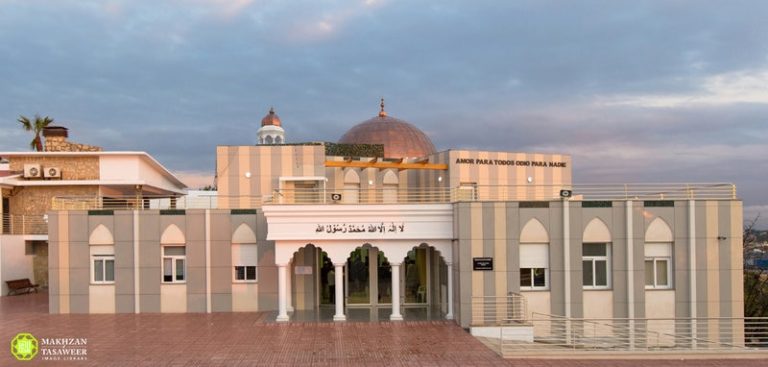
Baitur Rahman Mosque in Valencia, Spain

Huzooraa said that every Ahmadi carries the responsibility to first understand the purpose of our creation and then to make it known to others.

Huzooraa quoted the Promised Messiahas where he clearly stated that merely saying the words of the Bai’at (the pledge) is of no value; what is important is that one understands the actual purpose behind it, and that is to progress in taqwa (fear of Allah).

Huzooraa drew the attention of Ahmadis to the fact that as world-peace speedily heads towards instability, there is no true refuge but only in having a strong relationship with our Creator.

(To listen to this Friday Sermon, visit www.mta.tv)

Go Green or Go Pure

0

This week brings with it memories of a great natural calamity. On 18 April 1906, the San Francisco Earthquake struck at 5:13am followed by a massive fire from overturned wood stoves and broken gas pipes. 

The fire raged uncontrollably for three days resulting in the destruction of over 10,000 acres of property and a loss of 4,000 lives.

Hazrat Mirza Ghulam Ahmadas, the Promised Messiah and Mahdi, had foretold that earthquakes would soon envelope many parts of the earth. This he wrote on 15 April 1905 and the San Francisco Earthquake struck the region exactly a year after on 18 April 1906. The prophecy can be read in part five of Barahin-e-Ahmadiyya – a work of magnificence by the Promised Messiahas.

Some people ask as to why earthquakes should occur in places where there has been no significant opposition of Islam. There was no known opposition in San Francisco at that time, then why should it come under the “Wrath of God”?

What needs to be kept in mind is that the world, in the time of the Promised Messiahas, was speedily drifting away from religion and the concept of God. Atheism was becoming more and more common and mockery of God and His Attributes had become fashionable. It was in this scenario that Allah the Almighty, through His Messiah and Mahdi, decided to show the world that howsoever mankind may progress in science and technology, the Omnipotent God would always remain the centre of all powers.

Even today, more than a hundred years on since the prophecy of earthquakes was made public by the Promised Messiahas, even the most intelligent of technologies are unable to predict natural calamities; and even if meteorologists are able to give a forecast of climatic effects for the near future, they are unable to control them.

Tsunamis, landslides, floods, earthquakes, storms and hurricanes all seem to be on the rise. Environment scientists have been suggesting various ways to save Planet Earth from a disastrous catastrophe which they believe is destined to emerge from human failure to comply with what environmentalists have been preaching. They are quite right in calling human beings to pay heed but the actual question is: Pay heed to what?

Although the global environment needs to be protected by “going green” as environmental scientists like to say, but to listen to the cry of the one sent by God is of even more importance. We now know that environmental factors may be assessed but cannot be harnessed. We have learnt, or should have learnt, that there is a Power that controls all these forces and will continue to demonstrate its Omnipotence until we accept our helplessness. 

It must not be mistakenly thought that the Omnipotent God needs to prove His strength by bringing destruction to the earth and its inhabitants. It is only when the inhabitants wrong themselves and their large following by drifting the human soul away from its Creator that the Creator shows that He alone is the One with all power. This exhibit of power is, again, only to keep mankind on a path that leads to true prosperity.

33rd Jalsa Salana Australia

0
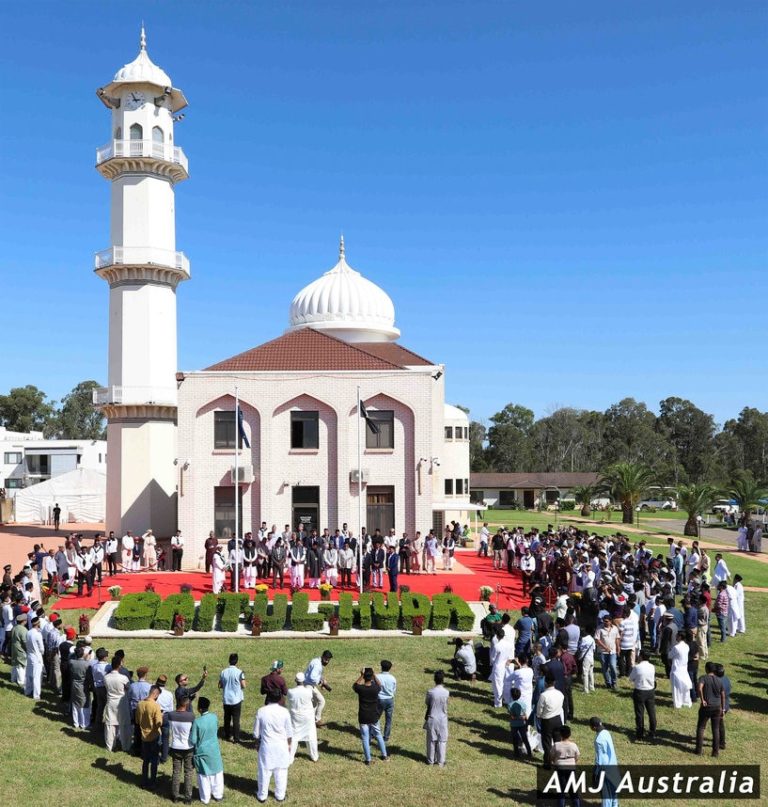
rsz_1rsz_1flag_hoisting_2.jpg

Flag Hoisting Ceremony

The 33rd Jalsa Salana of Jamaat Australia was held from 30  March to 1  April in Masjid Baitul Huda, Sydney.

Hard work, time and dedication went into the preparation for Jalsa Salana Australia 2018. Marquees were erected, signs were put in place, and fresh grass was laid, beautifying the House of God for the guests of the Promised Messiahas

Over 3,300 members from across Australia – including over 100 guests from 18 countries – participated. It had the second largest attendance since Jalsa Salana 2013. 

Jamaat Australia’s Amir and Missionary In-Charge, Inamul Haq Kausar sahib, conducted the inspection preceding the Jalsa Salana on 28 March. 

After Jumu’ah prayers on the first day of Jalsa Salana, as per tradition, the Liwa-e-Ahmadiyyat (Flag of Ahmadiyyat) was hoisted, which was followed by the opening session of Jalsa. In his opening address, Amir Sahib conveyed Huzoor-e-Anwar’saa message and prayers for the participants of Jalsa Salana. 

rsz_jalsagah1.jpg

Over 3,300 attendees at Australia Jalsa Salana

Over the three days, various speakers delivered insightful speeches on a range of topics, including: “The Unity of God”, “Noble character of the Holy Prophetsa”, “The Promised Messiah’sas love for the Holy Prophetsa”, “Khilafat – a Divine source of unity”, “Peace through the Messiah” and “Obedience”. The recitation of the Quran was presented in melodious voices which inspired the audience, as well as Urdu poems of the Promised Messiahas that raised heartfelt slogans for Islam Ahmadiyyat, the Holy Prophet Muhammadsa and Hazrat Mirza Ghulam Ahmadas

The Jalsa Bazar was setup with different food stalls. Various Jamaat departments such as Humanity First, Ta‘lim, Tabligh, Wasiyyat and Rishta Nata were also present and had marquees setup. Bookstalls and exhibitions were also another highlight of the Jalsa. 

The Lord Mayor of Blacktown Council, many other Members of Parliament and guests from different walks of life also participated in different sessions of the Jalsa and appreciated the volunteer work of the Jamaat and its contributions to the broader Australia Community.

The weather was hot over the three days but volunteers did an excellent job in serving the guests of the Promised Messiahas. The Jalsa concluded on the third day with silent prayer.

100 Years Ago… – Open Letter to Reverend Brown

0

While Hazrat Mufti Sadiq Sahibra was in England, he wrote this letter to Al Fazl concerning an English priest located in India. This letter has been taken from Al Fazl, 2 April 1918.

My friend, Sheikh Abdul Qadir (bookseller, Hyderabad, Deccan) has written to inform me that a priest, Rev. Brown [a priest who resided in India at the time], has allegedly claimed that no Englishmen have converted to Islam and that my reports are nothing but tales. 

Sheikh sahib has thus suggested that I get the English converts to sign their statements to testify my reports. He wished to show these to the Rev. Brown, so I have sent four signed statements from those who accepted Islam through me. But the priest could potentially simply reject them on the grounds that they were all forged. 

I therefore challenge Rev. Brown to choose one of the following two methods to testify my claims:

The first method being that Rev. Brown should travel to England to testify my claims. Anjuman Taraqqi-e-Islam, Qadian shall bear his second-class travel and day-to-day expenses. During his stay here, he will be our guest and will get to meet the English Muslim converts in person. We will arrange for his doubts to be removed in every way. 

If his doubts are removed and the truthfulness of Muslim missionaries proved, he will have to accept Islam. If he refuses to convert, he will pay back to our mission the amount spent on his journey, amounting to one-thousand pounds. And if we are unable to prove our claims, Rev. Brown will not be liable to pay us back, rather I shall repay him a thousand pounds and quit the activities of our mission.

If he is unable to travel, he can appoint a missionary based in London to represent him. In this case, all conditions will remain the same, save the reimbursement of travel expenses.

Either way, Rev. Brown will sign an agreement endorsing the above conditions (which will soon be published in Al Fazl and sent to him) and have it registered with our attorneys. 

He may write to the Secretary of Anjuman Taraqqi-e-Islam Qadian to settle the arrangements in good time. 

13 November 1917                          

Mufti Muhammad Sadiq, 4 Star Street, Edgware Road, London W2

(Al Fazl, 2 April 1918)

A Quick Glance at the Fourth Era of Khilafat-e-Ahmadiyya

0

The Khilafat of Hazrat Mirza Tahir Ahmad, Khalifatul Masih IVrt saw great milestones being achieved. This was partly a result of the migration which he had to undertake due to opposition in Pakistan, which all took place in the month of April.

That migration proved in our favour and brought about achievements, the fruits of which we reaped then and continue to reap today. Below is a brief selection of the accomplishments in the fourth Khilafat of Ahmadiyyat (1982-2003). 

rsz_1_st004_copy.jpg

Hazrat Mirza Tahir Ahmad, Khalifatul Masih IV r.t.

·          The Nasir Foundation

·          Headquarters of the Ahmadiyya Muslim Jamaat established in London

·          Launch of the global satellite channel of the Jamaat, MTA International

·          Launch of the Waqf-e-Nau scheme – parents devoting their unborn children for the service of the Jamaat

·          Urdu translation of the Holy Quran

·          Thousands of episodes of Quran classes, homeopathy classes and many other sessions recorded for MTA International

·          Launch of the Baitul Futuh Mosque scheme

·          Revelation, Rationality, Knowledge and Truth – Huzoor’srt magnum opus covering religio-philosophical subjects

·          Launch of scheme to translate the Holy Quran into 100 languages

·          Globalisation of Waqf-e-Jadid (previously restricted to Pakistan and India)

·          Syedna Bilal Fund (for the families of martyrs)

·          Maryam Shadi (marriage) Fund – to facilitate marriage of underprivileged girls

·          Detailed sessions on homeopathy, later compiled in book form

·          Launch of Al Fazl International, London (weekly Urdu newspaper)

·          Majlis-e-Shura [Consultative Body] started being held on a national scale

·          Purchase of Islamabad (Tilford, Surrey) for Jalsa Salana UK, which became the central Jalsa for the Jamaat

·          Humanity First, a global relief organisation

·          100 Mosque Scheme for Germany

·          Buyutul Hamd scheme, Rabwah – providing accommodation for those in need

·          National auxiliary bodies given autonomous status

·          Kafalat Yak Sad Yatama (sponsoring a hundred orphans) scheme launched

·          Scheme for financial sacrifice towards the Washington DC Mosque

·          Scheme to increase subscription of Al Fazl and The Review of Religions

·          Scheme to contribute towards establishing missions in Eastern Europe 

·          Scheme to provide aid to Iraqi people

·          Scheme to recite Durud (invoking salutations upon the Holy Prophetsa) extensively during Muharram-ul-Haram

·          Scheme to turn every Ahmadi into Dai-e-Ilallah (caller towards Allah)

·          Tehrik-e-Jadid, Daftar Chaharam (4th Generation of Financial Sacrifice towards Tehrik-e-Jadid)

·          Scheme to celebrate centenary of the Ahmadiyya Muslim Jamaat. Celebrated globally in 1989

·          Instruction to students to learn languages

·          Instruction to learn Spanish and go for Waqf-e-Arzi in Spain

·          Further establishing global missionary activity

·          Establishing mosques in various parts of the world

The Ahmadis and the Politics of Religious Exclusion in Pakistan

0

Asif M Basit

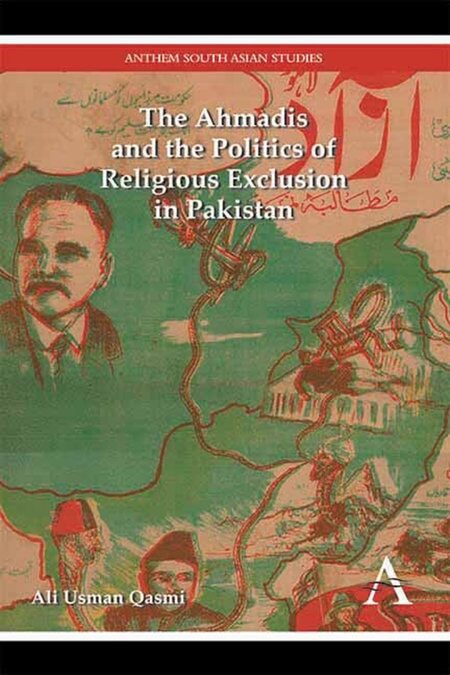
rsz_book_review_1.jpg

(Courtesy of Ali Usman Qasmi and Anthem Press)

Author: Ali Usman Qasmi

Publisher: Anthem Press

Ahmadis were officially declared non-Muslims by a special committee of Pakistan’s National Assembly in 1974. But this did not just happen in a day or two. The problem was deep-rooted and dated back to the time of the Ahmadiyya Muslim Community’s Founder – Hazrat Mirza Ghulam Ahmadas of Qadian. 

The message of Hazrat Mirza Ghulam Ahmadas was unanimously rejected by major schools of the Muslim Ummah, but – logical, powerful and promising as it was – it was widely accepted by those who saw it from an unbiased angle. As the Community flourished it was destined to face opposition, and so it did.

By the early 1930s, the Community had gained hundreds of thousands of followers, the majority living in pre-partition India. This was a time of great political controversy. It must be remembered that religion was the bedrock of Indian politics, as most of the debates revolved around Hindu-Muslim issues. 

Hazrat Mirza Bashiruddin Mahmud Ahmadra, then Head of the Community, was looked up to by great leaders of the day – religious and non-religious alike – for his opinion and guidance. It was in this climate that the leadership of the All India Kashmir Committee was offered to Hazrat Mirza Bashiruddin Mahmud Ahmadra

Despite his reluctance, he was asked to take up the responsibility as only he was capable of mobilising the Muslims for the cause of Kashmir. The Committee saw great success under the leadership of Hazrat Mirza Bashiruddin Mahmud Ahmadra, to the extent that it aroused apprehensions in the hearts of even those who had offered him to head the committee. From here, started the organised and politically-motivated opposition of the Ahmadiyya Muslim Community.

After two decades of unsuccessful attempts to curb the growth of the Community, the anti-Ahmadiyya circles resorted to use the unstable political atmosphere of Pakistan as a tool. In 1952, the anti-Ahmadiyya agitation began by the Majlis-e-Ahrar – an organisation founded with the sole purpose of opposing Ahmadiyyat. Other organisations with similar agendas joined hands and the alliance was known as Majlis-e-Amal. This led to the most organised anti-Ahmadiyya agitation, up to that point, in the history of the Community. 

The Majlis-e-Amal issued a fatwa from Lahore on 14 October 1952 where the so-called Ulema unanimously declared Ahmadis non-Muslim.

The fatwa was not only against Ahmadis but also had tones of uprising against the government.

“If such a government is failing to carry out the order of the Islamic Shari‘ah, there was justification for boycotting it.”

This and other fatwas of similar nature led to the anti-Ahmadiyya violence in Pakistan during February and March of 1953. The government thus set up a committee consisting of Justice Muhammad Munir and Justice Malik Rustam Kiyani to inquire the anti-Ahmadiyya violence and the differences that it allegedly stemmed out from.

Ali Usman Qasmi carried out, very painstakingly, a thorough research into the hearings of the Munir-Kiyani commission and its outcome. Qasmi’s book, The Ahmadis and the Politics of Religious Exclusion in Pakistan, provides an insight into the turbulent days of politics and religious conflicts in the early years of the formation of Pakistan. 

Where the writer touches upon theological differences, the reader feels that it could be better presented. But then, understandably so, it is not meant to be a book on theology.

(AB)