
Masood Nawaz Malik, UK
A space for reflection
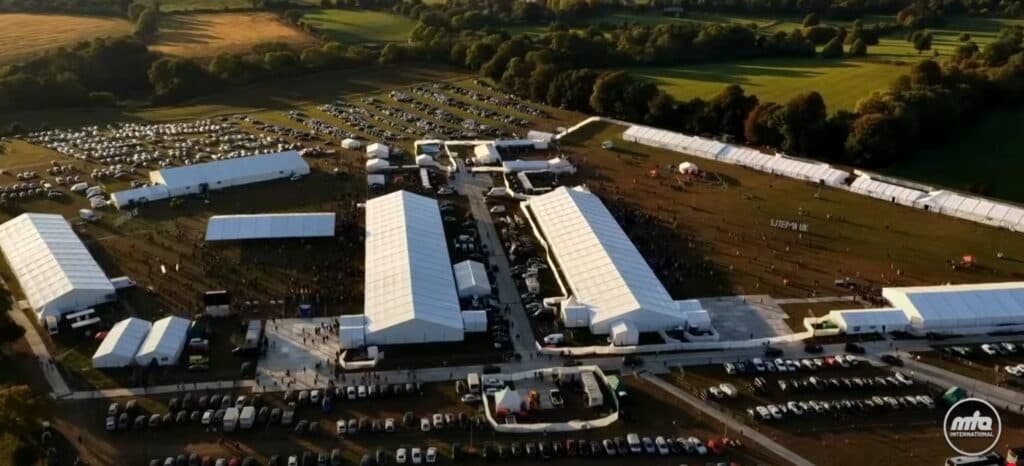
This year’s National Ijtema for Majlis Ansarullah UK introduced a new feature: the Auditorium. At its heart, the Auditorium was intended as a quiet sanctuary – a space where ansar could pause, reflect, and reconnect amidst the busy schedule of the ijtema. It welcomed visitors into an atmosphere of inspiration through uplifting talks, engaging exhibitions, and the warmth of coffee and conversation at the Cycling Cafe. It was a place where learning and reflection were given room to breathe, and where brotherhood could be strengthened in a natural and unhurried way.
The atmosphere inside the Auditorium had a calmness about it, a gentleness in the way people interacted, whether they were reading through exhibits, enjoying a book in the reading area, listening to a talk, or simply enjoying a cup of coffee with a brother they had not seen for some time. It became a reminder that the ijtema is not only a place of activity and competition, but also a space for spiritual nourishment and connection.
My part in all of this was small, yet it was a privilege for which I will always remain grateful. I was asked to assist with the design, artwork, and layout of the exhibitions, as well as oversee the printing, ensuring everything was ready on time. Under the leadership of Hafiz Ijaz Tahir Sahib (Naib Sadr Saff-e-Daum, Majlis Ansarullah UK), preparations began a month prior to the ijtema. My involvement deepened in the final weeks, as I worked on the site layout, the Cycling Expo, the Cycling Cafe, the stage backdrop, and the entrance panels.
Among the exhibits I worked on was one on the “Articles of Faith”, and another displaying the sayings of the Promised Messiahas and the Khulafa about “Belief in the Unseen”. This was the overall theme of the National Ijtema. This display touched me deeply. As I carefully placed the words of Khilafat on the panel, I felt a personal reminder that belief is not tied to what we can see with our eyes, but to the trust we place in Allah. What seemed at first like a design task became, for me, a way of quietly reaffirming my own faith.
It was in this spirit that The Review of Religions session on inspirational accounts from the God Summit resonated with me so strongly. Brief as it was, the most striking part was hearing the personal experience of Hazrat Khalifatul Masih Vaa with Allah – a reminder that belief in the unseen is not theoretical, but a lived reality for those chosen by Allah. It gave me a glimpse of how the unseen, when nurtured through faith and devotion, becomes a certainty that transforms every aspect of life.
The process was intense. Many designs went through multiple rounds of revisions before a final version was approved. I spent long hours at the printers, carefully checking details, ensuring colour consistency, and doing whatever little I could to minimise mistakes. By the sheer grace of Allah, the errors in the final work were extremely minimal – to the point of being almost non-existent, alhamdulillah.
This verse often echoed in my mind:
“And say, ‘Work, and Allah will surely see your work and also His Messenger and the believers.” (Surah at-Taubah, Ch.9: V.105)
It reminded me that even hidden service – checking proofs, aligning panels, staying awake at the printers – is never hidden from Allah.
Cycling with a purpose
The Cycling Expo itself followed a clear theme. It began with the words of the Khulafa about cycling and their vision for what they desired of us as ansar. This was followed by an exhibit showcasing the achievements of the AMEA UK Cycling Club over the past two years, carefully aligned with the guidance of Huzooraa. The final exhibit carried the title “Cycling with a Purpose” – a striking poster charting the many journeys undertaken across mainland Europe, where peace and harmony were promoted not only through events and conversations, but also through the silent yet powerful message emblazoned on our cycling jerseys: “Love for All, Hatred for None.”
To the casual observer, cycling may seem like just a sport, a way to stay healthy, or an enjoyable way to spend time outdoors. However, under Khilafat’s guidance, it has evolved into something far deeper: a means of service, a form of tabligh, and even a vehicle for spreading peace. As I worked on these designs, I realised afresh that when Khilafat instructs us, even everyday activities like riding a bicycle gain spiritual purpose.
In the two weeks leading up to the ijtema, my personal life almost came to a standstill. Days turned into sleepless nights, often accompanied by coffee and always by du‘a (prayers). Yet even in the tiredness, there was a sense of peace. Each task, however small, became an opportunity to seek Allah’s help. I found myself quietly repeating prayers of istighfar (seeking forgiveness) as I worked, asking Allah to cover my shortcomings and to accept the effort for His sake. One of the key lessons I learnt was that we need to reach a point where human striving meets divine grace, and remain in constant istighfar so that Allah in His mercy, veils our shortcomings.
There were times when exhaustion made me feel I could not continue, but prayer carried me through. It was in those quiet, solitary hours – sitting in front of a glowing screen or waiting for the next set of prints to roll off – that I realised how true it is that Allah supports those who strive in His cause. The Quran says:
“Then whoso does an atom’s weight of good will see it.” (Surah al-Zilzal, Ch.99: V.8)
This verse comforted me. Even the smallest efforts – a correction here, a late-night adjustment there – could be counted in Allah’s sight, provided the intention was pure.
When the ijtema finally began, the long hours of preparation gave way to moments of quiet joy. I found myself connecting and reconnecting with brothers over coffee and pastries, guiding visitors through the exhibits, and tidying the space so that each new guest would feel welcomed. I had also brought cycling books and equipment to display alongside the bikes, which added a layer of depth to the expo and caught the interest of many visitors.
For many, the highlight was the Cycling Cafe. It quickly became more than a refreshment corner – it was a hub of warmth and conversation. Some khuddam remarked how much they loved the idea and hoped it could be introduced at their own ijtema. On the final day, one Nasir cycled in, leaned his bike inside the cafe, spent the day immersed in the atmosphere, and then rode home again in the evening. That small, simple act summed up the spirit of the project: faith expressed in action, service expressed in simplicity.
Looking back, I realise how much of this depended on teamwork. The group included cyclists with whom I had long shared the road, as well as others I had known since childhood. One brother described how cycling had bound us not just as friends, but as family – words that reminded me of the saying of the Promised Messiahas, that two people united by faith can be closer than brothers of the same mother.
The camaraderie within the team was exceptional. Each member looked out for the other; every brother had the next one’s back. Long nights of edits and endless changes became bearable – indeed, even enjoyable – because they were carried out together, with the spirit of serving the jamaat at heart.
Closing reflections
In truth, whatever I contributed to the Auditorium feels very small compared to the scale of blessings Allah granted. If anything good came of it, it was only through His grace, and if there were shortcomings, they were entirely mine.
Yet, as I reflect, one session from the ijtema stands above all others in my heart: The Review of Religions presentation at the God Summit. Hearing Beloved Huzooraa speak of his personal experiences with Allah was not only inspiring – it was profoundly humbling. It was as though the very theme of the ijtema, “Belief in the Unseen”, came to life before our eyes. In Huzoor’saa account, faith was no longer a concept, but a living and breathing certainty, shining with the light of personal experience.
That talk left me with the realisation that everything we do – whether designing exhibitions, serving coffee, cycling for peace, or staying awake over proofs – finds its true meaning only when connected to Khilafat. For it is under the shade of Khilafat that our actions are given direction, and it is through the words and prayers of the Khalifa that Allah’s nearness is experienced in the most tangible of ways.
The more I thought about it, the more I realised that my small acts of service – checking layouts, revising panels, tidying spaces – were not separate from that grand spiritual reality. They too could be transformed into steps towards Allah if carried out with sincerity, humility, and obedience. In fact, Huzoor’saa account reminded me that nearness to Allah is not something distant or unattainable. It begins in the quiet corners of service, in prayers whispered between tasks, and in the resolve to offer one’s best, however modest, for the sake of Allah and His jamaat.
This was the true lesson I carried home from the ijtema: that the blessings of Khilafat are not abstract, but living, breathing guidance. Through Huzoor’saa example, I came to see that even the smallest service, when done with love and sincerity, can draw a person nearer to Allah. And for this realisation, I am profoundly grateful.