

Friday Sermon
6 February 2026
The harmony of love and worship: The Prophet’ssa model
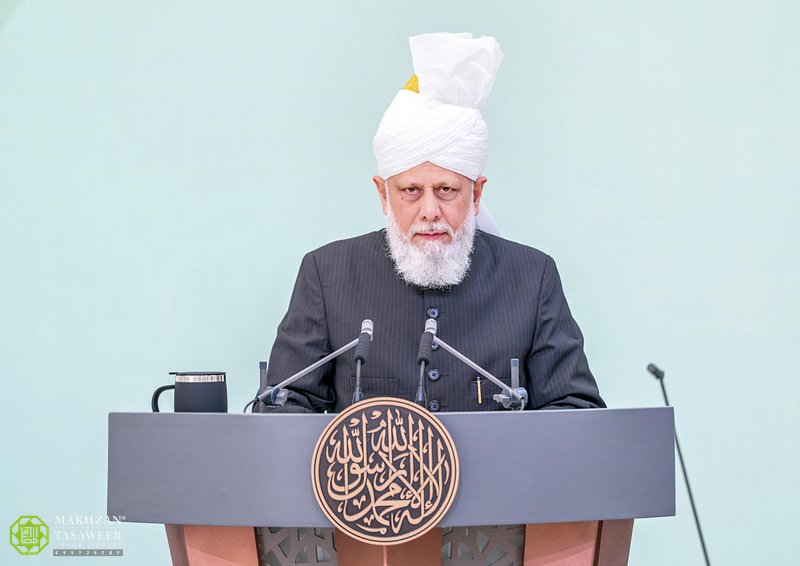
After reciting the tashahhud, ta‘awwuz and Surah al-Fatihah, Hazrat Khalifatul Masih Vaa stated:
Allah the Almighty has declared that the Holy Prophetsa is an excellent model for us in every regard. In the previous sermons, the love of the Holy Prophetsa for Allah was being mentioned. In relation to his love for Allah, the standard of his worship was also mentioned. Initially, I intended to mention his worship as a separate subject after having completed the topic of his love for Allah. However, when I started relating accounts about his love for Allah, many incidents of his worship were also mentioned.
Although I wanted to, I was unable to separate these two topics, as both are intertwined. Worship is not possible without the love of Allah, and to love Allah is not possible without worship. If one does not love Allah, they cannot truly worship Him either. Nevertheless, I will elaborate further on this topic today, but from the perspective of worship. However, as I mentioned in the previous sermon, the pinnacle of this is the love of Allah the Almighty. In reference to a verse, I have already elaborated in the previous sermon how Allah the Almighty has mentioned the status of the worship of the Holy Prophetsa in the Holy Quran, in the following verse:
قُلْ اِنَّ صَلَاتِیْ وَنُسُکِیْ وَمَحْیَایَ وَمَمَاتِیْ لِلّٰہِ رَبِّ الْعَالَمِیْنَ
“Say, ‘My Prayer and my sacrifice and my life and my death are [all] for Allah, the Lord of the worlds.’”
As I mentioned, I have already expounded on this verse in the previous sermon. As such, there is no need to repeat it again. Following this, Allah the Almighty commanded the Holy Prophetsa to proclaim:
فَاتَّبِعُوْنِیْ یُحْبِبْکُمُ اللّٰہُ
[“Follow me: (then) will Allah love you.”]
Thus, commanding us to acquire those standards as well. Allah the Almighty says that tell people that if you follow me, then Allah will love you as well, and you will be able to acquire the love of Allah. Thus, by commanding the Holy Prophetsa to make this announcement, Allah the Almighty also commanded us to make sincere efforts to attain these standards.
With regard to worship, Allah the Almighty has given us countless commandments in the Holy Quran through the Holy Prophetsa. At one place, He says the following:
وَمَا خَلَقْتُ الْجِنَّ وَالْاِنْسَ اِلَّا لِیَعْبُدُوْنِ
“And I have not created the Jinn and the men but that they may worship Me.”
As such, the Holy Prophetsa clearly said that if you wish to follow me, then just as I have understood the purpose of the creation of man, you too should understand it and try to discharge its due right. Only then will you be able to fulfil the purpose of your creation, and only then will you be able to acquire the love of Allah the Almighty.
Then, drawing our attention towards prayer, Allah the Almighty has stated at another place:
يٰٓاَيُّہَا النَّاسُ اعْبُدُوْا رَبَّكُمُ الَّذِىْ خَلَقَكُمْ وَالَّذِيْنَ مِنْ قَبْلِكُمْ لَعَلَّكُمْ تَتَّقُوْنَ
“O ye men, worship your Lord Who created you and those who were before you, that you may become righteous.”
Thus, in order to gain the nearness of Allah the Almighty and to become righteous, it is essential to worship Allah the Almighty and to elevate the standard of worshipping Him to the highest degree.
Following this, Allah the Almighty says:
يٰٓاَيُّہَا الَّذِيْنَ اٰمَنُوا ارْكَعُوْا وَاسْجُدُوْا وَاعْبُدُوْا رَبَّكُمْ وَافْعَلُوا الْخَــيْرَ لَعَلَّكُمْ تُفْلِحُوْنَ
“O ye who believe! bow down and prostrate yourselves in Prayer, and worship your Lord, and do good deeds that you may prosper.”
Thus, when the Holy Prophetsa gave us these commandments, he demonstrated their highest standard through his own practice and then drew our attention to the fact that true obedience and following him would only be complete when you strive to bring yourselves to that standard. The prayers he offered for his Ummah will only encompass us and benefit us when we constantly keep his example and his commandments in view and try to act upon them. Mere outward display or verbal claims cannot bring true benefit. In any case, I have already presented many examples from the standards he established, and there are others which I shall now present.
He never allowed any opportunity for the worship of Allah Almighty to slip by. Rather, even while sleeping, he was engaged in worship, as he himself stated: “My eyes sleep, but my heart is never heedless of the remembrance and worship of Allah Almighty.” (Sahih al-Bukhari, Kitab al-manaqib, Hadith 3569)
He also instructed his followers that this should be their standard – that Allah Almighty should always remain before them, as it were.
In matters of worship, he would analyse himself with absolute precision. In this regard, there is a narration in which Hazrat Aishara stated that the Holy Prophetsa once offered prayer wearing a cloak that had patterns on it. He glanced at its patterns once, and when he had finished the prayer, he said, “Take this cloak of mine to Abu Jahm and bring me Abu Jahm’s Anbijani cloak (i.e., a plain cloak without patterns) because it has just distracted me from my prayer.” In other words, even a slight glance towards it was unacceptable to him, lest his attention be diverted from Allah Almighty.
Hazrat Aishara further stated that the Holy Prophetsa said, “I kept seeing its patterns while I was in prayer, and I feared that it might take place in trial.” (Sahih al-Bukhari, Kitab as-salat, Hadith 373)
Explaining this, Syed Zain-ul-Abidin Waliullah Shah Sahib writes, “The theme of this chapter is that clothing should be simple and free from such adornment that diverts attention. With intellectual development, a person is naturally inclined towards simplicity.”
Even today, we observe that people of refined taste prefer simple colours when choosing clothing, whereas some people are constantly looking at their clothes and focusing on keeping their creases straight. In prayer, however, one’s entire attention should be directed towards Allah and not towards clothing.
He further writes, “Prayer requires complete concentration. (That is, prayer can only truly be counted as a prayer when a person is wholly absorbed in it and offers it with full concentration.) Therefore, the customs and teachings of Islam have disapproved of the presence of anything in the worshipper’s environment that draws his attention towards itself. From this, it becomes clear how deeply and attentively the Holy Prophetsa wished to worship Allah Almighty – to the extent that even the slightest glance at anything that could divert attention from Allah was not tolerated.
Accordingly, various ahadith mention that there should be no pictures, no clothing with images in front of a person, and no curtains bearing images, because all such things can become a cause of distraction in prayer. For this reason, they have been prohibited. While offering prayer, there should be no curtains or images in front of a person that divert attention by facing them, and such things should not be in the direction of the Qiblah.” (Sahih al-Bukhari [Urdu translation], Vol. 1, Nizarat Ishaat, p. 479)
Similarly, another narration mentions his exemplary standard. Hazrat Ja‘far bin Muhammad narrates from his father that Hazrat Aishara was asked: “In your house, how was the bed of the Messengersa of Allah?” She replied, “It was made of leather, and date-palm fibres were filled inside it.” Hazrat Hafsahra was asked, “What was the condition of the bed of the Holy Prophetsa in your house?” She replied, “It was made of wool, (meaning it was made from the soft hair of animals). I used to place two layers of it, and it would become a little soft, and the Holy Prophetsa would sleep on it. One night, I thought, why should I not place four layers so that it becomes softer and more comfortable and becomes a greater source of comfort for him. So, I placed four layers of it. In the morning, the Holy Prophetsa said: ‘What did you spread for me last night?’” Hazrat Hafsahra says: “I submitted, ‘It was your own bed; but I only placed four layers so that it might become more comfortable for you.’ The Holy Prophetsa said, ‘Leave it as it was before, because its extra softness was becoming an obstacle for me in the night prayer.’” (Shamail-ul-Nabi, Hadith 314, Noor Foundation, p. 134)
Even though the softness of the bed could not actually become a barrier in his worship, even then the Holy Prophetsa could not tolerate the idea that because the bed was soft, he might lie down on it for a little while and not awaken for the worship of Allah the Almighty. He had noticed its softness. So, this was his exemplary standard.
The condition of his worship has been described by the Mother of the Believers, Hazrat Saudahra, in the following way: she states, “Once I prayed behind the Holy Prophetsa, and he went into the bowing position, to the extent that I eventually had to hold onto my nose.” Meaning the bowing was so long that I feared blood might start flowing from my nose. (Al-Isabah Fi Tamyiz Al-Sahabah, Kitab-ul-Nisa, Vol. 8, Dar Al-Kotob Al-Ilmiyah, 1995, pp. 196-197)
Nonetheless, this condition is only possible when such love exists that a person does not wish to leave the doorstep of the Beloved. In whichever posture he goes, in whichever condition he goes, he becomes completely absorbed in it. Similarly, regarding the standard of worship, another narration is related by Mutarraf from his father. He says: “I saw the Messengersa of Allah offering prayer in such a condition that because of weeping, a sound like the grinding of a mill was coming from his chest” (Sunan Abi Dawud, Kitab as-salat, Hadith 904)
It means that just as a mill operates and a grinder turns, a similar sound was emanating from him. In another narration, the example of a pot boiling has also been given. (Sunan an-Nasa‘i, Kitab as-sahw, Hadith 1214)
Then, in another narration, it is mentioned that Hazrat Mu‘adh bin Jabalra relates, “I was seated behind the Holy Prophetsa on a mount, and between him and me was the back part of the saddle. He said, ‘O Mu‘adh bin Jabal.’ I said, ‘I am present, O Messengersa of Allah, and this is my honour.’ Then he travelled for a short while and said, ‘O Mu‘adh bin Jabal.’ I again said: ‘I am present, O Messengersa of Allah, this is my honour.’ Then he travelled for a short while and said: ‘O Mu‘adh bin Jabal.’ I said, ‘I am present, O Messengersa of Allah, and this is my honour.’ The Holy Prophetsa said, ‘Do you know what rights Allah has over His servants?’ I said, ‘Allah and His Messengersa know best.’ He said, ‘The right of Allah over His servants is that they worship Him and do not associate anyone with Him.’ Then he travelled for a short while and said, ‘O Mu‘adh bin Jabal.’ I said, ‘I am present, O Messengersa of Allah, and this is my honour.’ He said, ‘Do you know what rights the servants have over Allah? (First, it was Allah’s right; now, it’s the right of the servants, once they perform worship, what are their due rights?) I said, ‘Allah and His Messengersa know best.’ He said, ‘That He should not punish them, (meaning Allah the Almighty should not punish His servants).’” (Sahih Muslim, Kitab al-iman, Hadith 35)
Thus, the Holy Prophetsa not only established his own standards, but also advised others to attain those standards, that if you also act in this way, you will gain the love of Allah the Almighty and will be saved from Allah the Almighty’s punishment.
Whilst praising the Holy Prophetsa, the Promised Messiahas states in one place:
“The Holy Prophetsa was commissioned for the propagation of the Holy Quran, and likewise he was commissioned to establish the sunnah. Therefore, just as the Holy Quran is certain and incontrovertible, so too is his established sunnah (that is, an established practice which reaches back to the Holy Prophetsa, and which has been transmitted continuously through an unbroken chain of practical observance).
Both of these services were personally fulfilled by the Holy Prophetsa and he regarded both as his duty. When the commandment concerning Prayer was revealed, the Holy Prophetsa explained the Word of Allah the Almighty through his own practice and demonstrated it in a practical form. Thus, he demonstrated that these are the units (rak‘at) of the Fajr prayer, those of the Maghrib prayer, and likewise specified the rak‘ats for the remaining prayers. In the same manner, he demonstrated the performance of Hajj through his own example, and thereafter, by personally obligating thousands of Companions to adhere to this practice, he firmly established a powerful and enduring system of practical continuity. He demonstrated these acts himself and then ensured their observance by others.
Thus, that practical model which continues to be witnessed and experienced within the Ummah as an established practice is what is called the sunnah.”
The Promised Messiahas further states:
“Ahadith were not written down in the presence of the Holy Prophetsa nor was there any formal arrangement made at that time for their compilation.”
The Promised Messiahas was drawing a comparison between sunnah and Hadith, seeking to clarify the distinction between the two. He stated that the sunnah precedes Hadith in rank, and that the position of Hadith comes thereafter. Moreover, any Hadith that does not conflict with the Holy Quran or with the sunnah of the Holy Prophetsa is to be regarded as authentic. (Review Bar Mubahatha Batalwi Wa Chakralwi, Ruhani Khazain, Vol. 19, pp. 210-212)
Hence, while praising the lofty standards of worship established by the Holy Prophetsa he also made it clear that he demonstrated all of these acts through his own practice, exhorted his followers to act upon them, and ensured that they did so. This, then, is the sunnah that has continued to reach us until this day. The exemplary models of the noble Companions that have been transmitted to us are the direct result of the training imparted by the Holy Prophetsa.
The Holy Prophetsa trained his Companions in such a manner that the standards of their worship continued to rise ever higher, and their degree of love for Allah the Almighty likewise continued to increase. This is the noble model established by the Holy Prophetsa – one that his Companions adopted and which remains the same injunction for us as well.
The Holy Prophetsa greatly emphasised the importance of the Tahajjud prayer and exhorted that it should be regularly observed. Elaborating upon this in one place, Hazrat Musleh-e-Maudra has written:
“The Holy Prophetsa, attached such importance to these voluntary prayers that, despite their being voluntary, he would personally go out at night to observe who among the Companions was offering them. (That is, he would walk through the streets and pathways of the city, and from the sounds of prayer, it would become apparent where people had risen for worship at the time of Tahajjud and who had not.) In this manner, he would also take note of who was observing the Tahajjud prayer and who was not.”
In contrast, today, if someone is asked about their prayers, or is merely advised that one should offer prayers in the mosque – or if one is asked how many daily prayers one attends in congregation – people immediately begin to object, saying that this is a personal matter, what right does anyone have to object or what right does the Jamaat have to ask, as this is a personal matter between themselves and God! Yet the Holy Prophetsa, himself used to take account even of the Tahajjud prayer.
“On one occasion, mention was made in his gathering of Hazrat Abdullah bin Umarra that he was a very good person and possessed many admirable qualities. The Holy Prophetsa remarked, ‘Yes, he is indeed a very good man – provided he observes the Tahajjud prayer,’ for he was young and did not observe regularity in offering Tahajjud, and thus the Holy Prophetsa drew his attention to it in this manner.
“The Holy Prophetsa further stated that Allah the Exalted shows mercy to that husband and wife such that when the husband awakens at night, he rises to offer Tahajjud and also awakens his wife, encouraging her to do the same; and if she does not awaken, he sprinkles water upon her face to awaken her. Likewise, if the wife awakens first, she should offer Tahajjud herself and awaken her husband, and if he does not awaken, she should sprinkle water upon his face.
“Observe how, on the one hand, the Holy Prophetsa declared the observance of due respect by the wife towards her husband to be of great importance, and yet, on the other hand, he deemed it permissible – even to the extent of sprinkling water upon the face – for the purpose of awakening one another for the Tahajjud prayer. This clearly demonstrates the degree to which the Holy Prophetsa regarded the Tahajjud prayer as essential.
“The Holy Quran states that rising at night disciplines the soul, and that is why the Holy Prophetsa would say to his Companions, ‘Even if you can offer only two rak‘at [units of prayer] of Tahajjud, do not neglect it.’
“Narrations from the ahadith also affirm that in the last part of the night, Allah draws near and accepts many prayers. Thus, Tahajjud is of great importance and immense benefit.” (Sirat-un-Nabi, Vol. 1, pp. 416-417)
There is no doubt that salvation comes only through Divine grace; no person can claim deliverance on account of his deeds. The one most perfect in deeds and most obedient to God is Prophet Muhammadsa, yet even he placed no reliance upon his deeds.
As narrated in the hadith, which I have mentioned in a previous sermon, the Holy Prophetsa told Hazrat Aishara and others when they asked, “Will you not enter Paradise because of your deeds?” He replied, “No, Aisha, I shall enter Paradise only through the grace of Allah.”
When a person such as Prophet Muhammadsa, whose every breath, every movement and action was worship, whose sleep and wakefulness were acts of devotion, whose every act, even attending to personal needs or approaching his wives, was counted as worship – when such a devoted worshipper declares that he depends not on his deeds but upon God’s grace, then who among us can claim they will enter Paradise through deeds alone?
Do not fixate on how every action of the Holy Prophetsa became worship. It is because Allah the Almighty Himself declared that his every state was worship. A person who is unaware may question how every action of the Holy Prophetsa could be counted as worship, but we must remember that it is entirely true that every deed of Prophet Muhammadsa was worship. This is not applicable to any person besides him. He alone is the perfect exemplar, and all his deeds were performed solely for the pleasure of God.
Any act carried out purely for God’s pleasure becomes an act of worship. This is not true for any other person, that their every single action is, in fact, worship. Regarding the Holy Prophetsa, God has said:
لَکُمْ فِیْ رَسُوْلِ اللّٰہِ اُسْوَةٌ حَسَنَةٌ
That is, in every action of the Prophetsa of Allah is an example for you.
Does this not mean that through his actions the Holy Prophetsa should demonstrate which deeds are lawful and which are unlawful, which are praiseworthy and which are reprehensible, which are permissible and which are forbidden? Every act of his was a teaching and a description.
For instance, his prayers were not merely obedience to a divine command; they were a declaration: “These are the obligatory prayers, these are the sunnah prayers, and these are the voluntary – distinct from obligatory prayers – which are necessary in bringing one nearer to God.”
His eating was likewise an open declaration about what he ate being lawful and whatever he refrained from eating not being fit for consumption.
Since every action of the Holy Prophetsa was an example for mankind, whatever he permitted or practised became a form of worship, and whatever he forbade or abstained from also fell within the bounds of worship.
Thus, all his actions were acts of worship, for each was in accordance with the command of God Almighty.
For example, a man once asked about the time of the Asr prayer. Normally, offering a prayer at its earliest time is most preferred, but the Holy Prophetsa delayed the Asr prayer until the time had become very constrained. That delay too was worship, because he was teaching that if one, for some reason, cannot pray at the earliest time, then even if one offers it before the end of its prescribed time, the prayer remains valid.
Hence, in his duties and in his obligatory acts, and in the voluntary devotions and established practices, all were a proclamation that these are forms of worshipping God.
Despite all of this, the Holy Prophetsa still said that he would enter Paradise only by God’s grace. Although Allah the Almighty had declared that all his actions were acts of worship, he still said, “I shall enter Paradise by the grace of Allah.”
So how can we, whose deeds are meagre, claim that we shall enter Paradise because of our deeds? This makes it clear just how indispensable divine grace is. It is an essential component. Yet that grace is not attained by mere words or claims of faith, for it also demands something. Merely claiming to have faith carries no weight. What does it demand? It requires striving in deeds. It is to act upon the practices of the Holy Prophetsa, to strive to raise one’s standard of worship, and to seek the love of Allah the Almighty. As I said in the beginning, worship cannot exist without the love of God, nor can the love of God exist without worship. (Khutbat-e-Mahmud, Vol. 7, pp. 111-112)
Concerning the Holy Prophet’ssa manner of supplication, Hazrat Musleh-e-Maudra writes in his commentary – some of which I will mention in my own words; however, this is taken from his excerpt – that many people pray, yet their eyes, hearts, minds and souls do not support their prayer. They pray, yet their eyes wander, their hearts are disconnected, their minds are distracted, and their chests contain no fervour of divine love.
The result is that, since their hearts and minds do not support their supplication, their prayer remains a hollow formality. Their eyes do not moisten; their hearts do not melt. In true prayer, one’s eyes should brim with tears, the heart should melt out of tenderness, and the mind should turn wholly toward God.
When the chest does not surge with passion, the prayer disperses like dust in the wind.
The Holy Prophetsa, who was the most self-reliant and honourable among men, but during supplications, sounds would emanate from his blessed chest like the boiling of a pot, and he would weep so profusely that his beard would become soaked with tears. Yet many people, out of pride and habit, even before God, disdain weeping in prayer. (Sirat-un-Nabi, Vol. 2, p. 149)
Developing fervour in prayer is also extremely important. One must make a conscious effort to achieve this. In order to do so, the Promised Messiahas has provided a practical solution: one should compose their facial expression to resemble crying, for the external state has an effect upon the heart, and then tears naturally begin to flow. (Malfuzat, 2022, Vol. 7, p. 79)
Thus, where the Holy Prophetsa taught us that the standards of his worship were that he remained ever grateful and recognised that Allah’s grace would safeguard him and he worshipped and expressed gratitude for Allah’s blessings in order to receive this grace, he also demonstrated that as Allah the Almighty is Self-Sufficient, he felt that if he would not be grateful then there was no telling how Allah the Almighty might treat him. Therefore, when the likes of the Holy Prophetsa, the chief of all the righteous, did not consider himself to be free from undertaking righteous deeds, how can anyone else claim to be free from them? How can people say that they are now free of the need to act, that they have no need for undertaking good deeds, and that, in any case, Allah the Almighty will forgive them? Such statements can only be made by disbelievers, not believers. (Sirat-un-Nabi, Vol. 2, p. 183)
The Holy Prophet’ssa remembrance of Allah is part of his sunnah [practice]. He regularly engaged in the remembrance of Allah. In this regard, Hazrat Musleh-e-Maudra once explained in a sermon that one form of remembrance is that which is performed at the time of sleeping. When going to sleep, the Holy Prophetsa would recite Ayat al-Kursi, Surah al-Ikhlas, Surah al-Falaq and Surah an-Nas – the last three chapters of the Holy Quran – three times, then blow into his hands and pass his hands over his body. He would begin from the head and pass his hands over his body as far as they could reach. This is a sunnah of the Holy Prophetsa. Any act which he consistently and regularly observed as a religious practice is termed sunnah. Since he always observed this form of remembrance – reciting Ayat al-Kursi and the last three chapters of the Holy Quran – every Muslim should adhere to this sunnah and, indeed, make it an essential part of their life.
Thus, remembrance of Allah should not be abandoned with the thought that it is not entirely essential and that overlooking it would not lead one to Hell; nor should one think that remembrance of Allah alone is sufficient to lead one to Paradise, with no need for carrying out any deeds. The obligatory duties must also be fulfilled. Some people write to me asking for a small supplication or a form of remembrance which they can practise so that they may develop virtue, so that their sins may be removed, their affairs may be resolved, and they may attain nearness to Allah the Almighty. The foremost practice is worship; that is, the obligatory prayers. In addition to the obligatory prayers, the Holy Prophetsa also offered voluntary prayers. Therefore, a person must first attain the standards of presenting oneself before Allah the Almighty in prayer. Then come the voluntary prayers, and then the remembrance of Allah.
Remembrance of Allah leads a person towards virtue, but one must simultaneously adopt other moral qualities as well. A person must adopt a high moral character. To attain nearness to Allah the Almighty, to resolve one’s problems, and to secure the acceptance of one’s prayers, it is essential to act upon every command of Allah the Almighty and to do so in the manner demonstrated by the Holy Prophetsa. One must strive towards this and adhere to the complete sunnah.
In any case, one should not think that abandoning remembrance of Allah leads to Hell, nor that remembrance of Allah alone will lead to Paradise or resolve all problems. Deeds are essential, and fulfilling the obligatory duties is essential. When someone like the Holy Prophetsa employed the remembrance of Allah for his [spiritual] progress, how can we claim that we have no need for the remembrance of Allah? It was the sunnah of the Holy Prophetsa that whenever he went to sleep, he would recite Ayat al-Kursi and the last three chapters of the Holy Quran three times, as mentioned, then blow into his hands and pass them over his body. (Khutbat-e-Mahmud, Vol. 11, pp. 19-21)
Hazrat Musleh-e-Maudra has also drawn attention to other matters in great detail. At one instance, he writes that those who become religious leaders often feel that their worship and remembrance of God must exceed that of others. Some religious leaders who regard themselves as scholars or heads of religious organisations believe that their worship should surpass that of ordinary people, and for this purpose, they deliberately adopt artificial behaviour so that others may regard them as pious. Major leaders and politicians have now also begun to adopt such practices whereby prayer beads are seen in their hands. Imams of mosques or office-holders of organisations present themselves as role models for the world or attempt to create the impression that they are exemplars. Believing themselves to be models, they resort to pretence and outward display.
Such tendencies are found among Muslim and non-Muslim leaders alike, and even within the traditions of certain tribes. In any case, among Muslims, this outward display is manifested through things like ablution, which they do with excessive care, washing their limbs for prolonged periods, even claiming that the drops of water falling during ablution should not touch the body as they would cause impurity. They prolong their prostrations and bowing in prayer, displaying an outward form of humility and submissiveness purely for show. If this were done to attain the love of Allah the Almighty, it would be another matter, but it is done merely to impress the world. They recite lengthy incantations in public, keep prayer beads in their hands, and outwardly appear to be engaged in the remembrance of God. However, despite being the most God-fearing and the most righteous, and despite the fact that no human being could match him in the fear of Allah, the Holy Prophetsa maintained simplicity in all these matters. His life was entirely free from such pretensions.
It is narrated by Hazrat Abu Qatadahra that the Holy Prophetsa said: “At times, I stand in prayer intending to prolong it, but when I hear the crying of a child, I shorten my prayer out of concern that I may cause hardship for the child’s mother.” Such was the Holy Prophet’ssa simplicity that upon hearing a child’s crying, he would hasten his prayer. The Sufis of today might consider such a statement beneath their dignity. They take pride in proclaiming that they become so absorbed in prayer that they lose all awareness, and even if drums were beaten beside them, they would remain unaffected. But the Holy Prophetsa was free from such pretensions. His greatness was bestowed by God Almighty, not conferred by human beings. He sought nothing from people; he sought greatness only from God Almighty. Hence, he was free from these affectations. Such notions can only be held by those who believe that honour is granted by people.
Such ostentation can only be found among those who consider the source of honour to be man. Those who regard Allah the Almighty as the true Bestower of honour – following the practice established by the Holy Prophetsa and demonstrated through his own example – can never entertain such notions. Simplicity is found among them, and indeed it ought to be the case.
Hazrat Anasra relates that on one occasion, he was asked whether the Holy Prophetsa ever offered prayer while wearing his shoes. On the one hand, there are acts of worship and the striving for lofty spiritual standards; yet, where ease is required, Islam provides ease as well. Just as I have explained with regard to the time of the Asr prayer, every aspect was taken into consideration by the Holy Prophetsa. Nevertheless, the true reality is that the worship of Allah and attaining His pleasure should be foremost in view.
When Hazrat Anasra was asked whether the Holy Prophetsa offered prayer while wearing his shoes, he replied that indeed he did. From this incident, it becomes evident how the Holy Prophetsa avoided unnecessary formalities and undue constraints.
There are Muslims [today] who are unfamiliar not only with the true essence of faith and Islam but even with its teachings. If they were to see someone offering a prayer while wearing shoes, they would raise an uproar. Unless a person fulfils every condition according to their own assumptions, they are unable even to tolerate the sight of him. Yet the Holy Prophetsa is the perfect model for us. His practice was to consider the reality of circumstances rather than bind himself to unnecessary formalities.
Such attitudes persist even today. An Ahmadi has written to me, narrating that someone objected to him, saying, “You have said such-and-such words, or you have recited the Kalimah.” To this, he responded, “You do not even offer prayers; you neither know how to pray nor have you read the Holy Quran. What connection do you have with these matters?” He went on to say that whether one knows how to pray or not, since “you are an Ahmadi, a Mirzai, a Qadiani, you should neither offer prayers nor know how to do so.” Such is the condition of people even in our own times. They oppose us, yet themselves do not act upon these teachings.
In any case, purity and cleanliness are prerequisites for the worship of Allah the Almighty, and this is established by the Holy Quran and the ahadith. Therefore, if one’s shoes are clean and have not been worn in places where there is a likelihood of impurity, there is no harm, when the need arises, in offering prayer while wearing them. By practising this, the Holy Prophetsa conferred a great favour upon his Ummah by delivering them from unnecessary formalities and artificialities for the future. Those who indulge in disputes over such matters today and are enamoured of rigid formalism should derive benefit from this noble example.
An action that does not detract from the majesty of Allah the Almighty or from righteousness cannot diminish a person’s spiritual rank. (Aan-Hazratsa Ki Sadah Zindagi, Anwar-ul-Ulum, Vol. 12, pp. 517-519)
The establishment of salat is of the utmost importance. It includes offering prayer oneself, encouraging others to do so, and offering it with sincerity and fervour – performing it in a state of ablution, calmly and attentively, in congregation, and in full observance of its conditions. The ahadith state that salat serves as a means of communion between God and His servant. Through it, that Divine quality which Allah the Almighty seeks to instil in believers through the Prophet descends upon them, and they become imbued with the colour of Allah.
The Holy Prophetsa attached such great importance to congregational salat that on one occasion a blind man came to him and submitted, “O Messengersa of Allah, my home is very far from the mosque, and I experience great difficulty in reaching it. Therefore, if you permit me, I would like to offer my prayers at home on the days it rains.”
In Medina, the houses were constructed of mud, and during rainfall, water would accumulate in the streets, making it necessary to walk along the sides of the houses. Therefore, to protect the walls from rainwater, stones were placed along their bases so that the water would strike the stones rather than damage the mud walls. The blind Companion explained that because of the water, he could not walk in the middle of the path, and if he walked along the sides, he could not see, and the stones would hurt his feet, creating a risk of injury or falling. He therefore asked whether he might offer his prayers at home.
The Holy Prophetsa replied, “Very well, you may do so; there is no harm if you experience such difficulty.” When the man had departed, the Holy Prophetsa, after a short while, said to the Companions, “Call him back.” When he returned, the Holy Prophetsa asked, “Does the call to prayer [Azan] reach your home?” He replied, “Yes, O Messengersa of Allah, the call to prayer does reach my home.” Thereupon, the Holy Prophetsa said, “If the call to prayer reaches your home, then you must come to the mosque, even if you stumble or are injured on the way.” (Tafsir-e-Kabir, 2022, Vol. 10, pp. 23-25)
The Promised Messiahas states:
“I say again that such are the people in whom the trees of the love of Allah the Almighty are planted and nurtured, and upon them grow those sweet and pure fruits which are everlasting. Remember that this is the very station at which the spiritual journey of the Sufis reaches its culmination. When the seeker arrives at this point, he beholds nothing but the manifestation of God.” The Promised Messiahas states: “When one reaches the state of Ta‘abbud (i.e., offering prayer in its correct form, deemed to be prayer in its true essence) it is in this state that one only remembers Allah the Almighty and while worshipping Him, only Allah remains his focus; this is termed as true worship.”
The Promised Messiahas states:
اِنَّنِیْ لَکُمْ مِّنْہُ نَذِیْرٌ وَّ بَشِیْرٌ
“I am to you a Warner, and a bearer of glad tidings from Him”.
The Promised Messiahas states: “Since this ‘Ta‘abbud Tam’ that is – complete and absolute devotion rendered purely and exclusively for Allah the Exalted – is a matter of the highest significance, a human being cannot fulfil it without a noble example and a perfect model. Nor can one accomplish this without the full effect of a holy and divine power. For this very reason, the Holy Prophetsa stated that he had been sent by that very God as a Warner and a Bearer of glad tidings: if you obey me and accept me, then there are great glad tidings for you, for I am a Bearer of glad tidings; but if you reject me, then remember that I have come as a Warner, and you will then have to face great punishments and afflictions.” (Malfuzat, 2022, Vol. 1, pp. 472-473)
Thus, this is a matter which we must ponder over deeply. Having accepted the Holy Prophetsa by following his perfect example, we have accepted him as one who gives glad tidings. Yet, we can attain these glad tidings only when we fulfil the due rights of our worship and endeavour to attain that standard which is required to follow his noble example. It should be remembered that such an endeavour demands sacrifice; it requires striving. Upon asking, some people easily say that they try to offer the five daily prayers. This is akin to deceiving one’s own self. If one’s effort were genuine, it would be accompanied by deep concern and restlessness. Therefore, we need to analyse ourselves and see whether our efforts are truly sincere efforts or not.
The Promised Messiahas stated: “Observe the condition of the Holy Prophet’ssa worship.
He would go to the Cave of Hira, a cave where there was fear of all kinds of wild animals, snakes, leopards, etc. (It has already been mentioned earlier that he would go there to supplicate and pray. Having mentioned this, the Promised Messiahas stated:)
“It is a general rule that when the attraction of one side increases significantly, the fear of the other side is removed from the heart. (When the attraction of the love of Allah the Almighty increases and one’s attention is drawn towards His worship, then the fear of other worldly things vanishes. The Promised Messiahas then gives an example:)
“Some women who are easily frightened have been observed going to places out of necessity in the dark of night when a child is sick, where it would be difficult for them to go even during the day.”
The Promised Messiahas states: “When fear of God and love prevail, all other fears and types of love disappear. Isolation is necessary for making such a supplication. It is through such a complete relationship that Divine splendour becomes manifest, and every relationship requires such privacy,” i.e., it is manifested only when one forges a connection with God in isolation. (Malfuzat, 2022, Vol. 7, p. 186)
He further states:
“Worship should be solely for Allah the Almighty and not out of pretentiousness. If, in obedience, worship, and service, one proceeds with patience, Allah will never allow it to be wasted. In Islam, there have been thousands whom people recognised solely through their spiritual light. They did not need saffron-coloured garments, long cloaks, or special attire to distinguish them, nor have the righteous servants of God worn such clothing whereby, adorning such cloaks, they might be considered great ascetics, Sufis, or exceptionally pious. The Holy Prophetsa did not wear any distinctive garment by which he could be recognised among the people. Rather, on one occasion, a man mistook Hazrat Abu Bakrra for the Prophet and shook hands with him, showing him reverence and respect. Subsequently, Hazrat Abu Bakrra stood up and began to fan the Prophetsa of God, thereby demonstrating not through words but through action that this is the Holy Prophetsa, and that I am merely a servant.
“When a person worships God, what need do they have to wear such colourful garments, adopt a special appearance, or walk about adorned with rosaries and garlands? (That is, some people hang garlands of beads around their necks and carry long rosaries in their hands.) Such people belong to the world; they are not of God. Those who seek the path of God do not spend time making special arrangements for a particular dress or uniform. They wish to remain hidden from the gaze of creation. However, in accordance with His wisdom, Allah the Almighty causes some to go out into the open so that He may furnish proof of His Divinity. The Holy Prophetsa had no desire whatsoever that people should call him a Prophet and obey him. It was for this reason that he would go and worship in a cave which was narrower than a grave, and he had no intention at all of emerging therefrom. Ultimately, Allah the Almighty, in accordance with His wisdom, brought him out and through him, manifested His light to the world.” (Malfuzat, 2022, Vol. 6, pp. 125-126)
May Allah the Almighty enable us to derive the blessings of this light. May we be granted the ability to fulfil the due rights of the worship of Allah the Almighty and to adopt the noble example of the Holy Prophetsa and may Allah the Almighty grant us the ability to strive to follow his noble example in its true spirit.
(Official Urdu transcript published in the Daily Al Fazl International, 27 February 2026, pp. 2-8. Translated by The Review of Religions.)