
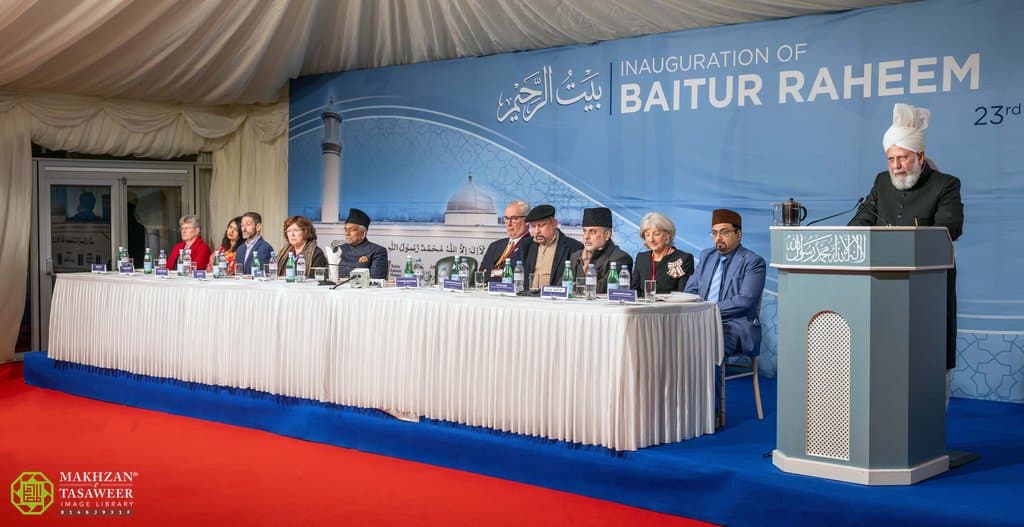
On Sunday, 23 November 2025, the Ahmadiyya Muslim Jamaat in the United Kingdom witnessed a historic milestone as Hazrat Mirza Masroor Ahmad, Khalifatul Masih Vaa, inaugurated the Baitur Raheem Mosque in Cardiff. This marks the first purpose-built mosque of the Jamaat in Wales.
Just before 17:00 GMT, Huzooraa arrived at the site. Upon arrival, he unveiled the commemorative plaque, planted a commemorative sapling in the mosque grounds and led a silent prayer to mark the inauguration. Shortly after, Huzooraa led the Maghrib and Isha prayers in the new mosque. Huzooraa also graciously met with various dignitaries, followed by various group photographs with Jamaat members.
The inauguration reception
The formal reception to celebrate the opening began shortly after 18:00 in a marquee erected on the mosque premises.
The proceedings commenced with the recitation of verses 128-130 of Surah al-Baqarah from the Holy Quran, followed by its English translation.
The Regional Amir of the Ahmadiyya Muslim Jamaat gave a welcome address, expressing gratitude to Huzooraa for gracing the occasion. This was followed by brief remarks from several guest dignitaries who congratulated the Jamaat on this achievement.
The speakers included the High Sheriff Janet Davies and the High Sheriff of Gwent, Lieutenant Colonel Ralph Griffin. A video message was played from the Rt Hon Jo Stevens MP, Secretary of State for Wales, who sent her felicitations. Jane Elizabeth Hutt CBE, Cabinet Secretary for Social Justice (Wales), also addressed the gathering, acknowledging the Jamaat’s contributions to society.
Keynote address by Hazrat Khalifatul Masih Vaa
Just before 18:30, Hazrat Amirul Momineenaa took to the podium to deliver the keynote address. After reciting tashahhud, ta‘awwudh and bismillah, Huzooraa conveyed his salaam to all attendees.
Huzooraa began by thanking the guests for accepting the invitation, stating that their attendance at a “purely religious and spiritual event” demonstrated their “open hearts and generosity of spirit.”
The purpose of a mosque
Huzooraa explained that the primary purpose of this mosque, like all true mosques, was to serve as a sacred place for the worship of Allah. However, he emphasised that a mosque also stands as a testament to the Jamaat’s commitment to its neighbours and the local community.
“Indeed, the abiding message that echoes aloud from all our mosques is that where they serve as a place to worship Allah, they also serve to foster peace, compassion and harmony throughout the world,” Huzooraa stated.
Addressing potential misconceptions about Islam, Huzooraa reassured the local community that our mosques always stand as “shining beacons of peace, love, and harmony.” He referenced an incident from the life of the Holy Prophetsa where a mosque built with malicious intent to create disorder (known as Masjid Dirar) was ordered to be demolished by Allah the Almighty. Huzooraa explained that a physical structure only fulfils the purpose of a mosque when used to manifest Islam’s true teachings of kindness and to spread peace.
Rights of mankind and true worship
Huzooraa affirmed that the Ahmadiyya Muslim Community has always stood at the forefront of striving for peace, upholding the rights of all people regardless of faith. He explained that this conduct is not a deviation from Islam but adherence to it.
Quoting chapter 107 of the Holy Quran, Huzooraa highlighted that Allah rejects the prayers of those who disregard the rights of the vulnerable, such as orphans and those mired in poverty. He stated, “Allah the Almighty explicitly states that prayers and worship shall only be of value and accepted when aligned with service to humanity.”
Referring to chapter 90, verse 11, Huzooraa noted that Allah has pointed out the “two highways of good and evil”, granting humans the moral compass to discern right from wrong. “However, if a person ignores their internal compass and follows selfish and worldly desires, they are bound to deviate from the right path and embrace evil and wrongdoing,” Huzooraa explained.
Ending slavery and exploitation
Huzooraa elaborated on verse 14 of chapter 90, which categorises freeing an enslaved person as a high form of worship. He noted that while the Holy Prophetsa liberated slaves and ended physical slavery as “Islam came to end all forms of slavery in the world”, a form of “economic servitude” persists today.
“Less developed nations are trapped by crippling debt,” Huzooraa observed, noting that vulnerable nations are often dictated to by wealthier ones. He stated that Islam condemns such exploitation, as inequalities and injustices inevitably shatter the foundations of global peace.
Helping the vulnerable
Continuing with the themes of chapter 90, Huzooraa spoke on the virtue of feeding the hungry and supporting the impoverished. He drew specific attention to the Quranic instruction to help “a poor man lying in the dust.”
Huzooraa explained, “These words are deeply significant, meaning Muslims are obligated to help those who are utterly crestfallen, who have no one else to aid them and who have been forgotten by society. While some people have family and friends to support them, Muslims are instructed to identify and to help those who have no one else. In economic terms, it means that if an individual has hit rock bottom and has no one to help them, a Muslim must endeavour to assist them and help them get back on their feet.”
He invited all people to join the Community in this mission of establishing peace and goodwill, stating, “Imagine the impact if all the nations of the world, including every Muslim country, acted upon this unifying and magnanimous principle. Surely, it would be the means of tearing down the walls of crippling inequality, injustice, and ignorance that plague the world. And in their place, we would witness the majestic sight of rising tides of love, compassion, and understanding sweeping across society; true contentment, peace, and security would prevail.”
A comprehensive code of moral values
Huzooraa then quoted chapter 4, verse 37 of the Holy Quran, describing it as a comprehensive code of moral duties. This verse commands Muslims to worship Allah alone while simultaneously showing kindness to parents, kindred, orphans, the needy, neighbours, travel companions and subordinates.
Huzooraa said, “In terms of human rights, the verse firstly calls on Muslims to treat their parents with tenderness and affection. Neglecting one’s parents weakens the family unit whilst increasing the strain on the wider community. So, Allah says that caring for others should start from one’s home. Then, Allah says, Muslims must care for their relatives and friends and fulfil their rights.”
Huzooraa emphasised that the Quran requires Muslims to show kindness even to “the neighbour that is a stranger”, which includes those living further afield as well as work colleagues.
Regarding travel companions, he noted that on public transport, Muslims must show courtesy and protection to fellow passengers.
Huzooraa said, “Muslims must care for their subordinates, or those under their duty of care. Those in a position of power should never wield their authority harshly or needlessly, as Allah dislikes arrogance or pride.”
Loyalty and obedience
Huzooraa reiterated that the Holy Quran instructs Muslims to respect leaders and uphold the laws of the land, making loyalty to one’s country an intrinsic element of faith.
“Consequently, those who possess even a basic attachment to Islam understand that pleasing God and fulfilling a mosque’s objectives are inseparable from adopting the highest moral values and serving humanity,” he said.
Practising what is preached
Huzooraa clarified that the Community does not merely make claims to impress others but is determined to act on its teachings. He highlighted the Community’s humanitarian efforts, including hospitals, schools and water projects in the developing world that serve people irrespective of religion.
Speaking on the value of water, Huzooraa noted that in the West, it is difficult to appreciate the struggle of children in deprived countries who walk miles daily to fetch clean drinking water. He explained that the Community sends engineers to provide water at people’s doorsteps to break the cycle of poverty.
Huzooraa said, “In terms of education, we have established hundreds of schools across the developing nations that provide primary and secondary education without any distinction. It matters not whether the students in our classrooms are Christians, Jews, Muslims, atheists, or followers of any other belief. Every child is of immeasurable worth and value, and so, with the grace of Allah, the Ahmadiyya Muslim Community is constantly engaged in serving humanity, and this includes supporting local charities and community projects across the United Kingdom. Our sole aspiration and motivation is to alleviate suffering and to enable people to live their lives with dignity.”
Conclusion
Concluding his address, Huzooraa reminded the local Ahmadi Muslims of their responsibilities:
“I also wish to remind all Ahmadi Muslims living in this area that they must strive to live according to the inclusive and noble teachings of Islam that I have outlined today. While it is their duty to worship Allah in this mosque and pray for peace, it is equally their obligation to strive towards achieving it and to be ready to make sacrifices for the greater good of mankind. They must consider how they can play a practical role in bringing peace to the world.”
Huzooraa prayed, “Now that this mosque is open, it is my heartfelt prayer that those who enter it will fulfil not only the requirements of worshipping Allah but also all needs of humanity.”
The event concluded with a silent prayer led by Huzooraa, followed by dinner.
About Baitur Raheem Mosque
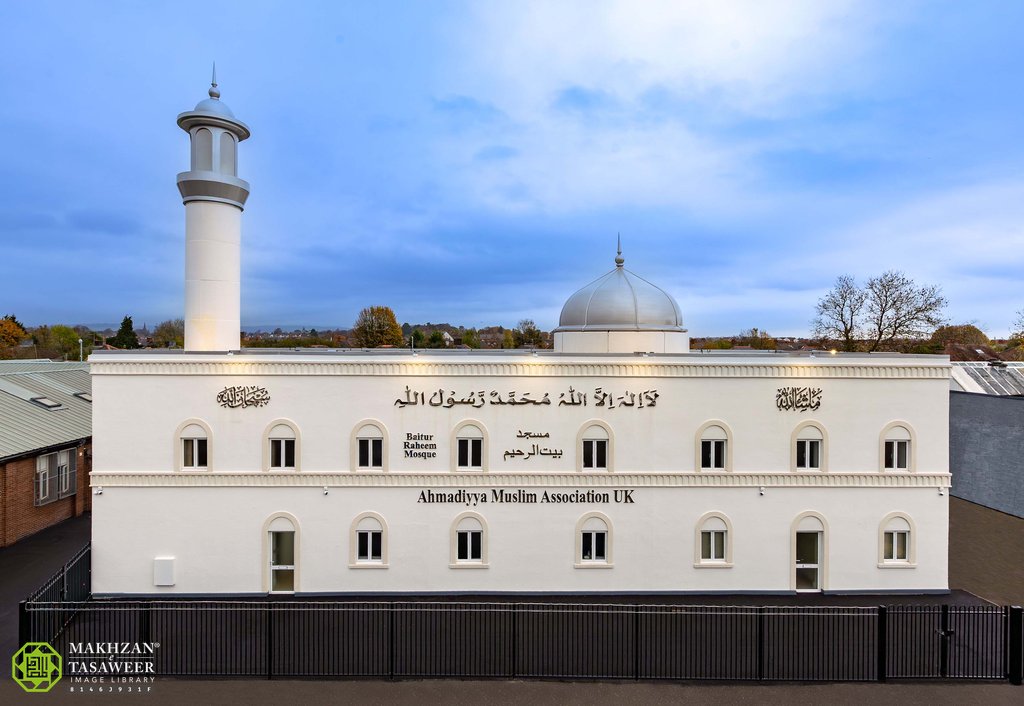
The inauguration of the Baitur Raheem Mosque (House of the Merciful) represents the culmination of a long journey for the Ahmadiyya Muslim Jamaat in Wales. The history of the Jamaat in this region dates back to the early 20th century, with early converts such as Mrs Mabel Emma Ali (Safia) accepting Ahmadiyyat in Cardiff in 1920.
The specific need for a mosque in Wales was formally raised in 2011 by the Cardiff chapter of Majlis Ansarullah. Following approval from Hazrat Khalifatul Masih Vaa, the project was assigned to Majlis Ansarullah UK. After an extensive search, an office building in the Canton area of Cardiff was purchased in 2015. Canton is an inner-city district and community in the west of Cardiff, the capital of Wales, lying just 2 miles west of the city’s civic centre.
The project faced significant hurdles, with planning permission initially rejected twice by the local council due to opposition. However, following a successful appeal process and negotiations, full planning approval was granted in 2018. Huzooraa graciously named the mosque “Baitur Raheem.”
The foundation stone was laid on 9 September 2023 by Rafiq Ahmed Hayat Sahib, Amir Jamaat-e-Ahmadiyya UK, using a brick prayed upon by Hazrat Amirul Momineenaa. Construction formally commenced in 2024 and was completed in 2025. The project was funded entirely by the sacrifices of the members of Majlis Ansarullah UK. This marks the second mosque being built by Majlis Ansarullah UK, with the first being erected in Hartlepool in 2005.
The two-storey complex, built on a 1,200-square-metre site, comprises two halls, including a main prayer hall of 170 square metres with a capacity of 270 worshippers.
(Report prepared by Al Hakam)