

Honey is widely recognised and valued across the globe. It is also very important to Muslims, as it is mentioned in the Holy Quran as a cure and also as a reward in paradise. Allah the Almighty states:
“A description of the Garden promised to the righteous: therein are rivers of water which corrupts not; and rivers of milk of which the taste changes not; and rivers of wine, a delight to those who drink, and rivers of clarified honey.” (Surah Muhammad, Ch.47: V.17)
Honey is also mentioned as a cure in the following verse:
“‘Then eat of every [kind of] fruit, and follow the ways of thy Lord [that have been] made easy [for thee].’ There comes forth from their bellies a drink of varying hues. Therein is cure for men. Surely, in that is a Sign for a people who reflect.” (Surah an-Nahl, Ch.16: V.70)
It is important to understand how honey can benefit patients and how it can potentially serve as a cure for several medical diseases. The scope of this article will be mainly focused on Manuka honey due to its medicinal advantages, such as anti-bacterial and anti-viral effects. It is also important to outline how to use Manuka honey for the best results.
Origins of Manuka honey
Manuka honey originates mostly from New Zealand and Australia. The nectar used in this honey comes from the flowers of the Manuka tree (Leptospermum scoparium). The Maori people of New Zealand were among the first to use the Manuka tree for its medicinal benefits, brewing its leaves into tea and creating ointments to treat various ailments.
In the 19th century, Europeans introduced bees to the locals and they began producing honey from the nectar of the Manuka tree flowers. Manuka honey is a thick, dark and monofloral honey with an exceptional taste. Interestingly, honey with a darker colour tends to have a higher antioxidant content.
In the late 1980s, Dr Peter Molan, a New Zealand biochemist, scientifically confirmed Manuka honey’s powerful antibacterial and medicinal benefits, solidifying its reputation as a potential natural remedy with widespread health applications.
Science behind Manuka honey and its applications
Research shows that Manuka honey contains MGO (methylglyoxal), which is a special chemical compound known to be highly reactive. It is mainly formed during the metabolism of sugars in Manuka honey and interacts with several proteins and amino acids. These chemical reactions due to MGOs can damage bacteria, viruses and inhibit their growth and destroy their cellular structures (which they need to multiply). There are different kinds of MGOs present in Manuka honey.1 The higher the MGO, the higher the potency of the Manuka honey.2
They can be divided into different categories and different uses for each health condition. The classification can vary, depending on the country. In this article, we will use the Manuka honey guide strength chart from BIOSOTA as a guideline.3 The main focus will remain on the MGO classification (instead of NPA/ULF).
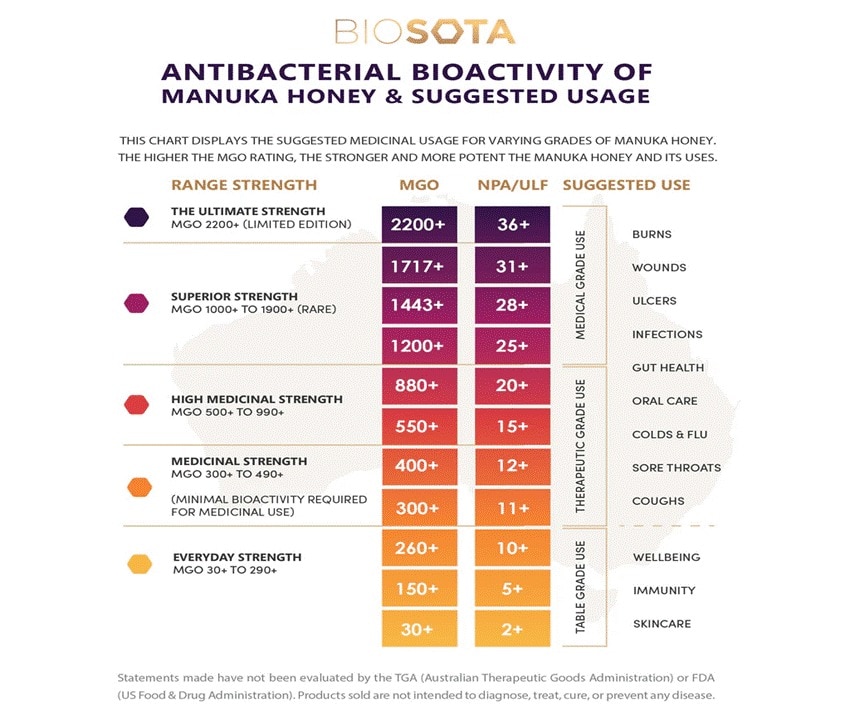
The above chart advises the suggested use of the responding MGO for the following – which we will discuss with research and scientific articles.
Skin health, immune health, cancer and flu
Manuka honey (everyday strength) can be considered for daily strength, such as skincare and immunity.
In a review, honey in general shows promise in multiple dermatologic contexts (wounds, burns, tinea, seborrhea, dandruff, psoriasis) largely due to antimicrobial activity (via e.g., hydrogen peroxide release, phenolic compounds, methylglyoxal) and anti-inflammatory effects.4
Another study found that in a skincare product containing Manuka honey and royal jelly, there were significant improvements in fine lines, wrinkles, hyperpigmentation, dryness and overall skin health over eight weeks.5
In general, honey can also have a positive effect on immunity. A review published in 2021, describes how honey in general has modulatory effects on immune cells, via anti-oxidant, anti-inflammatory and possibly direct immune cell activation pathways.6 Honey has been shown to suppress cancer cell growth by promoting apoptosis (cell death) and exhibiting anti-proliferative (anti-growth) and anti-metastatic (anti-spreading) effects.
If we focus deeper on Manuka honey, a study in 2022 showed that in mice (in-vitro), administration of manuka honey induced changes in immune cell populations (e.g., increased neutrophils (white blood cells) indicating modulation of innate immune responses.7
In another study, Manuka honey shows promising antitumor effects in preclinical breast cancer models in these mice (in-vitro), meaning supporting the immune system in the fight against cancer cells.8
This basic medicinal strength dosage, MGO 300+ to 990+, can help fight bacterial and viral infections, which are responsible for flu and cold symptoms.9
Respiratory health
Recent studies have explored its potential role in managing respiratory tract infections, including chronic bacterial and acute viral infections. In a randomised controlled trials on chronic rhinosinusitis have shown that Manuka honey nasal irrigations can reduce bacterial colonisation and improve sinonasal symptoms compared with saline or standard treatments. These findings indicate that topical Manuka formulations may serve as safe, feasible adjunctive therapies for persistent upper-airway bacterial infection.10,11
Laboratory investigations provide stronger mechanistic support. In vitro and ex vivo lung models demonstrated that Manuka honey disrupted Pseudomonas aeruginosa biofilms and enhanced the antibacterial efficacy of conventional antibiotics. Additional studies confirmed activity against Staphylococcus aureus and P aeruginosa biofilms relevant to chronic airway disease.12 Histologic evaluations further suggest that Manuka honey is well-tolerated by respiratory mucosa at therapeutic concentrations.13
Regarding viral infections, in vitro research reported inhibition of influenza A and B virus replication by Manuka honey, improving host-cell survival and reducing viral yield.14 Reviews of honey’s bioactive compounds also emphasise Manuka’s superior antiviral and immunomodulatory properties, likely due to its phenolic content and MGO-mediated oxidative stress modulation.15
Collectively, these findings indicate that Manuka honey exhibits potent antibacterial, antibiofilm, and antiviral activities that could aid respiratory health, particularly as an adjunctive therapy to antibiotics or anti-inflammatory agents.
Oral care and digestive health
The high medicinal strength MGO 500+ to 900+ can be used in oral care and digestive health.
A study published in the Swiss Dental Journal demonstrated that Manuka honey exhibits potent antibacterial activity against key oral pathogens (including Streptococcus mutans, Porphyromonas gingivalis and Aggregatibacter actinomycetemcomitans).These microorganisms are commonly associated with dental plaque and gingivitis. The authors concluded that the regular use of Manuka honey may contribute to improved periodontal health through inhibition of these pathogenic bacteria.16
Recent research suggests that Manuka honey may also benefit the gastrointestinal tract through multiple mechanisms, including inhibition of pathogenic bacteria, protection of gastric mucosa, modulation of inflammatory responses and maintenance of a balanced gut microbiota.
The gram-negative bacterium Helicobacter pylori is implicated in the development of gastritis, peptic ulcer disease and gastric carcinoma (stomach cancer). Early in vitro studies demonstrated that Manuka honey inhibited the growth of H pylori strains isolated from gastric biopsies, showing minimal inhibitory concentrations comparable to standard antibiotics.17
Experimental models support a protective role of Manuka honey against gastric mucosal injury. In an in vitro study, it demonstrated that rats pretreated with Manuka honey exhibited significantly fewer gastric lesions following ethanol or indomethacin exposure.18
A balanced gut microbiota plays a pivotal role in digestion and intestinal barrier integrity. One study about microbiota demonstrated that Manuka honey derived oligosaccharides selectively stimulated Bifidobacterium longum and Lactobacillus acidophilus in vitro, indicating a potential prebiotic effect that supports gut microbiota balance and assist digestive health.19 These polyphenol-rich honeys, including Manuka, enhanced short-chain fatty acid production, thereby improving colonic health and epithelial energy supply.20
The anti-inflammatory potential of Manuka honey has been investigated in experimental models of inflammatory bowel disease (IBD). Preclinical studies have demonstrated the therapeutic potential of Manuka honey in inflammatory bowel disease models.
In a study, it was reported that oral administration of Manuka honey markedly reduced colonic inflammation, suppressed pro-inflammatory cytokine expression and improved histopathological features in a rat model of ulcerative colitis.21
Similarly, another study found that Manuka honey enhanced antioxidant enzyme activity and restored colonic mucosal architecture in acetic acid-induced colitis, indicating its role in mitigating oxidative stress and promoting tissue healing.22
Wound management
The last and third group is the MGO 1000+ and above and can also contribute to its efficacy in wound management and control. In a recent study conducted in 2021, the study reviewed the use of medical‐grade Manuka honey as a wound-dressing material in chronic non-healing discharging wounds. Manuka honey dressings of high MGO significantly improved healing rates, reduced infection signs and were well tolerated by patients.23
Recommended advice practical of general practitioner methods of usage
At present, there are no standardised clinical guidelines for the therapeutic use of Manuka honey in digestive or respiratory health management. Here is some recommended advice for practical use.
For digestive health, Manuka honey is commonly consumed on an empty stomach, as this is believed to enhance its absorption and bioactivity. A practical method involves dissolving approximately one teaspoon (5 ml) of Manuka honey in a glass of lukewarm (not hot) water and consuming it before breakfast. Following ingestion, it is recommended to avoid additional food or fluid intake for at least 30 minutes to minimise potential interactions with the honey’s active components in the gastrointestinal tract.
For respiratory tract health, Manuka honey may be administered orally either in its natural form or as part of commercial lozenges or syrups. These preparations are used to soothe throat irritation, reduce cough frequency and potentially support immune function.
Conclusion
It is important to note that there are many studies (systematic reviews and meta-analyses) about Manuka honey and its medical benefits but mostly in pre-clinical stadium. Further and larger clinical trials with humans are needed to determine the precise medicinal qualities of this precious Manuka honey.
While most current evidence arises from in vitro or animal studies, Manuka honey’s therapeutic potential in digestive and respiratory health appears promising. Its multifaceted effects such as antibacterial, antioxidant, anti-inflammatory and prebiotic address several underlying mechanisms of gastrointestinal disease.
Manuka honey is generally safe for adult oral consumption, though excessive intake may contribute to hyperglycemia in diabetic individuals. It should not be administered to infants under 12 months due to the risk of botulism.
It is important to consult a health care professional to ensure your safety and appropriateness for your specific condition. When selecting or buying Manuka honey, always ensure it is certified, indicating its potency and authenticity.
References
1. “Antibacterial activity of Manuka honey and its components: An overview”, Frontiers in Microbiology, pmc.ncbi.nlm.nih.gov, Article 2603, 27 November 2018
2. “Methylglyoxal in Manuka honey – Correlation with antibacterial properties”, Czech Journal of Food Sciences, doi.org, Vol. 27 (Special Issue), pp. S163-S165, 2009
3. “Manuka honey guide and strength chart”, Biosota Organics, biosota.com.au, 2024
4. “Honey in dermatology and skin care: A review”, Journal of Cosmetic Dermatology, doi.org, Vol. 12, No. 4, pp. 306-313, 4 December 2013
5. “Investigating the effects of a Manuka honey, royal jelly, and bee venom-derived face serum on skin health and signs of aging”, Cureus, doi.org, Vol. 16, No. 8, e81244, 26 March 2025
6. “The immunomodulatory effects of honey and associated flavonoids in cancer”, Nutrients, doi.org, Vol. 13, No. 4, 1269, 13 April 2021
7. “Characterization of immunomodulatory responses induced by manuka honey”, Frontiers in Immunology, pmc.ncbi.nlm.nih.gov, Vol. 13, Article 1020574, 2 November 2022
8. “Manuka honey inhibits human breast cancer progression in preclinical models”, Nutrients, doi.org, Vol. 16, No. 14, 2369, 22 July 2024
9. “Anti‑influenza viral effects of honey in vitro: potent high activity of manuka honey”, Archives of Medical Research, pubmed.ncbi.nlm.nih.gov, Vol. 45, No. 5, pp. 359-365, 29 May 2014
10. “Safety and efficacy of Manuka honey sinus irrigation in chronic rhinosinusitis: A randomized controlled trial”, International Forum of Allergy & Rhinology, doi.org, Vol. 7, No. 11, pp. 1112-1120, 1 September 2017
11. “Manuka honey irrigations in recalcitrant chronic rhinosinusitis: Phase 1 trial results”, International Forum of Allergy & Rhinology, doi.org, Vol. 9, No. 6, pp. 629-637, 23 April 2019
12. “Manuka honey inhibits biofilms of Pseudomonas aeruginosa and Staphylococcus aureus”, Otolaryngology-Head and Neck Surgery, doi.org, Vol. 141, No. 2, pp. 253-258, 1 August 2009
13. “Histological effects of Manuka honey on respiratory mucosa”, Australian Journal of Otolaryngology, doi.org, Vol. 13, pp. 21-27, 12 March 2012
14. “Anti-influenza viral effects of Manuka honey in vitro”, Archives of Medical Research, pubmed.ncbi.nlm.nih.gov, Vol. 45, No. 7, pp. 359-365, 29 May 2014
15. “Antiviral and immunomodulatory effects of phytochemicals from honey against COVID‑19: potential mechanisms of action and future directions”, Molecules, pmc.ncbi.nlm.nih.gov, Vol. 25, No. 21, 5017, 29 October 2020
16. “Antibacterial potential of Manuka honey against three oral bacteria in vitro”, Swiss Dental Journal, pubmed.ncbi.nlm.nih.gov, Vol. 124, No. 9, pp. 922-927, 13 October 2014
17. “Susceptibility of Helicobacter pylori to the antibacterial activity of Manuka honey”, Journal of the Royal Society of Medicine, pubmed.ncbi.nlm.nih.gov, Vol. 87, No. 1, pp. 9-12, December 1993
18. “Manuka honey exerts antioxidant and anti-inflammatory activities that promote healing of acetic acid-induced gastric ulcer in rats”, Evidence-Based Complementary and Alternative Medicine, pubmed.ncbi.nlm.nih.gov, 2017, Article 5413917, 28 May 2017
19. “Oligosaccharides from Manuka honey promote the growth of beneficial gut bacteria”, Food Chemistry, doi.org, Vol. 173, pp. 480-486, 15 April 2015
20. “Honey polyphenols and gut health: Modulation of microbiota and metabolic outcomes”, Nutrients, doi.org, Vol. 13, No. 5, 1638, 13 May 2021
21. “Manuka honey exerts protective effects against experimentally induced colitis in rats”, BMC Complementary and Alternative Medicine, pubmed.ncbi.nlm.nih.gov, Vol. 17, No. 1, p. 399, 13 September 2017
22. “Effect of different doses of Manuka honey in experimentally induced inflammatory bowel disease in rats”, Phytotherapy Research, pubmed.ncbi.nlm.nih.gov, Vol. 22, No. 11, pp. 1511-1519, 7 August 2008
23. “Manuka honey: A promising wound-dressing material for chronic non-healing discharging wounds – A retrospective study”, National Journal of Maxillofacial Surgery, pubmed.ncbi.nlm.nih.gov, Vol. 12, No. 2, pp. 233-237, 15 October 2021