
Home Blog Page 609

Act upon my counsel

0
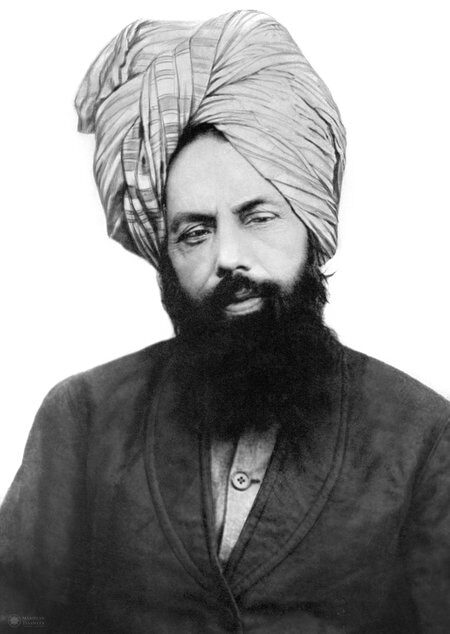
rsz_hazrat_mirza_ghulam_ahmad_qadiani_as.jpg

I have given you this advice because you, who hold a relationship with me, have become my limbs. Act upon my words and make use of reason and the Word of Allah so that the light of true insight and certainty develops within you, and so that you may become a path that leads others from darkness into light. For in this era, various allegations are raised on the basis of natural science, medicine and astronomy; it is necessary, therefore, to acquire a knowledge of the scope and background of these sciences so that we are able to understand such allegations before responding.

(Hazrat Mirza Ghulam Ahmadas, Malfuzat, Vol. 1, p 66)

Those who are not merciful to mankind

0

Hazrat Jarir bin Abdullah, Allah be pleased with him, narrates that the Holy Prophet, peace and blessings of Allah be upon him, said:

“Allah will not be merciful to those who are not merciful to mankind.”

(Sunan al-Bukhari, Kitab alTawheed)

32nd Majlis Khuddam-ul- Ahmadiyya Canada Ijtema

0

S Mukarram Nazeer, Canada Correspondent

1111

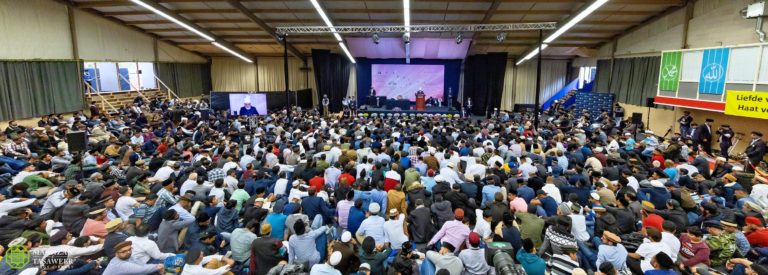
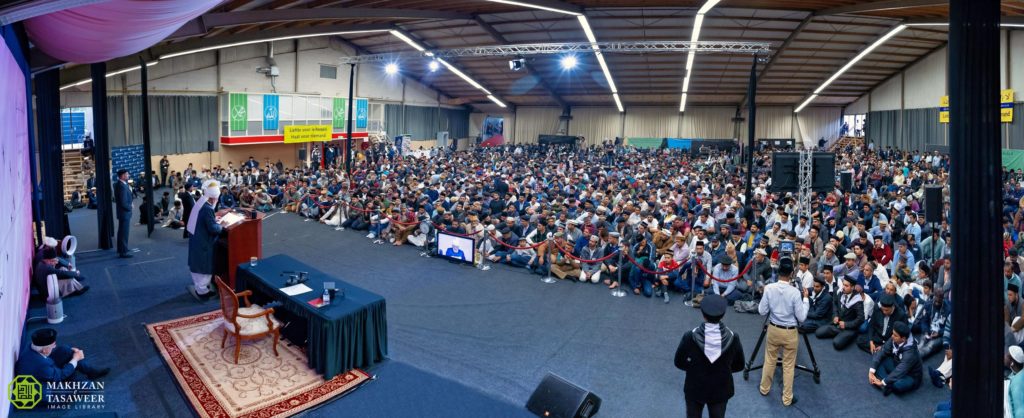
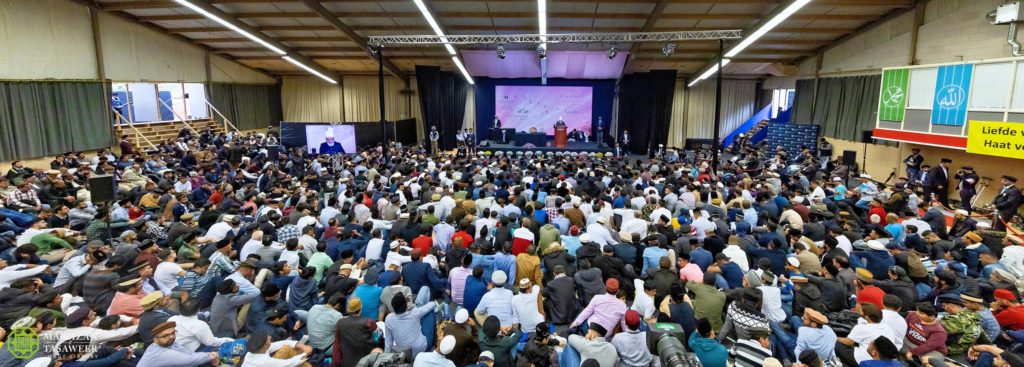
The 32nd Annual Majlis Khuddam-ul Ahmadiyya Canada Ijtema was held on 26, 27 and 28 July at Hadiqa-e-Ahmad, Bradford, Ontario where hundreds of Khuddam from all over Canada participated.

Official registration began at the Ijtema site at 10am, with Khuddam arriving to participate in a weekend of spiritual transformation.

Lunch was served at mid-day. After lunch, they had the opportunity to listen to the Friday Sermon of Hazrat Khalifatul Masih Vaa. It was a hot day by Canadian standards. Thermometers showed 30 degrees Celsius, while the humidity made it feel like 35 degrees. 

The Khuddam-ul-Ahmadiyya flag was raised by Markaz Representative, Additional Nazir Islah-o-Irshad & Dawat Ilallah, and Mufti-e-Silsila, Mubashar Ahmad Kahlon Sahib, accompanied by Amir Jamaate-Ahmadiyya Canada, Lal Khan Malik Sahib.

The Canadian flag was raised by Sadr Majlis Khuddam-ul-Ahmadiyya Canada, Zubair Afzal Sahib.

The first azan for Friday prayers followed flag hoisting.

Amir Jamaat Canada, Lal Khan Malik Sahib delivered the Friday Sermon. He shared the summary of the sermon delivered by Hazrat Khalifatul Masih Vaa earlier in the day. He advised Khuddam on how to get maximum benefit from the Ijtema. 

After prayers, the audience prepared for the opening session. The opening session started with the recitation of the Holy Quran followed by nazm. 

Mubashar Ahmad Kahlon Sahib delivered an inspiring speech on the topic of obedience, which was followed by silent prayer. After the opening session, there were three options for Khuddam to choose from: the first, academic competitions with tilawat, azan and book-reading quiz; the second offered individual and team sports, along with various races, while the third offered workshops on a variety of topics, including virtual reality tour of Mecca and tackling mental health issues.

Multiple recreational activities were also arranged for Khuddam throughout the Ijtema. These included archery, arm wrestling, pull up challenge, ring toss and a limbo challenge. 

For more relaxed individuals, the Patio area provided a lounge, carrum board, PlayStation 4, fussbal and a table tennis setup. 

Various exhibitions and food stalls were set up and gave the Ijtema a fun-filled atmosphere. All those present came together for dinner and prepared for the Maghrib and Isha prayers afterwards. Some spent the evening at the very entertaining and challenging impromptu speeches, while others opted for a game called Kahoot!  

The Patio was open for all to enjoy a barbecue hosted by various participating regions. Similarly, Khuddam enjoyed food stalls, indoor games and exhibitions. The second day commenced with Tahajud and Fajr prayers. This was the longest day of Ijtema, with temperatures forecast to 33 Celsius, with a real-feel of 38 Celsius with humidity. 

Round 1 of Canada’s Smartest Khadim challenged the brainiest Khuddam to test their intellectual skills against one another in the early hours of the new day. Educational events included speeches in English and French languages, Ahmadiyya Muslim Students Association Inter University Quiz and a message relay competition. 

Individual and team sports, along with races, filled up the sports events. Various physical activities from the first day continued, along with some new ones such as canoeing, punching power, bubble soccer, sumo suit fight, and hot air balloon rides.

Lunch was followed by congregational Zuhr and Asr prayers.

Sadr Majlis Khuddam-ul-Ahmadiyya Canada, Zubair Afzal Sahib delivered an inspiring address on the topic of “Identity of an Ahmadi Khadim in the Western Society” at the start of the Second Session of the Ijtema.   

Following this was a very interesting question and answer session with Mubashar Ahmad Kahlon Sahib. 

He was accompanied by Amir Jamaat Canada and Sadr Majlis Khuddam-ul-Ahmadiyya Canada. The questions and answers were very informative and the audience really enjoyed the knowledge and guidance shared by the panel. Questions covered a myriad of topics, including common issues faced by our youth on talim, tarbiyat, tabligh etc.

A special sitting for Arabs, new-converts and Khuddam from families of martyrs was held with Mubashar Kahlon Sahib.

Educational competitions offered Urdu speech, bait bazi and Friday Sermon quiz.

In sports, individual and team matches, along with a 4-way tug of war tournament were available to participate.  

An interesting workshop called How to Start a Business was of interest to entrepreneurial-minded Khuddam.

A bonfire was setup where any Khadim could come and share his talent, while others could enjoy the gathering. Some continued their recreational activities in the Patio area where they also enjoyed corn on the cob, tea and stargazing. They also had the option of attending a session called Ask a Murabbi Questions, or they could write to Huzoor-e-Anwaraa.

Lights went out at 10:30pm for all to recover for the next day.

Sunday was the last day of the Ijtema and Khuddam prepared for Tahajud and Fajr prayers. After Dars-ul-Quran, some went to participate in the memory and observation test. All came together for the final breakfast service of the annual Ijtema. 

Afterwards, many went to the nazm and hifz-ul-Quran competition, as well as the final round of Canada’s Smartest Khadim contest. At the same time, some chose to relax and spend time with other Khuddam from all over the country. The finals for team sports were held along with 100m, 400m and relay race competitions. 

Many enjoyed recreational events at the Patio while others participated in the final workshop event on physical fitness and health. Sunday was the hottest day of the Ijtema, with temperatures feeling like 36 degrees Celsius (with humidity).

Khuddam came together for the closing session of the Ijtema. Everyone enjoyed the prize distribution ceremony, before Mubashar Kahlon Sahib delivered the final address of the National Ijtema. 

The Khuddam-ul-Ahmadiyya pledge by Sadr Majlis Khuddam-ul-Ahmadiyya Canada, Zubair Afzal Sahib brought the Ijtema to an end. 

Zuhr and Asr prayers were followed by lunch service.  

By the grace of Allah, the total attendance was 2,352 from across Canada, an increase of 124 (6%) from last year, and 282 guests also attended.

Men of Excellence

0

Friday Sermon

26 July 2019

Men of Excellence

Screenshot 2019 07 02 at 23.39.12

After reciting the Tashahud, Ta‘awuz, and Surah al-Fatihah, Hazrat Khalifatul Masih Vaa stated: 

Today, I shall continue to relate accounts of the Badri companions’ lives [those companions who took part in the Battle of Badr].

The first companion to be mentioned is Hazrat Muzahirra bin Rafay. The name of Hazrat Muzahir’s father was Rafay bin Adi. Hazrat Muzahirra belonged to the Banu Harithah bin Harith clan of the Aus tribe of the Ansar. Hazrat Muzahirra and Hazrat Zuhairra were brothers and both of them were paternal uncles of Hazrat Rafayra bin Khudaij. (Al-Sirat al-Nabawiyyah li Ibn Hisham, p. 324 footnote, Dar-ul-Kutub al-Ilmiyyah, Beirut, 2001)

Hazrat Rafayra bin Khudaij is being mentioned because, although he was not a Badricompanion, but nevertheless, he holds great importance in history. Hazrat Muzahirra was his uncle, and so Rafay was his nephew’s name as well as his father’s.

I shall briefly mention about Hazrat Rafayra that he was the companion who presented himself for participation in the Battle of Badr, but the Holy Prophetsa sent him back due to his young age. He later permitted him to participate in the Battle of Uhud. Hazrat Rafayra participated in the battles of Uhud, the Ditch and the rest of the battles. His collarbone was struck by an arrow on the day of Uhud and although the arrow was removed but a piece of the arrowhead remained in his body until his demise.

The Holy Prophetsa once said to Hazrat Rafayra, “I will bear witness in your favour on the Day of Judgment.” Hazrat Rafayra passed away during the reign of Abdul Malik bin Marwan in 74 AH at the age of 86.

(Usdul Ghaba Fi Marifat Al-Sahaba Li Ibn Athir, Vol. 2, p. 232-233, Rafay bin Khudaijra, Dar-ul-Kutub al-Ilmiyyah, Beirut, 2008)

In any case, these were some details in reference to his nephew. However, I will now continue to relate the account of Hazrat Zuhairra.

Imam Bukharirh has mentioned that Hazrat Zuhairra participated in the Battle of Badr along with his brother. He has not recorded the name of that brother, however, the commentators of Bukhari have written that the brother’s name was Muzahir. Similarly, regarding Hazrat Zuhairra bin Rafay, it is written in Subul al-Huda War-Rashaad, a book on the biography of the Holy Prophetsa, that according to Bukhari, his brother, Hazrat Muzahirra, also participated in the Battle of Badr.

Earlier, I stated the name of Hazrat Zuhairra, however I am relating the account of Hazrat Muzahirra.

In the books on the biographies of the companions, such as Usdul Ghaba, al-Isabah and al-Isti‘ab etc. there is no mention of Hazrat Muzahir’s participation in the Battle of Badr. With regard to Hazrat Muzahirra, it is written in these three books that Hazrat Muzahirra participated in the Battle of Uhad and in all the subsequent battles alongside the Holy Prophetsa. Hazrat Muzahirra passed away during the Khilafat of Hazrat Umarra.  (Sahih al-Bukhari, Kitabul Maghazi) (Irshad As-Sari Li Sharhi Sahih al-Bukhari, Vol 7, p 195, Darul Fikr, Beirut, 2010) (Subulal Huda War Rashaad, Vol 4, p.106, Ghazwah Badrul Kubra, Dar-ul-Kutub al-Ilmiyyah, Beirut, 1993) (Usdul Ghaba, Vol. 5, p. 185, Muzahir bin Raafi, Dar-ul-Kutub al-Ilmiyyah, Beirut, 2003) (Al-Isaba Fi Tamyeez Al-Sahaba, Vol. 6, p. 106, Muzahir bin Raafi, Dar-ul-Kutub al-Ilmiyyah, Beirut, 1995) (Al-Isti‘ab Fi Ma’rifatil Ashaab, Vol. 4, p. 39, Muzahir bin Raafi, Dar-ul-Jeel, Beirut, 2002)

However, the sources that prove that Hazrat Muzahirra participated in the Battle of Badr are considered more reliable. 

Yahya bin Sahl bin Abu Hathmah narrates that Hazrat Muzahirra bin Rafay Harithi brought some strong workmen along with him from the region of Levant so that they may work on his land. When he arrived at Khaybar, he stayed there for three days. There, the Jews started to instigate those labourers to murder Hazrat Muzahirra and also secretly gave them a few knives. When Hazrat Muzahirra came out of Khaibar and arrived at a place called Sibaar, which is situated six miles away from Khaibar, these men attacked Hazrat Muzahirra, piercing his abdomen as a result of which he was martyred.

Following this, these individuals returned to Khaybar upon which the Jews gave them provisions for their journey as well as food and set them off until they returned and reached Levant again. When Hazrat Umarra bin al-Khattab was informed of this news, he said that he would set out towards Khaybar, distribute the wealth that was found there and clearly mark the boundaries in the land. That is, revenge would be sought. He also declared that he would exile the Jews from there as the Holy Prophetsa had said in relation to them that he would grant them protection until God Almighty had granted them protection. Now, God Almighty had granted permission to exile them. Hence, Hazrat Umarra exiled them.

(Kanzul Ummal, Vol. 4, p. 509, Ikhraajul Yahood, Hadith 11505, Mu’assisah al-Risalah, Beirut) (Al-Isti‘ab, Vol. 4, pp. 39-40, Muzahir bin Raafi, Dar-ul-Kutub al-Ilmiyyah, Beirut, 2002) (Mu‘jamul Buldan, Vol. 2, p. 6, Dar Ihyaa al-Turath al-Arabi, Beirut)

The incident of the martyrdom of Hazrat Muzahirra occurred in 20 AH. (Al Kamil Fi Al Tarikh li Abi Hasan bin Ali, Vol 2, p.410, Dar-ul-Kutub al-Ilmiyyah, Beirut, 2002)

Then, the next companion to be mentioned is Hazrat Malikra bin Qudamah. Hazrat Malikra bin Qudamah’s father was Qudamah bin Arfajah, and according to one narration, the name of his paternal grandfather has been mentioned as Harith. That is, he was referred to as Harith instead of Arfajah. Hazrat Malik belonged to the clan of Banu Ghanam of the Ansar tribe of Aus. Hazrat Malikra participated in the Battle of Badr along with one of his brothers, Hazrat Munzirra bin Qudamah. Hazrat Malikra also participated in the battle of Uhud.

(Al-Sirat al-Nabawiyyah li Ibn Hisham, p. 466, Dar-ul-Kutub al-Ilmiyyah, Beirut, 2001) (Al-Tabaqaat-ul-Kubra li ibn Sa‘d, Vol. 3, p. 367, Dar-ul-Kutub al-Ilmiyyah, Lebanon, 1990)

The next companion to be mentioned is Khuraimra bin Fatik. Hazrat Khuraimra bin Fatik belonged to the Banu Asad. His father’s name was Fatik bin Akhram and his name has also been recorded as Akhram bin Shaddad. Hazrat Khuraim’s title was Abu Yahya, whereas according to another narration, it has been mentioned as Abu Ayman because the name of his son was Hazrat Ayman bin Khuraim. Hazrat Khuraimra bin Fatik participated in the Battle of Badr along with his brother, Hazrat Sabrahra bin Fatik.

(Al-Tabaqaat-ul-Kubra li ibn Sa‘d, Vol. 2, p. 167, Khuraim bin Faatik, Dar-ul-Kutub al-Ilmiyyah, Beirut, 2008)

According to a narration, Hazrat Khuraimra also participated in the Treaty of Hudaybiyyah. A lesser known narration also states that Hazrat Khuraimra and his son, Hazrat Aymanra, accepted Islam following the Conquest of Mecca along with the tribe of Banu Asad. However, the first narration is more authentic in that Hazrat Khuraimra participated in the Battle of Badr. Furthermore, Imam Bukharirh mentioned him as a Badri companion [who participated in the battle of Badr] in his book, Al-Tareekh-ul-Kabeer

Hazrat Khuraimra and his son later went to Kufa and according to one narration, both of them moved to the city of Raqqa, which is a well-known city located to the north of the Euphrates River. Both of them passed away there during the rule of Hazrat Amir Muawiyahra.

(Al-Isaba Fi Tamyeez Al-Sahaba, Vol. 2, p. 236, Khuraim bin Faatik, Dar-ul-Fikr, Beirut, 2001) (Al-Tarikh Al Kabir, Abdullah Muhammad bin Ismael Bukhari, Vol 3, p.196, Dar-ul-Kutub al-Ilmiyyah, Beirut, 1995) (Mu‘jamul Buldan, Vol. 4, pp. 413-414)

Hazrat Khuraimra bin Fatik narrates his incident of accepting Islam in the following manner: “I went in search of my lost camels and while seeking their trail, night had fallen. Eventually, I found them at Abraq-ul-Azaha‘f, which is the name of the famous well belonging to the Banu Asad bin Khazima, which is situated on the way from Medina to Basra. I found the camels there, tied them up at the very same place and took some rest, leaning against the leg of one of the camels.”

In other words, he sat there to spend the night. He further says: “This took place towards the early period of the Holy Prophet’s migration. I said in a loud voice that I seek the protection of the chief of this valley.”

This was their custom at that time. Hazrat Khuraimra says that during the period of ignorance [i.e. prior to the advent of Islam], this was a customary practice of the people. During the period of ignorance, when a person entered a barren valley in order to spend the night, he would utter these words in order to remain protected from the evil of its inhabitants and the foolish people. Nevertheless, he says: “All of a sudden, an individual called me whilst I was uttering these words and he said the following couplets:

‘May God have mercy on you. You should seek the protection of Allah, the Magnificent, Who sends down all that which has been made unlawful and lawful.

Affirm the Oneness of God, and you will have no concerns about the trials from Jinns. Remembrance of Allah Almighty will grant your protection from the Jinns in the surrounding lands and mountains for many miles. Their plots will become unsuccessful, and nothing will remain except for the righteous person and virtuous deeds.’”

This means that only good deeds would continue and no evil would remain.

Hazrat Khuraimra further narrates: “I responded, ‘O you who has proclaimed this! Do you consider this as the truth or are you merely seeking to misguide me?’” (The concept of the unity of God seemed strange to him because beliefs during the days of ignorance were contrary to this. “However, he replied, ‘He is the Messengersa of Allah! He is a bearer of glad-tidings, who brought Yasin and Hameemaat and other detailed chapters [of the Holy Quran] which explain everything. He has clearly distinguished what is forbidden and what is lawful. He commands us to offer prayer and observe fast. He forbids people from committing evil deeds, the evil which was witnessed amongst the people before us.’”

This was the response he gave as regards how they learnt about the message of the unity of God. Hazrat Khuraimra further narrates:

“I replied, ‘May Allah have mercy on you! Who are you?’ He replied, ‘I am Malak bin Malik. The Messengersa of Allah sent me to watch over the Jinn of the people of Najjad, (i.e. the chiefs of the people of Najjad).’” (This was the conversation that took place between the two). Hazrat Khuraimra stated, “If there was someone who would look after my camels for me then I would surely visit this Prophet and indeed accept him.”

He liked what he heard about the message regarding the unity of God. Malak bin Malik replied, “I will take the responsibility of looking after your camels and will ensure they reach your family safely.” Hazrat Khuraimra states:

“I prepared one of my camels and rode it to Medina and entrusted the rest to him. I arrived at the time of Jumuah [Friday Prayers], and everyone was engaged in offering prayers, so I decided it was better to go inside after they had completed their prayer. Since I was also tired, I therefore sat down and also rested my camel. Abu Dharra came outside and informed me that the Holy Prophetsa had instructed me to come inside, and so I went inside.

“When the Messengersa of Allah saw me, he stated, ‘What happened to the elderly man who had guaranteed the safe delivery of your camels to your house? Has he delivered your camels safely to your house.’”

Thus, Allah the Almighty had shown a vision to the Holy Prophetsa and had informed him about the entire incident. Hazrat Khuraimra further states:

“When I heard this, I stated, ‘May Allah have mercy on him.’ The Prophet of Allahsa replied, ‘Indeed, may Allah have mercy on him.’” Hazrat Khuraimra states, “I responded to this by proclaiming, ‘I bear witness that there is none worthy of worship except Allah.’” Thus, this was the beautiful manner in which he accepted Islam.

(Al-Mu‘jam Al-Kabir, Hafiz Abul Qasim bin Ahmad Tibrani, Vol 4, pp.211-213, Hadith No. 4166, Maktaba Ibn Taymiyyah, Cairo) (Al-Sirat al-Nabawiyyah li Ibn Hisham, Vol 1, p. 379, Dar-ul-Ma’rifah, Beirut, 1976) (Mu‘jamul Buldan, Vol. 1, p. 68, Dar Ihyaa al-Turath al-Arabi, Beirut) (Bulugh Al-Rabb, Dr Pir Muhammad Hasan, Vol 3, p. 135, Urdu Science Board, Lahore, 2002)

Hazrat Khuraimra himself has related this account of his acceptance of Islam. Hazrat Khuraimra bin Fatik had a very graceful personality and very meticulous nature. He was always well-dressed and well maintained.

 (Seeratus Sahabah, Vol 7, p. 307, Dar-ul-Ishaat, Karachi)

Prior to accepting Islam, he would wear an extra-long lower garment and kept long hair. There is a hadith recorded about this in Mustadrak Al-Hakim. Hazrat Khuraimra bin Fatik narrates that once the Holy Prophetsa arrived and stated, “O Khuraim! You would have been an excellent person if you did not possess these two traits.” Upon this Hazrat Khuraimra submitted, “O Messengersa of Allah! May my mother and father be sacrificed for your sake. What are those two traits?” The Holy Prophetsa replied, “Your long hair and allowing your lower garment to drag.” This referred to wearing extra-long lower garment, which was considered a sign of arrogance in those days. Hence, Hazrat Khuraimra went and had his hair cut and shortened his lower garment.

(Al-Mustadrak Ala Al-Sahihain, Vol. 6, p. 2363, Kitab Marifatu Al-Sahaba, Hadith No. 6608, Maktabah Nazzaar Mustafah, Mecca, 2000)

There is another narration in Tarikh-ul-Kabir by Hazrat ibn Hanzaliyyah that the Holy Prophetsa said, “How wonderful a man would Khuraim Asadi be if he did not let his hair grow to his shoulders or allow his lower garments to drag on the floor” i.e. not wear the izar or lower part of his clothes so long, out of pride. When Hazrat Khuraimra came to know about this he took a short blade and cut his hair to the height of his ears, rather than keeping the long hair he had. Furthermore, he cut the lower garments up to the middle of his calves. (Al-Tarikh Al Kabir, Abdullah Muhammad bin Ismael Bukhari, Vol 3, p.196, Dar-ul-Kutub al-Ilmiyyah, Beirut, 2001)

This is because wearing a long lower garment was perceived as a sign of arrogance in those days.

Therefore, this is a response for those men who are of the opinion that there is no harm in keeping long hair, without reason or cause.

One should keep the length of their hair to the length which the Holy Prophetsa has stated i.e. to the earlobes; it should not be long like the hair of women. Hazrat Khuraimra also participated in the conquests of Syria in the time of Hazrat Umarra.

(Seeratus Sahabah, Vol 7, p. 307, Dar-ul-Ishaat, Karachi)

Hazrat Qaisra bin Abu Hazim and Hazrat Aamirra Sha‘bi relate that Marwan bin Hakam asked Hazrat Aiman bin Khuraimra, “Why do you not join us in battle?” He replied, “My father and my uncles participated in the Battle of Badr and they strongly admonished me not to fight against anyone who declares that there is no God but Allah.”

Hazrat Aimanra then said to Marwan bin Hakam, “If you have brought me a guarantee of safeguarding against the hell-fire then I shall join you in battle.” Upon this, Marwan told him to leave. So he went forth reciting the couplets, “I shall not fight another [Muslim] simply because he praises another leader from among the Quraish. For him is his rule and for me is my own sin. I seek refuge with Allah from such ignorance and animosity. How can I kill an innocent Muslim? If I had done so then it would be of no avail to me, no matter how long I live.”

(Al-Mustadrak Ala Al-Sahihain, Vol. 3, p. 1004, Kitab Marifatu Al-Sahaba, Zikru Khuraim bin Faatik, Hadith No. 2667, Maktabah Nazzaar Mustafah, Mecca, 2000)

If we look at the actions of the Muslims nowadays, we will see just how far they have drifted away from the true teachings of Islam.

The next Companion I shall mention is Hazrat Ma‘marra bin Harith. Hazrat Ma‘marra bin Harith belongs to the Banu Jumuah tribe of the Quraish. His father was Harith bin Ma‘mar and his mother was Qutailah bint Maz‘un, who was the sister of Hazrat Uthmanra bin Maz‘un. Therefore, Hazrat Usmanra bin Maz‘un was the maternal uncle of Hazrat Ma‘marra. Hazrat Ma‘marra had two brothers – Hatibra and Hattabra. All three of them had accepted Islam prior to the Holy Prophetsa entering Dar-e-Arqam. Hazrat Ma‘marra is counted among

اَلسَّابِقُوْنَ الْاَوَّلُوْنَ

“The foremost among the believers”. (Usdul Ghaba, Vol. 5, p. 226, Dar-ul-Kutub al-Ilmiyyah, Beirut, 2008)

Hazrat Aishara bint Quddamah relates that from among the Banu Maz‘un – Hazrat Usmanra, Hazrat Quddamahra, Hazrat Abdullahra, Hazrat Sa‘ib bin Usman bin Maz‘unra  and Hazrat Ma‘marra bin Harith migrated from Mecca to Medina and stayed at the house of Hazrat Abdullahra bin Salama Ajlani.

(Al-Tabaqaat-ul-Kubra li ibn Sa‘d, Vol. 3, p. 307, Dar-ul-Kutub al-Ilmiyyah, Beirut, 1990) (Al Badaya Wan Nahaya Li Ibne Katheer, Vol 7, p. 139, Dar-ul-Kutub al-Ilmiyyah, Beirut, 2001)

The Holy Prophetsa established a bond of brotherhood between Hazrat Ma‘marra and Hazrat Muazra bin Afraa. Hazrat Ma‘marra bin Harith participated in all the battles alongside the Holy Prophetsa, including the battles of Badr, Uhud and the Ditch and all other battles. Hazrat Ma‘marra bin Harith passed away in 23 AH during the Khilafat of Hazrat Umarra.

The next companion is Zuhairra bin Rafay. He was the brother of the previously mentioned companion, Hazrat Muzahirra. Hazrat Zuhairra belonged to the Banu Haritha bin Harith branch of the Aus tribe of the Ansar.

(Al-Sirat al-Nabawiyyah li Ibn Hisham, p. 209, Dar Ibn Hazm, Beirut, 2009)

Hazrat Zuhairra bin Rafay had a son named Usaid, who also had the good fortune of being a companion of the Holy Prophetsa. Hazrat Zuhairra was the paternal uncle of Rafay bin Khudaij, whose account I have already mentioned. Hazrat Zuhair’s wife was Fatima bint Bishar, who belonged to the Bani Adi bin Ghanam tribe.

(Usdul Ghaba, Vol. 3, p. 103, Zuhair bin Raafi’, Dar-ul-Kutub al-Ilmiyyah, Beirut, 2008) (Usdul Ghaba, Vol. 1, pp. 243-244, Usaid bin Zuhair, Dar-ul-Kutub al-Ilmiyyah, Beirut, 2008)  (Al-Tabaqaat-ul-Kubra li ibn Sa‘d, Vol. 4, p. 273, Dar-ul-Kutub al-Ilmiyyah, Beirut, 1990)

Hazrat Muzahirra bin Rafay and Hazrat Zuhairra bin Rafay were brothers and both brothers had the opportunity of participating in the Battle of Badr.

(Usdul Ghaba, Vol. 3, p. 103, Zuhair bin Raafi’, Dar-ul-Kutub al-Ilmiyyah, Beirut, 2008) (Sahih al-Bukhari, Kitabul Maghaazi)

Majority of the historical sources state that they were both present during the Battle of Badr. Hazrat Zuhairra was present during the Second Bai‘at at Aqabah and participated in all Battles alongside the Holy Prophetsa, including the Battles of Badr and Uhud.

(Usdul Ghaba, Vol. 3, p. 103, Zuhair bin Raafi’, Dar-ul-Kutub al-Ilmiyyah, Beirut, 2008)

Hazrat Rafayra bin Khudaij narrates on the authority of his uncle – Hazrat Zuhairra – that his uncle once said, “The Holy Prophetsa forbade us from something which later proved to better for our own good.” “I [Hazrat Rafayra bin Khudaij] replied, ‘Whatever the Holy Prophetsa had commanded was indeed the best advice.’ Hazrat Zuhairra then stated, ‘The Holy Prophetsa called me and asked, “What do you do with your crop fields?” I answered that we lease our land to others, on the condition that we can take the crops that grow near the furrow.’”

This means that they would take those crops that grow near the water, which were of a better quality. These were a few wasq of dates and barley. One wasq consists of 60 saa and one saa is equivalent to approximately 2.5 kilograms. Having listened to all of this, the Holy Prophetsa stated, “Refrain from doing this. You ought to harvest those crops yourselves, or get those crops harvested by someone else for you, or else, leave it uncultivated.” Hazrat Rafayra replied, “Indeed, I have understood and will act according to this in the future.”

(Sahih al-Bukhari, Vol 4, Hadith No. 2339) (Lughaat Al Hadith, Vol 4, p.51)

Hazrat Rafayra then said that subsequently, they would harvest the crops themselves or obtain the crops in a manner whereby everyone received their due share.

The next companion to be mentioned is Hazrat Amrra bin Iyaas. Hazrat Amrra was from Yemen and was the confederate of the Banu lauzan of the Ansar tribe. His father’s name was Iyaas bin Amr and according to another narration, Hazrat Amr’sra paternal grandfather’s name was Zaid. Hazrat Amrra participated in the battles of Badr and Uhud alongside the Holy Prophetsa. Hazrat Amrra was the brother of Hazrat Rabi‘ra bin Iyaas and Hazrat Warqahra bin Iyaas. All three brothers had the opportunity of participating in the Battle of Badr.

(Al-Sirat al-Nabawiyyah li Ibn Hisham, p. 469, Dar-ul-Kutub al-Ilmiyyah, Beirut, 2001) (Usdul Ghaba, Vol. 4, p. 186, Dar-ul-Kutub al-Ilmiyyah, Beirut, 2008)

The next companion is Hazrat Mudlijra bin Amr. The name of Hazrat Mudlijra bin Amr is also recorded as Midlaaj. He belonged to the Banu Hajar branch of the Banu Sulaim tribe and were the confederates of the Banu Kabir bin Ghanam bin Dudaan tribe. According to another narration, the Banu Sulaim were the confederates of the Banu Amr bin Dudaan, who in turn were the confederates of the Banu Abdi Shams tribe.

(Al-Tabaqaat-ul-Kubra li ibn Sa‘d, Vol. 3, p. 53, Beirut, 1996) (Al-Sirat al-Nabawiyyah li Ibn Hisham, p. 469, Dar-ul-Kutub al-Ilmiyyah, Beirut, 2001) (Al-Isaba Fi Tamyeez Al-Sahaba, Vol. 6, p. 49, Dar-ul-Kutub al-Ilmiyyah, Beirut, 1995)

Hazrat Mudlajra participated in the Battle of Badr alongside two of his brothers, Hazrat Saqafra bin Amr and Hazrat Malikra bin Amr. Hazrat Mudlijra bin Amr participated in all the battles alongside the Holy Prophetsa including the Battles of Badr and Uhud.

(Al-Isti‘ab, Vol. 4, pp. 31-32, Dar-ul-Kutub al-Ilmiyyah, Beirut, 2003) (Usdul Ghaba, Vol. 5, p. 127, Dar-ul-Kutub al-Ilmiyyah, Beirut, 2003)

Hazrat Mudlajra passed away in 50 AH during the rule of Hazrat Amir Muawiyyahra.

 (Al-Tabaqaat-ul-Kubra li ibn Sa‘d, Vol. 3, p. 53, Dar-ul-Kutub al-Ilmiyyah, Beirut, 1990)

The next companion to be mentioned is Hazrat Abdullah bin Suhailra. Hazrat Suhail’s father was Suhail bin Amr and his mother’s name was Fakhta bint Amr. Hazrat Abdullahra’s brother’s name was Abu Jandal who was younger than Hazrat Abdullahra. Hazrat Abdullah was also known by the title Abu Suhail and belonged to the Banu Aamir bin Loi tribe of the Quraish. Ibn-e-Ishaq has made mention of Hazrat Abdullah bin Suhailra in his book on Islamic history in reference to the second migration to Abyssinia. When Hazrat Abdullah bin Suhailra returned from Abyssinia, his father detained him and forced him to abandon his faith. Hazrat Abdullah bin Suhailra expressed his intention to leave Islam. He stated to his father that he would abandon Islam and subsequently, he travelled with the idolaters to the Battle of Badr. Although he had stated that he would leave Islam, however, his heart was not content with this decision. Nonetheless, he set off for the Battle of Badr alongside the idolaters. Hazrat Abdullah bin Suhailra travelled to Badr on the expenditure of his father, Suhail bin Amr, and also used his mount. His father had no inclination that he had abandoned their [idolatrous] faith and had in fact accepted Islam once again. When the Muslim army encountered the army of the idolaters of Mecca and both armies were facing each other, Hazrat Abdullah bin Suhailra returned to the Muslims and presented himself before the Holy Prophetsa before the battle commenced. In this way, Hazrat Abdullahra participated in the Battle of Badr as a Muslim. At the time of the battle he was 27 years old. Due to this action of his, Hazrat Abdullahra’s father – Suhail bin Amr – became enraged.

Hazrat Abdullah bin Suhailra participated in all of the battles alongside the Holy Prophetsa including the battles of Badr, Uhud and the Ditch. During the Conquest of Mecca, Hazrat Abdullahra sought amnesty for his father from the Holy Prophetsa, i.e. to grant him protection. He went to the Holy Prophetsa and said, “O Messengersa of Allah! Would you grant my father protection?” The Holy Prophetsa replied, “He has been granted safety due to the decree of God Almighty. Therefore, he has been granted protection and he ought to come outside.” The Holy Prophetsa then said to those around him, “Whosoever of you sees Suhail bin Amr, do not look upon him with disdain. I swear on my life, indeed Suhail bin Amr is an intelligent and noble man. Any person with the characteristics that Suhail possess will inevitably accept Islam.” Hazrat Abdullah bin Suhailra narrated the entire incident to his father, who responded by saying: “By God! He [i.e. Muhammadsa] was righteous in his youth and even in his old age.” Subsequently, Suhail accepted Islam and after this incident of granting him peace, he would say that God Almighty had bestowed great favours upon his sons through Islam.

Hazrat Abdullahra participated in the Battle of Yamama in 12 AH, during the Khilafat of Hazrat Abu Bakrra and he was martyred in this very battle at the age of 38. On one occasion, Hazrat Abu Bakrra travelled to Mecca to perform the hajj during his Khilafat. Whilst he was staying in Mecca, Hazrat Abdullah’s father, Hazrat Suhailra bin Amr came to visit Hazrat Abu Bakrra. Hazrat Abu Bakrra offered his condolences for the martyrdom of Hazrat Suhail’s son [i.e. Hazrat Abdullahra]. Hazrat Suhailra replied, “I have heard that the Holy Prophetsa once said that the one who is martyred can intercede for 70 members of his family. I am hopeful that on the Day of Judgement, my son will not begin with anyone before me.” i.e. when he passes away, that his son would intercede for him.

According to another source, it is stated that Hazrat Abdullahra was martyred in Juwasa, Bahrain, at the age of 88. In Juwasa, Bahrain, there is a fort named “Abdul Qais”, which was conquered by A’la bin Hadhrami in 12 AH, during the Khilafat of Hazrat Abu Bakrra.

(Al-Tabaqaat-ul-Kubra li ibn Sa‘d, Vol. 3, pp. 216-217, Dar-ul-Kutub al-Ilmiyyah, Beirut, 1996) (Al-Isaba Fi Tamyeez Al-Sahaba, Vol. 4, p. 107, Dar-ul-Kutub al-Ilmiyyah, Beirut, 2005) (Usdul Ghaba, Vol. 3, p. 272, Abdullah bin Suhail, Dar-ul-Kutub al-Ilmiyyah, Beirut, 2008) (Usdul Ghaba, Vol. 2, p. 585, Suhail bin Amr Qarshi, Dar-ul-Kutub al-Ilmiyyah, Beirut, 2008) (Mu‘jamul Buldan, Vol. 2, p. 84, Dar Ihyaa al-Turath al-Arabi, Beirut)

Nonetheless, there are two narrations [with regard to his demise].

The next companion that I will mention is Hazrat Yazid bin Harithra, who belonged to the Banu Ahmar bin Haritha clan of the Ansar tribe of the Khazraj. Hazrat Yazid’s fathers name was Harith bin Qais and his mother’s name was Fusham, who belonged to the Qain bin Jusar tribe. Qain was a branch of the Khudha’a tribe of Yemen. Hazrat Yazidra was also known as Yazid Fusham and Yazid bin Fusham due to his mother.

(Al-Sirat al-Nabawiyyah li Ibn Hisham, p. 474, Al-Ansar wa man ma’ahum, Dar-ul-Kutub al-Ilmiyyah, Beirut, 2001)  (Al-Tabaqaat-ul-Kubra li ibn Sa‘d, Vol. 3, p. 115, Dar-ul-Kutub al-Ilmiyyah, Beirut, 1990) (Al-Ansaab Li Samaani, Vol 10, p.545 footnote, Maktabah Shamilah)

One of the brothers of Hazrat Yazidra was Abdullah bin Fusham and was also known by the name of Zus-Shamaalain. With regards toHazrat Umair bin Abdi Amr, who was known as Zus-Shamaalain, Ibn Hisham narrates that Hazrat Umair was known as Zus-Shamaalain because he was lefthanded and would primarily use his left hand. He was also known as Zul-Yadain due to his long hands. Similarly, another reason why he was known as Zul-Yadain was because he was skilled with both his hands. His full name was Umair bin Abdi Amr Khuza‘i. After migrating to Medina, the Holy Prophetsa established a bond of brotherhood between Hazrat Umairra and Hazrat Yazidra bin Harith. The reason why Hazrat Umair bin Abdi Amr, i.e. Zus-Shamaalain, was mentioned was that a bond of brotherhood was established between him and Hazrat Yazidra bin Harith. Both Hazrat Yazid and Hazrat Zus-Shamaalain had the good fortune of participating in the Battle of Badr and both attained martyrdom in this very battle. Naufal bin Muawiyya Deeli martyred Hazrat Yazidra but according to another narration, Hazrat Yazidra was martyred by Tu‘aimah bin Adi.

(Al-Tabaqaat-ul-Kubra li ibn Sa‘d, Vol. 3, p. 275, Dar-ul-Kutub al-Ilmiyyah, Beirut, 1996) (Al-Isaba Fi Tamyeez Al-Sahaba, Vol. 6, p. 511, Dar-ul-Kutub al-Ilmiyyah, Beirut, 2005) (Usdul Ghaba, Vol. 5, p. 449, Yazid bin Harith, Dar-ul-Kutub al-Ilmiyyah, Beirut, 2006) (Al-Sirat al-Nabawiyyah li Ibn Hisham, p. 461, Al-Ansar wa man ma’ahum, Dar-ul-Kutub al-Ilmiyyah, Beirut, 2001)(Ar Raudul Anf, Vol 5, p. 299)  (Al-Tabaqaat-ul-Kubra li ibn Sa‘d, Vol. 3, p. 124, Dar-ul-Kutub al-Ilmiyyah, Beirut, 1990)

On the day of the Battle of Badr, Hazrat Yazidra bin Harith had a few dates in his hand, which he threw away and began fighting. Subsequently, he was martyred during the battle.

 (Al-Isaba Fi Tamyeez Al-Sahaba, Vol. 6, p. 511, Dar-ul-Kutub al-Ilmiyyah, Beirut, 2005)

The next companion who will be mentioned is Hazrat Umairra bin Humaam, who belonged to the Banu Haraam bin Kaab tribe, which was a sub-branch of the Khazraj tribe of the Ansar called the Banu Salamah.

(Al-Sirat al-Nabawiyyah li Ibn Hisham, p. 476, Dar-ul-Kutub al-Ilmiyyah, Beirut, 2001)

Hazrat Umairra’s fathers name was Humaam bin Jamu and his mother’s name was Nawaar bint Aamir.

(Al-Tabaqaat-ul-Kubra li ibn Sa‘d, Vol. 3, p. 426, Umair bin Al Hammam, Dar-ul-Kutub al-Ilmiyyah, Beirut, 2012)

The Holy Prophetsa established a bond of brotherhood between Hazrat Umairra bin Humaam and Hazrat Ubaidahra bin Harith Muttalbi, upon his migration to Medina. Both of these companions were among those who were martyred during the Battle of Badr.

(Usdul Ghaba, Vol. 4, p. 278, Dar-ul-Kutub al-Ilmiyyah, Beirut, 2008)

During the Battle of Badr, when the idolaters were approaching, the Holy Prophetsa said, “Move forward to attain paradise, the breadth of which spans the heavens and the earth.” The narrator says, “Hazrat Umairra bin Humaam asked, ‘O Messengersa of Allah! Did you mention that Paradise spans the breadth of the heavens and the earth?’“The Holy Prophetsa replied, ‘Yes’. Upon this, he said, ‘Bakhe Bakhe [How wonderful that is indeed].’ The Holy Prophetsa then asked the reason why he said Bakhe Bakhe. Hazrat Umairra replied, ‘O Prophetsa of Allah! By God, I merely say this owing to my desire of becoming among the dwellers of paradise.’ The Holy Prophetsa replied, ‘Indeed, you are among the dwellers of paradise.’ Hazrat Umairra bin Humaam then took out some dates from his quiver and began to eat them and said, ‘If I remain alive to finish all of these, I will consider myself to have been granted a long life.’”

The narrator of this tradition further states, “Hazrat Umairra bin Humaam then threw away those dates and began to fight against the disbelievers till he was ultimately martyred.”

(Sahih Muslim, Kitabul Imaarah, Hadith 3506)

On the occasion of the Battle of Badr, Hazrat Umairra bin Humaam was reciting the following couplets:

رَکْضًا اِلَی اللّٰہِ بِغَیْرِ زَادِ اِلَّا التُّقٰی وَ عَمَلَ الْمَعَادِ وَالصَّبْرَ فِی اللّٰہِ عَلَی الْجِھَادِ اِنَّ التُّقٰی مِنْ اَعْظَمِ السَّدَادِ وَ خَیْرُ مَا قَادَ اِلَی الرَّشَادِ وَ کُلُّ حَیٍّ فَاِلٰی نَفَادِ

“I take nothing with me from my provisions apart from Taqwa [righteousness] and the hope of the hereafter. I remain steadfast in my Jihad in the way of God.

Indeed, Taqwa is the most excellent thing and the best source of guidance. And all those living, shall one day taste death.” (Usdul Ghaba, Vol. 4, p. 278, Dar-ul-Kutub al-Ilmiyyah, Beirut, 2008)

Hazrat Umairra bin Humaam was the first person to attain the status of martyrdom in Islam from among the Ansar. He was martyred by Khalid bin A‘lam. However, there some who claim that Hazrat Harithara bin Qais was the first to be martyred amongst the Ansar companions. Thus, there are two narrations and both were martyred during the Battle of Badr.

(Al-Tabaqaat-ul-Kubra li ibn Sa‘d, Vol. 3, p. 426, Dar-ul-Kutub al-Ilmiyyah, Beirut, 1990) (Al-Sirat al-Halabiyyah, Vol. 2, p. 222, Bab Dhikr Maghaziyah, Dar-ul-Kutub al-Ilmiyyah, Beirut, 2002)

The next companion to be mentioned is Hazrat Humaidra Ansari. Hazrat Zubairra narrates that one day he had a dispute with one of the Ansar, who had taken part in the Battle of Badr, over a small watercourse in an arid region. In order to settle their dispute, they both presented their case to the Holy Prophetsa because they both used this watercourse to irrigate their land. The Holy Prophetsa said to Hazrat Zubairra, “Zubair, you should water your land first (since it was his land) and then leave the water for your neighbour.” i.e. let the water run freely to reach the other companions’ land as well. Upon hearing this decision, the Ansari companion became upset and said, “O Prophetsa of Allah! Are you passing this decision in his favour because he is the son of your paternal aunt?” The complexion of the Holy Prophetsa’s face became red and he said to Hazrat Zubairra, “I gave my initial decision to also grant him some of the water as an act of benevolence but now it is a question of one’s actual right. Therefore, hold back the water till it reaches the ridge and give all the water to your land only.”

Thus, the Holy Prophetsa granted Hazrat Zubairra what was rightfully his. Initially, the Holy Prophetsa gave his decision in which there was some provision for the Ansar Companion as well, but when the Holy Prophetsa became displeased with this companion, he gave Hazrat Zubairra the full share of what was rightfully his. Urwah states that Hazrat Zubairra used to say, “By God, I believe that the following verse was revealed in relation to this very incident:

فَلَا وَ رَبِّکَ لَا یُؤۡمِنُوۡنَ حَتّٰی یُحَکِّمُوۡکَ فِیۡمَا شَجَرَ بَیۡنَہُمۡ

“But no, by thy Lord, they are not believers until they make thee judge in all that is in dispute between them…” [Surah al-Nisa: V.66]

I shall also quote the full verse which is as follows:

فَلَا وَ رَبِّکَ لَا یُؤۡمِنُوۡنَ حَتّٰی یُحَکِّمُوۡکَ فِیۡمَا شَجَرَ بَیۡنَہُمۡ ثُمَّ لَا یَجِدُوۡا فِیۡۤ اَنۡفُسِہِمۡ حَرَجًا مِّمَّا قَضَیۡتَ وَ یُسَلِّمُوۡا تَسۡلِیۡمًا

“But no, by thy Lord, they are not believers until they make thee judge in all that is in dispute between them and then find not in their hearts any demur concerning that which thou decidest and submit with full submission.” It is mentioned in Al-Asaba, Usdul Ghaba and in the commentary of Sahih al-Bukhari that the name of the Ansar companion who had a dispute with Hazrat Zubairra was Hazrat Humaid Ansarira, who took part in the Battle of Badr.

 (Usdul Ghaba, Vol. 2, p. 76, Atiyyah bin Nuwairahra, Dar-ul-Kutub al-Ilmiyyah, Beirut, 2008) (Al-Isaba Fi Tamyeez Al-Sahaba, Vol. 2, p. 112, Dar-ul-Kutub al-Ilmiyyah, Beirut, 2005) (Irshad As Saari Li Sharah Sahih Al Bukhari, Kitabus Sulah, Hadith No. 2708, Darul Fikr, Beirut, 2010)

However, at times, Satan can secretly incite people. In any case, God Almighty has already proclaimed to grant His forgiveness for those Companions who took part in the Battle of Badr.

The next companion is Hazrat Amrra bin Muaz bin Nauman Ausi. Hazrat Amr’s father’s name was Muaz bin Nauman and his mother’s was Kabsha bint Rafi. Hazrat Amrra bin Muaz was the brother of Hazrat Saadra bin Muaz, who was the leader of the Ashali tribe from the Ansar. Those who belonged to the tribe of Banu Abdil Ashahal were also known as Ashali. A large number of people accepted Islam from this tribe.

It has been narrated from Hazrat Asimra bin Umar bin Qatadah that the Holy Prophetsa established a bond of brotherhood between Hazrat Amrra bin Muaz from among the Ansar and Hazrat Umairra bin Abu Waqas, who migrated to Medina from Mecca. Umairra bin Abu Waqas was the brother of Hazrat Saadra bin Abu Waqas. Hazrat Amrra bin Muaz took part in the Battle of Badr along with his brother, Hazrat Saadra. Hazrat Amrra bin Muaz was martyred during the Battle of Uhad by Dhirar bin Khataab. Dhirar attacked Hazrat Amrra bin Muaz with a spear which pierced through his body and then mockingly said, “Do not let that individual out of your sight who will get you married to Hoorun Ain.” At the time, Dhirar said this in a very mocking fashion. Dhirar accepted Islam on the day of the Conquest of Mecca.

Hazrat Amrra bin Muaz was 32 years of age when he was martyred. Dhirar bin Khataab bin Mirdas’ father, Khataab, was the leader of the Banu Fehr during his time. He had prepared a resting place for those people travelling from his tribe. On the day of the Battle of Fujaar, Dhirar was the leader of the Banu Harib bin fehr. Amongst the Quraish, Dhirar was considered one of the skilled riders and courageous individuals and was also among its eloquent poets. It is also stated that he was among the 4 individuals who crossed the trench on the occasion of the Battle of Khandaq. Ibn Isakur Dimashqi has counted him among the companionsra in his book, Tarikh Dimashq. Zirar accompanied Hazrat Abu Ubaidara in the conquest of Syria and accepted Islam on the occasion of the conquest of Mecca. His acceptance of Islam is widely confirmed and his poetic works also prove this.

(Usdul Ghaba, Vol. 4, p. 260, Dar-ul-Kutub al-Ilmiyyah, Beirut, 2008) (Usdul Ghaba, Vol. 2, p. 447-448, Dar-ul-Kutub al-Ilmiyyah, Beirut, 2008)

(Al-Isaba Fi Tamyeez Al-Sahaba, Vol. 4, p. 567, Dar-ul-Kutub al-Ilmiyyah, Beirut, 2005)

 (Al-Isti‘ab, Vol. 3, p. 279, Umair bin Muaz Ashahil, Dar- ul-Kutub al-Ilmiyyah, Beirut, 2002)  (Al-Tabaqaat-ul-Kubra li ibn Saad, Vol. 2, p. 359, Dar-ul-Kutub al-Ilmiyyah, Beirut, 1990) (Al Ansaab, Abu Saad Abdul Kareem bin Muhammad bin Mansoor Al Tameemi, Vol 1, pp. 283-284, Maktabah Ibn Taymiyyah, 2009)

The next companion is Hazrat Masudra bin Rabieya bin Amr. Hazrat Masudra bin Rabieya belonged to the Qaara tribe and they were the confederates of the Banu Zuhra tribe. Hazrat Masud’s title was Abu Umair. Hazrat Masud’s father was Rabee and his name is also reported as Rabieya and Amir. Hazrat Masudra had a son called Abdullah. Hazrat Masud’s family was also known in Medina as Qari. Hazrat Masudra bin Rabieya accepted Islam prior to the Holy Prophetsa coming to Dar-e-Arqam. When Hazrat Masudra bin Rabieya migrated to Medina, the Holy Prophetsa established a bond of brotherhood with Hazrat Ubaidra bin Taiyhaan. Hazrat Masudra bin Rabieya participated in all the battles alongside the Holy Prophetsa, including the Battle of Badr, Uhad and Khandaq. Hazrat Masudra passed away in 30AH and was just over 60 years of age.

(Al-Sirat al-Nabawiyyah li Ibn Hisham, pp. 460-461, Dar-ul-Kutub al-Ilmiyyah, Beirut, 2001) (Al-Tabaqaat-ul-Kubra li ibn Saad, Vol. 3, p. 89-90, Dar-ul-Kutub al-Ilmiyyah, Beirut, 1996) (Usdul Ghaba, Vol. 5, pp. 154-155, Dar-ul-Kutub al-Ilmiyyah, Beirut, 2003) (Al-Isaba Fi Tamyeez Al-Sahaba, Vol. 6, p. 77, Darul Fikr, Beirut, 2001)

May God Almighty elevate the rank of the companions and may we also continue to adopt their good deeds.

I would now briefly like to mention that from next Friday, Insha-Allah, Jalsa Salana UK will be starting. Pray that may God Almighty bless this in every respect.

Those who have been assigned duties, they should strive to fulfil them with their utmost effort and abilities and they should also pray that may God Almighty enable them to fulfil their duties in the best manner. May God Almighty enable them to serve the guests of the Promised Messiahas in an excellent fashion.

This year, the department overseeing transport will have to work even harder and for this they would also need implement a proper plan because they will have to transport the guests who are residing in the various Jamaat accommodations to Islamabad for a few days before and after the Jalsa. I instructed the Afsar Jalsa Salana to plan accordingly and I am hopeful that they have begun working on this, so that the guests can also come to Islamabad and offer their prayers. The transport system to Hadeeqatul Mahdi is already in place for the Jalsa days.

May God Almighty enable everyone to fulfil their duties in a most exemplary manner.

(Translated by The Review of Religions.

 Originally published in Al Fazl International, pp. 5-9, 16 August 2019)

23-29 August

0

23 August 1932: Hazrat Musleh-e-Maudra set off on a journey towards Lahore.

23 August 1947: Missionary in Spain, Hazrat Maulana Karam Ilahi Zafar published the Spanish translation of the book of Hazrat Musleh-e-Maudra, The Economic System of Islam (Islam Ka Iqtisadi Nizam).

23 August 1952: The Jamaat’s delegation had a meeting with governor of Punjab.

24 August 1941: The foundation stone of a mosque in Quetta was laid. Jamaat members earlier had a mosque in this city – the largest city in Balochistan – which caved in during the earthquake of 1935. The new construction was completed by the end of November of the same year.

25 August 1934: Hazrat Musleh-e-Maudra inaugurated the Star Hosiery Works in Qadian.

25 August 1947: Hazrat Amma Jan, Nusrat Jehan Begum Sahibara and other revered female members of the family of the Promised Messiahas were scheduled to reach Lahore from Qadian in the midst of the disturbances of the Indo-Pak partition.

25 August 1954: Hazrat Maulvi Ghulam Rasul Rajekira laid bricks on the construction site of the proposed building for Jamiatul Mubashirin. These blessed bricks were earlier prayed on by Hazrat Musleh-e-Maudra. This site was later converted and served as the hostel of Jamia Ahmadiyya.

25 August 1955: Hazrat Musleh-e-Maudra addressed a gathering in London, which was attended by the high commissioner of Pakistan and other dignitaries of the city.

25 August 1955: Hazrat Master Muhammad Hassan Asanra from Delhi passed away. He accepted the Promised Messiahas in 1900. Hazrat Musleh-e-Maudra lauded his unique act of educating his five sons to the highest possible level. These five sons would render their services to the Jamaat instead of pursuing worldly benefits.

25 August 1962: Hazrat Nawab Amatul Hafeez Begumra, respected daughter of the Promised Messiahas, attended the foundation stone laying ceremony of Mahmud Mosque in Zurich. This is the first purpose-built mosque of Switzerland.

Capture 12

26 August 1898: Hazrat Hakim Maulvi Nuruddin’sra daughter, Imama passed away.

26 August 1910: Hazrat Sahibzada Mirza Bashiruddin Mahmud Ahmadra led the Jumuah prayer. As he was suffering poor health, Hazrat Khalifatul Masih Ira offered the prayer behind him.

On the same date, after Maghrib prayer, Hazrat Khalifatul Masih Ira announced the nikah of his granddaughter while seated on a chair.

26 August 1921: Hazrat Musleh-e-Maudra addressed the Jalsa of Jamaat Asnoor in Kashmir.

26 August 1955: Hazrat Musleh-e-Maudra started his journey back home from London.

His son, Hazrat Sahibzada Mirza Tahir Ahmadrh (seen standing behind Hazrat Musleh-e-Maudra on the right) stayed behind to pursue education until his return to Pakistan on 4 October 1957.

ww

27 August 1955: Hazrat Musleh-e-Maudra arrived in Zurich, where he delivered an address to a gathering of Ahmadis.

28 August 1955: Syed Ibrahim Abbas Fazalullah Sahib passed away. This devout Ahmadi was from Khartoum and served the Jamaat as an honorary missionary in Sudan.

28 August 1958: The Ahmadiyya mission in Oslo, Norway was established.

28 August 1965: Jamaat-e-Ahmadiyya in England held its annual convention, which was attended by Mirza Mubarak Ahmad Sahib, Wakil-e-Ala Tahrik-e-Jadid.

29 August 1933: Hazrat Sir Chaudhry Muhammad Zafarulla Khanra went to America for the first time. This was considered his first journey towards this part of the world.

29 August 1947: Hazrat Musleh-e-Maudra delivered a Friday Sermon from Masjid Mubarak, Qadian, which proved to be his last address in this blessed mosque. During his sermon, Huzoorra drew the attention of Jamaat members towards particular topics and instructed them to pray for them regularly and profusely.

29 August 1955: Hazrat Musleh-e-Maudra was in Switzerland and a medical examination was conducted on him in Zurich.

29 August 1964: Around 80 people from England’s 11 local Jamaat branches arranged a two-day gathering to increase their religious and spiritual level. This was the first attempt towards laying the foundations of Jalsa Salana in the United Kingdom.

Prophecies of the Promised Messiah a.s.: Definition of “plague” in the prophecy

“It appears to me [the Promised Messiahas] that the years of the given outbreak of plague are equal to the numerical value of the letters in the word ta‘un.” (Malfuzat, Vol. 4, p. 80)

Referring to the aforementioned extract of the Promised Messiahas, dated 18 October 1902, opponents of the Ahmadiyya Jamaat claim that according to the knowledge of numerology, the numerical value present in the word ta‘un amounts to 136, which means that in view of the Ahmadiyya Jamaat’s founder, the plague should have continued to spread for 136 years, i.e. up to the year 2038, but this did not happen.

The above-mentioned allegation is another false assertion by the opponents. We have explained in the previous article of Responding to Allegations under the heading Prophecies of the Promised Messiahas – Part XVI with conclusive evidence that the plague, in various shapes and forms, continues to spread in the current century as well.

Hence, if Allah the Almighty has demonstrated the truth of the prophecy foretold by His Messiah and Mahdi to date, it is certainly possible that He will continue to do so till the year 2038 in order to fulfil the words of His chosen one. The opponents, targeting another statement of the Promised Messiahas, point out that he claimed, ten months prior to his demise, on 18 July 1907, that Allah the Almighty had informed him that the plague would increase further in severity than its prior state, but it was not known whether it would happen the next year or whether there would be a delay of a year and then it would intensify the following year.

The opponents assert that the founder of the Ahmadiyya Jamaat died before the next outbreak of plague and people remained unharmed from it. The statement presented by the opponents was in fact given on 14 July 1907. The Promised Messiahas states:

“I have been told by Allah the Almighty that the disease is yet to occur more severely than before. I cannot predict if it will intensify in the next year or a peaceful year will pass in between and then it will show its wrath. Be that as it may, the next outbreak of the plague will be more extreme than the previous one.” (Malfuzat, Vol. 9, p. 315)

The actual extract of the Promised Messiahas makes it clear that the opponents have objected by way of deception because there is not the slightest indication or even a hint that the prophecy would be fulfilled in the lifetime of the Promised Messiahas. It is a usual practice of opponents to present a statement of the Promised Messiahas out of context and deliberately overlook those sayings that explain or elaborate the actual meaning of the previous discourse.

They do so in order to hide the reality from the masses and manipulate innocent minds against the Ahmadiyya Jamaat and its founder. The Promised Messiahas delivered a long address during Jalsa Salana on 27 December 1907 and stated:

“Behold, the plague is on its way. The world says that it is over now and its period has come to end, but God says that soon enough, a type of plague is about to spread which will be more vehement and extreme than before. Moreover, [God] said that there will be an intense outbreak of an epidemic which cannot even be named.

“Despite all this, I say to you, the mercies of God Almighty are greater than even the oceans. If He is severe in retribution, then He is Most Forgiving and Merciful as well. The person who repents and seeks forgiveness, and engages in ‘la haul’ [words to express that there is no way or strength save Allah] and gives precedence to faith over the world, then they are surely saved.

124,000 prophets agree upon this matter that the ones who express fear before the actual appearance of a torment and indulge in the remembrance of God, they are certainly safeguarded at the time when a catastrophe suddenly appears. However, those who cry and express extreme grief after the torment overcomes them, and [they] beseech and repent at a time when even the one with the hardest of hearts would tremble and show fear, they are unfaithful and they will certainly not be saved.” (Malfuzat, Vol. 10, p. 69)

Just weeks before his demise, on 2 May 1908, the Promised Messiahas stated:

“This year, the extremity of the plague is lower. It is not a matter of delight because people did not take any benefit from the plague. The reason for which it appeared has not been fulfilled. As a matter of fact, the word ta‘un is the name of death. Those harmful diseases which result in death are called ta‘un in the lexicon. It is a very broad word according to the lexicon. It is quite possible that this time it occurs in another form or it outbreaks in a similar manner with much more severity. The revelation of Allah the Almighty also states the words:

افطر و اصوم

“[I shall break the fast and I shall fast (again)], meaning that as it is permissible to eat and drink during the breaking of a fast, there will be a time when the plague will continue to devour people, and there will be another period of time which will be peaceful, this being the state of fasting…

انی مع الرسول اقوم۔ افطر و اصوم۔ لن ابرح الارض الی الوقت المعلوم۔

“[I shall stand with My messenger and shall break the fast and also observe it. I shall not depart from this land till a determined time.]

“People are quick to formulate an opinion for their peace and comfort. [They say] that it was like a disease, so it left. How [could it be considered] a sign or an admonishment?

Hence, they console themselves through similar ideas. In reality, the word ta‘un is a very broad term. Plague [means] death by all those diseases which circulate after a period of time. For instance, small pox, pleurisy, fever, tumours, vomit and coma [etc.] are included in all of these diseases.” (Malfuzat, Vol. 10, p. 287)

It is clearly evident from the above extract that the Promised Messiahas has considered all kinds of epidemics and deadly diseases while referring to the word “plague”.

It has been mentioned earlier that these pandemics are still prevalent in this world, which proves that the words of Allah the Almighty foretold by the Promised Messiahas were fulfilled.

The opponents try to criticise the founder of the Ahmadiyya Jamaat from another angle and highlight that people must be aware of that person who calls mankind towards annihilation and hates them. However, while urging the masses towards conflict, the opponents either forget or intentionally turn a blind eye towards the statements of Allah the Almighty in the Holy Quran.

Prophets are sent to this world by Allah the Almighty as bearers of glad tidings and warners.

Hence, it is stated in the Holy Quran:

وَ مَا نُرۡسِلُ الۡمُرۡسَلِیۡنَ اِلَّا مُبَشِّرِیۡنَ وَ مُنۡذِرِیۡنَ ۚ فَمَنۡ اٰمَنَ وَ اَصۡلَحَ فَلَا خَوۡفٌ عَلَیۡہِمۡ وَ لَا ہُمۡ یَحۡزَنُوۡنَ۔ وَالَّذِیۡنَ کَذَّبُوۡا بِاٰیٰتِنَا یَمَسُّہُمُ الۡعَذَابُ بِمَا کَانُوۡا یَفۡسُقُوۡنَ

“And We send not the messengers but as bearers of glad tidings and as warners. So those who believe and reform themselves, on them shall come no fear nor shall they grieve. And those who reject Our signs, punishment will touch [reach] them, because they disobeyed.” (Surah al-Anam, Ch.6: V.49-50)

Allah the Almighty states at another place in the Holy Quran:

وَ مَاۤ اَرۡسَلۡنَا فِیۡ قَرۡیَۃٍ مِّنۡ نَّبِیٍّ اِلَّاۤ اَخَذۡنَاۤ اَہۡلَہَا بِالۡبَاۡسَآءِ وَ الضَّرَّآءِ لَعَلَّہُمۡ یَضَّرَّعُوۡنَ

“And never did We send a prophet to any town but We seized the people thereof with adversity and suffering, that they might become humble.” (Surah al-Araf, Ch.7: V.95)

The exact same practice of earlier prophets was carried out by the founder of the Ahmadiyya Jamaat. The Promised Messiahas announced that he was appointed by Allah the Almighty, showed signs of acceptance of prayers, conveyed divine pearls of wisdom to mankind and manifested various signs comprising of prophecies and glad tidings.

Despite all this, when people did not reform themselves and denied the signs of God, the Promised Messiahas received a revelation by Allah the Almighty and thus he prophesied the outbreak of the plague. He continued to admonish mankind to perform good deeds and be chaste and abstain from mockery and bad deeds to save themselves from torment. In the end, we present a statement of the Promised Messiahas which is filled with great compassion and sympathy for mankind.

He stated on 4 May 1908:

“Allah the Almighty states:

اِنَّ اللّٰہَ مَعَ الَّذِیۡنَ اتَّقَوۡا وَّ الَّذِیۡنَ ہُمۡ مُّحۡسِنُوۡنَ

[Verily, Allah is with those who are righteous and those who do good. (Surah al-Nahl, Ch.16: V.129)].

Those who adhere to righteousness, purity and chastity, they are under the protection of God Almighty and they are always afraid and fearful from any act of disobedience. Nowadays, it is a norm for the world to live a life of hypocrisy. Initially, a person acts hypocritically towards another person … Then, this habit gradually progresses and reaches a point where [a person also] desires to form a hypocritical relationship with God Almighty and tries to deceive God. Although he is not a momin [true believer] and knows that God is the Knower of all hidden secrets of the heart, he tries to become a momin in the sight of God.

“Is it possible to deceive God? Surely not. Behold! Righteousness is a type of characteristic. Allah the Almighty showers His mercy upon others for the sake of a single righteous person. [This mercy spreads to] his family members, close relatives and associates. Likewise, if [a person] commits wrong deeds and evil acts, then it also casts an impact [on that person].

“Hence, fearing God Almighty and being righteous is a significant trait. Through it, God safeguards [a person] from countless catastrophes. Nobody can say that a calamity would not befall him if God Almighty’s protection was not on his side. No one should feel content. Catastrophes occur suddenly. Who knows what can happen in the darkness of the night?

“It is recorded that once, the Holy Prophetsa was standing and after crying fervently, he turned towards the people and said, ‘O men of God, be fearful of your Lord. Calamities and catastrophes are attached with a person like ants. The only way to remain safe from them is to repent and engage in seeking forgiveness with purity of heart.’” (Malfuzat, Vol. 10, pp. 336-337)

(Research conducted by a panel of scholars at the Research Cell, Rabwah. Translated by Al Hakam)

What to learn from Eid-ul-Adha

Hazrat Amirul Momineenaa explains the essence of sacrifice in Eid-ul-Adha Sermon

Eidul Adhia Baitul Futuh Mosque 2019 8809

After his arrival at around 10:20am, Hazrat Amirul Momineen, Khalifatul Masih Vaa led the congregation that had gathered at the Baitul Futuh Mosque, Morden in the Eid-ul-Adha prayer.

Huzooraa then delivered his Eid Sermon.

After Tashahud, Ta‘awuz and the recitation of Surah al-Fatihah, Hazrat Amirul Momineenaa recited verse 38 of Surah alHajj (chapter 22 of the Holy Quran), the translation of which is:

“Their flesh reaches not Allah, nor does their blood, but it is your righteousness that reaches Him. Thus has He subjected them to you, that you may glorify Allah for His guiding you. And give glad tidings to those who do good.”

Hazrat Khalifatul Masihaa then said that we had gathered to celebrate Eid-ul-Adha, or the Eid of sacrifice. Not only in Mecca, but all over the world, Muslims would be sacrificing animals. However, Allah has explained that although this is a part of Eid and it is a righteous deed, if the essence of sacrifice is not borne in mind during this practice, then these sacrifices are worthless. God is not desirous of the blood of animals, nor is He in need of this sacrifice. If anyone is bereft of Taqwa, even if hundreds of thousands of animals are sacrificed, God’s pleasure cannot be won.

Allah thus explains that Taqwa is the actual essence of this sacrifice. One should be ready to sacrifice everything for the sake of Allah. One should be ready to sacrifice a small thing to attain a much more exalted goal; one should be ready to follow God’s commands always. Through this sacrifice, one should realise that faith must be given precedence above worldly affairs.

Huzooraa explained that if this Eid of sacrifice does not draw our attention towards our responsibilities and obligations, then it is no more than a festival and is not a means of attaining the higher ranks of Taqwa. This Eid should take us to our actual purpose and we should not just be happy in consuming meat and feeding it to others.

Capture 8

We can only benefit from this day if we are ready to present our necks before God, worship Him as is required, become grateful servants of our Lord for turning us towards Islam and Ahmadiyyat and for becoming such servants who are ready to sacrifice our life, wealth, time and honour for the sake of the Jamaat.

We should pledge to seek Allah’s pleasure in fulfilling the rights of our Bai‘at. Once we attain these objectives, only then can Allah count us among His loved ones.

Huzooraa narrated a quote of the Promised Messiah, Hazrat Mirza Ghulam Ahmadas, in which he said that Namaz and roza (fasts), if observed without sincerity, are completely worthless.

Yogis and Sannyasis also have many spiritual exercises and due to the extent of their exercises, their hands become sore due to constant use. However, the Promised Messiahas explained that these exercises and struggles were such that could not bring nur (spiritual light) to them. Yes, it may appear to be a physical struggle in the way of their faith, but in fact, as it is an extreme physical exercise, it takes away from the soul and becomes an entirely physical ritual. That is why in the Quran, Allah states:

“Their flesh reaches not Allah, nor does their blood, but it is your righteousness that reaches Him.”

Allah does not desire for our physical endeavours to reach him, rather the betterment of our spiritual conditions. The Promised Messiahas then says that a question arises that if only the spiritual conditions reach Him, why then must we practice such physical exercises? From dawn to dusk, why should we fast and torment ourselves if only the spiritual conditions are what matter?

The answer is that if there is nothing occurring physically, then the spirit cannot be improved. The various movements in Salat impel various levels in our spirituality. If we practice rituals without knowing what purpose they are serving, then it is futile.

When humility is practiced physically, the spirit also humbles. With the various actions in Salat, our soul is taught true humility before Allah. The hallmark of a true believer is to follow the commands of Allah, and to do so, be able to sacrifice their body and soul in His way and excel in Taqwa.

Referring to attaining Taqwa and excelling in spirituality, the Promised Messiahas said that we should love Him as if we have died in His way. Just as we slaughter animals, we should consider ourselves slaughtered in the way of Allah. When anyone’s Taqwa is less than this, then it is not a sufficient level of Taqwa.

Prophet Abrahamas, Prophet Ishmaelas and Hazrat Hajiraas (Hagar) attained this rank and made huge sacrifices in the way of Allah. In their remembrance, today, Muslims commemorate the noble examples of sacrifice in an attempt to attain those levels of sacrifice.

This family did not permit any believer of any age group or of any gender to make excuses that they should be exempted. Young and old, man and woman, all presented the highest standards of sacrifice and this is an example for us all.

Hazrat Hajira’sas response to Prophet Abrahamas was that if God had instructed him to leave his family in the desert, then he should not fret over leaving them and should follow the command verbatim. Thus, sacrifices made in the way of Allah are never wasted, something which this family witnessed, and something that many would later witness.

This noble sacrifice was such that it remains to this day an example for us all. Not only this, but in this line, a noble prophet would appear who would revive the highest examples of sacrifice and sincerity – Prophet Muhammad, peace and blessings of Allah be upon him.

Huzooraa said that the narration of Badri Companionsra he is giving sermons on nowadays shows that not only men, but women and children presented the most noble sacrifices in the way of Islam. In this age, in the Bai‘at of the Promised Messiahas, we should assess whether we have attained the same levels of piety, or if not the same, then at least close to their examples.

By the grace of God, there is a group from among us who follow Allah’s commands to the letter and sincerely tries to improve their moral and spiritual conditions.

However, there is another group, unfortunately, that has been engulfed in worldly pursuits and materialistic gains. They lack the true essence of Taqwa.

Regarding the ranks that we should endeavour to attain, the Promised Messiahas once said that we should ponder over the finest ways of attaining Allah’s pleasure.

Huzooraa further explained that if we do not try to improve ourselves and better even the smallest of sins, they gradually take us away from Allah. For example, if we miss even one Namaz, it gradually draws us away from higher ranks of spirituality.

At another place, the Promised Messiahas says that the Quran has explicitly mentioned the dos and don’ts. God Almighty does not desire for disorder to spread in the earth, rather He desires for unity to lead in the world. Whoever has an iota of enmity or spite for their brethren does allow for this to happen. Only one who is an enemy of unity can have hatred for his fellow beings or wish to cause them hurt.

Huzooraa prayed towards the end that Allah may enable us to tread along the paths of Taqwa, that this day of sacrifice draws us towards the true meanings of sacrifice and we are able to cleanse our soul, attain Allah’s pleasure and become of those who Allah has given glad tidings to.

Huzooraa instructed the Jamaat to pray for those who have offered their souls in the way of Allah. May their progenies always partake of the blessings of Allah. May Allah accept the sacrifices of their progenies also.

We should also pray for the early and pioneering missionaries who were sent to Western and worldly countries for their lofty statuses. We should also pray that their progenies always remember their forefathers’ noble examples and try to live up to their examples. Those who offer their time and services for the Jamaat and its propagation should also be remembered in prayers; may Allah accept their sacrifices. Asiran-e-rah-e-Maula should also be prayed for that Allah swiftly removes all difficulties from their way.

Huzooraa then prayed that Allah may also have mercy upon us all and cover our flaws and shortcomings. May each and everyone of us increase in our level of faith. May we witness the victories of Islam more than ever before so that we may witness the true Eid.

Towards the end, Huzooraa said:

“Offer these prayers profusely, increase your levels of faith and always bear in mind the rights of your fellow brothers. This is the lesson that Eid-ul-Adha gives us. May Allah enable us to act upon it.”

After Khutba-e-Thaniya, Huzooraa led everyone in dua, after which he extended a hearty “Eid Mubarak” to all those present and those celebrating Eid around the world.

Huzooraa then departed for the Fazl Mosque where he had lunch with his greater family and other members of the Jamaat.

Worldwide delegations meet Huzoor post-Jalsa Salana UK

0
GHANA
Delegates from Ghana in the blessed presence of Hazrat Khalifatul Masih Vaa

The Jalsa Salana activities of Hazrat Khalifatul Masih Vaa are not limited to three days at Hadeeqatul Mahdi. Following Jalsa Salana, the vast number of international delegates consisting of new converts, members of parliament, journalists, civil servants, professors, academics, dignitaries, religious leaders, chiefs and professionals are granted the opportunity to meet with Huzooraa.

Both Ahmadi and non-Ahmadi guests are present within these delegations. In the mulaqats, they share their sentiments regarding Jalsa, take advice and ask questions to Hazrat Amirul Momineenaa. The groups were fortunate to have personal and group pictures with Huzooraa and were also gifted books in their respective languages by Hazrat Amirul Momineenaa.

This year, the meetings were held at the new Markaz in Islamabad immediately after Jalsa Salana, on 5,6 and 7 August.

On Monday, 5 August, a group of newly converted Kurdish and Dutch guests had the opportunity to meet with Hazrat Khalifatul Masihaa. During the mulaqat, the converts expressed their happiness for meeting Huzooraa. As the mulaqat started, Huzooraa asked if it was their first time visiting the UK and how they found the Jalsa. Upon this, the new converts replied in the affirmative and said that they had found the Jalsa to be a symbol of love.

During the mulaqat, one girl requested for prayers for her mother who was suffering from progressive blindness. In response, Huzooraa graciously said, “You can use homeopathic medicine. If you write to me and send me the medical report, I will prescribe some homeopathic medicine.”

Throughout the mulaqat, Huzooraa enquired from the young new converts if they all attend school and gifted them with a pen each.

A guest from the government of Kyrgyzstan, who is an expert in religion and counter-terrorism, had the opportunity to meet with Hazrat Khalifatul Masih Vaa. At the beginning of the mulaqat, Huzooraa asked how her experience was at the UK Jalsa. She replied expressing her surprise at the discipline and the humanitarian work the Ahmadiyya Jamaat carries out throughout the year.

She further said that after seeing the prize distribution during Jalsa Salana, she really liked how the Jamaat paid special attention to education, especially for girls. During the meeting, while discussing the state of the Muslims and alluding to the fear many people have with Muslims, Huzooraa stated, “Unfortunately, this [fear of Muslims] is due to the actions and deeds of the Muslim groups. I don’t say that their fear is absolutely wrong; they’re quite right, those who fear. But they should see our example as well.”

At the end of the mulaqat, Huzooraa presented the guest with a gift of the Holy Quran and a pen.

A group of five Icelandic men had the opportunity to meet with Huzooraa on 5 August. One member, who works for the US government in international development, expressed his surprise at Huzoor’saa background in agriculture and said he that himself has an interest in agriculture and works with farmers. He went on to say that he had been travelling back and forth to Ghana and other parts of Africa and was trying to implement an irrigation facility. Upon this Huzooraa said, “They all depend on rain water. There is no irrigation facility.” Huzooraa also said, “Provide them with an irrigation facility because the soil there is very fertile.”

An integrated community

Hazrat Amirul Momineenaa then asked the guests about their professions and how they found the Jalsa. To this, they replied that they were very fascinated to see the Jalsa and expressed their surprise on how organised it was. One member asked about the challenge of integrating different cultures from across the world into one community. Upon this Huzooraa stated:

“The basic thing is the religion. If you are a true follower of religion and you believe in the true teachings, then there should not be any difficulty because the Quran states that Allah has made different tribes and ethnic groups and people of different nations.” Huzooraa further added, “If you realise this fact, then you can integrate easily.”

The mulaqat came to a close with a group picture, after which Huzooraa presented them with books.

indonesia
Ahmadis from Indonesia in the blessed company of Huzooraa after Jalsa UK 2019

Success of a country

A three-man group from Gabon’s government had the opportunity to meet with Hazrat Amirul Momineenaa. During the mulaqat, Huzooraa asked their views on Jalsa Salana, to which they showed gratitude for being invited and said that it was very large well organised conference and were amazed at how such an event could take place with no issue.

Huzooraa said that this what is necessary for the growth and development of the world and other world leaders should try to implement this. During the mulaqat, the members of government discussed and sought advice from Huzooraa on how they can further develop their country.

Huzooraa made it clear that success lies with leaders showing absolute justice whilst also stressing the importance of education. Hazrat Amirul Momineenaa added, “We are ready to help with what we can.”

“The future of the nation is in the women’s hands”

A total of six people from Belize had the opportunity to meet with Huzooraa.

Among them was a journalist, police commissioner, organiser of Belize Basketball Tournament and a graduate of Jamiat-ul-Mubashireen Ghana. During the mulaqat, Huzooraa asked the police commissioner what he thought of the Jalsa.

Replying to this, he said that looking at the world today, the message His Holinessaa gave at the Jalsa is the right message and something there is a dire need of.

Adding to this, the journalist, who stated that she personally has committed to further support the message of Ahmadiyyat, said that Huzoor’saa address to the women was very powerful. She said that it was a message of empowering women and is very important today.

Upon this, Huzooraa stated, “The future of the nation is in the women’s hand.”

At the end of the mulaqat, all members were fortunate to have a personal picture with Huzooraa and were presented with books as a gift.

Not a new Islam

A group from Macedonia and Slovenia, consisting of lawyers, professors, doctors, students and journalists, came to see Hazrat Amirul Momineenaa on 5 August. Once everyone took a seat, Huzooraa asked how everyone was and how they saw Jalsa Salana.

One elderly lady replied by saying, “[We enjoyed it] very, very much. It was something completely new and different. What we expected from Islam, this was something new. I did not know that you exist.”

She further added that though she was a Christian, she loved Islam and enjoyed discussing the religion. Talking about Ahmadiyyat, she said:

“Now I have found another type of Islam. [This is] just what we have always wanted; something less strict, something more open, something more tolerant, something full of love, and that was this [Islam Ahmadiyyat].”

In response, Hazrat Amirul Momineenaa smiled and said, “That is the true Islam, not a new kind of Islam.”

The background to Islamabad

A reporter from the most viewed television channel in Macedonia told Huzooraa of a story he published earlier in the year, connecting Huzoor’saa address at the National Peace Symposium 2019 and the Christ Church Mosque shootings – the report proved effective in battling Islamophobia and religious radical groups, he explained.

The journalist also spoke of a new report his channel was preparing with regard to the new Islamabad Markaz. He asked Huzooraa how Islamabad was chosen as a mini city and whether there were plans to establish similar places around the world. Hazrat Amirul Momineenaa replied by saying:

“Wherever we have communities, they are trying to acquire lands. Even in Canada, we have a village there that is called Peace Village and almost 95% of the inhabitants of that village are Ahmadis.”

Huzooraa further explained the demographics of peace village and other properties of the Jamaat such as the Abode of Peace building in Canada. Regarding Islamabad, Huzooraa said that not every Ahmadi would stay here, rather only the staff and office workers of the community. Huzooraa said, “Since I am the head of the Ahmadiyya Community and I am living here, there is a need to have a centre here.”

Huzooraa also explained that all across the world, we try to establish areas where Ahmadis can live in close proximity so that mosques and other facilities are easily accessible. Hazrat Amirul Momineenaa then clarified an important point.

He said “It does not mean that we do not want to integrate with the local society. We try to integrate and this is why we announced that our multipurpose hall, just adjacent to the mosque, is open to everybody, whenever local communities want to hold their functions and they can come here.”

Huzoor’saa view on Jalsa Salana

The same Macedonian journalist asked Huzooraa about his own views concerning this year’s Jalsa Salana, whether he was satisfied with it. Hazrat Khalifatul Masih Vaa replied:

“My main concern is that whatever message we give to our community members, they digest it and practice it. And if they are doing it, that is my wish. And if it has been done, then I am happy.”

A medical doctor who attended the Jalsa Salana for the first time said that something she noticed about Jalsa Salana in particular was the welcoming nature of people and their generosity. She said that as an organisation, the Jalsa, both in the men and women’s side, was exceptional.

The nicest people

A Slovenian gentleman who is a Muslim expressed his sentiments regarding Jalsa before Huzooraa.

He said that he found the Ahmadiyya Muslim teachings very appealing and the people who were at Jalsa Salana were the nicest group of people he had witnessed.

He also mentioned that he enjoyed praying behind Huzooraa and the whole experience at Jalsa was very special for him.

Help for children

A delegation from Spain also had the opportunity to meet with Hazrat Khalifatul Masih Vaa.

Huzooraa asked the group how they found the UK Jalsa.

spain
Guests from Spain meet Huzooraa

One member said that it was an honour to experience the Jalsa and stated that they wished to come back and continue learning about the Jamaat.

During the mulaqat, the group had the opportunity to ask Huzooraa various questions and seek advice with regard to their respective fields. One lady was the president of a Spanish non-profit organisation that is dedicated to help orphan children with special needs. She requested for guidance on how to further help these children. Huzooraa said, “We can also help you for giving homeopathic medicine. If you send us their symptoms and conditions, we can send some medicine which is quite helpful.”

At the end of the meeting, one lady, expressed that this was her first time visiting the Jalsa and said that the message the Ahmadiyya Community gives is something very good. She said that she hoped that the community would continue to spread this message.

A delegation from Kababir had the opportunity to have a sitting with Hazrat Khalifatul Masih Vaa on Monday, 5 August, the day after Jalsa.

As Huzooraa entered, he enquired regarding the total number of people present and further asked how everyone found the Jalsa and who was here for the first time. During the mulaqat, the group had the opportunity to share their stories with Huzooraa.

One gentleman stated that coming here after a long time, it was a surprise to see how much the Jamaat had grown and developed in the UK. His son said that during Jalsa Salana, we learnt the true essence on patience and he expressed his gratitude to Huzooraa. He stated that after coming here, he now appreciated the very busy schedule of Huzooraa and how much he does in a day.

During the mulaqat, Hazrat Amirul Momineenaa gifted the children with pens and chocolates.

“African countries emerge as leaders of the world” – Advice to politicians

Delegates from Sierra Leone consisting of member of parliament and judges met with Hazrat Khalifatul Masih Vaa.

As with all delegates, Huzooraa enquired about the sentiments and views on Jalsa Salana from the guests. Talking to a member of the new ruling party of Sierra Leone, Huzooraa said:

“Now people have voted for you, so you should work hard to get the love of people and to serve them. This is the duty and responsibility of the ruling party because Islam says and the Holy Prophetsa said that a leader of the nation is the servant of the nation, so this should be in your mind all the time.” Advising further, Huzooraa said:

“If political parties stick to their manifestos, then you can bring a very significant and big change in your country. But unfortunately, in our countries, including Pakistan, our manifestos are very positive and give hope to the people. But when the time comes for implementation, all the politicians withdraw and they make so many excuses. So there should not be any excuse.”

Speaking of service, Hazrat Amirul Momineenaa added:

“If you want to improve your nation, if you want to improve your country, then Allah the Almighty has given you the opportunity to serve your nation and you should make the best use of it. There should not only be an ambitious manifesto and no result.”

Speaking of developed countries, Huzooraa explained:

“European countries and Western countries; why are they developed countries? Because they at least implement and work on their manifestos. At least 70 percent of their manifesto is followed by the parties, the leader of the house and the head of the country. But in our countries, I don’t think we implement or work on 10 percent of whatever we have given within our manifesto.”

There was a member of the opposition party also present. Huzooraa made light hearted remarks concerning both the ruling party and opposition to which all members of parliament laughed and enjoyed the remark.

Talking to both the opposition and ruling party members, Huzooraa said:

“The opposition should not be for the sake of opposition. Wherever you feel that something is good for the nation and it has been presented before the house by the government, the opposition should help them. The government should also see that if the objections raised or the suggestions given by the opposition in any of the bills are good, then you should accept them. This is how you can work amicably and be helpful for the progress of your nation. And I pray that Allah the Almighty gives both of you the opportunity to join hands together and work for the betterment of the nation.”

Further, Huzooraa clarified that he was neither with the opposition or the ruling party.

Concluding, Huzooraa said, “I pray and wish that African countries emerge as the leaders of world.”

Jihad, brotherhood and progress

A group also travelled from Senegal for the Jalsa Salana and they also had the chance to sit with Huzooraa.

Upon being asked about how they found the Jalsa Salana by Huzooraa, one member replied by saying, “I was very impressed with the Jihad the Jamaat is doing by publishing a great deal of literature about Islam.”

Another guest said, “I have been very deeply affected. Wherever we go, people greet us with great brotherhood”.

One guest had attended the Jalsa Salana UK twelve years ago. Hazrat Amirul Momineenaa asked him what difference he felt this year. Passionately, he replied, “It is as if I am experiencing a dream … This year, my faith has increased manifold. The Jamaat is truly progressing”.

Delegates from various South American countries also had the opportunity to meet with Huzooraa.

An Anglican bishop from Ecuador expressed his sentiments about Jalsa saying that it helped in changing his misconceptions about Islam and that “it was an intellectual experience but with a special spiritual aspect present”.

The bishop spoke of the peaceful environment at Jalsa. Upon this, Huzooraa said, “Being a religious leader, I think this is the main thing which needs to be created among those people whom you are leading and this is the behaviour your followers should show. Now, when you are going back, tell them that this is how you can progress.”

The minister of religion from Paraguay had only visited the last day of Jalsa Salana. Nevertheless, he said “I am amazed because of the level of commitment of the people working. Most of them are voluntary people and even kids [are] serving water. This is a strong message for us.”

Huzooraa responded and told the minister that this was how one can discipline a nation, by training children from a very young age. A university professor of Islam from Uruguay expressed her desire to work closely with the Jamaat and to establish religious dialogue. Huzooraa advised the professor on possible peace events that can take place in South America amongst various religious communities.

Grandson for the service of Islam

A large delegation from various other Russian states visited Hazrat Amirul Momineenaa, which included new converts. The first Ahmadi convert of Kazakhstan was present, who said that he wanted to present his grandson (who was also present) for the service of Islam Ahmadiyyat and to be raised with the guidance of Hazrat Khalifatul Masih Vaa.

kirgistan
Guests from Kyrgyzstan meet Huzooraa in his office at Islamabad

Upon this, Huzooraa asked if his grandson would do this out of his own free will. The reply from both the grandson and his grandfather was in the affirmative. Huzooraa acknowledged and appreciated the sentiment of both.

One member who has a PhD in philosophy and religion commended Hazrat Khailfatul Masih IV’srh book, Revelation, Rationality, Knowledge and Truth and the connection between science and religion presented within the book.

Comparing the Bible and the Holy Quran

Members from Argentina travelled for the Jalsa. They too had the opportunity to meet with Huzooraa. One Christian lady said she wanted to know more as she found the Jamaat very interesting.

Huzooraa asked her if she was practising her faith, to which she said that she was. Huzooraa smiled and replied:

“That is good. Whatever religion you hold, you must at least practice it and try to find out the common things in the Bible and the Quran. When you find out, then try to see what is extra in the Quran and what was the need of another book. Increase your knowledge, not to change your religion, but to increase your knowledge.”

A lady who works in the press and communication department for the Argentinian government shared her sentiments to Huzooraa. Emotionally, she said how great her experience was during the Bai‘at ceremony. She said that she wanted to tell everyone about her experience.

Another guest described the Jalsa as “one of the most impressive experiences of my life”.

He also said that he developed great respect for Huzooraa during his visit this year.

A diplomat commended the works of the missionary in Argentina.

Ahmadiyyat in Argentina

A journalist asked Huzooraa what the plans and projects are within Argentina. Huzooraa replied by saying:

“We are new in Argentina. Our mission is in its infancy in Argentina. Our message is the message of love, peace and harmony – the message which Islam gives to everyone. It is written in the Holy Quran that you must give your message of love, peace and harmony and let the people understand their duties … whether people join the community or not, people like this message. It is the message the world needs today.”

The journalist asked Hazrat Amirul Momineenaa if he planned to visit South America. Huzooraa responded by saying that he does desire to visit South America and that he shall include Argentina when he visits.

To various guests, Huzooraa reiterated that though they may not be religious or Muslims, the important point is that everyone is one community and the creation of God – religion puts humanity first.

A new convert requested Huzooraa to give him a Muslim name. Upon reflection and asking his own opinion, Huzooraa presented him with the Muslim name, Bashir.

Next, French speaking members of parliament and a chief from Burkina Faso came to meet Huzooraa. At the very beginning of the meeting, a member stood up.

Hazrat Amirul Momineenaa requested him to take a seat, to which he replied that whenever one speaks to an elder, he felt that they should stand before them. Huzooraa replied by saying, “I believe a guest should be seated with respect.”

The delegation appreciated this gesture from Hazrat Khalifatul Masih Vaa.

One guest spoke of the spiritual atmosphere of Jalsa Salana and how he greatly benefitted from Huzoor’saa address.

A spell of magic

Two delegates from Benin came to meet Huzooraa, one of whom was a member of parliament. Describing Jalsa Salana, the MP said, “It was a great experience and we cannot put it into words … I still cannot understand what magic spell you have that no incident took place.”

Huzooraa replied saying, “I believe this discipline will be within our Ahmadis in Benin as well.”

The MP expressed that such an event, without the presence of police, is not possible in Benin. Upon this, Huzooraa remarked how it would be possible when Ahmadis organise an event there.

The MP said that if this happens, it would be an example for everyone within Benin.

Shoulder to shoulder

The chief priest of Shinshoji Temple, a Buddhist leader from Japan, congratulated Huzooraa for the new Mubarak Mosque.

He said, “Participating in the Jalsa Salana this year, I had previously vowed that I would stand shoulder to shoulder with the aims and objectives of Huzooraa.”

Further, he added, “The address Huzooraa delivered regarding the need for religion and the teachings of the Quran, I will myself implement”.

He also commended the efforts by Hazrat Sir Zafrulla Khanra, the first foreign minister of Pakistan and president of the International Court of Justice, for his efforts towards Japan after WWII.

The Buddhist leader also took advice from Huzooraa regarding a third world war and politics concerning Japan.

“Once a friend, always a friend”

The chief emir of Niger State (within Nigeria) met with Huzooraa, accompanied by his family. He thanked Huzooraa for the invitation to Jalsa Salana and commended the mission of the Ahmadiyya Jamaat in Niger State.

He said that seven years ago, he made the intention to visit Jalsa Salana and now, he finally made it. The emir acknowledged that his misconceptions about Ahmadis not being Muslims vanished after observing the Jalsa Salana and hearing the recitation of the Quran, listening to speeches about the Holy Prophetsa and the salutations of Salaam he heard at the Jalsa.

Huzooraa extended the offer of friendship to the emir, which pleased the emir very much.

Huzooraa commented by saying, “We believe, once a friend, always a friend”.

The emir said he wants to visit in the future and understand the Jamaat further. The emir also requested Huzooraa to lead silent prayer for them.

Huzooraa accepted and raised his hands for dua.

“Love for all, hatred for none”

A member from the government of Haiti met with Huzooraa. He conveyed salutations from members of the Haiti government.

Speaking of the Jalsa, he said, “I thank you for the speeches you delivered, in particular, the topics of those addresses. At this Jalsa, I have gained a lot of knowledge about the Jamaat. I will go back and tell the government about the efforts the Ahmadiyya Community is exerting for humanity.”

Further, he said, “The Ahmadiyya Jamaat will surely spread in Haiti due to its motto of ‘Love for all, hatred for none.’” In response, Hazrat Amirul Momineenaa said that politicians must exert effort in spreading this motto and once this is achieved, the populace will gain trust within them.

The best of humanity

A government spokesperson and a regional governor from The Gambia had the opportunity to meet Hazrat Amirul Momineenaa.

When asked about their views on Jalsa, the government spokesperson said, “I described the gathering as ‘The best of humanity gathering.’”

“Very impressive”, and “very inspirational” were some of the words used by the spokesperson to describe Jalsa.

He further voiced that he was not surprised with the great discipline and organisation of the Jalsa as he was a former student of Nusrat High School, a school of the Ahmadiyya Muslim Jamaat. Hearing this, Huzooraa smiled and commented, saying, “So you know how we Ahmadis work?”

The member of government spoke highly of his schooling experience and the values he was taught by Ahmadi teachers.

Talking of the Jamaat’s impact, he said, “We are deeply touched by the Jamaat’s impact on Gambia and on Gambians, from health to education, psychologically, sociologically and spiritually.”

A considerably large delegation from the USA who attended Jalsa Salana also had the opportunity to meet Huzooraa. The large group consisted of men, women and children. Huzooraa first asked the women about their sentiments regarding Jalsa Salana.

Various women expressed their positive experiences of Jalsa Salana. Hazrat Amirul Momineenaa also listened to the impressions of the men as well.

A convert said that the hospitality of Jalsa Salana UK is like the USA Jalsa, “but it’s much more special being here with you Huzooraa”, he said.

A young convert told Huzooraa that he was accepted into Jamia Ahmadiyya Canada and desired to become a missionary.

In response, Huzooraa told him to be determined to never leave Jamia until he completes his course.

During the mulaqat, Hazrat Amirul Momineenaa also gifted pens to the students within the delegation.

A large delegation from Ghana also met with Hazrat Amirul Momineenaa, consisting of men and women. Huzooraa said that the meeting would start with the sentiments of the women first, followed by the men.

As with all groups, Huzooraa asked the gathering whether they liked Jalsa Salana and what their impressions were.

The ladies gave positive feedback and took the opportunity to request for prayers from Huzooraa. The men also introduced themselves. Some, Huzooraa had recognised from his years in Ghana prior to Khilafat.

The men also took the opportunity to seek prayers from Huzooraa and expressed their positive sentiments. How to improve Chanda Answering a question about how to improve Chanda contributors, Huzooraa advised:

“You should not force [members of the Jamaat], just ask them and tell them of the importance of financial sacrifice … Reach out to them personally and make them realise the importance of financial sacrifice.”

Huzooraa also said that those earning less are usually the better Chanda payers compared to those with a steady income, therefore a plan should be made to encourage those who lapse in paying Chanda.

One delegate enthusiastically said that he was a student at a school in Salaga when Huzooraa was headmaster.

Another large delegation included those from Indonesia, Malaysia and Thailand. The meeting started with Hazrat Amirul Momineenaa asking the ladies to present any questions or share sentiments.

One lajna member took advice on how to organise Ijtemas with the refugee crisis present in Thailand, Huzooraa advised to hold small regional Ijtemas with the purpose of training members.

The standard of purdah

Answering a question regarding the standard of purdah, Huzooraa said that the Quran should be followed and modesty is key. The head and bosoms must be covered, but at the same time, lower dresses should be very modest and cover the legs.

Huzooraa said that if someone is not observing purdah, they cannot be office-bearers. Only those who observe purdah can be in the amilas.

The only Muslim leader to spread the true Islam

A non-Ahmadi professor of Islamic Studies also came with the delegation. He expressed his happiness to meet Huzooraa for the second time.

He also spoke of how he teaches the true teachings of Ahmadiyyat to his students. He had also written a thesis on Ahmadiyyat in western Java.

The professor described the Jalsa as “incredible”.

Addressing Huzooraa, he said, “I think you are the only one of the spiritual leaders now who will spread out the true Islam all over the world.”

Huzooraa advised him to tell this to his colleagues when he returns to his country. The professor also desired for Indonesian journalists to come to Jalsa Salana and report on the true facts about Ahmadi Islam.

Huzooraa encouraged the professor to use his influence and make such arrangements, while also advising the Jamaat of Indonesia to pursue inviting journalists. The professor passionately said that he would inform journalists and would further write about the Jamaat.

During the meeting, Hazrat Amirul Momineenaa listened to the views of members regarding Jalsa Salana and answered any questions they had.

Pens were graciously gifted by Huzooraa to the students present.

On 7 August, a new convert from the Cayman Islands had the opportunity to meet with Hazrat Amirul Momineenaa. At the beginning of the mulaqat, Huzooraa asked when this lady accepted Ahmadiyyat. She replied that she had accepted in March 2019.

Huzooraa then asked what she thought of the Jalsa to which she replied that she was very much inspired by the Bai‘at and Huzoor’saa Friday Sermon.

Enquiring about the career she wanted to pursue in the future, she replied by saying that she had two things in mind – law or marketing. Hearing this, Huzooraa replied, “I recommend you study law, then human rights law and then practice women’s rights.” After this, Huzooraa graciously gifted her with a pen.

usa

The true essence of Islam

An inspector of religious affairs and a government official from Cameroon had a meeting with Hazrat Khalifatul Masih Vaa on 7 August.

Huzooraa asked how they found the UK Jalsa, to which the inspector of religious affairs stated that this Jalsa, being an international Jalsa, captured the true image and essence of Islam and that in this day and age, there is a dire need of a leader who can guide all the Muslims to the true Islam.

He further expressed that after seeing how well organised the Jalsa was, it is was as if the Holy Prophetsa is among us.

He then said, after seeing the way everyone was treating each other, it was as if it is only the Ahmadis who are acting upon the true teachings of Islam.

Alluding to Huzoor’saa speeches, he stated that he wished to have a copy of all of them so that he can go back and tell his people back at home. Upon this, Huzooraa answered in the affirmative and stated, “You shall receive them translated into the French language.”

Huzooraa thanked the guest for coming and said, “May Allah bless you.”

Huzooraa further stated, “All that you have seen here at Jalsa is the true Islam, which the rest of the Muslims today have forgotten.”

Huzooraa added, “I pray that all Muslims over the world be those who act upon the true teachings of Islam.”

Huzooraa then turned to other guests and asked about the Jalsa.

A lady expressed her positive views about Ahmadiyyat and the Jalsa.

A Muslim group from Bosnia and a guest also had the opportunity to meet with Huzooraa. At the start, Huzooraa asked if they all enjoyed the UK Jalsa. Upon this, one person, who had attended the Germany Jalsa before, stated that the UK Jalsa was entirely different.

He further expressed that this was his third Jalsa. Huzooraa then said, “In Germany we have a ready-made facility that we utilise for Jalsa, whereas here we have to create a village ourselves.”

Huzooraa then advised them that, as Muslims, if we remember our purpose and the Islamic teachings, we can then spread the true Islam.

Huzooraa then gifted two children who were present with chocolates and pens.

Selfless service for humanity

A representative of the president of Liberia met with Hazrat Amirul Momineenaa. The guest expressed his gratitude towards Huzooraa for the invitation and stated that he was going to take back a very positive message to his country.

He stated that he wished every religion preached peace like the Ahmadiyya Community. He further stated that even in his own country, the services the Ahmadiyya Community was rendering is very good. Huzooraa remarked, “They are there for the service of humanity, not to earn money.”

He then requested Huzooraa to pray for the country as the president is a young man and the country’s economy is not so good. Upon this, Huzooraa prayed, “Allah bless your country; Allah bless your government; Allah give them the strength to serve the nation with all their potential and capabilities so that they prosper. And Allah let the people understand their duty towards their government.”

At the end, Huzooraa thanked the guest for coming and said, “Extend my greetings and well wishes to your president.”

A one-to-one address

A journalist from Albania had the opportunity to meet with Huzooraa.

In the meeting, Huzooraa asked the journalist what he thought of the Jalsa. Upon this, the journalist stated that he was very much impressed with Huzoor’saa speech on the first day.

He further stated that it did not feel as if Huzooraa was addressing all members but as if it was a one-on-one personal address.

The journalist said that when he came here, he saw the slogan “Love for all, hatred for none” and further said that after listening to Huzoor’saa speech, he felt that this was not a slogan but a philosophy. A delegation from Brazil had the opportunity to meet with Huzooraa. At the start of the mulaqat, Huzooraa enquired how they were. Upon this, one guest, whilst thanking Huzooraa for the invitation, expressed his feelings saying that it was a very emotional experience and said that this Jalsa would change his life for the better.

Lifetime friendship

One guest from Brazil expressed his gratitude towards the Jamaat and the message the Ahmadiyya Community is spreading. He then thanked Huzooraa for his leadership and further went on to invite Huzooraa to Brazil as a sign of gratitude. Upon this, Huzooraa stated, “Insha-Allah, we will try to make a plan.”

Huzooraa further stated, “Once we extend the hand of friendship, we don’t turn back.”

Upon this, the guest said that he would hold onto this friendship for his entire life.

MTA AFRICA

Leaders and subjects

Another guest, who is a journalist, stated that he was very impressed to see how organised the Jalsa was and to see so many people from different walks of life happily together.

He further requested Huzooraa to give a message to the people of his country.

Upon this, Huzooraa stated, “The message is this: There are two types of people, leaders and the people. Islam’s teaching regarding leadership is that the leader of the nation should serve the nation.”

Huzooraa further stated, “It is necessary for people to follow the policies raised by the government and to also work towards the betterment of the country.”

A group on new converts from Mexico had a mulaqat with Hazrat Amirul Momineenaa.

During the mulaqat, Huzooraa asked the new converts what they thought of the UK Jalsa.

Upon this, one guest replied that he was very much impressed and said that he had no words to express how he felt.

Another guest, whilst exhibiting his gratitude said that he was very thankful to Huzooraa and to all those involved in making the Jalsa.

He further stated that the most iconic thing was the international Bai‘at. Near the end of the mulaqat, Huzooraa said, “May Allah increase you all in faith and certainty. And may you all go back and preach the true teachings of Islam, and may your actions be in line with its teachings.”

A group from Latin America had the opportunity to meet with Huzooraa.

One guest said that this was their fourth visit to the UK Jalsa and the last time she visited was year before. Upon this, Huzooraa asked if she saw any difference. The guest answered by saying that there was a huge difference, which she was unable to express through words.

A new name

One Muslim guest named Carlos requested Huzooraa if he could give him an Islamic name. Upon this, Huzooraa asked what the meaning of Carlos was. Hearing this, another guest said that its equivalent in English is Charlie. Huzooraa then graciously named him Khalid and said, “Khalid means something which remains forever.” Huzooraa then prayed, “May your faith remain strong forever.”

The guests expressed their views of Jalsa and said that they really enjoyed listening to Huzoor’saa speeches and said that it was completely different to the Islam portrayed in the media.

The role of Ahmadiyyat in

Islam A group of Ahmadis from Mayotte Island and a journalist had the opportunity to meet with Huzooraa.

In the beginning of the mulaqat, Huzooraa enquired from the Ahmadi family what they did. Huzooraa then gifted all guests with a pen each.

During the mulaqat, the journalist said she had a few questions she wished to ask. The first question she asked was how Islam Ahmadiyyat is different to other sects of Islam.

Upon this Huzooraa stated, “This is the same Islam that was brought by the Holy Prophetsa and the same teaching revealed to the Holy Prophetsa.”

Huzooraa further stated: “Islam means peace, not extremism. It was prophesied by the Prophetsa of Islam that in the latter days, with the passage of time, the true teachings of Islam would be forgotten by the majority of Muslims and clerics and scholars would try to make their own interpretations of the Holy Quran.

At the time, the Promised Reformer would come, who we believe is the Promised Messiahas, and the guided one and will revive the true teachings of Islam.”

Huzooraa then stated, “So, we have accepted that man who was the founder of the Ahmadiyya Community … This is the main difference.”

This is just a glimpse into the busy schedule and countless engagements of Hazrat Amirul Momineenaa after Jalsa Salana UK 2019.

Aside from these mulaqats, personal mulaqats have been held in the evenings almost daily since Jalsa, and many other events have taken place.

May Allah bless the health and schedule of Hazrat Khalifatul Masih Vaa and may we all assist him in carrying the name of Islam towards victory and triumph.

Do members of the Ahmadiyya Jamaat perform Hajj?

Capture 3

Global media continues to cover the Hajj season in the Holy house of Ka‘bah, located in Mecca.

The weekly Al Hakam has already published a series of brief articles on this subject in its recent issue.

In the coming lines, we will discuss a widespread misconception by the opponents of the Jamaat that its members supposedly do not perform Hajj in Mecca and they do not give precedence to the journey of traveling to this most sacred place for Muslims.

It is reported that the Promised Messiahas used to receive guests and sometimes, he would simply uncover his forearms while talking to them. By doing so, in a very effective and subtle manner, he used to refute a false allegation leveled against him by his opponents, which was that his skin had been damaged due to leprosy or similar ailments.

The Promised Messiahas could have made a long speech like his rival camps, but instead of all that, he plainly made his point by only presenting the reality.

Following this method, here we present short accounts of Hajj performed by members of the Jamaat.

Hazrat Hakim Maulvi Nuruddinra had the blessed opportunity to travel to the holy land in Arabia as a student. There, he performed Hajj more than once.

Hazrat Mirza Bashiruddin Mahmud Ahmadra embarked on his Hajj journey from Qadian on 26 September 1912. He went along with his maternal grandfather, Hazrat Mir Nasir Nawabra and Syed Abdul Muhy Arabra. The details of this long journey spanning many months are so faith-inspiring and captivating that one remains engaged till they finish reading this lengthy account.

Hazrat Chaudhry Sir Muhammad Zafrulla Khanra performed Hajj as the special guest of the Saudi Shah Faisal in 1967. Before this, in March 1958, Sir Zafarulla Khan Sahibra performed Umrah and, at the same time, visited the shrine of the Holy Prophet Muhammadsa in Medina, Saudi Arabia. During his visit, he met with the King Ibn Saud of Saudi Arabia, and stayed at the Royal Palace as a personal guest of the king. Later, in 1967, he performed Hajj, a religious duty that must be carried out at least once in a lifetime by every able-bodied Muslim who can afford to do so.

Once, Sir Zafarulla Khan Sahibra recalled his parents’ Hajj journey, saying:

“In the summer of 1924, my parents went on the pilgrimage to the House of Allah. They took with them Mian Jumman, the family steward. The sea voyage in both directions was made in the monsoon season. My father suffered greatly from sea-sickness, but my mother enjoyed every moment thoroughly. At Mina and Arafat, there was a great scarcity of drinking water that year and the pilgrims experienced acute circumstances for that reason. Thousands died of thirst.

“The news caused me grave anxiety, which was relieved only by their safe return. My mother had taken with her the sheets that were to serve as shrouds for my father and her at the time of their departure from the world, and she washed them with the water of Zam Zam, the perennial spring that runs close to the Ka‘bah. Two years later, they used that sheet for my father and for my mother, twelve years thereafter. The journey left my father in a reduced state of health.”

Among the martyrs of the Lahore massacre on 28 May 2010 was Mian Muhammad Saeed Sahib, who is reported to have performed Hajj about six times in his life.

Al-Haj Muhammad Abdul Hadi Italo Chiussi, an orientalist from Germany and translator of Holy Quran into Espranto language visited Mecca and Medina, went to Qadian and travelled to Jalsa Salana Rabwah in 1970. His travelogue, containing his spiritual experiences during his visit to the holy city of Mecca was much loved by Hazrat Mirza Tahir Ahmadrh

The Jamaat’s rich history expands more than a century. To cover this vast period of time, two examples are presented from both ends, i.e. from 1885 to 2019. On 19 September 1885, which was 9 Dhul Hijjah 1302 AH, Hazrat Sufi Ahmad Jan Sahib read out a prayer in the field of Arafat, which was written by the Promised Messiahas.

In the early days of this year, when Hazrat Sufi Sahib was about to embark on Hajj, the Promised Messiahas wrote down a prayer and asked him to read it upon witnessing the veil of the Ka‘bah. The wording and gist of this prayer shows his steadfastness, righteousness and love for the revival of Islam.

Most recently, upon the inauguration of the Mubarak Mosque in Islamabad, Tilford, the worldwide head of the Ahmadiyya Jamaat, Hazrat Mirza Masroor Ahmadaa prayed:

“May the journey to Mecca and Medina – the home of our guide and master, the Holy Prophetsa and the permanent headquarters of Islam – be made accessible for us. May the people living there receive the true message of Islam and may they accept it and attest to the truth of the Ardent Devotee of the Holy Prophetsa. May God Almighty enlighten all those who harbour prejudice [against Ahmadiyyat] owing to their ignorance and may He hold all those accountable who are instilling hatred amongst the people against Ahmadiyyat only because of their hatred and to fulfil their agendas.”

Hence, it is clearly evident that the first two Khulafara of the Promised Messiahas had the blessed opportunity to perform Hajj before they were commissioned with the successorship of the mission of the Holy Founder of the Jamaat. Surely, that day will soon arrive when the esteemed Khalifa of the Promised Messiahas shall lead the Hajj congregations. Insha-Allah!

100 Years Ago… – Ahmadiyya mission news

0

The Review of Religions, August & September 1919

Capture 9

England

Chaudhry Fateh Mohammad Sayal and Mr Abdul Rahim Nayyar who left Qadian for England in the middle of July last, reached London on 6 August 1919.

For the present their activities are confined to the lines already followed by our missionaries. But they are now thinking of improving on the present method of preaching, and it is hoped that they, being fresh, will commence their work on some improved lines with increased knowledge, experience and enthusiasm.

They mean to open an agency there and start a weekly paper for the purpose of giving religious instruction to the new converts. They have already made some converts there and it is reported that a Nigerian Prince has recently been converted to Islam through the efforts of Mr Abdul Rahim Nayyar.

Another important convert is Mr Sagar Chand, Bar-at-Law, who has made up his mind to devote his life to the service of Islam. We are glad to note that the new converts in England have begun to contribute their quotes to the mission funds like other Ahmadis. Qazi Abdulla will soon come back to Qadian and Mufti Muhammad Sadiq has been instructed to proceed to West Africa. His travelling expenses have been paid by Mr Pedru of Nigeria. Mr Sayal will lead the Ahmadia propaganda in London after Mufti Muhammad Sadiq leaves for Africa.

Nigeria

Mr Abdul Rahim Smith reached Qadian on the morning of the last Eid-ul-Adha. He means to stay here for 4 or 5 years and return to his native country as an Ahmadi Missionary. He has already begun his studies in right earnest.

Although no Ahmadi missionary has yet set his foot on Nigerian soil, yet, through God’s grace, we have a regular Anjuman there with about 60 members.

East Africa

The Ahmadiyya Association, Nairobi, presented the following address to His Excellency the Governor of British East Africa and it has been published in some of the daily papers of that country:

“May [it] please your Excellency,

“We, on behalf of the Ahmadiyya Moslem Association of Nairobi, the entire Ahmadiyya Community of British East Africa, desire, though rather late owing to certain unavoidable circumstances, to bid Your Excellency and family the most hearty welcome and offer sincerest congratulations upon the honour bestowed upon Your Excellency by His Most Gracious Majesty The King Emperor for your meritorious services in connection with the world-war.

“We are sure your Excellency is not unaware of the great movement to which we belong. The Founder of our Ahmadiyya Movement was the late Mirza Ghulam Ahmad of Qadian, Punjab, the Blessed Messenger of the Latter Days whose advent was foretold by almost all the prophets of the world. His present and second successor is His Holiness Hazrat Mirza Basheerud Deen Mahmood Ahmad; the First Successor being Hazrat Maulvi Noorud Deen who died in 1914.

“Among the grievous errors which the said Messenger or the Promised Messiahas found prevailing among the Moslems were the doctrines of Ghaziizm [the movement of Ghazis who swore to destroy all infidels in age] and bloody Mahdi. He saw that the most revolting of crimes were committed in the name of religion. The belief in such a doctrine commonly known as “Jehad” was so very rampant among the entire Moslem World that to wage war against non-Moslems was held to be a means of salvation. The Promised Messiah from the very beginning of his career to the end of his days worked hard to weed out this deep-rooted evil. The result of his efforts was marvelous. Not only those who accepted him as the Promised Messiah and Mahdi (and they are counted by hundreds of thousands residing in the various parts of the world) abandoned these doctrines – but so reasonable and powerful was his refutation of these erroneous beliefs that all sensible men, among his opponents, realised the absurdity of “Ghaziizm and Jehad.” The Movement founded by him has been and is doing its level best to spread these doctrines throughout the Moslem world not only in India but also in Afghanistan, Persia, Arabia, Turkey, Egypt, etc.

“Two of his followers were put to a most horrible death by the late Amir and his father in Kabul for their preaching against Ghazi Mahdi and the doctrine of ‘Jehad’. The Promised Messiahas who was the recipient of Divine revelations prophesied that the late Amir and his accomplices shall meet with a horrible fate as a punishment for their tyrannical act and we have today seen the fulfilment of this grand prophecy to the very letter, Amir Habibullah Khan hiving been shot dead in a similar cruel manner.

“We cannot help adding here a few words regarding some of the hundreds of prophecies regarding the Partition of Bengal, the defeat of Russia and the annexation of Korea by Japan. The Persian Revolution, the outbreak of plague in India, occurrence of earthquakes of unparalleled severity in diverse parts of the earth, the defeat of Turks in Thrace and their subsequent victory over Bulgarians, the downfall and death of Dr Dowie, the false prophet of America, etc., and many still await fulfilment. He published a very remarkable prophecy in 1905 regarding the late world-war which has been fulfilled to the very letter. (Please refer to pamphlet, Mighty Signs). His warnings and prophecy regarding the prevalence of the present mysterious disease in Europe and other Christian countries are also worthy of note:

‘Thou, O Europe! art not safe, nor thou O Asia; and ye that dwell in islands, no self-made deity will assist you on that day. The omnipotent God has kept silent for a long time while detestable deeds were done in His sight; now He will show His face with great awe. Let him who has ears hear that that time is not distant.’ (1905)

‘In Europe and other Christian countries there will appear a kind of plague which will be very severe.’ (13 March 1907)

“His teachings, inter alia, enjoin upon the Moslems in general and Ahmadis in particular the duty of loyalty to the British Government. He always dwelt upon the numerous blessings of the British Rule and declared it a sin to be disloyal to the Government. As for his own followers, he made loyalty to the British Government as one of the conditions of Baiat (initiation into the Movement). The result is that every Ahmadi thinks loyalty to the Crown as part of his religion. It may also be noted that Ahmad’s teachings demand loyalty not only to the British Government but also to every other Government under which an Ahmadi may happen to live.

“We beg to assure your Excellency of our loyal cooperation with the Government.

“We have much pleasure in presenting Your Excellency with a copy of each of the following books of our propaganda with the earnest hope that Your Excellency will be pleased to accept them:

i. English Translation of the Holy Quran Part I

ii. The Teachings of Islam

iii. Mighty Signs of the Living God

“We Ahmadis by reason of being staunch adherents to these teachings and consequently keeping aloof from all kind of agitation are sometimes persecuted and placed under various disabilities by those differing from us in our convictions. We do not, however, propose to dwell on these in the present address, as it would make it unnecessarily long and therefore close this humble address with a fervent prayer to Almighty Allah that Your Excellency’s term of office in the Protectorate may be crowned with that remarkable success which your activities have achieved in other spheres and that Your Excellency and family may enjoy continual good health and happiness during Your Excellecny’s stay in the Protectorate.

“We, beg to remain,

Your Excellency’s most obedient servants. Sultan Mahmud Khan, President Ahmadiyya Association, Nairobi. Syed Mohammad Meerajud Deen, Contractor, Nairobi. Choudhari Akbar Ali Khan, Railway Contractor, Mombasa. Khawaja Qamerud Deen, Merchant, Nyeri. Malak Mohammad Hussain Ahmadi, Nairobi. Sheikh Ghulam Farid Khan, Nairobi. Malik Ahtnad Hussain, Secretary, Ahmadia Association, Nairobi.

Mauritius

The Mosque case between Ahmadis and non-Ahmadis is going on as before and about 2,500 rupees have already been spent by Anjuman Ahmadiyya Mauritius. An interesting feature of the case is that the points of difference between Ahmadis and non-Ahmadis, such as the natural death of Jesus and the claims of the Promised Messiahas are being discussed at great length and these discussions naturally draw large audiences. Thus, whatever the result of the case may be, the proceedings are serving at least one good purpose. They are serving as a means for propagating Ahmadiyya doctrines in the island of Mauritius.

Three Mauritius students are at present studying at Qadian.

Egypt

Brother Abdul Karim Khan and his friends are very earnestly engaged in propagating Ahmadiyya doctrines. They have recently published a tract in Arabic explaining the distinguishing doctrines of the Ahmadiyya movement. The language is very simple and the message of the Promised Messiah (peace be with his soul) has been successfully conveyed to the people of Egypt.

Ceylon

Our Ceylon brethren are very energetically busy is the propagation of Ahmadiyya doctrines. Their enthusiasm, zeal and sincerity can be measured by the fact that they have recently sent six young men from their country to receive instruction at Qadian. When they left Ceylon, one of our Ceylon brethren wrote to Hazrat Khalifatul Masih, saying:

“We are fully alive to the interest Your Holiness takes in the cause of the Ceylon Ahmadis and we trust you will kindly pray for the safety, welfare and success of the six students who are leaving Ceylon today.” Four of them have been admitted in the TI High School and the rest are being taught Urdu. It is proposed that a regular teacher be appointed to teach Urdu, Arabic and other subjects to all those who come from foreign countries to study and learn Islam at Qadian.

Australia

Mr Hasan Musa Khan writes:

“Non-Ahmadi Christian friends are kind enough to publish my articles in their esteemed papers while the non-Ahmadi Musalmans are so bitterly opposed to the Ahmadiyya movement that they do not even allow me to enter their mosques. For the former I pray and for the latter my heart deeply mourns.” Among other papers, he sends a cutting from the Register, Adelaide, dated Monday, 21 July 1919, containing an article from his pen, entitled Peace and Prophecy.

India

Maulvi Ghulam Rasul Rajeki was sent on a preaching mission to Malabar where he remained for about four or five months. And it is a great pleasure to note that the mission has been entirely successful. In spite of illness and severe pain, the learned Maulvi carried on the sacred work with unwearied zeal and enthusiasm. He was lecturing, preaching and teaching even from his bed of sickness and we are glad to note that he succeeded in making 50 new converts there. For the better organisation of propaganda work Hazrat Khalifatul Masih has ordered that missionary secretaries be appointed in every Ahmadia Anjuman, whose duty will be to make proper arrangements for the propagation of Ahmadiyya doctrines and to send regular reports about the work carried on in their respective districts and to help the Nazir Talif-o-lshaat (secretary for propagation) in his work. To strengthen the financial status of the missionary department it has been proposed to open different kinds of commercial agencies in big cities and some of the principal firms in the country have been consulted on the point and it is hoped that the work will soon be started on some suitable lines.